
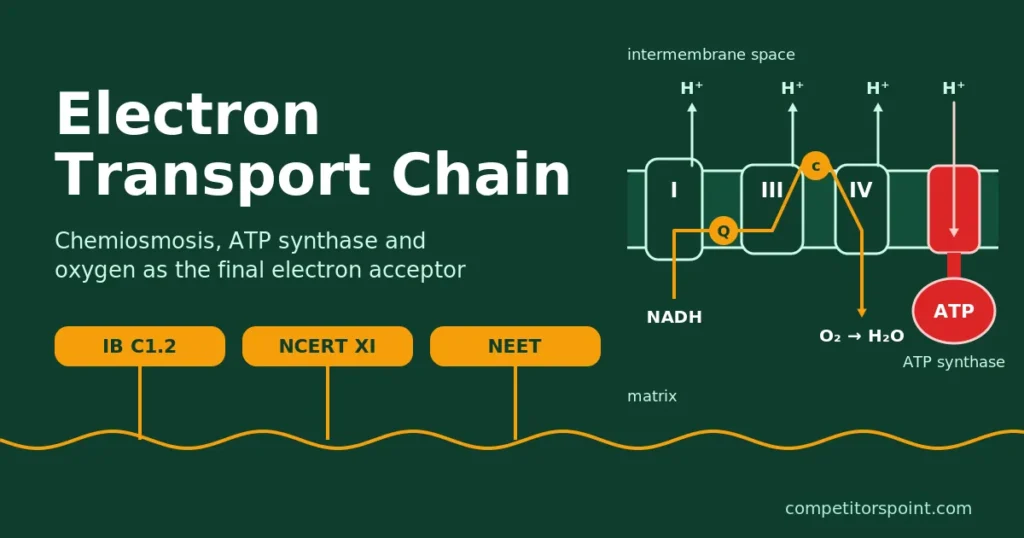
Electron Transport Chain and Oxidative Phosphorylation
The electron transport chain (ETC, or electron transport system, ETS) is the final stage of aerobic respiration: a series of protein complexes in the inner mitochondrial membrane that pass electrons from NADH and FADH2 to oxygen. The energy released pumps protons, and the proton gradient drives ATP synthase to make ATP by oxidative phosphorylation.
1 Introduction to the electron transport chain
Syllabus link: IB Biology C1.2 Cell respiration (first assessment 2025; C1.2.13 to C1.2.17 are Higher Level, with B2.2.4 on the mitochondrion); NCERT Class XI Respiration in Plants (electron transport system and oxidative phosphorylation, respiratory balance sheet)
NEET = point NCERT and NEET stress IB HL = detail the IB guide expects at Higher Level
Aerobic respiration has four stages: glycolysis in the cytoplasm, the link reaction and the fate of pyruvate, the Krebs cycle in the mitochondrial matrix, and the electron transport chain with oxidative phosphorylation. After the Krebs cycle all six carbons of glucose have left as CO2, yet only 4 ATP have been made; most of the energy is still held in the electrons of NADH and FADH2.
The electron transport chain passes those electrons from carrier to carrier, uses the energy released to pump protons (H+) across the inner mitochondrial membrane, and lets the protons flow back through ATP synthase, which makes ATP. Oxygen accepts the electrons at the end, forming metabolic water. About 90% of the ATP of aerobic respiration is made here.
The electron transport system (ETS) is the pathway that oxidises NADH and FADH2 and passes their electrons to oxygen. Oxidative phosphorylation is the ATP synthesis it drives, through a proton gradient (the proton motive force). For the wider picture, see the photosynthesis and cell respiration hub.
2 Where is the electron transport chain?
In eukaryotes the chain sits in the inner mitochondrial membrane, mostly in the folds called cristae (see the structure of the mitochondrion and other organelles).
- Matrix: where NADH and FADH2 are made, oxygen is reduced to water and ATP synthase makes ATP.
- Intermembrane space: protons are pumped into it; its small volume means a steep gradient builds quickly.
- Inner membrane: impermeable to H+, so protons return only through ATP synthase (see why ions cannot cross the phospholipid bilayer).
- Prokaryotes: aerobic bacteria have the chain in the plasma membrane, one piece of evidence for the endosymbiotic origin of mitochondria.
IB HL Adaptations of the mitochondrion for ATP production (B2.2.4)
- Double membrane with a small intermembrane space: pumped protons quickly reach a high concentration.
- Cristae: a large surface area for many chains and ATP synthases, the same principle as the surface area to volume ratio. Active cells such as heart muscle have densely packed cristae, as electron microscope images of mitochondria show.
- Matrix: compartmentalises the enzymes and substrates of the link reaction and Krebs cycle next to the chain that reoxidises their NADH.
3 The electron donors: NADH and FADH2
Oxidation is the loss of electrons. In respiration substrates are oxidised by dehydrogenation: two hydrogen atoms (two electrons and two protons) are removed and passed to a coenzyme. NAD+ becomes NADH + H+ and FAD becomes FADH2; these reduced coenzymes fuel the chain.
| Stage (per glucose) | NADH | FADH2 | Where made |
|---|---|---|---|
| Glycolysis | 2 | 0 | Cytoplasm (must be shuttled in) |
| Link reaction | 2 | 0 | Mitochondrial matrix |
| Krebs cycle | 6 | 2 | Matrix (FADH2 stays bound to succinate dehydrogenase in the inner membrane) |
| Total | 10 | 2 |
IB HL The IB guide says energy is transferred when a pair of electrons passes from reduced NAD to the first carrier, converting reduced NAD back to NAD, and that reduced NAD comes from glycolysis, the link reaction and the Krebs cycle. The regenerated NAD+ and FAD return to those pathways. See the net ATP yield of glycolysis and the Krebs cycle yield per glucose.
NEET NCERT and many Indian texts write NADH + H+ as NADH2; they mean the same. NCERT also writes FAD+, but the oxidised form is FAD, with no charge.
4 Complexes of the electron transport chain (I to V)
The chain has four protein complexes (I to IV), two mobile carriers (ubiquinone and cytochrome c) and ATP synthase, which NCERT calls complex V. The complexes are integral proteins spanning the membrane (see integral and peripheral membrane proteins); inside them electrons hop between flavins (FMN, FAD), iron–sulfur centres, the haem iron of cytochromes, and copper.
Swipe the table sideways to see every column.
| Complex | Name | Carriers inside | Electrons from → to | Pumps H+? (per 2 e−) | Classic inhibitor |
|---|---|---|---|---|---|
| I | NADH dehydrogenase | FMN, iron–sulfur (Fe–S) centres | NADH → ubiquinone | Yes, 4 H+ | Rotenone |
| II | Succinate dehydrogenase | FAD, Fe–S centres | Succinate (via FADH2) → ubiquinone | No | Malonate |
| III | Cytochrome bc1 complex (cytochrome c reductase) | Cytochrome b, Fe–S (Rieske protein), cytochrome c1 | Ubiquinol → cytochrome c | Yes, 4 H+ | Antimycin A |
| IV | Cytochrome c oxidase (cytochrome aa3) | Cytochromes a and a3, two copper centres (CuA, CuB) | Cytochrome c → O2 | Yes, 2 H+ | Cyanide, azide, CO, H2S |
| V | ATP synthase (F0–F1 complex) | F0 proton channel, F1 headpiece | H+ flow drives ADP + Pi → ATP | No, H+ flow back in | Oligomycin |
Complex I: NADH dehydrogenase
Complex I oxidises NADH to NAD+ and passes the two electrons through FMN and a series of Fe–S centres to ubiquinone, pumping 4 H+ into the intermembrane space. It is the largest complex (about 45 polypeptides, close to 1,000 kDa; older texts quote 850 kDa) and is L-shaped, with one arm in the membrane and one in the matrix.
Complex II: succinate dehydrogenase
Complex II is the Krebs cycle enzyme that oxidises succinate to fumarate, so it is the direct link between the Krebs cycle and the ETC. Its FADH2 passes electrons through Fe–S centres to ubiquinone. It is the smallest complex (about 125 to 140 kDa) and pumps no protons, because the energy released between FADH2 and ubiquinone is too small to drive a pump.
Ubiquinone (coenzyme Q): mobile carrier 1
Ubiquinone (UQ, Q) is a small lipid-soluble molecule that moves within the membrane. It takes two electrons from complex I or II, plus two protons from the matrix, becoming ubiquinol (QH2), and carries them to complex III.
Complex III: cytochrome bc1 complex
Complex III (cytochrome c reductase) passes electrons from ubiquinol through cytochrome b, an Fe–S (Rieske) centre and cytochrome c1 to cytochrome c, releasing 4 H+ into the intermembrane space (by the Q cycle). Cytochromes are haem proteins whose iron switches between Fe3+ and Fe2+, carrying one electron at a time.
Cytochrome c: mobile carrier 2
Cytochrome c is a small water-soluble protein loosely attached to the outer surface of the inner membrane. It carries one electron at a time from complex III to complex IV.
Complex IV: cytochrome c oxidase
Complex IV contains cytochromes a and a3 and two copper centres. Electrons pass from cytochrome c to CuA, cytochrome a and the cytochrome a3–CuB centre, where four electrons and four matrix protons reduce one O2 to two H2O. It pumps 2 H+ per pair of electrons.
Complex V: ATP synthase
Complex V is not an electron carrier but the enzyme that makes ATP from the returning protons; see chemiosmosis and ATP synthase.
IB HL IB students are not required to name the complexes; explain the sequence of electron flow, energy release, proton pumping, gradient and chemiosmosis. NEET NEET expects the names, the carriers in each complex and the mobile carriers.
5 How electrons flow along the chain
Each carrier is reduced by the one before it and oxidised by the one after it, so the chain is a series of redox reactions. Electrons move from a more negative to a more positive redox potential; redox (reduction) potential measures how strongly a substance attracts electrons. NADH is at the negative end (about −0.32 V) and oxygen at the positive end (about +0.82 V). Each step releases a little energy, which complexes I, III and IV use to pump protons.
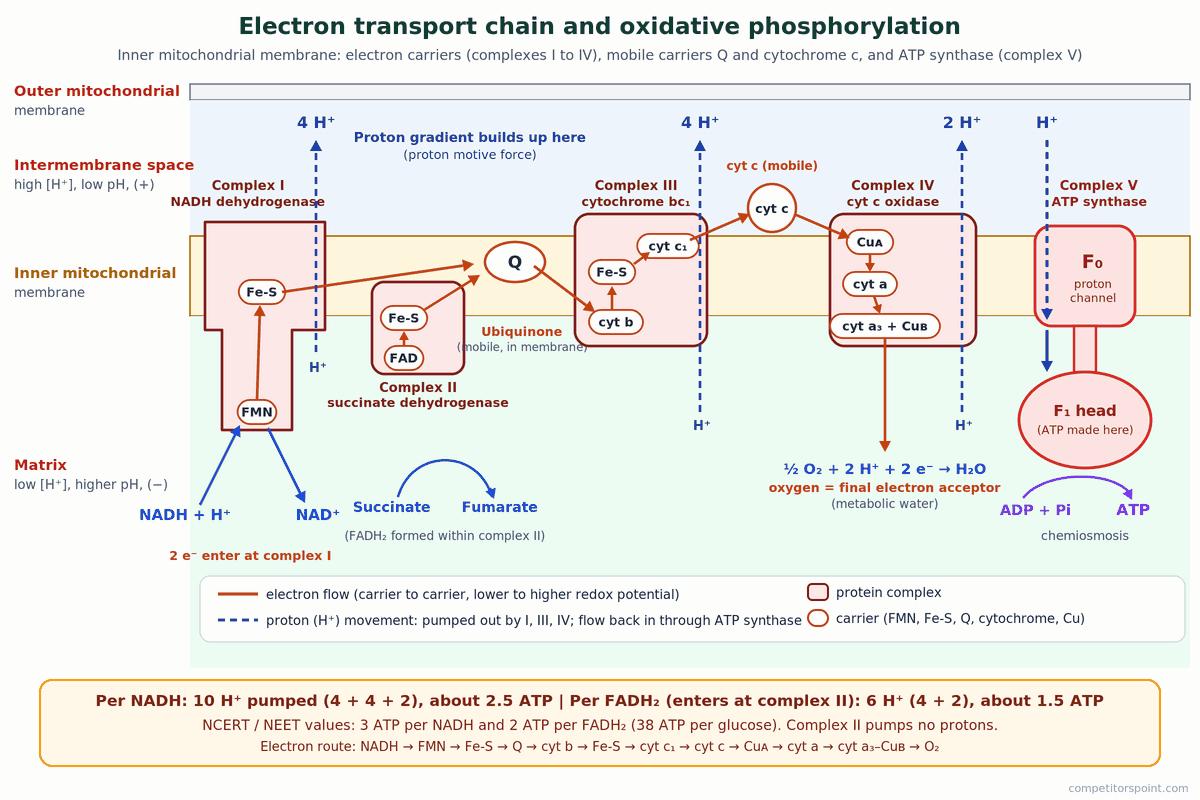
Oxidation of one NADH, step by step
- NADH + H+ gives two electrons to complex I and becomes NAD+.
- Complex I passes them via FMN and Fe–S to ubiquinone, pumping protons.
- Ubiquinol (QH2) carries them through the membrane to complex III.
- Complex III passes them via cytochrome b, Fe–S and cytochrome c1, pumping protons.
- Cytochrome c carries them, one at a time, to complex IV.
- Complex IV passes them via CuA, cytochrome a and a3, pumping protons.
- Oxygen accepts the electrons and protons from the matrix, forming metabolic water.
NADH → FMN → Fe–S → ubiquinone (Q) → cyt b → Fe–S → cyt c1 → cyt c → CuA → cyt a → cyt a3–CuB → O2
Oxidation of FADH2
FADH2 is formed inside complex II. Its electrons pass through Fe–S centres straight to ubiquinone, bypassing complex I, then follow the same route to oxygen. One proton pump is skipped, so less ATP is made.
Succinate → FAD (FADH2) → Fe–S → Q → complex III → cyt c → complex IV → O2
6 Generating the proton gradient
IB HL C1.2.14: the energy released as electrons move to carriers with a more positive redox potential is used by complexes I, III and IV to move H+ from the matrix into the intermembrane space. This is active transport powered by redox energy rather than ATP (compare active transport by protein pumps).
- Per pair of electrons from NADH: complex I moves 4 H+, complex III 4 and complex IV 2, a total of 10 H+. From FADH2 it is 6 H+, because complex I is bypassed.
- Protons build up in the small intermembrane space, which becomes more acidic (by about 0.5 to 1 pH unit) and positively charged relative to the matrix. Together these make an electrochemical gradient, the proton motive force (PMF).
- Protons taken from the matrix when ubiquinone and oxygen are reduced add to the gradient.
The gradient stores potential energy like water behind a dam: the inner membrane is the dam wall and ATP synthase the turbine.
7 Chemiosmosis and ATP synthase
Chemiosmosis is the synthesis of ATP using the energy of protons diffusing down their electrochemical gradient across a membrane. Peter Mitchell proposed it in 1961, when most biochemists were searching for a high-energy chemical intermediate linking electron transport to ATP synthesis. Mitchell argued that a proton gradient was the link; it took years of experiments to convince others, and he won the Nobel Prize in Chemistry in 1978, a classic paradigm shift.
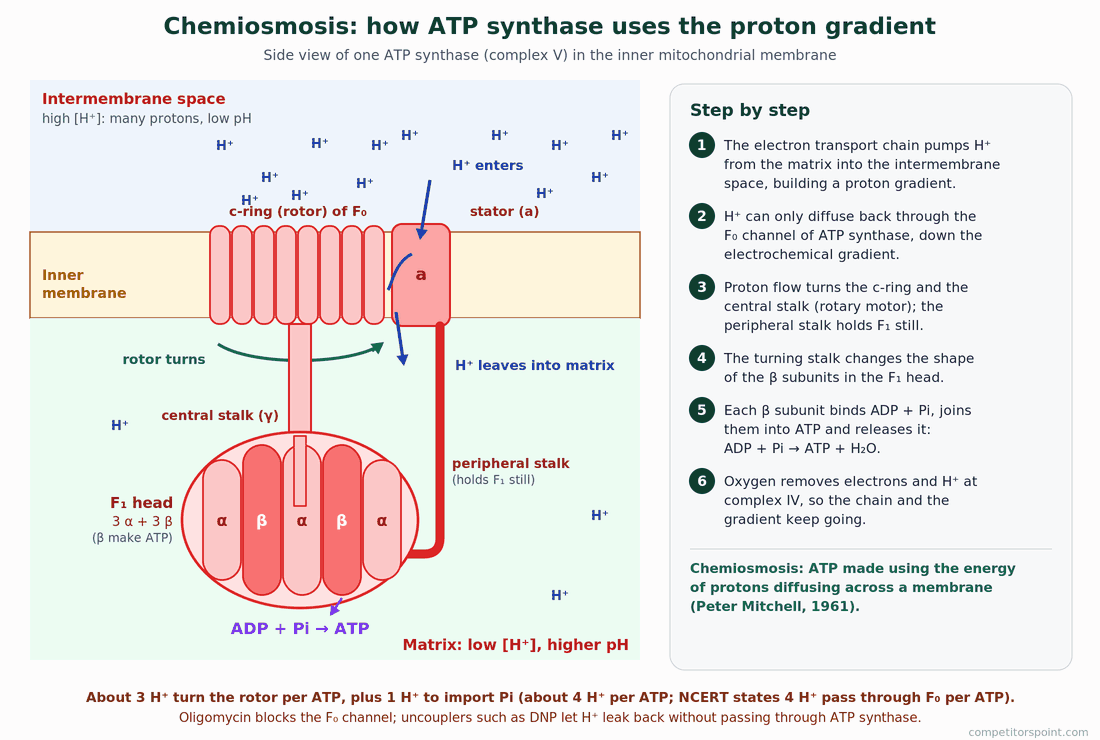
Structure of ATP synthase (F0–F1 complex)
- F0 is an integral membrane protein complex forming the proton channel: a ring of c subunits acts as a rotor, and an a subunit guides protons onto and off it. The subscript is the letter o, for oligomycin, which blocks the channel; it is not a zero.
- F1 is the headpiece, a peripheral membrane protein complex projecting into the matrix, with three α and three β subunits. The β subunits contain the active sites that make ATP from ADP and inorganic phosphate.
- A central stalk links the rotor to the head; a peripheral stalk holds the head still.
How ATP synthase makes ATP
- Protons diffuse through the F0 channel from the intermembrane space into the matrix, down the gradient: facilitated diffusion through a channel protein.
- Proton flow turns the c-ring and central stalk; ATP synthase is a rotary motor.
- The turning stalk changes the shape of each β subunit in turn.
- Each β subunit binds ADP and Pi, joins them into ATP (a condensation releasing water) and releases it: the binding change mechanism (Boyer and Walker, Nobel Prize 1997).
ADP + Pi →(ATP synthase, driven by H+ flow)→ ATP + H2O
IB HL C1.2.15 asks how ATP synthase couples energy release from the proton gradient with the phosphorylation of ADP: use proton gradient, diffusion through ATP synthase, rotation and phosphorylation of ADP. NEET NCERT states that for each ATP produced, 4 H+ pass through F0 from the intermembrane space to the matrix (some older books still say 2 H+). Modern estimates agree: about 3 H+ through ATP synthase plus 1 H+ to import phosphate.
8 The role of oxygen as the final electron acceptor
IB HL C1.2.16: oxygen is the terminal electron acceptor. At complex IV it accepts electrons from the chain and protons from the matrix, producing metabolic water, and by removing electrons it keeps them flowing along the chain.
O2 + 4 e− + 4 H+ →(cytochrome c oxidase)→ 2 H2O
- Oxygen has the highest affinity for electrons in the chain, so it sits at the end. Per glucose, 6 O2 are used and 12 H2O formed by the chain (one per NADH or FADH2); the overall equation shows only 6 H2O because water is also used and released in other steps.
- Without oxygen the carriers stay reduced and the chain stops, so NAD+ and FAD are not regenerated and the link reaction and Krebs cycle stop too. Only glycolysis continues, regenerating NAD+ by alcoholic and lactic acid fermentation for just 2 ATP per glucose. This happens in muscles in intense exercise, when oxygen carried in the blood cannot keep up.
NEET NCERT stresses that oxygen’s role is limited to the terminal stage, yet it is vital because it removes hydrogen from the system: oxygen is the final hydrogen acceptor. In respiration the proton gradient is built with redox energy, not light as in photophosphorylation, hence oxidative phosphorylation.
9 How many ATP per NADH and per FADH2?
The ATP yield depends on the electron donor, because NADH and FADH2 pump different numbers of protons.
| Electron donor | Enters at | Proton-pumping complexes | H+ pumped | NCERT / NEET ATP | Modern estimate |
|---|---|---|---|---|---|
| NADH | Complex I | I, III, IV | 10 | 3 | about 2.5 |
| FADH2 | Complex II (to Q) | III, IV | 6 | 2 | about 1.5 |
The NCERT figures come from the older coupling sites model: complexes I, III and IV each give one ATP, so 3 for NADH and 2 for FADH2, which skips complex I. Measured ratios are lower: 10 H+ ÷ about 4 H+ per ATP gives 2.5 for NADH, and 6 ÷ 4 gives 1.5 for FADH2. Part of the gradient is also used to import pyruvate, ADP and phosphate.
NEET Use the NCERT values in NEET
- One NADH gives 3 ATP; one FADH2 gives 2 ATP, the basis of the NCERT total of 38 ATP per glucose.
IB HL What IB expects
- No fixed totals. Explain why FADH2 yields less: its electrons enter after the first proton pump, so fewer protons are pumped.
10 The respiratory balance sheet: 38 ATP per glucose
The ATP yield of one glucose can only be calculated on assumptions. NCERT lists four:
- The pathways run in a sequential, orderly way: glycolysis, then the TCA cycle, then the ETS.
- NADH made in glycolysis is transferred into the mitochondria for oxidative phosphorylation.
- No intermediate is withdrawn to make other compounds.
- Only glucose is respired; no other substrate enters part-way.
None of these is strictly true in a living cell (the pathway is amphibolic), so the balance sheet is a theoretical maximum.
Swipe the table sideways to see every column.
| Stage | ATP by substrate-level phosphorylation | Reduced coenzymes | ATP by oxidative phosphorylation (NCERT: 3 per NADH, 2 per FADH2) | Total (NCERT) | Modern estimate (2.5 / 1.5) |
|---|---|---|---|---|---|
| Glycolysis | 4 made − 2 used = 2 | 2 NADH (cytoplasm) | 2 × 3 = 6 | 8 | 2 + 5 = 7 |
| Link reaction (2 pyruvate) | 0 | 2 NADH | 2 × 3 = 6 | 6 | 5 |
| Krebs cycle (2 turns) | 2 (via GTP) | 6 NADH + 2 FADH2 | 18 + 4 = 22 | 24 | 2 + 15 + 3 = 20 |
| Total | 4 | 10 NADH + 2 FADH2 | 34 | 38 | about 32 (30 with the glycerol phosphate shuttle) |
By the NCERT count there is a net gain of 38 ATP per glucose: 4 by substrate-level and 34 by oxidative phosphorylation, so almost 90% comes from the ETC. Compare the stage figures in the comparison of all four respiration stages.
Efficiency of aerobic respiration
Oxidising one mole of glucose releases about 2870 kJ (686 kcal); hydrolysing one mole of ATP releases about 30.5 kJ (7.3 kcal) under standard conditions.
Energy trapped = 38 × 30.5 = 1159 kJ; efficiency = 1159 ÷ 2870 × 100 = about 40%
So about 40% of the energy is conserved in ATP and about 60% is released as heat, which helps birds and mammals stay warm. With 32 ATP the figure is about 34%. Fermentation traps only about 2%.
11 Shuttle systems for NADH from glycolysis
The inner mitochondrial membrane is impermeable to NADH, so the electrons of the 2 NADH made by glycolysis in the cytoplasm are carried in by a shuttle system. The shuttle used changes the ATP total.
| Feature | Malate–aspartate shuttle | Glycerol phosphate shuttle |
|---|---|---|
| In the cytoplasm | NADH reduces oxaloacetate (OAA) to malate | NADH reduces DHAP to glycerol 3-phosphate |
| At the mitochondrion | Malate enters on a carrier and is oxidised back to OAA, making NADH in the matrix | Glycerol 3-phosphate is oxidised on the outer face of the inner membrane, making FADH2, which passes electrons to ubiquinone |
| Recycling | OAA → aspartate by transamination, which leaves and is converted back | DHAP returns to the cytoplasm |
| ATP per cytoplasmic NADH (NCERT values) | 3 | 2 |
| ATP per glucose (NCERT count) | 38 | 36 (2 × 2 instead of 2 × 3) |
| Main tissues | Liver, heart, kidney | Skeletal muscle, brain |
This is why some books give 36 ATP per glucose. Prokaryotes need no shuttle, as their chain is in the plasma membrane. NEET The shuttles are beyond the NCERT text but explain the 36 versus 38 question.
12 Inhibitors and uncouplers of the ETC
Blocking the chain leaves carriers before the block reduced and those after it oxidised, which is how the order of carriers was worked out.
Swipe the table sideways to see every column.
| Agent | Site | What it blocks | Effect |
|---|---|---|---|
| Rotenone; amytal | Complex I | Fe–S → ubiquinone | Electron transport and ATP synthesis stop |
| Malonate | Complex II | Competitively inhibits succinate dehydrogenase | FADH2 route blocked |
| Antimycin A | Complex III | Cytochrome b → cytochrome c1 | Electron transport and ATP synthesis stop |
| Cyanide, azide, CO, H2S | Complex IV | Bind cytochrome a3; no transfer to O2 | Whole chain stops; oxygen uptake stops |
| Oligomycin | F0 of ATP synthase | Proton channel | No ATP; gradient builds, so electron transport slows |
| DNP; thermogenin (UCP1) | Inner membrane (uncouplers) | Let H+ leak back, bypassing ATP synthase | Oxygen use continues or rises, little ATP, energy released as heat |
NADH →[rotenone]→ Q → cyt b →[antimycin A]→ cyt c1 → cyt c → cyt a + a3 →[cyanide, CO]→ O2
- Cyanide binds the iron of cytochrome a3, so the chain backs up, the gradient collapses and aerobic ATP production stops within seconds, even though the blood is full of oxygen. CO also binds haemoglobin, cutting the oxygen carried to respiring cells.
- DNP, a lipid-soluble weak acid, picks up H+ in the intermembrane space, diffuses across and releases it in the matrix. Once sold as a slimming drug, it caused deaths from overheating.
- Brown adipose tissue in newborns and hibernating mammals uncouples on purpose: protons return through thermogenin instead of ATP synthase, releasing heat (non-shivering thermogenesis), alongside the effect of thyroid hormones and metabolic rate.
13 Lipids and carbohydrates as respiratory substrates
IB HL C1.2.17: both fuels feed the same chain but differ in yield and entry route. They come from the absorption of digested food or from stores.
| Feature | Carbohydrate (glucose) | Lipid (fatty acids) |
|---|---|---|
| Energy per gram | About 17 kJ | About 37 kJ |
| Why | More oxygen; already partly oxidised | Less oxygen, more oxidisable C and H, so more NADH and FADH2 |
| Entry | Glycolysis, then link reaction | β-oxidation to acetyl CoA in the matrix; glycerol enters glycolysis |
| Anaerobic respiration | Yes | No |
| Respiratory quotient | 1.0 | About 0.7 |
Worked example: palmitic acid (16C)
A fatty acid with n carbons gives n/2 acetyl CoA after (n/2 − 1) rounds of β-oxidation, each giving 1 NADH and 1 FADH2.
| Product (palmitic acid) | Number | NCERT-style ATP | Modern ATP |
|---|---|---|---|
| Acetyl CoA (Krebs cycle + ETC) | 8 | 8 × 12 = 96 | 8 × 10 = 80 |
| NADH | 7 | 7 × 3 = 21 | 7 × 2.5 = 17.5 |
| FADH2 | 7 | 7 × 2 = 14 | 7 × 1.5 = 10.5 |
| Activation | −2 | −2 | |
| Net | 129 | 106 |
That is about 8 ATP per carbon, against about 6 for glucose.
14 Electron transport in mitochondria and chloroplasts
Chloroplasts also make ATP by chemiosmosis, in the light-dependent reactions, with the same logic: a membrane chain, proton pumping and ATP synthase.
Swipe the table sideways to see every column.
| Feature | Mitochondrion (oxidative phosphorylation) | Chloroplast (photophosphorylation) |
|---|---|---|
| Membrane | Inner membrane (cristae) | Thylakoid membrane |
| Energy for the gradient | Redox energy of NADH, FADH2 | Light |
| Electron donor → final acceptor | NADH → O2 (water formed) | H2O → NADP+ (NADPH formed) |
| Mobile carriers | Ubiquinone, cytochrome c | Plastoquinone (PQ), plastocyanin (PC) |
| Protons pumped into | Intermembrane space | Thylakoid lumen |
| ATP synthase head faces | Matrix (F1) | Stroma (CF1) |
NADPH from chloroplasts and from the pentose phosphate pathway, which makes NADPH, is used for biosynthesis, not respiration.
15 NEET favourite points (NCERT)
NEET Learn these exactly as NCERT puts them
- The ETS is in the inner mitochondrial membrane; NADH + H+ and FADH2 are oxidised and their electrons passed to O2, forming H2O.
- NADH dehydrogenase (complex I) passes electrons from matrix NADH to ubiquinone, which also receives electrons from FADH2 (complex II), made when succinate is oxidised.
- Ubiquinol passes electrons to cytochrome c via the cytochrome bc1 complex (complex III).
- Cytochrome c is a small protein on the outer surface of the inner membrane, a mobile carrier between complexes III and IV.
- Complex IV, cytochrome c oxidase, contains cytochromes a and a3 and two copper centres.
- Electron flow is coupled to ATP synthase (complex V): one NADH gives 3 ATP, one FADH2 2 ATP.
- F1 headpiece: peripheral membrane protein, site of ATP synthesis. F0: integral membrane protein, the proton channel. 4 H+ pass through F0 per ATP.
- Oxygen is the final hydrogen acceptor; its role is limited to the terminal stage but it drives the whole process.
- Redox energy builds the gradient in respiration (oxidative phosphorylation), light in photosynthesis (photophosphorylation); both follow the chemiosmotic hypothesis.
- Balance sheet: net 38 ATP per glucose on four assumptions; fermentation gives net 2 ATP.
Revise the NCERT features of mitochondria (double membrane, cristae, matrix with circular DNA and 70S ribosomes), and remember that mature red blood cells, which lack mitochondria, rely on glycolysis.
16 Common exam traps
Watch out for these
- “The ETC is in the matrix.” It is in the inner mitochondrial membrane. The Krebs cycle is in the matrix.
- “Protons are pumped into the matrix.” Complexes I, III and IV pump protons out of the matrix into the intermembrane space. They flow back into the matrix through ATP synthase.
- “ATP synthase pumps protons.” Protons diffuse through ATP synthase down their gradient. The pumps are complexes I, III and IV.
- “Electrons are pumped.” Electrons are transferred from carrier to carrier; only protons are pumped.
- “Oxygen is reduced to CO2.” Oxygen is reduced to water. CO2 comes from the link reaction and Krebs cycle.
- “Complex II pumps protons.” It does not; that is why FADH2 yields less ATP than NADH.
- “Redox potential is the ability to donate electrons.” It measures the tendency to accept electrons. Electrons flow towards the more positive redox potential, ending at oxygen.
- Actinomycin or antimycin? Antimycin A blocks complex III. Actinomycin D is a different antibiotic that blocks transcription.
- “Cytochrome c is an integral protein of complex III.” It is a small mobile protein on the outer surface of the inner membrane, carrying electrons from complex III to complex IV.
- “Uncouplers stop electron transport.” Uncouplers such as DNP let electron transport and oxygen use continue but stop ATP synthesis; inhibitors such as cyanide stop electron transport.
- 38, 36 or 30 to 32 ATP? 38 is the NCERT theoretical figure; 36 if the glycerol phosphate shuttle is used; about 30 to 32 with modern ratios. Answer with the figure the syllabus uses.
17 Key terms
| Term | Meaning |
|---|---|
| Electron transport chain (ETS) | Series of carriers in the inner mitochondrial membrane that pass electrons from NADH and FADH2 to oxygen. |
| Oxidative phosphorylation | ATP synthesis driven by the proton gradient that electron transport creates. |
| Chemiosmosis | ATP synthesis using the energy of protons diffusing across a membrane through ATP synthase. |
| Proton motive force | The combined concentration and charge gradient of protons across the inner membrane. |
| ATP synthase (complex V) | Enzyme with F0 (proton channel, rotor) and F1 (headpiece that makes ATP). |
| Ubiquinone (Q) | Lipid-soluble mobile carrier in the membrane, from complexes I and II to complex III. |
| Cytochrome c | Small mobile protein on the outer face of the inner membrane, from complex III to IV. |
| Cytochrome | Protein with a haem group whose iron carries one electron (Fe3+ / Fe2+). |
| Terminal electron acceptor | Oxygen, which is reduced to metabolic water at complex IV. |
| Redox potential | Tendency of a substance to accept electrons; electrons flow from negative to positive. |
| Uncoupler | Substance that lets protons leak across the membrane, separating electron transport from ATP synthesis. |
| Shuttle system | Indirect route that carries electrons from cytoplasmic NADH into the mitochondrion. |
18 Common doubts about the electron transport chain
These are the questions students ask us most often about the electron transport chain.
Where is the electron transport chain located?
In eukaryotes the electron transport chain is in the inner mitochondrial membrane, especially the cristae. Protons are pumped from the matrix into the intermembrane space. In aerobic prokaryotes, which have no mitochondria, the chain is in the plasma membrane.
What is the final electron acceptor of the electron transport chain?
Oxygen. At complex IV, cytochrome c oxidase passes electrons to oxygen, which also takes protons from the matrix and forms metabolic water. By removing electrons from the end of the chain, oxygen keeps electrons flowing. NCERT calls oxygen the final hydrogen acceptor.
How many ATP are produced from one NADH and one FADH2?
NCERT and NEET use 3 ATP per NADH and 2 ATP per FADH2. Modern estimates are about 2.5 and 1.5, because NADH pumps about 10 protons, FADH2 about 6, and about 4 protons are needed for each ATP.
Why does FADH2 produce fewer ATP than NADH?
FADH2 passes its electrons to ubiquinone through complex II, so they bypass complex I, which is a proton pump. Fewer protons are pumped per pair of electrons, so less ATP is made by chemiosmosis.
What is chemiosmosis?
Chemiosmosis is the synthesis of ATP using the energy of protons diffusing down their electrochemical gradient through ATP synthase. In mitochondria the electron transport chain pumps protons into the intermembrane space and they flow back into the matrix through ATP synthase. Peter Mitchell proposed it in 1961.
What are the F0 and F1 parts of ATP synthase?
F0 is an integral membrane protein that forms the proton channel and rotor. F1 is the headpiece that projects into the matrix and contains the sites where ADP and inorganic phosphate are joined to form ATP. Proton flow through F0 turns a stalk that drives ATP synthesis in F1.
Why is cyanide poisonous?
Cyanide binds cytochrome a3 in complex IV, so electrons cannot be passed to oxygen. The whole chain stops, the proton gradient collapses and aerobic ATP production fails, even though oxygen is present.
How many ATP are produced in aerobic respiration of one glucose?
NCERT gives a net gain of 38 ATP: 8 from glycolysis, 6 from the link reaction and 24 from the Krebs cycle. It is 36 when the glycerol phosphate shuttle carries the NADH from glycolysis, and about 30 to 32 with modern values.
19 Practice questions
Tap each question to reveal the answer.
Test yourself on the electron transport chain
1. State the exact location of the electron transport chain in a eukaryotic cell.
The inner mitochondrial membrane (cristae).
2. Name the two mobile electron carriers and say where each is found.
Ubiquinone (coenzyme Q), lipid-soluble within the inner membrane; cytochrome c, a small protein on the outer surface of the inner membrane (intermembrane space side).
3. (NEET) Which complex contains cytochromes a and a3 and two copper centres?
Complex IV, cytochrome c oxidase.
4. Why does complex II not pump protons?
The energy released when electrons pass from FADH2 to ubiquinone is too small to drive proton pumping.
5. (IB HL) Explain how the flow of electrons generates a proton gradient. [3 marks]
Electrons pass from carrier to carrier, releasing energy; the energy is used by protein complexes / proton pumps to move H+ from the matrix into the intermembrane space; the intermembrane space is small so H+ concentration rises; the inner membrane is impermeable to H+, so a gradient is maintained.
6. (IB HL) Explain how ATP synthase produces ATP. [4 marks]
Protons diffuse from the intermembrane space back into the matrix; through the channel (F0) of ATP synthase, down the gradient; proton flow rotates part of the enzyme; this changes the shape of the active sites in the F1 head; ADP is phosphorylated / ADP + Pi → ATP; this is chemiosmosis.
7. (IB HL) Outline the role of oxygen in aerobic respiration. [2 marks]
Oxygen is the terminal electron acceptor; it accepts electrons and protons, forming water, which keeps electrons flowing along the chain.
8. (NEET) Using NCERT values, how many ATP are formed from the oxidation of 2 NADH and 1 FADH2?
2 × 3 + 1 × 2 = 8 ATP.
9. What happens to ATP production and to oxygen uptake when DNP is added to mitochondria?
ATP production falls, because protons leak back without passing through ATP synthase; oxygen uptake continues or rises, because electron transport is no longer held back by the gradient. The energy is released as heat.
10. (NEET) How many ATP per glucose does the respiratory balance sheet give, and why do some cells make 36?
38 ATP (NCERT). Cells that use the glycerol phosphate shuttle pass electrons from glycolytic NADH to FADH2, giving 2 instead of 3 ATP each, so the total is 36.
Ready to practise? Download the Electron Transport Chain IB question set with markscheme.
© competitorspoint.com · Biology notes. Diagrams are original to competitorspoint.com.