
Biology › Cell biology › Cellular chemistry
Cellular Chemistry: Biomolecules, Enzymes and ATP
Biomolecules for IB and NEET: water, carbohydrates, lipids, proteins and nucleic acids, how enzymes work and are inhibited, the structure of ATP and how cells release energy by respiration. HL-only content is marked.
1 Cellular chemistry: an overview of biomolecules, enzymes and ATP
Syllabus link: IB B1.1, B1.2, A1.2, C1.1, C1.2 and A1.1 (first assessment 2025); NCERT XI Ch 9 Biomolecules (old and rationalised books)
NCERT = statement as given in NCERT (use in NEET/CBSE answers) IB = IB Biology (first assessment 2025) link HL = IB Higher Level only
A cell is a bag of chemistry. Every structure you met in cell structure is built from a small set of carbon compounds called biomolecules, and every process in a cell is a chemical reaction that is speeded up by an enzyme and paid for with ATP. This chapter covers four linked topics: the main biomolecules (water, carbohydrates, lipids, proteins and nucleic acids), how enzymes work and are controlled, the structure of ATP, and how cells release and use energy.
It is card 9 of our Cell Biology series. If you are new to the topic, start with Introduction to cells for cell theory and the features of life.
Key points
- All carbon compounds obtained from living tissues are called biomolecules (NCERT).
- Water is the most abundant chemical in living organisms; among organic compounds, protein is the most abundant (NCERT Table 9.4).
- Carbohydrates, proteins and nucleic acids are polymers made by condensation and broken down by hydrolysis; lipids are not polymers.
- Enzymes are biological catalysts that lower activation energy; almost all are proteins.
- ATP is the energy currency of the cell: made in respiration, used for active transport, movement and synthesis.
2 What are biomolecules? Chemical analysis of living tissue
Syllabus link: NCERT XI 9.1 How to analyse chemical composition, 9.2 Primary and secondary metabolites, 9.3 Biomacromolecules; IB B1.1.1 to B1.1.3 (carbon compounds, condensation, hydrolysis); IB A1.1 Water
Elements in living and non-living matter
If you analyse a plant or animal tissue and a piece of the Earth’s crust, you find the same elements in both. What differs is the amount. Living matter has far more carbon and hydrogen; the crust has far more silicon. NCERT NCERT Table 9.1 gives these values (% of weight):
Swipe the table sideways to see every column.
| Element | Earth’s crust | Human body |
|---|---|---|
| Hydrogen (H) | 0.14 | 0.5 |
| Carbon (C) | 0.03 | 18.5 |
| Oxygen (O) | 46.6 | 65.0 |
| Nitrogen (N) | very little | 3.3 |
| Sulphur (S) | 0.03 | 0.3 |
| Sodium (Na) | 2.8 | 0.2 |
| Calcium (Ca) | 3.6 | 1.5 |
| Magnesium (Mg) | 2.1 | 0.1 |
| Silicon (Si) | 27.7 | negligible |
Note that NCERT’s figure for hydrogen in the body (0.5%) is unusually low; most physiology books give about 9.5%. By mass the body’s six most common elements are, in decreasing order, O > C > H > N > Ca > P. If a NEET question quotes the NCERT table, use its numbers.
How to find which biomolecules a tissue contains

- Take living tissue, such as a vegetable or a piece of liver.
- Grind it in trichloroacetic acid (Cl3CCOOH) with a mortar and pestle to get a thick slurry.
- Strain it through cheesecloth or cotton. This gives two fractions: the filtrate, or acid-soluble pool, and the retentate, or acid-insoluble fraction.
- Analyse each fraction to identify the compounds.
The acid-soluble pool has thousands of small organic compounds with molecular weights of 18 to about 800 daltons (Da): amino acids, monosaccharides, nucleotides, fatty acids, plus inorganic ions such as sulfate and phosphate. These small molecules are called micromolecules (biomicromolecules). The acid-insoluble fraction has proteins, polysaccharides and nucleic acids, which are over 10,000 Da, plus lipids. These large molecules are called macromolecules (biomacromolecules).
Why lipids end up in the macromolecular fraction
Lipids are small (up to about 800 Da) and are not polymers, so by size they belong with the micromolecules. But in a cell they are arranged into membranes. Grinding breaks the membranes into insoluble vesicles, and these are filtered out with the acid-insoluble fraction. So lipids are not strictly macromolecules; they appear in that fraction only because of how the test works.
Inorganic compounds: ash analysis
- Weigh a small piece of fresh tissue (wet weight).
- Dry it in an oven to remove water; weigh again (dry weight).
- Burn it fully. All carbon compounds are oxidised to CO2 and water vapour and are lost.
- The ash left contains inorganic elements such as calcium and magnesium.
Classifying biomolecules
Biomolecules can be grouped in three ways.
Swipe the table sideways to see every column.
| Basis | Groups | Examples |
|---|---|---|
| Chemical nature | Inorganic and organic | Inorganic: water, mineral ions. Organic: carbohydrates, lipids, proteins, nucleic acids, vitamins |
| Molecular weight | Micromolecules (<1000 Da) and macromolecules (>10,000 Da) | Monomers: amino acids, monosaccharides, nucleotides, fatty acids. Polymers: proteins, polysaccharides, nucleic acids |
| Role in survival | Primary and secondary metabolites | Primary: sugars, amino acids, nucleotides, fats. Secondary: alkaloids, pigments, rubber |
Water, the most abundant compound in cells IB
Water is the medium in which all other molecules dissolve and react. NCERT Water makes up 70 to 90% of a cell’s mass (NCERT Table 9.4). IB A1.1 explains why water is so useful:
- Polarity and hydrogen bonds: oxygen pulls electrons more strongly than hydrogen, so water is polar and forms hydrogen bonds between molecules.
- Cohesion: water molecules stick together, so xylem can pull water up in a continuous column and some insects walk on the surface.
- Adhesion: water sticks to other polar surfaces, which gives capillary action in soil and in cell walls.
- Solvent: polar and charged substances (glucose, amino acids, ions) dissolve, so water is the medium for metabolism and transport. Non-polar molecules (fats) are hydrophobic.
- Thermal properties: high specific heat capacity keeps habitats and bodies stable in temperature; high latent heat of vaporisation makes sweating an effective coolant.
- Buoyancy and viscosity: these affect how animals such as seals and birds move through water and air.
HL Water on Earth (A1.1.9 to A1.1.10)
- Water on Earth probably came from asteroids and comets that collided with the young planet; ice could survive only if the planet stayed cool enough.
- Liquid water is thought to be essential for life, so the search for life elsewhere looks for planets in the ‘Goldilocks zone’ where water can stay liquid.
Primary and secondary metabolites
Biomolecules can also be grouped by role. Primary metabolites have known roles in normal physiology: amino acids, sugars, nucleotides, fats. Secondary metabolites are made mainly by plants, fungi and microbes; they are not needed for basic metabolism but help the organism survive, for example by defending against herbivores. Many of these secondary metabolites are useful to humans as drugs, dyes and raw materials.
NCERT Table 9.3 Some secondary metabolites
Swipe the table sideways to see every column.
| Group | Examples |
|---|---|
| Pigments | Carotenoids, anthocyanins |
| Alkaloids | Morphine, codeine |
| Terpenoids | Monoterpenes, diterpenes |
| Essential oils | Lemon grass oil |
| Toxins | Abrin, ricin |
| Lectins | Concanavalin A |
| Drugs | Vinblastin, curcumin |
| Polymeric substances | Rubber, gums, cellulose |
- Anthocyanins: water-soluble vacuolar pigments that look red, purple or blue depending on pH (blueberries, black rice).
- Morphine: main alkaloid of opium, the dried latex of unripe poppy capsules; a powerful pain killer acting on the CNS. Codeine is a milder opiate used for pain and cough.
- Abrin (rosary pea, Abrus precatorius) and ricin (castor bean, Ricinus communis) are ribosome-inactivating proteins; a tiny dose of purified ricin can kill an adult.
- Concanavalin A: a lectin (sugar-binding protein) from the jack bean, Canavalia ensiformis.
- Vinblastine: an anticancer drug from the Madagascar periwinkle. Curcumin: the yellow pigment of turmeric.
3 Carbohydrates: sugars, starch, glycogen and cellulose
Syllabus link: IB B1.1.4 to B1.1.7 (monosaccharides, polysaccharides as energy stores, cellulose, glycoproteins); NCERT XI 9.3 Polysaccharides, 9.1 sugars
Carbohydrates are the most widespread energy sources. They contain C, H and O, usually in the ratio Cn(H2O)n, which is why they were called ‘hydrates of carbon’. Chemically they are polyhydroxy aldehydes (aldoses) or polyhydroxy ketones (ketoses), or compounds that give these on hydrolysis. In a ketose the C=O is usually on carbon 2; in an aldose it is on carbon 1.
Monosaccharides
Monosaccharides are the simplest carbohydrates: they cannot be hydrolysed into smaller sugars. They are sweet, crystalline and soluble in water, and have 3 to 7 carbons.
Swipe the table sideways to see every column.
| Type | Formula | Aldose examples | Ketose examples |
|---|---|---|---|
| Triose | C3H6O3 | Glyceraldehyde | Dihydroxyacetone |
| Tetrose | C4H8O4 | Erythrose, threose | Erythrulose |
| Pentose | C5H10O5 | Ribose, xylose, arabinose (deoxyribose is C5H10O4) | Ribulose |
| Hexose | C6H12O6 | Glucose, galactose, mannose | Fructose |
| Heptose | C7H14O7 | Glucoheptose | Sedoheptulose |
Glucose (grape sugar, dextrose) is the main respiratory fuel. Pentoses and hexoses form rings in water. Glucose and galactose differ only in the position of the -OH on carbon 4, so they are epimers; glucose (an aldose) and fructose (a ketose) are functional isomers. Fructose is the sweetest natural sugar.
Alpha and beta glucose IB
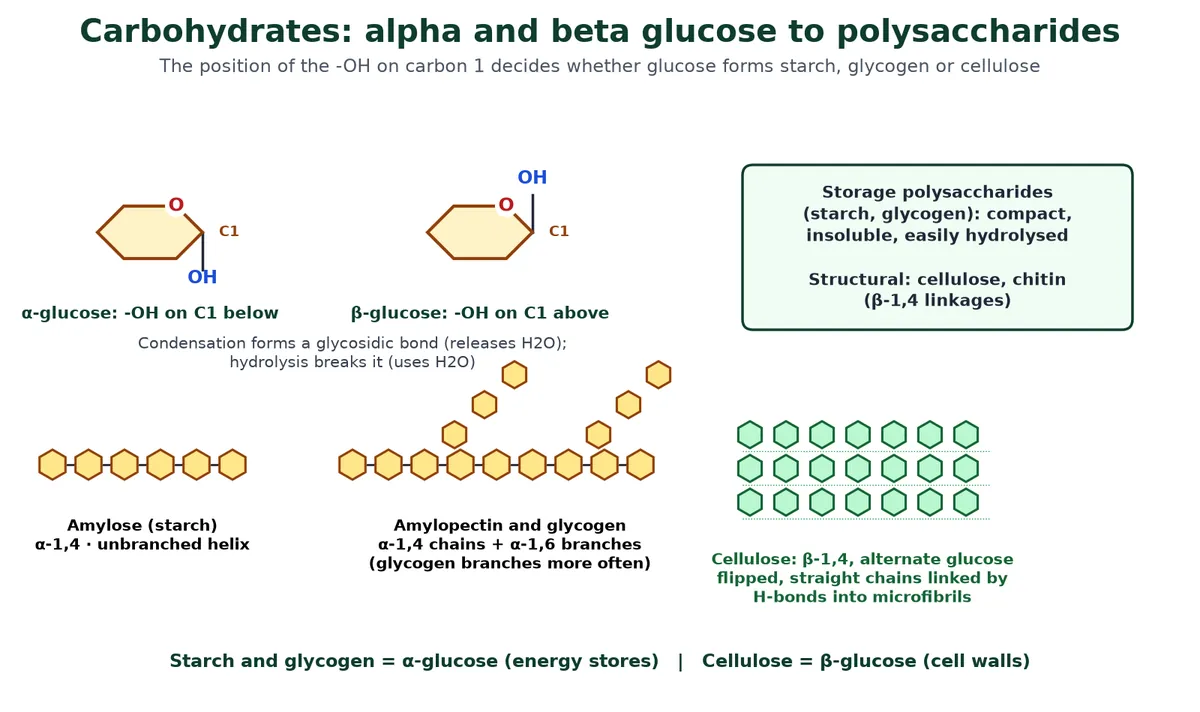
In the ring form of glucose, the -OH on carbon 1 can sit below the ring (α-glucose) or above it (β-glucose). This small difference decides whether glucose becomes an energy store or a structural material. IB expects you to draw both rings.
Condensation and hydrolysis
Two monosaccharides join by a glycosidic bond in a condensation reaction that releases one water molecule. Hydrolysis uses water to break the bond. The same two reactions build and break all the polymers: proteins (peptide bonds) and nucleic acids (phosphodiester bonds) too.
Disaccharides and oligosaccharides
These are two or a few sugars joined together.
Swipe the table sideways to see every column.
| Sugar | Made of | Bond | Source |
|---|---|---|---|
| Maltose | glucose + glucose | α-1,4 | malt, starch digestion |
| Sucrose | glucose + fructose | α-1,β-2 | cane sugar; transport sugar in phloem |
| Lactose | glucose + galactose | β-1,4 | milk sugar |
| Raffinose (trisaccharide) | galactose + glucose + fructose |
Oligosaccharides give 2 to about 10 monosaccharides on hydrolysis. Sweetness: sucrose > maltose > lactose.
Polysaccharides
Polysaccharides are large storage and structural molecules: long chains of hundreds to many thousands of monosaccharides. They are not sweet and are usually insoluble or only slightly soluble, so they do not affect osmosis. A homopolysaccharide has one kind of monomer; a heteropolysaccharide has more than one.
Swipe the table sideways to see every column.
| Polysaccharide | Monomer and bonds | Shape | Role |
|---|---|---|---|
| Amylose (starch, ~20%) | α-glucose, α-1,4 | unbranched helix | plant energy store |
| Amylopectin (starch, ~80%) | α-glucose, α-1,4 with α-1,6 branches every 24 to 30 units | branched | plant energy store |
| Glycogen | α-glucose, α-1,4 with α-1,6 branches every 8 to 12 units | highly branched | animal and fungal store (liver, muscle) |
| Cellulose | β-glucose, β-1,4 | straight chains, H-bonded into microfibrils | plant cell wall; most abundant organic compound on Earth |
| Chitin | N-acetylglucosamine, β-1,4 | straight chains | arthropod exoskeleton, fungal cell wall |
| Inulin | fructose | chain | storage in dahlia and chicory roots |
Branching matters: glycogen has many ends, so catalysts can add or remove glucose quickly when energy is needed. Cellulose is strong because every second β-glucose is flipped, so the chains are straight and lie side by side, held by hydrogen bonds. Other homopolysaccharides include agar (a galactan) and mannans (polymers of mannose); pentose polymers such as xylans are common in plant walls. Heteropolysaccharides include hyaluronic acid, heparin and the peptidoglycan of bacterial walls.
NCERT Starch and iodine; reducing and non-reducing ends
- Starch forms helical secondary structures and can hold I2 molecules in the helix, giving a blue colour. Cellulose does not hold I2.
- In a polysaccharide chain the right end is called the reducing end and the left end the non-reducing end (NCERT Fig. 9.2).
- Plant cell walls are made of cellulose; paper from plant pulp and cotton fibre are cellulosic. Exoskeletons of arthropods have chitin, a complex polysaccharide with amino-sugars.
Testing biomolecules: reducing sugars and Benedict’s test
A reducing sugar has a free aldehyde or ketone group (a free -OH on the anomeric carbon) that can reduce Cu2+ to Cu+. Heated with blue Benedict’s solution (copper sulfate with sodium citrate and sodium carbonate) it gives a green, yellow, orange or brick-red precipitate. All monosaccharides and most disaccharides (maltose, lactose) are reducing. Sucrose and trehalose are non-reducing because their anomeric carbons are joined in the glycosidic bond; boil sucrose with acid first to hydrolyse it, then it tests positive. Fehling’s solution works the same way but uses tartrate instead of citrate.
Glycoproteins IB
Short carbohydrate chains attached to membrane proteins form glycoproteins, which act in cell-cell recognition. The ABO blood group antigens on red blood cells are an IB example: the oligosaccharide differs between A, B and O. Carbohydrates also join lipids to make glycolipids, so many molecules are hybrids of two classes.
4 Lipids: fats, oils, phospholipids and steroids
Syllabus link: IB B1.1.8 to B1.1.15 (lipids, triglycerides, saturated and unsaturated fatty acids, energy storage, phospholipids, steroids); NCERT XI 9.1 lipids
Lipids are a varied group of compounds that are hydrophobic: insoluble in water but soluble in non-polar solvents such as chloroform and benzene. They include fats, oils, waxes, phospholipids and steroids.
Fatty acids
Fatty acids are the building blocks of most lipids. A fatty acid is a hydrocarbon chain with a carboxyl group: R-COOH. Most have 14 to 20 carbons; palmitic acid has 16 carbons and arachidonic acid 20, counting the carboxyl carbon.
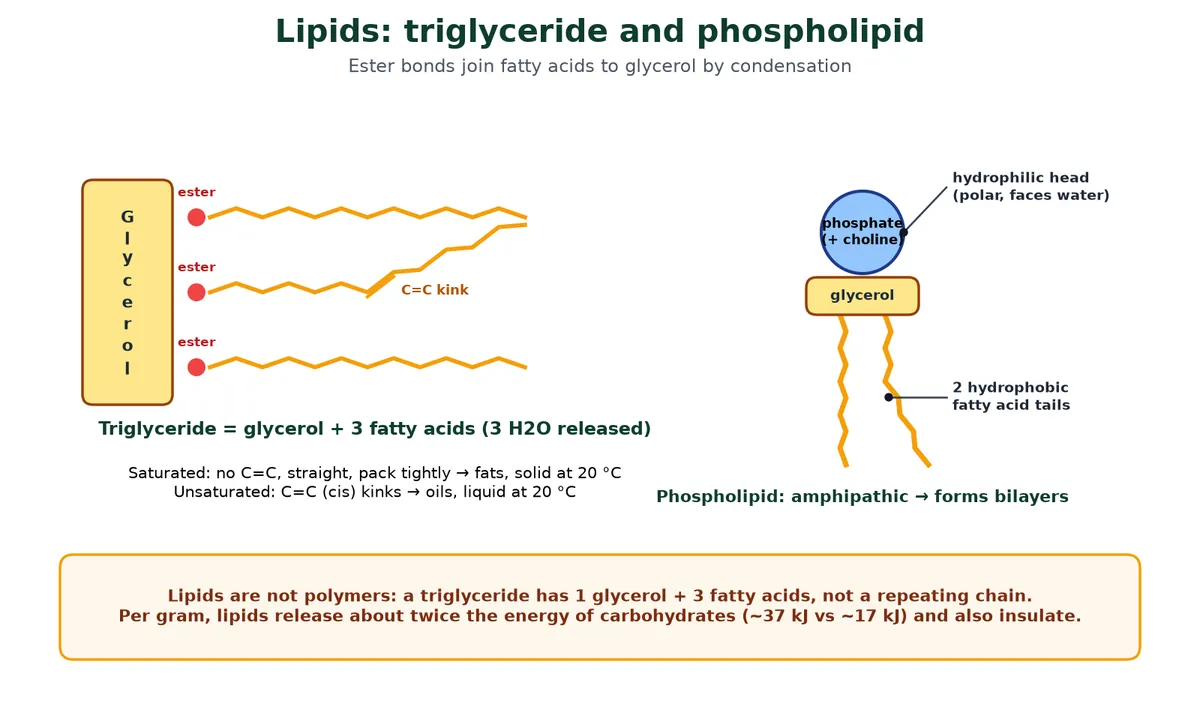
- Saturated: no C=C double bonds, general formula CnH2nO2; straight chains pack tightly, so they have high melting points and are solid at room temperature (animal fats, e.g. palmitic and stearic acid).
- Monounsaturated: one C=C (oleic acid); polyunsaturated: two or more (linoleic acid).
- Cis and trans IB: in natural unsaturated fats the hydrogens are on the same side of the double bond (cis), which kinks the chain, so the fat is liquid (an oil). Trans fats, mainly from partial hydrogenation, are straight and are linked to heart disease.
Essential fatty acids must come from food because humans cannot make them: linoleic acid (an omega-6) and alpha-linolenic acid (an omega-3). Arachidonic acid is made from linoleic acid, so it is essential only if linoleic acid is lacking. Oleic acid is an omega-9 fatty acid that we can make.
Triglycerides: fats and oils
Triglycerides are the main storage lipids. Glycerol (trihydroxypropane) is an alcohol, not a lipid. Fatty acids join its three -OH groups by ester bonds in condensation reactions, giving monoglycerides, diglycerides and triglycerides. Fats are solid at 20°C; oils such as gingelly (sesame) oil are liquid. Drying oils such as linseed oil, rich in unsaturated fatty acids, harden in air and are used in paints.
IB Triglycerides are ideal for long-term energy storage in adipose tissue: they release about 37 kJ g-1 compared with about 17 kJ g-1 for carbohydrates, are not osmotically active, and also insulate the body (blubber in whales) and protect organs. Glycogen is used for short-term storage because it can be mobilised faster and can be broken down without oxygen.
Waxes, cutin and suberin: protective lipids
- Waxes: esters of a long-chain fatty acid with a long-chain alcohol. Beeswax (mainly myricyl palmitate) is secreted by wax glands on the underside of the worker bee’s abdomen. Carnauba wax from a Brazilian palm is used in polishes; jojoba seeds give a liquid wax that replaced spermaceti from whales.
- Wax D is part of the cell wall of Mycobacterium, the genus that causes tuberculosis and leprosy.
- Cutin, with wax, forms the plant cuticle, which reduces water loss by cuticular transpiration and protects against pathogens.
- Suberin waterproofs cork cells and forms the Casparian strip of the root endodermis.
Phospholipids IB
Phospholipids are the membrane-forming lipids. In a phospholipid, glycerol carries two fatty acids and a phosphate group, often linked to choline (lecithin). The phosphate head is hydrophilic and the tails are hydrophobic, so the molecule is amphipathic. In water, phospholipids form a bilayer with heads outwards: the basis of every cell membrane. Sphingolipids, made from the amino alcohol sphingosine, are common in nerve cell membranes.
Lipoproteins
Lipoproteins are mixed molecules. Lipids travel in blood bound to proteins. LDL (low-density lipoprotein) carries cholesterol from the liver to body tissues; high LDL leads to cholesterol deposits in artery walls (atherosclerosis). HDL (high-density lipoprotein) carries excess cholesterol back to the liver. Chylomicrons carry absorbed dietary fat in the lymph.
Steroids and other derived lipids IB
Steroids are lipids with four fused carbon rings. IB asks you to recognise them from a diagram. Cholesterol:
- regulates the fluidity of animal cell membranes;
- is the precursor of steroid hormones: oestrogen, progesterone, testosterone and the adrenal corticoids;
- forms bile salts (sodium glycocholate and taurocholate) that emulsify fats;
- is converted to vitamin D: 7-dehydrocholesterol in skin changes when exposed to UV light;
- in excess causes atherosclerosis and gallstones.
IB Steroid hormones are non-polar, so they pass through the phospholipid bilayer and bind receptors inside the cell. Plant sterols (phytosterols) include sitosterol and stigmasterol. Other derived lipids: prostaglandins, made from arachidonic acid in almost all tissues and abundant in semen, make smooth muscle contract and are used to induce labour; diosgenin from yam (Dioscorea) was the raw material for the first contraceptive pills; carotenoids such as β-carotene are the precursor of vitamin A.
5 Proteins and amino acids
Syllabus link: IB B1.2.1 to B1.2.6 (amino acids, peptide bonds, essential amino acids, variety, denaturation) and B1.2.7 to B1.2.13 HL (R groups, levels of structure, fibrous and globular); NCERT XI 9.1 amino acids, 9.5 proteins
Amino acids
Proteins are the most varied molecules in a cell, and they are built from amino acids. NCERT Amino acids are organic compounds with an amino group and an acidic (carboxyl) group as substituents on the same carbon, the α-carbon; so they are called α-amino acids, and they are substituted methanes. The four groups on the α-carbon are hydrogen, the carboxyl group, the amino group and a variable R group. Twenty amino acids are coded by genes and used to make proteins, and the R group decides each one’s properties.
- Glycine (R = H) is the simplest and the only one that is not chiral (optically inactive). All other coded amino acids have a chiral α-carbon. Proteins use only L-amino acids.
- Acidic (extra -COOH): aspartic acid, glutamic acid. Basic (extra amino group): lysine, arginine, histidine. Neutral: the other 15, e.g. valine.
- Aromatic: phenylalanine, tyrosine, tryptophan. Sulfur-containing: cysteine, methionine. Hydroxy: serine, threonine.
Zwitterions and the isoelectric point
Amino acids are charged molecules in water. In water the -COOH loses H+ (to -COO–) and the -NH2 gains H+ (to -NH3+), giving a zwitterion with both charges.
Zwitterions behave like salts: amino acids are crystalline, have high melting points and dissolve in water. They are amphoteric: they act as acids and as bases, which is why they are good buffers. In acid, the amino acid is mostly positive and moves to the cathode in an electric field; in alkali it is negative and moves to the anode.
The pH at which the net charge is zero and it does not move is the isoelectric point (pI). This is different for each amino acid (about 6 for glycine, 2.8 for aspartic acid) and is where it is least soluble. Do not confuse amphoteric with amphipathic (having hydrophilic and hydrophobic parts, like phospholipids).
Essential and non-essential amino acids IB
Humans can make some amino acids (non-essential) but must eat the rest (essential). Adults need nine: histidine, isoleucine, leucine, lysine, methionine, phenylalanine, threonine, tryptophan and valine. Arginine is conditionally essential in growing children, which is why older books say 10 for children. A memory aid is PVT TIM HALL: phenylalanine, valine, threonine, tryptophan, isoleucine, methionine, histidine, (arginine), leucine, lysine. Cereals are low in lysine and pulses in methionine, so eating both gives a complete set; animal proteins already contain all of them.
Some amino acids are non-coded: GABA (an inhibitory neurotransmitter), and ornithine and citrulline (urea cycle). Amino acids are also precursors: tyrosine gives adrenaline, thyroxine and melanin; tryptophan gives serotonin, melatonin, niacin and the plant hormone IAA; histidine gives histamine; glycine is used in haem synthesis. Note that pantothenic acid (vitamin B5) is made from β-alanine, not from the α-alanine of proteins, and penicillin is not an amino acid: it is a β-lactam built from cysteine and valine.
Peptide bonds
As with the other polymers, amino acids join by condensation between the -COOH of one and the -NH2 of the next, forming a peptide bond (-CO-NH-) and water. Two amino acids give a dipeptide with one peptide bond; three give a tripeptide with two. A chain of many is a polypeptide; a protein is one or more polypeptides folded into a working shape, usually over 50 amino acids. With 20 amino acids there are 20n possible sequences for a chain of n amino acids, so the variety of proteins is almost unlimited (IB B1.2.5).
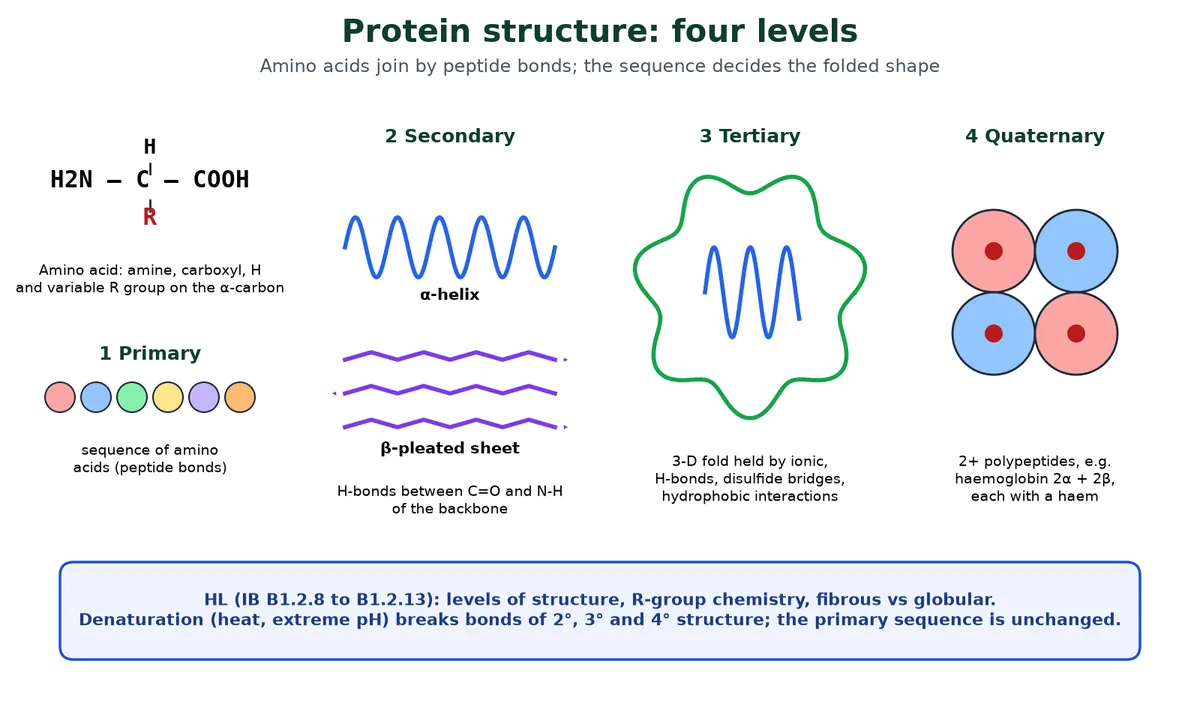
Levels of protein structure HL NCERT
- Primary: the sequence of amino acids, held by peptide bonds. It is coded by a gene and decides how the chain will fold, so it decides the protein’s function. NCERT The first amino acid is the N-terminal amino acid and the last is the C-terminal amino acid.
- Secondary: local folding stabilised by hydrogen bonds between the C=O and N-H groups of the backbone. In an α-helix (right-handed, 3.6 amino acids per turn, pitch 5.4 Å) each C=O bonds to the N-H four residues along. In a β-pleated sheet stretched sections lie side by side, parallel or antiparallel. Pauling and Corey described both. Examples: α-keratin in hair and nails; silk fibroin is mostly β-sheet.
- Tertiary: the overall 3-D fold of one polypeptide, held by interactions between R groups: hydrogen bonds, ionic bonds, disulfide bridges between cysteines, and hydrophobic interactions. In a soluble globular protein the hydrophobic R groups cluster inside and the hydrophilic ones face the water. Example: myoglobin.
- Quaternary: two or more polypeptide chains (subunits), which may be the same or different, joined into one protein. Haemoglobin has four: two α and two β, each with a haem prosthetic group. Collagen’s triple helix of three chains, described by G. N. Ramachandran, is another example.
HL Fibrous versus globular proteins (B1.2.13)
Swipe the table sideways to see every column.
| Feature | Fibrous | Globular |
|---|---|---|
| Shape | long, narrow strands | rounded, compact |
| Solubility | insoluble in water | usually soluble |
| Sequence | repetitive | irregular |
| Role | structural | enzymes, transport, hormones, antibodies |
| Examples | collagen, keratin, silk fibroin | haemoglobin, insulin, most enzymes |
Functions of proteins
NCERT Table 9.5 Some proteins and their functions
Swipe the table sideways to see every column.
| Protein | Function |
|---|---|
| Collagen | Intercellular ground substance |
| Trypsin | Enzyme |
| Insulin | Hormone |
| Antibody | Fights infectious agents |
| Receptor | Sensory reception (smell, taste, hormone, etc.) |
| GLUT-4 | Enables glucose transport into cells |
NCERT Collagen is the most abundant protein in the animal world and RuBisCO is the most abundant protein in the whole biosphere. Other examples: haemoglobin carries O2 and some CO2; transferrin carries iron in blood; actin and myosin cause contraction; rhodopsin absorbs light in the retina; P-protein seals the sieve plates of damaged phloem; histones (basic) package DNA; casein in milk is a phosphoprotein.
Simple and conjugated proteins
Proteins often combine with other molecules. Simple proteins give only amino acids on hydrolysis: albumins, globulins, glutelins of wheat, histones. Conjugated proteins have a non-protein part called a prosthetic group: glycoproteins (carbohydrate), lipoproteins (lipid), nucleoproteins (nucleic acid), phosphoproteins (phosphate, e.g. casein), chromoproteins (pigment, e.g. haemoglobin).
Denaturation IB
High temperature, extreme pH, heavy metals and some solvents break the hydrogen bonds, ionic bonds and hydrophobic interactions that hold the 3-D shape. The protein unfolds (denatures) and loses its function (other folded molecules, such as DNA, can also denature), but the primary structure is not changed because peptide bonds are not broken. Denaturation is usually permanent: cooking an egg cannot be reversed.
6 Nucleic acids: DNA and RNA
Syllabus link: IB A1.2.1 to A1.2.8 (nucleotides, sugar-phosphate backbone, bases, RNA and DNA, complementary pairing) and A1.2.9 to A1.2.15 HL; NCERT XI 9.1 nucleotides, 9.6 nucleic acids
Nucleic acids are the information molecules: they store and pass on the instructions to make proteins. Both DNA (deoxyribonucleic acid) and RNA (ribonucleic acid) are polymers of nucleotides.
Nucleotides and nucleosides
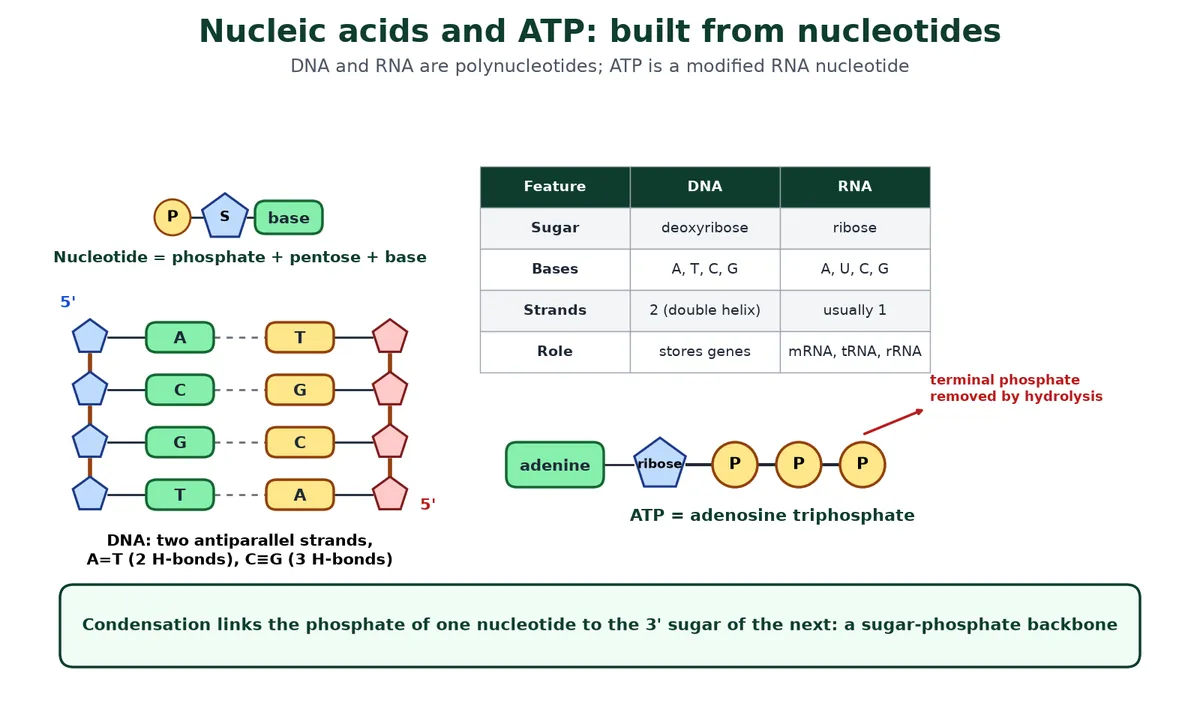
Nucleotides are small molecules in the acid-soluble pool; joined together they make the largest molecules of all. A nucleotide has three parts: a phosphate group, a pentose sugar (ribose in RNA, deoxyribose in DNA) and a nitrogenous base. A nucleoside is a sugar plus a base without the phosphate. NCERT The bases are of two kinds: purines (adenine, guanine), which have two rings, and pyrimidines (cytosine, thymine, uracil), which have one. Adenosine and guanosine are nucleosides; adenylic acid and thymidylic acid are nucleotides.
The DNA double helix IB
DNA is the most stable information store in the cell.
- Nucleotides are joined by condensation into a strand with a sugar-phosphate backbone: a 3′-5′ phosphodiester bond links the phosphate of one nucleotide to the sugar of the next. The bases stick out from the backbone.
- DNA has two strands held by hydrogen bonds between complementary bases: A with T (two hydrogen bonds), G with C (three). So a purine always pairs with a pyrimidine and the helix has a constant width of 2 nm.
- The double helix (Watson and Crick, 1953) is right-handed, with one turn every 3.4 nm and 10 base pairs per turn.
- The base sequence carries information. Four bases in any order can encode an unlimited amount of information.
- RNA is usually single-stranded, uses ribose and has uracil instead of thymine. mRNA, tRNA and rRNA work together in protein synthesis.
HL Extra nucleic acid content for HL (A1.2.9 to A1.2.15)
- Directionality: each strand runs from a 5′ end (free phosphate) to a 3′ end (free -OH on the sugar). The strands are antiparallel, which matters for replication, transcription and translation.
- Purine-pyrimidine pairing keeps the helix the same width all along, so any sequence fits.
- Nucleosomes: in eukaryotes DNA is wound around a core of eight histone proteins, which packs it into a small space.
- Hershey and Chase (1952) used viruses labelled with 35S (protein) or 32P (DNA) to show that DNA is the genetic material.
- Chargaff’s data: in any DNA, the amount of A equals T and G equals C, but A+T differs from G+C between species. This disproved the ‘tetranucleotide’ idea and supported base pairing.
7 Enzymes: biological catalysts
Syllabus link: IB C1.1.1 to C1.1.11 (enzymes and metabolism, active site, induced fit, activation energy, factors affecting rate); NCERT XI 9.7 Enzymes (9.7.1 to 9.7.5)
NCERT Almost all enzymes are proteins. A few nucleic acids also behave like catalysts; these are ribozymes, such as the rRNA that forms peptide bonds in the ribosome. An enzyme is a biological catalyst: it speeds up a reaction without being used up. Enzymes are usually globular proteins with a tertiary (and sometimes quaternary) structure, and in the folded chain is a pocket called the active site into which the substrate fits.
Metabolism IB
Enzymes are the molecules that run metabolism. Metabolism is the complex network of all the enzyme-catalysed reactions in a cell or organism. Anabolism builds larger molecules from smaller ones by condensation (protein synthesis, photosynthesis, glycogen formation) and needs energy. Catabolism breaks larger molecules into smaller ones by hydrolysis or oxidation (digestion, respiration) and releases energy.
How enzymes work: activation energy
Every reaction must first get over an energy barrier, the activation energy. A can of petrol does not burn in air until a spark supplies it. Enzymes lower the activation energy, so more substrate molecules can react at body temperature.
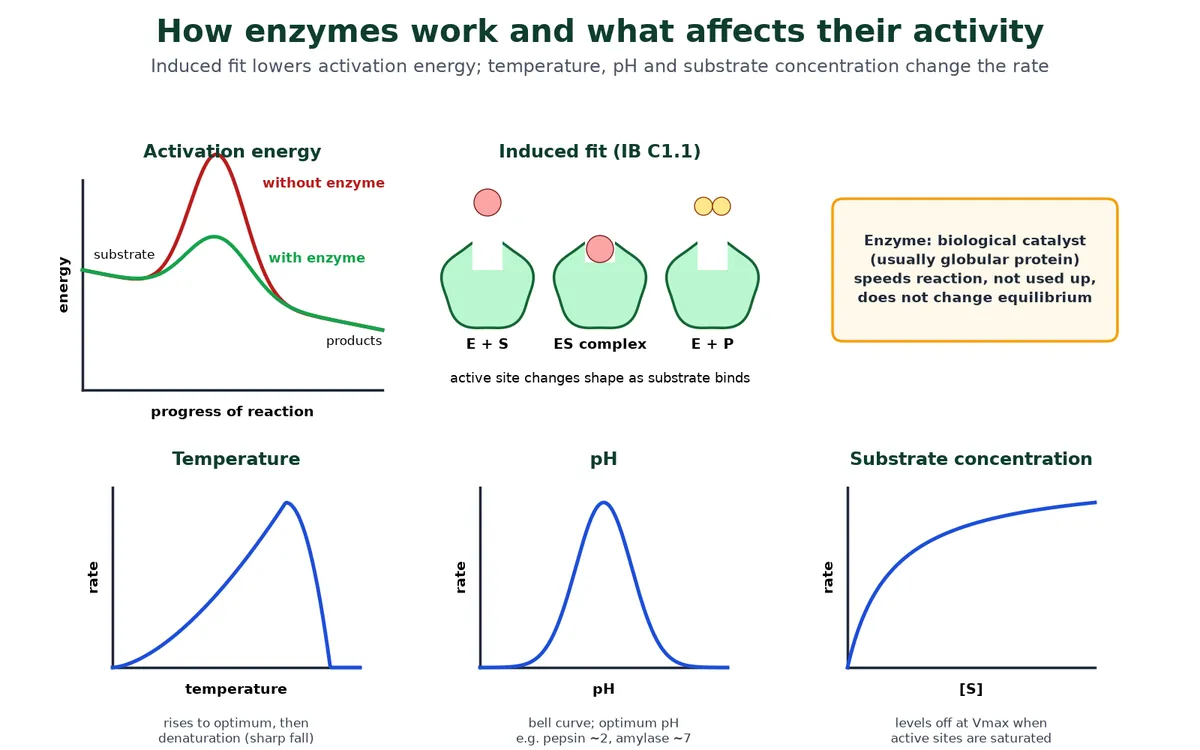
- Collision: substrate and enzyme move randomly in solution and collide. Only collisions with the right orientation and enough energy lead to binding.
- Binding: the substrate binds the active site, forming an enzyme-substrate complex (ES). IB In the induced-fit model, both the substrate and the active site change shape slightly as they bind, which stresses the bonds in the substrate.
- Catalysis: the substrate is converted to product while bound (EP complex).
- Release: the products leave and the enzyme is free to bind another substrate.
NCERT NCERT writes this as E + S ⇒ ES → EP → E + P. The older lock-and-key model (Emil Fischer, 1894) explains specificity but treats the active site as rigid; induced fit (Koshland, 1958) is the current model.
Enzymes change rate, not equilibrium
An enzyme speeds up the forward and the reverse reaction equally, so the reaction reaches equilibrium sooner, but the position of equilibrium does not change. Enzymes cannot make an unfavourable reaction happen on its own; cells do that by coupling it to ATP hydrolysis.
Factors affecting enzyme activity
Because these catalysts are folded proteins, anything that changes their shape changes their activity.
Swipe the table sideways to see every column.
| Factor | Effect | Why |
|---|---|---|
| Temperature | Rate rises to an optimum (about 37°C in humans), then falls sharply | More kinetic energy gives more frequent, harder collisions; above the optimum, bonds holding the active site break and the enzyme denatures. Low temperature only makes the enzyme inactive, temporarily |
| pH | Each enzyme has an optimum pH: pepsin about 2, salivary amylase about 7, trypsin about 8 | Changes in H+ alter the charges on R groups, disrupting ionic and hydrogen bonds in the active site |
| Substrate concentration | Rate rises then levels off at Vmax | At high concentration all active sites are occupied (saturated), so enzyme concentration becomes limiting |
| Enzyme concentration | Rate rises in proportion if substrate is in excess | More active sites available |
NCERT NCERT also notes that the rate of a reaction roughly doubles, or halves, for every 10°C change in either direction (Q10 ≈ 2), within the range where the enzyme is stable. IB asks you to calculate rates as amount of product formed (or substrate used) per unit time, and to design experiments that control the other variables.
Michaelis constant (Km)
NCERT Km is the substrate concentration at which the rate is half of Vmax. Vmax is the maximum rate when the enzyme is saturated with substrate; it is not an equilibrium. A low Km means high affinity. For glucose, hexokinase has a Km of about 0.1 mM and liver glucokinase about 10 mM, so hexokinase works even when blood glucose is low. The turnover number is the number of substrate molecules one enzyme molecule converts per second when saturated; catalase and carbonic anhydrase have some of the highest values (millions per second).
Naming and classifying enzymes
Thousands of different catalysts are known, so naming rules matter. Most are named by adding -ase to the substrate (sucrase, lipase, maltase), a convention proposed by Duclaux; some keep old names (pepsin, trypsin) or are named after a source (papain from papaya, bromelain from pineapple, ficin from fig latex). The IUB system gives each enzyme a four-part EC number: class, subclass, sub-subclass and the enzyme’s serial number. Hexokinase is EC 2.7.1.1.
NCERT Six classes of enzymes (NCERT 9.7.4)
Swipe the table sideways to see every column.
| Class | Reaction | Examples |
|---|---|---|
| 1 Oxidoreductases (dehydrogenases) | S reduced + S’ oxidised → S oxidised + S’ reduced | alcohol dehydrogenase, succinate dehydrogenase, cytochrome oxidase, catalase |
| 2 Transferases | transfer a group G (other than hydrogen) from S to S’ | transaminases, hexokinase and other kinases (transfer phosphate from ATP), citrate synthase |
| 3 Hydrolases | break ester, ether, peptide, glycosidic, C-C, C-halide or P-N bonds by adding water | all digestive catalysts: amylase, lipase, pepsin, trypsin |
| 4 Lyases | remove groups by means other than hydrolysis, leaving double bonds (or add groups to them) | aldolase, carbonic anhydrase, fumarase, PEP carboxylase, RuBisCO |
| 5 Isomerases | rearrange a molecule into an isomer (optical, geometric or positional) | phosphohexose isomerase (glucose-6-phosphate → fructose-6-phosphate) |
| 6 Ligases | join two compounds using energy from ATP (C-O, C-S, C-N, P-O bonds) | DNA ligase, pyruvate carboxylase |
Since 2018 the IUBMB recognises a seventh class, translocases, which move ions or molecules across membranes. NCERT and NEET still use six.
Cofactors
Some catalysts need help from other, smaller molecules. NCERT Some enzymes need a non-protein cofactor to work. The protein part alone is the apoenzyme; apoenzyme + cofactor = holoenzyme. When the cofactor is removed, catalytic activity is lost. The protein gives specificity; the cofactor often takes part in the chemistry.
- Prosthetic groups: organic and tightly bound. Haem in peroxidase and catalase, which break down hydrogen peroxide.
- Coenzymes: organic and only transiently bound, often carrying groups or electrons between catalysts. Many are made from B vitamins: NAD and NADP from niacin (B3), FAD and FMN from riboflavin (B2), TPP from thiamine (B1), coenzyme A from pantothenic acid (B5). Vitamin C is a cofactor for prolyl hydroxylase, needed to make collagen.
- Metal ions: zinc for carboxypeptidase and carbonic anhydrase, Mg2+ for kinases and many ATP-dependent catalysts, Cu for cytochrome oxidase and tyrosinase, Mo for nitrate reductase, Cl– for salivary amylase, Ca2+ for some lipases. Enzymes with a tightly bound metal are metalloenzymes; those only activated by a loosely bound ion are metal-activated enzymes.
Isoenzymes (isozymes) are different forms of an enzyme that catalyse the same reaction but are coded by different genes and differ in properties. Lactate dehydrogenase has five isozymes.
A short history of enzyme research
- Eduard Buchner (1897) showed that a cell-free extract of ground yeast could still ferment sugar, so fermentation is caused by chemicals (he called them zymase), not by the living cell itself.
- Wilhelm Kühne (1877) coined the word enzyme, meaning ‘in yeast’.
- James Sumner (1926) crystallised urease from jack bean and showed it was a protein.
- Arber, Smith and Nathans shared the 1978 Nobel Prize for discovering restriction endonucleases, the ‘molecular scissors’ of gene cloning.
HL Enzyme inhibition and regulation (C1.1.12 to C1.1.17)
Intracellular and extracellular enzymes. Most work inside the cell (e.g. glycolytic catalysts in the cytoplasm); some are secreted to work outside it, such as digestive enzymes. Metabolic pathways are linear (glycolysis) or cyclic (Krebs cycle, Calvin cycle).
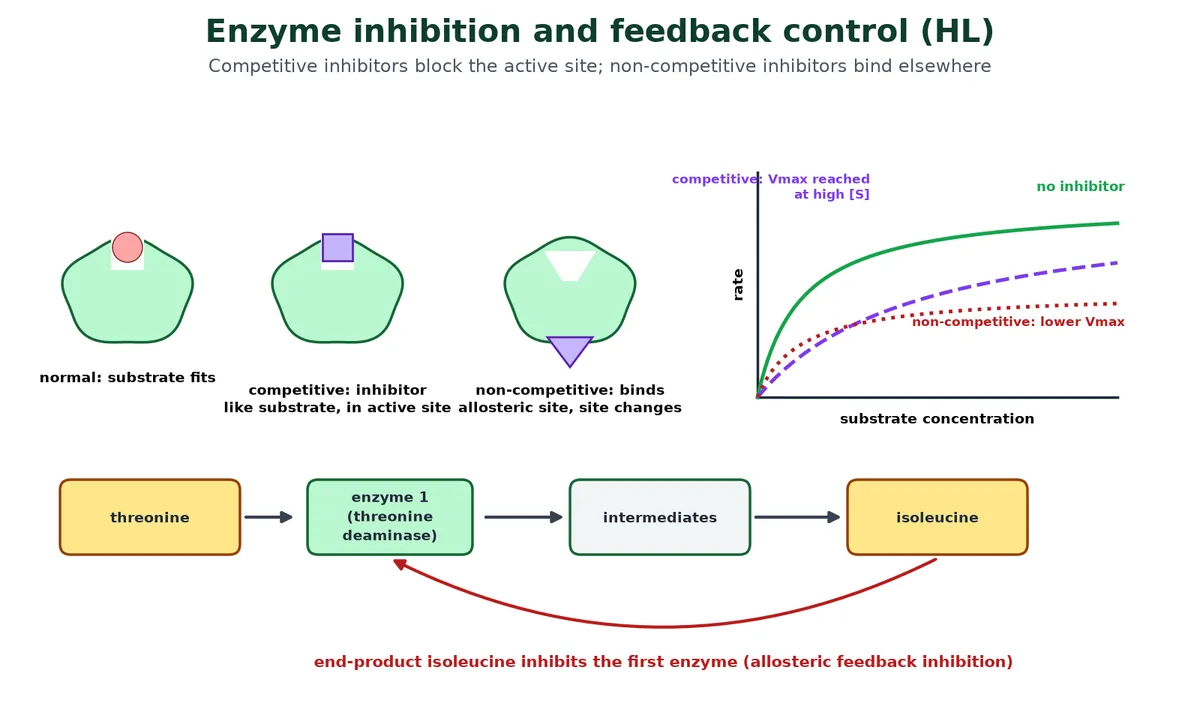
Swipe the table sideways to see every column.
| Feature | Competitive | Non-competitive |
|---|---|---|
| Inhibitor shape | similar to substrate | not similar to substrate |
| Binds | active site | allosteric site, elsewhere on the enzyme |
| Effect of more substrate | inhibition overcome; Vmax still reached | inhibition not overcome; Vmax lowered |
| Effect on Km | apparent Km raised | Km unchanged (pure non-competitive) |
| Examples | malonate inhibits succinate dehydrogenase; sulfonamides mimic PABA in folate synthesis by bacteria; statins | cyanide on cytochrome oxidase; heavy metals such as Hg2+ and Ag+ |
- Allosteric regulation: a regulator binding at an allosteric site changes the shape of the active site, decreasing (or in some cases increasing) activity. It is reversible.
- Feedback inhibition: the end product of a pathway inhibits the first enzyme. In bacteria, isoleucine inhibits threonine deaminase, the first enzyme in its synthesis from threonine, so it is made only when needed. The first step is the best control point because no energy is wasted on unneeded intermediates.
- Mechanism-based inhibition: penicillin binds irreversibly (covalently) to the active site of transpeptidase, which makes cross-links in bacterial walls. Resistant bacteria make an altered transpeptidase or β-lactamase.
- Heat from metabolism: no reaction is 100% efficient; the heat released keeps birds and mammals warm.
8 ATP: the energy currency of the cell
Syllabus link: IB C1.2.1 to C1.2.3 (ATP structure, properties, life processes, ATP-ADP interconversion); NCERT XI 9.4 (nucleotides), 9.7 (enzymes using ATP), Ch 14 Respiration in Plants
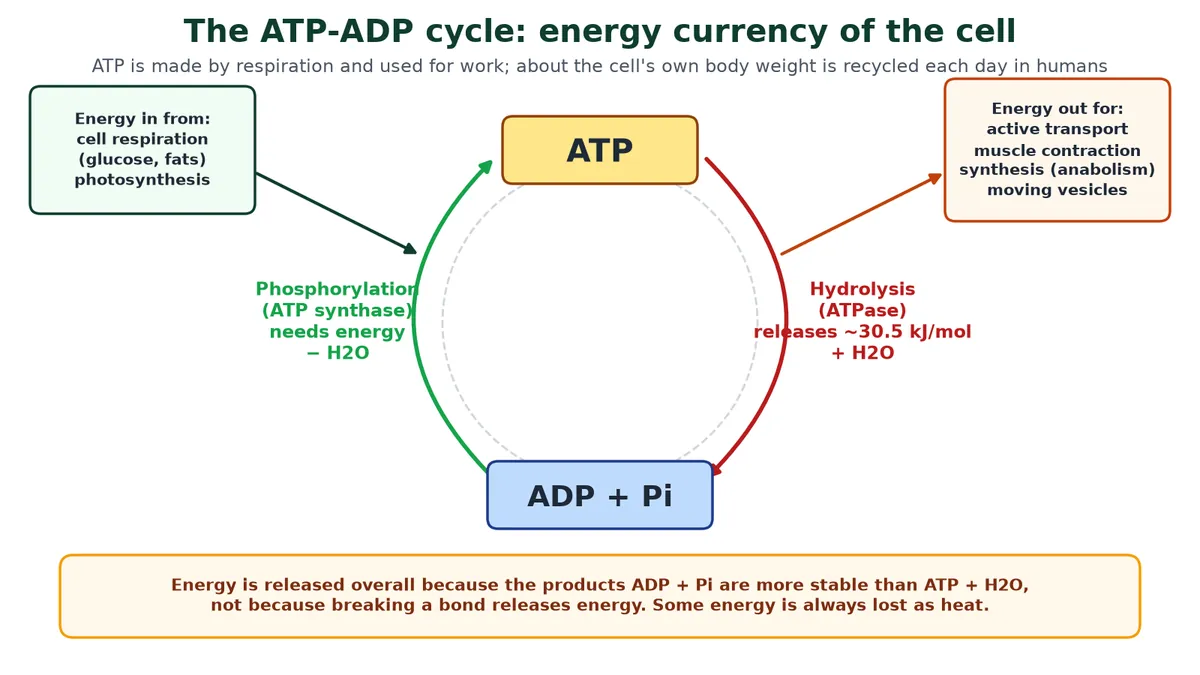
Adenosine triphosphate (ATP) is a nucleotide: adenine + ribose (together called adenosine) + three phosphate groups. It is the short-term energy carrier in every cell, which is why it is called the energy currency. Cells store energy long-term in other compounds, mainly lipids and polysaccharides, and convert it to this carrier as needed.
Why ATP suits its role IB
Of all the energy-carrying molecules, ATP has the best mix of properties.
- Soluble in water, so it moves easily to wherever it is needed in the cell.
- Stable at cell pH but hydrolysed quickly by catalysts, so energy is released only where and when an enzyme acts.
- Hydrolysis of the terminal phosphate releases a convenient amount of energy, about 30.5 kJ mol-1: enough for most cell reactions without wasting much.
- It cannot pass freely through membranes, so each compartment keeps its own supply.
- It is recycled quickly: ADP + Pi is turned back into ATP. An adult turns over roughly their own body mass of it each day, yet the body holds only about 250 g at any moment.
The ATP-ADP cycle
This cycle links the energy-releasing breakdown of food molecules to the energy-using synthesis of new ones. Hydrolysis: ATP + H2O → ADP + Pi, energy released (catalysed by ATPases). Phosphorylation: ADP + Pi + energy → ATP + H2O (catalysed by ATP synthase). The energy for phosphorylation comes from cell respiration in all cells and, in plants and algae, also from the light reactions of photosynthesis. It can also give its phosphate directly to another molecule (phosphorylation), which makes that molecule more reactive or changes its shape, as in the first steps of glycolysis or a sodium-potassium pump.
Where does the energy really come from?
Many books talk of ‘high-energy bonds’, which misleads students. Breaking any bond needs energy. ATP hydrolysis releases energy overall because the products, ADP and phosphate, are more stable than ATP and water: the three negatively charged phosphates repel each other, and the products are better stabilised by water. The net energy released is what cells use.
What cells use ATP for IB
- Active transport: pumping ions against a gradient (Na+/K+ pump).
- Movement: muscle contraction (myosin heads), cilia and flagella, moving chromosomes and vesicles along the cytoskeleton.
- Synthesis (anabolism): making large molecules such as proteins, DNA, polysaccharides and lipids.
- Cell signalling and secretion: exocytosis, and making second messengers such as cAMP.
- Activating molecules: phosphorylating glucose so it can be respired.
9 Energy in cells: cell respiration
Syllabus link: IB C1.2.4 to C1.2.8 (cell respiration, aerobic and anaerobic, variables affecting rate) and C1.2.9 to C1.2.18 HL; NCERT XI Ch 14 Respiration in Plants; NCERT XI 9 metabolic basis of living
Cells cannot use the energy in glucose, fat or other fuels directly. Cell respiration is the controlled release of energy from organic compounds, such as glucose and fatty acids, to produce ATP. It happens in small enzyme-controlled steps, so energy is captured as ATP instead of being lost all at once as heat, as it would be in burning. Do not confuse respiration with gas exchange or breathing: those just supply oxygen and remove CO2.
Aerobic and anaerobic respiration IB
Swipe the table sideways to see every column.
| Feature | Aerobic | Anaerobic (animals) | Anaerobic (yeast, plants) |
|---|---|---|---|
| Oxygen needed | yes | no | no |
| Substrates | glucose, fatty acids, amino acids | glucose only | glucose only |
| Products | CO2 + H2O | lactate | ethanol + CO2 |
| ATP per glucose | about 30 to 38 (NCERT net 38) | 2 | 2 |
| Where | cytoplasm, then mitochondria | cytoplasm | cytoplasm |
Aerobic: C6H12O6 + 6O2 → 6CO2 + 6H2O + energy (part captured as ATP). Anaerobic respiration gives a fast but small energy yield. In humans it supports short bursts of intense exercise, but lactate builds up and must be removed later (oxygen debt). Yeast’s anaerobic respiration (alcoholic fermentation) is used in brewing and to raise bread with CO2.
Which fuel? Carbohydrates versus fats
Not all molecules are equal as fuels. Per gram, fats give about twice as much energy as carbohydrates because they contain more C-H bonds and little oxygen. But fats need more oxygen to oxidise per unit of energy and can only be respired aerobically, so during very hard exercise muscles rely on glucose and glycogen. At lower intensity, when plenty of oxygen is available, a greater share of energy comes from fat.
Measuring the rate of respiration IB
Use a respirometer: an organism such as germinating seeds or woodlice is sealed with potassium hydroxide (or soda lime), which absorbs CO2. As O2 is used, the gas volume falls and a coloured drop moves along a capillary tube. Variables you can test include temperature and the type of organism; keep the mass of organisms and the time constant, and include a control with glass beads.
HL Cell respiration in detail (C1.2.9 to C1.2.18)
- NAD is a hydrogen (electron) carrier: it is reduced to NADH in oxidation reactions and passes electrons on. Oxidation is loss of electrons or hydrogen; reduction is gain.
- Glycolysis (cytoplasm): glucose is phosphorylated using 2 ATP, split into two 3-carbon molecules, and oxidised to 2 pyruvate. Net gain: 2 ATP and 2 NADH per glucose.
- Anaerobic: pyruvate is reduced to lactate (animals) or ethanol + CO2 (yeast) to regenerate NAD so glycolysis can continue.
- Link reaction (matrix): pyruvate is decarboxylated and oxidised to an acetyl group carried by coenzyme A.
- Krebs cycle (matrix): acetyl joins oxaloacetate to form citrate; two decarboxylations and four oxidations release 2 CO2 per turn and reduce NAD and FAD.
- Electron transport chain (inner membrane, cristae): electrons pass along carriers, energy pumps protons into the intermembrane space; chemiosmosis drives ATP synthase as protons flow back. Oxygen is the final electron acceptor and forms water.
- Lipids are respired by breaking fatty acids into 2-carbon acetyl groups (β-oxidation) that enter the Krebs cycle; glycerol enters glycolysis.
Connecting it all
This is the core idea of cellular chemistry. Biomolecules (glucose, fats) are the fuel. Enzymes catalyse each step of respiration, and many need coenzymes made from vitamins (NAD from niacin). The energy is captured as ATP, which then drives the synthesis of new molecules: proteins on ribosomes, DNA during replication, glycogen in the liver. So the four topics in this chapter form one cycle of energy and matter that keeps the cell alive. NCERT calls this the dynamic state of body constituents: cell components are constantly being made and broken down, and the living state is a non-equilibrium steady state that can do work.
10 Key terms
Learn these key terms for this chapter; most one-mark questions test a definition.
Swipe the table sideways to see every column.
| Term | Meaning |
|---|---|
| Biomolecules | All carbon compounds obtained from living tissues (NCERT); with water and ions, the chemicals of life. |
| Monomer / polymer | Small subunit / long chain of similar subunits; the two sizes of organic molecules. |
| Condensation | Joining two molecules with the release of water. |
| Hydrolysis | Breaking a bond between molecules by adding water. |
| Glycosidic bond | Bond between two monosaccharides. |
| Ester bond | Bond between glycerol and a fatty acid. |
| Peptide bond | -CO-NH- bond between two amino acids. |
| Phosphodiester bond | Sugar-phosphate link between nucleotides. |
| Amphipathic | Having hydrophilic and hydrophobic parts. |
| Zwitterion | Molecule with both + and – charges but no net charge. |
| Denaturation | Loss of 3-D shape and function of a protein. |
| Active site | Region of an enzyme where the substrate binds. |
| Activation energy | Energy needed to start a reaction. |
| Cofactor | Non-protein part needed by some enzymes; often small organic molecules or ions. |
| Allosteric site | Site away from the active site where a regulator binds (HL). |
| ATP | Adenosine triphosphate; the cell’s energy currency. |
| Cell respiration | Controlled release of energy from organic compounds to make ATP. |
11 Common doubts about biomolecules, enzymes and ATP
These are questions students keep asking on forums and homework sites. Khan Academy’s comment threads would not load for our checker, so we used the same doubts as they appear on Reddit, Stack Exchange, Physics Forums and CK-12. Each answer is ours; the link shows where the doubt comes from.
Are lipids polymers? They are big molecules.
No. A polymer is a chain of many repeating monomers. A triglyceride is one glycerol plus three fatty acids, and a phospholipid has only two fatty acids, so there is no repeating chain. Lipids are grouped with the macromolecular fraction only because membrane fragments land in the acid-insoluble fraction. (Doubt seen on ck12.org)
Starch and cellulose are both glucose. Why can we digest one and not the other?
Starch has α-glycosidic bonds; cellulose has β-1,4 bonds between flipped glucose units. Human amylase fits only the α bonds and we make no cellulase. Cows and termites digest cellulose only because microbes in their gut make cellulase. (Doubt seen on reddit.com)
Why does high temperature destroy an enzyme but low temperature only slows it?
Cold reduces kinetic energy, so there are fewer successful collisions, but the folded shape stays; warm it up and activity returns. Heat above the optimum breaks the hydrogen and ionic bonds that hold the active site, so the enzyme denatures, usually permanently. (Doubt seen on physicsforums.com)
If an enzyme speeds up a reaction, why doesn’t it change the equilibrium?
An enzyme lowers the activation energy for the forward and reverse reactions equally. Both speed up, so equilibrium is reached sooner, but the ratio of products to reactants at equilibrium is the same. (Doubt seen on biology.stackexchange.com)
A non-competitive inhibitor changes the active site. Why does Km not change?
In pure non-competitive inhibition, the inhibitor binds the enzyme and the enzyme-substrate complex equally well. The inhibited molecules are simply out of action, as if there were less enzyme; the uninhibited ones bind substrate as before. So Vmax falls but Km stays the same. NEET and IB usually ask only about Vmax. (Doubt seen on reddit.com)
Breaking bonds needs energy, so how can breaking ATP release energy?
It is not the bond breaking that releases energy. In this hydrolysis a bond is broken and new bonds form with water; the products ADP and phosphate are more stable, so the whole reaction releases energy overall. ‘High-energy bond’ is a shortcut, not chemistry. (Doubt seen on reddit.com)
Why do cells make ATP instead of using glucose directly?
Glucose and other fuel molecules hold a lot of energy: about 2,870 kJ per mole of glucose, far too much to release in one reaction. Respiration splits it into many small steps and stores the energy in about 30 ATP, each a small ‘coin’ that any enzyme in the cell can use. It is also quick to regenerate. (Doubt seen on biology.stackexchange.com)
Is ATP an energy store?
Not a long-term one. A cell holds only a few seconds’ supply. Long-term stores are lipids, starch and glycogen; it is the short-term carrier that moves energy from respiration to where work is done. (Doubt seen on reddit.com)
12 FAQ
Short answers to the questions we are asked most about this chapter.
What are biomolecules?
Biomolecules are all the carbon compounds found in living tissues: carbohydrates, lipids, proteins and nucleic acids, plus small molecules such as amino acids and vitamins. Water and mineral ions are inorganic biomolecules in the wider sense.
What are the four main types of biomolecules?
Carbohydrates, lipids, proteins and nucleic acids. Three of these are polymers; lipids are not.
Which are the most abundant biomolecules in a cell?
Water (70 to 90% of cell mass). Among organic compounds, proteins are the most abundant (10 to 15%). On Earth, cellulose is the most abundant organic compound and RuBisCO the most abundant protein.
Are all enzymes proteins?
Almost all biological catalysts are proteins. Ribozymes, such as the rRNA in ribosomes, are RNA molecules that act as catalysts.
What is the difference between a coenzyme and a prosthetic group?
Both are organic cofactors. A prosthetic group is tightly bound to the enzyme (haem in catalase); a coenzyme binds only briefly (NAD).
What is enzyme inhibition?
Enzyme inhibition is any reduction in an enzyme’s activity caused by a molecule binding to it. Competitive inhibitors block the active site; non-competitive inhibitors bind an allosteric site. Feedback inhibition by an end product controls metabolic pathways.
Why is ATP called the energy currency of the cell?
Because almost every energy-requiring process in the cell is paid for with ATP, and it is made by respiration from any fuel. Like money, it links earning (respiration) to spending (work).
13 Quick check
Tap each question to reveal the answer and check your grasp of the chapter before trying the full question set.
Test yourself on this chapter
1. Which fraction of a tissue ground in trichloroacetic acid contains proteins?
The acid-insoluble fraction (retentate).
2. Name the bond in maltose and the bond in a protein.
Glycosidic bond (α-1,4); peptide bond.
3. How does cellulose differ from starch?
Cellulose has β-glucose with β-1,4 bonds in straight, H-bonded chains; starch has α-glucose (amylose unbranched, amylopectin branched).
4. Why are triglycerides good energy stores?
About twice the energy per gram of carbohydrates, insoluble so osmotically inactive, and also insulate.
5. What holds the secondary structure of a protein?
Hydrogen bonds between C=O and N-H of the backbone.
6. Which base is found in RNA but not DNA?
Uracil.
7. What does an enzyme do to activation energy?
Lowers it.
8. Why does pepsin stop working in the small intestine?
The pH (about 8) is far from its optimum (about 2), so the active site changes shape.
9. What happens to Vmax with a competitive inhibitor at high substrate concentration?
It is still reached; the inhibition is overcome.
10. Give the products of ATP hydrolysis.
ADP and inorganic phosphate, with energy released.
Ready to practise? Download the Cellular Chemistry (biomolecules, enzymes and ATP) IB and NEET question set with markscheme (25 MCQs + 6 structured questions, 65 marks, free for signed-up members).
⬇ Download practice questions (PDF)© competitorspoint.com · Biology notes. Diagrams are original to competitorspoint.com except Figure 2, from the author’s notes.