
Fate of Pyruvate After Glycolysis
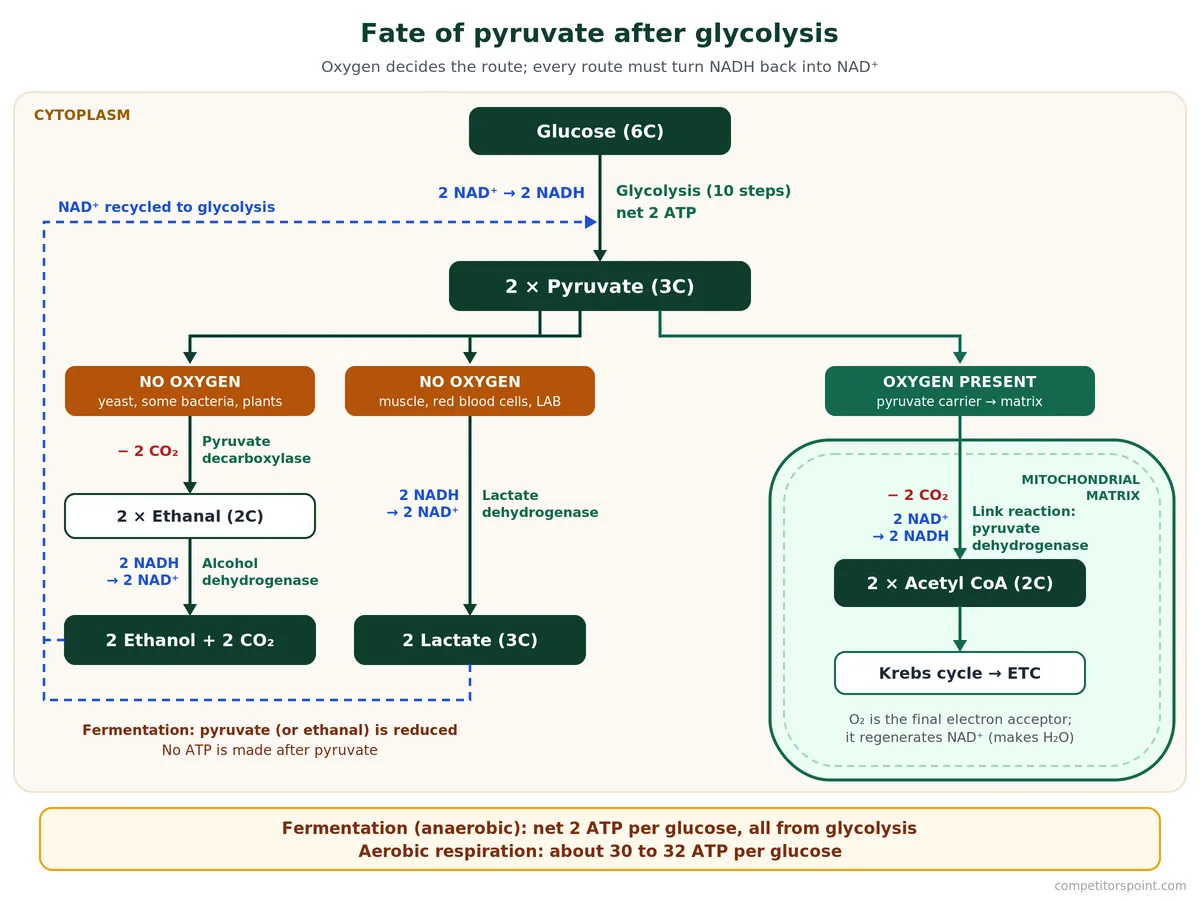
The fate of pyruvate after glycolysis depends on oxygen. With oxygen, pyruvate enters the mitochondrial matrix, where the link reaction turns it into acetyl CoA, CO2 and NADH for the Krebs cycle. Without oxygen, fermentation reduces it to ethanol and CO2 in yeast or to lactate in muscle, regenerating NAD+ so glycolysis can continue.
1 What is the fate of pyruvate?
Syllabus link: IB Biology C1.2 Cell respiration (first assessment 2025): C1.2.5 differences between anaerobic and aerobic respiration in humans (SL); C1.2.9 pyruvate to lactate to regenerate NAD, C1.2.10 anaerobic respiration in yeast for brewing and baking and C1.2.11 the link reaction (Higher Level).
SL = needed by every IB Biology student IB HL = Higher Level only Extension = beyond the IB guide
Two molecules of pyruvate (pyruvic acid, 3C) are formed from each glucose in the ten steps of the glycolysis pathway. Glycolysis is common to aerobic and anaerobic respiration, and it also leaves 2 NADH and a net 2 ATP. What happens next, the fate of pyruvate, depends on two things: whether oxygen is available, and what kind of cell it is.
- Oxygen present (aerobic respiration): in eukaryotic cells pyruvate is carried into the mitochondrial matrix. The link reaction converts it to acetyl CoA, which enters the Krebs cycle, and the glucose is oxidised completely to CO2 and water.
- Oxygen absent (anaerobic respiration, fermentation): pyruvate stays in the cytoplasm and is reduced, either to ethanol and CO2 (yeast, some bacteria and plant cells in waterlogged soil) or to lactate (human muscle, red blood cells and lactic acid bacteria such as Lactobacillus).
The key idea behind every fate of pyruvate is the coenzyme NAD+. Glycolysis needs a steady supply of NAD+ to accept hydrogen. In aerobic cells the electron transport chain regenerates it; without oxygen, the cell regenerates it by passing the hydrogen to pyruvate. This chapter follows the fate of pyruvate along both routes and covers the energy yields, what happens to lactate after exercise, the uses of fermentation, and the exam traps. For the bigger picture, start from the photosynthesis and cell respiration hub.
2 The three fates of pyruvate at a glance
The table summarises the fate of pyruvate in different cells and conditions.
Swipe the table sideways to see every column.
| Route | Condition and cells | Site | Product from 2 pyruvate | How NADH is reoxidised |
|---|---|---|---|---|
| Link reaction (aerobic) | Oxygen present; most eukaryotic cells and aerobic bacteria | Mitochondrial matrix | 2 acetyl CoA + 2 CO2 + 2 NADH | Electron transport chain, with O2 as final acceptor |
| Alcoholic fermentation | No oxygen; yeast, some bacteria, plant roots in waterlogged soil | Cytoplasm | 2 ethanol + 2 CO2 | Ethanal (acetaldehyde) accepts the hydrogen |
| Lactic acid fermentation | Too little oxygen (muscle in intense exercise), no mitochondria (red blood cells), lactic acid bacteria | Cytoplasm | 2 lactate | Pyruvate itself accepts the hydrogen |
Notice that the word fermentation covers both anaerobic routes. The IB guide calls the same process anaerobic cell respiration and stresses that the pathway in yeast and in humans is identical up to pyruvate. Only the way NAD+ is regenerated, and so the fate of pyruvate and the final products, differ (C1.2.10).
Key idea: the fate of pyruvate is a redox choice
- Aerobic: pyruvate is oxidised (loses hydrogen to NAD+) and decarboxylated.
- Anaerobic: pyruvate (or ethanal made from it) is reduced (gains hydrogen from NADH).
- Fermentation itself makes no ATP; its only job is to regenerate NAD+ so that glycolysis can keep making its 2 ATP.
Pyruvate also has building-up fates that matter in metabolism, though not in exam questions on respiration: it can be carboxylated to oxaloacetate (topping up the Krebs cycle and starting gluconeogenesis in the liver) or converted to the amino acid alanine by transamination.
3 Aerobic fate: the link reaction (pyruvate to acetyl CoA) IB HL
When oxygen is available, the fate of pyruvate in a eukaryotic cell is to move from the cytoplasm into the mitochondrion. It crosses the outer membrane through porin channels and the inner membrane on a specific carrier protein, the mitochondrial pyruvate carrier (see membrane transport proteins and mitochondria among the cell organelles). In the matrix it undergoes oxidative decarboxylation, catalysed by the large pyruvate dehydrogenase complex. This is the link reaction, because it links glycolysis to the Krebs cycle.
Pyruvate + CoA + NAD+ →(pyruvate dehydrogenase, Mg2+)→ Acetyl CoA + CO2 + NADH + H+
What happens in the link reaction
- Decarboxylation: the carboxyl group of pyruvate is removed as CO2, leaving a 2C unit held on the enzyme (by the coenzyme thiamine pyrophosphate, TPP).
- Oxidation (dehydrogenation): hydrogen is removed from the 2C unit and passed, via FAD inside the complex, to NAD+, forming NADH + H+. The 2C unit becomes an acetyl group.
- Formation of acetyl CoA: the acetyl group is attached to coenzyme A. Acetyl CoA carries it into the Krebs cycle, where it joins oxaloacetate.
All three happen on one enzyme complex, so no free ethanal or acetic acid is ever released. The complex uses five coenzymes: TPP (from vitamin B1), lipoic acid, coenzyme A, FAD and NAD+.
| Link reaction | Per pyruvate | Per glucose (2 pyruvate) |
|---|---|---|
| Acetyl CoA | 1 | 2 |
| CO2 released | 1 | 2 |
| NADH formed | 1 | 2 |
| ATP made directly | 0 | 0 |
IB HL C1.2.11 in exam language
- The link reaction is the oxidation and decarboxylation of pyruvate; it occurs in the mitochondrial matrix.
- Both carbohydrates and lipids are broken down to acetyl groups (2C), which coenzyme A transfers to the Krebs cycle. Fatty acids enter here, not through glycolysis, so they can only be respired aerobically (C1.2.17).
- The reaction is irreversible: acetyl CoA cannot be turned back into pyruvate.
From here the aerobic fate of pyruvate continues in the Krebs cycle: each acetyl CoA goes round the cycle once, so the cycle turns twice per glucose. Follow the next stage in the Krebs cycle chapter, which also summarises the link reaction as the entry to the Krebs cycle. The NADH from the link reaction is later reoxidised by the electron transport chain on the inner mitochondrial membrane, the step that needs oxygen.
4 Fermentation: the anaerobic fate of pyruvate IB HL
Fermentation is the anaerobic fate of pyruvate: the incomplete breakdown of glucose without oxygen. Glycolysis runs as normal in the cytoplasm, and then pyruvate is converted to a product that still holds most of the energy of glucose: ethanol or lactate. No Krebs cycle or electron transport chain is involved, so fermentation can take place in cells with no mitochondria and in organisms that live where oxygen is scarce.
Why NAD+ regeneration matters
Step 6 of glycolysis (the oxidation of glyceraldehyde 3-phosphate) needs NAD+ as a hydrogen acceptor. A cell holds only a small amount of NAD+. If the 2 NADH made per glucose were not reoxidised, all the NAD+ would be used up within seconds, glycolysis would stop, and the cell would make no ATP at all. Without oxygen, the electron transport chain cannot take the hydrogen, so the cell passes it to pyruvate (lactic acid fermentation) or to ethanal (alcoholic fermentation). The fate of pyruvate without oxygen is therefore really about recycling NADH.
5 Alcoholic fermentation in yeast IB HL
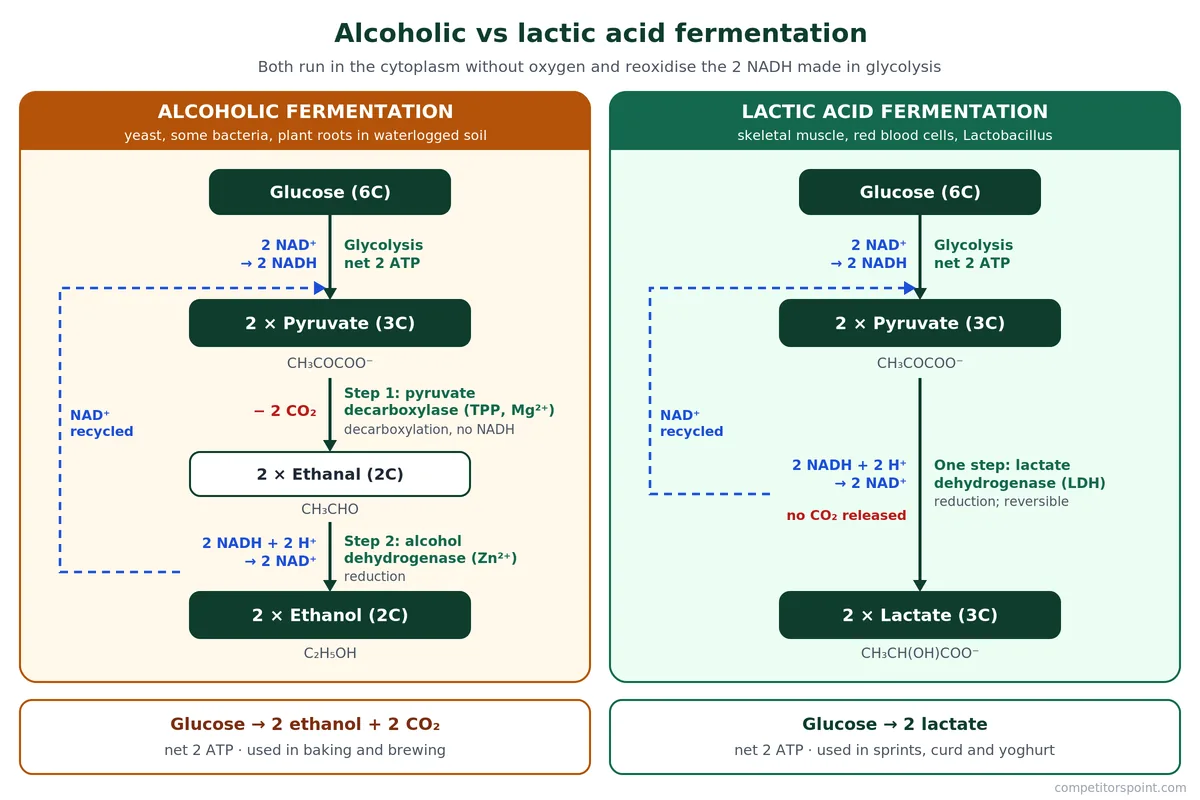
In yeast the fate of pyruvate depends on oxygen. Yeast (Saccharomyces cerevisiae) is a facultative anaerobe: it respires aerobically when oxygen is present and ferments when it is not. In alcoholic fermentation the two molecules of pyruvate are converted to ethanol (ethyl alcohol) and CO2 in two steps.
Yeast is a facultative anaerobe
- Facultative means optional: yeast can make ATP with or without oxygen and switches route according to what is available.
- With oxygen yeast respires aerobically, oxidising glucose completely to CO2 and water. It gets about 30 to 32 ATP per glucose, so it grows and buds quickly.
- Without oxygen it ferments glucose to ethanol and CO2, getting only 2 ATP per glucose. It survives but grows slowly and uses sugar much faster.
- Compare an obligate aerobe, which dies without oxygen (humans as whole organisms), and an obligate anaerobe, which is poisoned by oxygen (for example Clostridium bacteria).
- Brewers use this switch. Oxygen in the fresh mixture first lets the yeast multiply; once the yeast has used up the oxygen in the sealed vessel, it changes to fermentation and ethanol starts to build up.
- Decarboxylation: each pyruvate (3C) loses CO2 to form ethanal (2C). The enzyme is pyruvate decarboxylase, which needs TPP and Mg2+. This step is not an oxidation, so no NADH is made.
- Reduction: ethanal accepts hydrogen from NADH + H+ and is reduced to ethanol (2C). The enzyme is alcohol dehydrogenase, a zinc-containing enzyme. NAD+ is regenerated.
2 Pyruvate →(pyruvate decarboxylase)→ 2 Ethanal + 2 CO2; 2 Ethanal + 2 NADH + 2 H+ →(alcohol dehydrogenase)→ 2 Ethanol + 2 NAD+
Overall: C6H12O6 → 2 C2H5OH + 2 CO2 (net 2 ATP per glucose)
The 2 NADH made in glycolysis are used up in the second step, so there is no net gain or loss of NADH. The only ATP made is the net 2 ATP from glycolysis. The IB word equation is glucose → ethanol + carbon dioxide.
Why yeast stops at about 13 % ethanol
Ethanol is toxic. Yeasts poison themselves to death when the alcohol concentration reaches about 13 per cent. The exact limit depends on the strain; most brewing and wine yeasts are inhibited between about 12 and 15 %. This is why naturally fermented drinks such as beer and wine contain no more than this, while spirits such as whisky, rum and vodka need distillation to concentrate the ethanol.
Alcoholic fermentation is not limited to yeast. Some bacteria (for example Zymomonas) and the root cells of plants in waterlogged soil, such as rice, can also make ethanol. Human cells cannot, because they lack pyruvate decarboxylase.
6 Lactic acid fermentation in muscle and bacteria SL
In muscle and lactic acid bacteria, the fate of pyruvate without oxygen takes a single step. In lactic acid fermentation, pyruvate is reduced directly to lactate (lactic acid, CH3CH(OH)COOH) in a single step. The enzyme is lactate dehydrogenase (LDH), found in the cytoplasm. NADH + H+ provides the hydrogen and is reoxidised to NAD+. No CO2 is released, so all three carbon atoms of each pyruvate stay in lactate.
Pyruvate + NADH + H+ ↔(lactate dehydrogenase)↔ Lactate + NAD+
Overall: C6H12O6 → 2 C3H6O3 (net 2 ATP per glucose)
At the pH of the cell, lactic acid is ionised, so biologists usually say lactate; the IB guide uses lactate. The IB word equation is glucose → lactate. The reaction is reversible, which matters when lactate is cleared after exercise (section 8).
Where lactic acid fermentation happens
- Skeletal muscle during intense exercise: when the heart and lungs cannot deliver oxygen fast enough (see how oxygen is delivered to tissues), muscle fibres make extra ATP anaerobically for short bursts such as a sprint.
- Red blood cells: they have no mitochondria, so lactic acid fermentation is their only way to make ATP, even with plenty of oxygen.
- Lactic acid bacteria (LAB) such as Lactobacillus and Streptococcus thermophilus: prokaryotes that ferment the sugar in milk to lactic acid, which sets milk into curd or yoghurt.
The lactate dehydrogenase used in fermentation is an NAD-linked enzyme; it does not need FMN or zinc ions. For a clinical view of what happens when lactate builds up faster than the body can clear it, see the StatPearls review of anaerobic glycolysis on NCBI Bookshelf.
7 ATP and energy yield of each route SL
The fate of pyruvate decides how much ATP a cell gets from each glucose. Fermentation makes net 2 ATP per glucose, all from glycolysis by substrate-level phosphorylation (4 made, 2 used). The steps after pyruvate make none. Aerobic respiration makes far more, because the link reaction, Krebs cycle and electron transport chain release the energy that fermentation leaves locked in ethanol or lactate.
| Measure (per glucose) | Aerobic respiration | Alcoholic fermentation | Lactic acid fermentation |
|---|---|---|---|
| Net ATP | About 30 to 32 | 2 | 2 |
| Energy released | About 2,870 kJ (686 kcal): complete oxidation | About 235 kJ (8 %) | About 196 kJ (7 %) |
| End products | 6 CO2 + 6 H2O | 2 ethanol + 2 CO2 | 2 lactate |
The kilojoule figures above are standard free-energy changes from biochemistry textbooks; they show that alcoholic fermentation releases a little more energy than lactic acid fermentation, roughly 7 to 8 % of the total either way. Only about 61 kJ of it (2 ATP × about 30.5 kJ) is captured in ATP, about 2 % of the energy of glucose; the rest is lost as heat. For the glycolysis side of the balance sheet see the net ATP yield of glycolysis.
IB HL C1.2.9 and C1.2.10 wording
- Conversion of pyruvate to lactate is a means of regenerating NAD; this allows glycolysis to continue, with a net yield of two ATP per glucose.
- The pathways of anaerobic respiration in humans and yeast are the same apart from the regeneration of NAD using pyruvate, and therefore the final products.
8 Oxygen debt and the fate of lactate Extension
Lactate is not a dead end: the fate of pyruvate made in a sprinting muscle continues after the race. After intense exercise, breathing and heart rate stay high for some time, and the body takes in more oxygen than it would at rest. This extra oxygen is the oxygen debt, now usually called excess post-exercise oxygen consumption (EPOC). It is used to:
- oxidise lactate back to pyruvate (lactate dehydrogenase working in reverse), which then enters the link reaction and Krebs cycle, mainly in heart muscle and slow-twitch muscle fibres;
- convert lactate to glucose in the liver (the Cori cycle, below);
- remake ATP and creatine phosphate in muscle and reload myoglobin with oxygen.
The Cori cycle (extension)
Lactate diffuses from muscle into the blood and is carried to the liver. Liver cells convert it to pyruvate and then, by gluconeogenesis, to glucose, which returns to the muscle in the blood. This loop, named after Carl and Gerty Cori, moves the energy cost of clearing lactate from muscle to the liver: making one glucose from two lactate uses 6 ATP, more than the 2 ATP the muscle gained. The Cori cycle is beyond the IB core, but it is useful for extended answers.
Lactate myths
- “Lactic acid causes next-day muscle soreness.” Lactate is cleared from the blood within an hour or so of exercise; delayed soreness is caused by small muscle injuries and inflammation.
- “Lactate is waste.” It is a fuel for the heart and a substrate for gluconeogenesis.
If lactate production outruns its removal, for example in shock or severe infection when tissues get too little oxygen, blood pH falls. This condition is described in the StatPearls article on lactic acidosis.
9 Aerobic respiration vs alcoholic and lactic acid fermentation SL
This table compares the fate of pyruvate in each route side by side, the format most exam questions use.
Swipe the table sideways to see every column.
| Feature | Aerobic (link reaction onwards) | Alcoholic fermentation | Lactic acid fermentation |
|---|---|---|---|
| Oxygen | Needed (final electron acceptor) | Not needed | Not needed |
| Site after glycolysis | Mitochondrial matrix and inner membrane | Cytoplasm | Cytoplasm |
| Examples | Most plant and animal cells, yeast with oxygen | Yeast, some bacteria, waterlogged roots | Muscle, red blood cells, Lactobacillus |
| Steps after pyruvate | Link reaction, Krebs cycle, electron transport chain | 2: decarboxylation then reduction | 1: reduction |
| Key enzymes | Pyruvate dehydrogenase complex, Krebs enzymes | Pyruvate decarboxylase, alcohol dehydrogenase | Lactate dehydrogenase |
| Pyruvate is | Oxidised and decarboxylated | Decarboxylated, then the product reduced | Reduced |
| End products | CO2 and H2O | Ethanol (2C) + CO2 | Lactate (3C) |
| CO2 per glucose | 6 | 2 | 0 |
| NAD+ regenerated by | Electron transport chain | Reduction of ethanal | Reduction of pyruvate |
| Net ATP per glucose | About 30 to 32 | 2 | 2 |
| Oxidation of glucose | Complete | Incomplete | Incomplete |
| Reversible in the body? | No (link reaction irreversible) | No | Yes: lactate can be reoxidised |
For a comparison of all four stages of aerobic respiration, see the comparison of respiration stages in the glycolysis chapter.
10 Uses of fermentation and anaerobic respiration IB HL
People have used the anaerobic fate of pyruvate for thousands of years, long before anyone knew what pyruvate was.
IB HL C1.2.10 Yeast in baking and brewing
- Baking: yeast in bread dough ferments sugars; the CO2 forms bubbles that make the dough rise. The ethanol evaporates during baking.
- Brewing: in beer and wine making, the ethanol is the wanted product; fermentation is carried out in sealed vessels so that conditions become anaerobic. CO2 can be kept to make drinks fizzy.
- Spirits and fuel ethanol: because yeast stops at about 13 % ethanol, stronger drinks and fuel ethanol are concentrated by distillation.
- Curd, yoghurt and cheese: lactic acid bacteria acidify milk, which makes milk proteins coagulate. The dough for idli and dosa is also fermented by bacteria, and its puffed-up look is due to CO2.
- Pickles, sauerkraut and kimchi: lactic acid bacteria ferment the sugars in cabbage and other vegetables. Kimchi, the spiced fermented cabbage of Korea, sours as the lactic acid builds up.
- Food preservation: fermentation is one of the oldest ways of keeping food. The acid (lactate) or alcohol (ethanol) produced, together with the lack of oxygen, makes the food hostile to the bacteria and moulds that would spoil it, so fermented foods keep for weeks or months without refrigeration.
- Humans in exercise: anaerobic respiration supplies ATP quickly in a 100 m sprint or a heavy lift, when demand exceeds the oxygen supply. It cannot last long, because lactate and H+ build up and glucose is used about 16 times faster for the same amount of ATP.
11 Common exam traps
These are the mistakes examiners see most often in answers on the fate of pyruvate.
Watch out for these
- “Fermentation makes ATP when pyruvate is converted.” No ATP is made after pyruvate. The 2 ATP all come from glycolysis.
- “Lactic acid fermentation releases CO2.” Only alcoholic fermentation releases CO2. Lactate keeps all three carbons.
- “Human muscle can make alcohol.” Humans lack pyruvate decarboxylase; muscle makes only lactate.
- “Pyruvate enters the Krebs cycle.” Acetyl CoA enters. Pyruvate is first converted in the link reaction.
- “The link reaction takes place in the cytoplasm.” It is in the mitochondrial matrix; only glycolysis and fermentation are in the cytoplasm.
- Per pyruvate versus per glucose The link reaction gives 1 CO2 and 1 NADH per pyruvate, but 2 of each per glucose.
- “Fermentation produces NADH.” It uses up the NADH from glycolysis; the net NADH gain is zero.
- Decarboxylase vs dehydrogenase Pyruvate decarboxylase only removes CO2; pyruvate dehydrogenase removes CO2 and hydrogen.
- “Red blood cells respire aerobically because they carry oxygen.” They have no mitochondria and rely on lactic acid fermentation.
- NADH2 and NADH+ Older books write NADH2; the correct form is NADH + H+. “NADH+” does not exist.
12 Key terms
The terms you need to describe the fate of pyruvate in an exam answer.
| Term | Meaning |
|---|---|
| Pyruvate | 3C end product of glycolysis (pyruvic acid); two per glucose. |
| Link reaction | Oxidative decarboxylation of pyruvate to acetyl CoA in the mitochondrial matrix. |
| Pyruvate dehydrogenase complex | Enzyme complex of the link reaction; needs TPP, lipoic acid, CoA, FAD, NAD+ and Mg2+. |
| Acetyl CoA | Acetyl group (2C) carried by coenzyme A into the Krebs cycle. |
| Fermentation | Incomplete breakdown of glucose without oxygen to ethanol + CO2 or lactate. |
| Pyruvate decarboxylase | Yeast enzyme that removes CO2 from pyruvate, giving ethanal. |
| Alcohol dehydrogenase | Enzyme that reduces ethanal to ethanol using NADH. |
| Lactate dehydrogenase | Enzyme that reduces pyruvate to lactate using NADH; reversible. |
| Facultative anaerobe | Organism, such as yeast, that can respire with or without oxygen. |
| Oxygen debt (EPOC) | Extra oxygen taken in after exercise, used partly to remove lactate. |
| Cori cycle | Lactate from muscle converted to glucose in the liver and returned to muscle. |
13 Common doubts about the fate of pyruvate
These are the questions students ask us most often about what happens to pyruvate.
What is the fate of pyruvate after glycolysis?
The fate of pyruvate depends on oxygen. With oxygen, pyruvate enters the mitochondrial matrix and the link reaction converts it to acetyl CoA, CO2 and NADH; acetyl CoA then enters the Krebs cycle. Without oxygen, it stays in the cytoplasm and is reduced to ethanol and CO2 in yeast or to lactate in muscle.
What conditions are required for the fermentation of glucose in yeast?
Fermentation in yeast is the incomplete oxidation of glucose under anaerobic conditions, that is, in the absence of oxygen. A sugar substrate, a suitable temperature (about 30 to 35 °C for most strains) and water are also needed.
Which enzymes convert pyruvic acid to ethanol and carbon dioxide?
Pyruvate decarboxylase removes CO2 from pyruvic acid to form ethanal, and alcohol dehydrogenase then reduces ethanal to ethanol, using NADH + H+.
What does it mean that yeast is a facultative anaerobe?
It means yeast can live with or without oxygen. With oxygen it carries out aerobic respiration and gets about 30 to 32 ATP per glucose; without oxygen it switches to alcoholic fermentation, making ethanol and CO2 and only 2 ATP per glucose. Brewers and bakers rely on this switch.
How does fermentation in some bacteria differ from that in yeast?
Yeast produces ethanol and CO2, while lactic acid bacteria such as Lactobacillus reduce pyruvic acid directly to lactic acid, in one step and without releasing CO2.
When do animal cells carry out fermentation?
Animal cells, especially skeletal muscle during intense exercise, carry out lactic acid fermentation when the oxygen supply is inadequate for aerobic respiration. Red blood cells, which have no mitochondria, use it all the time.
What is the role of NADH in lactic acid and alcoholic fermentation?
NADH + H+ is the reducing agent: it gives hydrogen to pyruvate (forming lactate) or to ethanal (forming ethanol). In both processes it is reoxidised to NAD+, which glycolysis needs to continue.
How efficient is fermentation in terms of energy release?
Fermentation is not efficient. Less than 7 % of the energy in glucose is released, and not all of it is trapped in ATP. The net yield is only 2 ATP per glucose, compared with about 30 to 32 ATP in aerobic respiration.
Why are fermentation processes considered hazardous to the organisms?
They produce substances that harm the cell if they build up: an acid (lactic acid) or an alcohol (ethanol). Acid lowers the pH, and ethanol damages membranes and proteins.
What is the maximum alcohol concentration yeast can survive?
Yeasts poison themselves to death when the alcohol concentration reaches about 13 %. The limit varies with the strain, roughly 12 to 15 % for most brewing yeasts, so stronger drinks are made by distillation.
How does aerobic respiration differ from fermentation, and where does complete oxidation happen?
Aerobic respiration is the complete oxidation of organic substances using oxygen, releasing CO2, water and a large amount of energy. In eukaryotes, the steps after glycolysis (link reaction, Krebs cycle and electron transport chain) take place in the mitochondria and require oxygen. Fermentation oxidises glucose only partly, in the cytoplasm, without oxygen.
14 Practice questions
Tap each question to reveal the answer.
Test yourself on the fate of pyruvate
1. What is the fate of pyruvate when oxygen is present? Give the site and the products per pyruvate.
It enters the link reaction in the mitochondrial matrix, giving 1 acetyl CoA, 1 CO2 and 1 NADH per pyruvate (2 of each per glucose).
2. Name the two enzymes of alcoholic fermentation, in order.
Pyruvate decarboxylase (pyruvate → ethanal + CO2), then alcohol dehydrogenase (ethanal + NADH → ethanol + NAD+).
3. Which enzyme converts pyruvate to lactate, and which coenzyme is reoxidised?
Lactate dehydrogenase; NADH + H+ is reoxidised to NAD+.
4. (IB HL) Explain why the conversion of pyruvate to lactate allows glycolysis to continue. [3 marks]
Glycolysis needs NAD+ to accept hydrogen in the oxidation step; without oxygen NADH is not reoxidised by the electron transport chain; reducing pyruvate to lactate reoxidises NADH, regenerating NAD+; so glycolysis continues, giving a net 2 ATP per glucose.
5. How many molecules of CO2 are released per glucose in alcoholic fermentation and in lactic acid fermentation?
2 in alcoholic fermentation (one per pyruvate, by pyruvate decarboxylase); 0 in lactic acid fermentation.
6. (IB HL) Outline how yeast is used in baking and in brewing. [2 marks]
Baking: CO2 from anaerobic respiration makes the dough rise (ethanol evaporates on baking); brewing: ethanol is the product kept, made under anaerobic conditions.
7. Why can human muscle cells not produce ethanol?
They lack pyruvate decarboxylase, so the only anaerobic fate of pyruvate in human cells is reduction to lactate.
8. (IB SL) State two differences between anaerobic and aerobic respiration in humans.
Any two: anaerobic needs no oxygen; anaerobic takes place only in the cytoplasm, aerobic also needs mitochondria; anaerobic gives 2 ATP per glucose, aerobic about 30 or more; anaerobic waste is lactate, aerobic waste is CO2 and water; only glucose (carbohydrate) can be respired anaerobically.
9. (IB HL) Outline the link reaction. [3 marks]
In the mitochondrial matrix; pyruvate is decarboxylated, releasing CO2; it is oxidised / dehydrogenated, reducing NAD to NADH; the acetyl group (2C) formed is attached to coenzyme A as acetyl CoA, which carries it to the Krebs cycle.
Ready to practise? Download the Fate of Pyruvate IB question set with markscheme.
© competitorspoint.com · Biology notes. Diagrams are original to competitorspoint.com.