
Origin and Evolution of Cells
The origin of cells is how the first living cells arose from non-living chemicals, about 3.5 to 4 billion years ago. Organic molecules probably formed self-replicating RNA inside membrane vesicles. The last universal common ancestor (LUCA) gave rise to bacteria and archaea; eukaryotic cells later gained mitochondria by endosymbiosis, and algae and plants gained chloroplasts the same way.
The evolution of cells for IB and NEET: spontaneous generation and Pasteur’s experiment, Miller-Urey, the RNA world, LUCA and hydrothermal vents, the endosymbiotic theory and its evidence, membrane infolding, the three domains and the advantages of compartmentalization.
1 Origin and evolution of cells: an overview
Syllabus link: IB A2.1 Origins of cells (HL), A2.2.11 to A2.2.13 (endosymbiosis, multicellularity), B2.2 Organelles and compartmentalization (first assessment 2025); older IB 1.5 Origin of cells; NCERT XI Cell: The Unit of Life; NCERT XII Evolution
NCERT = statement as given in NCERT (use in NEET/CBSE answers) IB = IB Biology (first assessment 2025) link
Every cell alive today came from another cell, in an unbroken line that goes back about four billion years. The evolution of cells asks two questions: how did the first cells arise from non-living chemicals, and how did simple prokaryotic cells give rise to the complex, compartmentalized eukaryotic cells of plants, animals and fungi? This chapter covers the origin of cells (spontaneous generation, the RNA world, protocells, LUCA and hydrothermal vents), Pasteur’s experiment, the Miller-Urey experiment, the endosymbiotic theory and all its evidence, membrane infolding, the timeline and three domains of life, and why compartments matter.
It is card 8 of our Cell Biology series. Cell theory is in Introduction to cells, the organelles named here are drawn in Cell structure, and the evidence from electron micrographs is explained in Microscopy.
Key dates in the evolution of cells
The evolution of cells has been pieced together over 350 years of experiments.
- 1668: Francesco Redi showed that maggots come from fly eggs, not rotting meat.
- 1768: Lazzaro Spallanzani showed that broth boiled for long and sealed stays free of microbes.
- 1855: Rudolf Virchow: Omnis cellula e cellula, every cell comes from a pre-existing cell.
- 1859 to 1862: Louis Pasteur’s swan-neck flasks disproved spontaneous generation of microbes.
- 1924 to 1929: Oparin and Haldane proposed that life arose from simple molecules in a ‘primordial soup’.
- 1953: Stanley Miller and Harold Urey made amino acids from simple gases and electric sparks.
- 1967: Lynn Margulis set out the evidence for the endosymbiotic theory.
- 1977 to 1990: Carl Woese used ribosomal RNA to identify archaea and proposed the three domains.
Key points
- Cells come only from pre-existing cells today; the first cells must have arisen from non-living chemistry under very different conditions.
- Mitochondria and chloroplasts were once free-living bacteria taken in by a host cell (endosymbiosis).
- The nucleus and ER probably formed by infolding of the plasma membrane.
- Compartments let a cell keep different conditions and enzymes in different places.
2 Origin of cells: from chemistry to the first cell
Syllabus link: IB A2.1.1 to A2.1.9 (HL): conditions on pre-cellular Earth, cells as the smallest units of self-sustaining life, challenges of spontaneous origin, Miller-Urey, vesicles, RNA as first genetic material, LUCA and hydrothermal vents; A2.2.1 cell theory; older IB 1.5.U1; NCERT XII Evolution (origin of life)
Cells come from pre-existing cells
Cell theory says that all living things are made of cells, the cell is the smallest unit of life, and cells come only from pre-existing cells. A cell is the smallest unit of self-sustaining life: it carries out metabolism, responds, grows and reproduces on its own. A virus is not a cell, because it can reproduce only inside a host cell. NCERT NCERT credits Rudolf Virchow (1855) with explaining that cells divide and new cells are formed from pre-existing cells (Omnis cellula-e cellula), and says he modified the hypothesis of Schleiden and Schwann to give the cell theory a final shape.
Spontaneous generation
For two thousand years people believed in spontaneous generation (abiogenesis in its old sense): that living things arise from non-living matter, such as mice from grain and maggots from meat. Section 3 shows how Redi, Spallanzani and Pasteur disproved it. But this raises a puzzle that drives the whole study of the evolution of cells: if cells come only from cells, where did the first cell come from? The answer is that the first cells must have formed from non-living chemicals, slowly, on an early Earth with no life and no free oxygen. It is not happening now.
Conditions on the early Earth
The evolution of cells began in a world very unlike ours.
- Earth formed about 4.54 billion years ago; liquid water oceans existed by about 4.4 billion years ago.
- The atmosphere had little or no free oxygen (O2) and no ozone layer, so ultraviolet radiation reached the surface. It probably contained CO2, N2, water vapour and smaller amounts of CH4, NH3 and H2.
- Energy came from lightning, UV light, volcanoes, meteorite impacts and hydrothermal vents.
- Temperatures were higher than today.
Four steps the first cells needed
Any explanation for the origin of cells has to explain four processes. IB lists them as the challenges of a spontaneous origin of cells.
- Simple to complex molecules (catalysis and synthesis): simple inorganic molecules had to form carbon compounds such as amino acids, sugars and nucleotides, and these had to join into polymers.
- Self-replication: a molecule had to copy itself so that information could be inherited.
- Self-assembly: molecules had to assemble spontaneously into larger structures.
- Compartmentalization: these molecules had to be enclosed in a membrane, keeping the inside chemistry different from outside.
Evidence: the Miller-Urey experiment
In 1953 Stanley Miller, working with Harold Urey, tested the Oparin-Haldane idea. NCERT NCERT describes it as creating electric discharge in a closed flask containing CH4, H2, NH3 and water vapour at 800°C, which produced amino acids. The evolution of cells needed this first step, and the experiment showed it can happen without life.
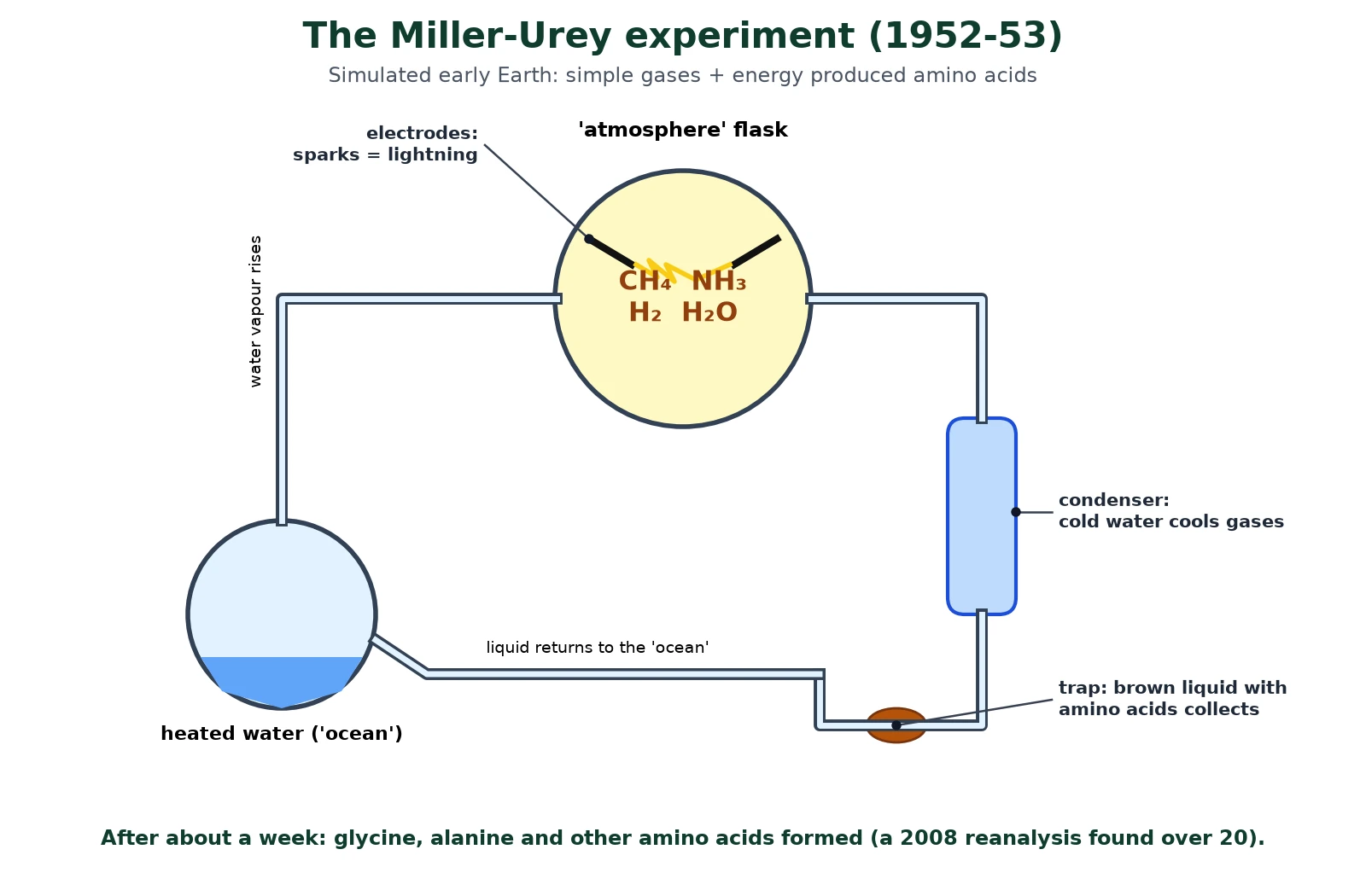
- Water was boiled to make water vapour (the ‘ocean’ and evaporation).
- The vapour mixed with methane, ammonia and hydrogen (the ‘reducing atmosphere’).
- Electrodes made sparks through the gas (lightning).
- A condenser cooled the gases so that droplets formed (rain).
- Products collected in a trap and circulated for about a week; the liquid turned brown.
Results: several amino acids, including glycine and alanine, plus other organic compounds. A 2008 reanalysis of Miller’s stored samples found over 20 amino acids. Limits: geologists now think the early atmosphere was less reducing (more CO2 and N2), which gives lower yields; and making amino acids is far from making a cell. Later experiments made nucleotide bases and sugars under other plausible conditions.
Self-replicating molecules: the RNA world
Heredity is the second requirement for the evolution of cells.
In living cells today, DNA stores information and proteins (enzymes) catalyse reactions, but each needs the other: DNA cannot copy itself without enzymes, and enzymes are made using DNA. RNA solves this ‘chicken and egg’ problem because it can do both jobs. RNA stores information in its base sequence and can copy itself by complementary base pairing, and some RNA molecules, called ribozymes, act as catalysts. Even today the bond-forming site of the ribosome, which links amino acids, is made of rRNA. The RNA world hypothesis says the first genetic material was RNA; DNA, which is more stable, and proteins, which are better catalysts, took over later.
Compartments: membranes and protocells
Without a boundary there is no cell, so membranes were the third milestone in the evolution of cells.
Fatty acids and phospholipids are amphipathic: they have a hydrophilic head and a hydrophobic tail. In water they spontaneously coalesce into spherical bilayers called vesicles, with water inside and out. Such vesicles can grow by taking in more fatty acids and divide when shaken. A protocell is a vesicle containing self-replicating molecules such as RNA. Inside, molecules are kept close together and a different chemistry can develop; a protocell whose RNA copies faster would grow and divide faster, so natural selection could begin.
LUCA, the last universal common ancestor
LUCA is the meeting point of every branch in the evolution of cells.
All living organisms share key features: the same genetic code, DNA as genetic material, ribosomes, ATP as energy currency, and many of the same genes. The simplest explanation is that all life descends from one population of cells, the last universal common ancestor (LUCA). LUCA was not the first cell: other early lineages existed, but they became extinct, out-competed by LUCA’s descendants.
- Dating: geologists date the oldest fossils by radioactive decay in surrounding rocks (stromatolites about 3.5 billion years old in Western Australia). Molecular clocks, which count differences in gene sequences and assume a steady mutation rate, put LUCA at about 4.2 to 3.8 billion years ago.
- Genes: a 2016 study traced about 355 gene families back to LUCA. They point to a cell that lived without oxygen, used hydrogen gas and CO2, fixed nitrogen and lived at high temperature.
- Hydrothermal vents: alkaline deep-sea vents release hot water rich in H2 and minerals such as iron sulfide, which can catalyse reactions. Their porous rock has tiny compartments, and natural pH gradients between vent fluid and seawater resemble the proton gradients cells use to make ATP. Possible fossil microbes at least 3.77 billion years old have been found in vent deposits in Quebec (still debated).
Exam tips on the origin of cells
- ‘Cells only come from pre-existing cells’ applies to present conditions; the origin of the first cells is not a contradiction.
- State all four challenges: synthesis of carbon compounds, self-replication, self-assembly, compartmentalization.
- Miller-Urey supports only the first step (making simple organic molecules).
3 Pasteur’s experiment: disproving spontaneous generation
Syllabus link: Older IB 1.5.A1 Evidence from Pasteur’s experiments that spontaneous generation of cells and organisms does not now occur on Earth; IB A2.1 context; NCERT XII Evolution (Louis Pasteur)
Before Pasteur, three experiments set the stage for the evolution of cells debate.
Redi (1668): maggots from flies
Francesco Redi placed meat in jars. Open jars had flies landing and soon had maggots. Jars sealed or covered with gauze had no maggots on the meat, although flies laid eggs on the gauze. Conclusion: maggots come from fly eggs. The gauze jar was the clever control, because air could still reach the meat.
Needham (1745) and Spallanzani (1768): microbes in broth
John Needham boiled broth briefly, sealed it, and microbes still grew, which he took as support for spontaneous generation. Lazzaro Spallanzani boiled broth for longer in sealed flasks, and it stayed clear; if the seal broke, microbes grew. Supporters of spontaneous generation objected that long boiling had destroyed a ‘vital force’ in the air that life needed.
Pasteur’s swan-neck flasks (1859 to 1862)
Pasteur’s experiment answered that objection by letting air in while keeping microbes out.
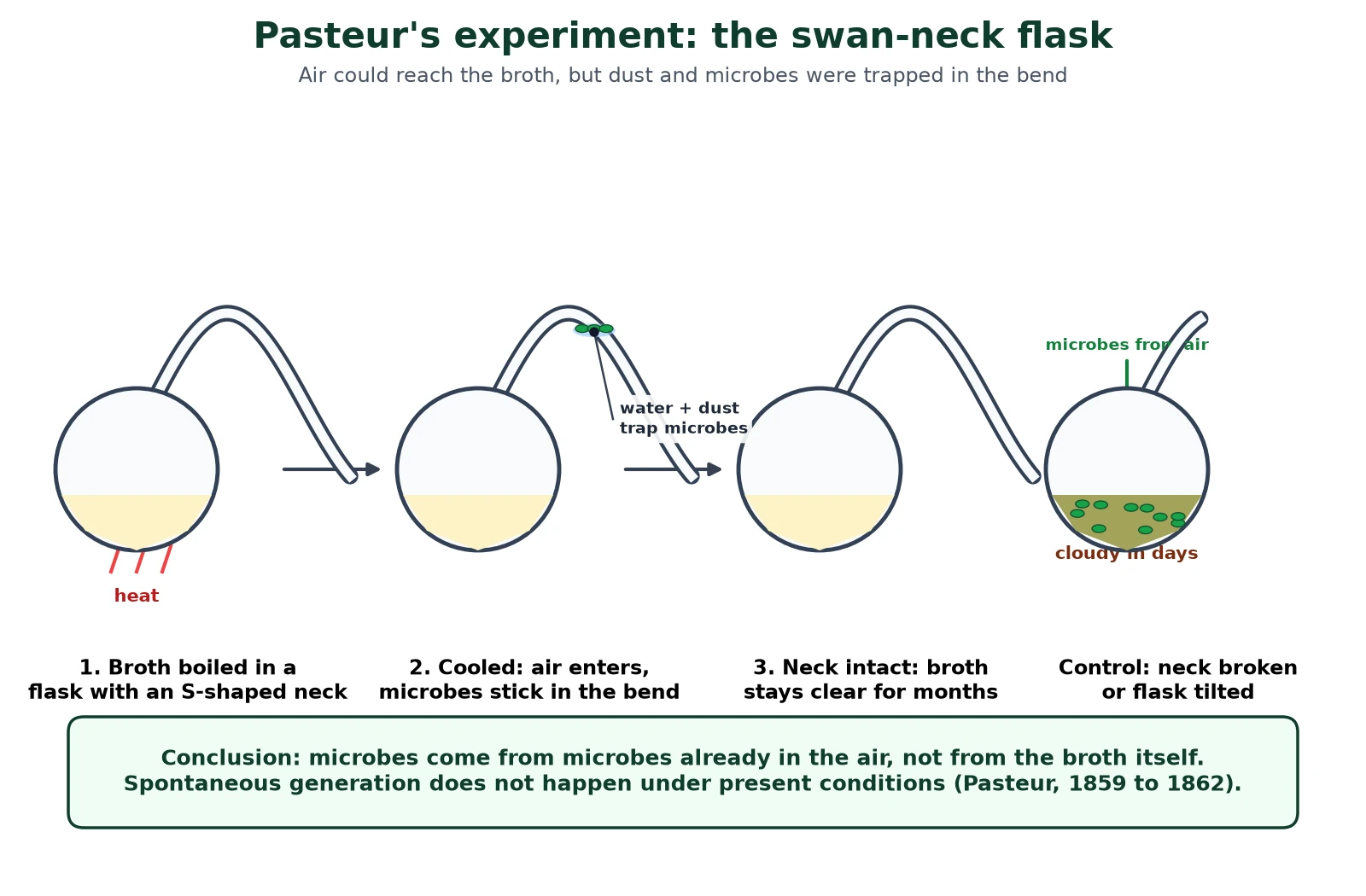
- Nutrient broth was put into flasks and the necks were heated and bent into an S (swan-neck) shape.
- The broth was boiled to kill any microbes already present and to drive out air.
- As the flasks cooled, air flowed back in freely, but dust and microbe spores settled in the lowest bend of the neck, where water condensed and trapped them.
- Flasks with intact necks stayed clear for months, and some sealed versions are still sterile today in Paris.
- Controls: when the neck was broken off, or the flask was tilted so the broth touched the trapped dust and then ran back, the broth went cloudy with microbes within days.
Variables and conclusions
Pasteur’s experiment is a model of good design, and IB often asks you to identify its variables.
Swipe the table sideways to see every column.
| Element | In Pasteur’s experiment |
|---|---|
| Independent variable | Whether microbes from the air could reach the broth (intact neck vs broken neck or tilted flask) |
| Dependent variable | Growth of microbes (cloudiness) in the broth |
| Controlled variables | Same broth, same boiling time, same temperature, air allowed in every flask |
| Why the neck was open | To answer the critics: air (and any ‘vital force’) could still reach the broth |
| Conclusion | Microbes come from microbes in the air; life does not arise spontaneously from broth |
| Limitation | Shows spontaneous generation does not occur now; it does not show how the first cells arose |
NCERT NCERT states that Louis Pasteur, by careful experimentation, demonstrated that life comes only from pre-existing life: he showed that in pre-sterilized flasks life did not come from killed yeast, while in another flask open to air new living organisms arose from killed yeast. NCERT then adds that spontaneous generation theory was dismissed once and for all, but this did not answer how the first life form came on earth.
Markscheme habits for Pasteur’s experiment
- Mention boiling (to sterilize), the open curved neck (air in, microbes trapped) and the broken-neck control.
- Pasteur’s conclusion concerns present conditions on Earth; say ‘does not now occur’.
- Pasteur’s work also founded germ theory and pasteurization.
4 Endosymbiotic theory: mitochondria and chloroplasts
Syllabus link: IB A2.2.11 Origin of eukaryotic cells by endosymbiosis; older IB 1.5.U2 and 1.5.NOS (evidence for endosymbiosis); NCERT XI Cell: The Unit of Life (mitochondria and plastids)
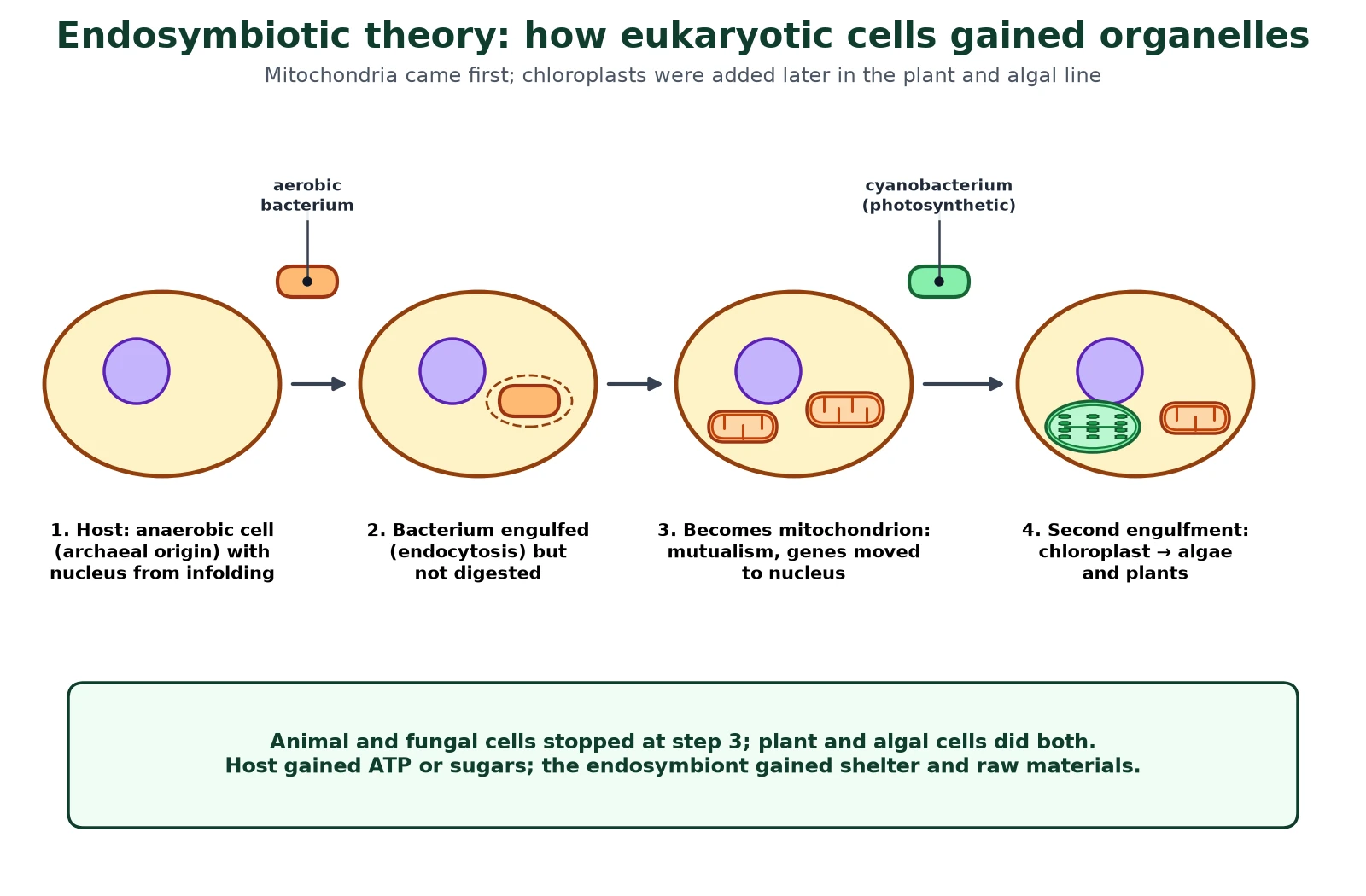
The endosymbiotic theory is the best-supported idea in the evolution of cells. It says that mitochondria and chloroplasts were once free-living prokaryotes that were taken into a larger host cell and, instead of being digested, survived inside it. Endosymbiosis means ‘living together, one inside the other’. Both partners benefited (mutualism), and over many generations the endosymbiont became a permanent organelle.
The sequence
The endosymbiotic theory describes the evolution of cells in four or five steps.
- A host cell, probably related to Asgard archaea and already with some internal membranes, lived without oxygen.
- It took in an aerobic bacterium (an alpha-proteobacterium) by endocytosis, or the bacterium entered it.
- The bacterium was not digested. It supplied ATP from aerobic respiration; the host supplied shelter and food molecules. It became the mitochondrion, about 2 billion years ago.
- Many of its genes moved to the host nucleus, so it could no longer live independently.
- Later, one line of these cells took in a photosynthetic cyanobacterium, which became the chloroplast. This line gave rise to algae and plants.
Because mitochondria are found in almost all eukaryotes, but chloroplasts only in plants and algae, the mitochondrion must have come first. This is one strand of the evidence for the evolution of cells as a sequence.
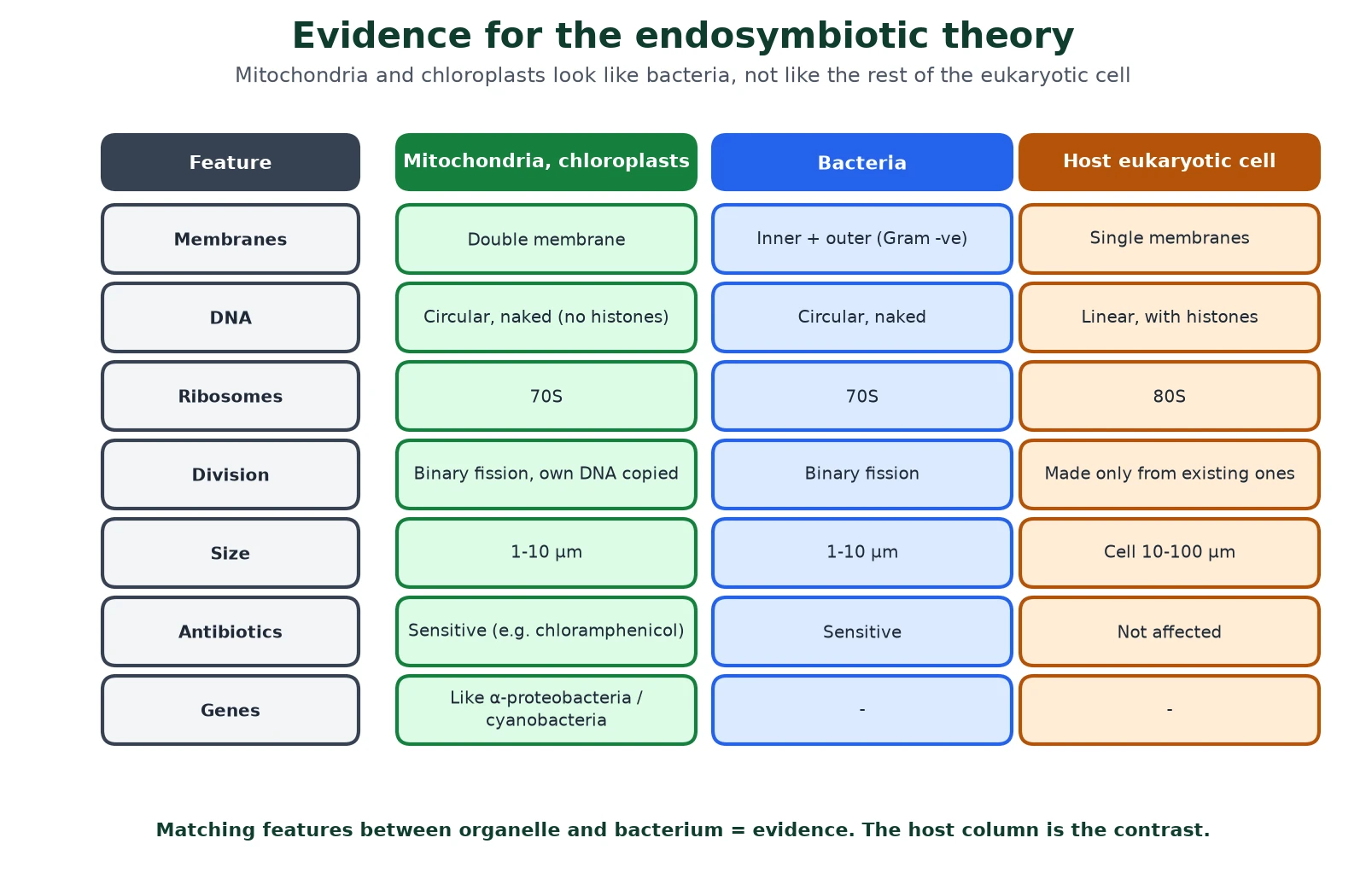
Evidence for the endosymbiotic theory
Swipe the table sideways to see every column.
| Evidence | Mitochondria and chloroplasts | Why it supports endosymbiosis |
|---|---|---|
| Double membrane | Two membranes around each organelle | The inner membrane matches the bacterium’s own membrane; the outer is also bacterial in origin (see Common doubts) |
| Own DNA | Circular, naked DNA without histones | Same as prokaryotic DNA; eukaryotic nuclear DNA is linear with histones |
| 70S ribosomes | Ribosomes smaller than the 80S of the cytoplasm | Prokaryotes have 70S ribosomes |
| Binary fission | Divide on their own, not made by the cell | Prokaryotes divide by binary fission; a cell that loses them cannot make new ones |
| Size | About 1 to 10 µm | The size of a typical bacterium |
| Antibiotic sensitivity | Ribosomes blocked by antibiotics such as chloramphenicol and streptomycin | These antibiotics target 70S ribosomes of bacteria, not 80S ribosomes |
| Gene sequences | Base sequences of their DNA and rRNA | Closest to alpha-proteobacteria (mitochondria) and cyanobacteria (chloroplasts) |
| Membrane proteins | Inner membrane with cardiolipin; outer membrane porins | Found in bacterial membranes, not other eukaryotic membranes |
NCERT NCERT notes that mitochondria and plastids have their own circular DNA and 70S ribosomes, and that mitochondria divide by fission. Use these words in NEET answers.
Living examples of endosymbiosis today
The evolution of cells by endosymbiosis is not only history; it can still be seen happening.
The endosymbiotic theory gained support from modern examples. Corals contain photosynthetic algae; Paulinella is an amoeba that took in a cyanobacterium only about 100 million years ago, which is becoming a chloroplast; and some insects depend on bacteria inside their cells that cannot live elsewhere.
Exam tips on the evolution of cells by endosymbiosis
- Learn at least four pieces of evidence; 70S ribosomes, circular naked DNA, double membrane and binary fission are most often credited.
- The theory explains mitochondria and chloroplasts, not the nucleus.
- Lynn Margulis’s theory was rejected at first and accepted after DNA evidence: a good ‘nature of science’ example of falsification and paradigm shift.
5 Evolution of eukaryotic cells
Syllabus link: IB A2.2.11 to A2.2.13 (endosymbiosis, differentiation, multicellularity); A2.2.6 to A2.2.8 prokaryote and eukaryote structure; D4 and A3.2 classification (three domains); NCERT XI Biological Classification (archaebacteria)
Prokaryotes lived alone on Earth for at least 1.5 billion years before the first eukaryotes. The evolution of cells from prokaryote to eukaryote needed new internal membranes, a nucleus, the cytoskeleton and endosymbiosis.
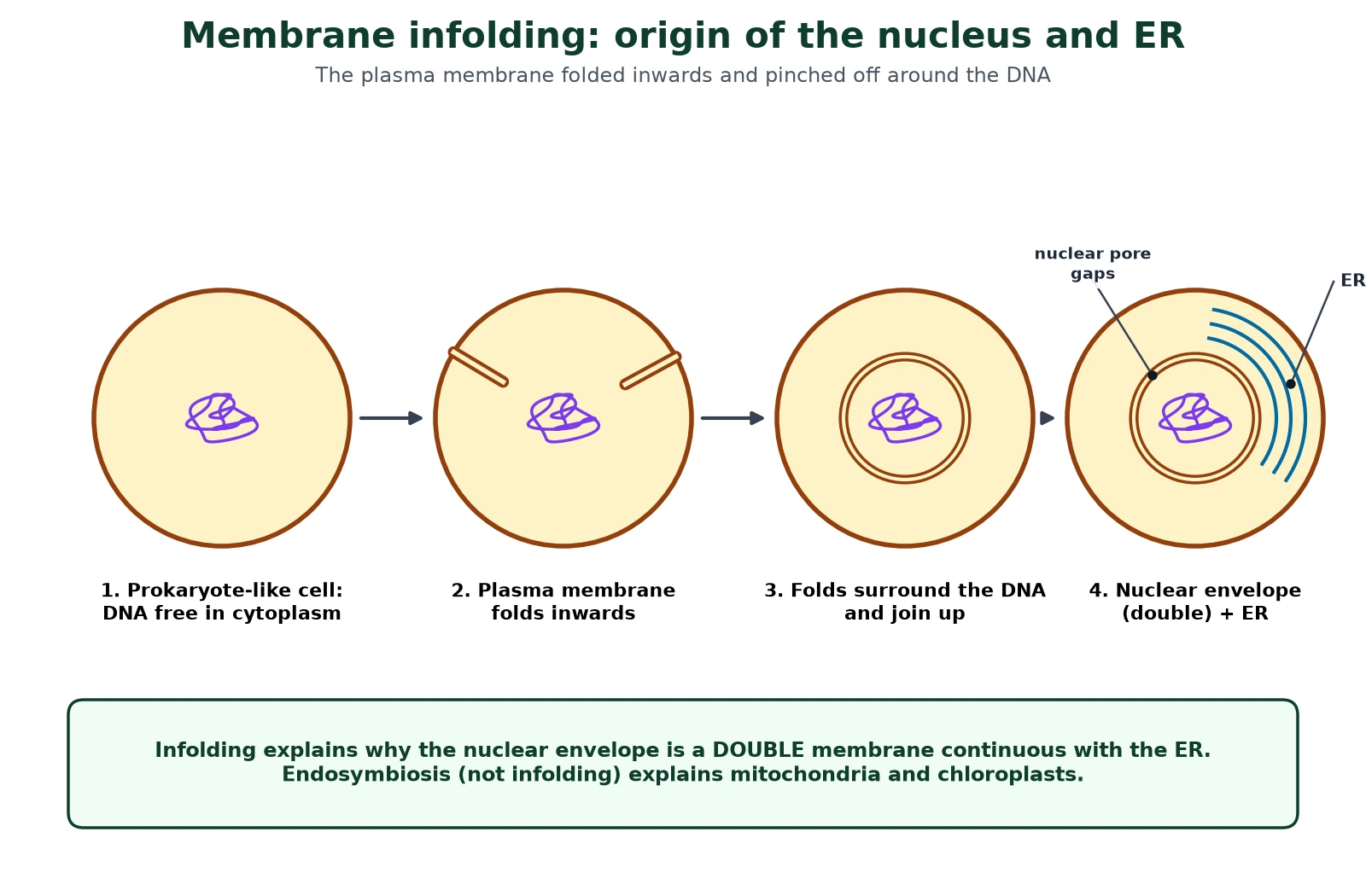
Membrane infolding: the nucleus and ER
The infolding hypothesis says that parts of the plasma membrane folded inwards. Infolds around the DNA closed up to form the nuclear envelope, and other infolds became the endoplasmic reticulum and, later, the Golgi apparatus. Infolding explains several facts: the nuclear envelope is a double membrane, it is continuous with the rough ER, and nuclear pores are gaps where the folds did not fully join. Some modern bacteria, such as Gemmata, and some archaea have internal membranes, showing that infolding is possible.
Timeline of life
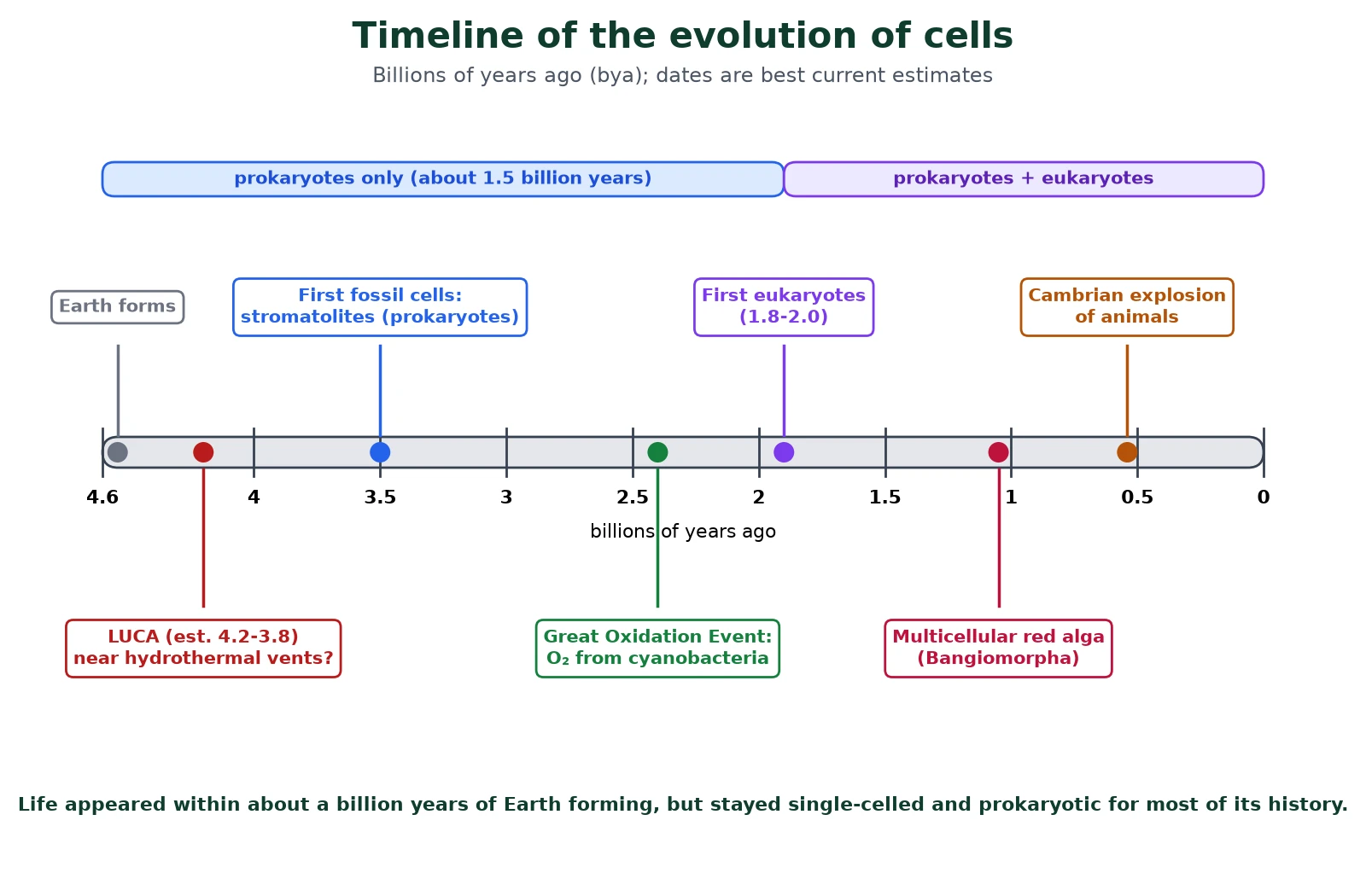
The evolution of cells took most of Earth’s history; this timeline puts the main events in order.
Swipe the table sideways to see every column.
| Time (billion years ago) | Event |
|---|---|
| 4.54 | Earth forms |
| 4.2 to 3.8 | LUCA (estimated by molecular clocks) |
| About 3.5 | Oldest widely accepted fossil cells: stromatolites, layered mats of prokaryotes (possible older traces at 3.7) |
| About 2.4 | Great Oxidation Event: oxygen from cyanobacteria builds up in the atmosphere |
| About 1.8 to 2.0 | First eukaryotic cells (fossil acritarchs; mitochondria acquired) |
| About 1.6 to 1.2 | First photosynthetic eukaryotes (chloroplasts) |
| About 1.05 | First well-dated multicellular eukaryote, the red alga Bangiomorpha |
| 0.54 | Cambrian explosion of animal groups |
NCERT NCERT (Class XII, Evolution) says life appeared about 500 million years after the formation of Earth, almost four billion years back, and that the first non-cellular forms of life could have originated three billion years back as giant molecules (RNA, protein, polysaccharides) that might reproduce. Quote these figures in NEET answers even though IB-style sources give older dates.
Archaea and the three domains
Molecular evidence changed how we see the evolution of cells.
Carl Woese compared the base sequences of ribosomal RNA, a molecule all cells have, and found that prokaryotes form two very different groups. This led to the three domains: Bacteria, Archaea and Eukarya.
Swipe the table sideways to see every column.
| Feature | Bacteria | Archaea | Eukarya |
|---|---|---|---|
| Nucleus | No | No | Yes |
| Membrane lipids | Ester-linked, unbranched | Ether-linked, branched | Ester-linked, unbranched |
| Histones on DNA | No | Some | Yes |
| Ribosomes | 70S | 70S (but eukaryote-like proteins) | 80S (70S in organelles) |
| Cell wall | Peptidoglycan | No peptidoglycan | Cellulose or chitin, or none |
| Examples | E. coli, cyanobacteria | Methanogens, halophiles, thermoacidophiles | Plants, animals, fungi, protists |
Archaea share many genes for DNA replication, transcription and translation with eukaryotes, so eukaryotes are thought to descend from an archaeal host (close to the Asgard archaea, found in 2015) that took in a bacterium. NCERT NCERT places archaebacteria in Kingdom Monera and describes them as living in extreme habitats (halophiles in salty areas, thermoacidophiles in hot springs, methanogens in marshes and the guts of ruminants), with a different cell wall structure that helps them survive.
Evolution of multicellularity
Multicellularity is the last big step in the evolution of cells covered by IB.
Multicellularity evolved independently many times: in animals, plants, fungi, and red and brown algae. Living groups show possible steps, from single cells (Chlamydomonas) to colonies (Volvox, with up to 50 000 cells and some division of labour). Being multicellular allows larger size, a longer life and, most importantly, cell differentiation: different cells specialize, so the organism can do many jobs efficiently. See our chapter on cell differentiation and stem cells for how this works.
6 Cell compartmentalization and organelle adaptations
Syllabus link: IB B2.2.1 to B2.2.9 Organelles and compartmentalization (B2.2.4 to B2.2.9 HL); older IB 1.2; NCERT XI Cell: The Unit of Life (endomembrane system)
The biggest change in the evolution of cells from prokaryote to eukaryote was compartmentalization: dividing the cell into membrane-bound organelles, each with its own conditions. An organelle is a discrete subunit of a cell adapted to a particular function. NCERT NCERT groups the ER, Golgi complex, lysosomes and vacuoles as the endomembrane system because their functions are coordinated; mitochondria, chloroplasts and peroxisomes are not part of it.
Advantages of compartments
Compartments explain why the evolution of cells favoured eukaryotes as cells got larger.
- Enzymes and substrates concentrated: e.g. Krebs cycle enzymes in the mitochondrial matrix, so reactions run faster.
- Different pH and conditions: lysosomes keep about pH 4.5 to 5 for their hydrolases, while the cytoplasm stays at about pH 7.2.
- Incompatible reactions separated: digestive enzymes in lysosomes and phagocytic vacuoles cannot digest the cell itself; synthesis and breakdown of the same molecule can happen in different places.
- Gradients: membranes let cells build proton gradients across the inner mitochondrial membrane and the thylakoid membrane to make ATP.
- Transport and sorting: proteins can be packed into vesicles and sent to precise destinations.
The nucleus separates transcription from translation
IB In eukaryotes, DNA is transcribed in the nucleus, but translation happens on ribosomes in the cytoplasm. This separation means the mRNA can be modified before it is translated: introns are removed (splicing), and a cap and tail are added. In prokaryotes, ribosomes can start translating mRNA while it is still being transcribed, so no such processing is possible. The double nuclear envelope also protects DNA from enzymes in the cytoplasm, and nuclear pores control what enters and leaves.
Organelle adaptations (IB B2.2, HL)
Each organelle shows how the evolution of cells matched structure to function.
Swipe the table sideways to see every column.
| Organelle | Function | Adaptations |
|---|---|---|
| Mitochondrion | ATP production by aerobic respiration | Double membrane; inner membrane folded into cristae for a large area of electron transport chains and ATP synthase; small intermembrane space so a proton gradient builds quickly; matrix with Krebs cycle enzymes, own DNA and 70S ribosomes |
| Chloroplast | Photosynthesis | Thylakoids stacked in grana give a large area for light-absorbing pigments, electron carriers and ATP synthase; small thylakoid space for a steep proton gradient; stroma holds Calvin cycle enzymes (RuBisCO), DNA and 70S ribosomes; starch grains store products |
| Nucleus | Stores DNA; transcription | Double membrane envelope separates and protects DNA; nuclear pores allow mRNA out and proteins in; nucleolus makes ribosome subunits; during mitosis the envelope breaks into vesicles |
| Free ribosomes | Proteins used in the cytoplasm | 80S, in the cytoplasm |
| Bound ribosomes (rough ER) | Proteins for secretion, lysosomes or membranes | Attached to the ER so proteins enter the ER lumen as they are made |
| Golgi apparatus | Modifies, sorts and packages proteins | Stack of flattened cisternae; cis face receives vesicles from ER, trans face buds off vesicles |
| Vesicles | Transport | Coated by proteins such as clathrin; fuse with target membranes (exocytosis, endocytosis) |
| Lysosome | Digestion of worn organelles and engulfed material | Single membrane holding acid hydrolases at low pH |
Markscheme habits for the evolution of cells
- For ‘advantages of compartmentalization’, give a named example for each point.
- For organelle adaptations, pair each structure with its function: ‘cristae, so a large surface area for ATP synthase’.
- Remember the link back to the evolution of cells: mitochondria and chloroplasts keep bacterial features (70S ribosomes, circular DNA).
Summary of the evolution of cells
- The evolution of cells began with simple molecules forming complex ones (Miller-Urey), then self-replicating RNA, then membrane-bound protocells and LUCA.
- Pasteur’s experiment showed that cells now arise only from pre-existing cells.
- The endosymbiotic theory explains mitochondria and chloroplasts; membrane infolding explains the nucleus and ER.
- Prokaryotes appeared about 3.5 billion years ago, eukaryotes about 1.8 to 2 billion years ago, then multicellular life.
- Compartmentalization is the key advantage that eukaryotic cells gained.
7 Key terms
Learn these key terms for the evolution of cells; most one-mark questions test a definition.
Swipe the table sideways to see every column.
| Term | Meaning |
|---|---|
| Spontaneous generation | Old idea that living things arise from non-living matter; disproved by Pasteur for present conditions. |
| Abiogenesis | Origin of the first life from non-living chemicals on the early Earth. |
| Protocell | Membrane vesicle containing self-replicating molecules; a possible precursor of cells. |
| Ribozyme | RNA molecule that acts as a catalyst. |
| RNA world | Hypothesis that RNA was the first genetic material and catalyst. |
| LUCA | Last universal common ancestor of all living organisms. |
| Hydrothermal vent | Opening in the sea floor releasing hot, mineral-rich water; a possible site of LUCA. |
| Endosymbiosis | One organism living inside another; origin of mitochondria and chloroplasts. |
| 70S ribosome | Smaller ribosome found in prokaryotes, mitochondria and chloroplasts. |
| Binary fission | Division of a prokaryote or organelle into two. |
| Membrane infolding | Inward folding of the plasma membrane that formed the nuclear envelope and ER. |
| Archaea | Domain of prokaryotes with ether-linked lipids, often in extreme habitats. |
| Compartmentalization | Division of a cell into membrane-bound regions with different conditions. |
| Molecular clock | Use of the number of sequence differences to estimate time since divergence. |
8 Common doubts about the evolution of cells
These are the questions students keep asking in forums and homework sites. Each answer is ours; the source link shows where the doubt comes from. They cover every stage in the evolution of cells.
If cells only come from pre-existing cells, where did the first cell come from?
Cell theory describes life now. The first cells formed from non-living chemicals about 4 billion years ago, under conditions that no longer exist: no oxygen, no life to eat the molecules, and plenty of energy from lightning, UV and vents. It was a gradual process through protocells, not one sudden ‘first cell’. The evolution of cells was chemistry first, biology later. (Doubt seen on reddit.com)
Why can’t life arise spontaneously today?
Two reasons. Today’s oxygen-rich atmosphere breaks down complex organic molecules, and existing microbes would eat any new organic molecules or protocells long before they could become cells. (Doubt seen on biology.stackexchange.com)
Did Miller-Urey prove that life began this way?
No. It showed only that amino acids, the building blocks of proteins, can form from simple gases with an energy source. It did not make proteins, self-replicating molecules or cells, and the gas mix it used is now thought to be too reducing. (Doubt seen on biology.stackexchange.com)
In Pasteur’s experiment, why not just seal the flask?
Earlier critics said sealed flasks failed because they kept out air or a ‘vital force’. The open swan neck let air in, so that objection no longer worked. Only microbes on dust were stopped, because they settled in the bend. The open neck also stops pressure building up during boiling. (Doubt seen on reddit.com)
How exactly does the swan neck stop microbes if air gets in?
Microbes travel on dust and droplets, not as free gas molecules. Air moves slowly through the long, curved neck, so particles settle in the lowest bend, where condensed water traps them. Tilt the flask so broth washes the bend and it goes cloudy. (Doubt seen on reddit.com)
Is the outer mitochondrial membrane really the host’s vesicle membrane?
That is the common textbook version, and it is accepted in IB answers. But research suggests the ancestor was a Gram-negative bacterium, which already had two membranes, and the outer membrane’s proteins are bacterial. Either way, the double membrane fits endosymbiosis. (Doubt seen on biology.stackexchange.com)
If mitochondria were bacteria, can they live outside the cell?
No. Over about 2 billion years most of their genes moved to the nucleus; human mitochondrial DNA has only 37 genes. They depend on hundreds of proteins imported from the cytoplasm, so isolated mitochondria work for only hours. (Doubt seen on reddit.com)
Why are mitochondria 70S evidence if eukaryotes have 80S ribosomes?
That contrast is the point: the cell’s own cytoplasm has 80S ribosomes, but mitochondria and chloroplasts have 70S, like bacteria. If the organelles had been made by the cell, you would expect 80S. (Doubt seen on thestudentroom.co.uk)
Are eukaryotes closer to archaea or to bacteria?
Both, in different ways. Our machinery for copying and reading DNA is archaeal, because the host cell was archaeal. Much of our metabolism and our mitochondria are bacterial, from the endosymbiont. Eukaryotes are a merger, which is why the evolution of cells is often drawn as a network rather than a simple tree. (Doubt seen on reddit.com)
9 FAQ
Short answers to the questions we are asked most about the evolution of cells.
What is the endosymbiotic theory in simple words?
Mitochondria and chloroplasts were once free-living bacteria that were swallowed by a bigger cell but not digested. They lived inside it, helped it, and became organelles. It is the central idea in the evolution of cells.
What did Pasteur’s experiment prove?
That microbes in broth come from microbes in the air, so living things do not arise spontaneously from non-living matter under present conditions. It did not explain the earliest evolution of cells.
What did the Miller-Urey experiment show?
That amino acids can form from simple gases (methane, ammonia, hydrogen, water vapour) when energy such as electric sparks is supplied, as might have happened on the early Earth at the start of the evolution of cells.
When did eukaryotic cells evolve?
About 1.8 to 2 billion years ago, after prokaryotes had existed alone for well over a billion years. This is the most important transition in the evolution of cells.
Is the origin and evolution of cells in the NEET syllabus?
Yes: NCERT Class XII Evolution covers the origin of life, Oparin-Haldane, Miller’s experiment and Pasteur, and Class XI covers cell theory, archaebacteria and the 70S ribosomes and DNA of mitochondria and plastids.
10 Quick check
Tap each question to reveal the answer and check your grasp of the evolution of cells before trying the full question set.
Test yourself on the evolution of cells
1. Who stated ‘Omnis cellula e cellula’?
Rudolf Virchow (1855).
2. Why did Pasteur leave the neck of his flasks open?
So air could enter, answering critics who said life needed air; microbes were trapped in the bend.
3. Which four gases were in the Miller-Urey apparatus?
Methane, ammonia, hydrogen and water vapour.
4. Why is RNA thought to be the first genetic material?
It can store information, self-replicate and act as a catalyst (ribozyme).
5. Give three pieces of evidence for the endosymbiotic theory.
Any three: double membrane, 70S ribosomes, circular naked DNA, binary fission, bacterial size, antibiotic sensitivity.
6. What does membrane infolding explain?
The origin of the nuclear envelope (double membrane) and the ER.
7. Name the three domains of life.
Bacteria, Archaea and Eukarya.
8. Give one advantage of separating transcription from translation.
mRNA can be modified (introns removed) before translation.
Ready to practise? Download the Origin and Evolution of Cells IB and NEET question set with markscheme (25 MCQs + 6 structured questions, 65 marks, free for signed-up members).
⬇ Download practice questions (PDF)© competitorspoint.com · Biology notes. Diagrams are original to competitorspoint.com.