Rishi Prakash

Rishi Prakash is a biology teacher with 15 years of experience teaching in schools, review centres and medical coaching institutes across India, and he now teaches IB Biology and NEET Biology. He holds a B.Sc Agriculture from Dr. Panjabrao Deshmukh Krishi Vidyapeeth, Akola, and an M.Sc Bioinformatics from the University of Rajasthan. He writes and reviews every chapter on Competitors Point, building each one from NCERT and the IB Biology guide.

Integration of body systems IB Biology C3.1 featured image

Integration of Body Systems IB Biology: 13 Best Notes (C3.1)

Home › IB Biology › Integration of Body Systems IB Biology Integration of Body Systems IB Biology: 13 Notes (C3.1) In integration of body systems IB Biology notes, integration means the coordination of cells, tissues, organs and organ systems so that a multicellular organism works as one unit. For the official syllabus, see the IB […]

Integration of Body Systems IB Biology: 13 Best Notes (C3.1) Read More »
The Living World NEET: What is Living, Taxonomy, Table 1.1

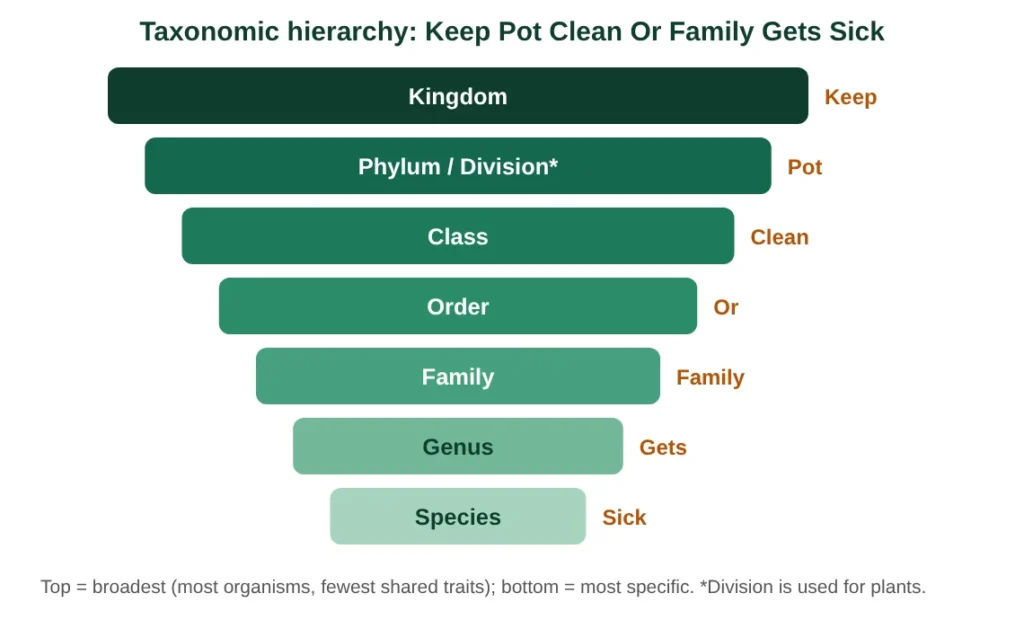
The Living World NEET: What is Living, Taxonomy, Table 1.1

Home › NEET Biology › The Living World › Full chapter notes The Living World NEET: What is Living, Taxonomy, Table 1.1 Living organisms are self-replicating, evolving and self-regulating interactive systems capable of responding to external stimuli. Cellular organisation, metabolism and consciousness are their defining features. Growth and reproduction are characteristic of life but are

The Living World NEET: What is Living, Taxonomy, Table 1.1 Read More »

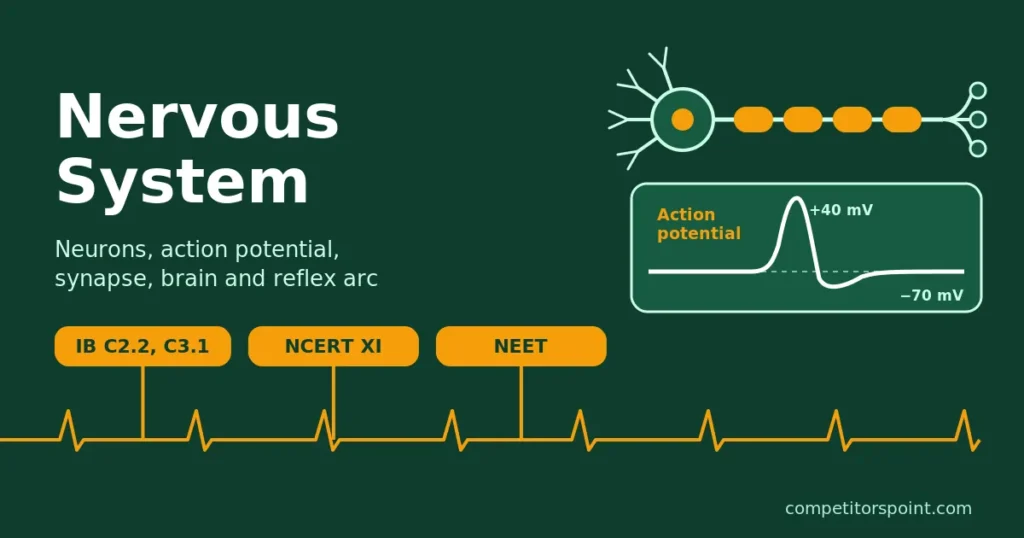
Nervous system notes for IB C2.2, C3.1 and NEET: neurons, action potential, synapse, brain and reflex arc

Nervous System IB Biology: 16 Easy Notes (C2.2, C3.1)

Home › Human Physiology › Nervous System IB Biology Nervous System IB Biology: 16 Easy Notes (C2.2, C3.1) In nervous system IB Biology notes, the nervous system is the network of neurons that detects stimuli, carries information as fast electrical impulses and coordinates responses. It has a central part, the brain and spinal cord, and

Nervous System IB Biology: 16 Easy Notes (C2.2, C3.1) Read More »

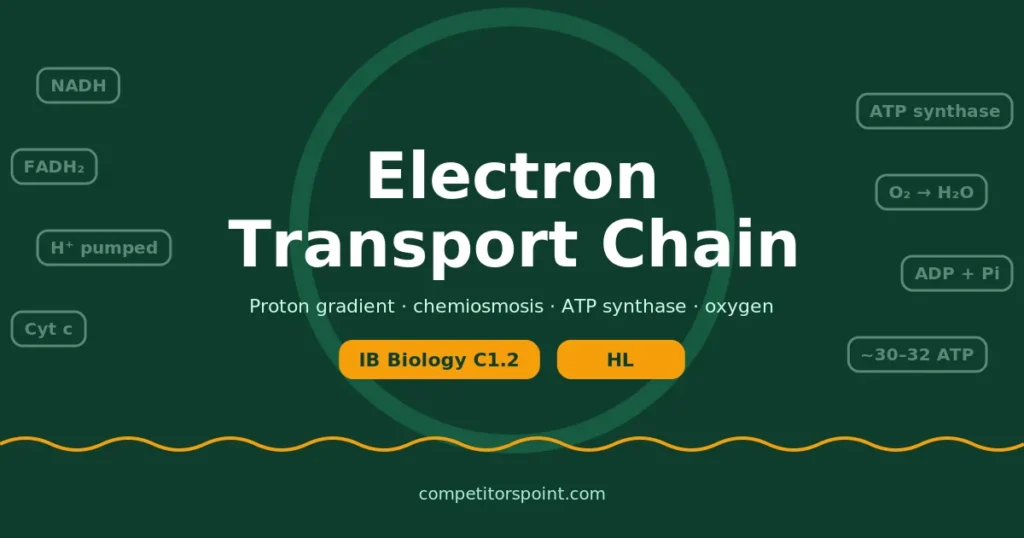
Electron transport chain: NADH passes electrons through complexes I, III and IV to oxygen while ATP synthase makes ATP

Electron Transport Chain and Oxidative Phosphorylation (IB Biology C1.2)

Home › IB Biology › Cell respiration › Electron Transport Chain Electron Transport Chain and Oxidative Phosphorylation The electron transport chain (ETC, or electron transport system, ETS) is the final stage of aerobic respiration: a series of protein complexes in the inner mitochondrial membrane that pass electrons from NADH and FADH2 to oxygen. The energy

Electron Transport Chain and Oxidative Phosphorylation (IB Biology C1.2) Read More »

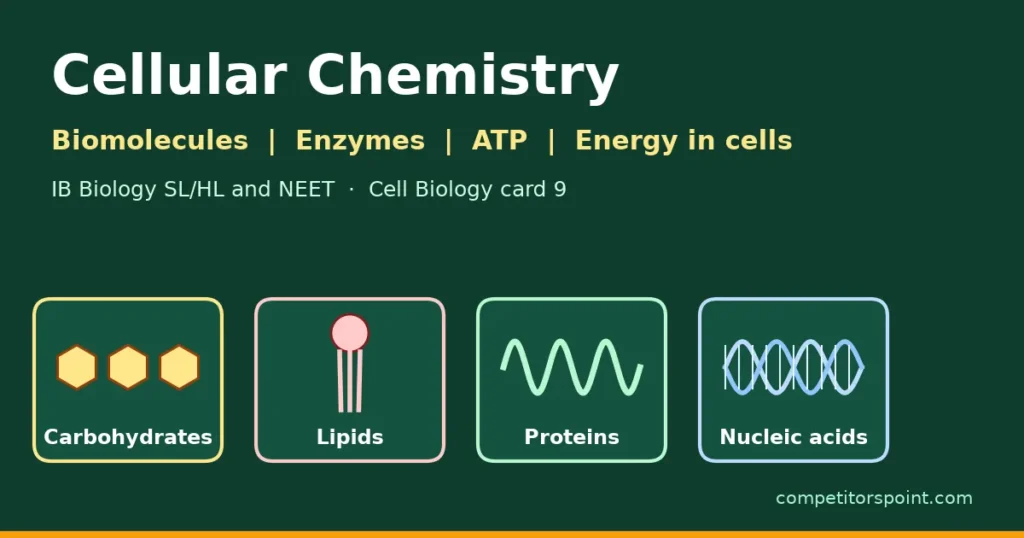
Cellular chemistry biomolecules title card with icons for carbohydrates, lipids, proteins and nucleic acids, for IB Biology and NEET notes on enzymes, ATP and energy in cells

Biomolecules: 4 Essential Topics, Enzymes and ATP (IB, NEET)

Biology › Cell biology › Cellular chemistry Cellular Chemistry: Biomolecules, Enzymes and ATP Biomolecules for IB and NEET: water, carbohydrates, lipids, proteins and nucleic acids, how enzymes work and are inhibited, the structure of ATP and how cells release energy by respiration. HL-only content is marked. IB B1.1 / B1.2 / A1.2 / C1.1 /

Biomolecules: 4 Essential Topics, Enzymes and ATP (IB, NEET) Read More »

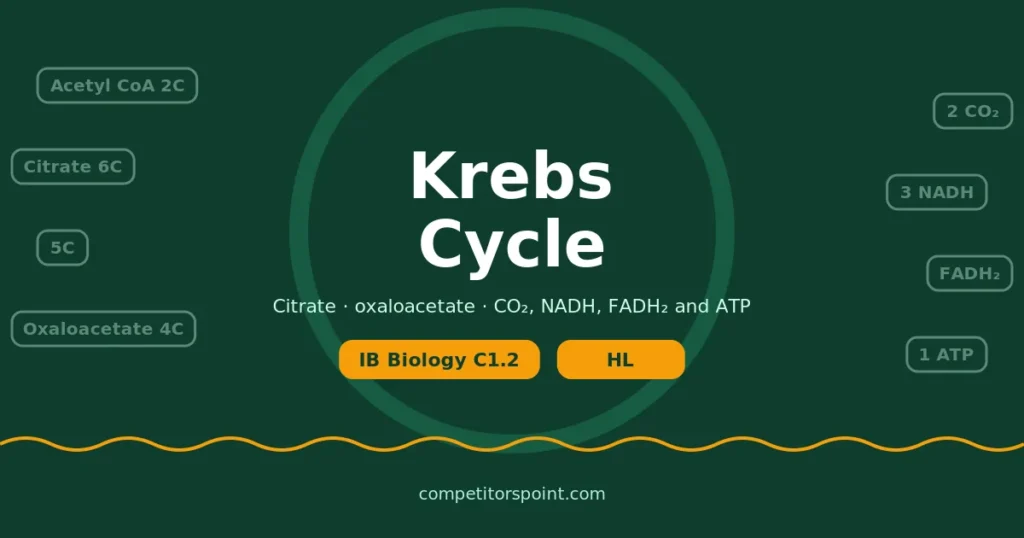
Krebs cycle: acetyl CoA joins oxaloacetate to make citrate, giving 2 CO2, 3 NADH, FADH2 and ATP per turn, IB Biology C1.2

Krebs Cycle (Citric Acid Cycle): 8 Steps, Enzymes and Yield (IB Biology C1.2)

Home › IB Biology › Cell respiration › Krebs Cycle Krebs Cycle (Citric Acid Cycle) The Krebs cycle (citric acid or TCA cycle) is the third stage of aerobic respiration, in which the acetyl group of acetyl CoA is fully oxidised in the mitochondrial matrix through eight enzyme-controlled steps. Each turn releases 2 CO2 and

Krebs Cycle (Citric Acid Cycle): 8 Steps, Enzymes and Yield (IB Biology C1.2) Read More »

Blood, heart and circulation title card with a heart, an ECG trace and IB Biology, B3.2 Transport and SL plus HL labels

Blood, Heart and Circulation: IB Biology B3.2 Notes (SL and HL)

Home › IB Biology › Blood, heart and circulation Blood, Heart and Circulation Blood is a fluid connective tissue made of plasma and formed elements: red blood cells, white blood cells and platelets. The heart is a four-chambered muscular pump that drives blood through a double circulation, the pulmonary circuit to the lungs and the

Blood, Heart and Circulation: IB Biology B3.2 Notes (SL and HL) Read More »

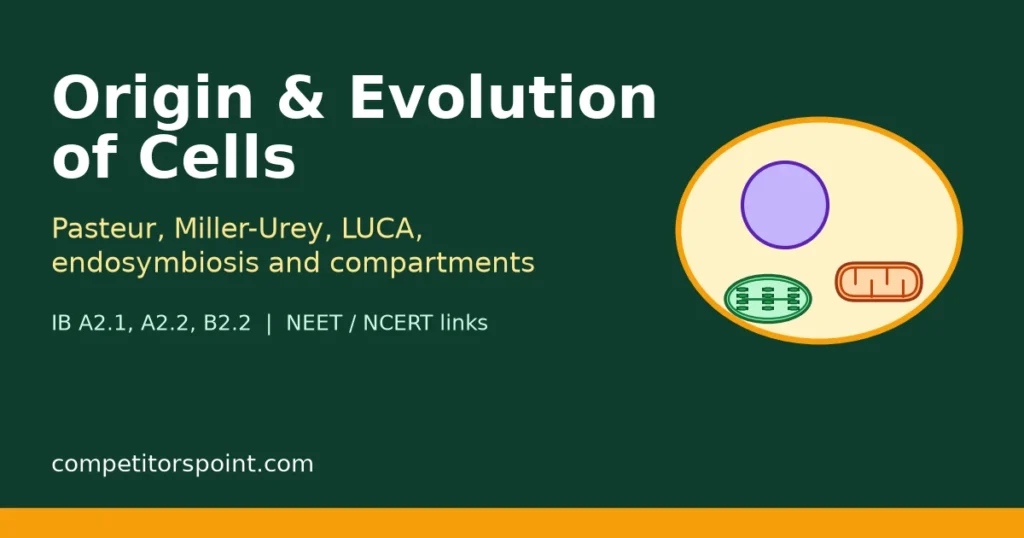
Evolution of cells title card showing a eukaryotic cell with a nucleus, mitochondrion and chloroplast for a chapter on Pasteur, Miller-Urey, LUCA and endosymbiosis

Origin and Evolution of Cells: LUCA to Eukaryotes (IB A2.1, NEET)

Home › IB Biology › Cell biology › Origin and evolution of cells Origin and Evolution of Cells The origin of cells is how the first living cells arose from non-living chemicals, about 3.5 to 4 billion years ago. Organic molecules probably formed self-replicating RNA inside membrane vesicles. The last universal common ancestor (LUCA) gave

Origin and Evolution of Cells: LUCA to Eukaryotes (IB A2.1, NEET) Read More »

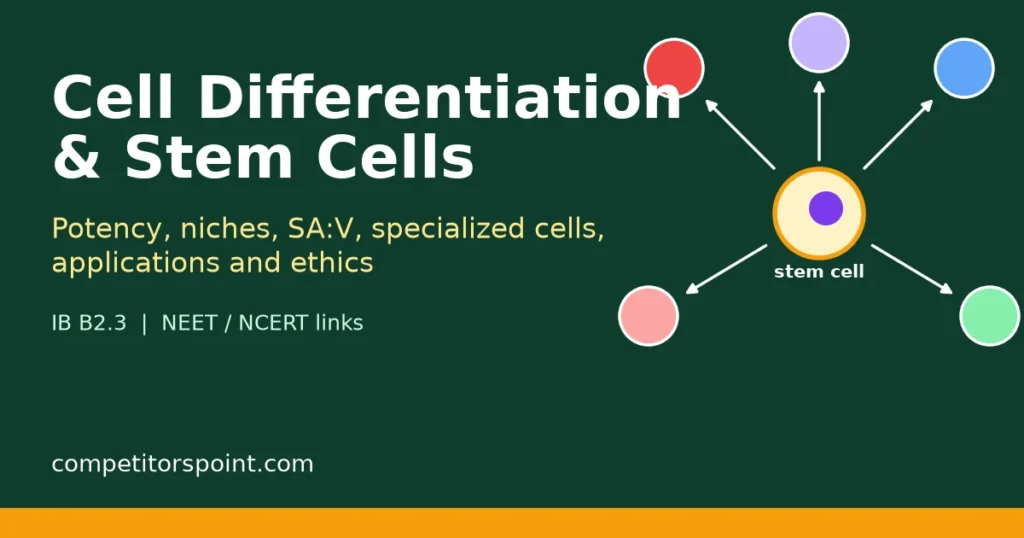
Cell differentiation and stem cells title card showing one stem cell with arrows to five different coloured specialized cells

Cell Differentiation and Stem Cells for IB B2.3 and NEET

Home › IB Biology › Cell biology › Cell differentiation and stem cells Cell Differentiation and Stem Cells Cell differentiation is the process by which an unspecialized cell becomes specialized for a particular function by expressing some of its genes and not others. Stem cells are unspecialized cells that can divide again and again and

Cell Differentiation and Stem Cells for IB B2.3 and NEET Read More »

Scroll to Top