
Integration of Body Systems IB Biology: 13 Notes (C3.1)
In integration of body systems IB Biology notes, integration means the coordination of cells, tissues, organs and organ systems so that a multicellular organism works as one unit. For the official syllabus, see the IB Biology subject guide. Animals integrate their organs by nervous signals, hormones and the transport of materials and energy in the blood (C3.1.1 to C3.1.3).
IB HL = detail the IB guide expects at Higher Level only
1 What is system integration? (C3.1.1)
Syllabus link: IB Biology (first assessment 2025) C3.1 Integration of body systems: C3.1.1 to C3.1.3 in full, with the integration view of C3.1.4 to C3.1.16 (all SL). Plant responses, C3.1.17 to C3.1.23, are HL only and have their own chapter.
A system is a set of parts that interact. A car engine, a city and a human body are all systems. Integration is the coordination of those parts so that the whole carries out functions no single part could. In biology, the parts are cells, tissues and organs, and the result of integration is a living organism that can move, feed, respond and reproduce.
When parts interact, the whole gains emergent properties: properties that are not present in, and could not be predicted from, the parts alone. A single heart muscle cell contracts, but only a heart of millions of coordinated cells pumps blood. One neuron carries impulses, but consciousness emerges only from billions of interacting neurons, as the notes on consciousness as an emergent property explain.
Key idea
- Integration = coordination of the parts of a system so it works as a whole.
- Emergent properties arise from interactions between parts, not from the parts themselves.
- Integration needs communication between parts: signals and transport.
2 Cells, tissues, organs and systems as a hierarchy (C3.1.2)
A multicellular organism is built as a hierarchy of subsystems. Each level is a system in its own right and also a component of the level above:
- Cells: the basic units, each specialised for a role by differentiation (see how cells become specialised by differentiation).
- Tissues: groups of similar cells working together, for example cardiac muscle or epithelium.
- Organs: several tissues forming a structure with a particular function, such as the heart or stomach.
- Organ systems: organs that cooperate, such as the circulatory or digestive system.
- Organism: all the systems integrated into one living individual.
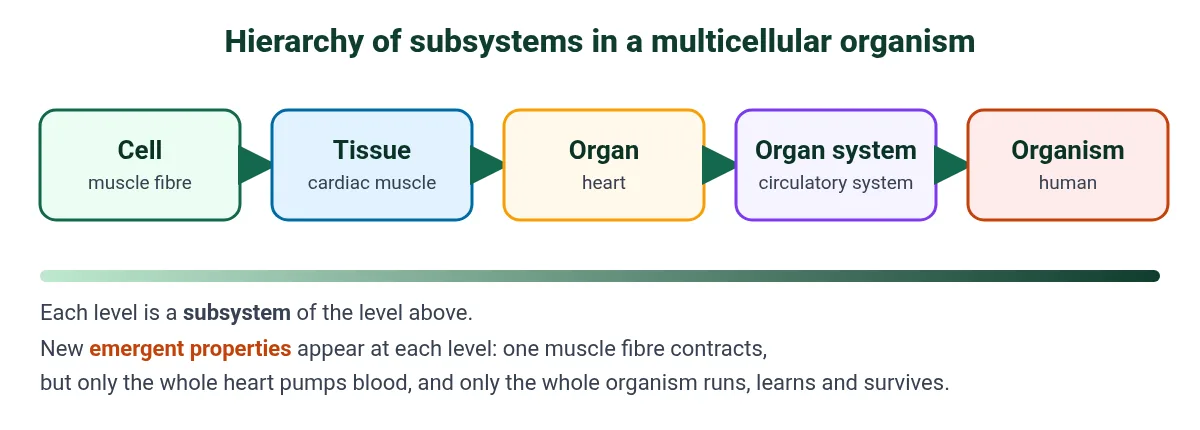
The stomach is a good example. Its epithelium secretes acid and enzymes, its smooth muscle churns food, nervous tissue coordinates the muscle and connective tissue holds it together. Only the organ as a whole can digest a meal, and only the digestive system with the circulatory system can deliver the products to body cells.
Nature of science: reductionism and holism
- Reductionism studies parts in isolation, for example one enzyme or one neuron. It has been very productive.
- But emergent properties can only be understood by studying how the parts interact. System biology combines both approaches.
3 How organs are integrated: nerves, hormones and transport (C3.1.3)
The IB guide names three ways that the organs of an animal are integrated:
- Nervous signalling: electrical impulses along neurons and neurotransmitters at synapses. Fast, precise and short-lived.
- Hormonal signalling: hormones secreted by endocrine glands into the blood. They reach every cell, but only cells with the right receptor respond. Slower and longer-lasting.
- Transport of materials and energy: the blood carries O2, glucose, CO2, urea, hormones and heat between organs, so that, for example, glucose absorbed in the gut fuels muscles in the leg and heat from the liver warms the skin.
Swipe the table sideways to see every column.
| Feature | Nervous signalling | Hormonal signalling |
|---|---|---|
| Signal | Electrical impulse; neurotransmitter at synapses | Hormone (chemical messenger) |
| Route | Along neurons | In the blood plasma |
| Target | Specific muscle fibres or gland cells | Any cell with a matching receptor |
| Speed | Milliseconds | Seconds to hours, even days |
| Duration | Short; stops when impulses stop | Longer; lasts until the hormone is broken down |
| Typical use | Reflexes, movement, rapid adjustments | Growth, metabolism, reproduction, long-term balance |
The two signalling systems are not separate. The hypothalamus is part of the brain yet controls the pituitary gland, and nerves trigger the release of some hormones, such as adrenaline. The full hormone side is in the endocrine system and hormones chapter.
4 Nervous integration at a glance (C3.1.4 to C3.1.10)
The nervous system is the fastest integrating system. Each point below is taught in full, with diagrams, in the nervous system IB Biology notes; here is how each one fits the integration picture.
Swipe the table sideways to see every column.
| Code | Integration role | Key fact to remember |
|---|---|---|
| C3.1.4 | The brain is the central integration organ | Combines information from several inputs; stores memories and learns |
| C3.1.5 | The spinal cord integrates unconscious processes | Reflexes are processed in its grey matter |
| C3.1.6 | Sensory neurons bring input | From receptors to the spinal cord and cerebral hemispheres |
| C3.1.7 | Motor neurons carry output | From the cerebral hemispheres to muscles |
| C3.1.8 | Nerves are bundles of fibres | Most are mixed: sensory and motor fibres together |
| C3.1.9 | The pain reflex arc is involuntary | Skeletal muscle is the effector |
| C3.1.10 | The cerebellum coordinates | Smooth skeletal muscle contraction and balance |
See the pain withdrawal reflex arc diagram for a worked example of input, integration in the spinal cord and output to an effector.
5 Hormonal integration: melatonin, adrenaline and the hypothalamus (C3.1.11 to C3.1.13)
Three SL statements show hormones integrating many organs at once. They are covered gland by gland in the endocrine chapter; here the focus is on what each one coordinates.
Melatonin and circadian rhythms (C3.1.11)
The pineal gland secretes melatonin in darkness and stops in light, so its blood concentration is high at night and low by day. This diurnal pattern synchronises sleep and waking, body temperature and other daily rhythms with the light-dark cycle. Night-shift work and jet lag upset it.
Adrenaline prepares the body for vigorous activity (C3.1.12)
The adrenal medulla secretes adrenaline (epinephrine) when sympathetic nerves stimulate it. One hormone acts on many organs together, so that the whole body is ready for “fight or flight”:
Swipe the table sideways to see every column.
| Target | Effect of adrenaline | How it helps vigorous activity |
|---|---|---|
| Heart | Faster and stronger beats | More blood, O2 and glucose to muscles |
| Bronchioles | Dilate | More air reaches the alveoli |
| Liver | Glycogen broken down to glucose | More fuel for respiration |
| Arterioles | Dilate in skeletal muscle; constrict in gut and skin | Blood diverted to where it is needed |
| Eye | Pupils dilate | More light, better awareness |
Hypothalamus and pituitary gland (C3.1.13)
The hypothalamus monitors the blood and receives nerve impulses, then controls the pituitary gland: it sends releasing hormones to the anterior pituitary through portal blood vessels and makes ADH and oxytocin that are released from the posterior pituitary. Pituitary hormones in turn control the thyroid, adrenal cortex and gonads. This is where the nervous and endocrine systems meet; see the hypothalamus and pituitary gland notes.
6 Feedback control of heart rate and ventilation (C3.1.14, C3.1.15)
Most integration in the body works by negative feedback: a change from the set point is detected and a response reverses it, keeping the internal environment within narrow limits. This is homeostasis. Every loop has the same parts: stimulus, receptor, control centre, effector and response.
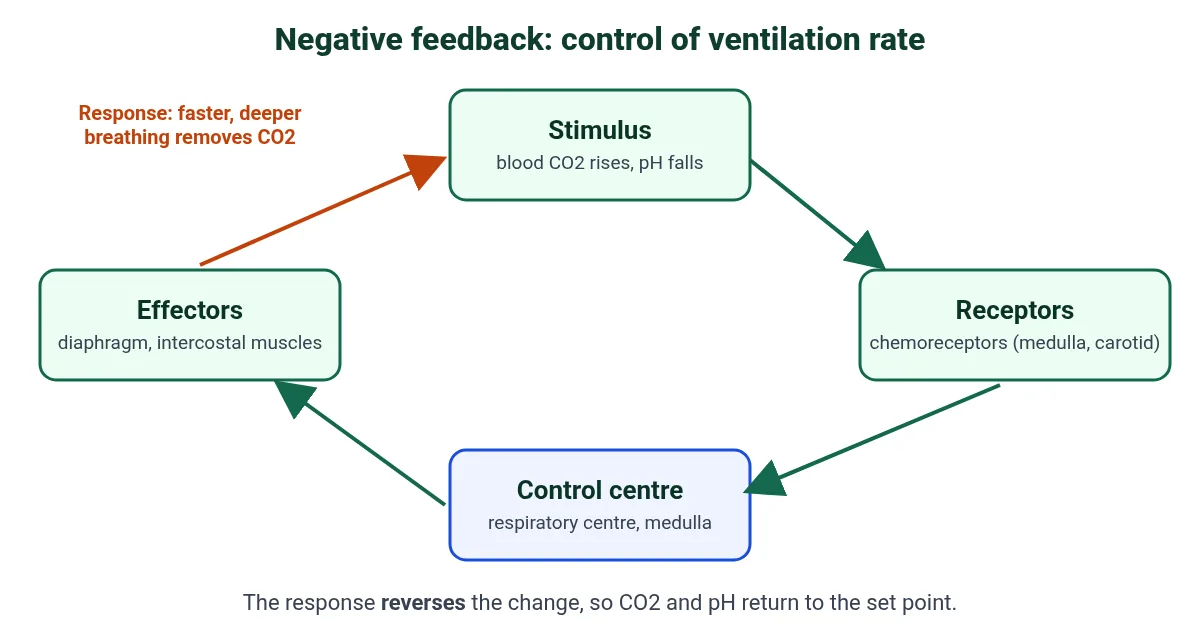
Swipe the table sideways to see every column.
| Part of loop | Heart rate (C3.1.14) | Ventilation rate (C3.1.15) |
|---|---|---|
| Stimulus | Change in blood pressure; rise in CO2 / fall in pH | Rise in blood CO2 / fall in pH |
| Receptors | Baroreceptors and chemoreceptors in the aorta and carotid arteries | Chemoreceptors in the medulla and in the carotid and aortic bodies |
| Control centre | Cardiovascular centre, medulla | Respiratory centre, medulla |
| Signal to effector | Sympathetic nerves speed up; vagus nerve slows | Nerves to the diaphragm and intercostal muscles |
| Effector | SA node (pacemaker) of the heart | Diaphragm and external intercostal muscles |
| Response | Heart rate and stroke volume change | Faster and deeper breathing |
The two loops are themselves integrated: during exercise both respond to the same rise in CO2, so more air reaches the lungs and more blood flows through them. Details are in the notes on heart rate control and the cardiac cycle and on gas exchange and ventilation in humans.
Negative vs positive feedback
- Negative feedback reverses a change and keeps conditions stable (heart rate, ventilation, blood glucose, body temperature).
- Positive feedback amplifies a change until an end point is reached, for example oxytocin in childbirth or ethylene in fruit ripening (HL plant topic).
7 Peristalsis: the CNS and the enteric nervous system (C3.1.16)
The gut shows two levels of nervous control working together. Swallowing at the start and egestion at the end are under voluntary control by the central nervous system. Between them, the waves of muscle contraction called peristalsis are involuntary and are run by the enteric nervous system (ENS), a network of neurons in the gut wall.
- Stretch receptors in the wall detect a bolus of food.
- The ENS makes circular muscle contract behind the bolus and relax ahead of it, pushing food along.
- The CNS can speed up or slow the ENS through autonomic nerves: parasympathetic stimulates, sympathetic inhibits.
See digestion and absorption in the human gut for the structure of the gut wall.
8 Case study: integration of body systems during exercise
A 400 m sprint uses every integration route at once. Follow the arrows in Figure 3.
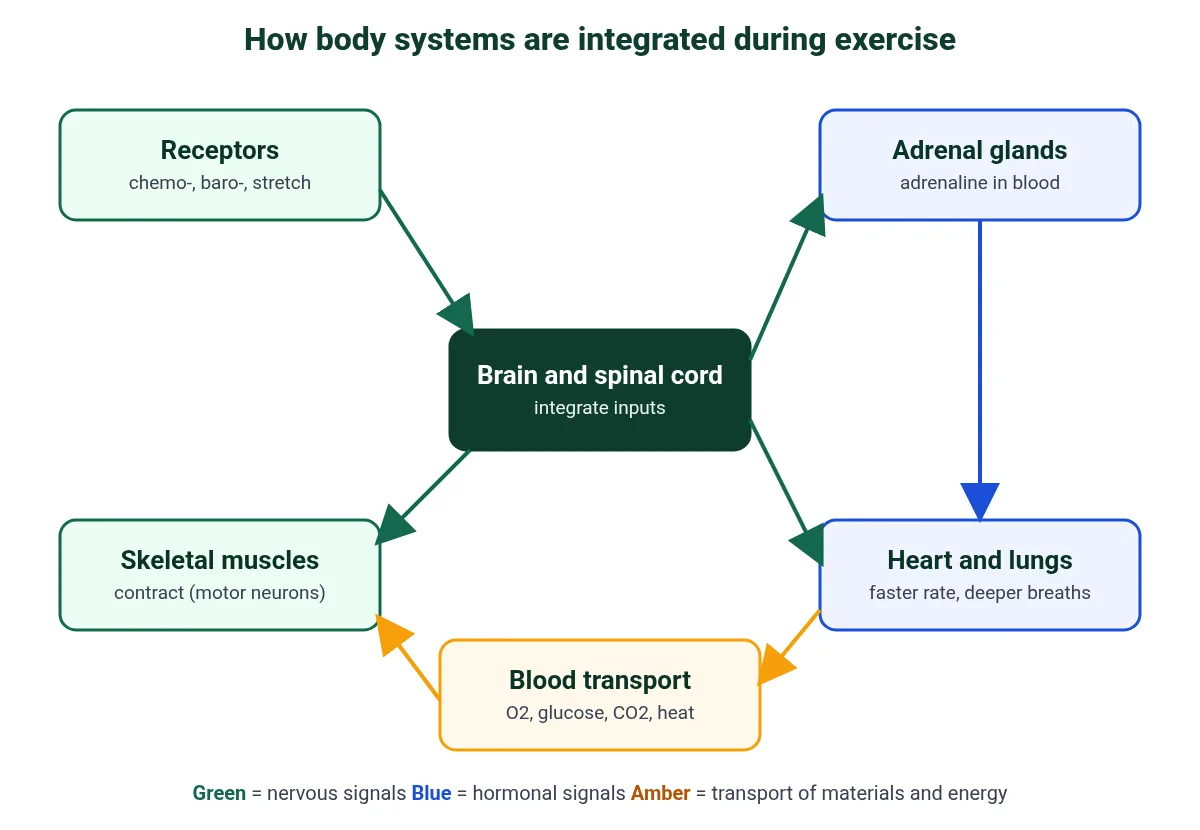
- Nervous output: the cerebral hemispheres send impulses along motor neurons to leg muscles; the cerebellum keeps the movement smooth and balanced.
- Hormonal signal: sympathetic nerves trigger adrenaline release, which raises heart rate, dilates bronchioles and releases glucose from the liver.
- Feedback control: chemoreceptors detect rising CO2; the medulla increases heart rate and ventilation rate.
- Transport of materials: blood carries extra O2 and glucose to muscles and removes CO2 and lactate.
- Transport of energy: blood carries heat from muscles to the skin, where vasodilation and sweating lose it.
- Peristalsis slows: sympathetic signals inhibit the gut, so blood can be diverted to muscles.
9 Integration in plants (HL preview, C3.1.17 to C3.1.23)
Plants have no nerves, yet they still integrate their organs. They use phytohormones, such as auxin, cytokinin and ethylene, and directional growth responses called tropisms. These statements are IB HL only and are covered in our separate plant tropisms and hormones chapter.
HL statements in that chapter
- C3.1.17 Observations of tropic responses in seedlings
- C3.1.18 Positive phototropism
- C3.1.19 Phytohormones as signalling chemicals
- C3.1.20 Auxin efflux carriers
- C3.1.21 Promotion of cell growth by auxin
- C3.1.22 Auxin and cytokinin interactions
- C3.1.23 Positive feedback in fruit ripening and ethylene production
10 Common exam traps
Watch out for these
- “Hormones only reach their target organ.” Hormones reach every cell in the blood; only cells with receptors respond.
- “Emergent properties are found in the parts.” By definition they arise only from interactions between parts.
- “Negative feedback means a bad effect.” It means the response opposes the change.
- “The heart rate centre is in the cerebrum.” It is in the medulla oblongata, an unconscious centre.
- “Baroreceptors detect CO2.” Baroreceptors detect pressure (stretch); chemoreceptors detect CO2, O2 and pH.
- Forgetting transport C3.1.3 has three routes: nerves, hormones and transport of materials and energy.
11 Key terms
| Term | Meaning |
|---|---|
| System integration | Coordination of the parts of a system so that it functions as a whole. |
| Emergent property | Property of a whole that arises from interactions between its parts. |
| Hierarchy of subsystems | Cells form tissues, tissues form organs, organs form systems, systems form the organism. |
| Hormone | Chemical messenger secreted into the blood that acts on target cells with receptors. |
| Homeostasis | Keeping the internal environment within narrow limits. |
| Negative feedback | A response that reverses a change from the set point. |
| Baroreceptor | Stretch receptor in the aorta and carotid arteries that detects blood pressure. |
| Chemoreceptor | Receptor that detects chemical changes such as CO2, O2 or pH. |
| Enteric nervous system | Network of neurons in the gut wall that controls peristalsis. |
12 Common doubts
Questions students ask us most often about this IB topic.
What is meant by system integration in IB Biology?
System integration is the coordination of the parts of a living system, such as cells, tissues and organs, so that the whole organism functions as one unit. It depends on communication between the parts and produces emergent properties.
What are the three ways organs are integrated in animals?
Nervous signalling, hormonal signalling and the transport of materials and energy in the blood. Nerves give fast, targeted responses, hormones give slower and longer-lasting ones, and the blood moves oxygen, nutrients, wastes and heat between organs.
Why is the heart rate centre described as unconscious?
It lies in the medulla oblongata of the brain stem, not in the cerebral hemispheres, so heart rate is adjusted automatically by feedback from baroreceptors and chemoreceptors without any decision or awareness.
What is an emergent property? Give an example.
An emergent property is a feature of a whole system that is not present in its parts and arises from their interactions. Pumping of blood by the heart is an example: single cardiac muscle cells only contract, but the coordinated organ pumps.
Is adrenaline part of nervous or hormonal integration?
Both. Sympathetic nerves stimulate the adrenal medulla, which then secretes adrenaline into the blood as a hormone. This links the fast nervous response to a wider, longer-lasting hormonal one that prepares many organs for vigorous activity.
13 Practice questions
Tap each question to reveal the answer.
Test yourself
1. (IB SL) State the three ways in which organs are integrated in an animal body. [3 marks]
Nervous signalling; hormonal signalling; transport of materials and energy (in the blood).
2. (IB SL) Using the heart as an example, explain what is meant by an emergent property. [2 marks]
A property of the whole that is not shown by its parts; single cardiac muscle cells contract but only the coordinated heart pumps blood.
3. (IB SL) List the levels of the hierarchy of subsystems from smallest to largest.
Cell, tissue, organ, organ system, organism.
4. (IB SL) Outline how blood pressure is restored after it falls. [3 marks]
Baroreceptors in the aorta/carotid arteries detect the fall; impulses to the cardiovascular centre in the medulla; sympathetic nerves increase heart rate and stroke volume, raising pressure (negative feedback).
5. (IB SL) Distinguish between nervous and hormonal signalling. [3 marks]
Nervous: impulses along neurons, hormonal: chemicals in blood; nervous targets specific effectors, hormones any cell with receptors; nervous is faster and shorter-lived.
6. (IB SL) Explain how adrenaline prepares the body for vigorous activity. [3 marks]
Increases heart rate/stroke volume; dilates bronchioles; glycogen broken down to glucose in liver; blood diverted to muscles; more O2 and glucose for respiration.
7. (IB SL) State the role of the enteric nervous system.
It controls peristalsis (involuntary contraction of gut muscle) between swallowing and egestion.
8. (IB SL) Describe how melatonin secretion helps to establish a sleep-wake cycle. [2 marks]
Pineal gland secretes melatonin in darkness, low in light; high levels at night promote sleep, low levels by day promote waking (diurnal/circadian pattern).
Ready to practise? Download the Integration of Body Systems IB question set with markscheme.
© competitorspoint.com · Biology notes. Diagrams are original to competitorspoint.com.