Rishi Prakash

Rishi Prakash is a biology teacher with 15 years of experience teaching in schools, review centres and medical coaching institutes across India, and he now teaches IB Biology and NEET Biology. He holds a B.Sc Agriculture from Dr. Panjabrao Deshmukh Krishi Vidyapeeth, Akola, and an M.Sc Bioinformatics from the University of Rajasthan. He writes and reviews every chapter on Competitors Point, building each one from NCERT and the IB Biology guide.

90 Glycolysis NEET MCQs with answers

90 Glycolysis NEET MCQs with Answers

Contents Glycolysis NEET MCQs: 30 single-answer questions Assertion–Reason questions on glycolysis (30) Match the pair questions on glycolysis (30) Common doubts These 90 glycolysis NEET MCQs test every part of the EMP pathway, from the hexokinase step to pyruvic acid and its fates. They are split into three sections: 30 single-answer MCQs, 30 assertion–reason questions

90 Glycolysis NEET MCQs with Answers Read More »

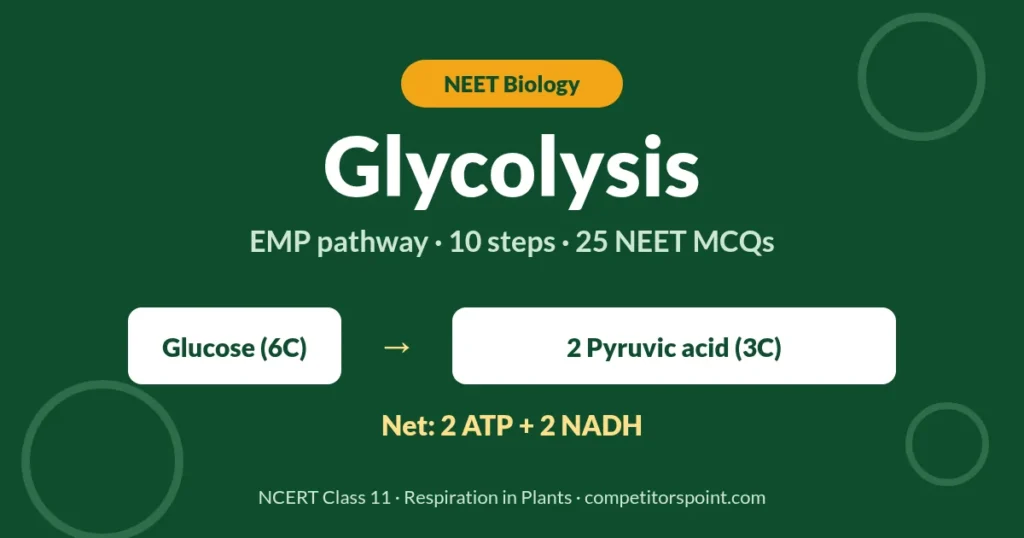
Glycolysis NEET featured image: glucose to 2 pyruvic acid, net 2 ATP + 2 NADH

Glycolysis NEET Notes: 10 Steps, EMP Pathway & 25 MCQs

Contents Respiration is not breathing What is glycolysis? Glycolysis NEET overview: the two phases Detailed steps: energy-requiring phase Detailed steps: energy-releasing phase What happens to pyruvic acid and NADH? Regulation of glycolysis: the role of PFK Glycolysis NEET: Common doubts Glycolysis NEET MCQs (25 questions) Glycolysis NEET questions appear almost every year, and the good

Glycolysis NEET Notes: 10 Steps, EMP Pathway & 25 MCQs Read More »

Ecosystem NEET MCQs practice quiz with assertion reason and match the following questions

Ecosystem NEET MCQs: Assertion Reason and Match Questions

Contents 25 MCQs Assertion–reason Match the following Revise the chapter Ecosystem NEET MCQs are one of the most scoring parts of NEET Biology, because almost every question comes straight from NCERT Class 12 Chapter 12. Practising Ecosystem NEET MCQs on trophic levels, productivity, decomposition, energy flow and ecological pyramids helps you spot the patterns NTA

Ecosystem NEET MCQs: Assertion Reason and Match Questions Read More »

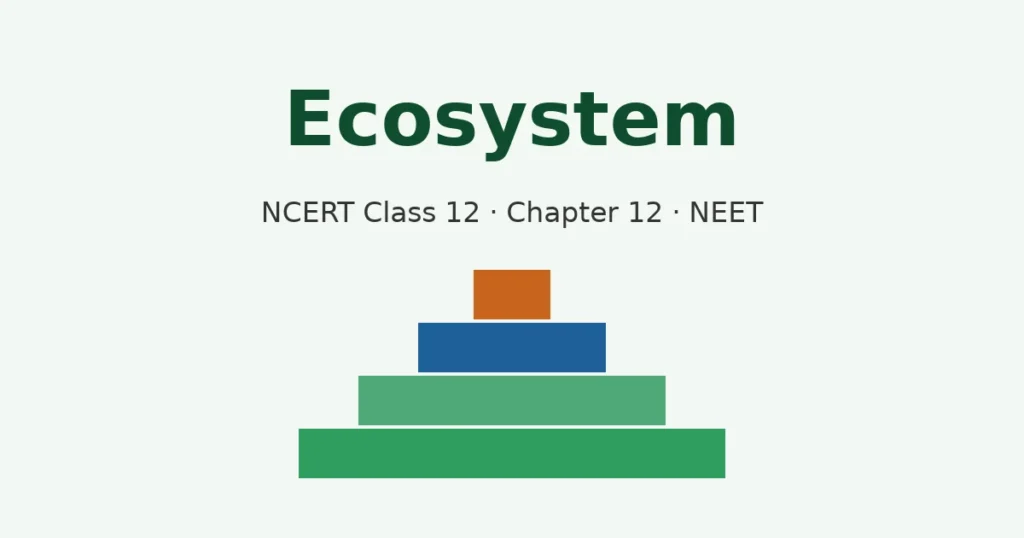
Ecosystem NEET notes NCERT Class 12 Chapter 12 cover with pyramid

Ecosystem NEET Notes: NCERT Class 12 Chapter 12 with Diagrams

Contents What is an ecosystem? Types of ecosystems Features of an ecosystem Productivity Decomposition Energy flow Trophic levels, food chain & web Ecological pyramids 10 per cent law Ecosystem NEET checklist Ecosystem NEET: Common doubts Ecosystem NEET Practice Questions Ecosystem NEET preparation starts with NCERT Class 12 Biology Chapter 12, and this guide explains it

Ecosystem NEET Notes: NCERT Class 12 Chapter 12 with Diagrams Read More »

Plant tropisms and hormones IB Biology HL featured image

Plant Tropisms and Hormones IB Biology: 12 Best Notes (C3.1 HL)

Home › IB Biology › Plant Tropisms and Hormones IB Biology Plant Tropisms and Hormones IB Biology: 12 Notes (C3.1 HL) In plant tropisms and hormones IB Biology notes, a tropism is a directional growth response of a plant organ to a stimulus from one direction, such as light or gravity. For the official syllabus,

Plant Tropisms and Hormones IB Biology: 12 Best Notes (C3.1 HL) Read More »

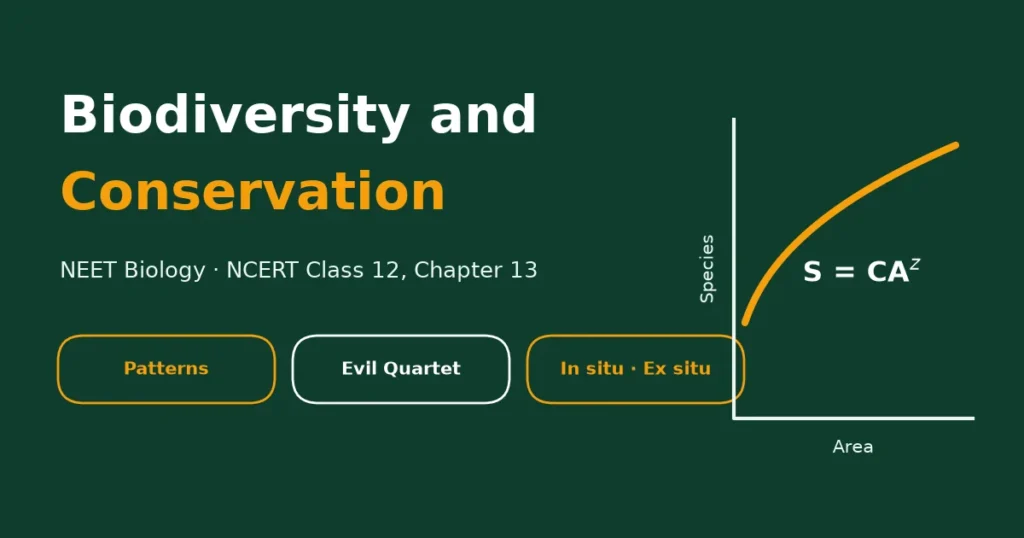
Biodiversity and conservation NEET notes: levels, hotspots, Evil Quartet and conservation

Biodiversity and Conservation NEET: Complete Notes + 22 MCQs

Home › NEET Biology › Biodiversity and Conservation › Full chapter notes Biodiversity and Conservation NEET: Complete Notes + 22 MCQs Biodiversity is the combined diversity at all levels of biological organisation, most importantly genetic, species and ecological diversity. This chapter explains how many species exist, why the tropics are richest, the species-area relationship, why

Biodiversity and Conservation NEET: Complete Notes + 22 MCQs Read More »

Photosynthesis for IB Biology C1.3: pigments, light-dependent reactions, Calvin cycle and limiting factors

Photosynthesis: Pigments, Light Reactions and Calvin Cycle (IB C1.3 SL + HL)

Home › IB Biology › Photosynthesis & respiration › Photosynthesis Photosynthesis: IB Biology C1.3 Photosynthesis is the process that turns light energy into chemical energy stored in carbon compounds. Plants, algae and cyanobacteria use it to build sugars from carbon dioxide and water, and release oxygen as a by-product. These notes cover the full IB

Photosynthesis: Pigments, Light Reactions and Calvin Cycle (IB C1.3 SL + HL) Read More »

Cell respiration and ATP for IB Biology C1.2 SL: ATP–ADP cycle, aerobic vs anaerobic respiration and respirometers

Cell Respiration and ATP: Aerobic, Anaerobic and Respirometers (IB C1.2 SL)

Home › IB Biology › Photosynthesis and respiration › Cell Respiration and ATP Cell Respiration and ATP Cell respiration is the controlled release of energy from organic compounds, such as glucose and fatty acids, to make ATP. ATP then carries that energy to every process that needs it. This page covers the SL core of

Cell Respiration and ATP: Aerobic, Anaerobic and Respirometers (IB C1.2 SL) Read More »

Scroll to Top