
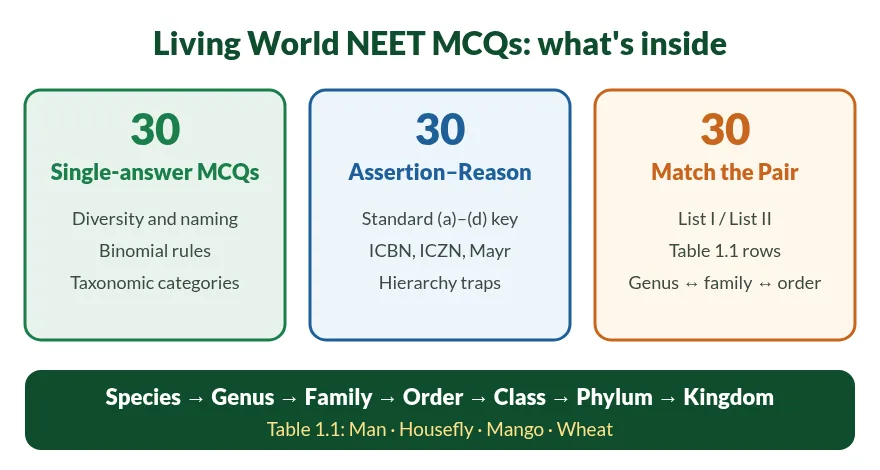
These 90 living world NEET MCQs test every part of NCERT Class 11 Chapter 1, from diversity and binomial nomenclature to the taxonomic categories and Table 1.1. They are split into three sections: 30 single-answer MCQs, 30 assertion–reason questions and 30 match-the-pair questions. Every question has a Show Answer button with a short explanation. Use these living world NEET MCQs after reading the notes, as a timed test, or for last-minute revision.
How to use this practice set
- Revise The Living World NEET notes first, or keep them open in another tab.
- Attempt each section without peeking, then check your answers and read the explanations.
- Learn Table 1.1 (man, housefly, mango, wheat) well; a third of the match questions use it.
- The questions follow the NCERT Class 11 Biology chapter The Living World.
Quick recap: about 1.7–1.8 million species are known. Naming follows ICBN (plants) and ICZN (animals) and the binomial system of Linnaeus. The hierarchy runs species → genus → family → order → class → phylum/division → kingdom, and common characters decrease as you go up.
Living world NEET MCQs: 30 single-answer questions
Start with these 30 single-answer living world NEET MCQs. They cover diversity, nomenclature, taxonomy, the taxonomic categories and Table 1.1. Each of these living world NEET MCQs has one correct option.
Living world NEET MCQs 1–10: diversity, naming and classification
The first ten living world NEET MCQs test diversity, nomenclature, identification and the binomial rules.
Q1. The number of species that are known and described ranges between:
- (a) 1.2–1.3 million
- (b) 2.7–2.8 million
- (c) 1.7–1.8 million
- (d) 17–18 million
Show Answer
Answer: (c) 1.7–1.8 million
About 1.7–1.8 million species are known and described; this number refers to biodiversity.
Q2. Standardising the naming of living organisms so that an organism has the same name all over the world is called:
- (a) Nomenclature
- (b) Identification
- (c) Classification
- (d) Characterisation
Show Answer
Answer: (a) Nomenclature
Nomenclature gives one standard name; it is possible only after correct identification.
Q3. Describing an organism correctly so that we know to which organism a name is attached is called:
- (a) Nomenclature
- (b) Systematics
- (c) Identification
- (d) Classification
Show Answer
Answer: (c) Identification
Identification comes first; naming is possible only for a correctly described organism.
Q4. ICBN provides principles and criteria for naming:
- (a) Animals
- (b) Viruses
- (c) Fossils only
- (d) Plants
Show Answer
Answer: (d) Plants
ICBN is the International Code for Botanical Nomenclature; animals follow ICZN.
Q5. The binomial system of nomenclature was given by:
- (a) Carolus Linnaeus
- (b) Ernst Mayr
- (c) Charles Darwin
- (d) Aristotle
Show Answer
Answer: (a) Carolus Linnaeus
Linnaeus gave the two-word naming system that biologists use worldwide.
Q6. Which is the correctly written scientific name of mango?
- (a) Mangifera Indica
- (b) mangifera indica
- (c) Indica mangifera
- (d) Mangifera indica
Show Answer
Answer: (d) Mangifera indica
The genus starts with a capital letter and the specific epithet with a small letter.
Q7. In Mangifera indica Linn., the word ‘Linn.’ indicates that:
- (a) Linnaeus discovered the genus only
- (b) The species was first described by Linnaeus
- (c) The plant grows in Linnaeus’s country
- (d) The species belongs to family Linnaeaceae
Show Answer
Answer: (b) The species was first described by Linnaeus
The abbreviated author name after the specific epithet shows who first described the species.
Q8. Biological names are generally in:
- (a) Latin
- (b) Greek
- (c) English
- (d) Sanskrit
Show Answer
Answer: (a) Latin
Biological names are Latinised or derived from Latin, whatever their origin.
Q9. The scientific term for convenient categories such as ‘dogs’, ‘mammals’ and ‘plants’ is:
- (a) Clones
- (b) Taxa
- (c) Keys
- (d) Monographs
Show Answer
Answer: (b) Taxa
These categories are taxa, and taxa can indicate very different levels.
Q10. The earliest classifications of organisms were based on their:
- (a) Evolutionary relationships
- (b) Uses
- (c) Cell structure
- (d) Chromosome number
Show Answer
Answer: (b) Uses
Early humans needed food, clothing and shelter, so they grouped organisms by use.
Living world NEET MCQs 11–20: taxonomic categories
In this block of living world NEET MCQs, focus on species, genus, family and order with their textbook examples.
Q11. The Latin word ‘systema’, from which ‘systematics’ is derived, means:
- (a) Naming of organisms
- (b) Study of fossils
- (c) Grouping by uses
- (d) Systematic arrangement of organisms
Show Answer
Answer: (d) Systematic arrangement of organisms
Systematics studies the kinds and diversity of organisms and the relationships among them.
Q12. Linnaeus used which title for his publication?
- (a) Origin of Species
- (b) Historia Plantarum
- (c) Genera Plantarum
- (d) Systema Naturae
Show Answer
Answer: (d) Systema Naturae
The word ‘systematics’ is linked to Linnaeus’s Systema Naturae.
Q13. The lowest taxonomic category for all organisms is:
- (a) Genus
- (b) Family
- (c) Variety
- (d) Species
Show Answer
Answer: (d) Species
All organisms, plants and animals alike, have species as the lowest category.
Q14. Insects are recognised as a group because they share:
- (a) Two pairs of jointed legs
- (b) Three pairs of jointed legs
- (c) Four pairs of jointed legs
- (d) A notochord
Show Answer
Answer: (b) Three pairs of jointed legs
Insects are concrete objects sharing three pairs of jointed legs, so they form a category.
Q15. Potato and brinjal are two different species of the genus:
- (a) Petunia
- (b) Datura
- (c) Panthera
- (d) Solanum
Show Answer
Answer: (d) Solanum
Potato is Solanum tuberosum and brinjal is S. melongena.
Q16. Which genus, including cats, differs from the genus Panthera?
- (a) Homo
- (b) Musca
- (c) Solanum
- (d) Felis
Show Answer
Answer: (d) Felis
Cats belong to Felis; both genera are placed in family Felidae.
Q17. The genera Solanum, Petunia and Datura are placed in the family:
- (a) Poaceae
- (b) Anacardiaceae
- (c) Solanaceae
- (d) Convolvulaceae
Show Answer
Answer: (c) Solanaceae
These three genera are grouped in Solanaceae.
Q18. Plant families Convolvulaceae and Solanaceae are placed in the order Polymoniales mainly on the basis of:
- (a) Floral characters
- (b) Root characters
- (c) Leaf venation only
- (d) Seed colour
Show Answer
Answer: (a) Floral characters
Order Polymoniales groups these families mainly on floral characters.
Q19. The animal order Carnivora includes the families:
- (a) Hominidae and Muscidae
- (b) Felidae and Hominidae
- (c) Felidae and Canidae
- (d) Canidae and Muscidae
Show Answer
Answer: (c) Felidae and Canidae
Cats (Felidae) and dogs (Canidae) are both in order Carnivora.
Q20. Order Primata, placed in class Mammalia, comprises:
- (a) Tiger, cat and dog
- (b) Lion, leopard and tiger
- (c) Housefly, monkey and dog
- (d) Monkey, gorilla and gibbon
Show Answer
Answer: (d) Monkey, gorilla and gibbon
Primata (monkey, gorilla, gibbon) and Carnivora are both orders of Mammalia.
Living world NEET MCQs 21–30: hierarchy and Table 1.1
The last single-answer living world NEET MCQs cover phylum, division, the hierarchy trend and Table 1.1.
Q21. Phylum Chordata is characterised by the presence of:
- (a) Three pairs of jointed legs
- (b) External ears and body hair
- (c) Notochord and dorsal hollow neural system
- (d) Flowers and seeds
Show Answer
Answer: (c) Notochord and dorsal hollow neural system
Fishes, amphibians, reptiles, birds and mammals share these two features.
Q22. In plants, classes with a few similar characters are assigned to a higher category called:
- (a) Order
- (b) Division
- (c) Family
- (d) Genus
Show Answer
Answer: (b) Division
Division is the plant equivalent of phylum.
Q23. As we go higher from species to kingdom, the number of common characteristics:
- (a) Goes on decreasing
- (b) Goes on increasing
- (c) Stays the same
- (d) First increases, then decreases
Show Answer
Answer: (a) Goes on decreasing
Lower taxa share more characters; higher categories share fewer.
Q24. According to Table 1.1, the family of housefly is:
- (a) Hominidae
- (b) Diptera
- (c) Muscidae
- (d) Poaceae
Show Answer
Answer: (c) Muscidae
Housefly, Musca domestica, belongs to family Muscidae (Diptera is its order).
Q25. According to Table 1.1, wheat belongs to the order:
- (a) Poales
- (b) Sapindales
- (c) Diptera
- (d) Primata
Show Answer
Answer: (a) Poales
Wheat (Triticum aestivum) is in family Poaceae, order Poales.
Q26. According to Table 1.1, mango belongs to the class:
- (a) Dicotyledonae
- (b) Monocotyledonae
- (c) Mammalia
- (d) Insecta
Show Answer
Answer: (a) Dicotyledonae
Mango is a dicot; wheat is the monocot in Table 1.1.
Q27. Which two organisms of Table 1.1 share the same phylum/division?
- (a) Man and housefly
- (b) Man and mango
- (c) Mango and wheat
- (d) Housefly and wheat
Show Answer
Answer: (c) Mango and wheat
Both mango and wheat are in division Angiospermae.
Q28. Family Anacardiaceae in Table 1.1 contains:
- (a) Wheat
- (b) Mango
- (c) Man
- (d) Housefly
Show Answer
Answer: (b) Mango
Mango (Mangifera indica) belongs to Anacardiaceae, order Sapindales.
Q29. Which sequence of taxonomic categories is in the correct ascending order?
- (a) Species → Genus → Family → Order
- (b) Genus → Species → Order → Kingdom
- (c) Species → Order → Genus → Kingdom
- (d) Family → Genus → Class → Order
Show Answer
Answer: (a) Species → Genus → Family → Order
The ascending order is species, genus, family, order, class, phylum/division, kingdom.
Q30. Ernst Mayr, the Harvard evolutionary biologist, has been called:
- (a) The father of genetics
- (b) The Darwin of the 20th century
- (c) The Newton of biology
- (d) The father of botany
Show Answer
Answer: (b) The Darwin of the 20th century
Mayr also pioneered the currently accepted definition of a biological species.
Assertion–Reason questions on The Living World (30)
These assertion–reason living world NEET MCQs follow the exam pattern. Attempting living world NEET MCQs in this format trains you to judge two statements at once. Each question has an Assertion (A) and a Reason (R). Choose:
- (a) Both A and R are true and R is the correct explanation of A
- (b) Both A and R are true but R is not the correct explanation of A
- (c) A is true but R is false
- (d) A is false but R is true
Assertion–reason living world NEET MCQs 31–40
Check each statement on its own first; these living world NEET MCQs often have both statements true.
Q31.
Assertion (A): Scientific names ensure that each organism has only one name.
Reason (R): Scientific names are given on agreed principles under ICBN and ICZN, followed by biologists all over the world.
- (a) Both A and R are true and R is the correct explanation of A
- (b) Both A and R are true but R is not the correct explanation of A
- (c) A is true but R is false
- (d) A is false but R is true
Show Answer
Answer: (a) Both A and R are true and R is the correct explanation of A
Agreed international codes make the name unique and universal.
Q32.
Assertion (A): Local names cannot be used to refer to organisms worldwide.
Reason (R): Local names vary from place to place, even within a country.
- (a) Both A and R are true and R is the correct explanation of A
- (b) Both A and R are true but R is not the correct explanation of A
- (c) A is true but R is false
- (d) A is false but R is true
Show Answer
Answer: (a) Both A and R are true and R is the correct explanation of A
Because local names vary, a standard scientific name is needed.
Q33.
Assertion (A): Mangifera indica is a binomial name.
Reason (R): It has two components, the generic name and the specific epithet.
- (a) Both A and R are true and R is the correct explanation of A
- (b) Both A and R are true but R is not the correct explanation of A
- (c) A is true but R is false
- (d) A is false but R is true
Show Answer
Answer: (a) Both A and R are true and R is the correct explanation of A
A name with two components is a binomial name.
Q34.
Assertion (A): Lower the taxon, more are the characteristics that its members share.
Reason (R): As we go higher from species to kingdom, the number of common characteristics goes on decreasing.
- (a) Both A and R are true and R is the correct explanation of A
- (b) Both A and R are true but R is not the correct explanation of A
- (c) A is true but R is false
- (d) A is false but R is true
Show Answer
Answer: (a) Both A and R are true and R is the correct explanation of A
R states the same trend from the other direction, so it explains A.
Q35.
Assertion (A): Lion, leopard and tiger are placed in the same genus Panthera.
Reason (R): A genus is a group of related species with more characters in common than with species of other genera.
- (a) Both A and R are true and R is the correct explanation of A
- (b) Both A and R are true but R is not the correct explanation of A
- (c) A is true but R is false
- (d) A is false but R is true
Show Answer
Answer: (a) Both A and R are true and R is the correct explanation of A
Their several common features place them in one genus.
Q36.
Assertion (A): Felidae and Canidae are placed in the order Carnivora.
Reason (R): An order is an assemblage of families which exhibit a few similar characters.
- (a) Both A and R are true and R is the correct explanation of A
- (b) Both A and R are true but R is not the correct explanation of A
- (c) A is true but R is false
- (d) A is false but R is true
Show Answer
Answer: (a) Both A and R are true and R is the correct explanation of A
Cats and dogs share a few characters, so their families form one order.
Q37.
Assertion (A): Fishes, amphibians, reptiles, birds and mammals are placed in phylum Chordata.
Reason (R): They share a notochord and a dorsal hollow neural system.
- (a) Both A and R are true and R is the correct explanation of A
- (b) Both A and R are true but R is not the correct explanation of A
- (c) A is true but R is false
- (d) A is false but R is true
Show Answer
Answer: (a) Both A and R are true and R is the correct explanation of A
These common features define phylum Chordata.
Q38.
Assertion (A): The earliest classifications were based on the uses of organisms.
Reason (R): Early humans needed sources for food, clothing and shelter.
- (a) Both A and R are true and R is the correct explanation of A
- (b) Both A and R are true but R is not the correct explanation of A
- (c) A is true but R is false
- (d) A is false but R is true
Show Answer
Answer: (a) Both A and R are true and R is the correct explanation of A
Their basic needs made usefulness the first basis of grouping.
Q39.
Assertion (A): Mango and wheat are placed in division Angiospermae.
Reason (R): Mango belongs to family Anacardiaceae.
- (a) Both A and R are true and R is the correct explanation of A
- (b) Both A and R are true but R is not the correct explanation of A
- (c) A is true but R is false
- (d) A is false but R is true
Show Answer
Answer: (b) Both A and R are true but R is not the correct explanation of A
Both are true, but the family of mango does not explain why both are angiosperms.
Q40.
Assertion (A): Housefly is placed in class Insecta.
Reason (R): The biological name of housefly is Musca domestica.
- (a) Both A and R are true and R is the correct explanation of A
- (b) Both A and R are true but R is not the correct explanation of A
- (c) A is true but R is false
- (d) A is false but R is true
Show Answer
Answer: (b) Both A and R are true but R is not the correct explanation of A
Both are true, but the name does not explain its class.
Assertion–reason living world NEET MCQs 41–50
This set of living world NEET MCQs mixes true statements with false reasons on codes, families and Mayr.
Q41.
Assertion (A): Biological names are printed in italics.
Reason (R): The first word of a biological name starts with a capital letter.
- (a) Both A and R are true and R is the correct explanation of A
- (b) Both A and R are true but R is not the correct explanation of A
- (c) A is true but R is false
- (d) A is false but R is true
Show Answer
Answer: (b) Both A and R are true but R is not the correct explanation of A
Both are true; italics indicate Latin origin, which R does not mention.
Q42.
Assertion (A): Ernst Mayr has been called ‘The Darwin of the 20th century’.
Reason (R): Mayr joined Harvard’s Faculty of Arts and Sciences in 1953.
- (a) Both A and R are true and R is the correct explanation of A
- (b) Both A and R are true but R is not the correct explanation of A
- (c) A is true but R is false
- (d) A is false but R is true
Show Answer
Answer: (b) Both A and R are true but R is not the correct explanation of A
Both are true, but joining Harvard does not explain the title.
Q43.
Assertion (A): Potato and brinjal are two different species.
Reason (R): Solanum, Petunia and Datura are placed in family Solanaceae.
- (a) Both A and R are true and R is the correct explanation of A
- (b) Both A and R are true but R is not the correct explanation of A
- (c) A is true but R is false
- (d) A is false but R is true
Show Answer
Answer: (b) Both A and R are true but R is not the correct explanation of A
Both are true, but R is about family placement, not about species.
Q44.
Assertion (A): Cats and dogs are placed in two different families.
Reason (R): Both cats and dogs belong to the order Carnivora.
- (a) Both A and R are true and R is the correct explanation of A
- (b) Both A and R are true but R is not the correct explanation of A
- (c) A is true but R is false
- (d) A is false but R is true
Show Answer
Answer: (b) Both A and R are true but R is not the correct explanation of A
Both are true; they are in different families because of their differences, not because of their shared order.
Q45.
Assertion (A): Man belongs to class Mammalia.
Reason (R): Man belongs to order Primata.
- (a) Both A and R are true and R is the correct explanation of A
- (b) Both A and R are true but R is not the correct explanation of A
- (c) A is true but R is false
- (d) A is false but R is true
Show Answer
Answer: (b) Both A and R are true but R is not the correct explanation of A
Both are true (Table 1.1), but the order does not explain the class.
Q46.
Assertion (A): The name of the author appears after the specific epithet.
Reason (R): The author’s name is always written in full, never abbreviated.
- (a) Both A and R are true and R is the correct explanation of A
- (b) Both A and R are true but R is not the correct explanation of A
- (c) A is true but R is false
- (d) A is false but R is true
Show Answer
Answer: (c) A is true but R is false
The author’s name is written in abbreviated form, e.g. Linn.
Q47.
Assertion (A): Animals are named under the ICZN.
Reason (R): ICZN was evolved by plant taxonomists.
- (a) Both A and R are true and R is the correct explanation of A
- (b) Both A and R are true but R is not the correct explanation of A
- (c) A is true but R is false
- (d) A is false but R is true
Show Answer
Answer: (c) A is true but R is false
ICZN was evolved by animal taxonomists; plants follow ICBN.
Q48.
Assertion (A): Wheat is a monocot.
Reason (R): Wheat belongs to the family Anacardiaceae.
- (a) Both A and R are true and R is the correct explanation of A
- (b) Both A and R are true but R is not the correct explanation of A
- (c) A is true but R is false
- (d) A is false but R is true
Show Answer
Answer: (c) A is true but R is false
Wheat is in family Poaceae; mango is in Anacardiaceae.
Q49.
Assertion (A): Species is the lowest taxonomic category.
Reason (R): Species is the lowest category only in plants, not in animals.
- (a) Both A and R are true and R is the correct explanation of A
- (b) Both A and R are true but R is not the correct explanation of A
- (c) A is true but R is false
- (d) A is false but R is true
Show Answer
Answer: (c) A is true but R is false
Species is the lowest category for all organisms, plants and animals alike.
Q50.
Assertion (A): Ernst Mayr won the Balzan Prize, the International Prize for Biology and the Crafoord Prize.
Reason (R): Mayr’s research was confined to plant physiology.
- (a) Both A and R are true and R is the correct explanation of A
- (b) Both A and R are true but R is not the correct explanation of A
- (c) A is true but R is false
- (d) A is false but R is true
Show Answer
Answer: (c) A is true but R is false
His research spanned ornithology, taxonomy, zoogeography, evolution and systematics.
Assertion–reason living world NEET MCQs 51–60
These living world NEET MCQs end the assertion–reason section with false assertions built on Table 1.1.
Q51.
Assertion (A): Systematics takes into account evolutionary relationships between organisms.
Reason (R): The word systematics is derived from the Greek word ‘systema’.
- (a) Both A and R are true and R is the correct explanation of A
- (b) Both A and R are true but R is not the correct explanation of A
- (c) A is true but R is false
- (d) A is false but R is true
Show Answer
Answer: (c) A is true but R is false
‘Systema’ is a Latin word meaning systematic arrangement of organisms.
Q52.
Assertion (A): Genera are aggregates of closely related species.
Reason (R): Species of the same genus share fewer characters than they share with species of other genera.
- (a) Both A and R are true and R is the correct explanation of A
- (b) Both A and R are true but R is not the correct explanation of A
- (c) A is true but R is false
- (d) A is false but R is true
Show Answer
Answer: (c) A is true but R is false
Species of one genus share more characters with each other than with other genera.
Q53.
Assertion (A): Housefly belongs to phylum Chordata.
Reason (R): Housefly belongs to class Insecta.
- (a) Both A and R are true and R is the correct explanation of A
- (b) Both A and R are true but R is not the correct explanation of A
- (c) A is true but R is false
- (d) A is false but R is true
Show Answer
Answer: (d) A is false but R is true
Housefly is in phylum Arthropoda (Table 1.1); R is true.
Q54.
Assertion (A): The specific epithet starts with a capital letter.
Reason (R): The genus starts with a capital letter while the specific epithet starts with a small letter.
- (a) Both A and R are true and R is the correct explanation of A
- (b) Both A and R are true but R is not the correct explanation of A
- (c) A is true but R is false
- (d) A is false but R is true
Show Answer
Answer: (d) A is false but R is true
R is the correct rule, which makes A false.
Q55.
Assertion (A): About 17–18 million species are known and described.
Reason (R): New organisms are continuously being identified.
- (a) Both A and R are true and R is the correct explanation of A
- (b) Both A and R are true but R is not the correct explanation of A
- (c) A is true but R is false
- (d) A is false but R is true
Show Answer
Answer: (d) A is false but R is true
The known and described species number 1.7–1.8 million.
Q56.
Assertion (A): Classification is a single-step process.
Reason (R): Classification involves a hierarchy of steps in which each step represents a rank.
- (a) Both A and R are true and R is the correct explanation of A
- (b) Both A and R are true but R is not the correct explanation of A
- (c) A is true but R is false
- (d) A is false but R is true
Show Answer
Answer: (d) A is false but R is true
Classification is a hierarchical, multi-step process.
Q57.
Assertion (A): Mango belongs to class Monocotyledonae.
Reason (R): Wheat belongs to class Monocotyledonae.
- (a) Both A and R are true and R is the correct explanation of A
- (b) Both A and R are true but R is not the correct explanation of A
- (c) A is true but R is false
- (d) A is false but R is true
Show Answer
Answer: (d) A is false but R is true
Mango is in Dicotyledonae; wheat is the monocot.
Q58.
Assertion (A): Taxonomic groups are merely morphological aggregates.
Reason (R): Taxonomic categories are distinct biological entities.
- (a) Both A and R are true and R is the correct explanation of A
- (b) Both A and R are true but R is not the correct explanation of A
- (c) A is true but R is false
- (d) A is false but R is true
Show Answer
Answer: (d) A is false but R is true
Taxonomic groups are distinct biological entities, not merely morphological aggregates.
Q59.
Assertion (A): The higher the category, the easier it is to determine its relationship to other taxa at the same level.
Reason (R): The higher the category, the fewer the characteristics its members share.
- (a) Both A and R are true and R is the correct explanation of A
- (b) Both A and R are true but R is not the correct explanation of A
- (c) A is true but R is false
- (d) A is false but R is true
Show Answer
Answer: (d) A is false but R is true
Higher categories are harder to relate, so classification becomes more complex.
Q60.
Assertion (A): Man belongs to family Muscidae.
Reason (R): The genus of man is Homo.
- (a) Both A and R are true and R is the correct explanation of A
- (b) Both A and R are true but R is not the correct explanation of A
- (c) A is true but R is false
- (d) A is false but R is true
Show Answer
Answer: (d) A is false but R is true
Man is in family Hominidae; Muscidae is the housefly family.
Match the pair questions on The Living World (30)
The last 30 living world NEET MCQs are match-the-pair questions. Match List I with List II and choose the correct code. Matching living world NEET MCQs reward knowing Table 1.1 row by row.
Match the pair living world NEET MCQs 61–70
Table 1.1 drives these living world NEET MCQs, so learn each row across and each column down.
Q61. Match the common name with the biological name (Table 1.1):
| List I | List II |
|---|---|
| P. Man | 1. Mangifera indica |
| Q. Housefly | 2. Musca domestica |
| R. Mango | 3. Triticum aestivum |
| S. Wheat | 4. Homo sapiens |
- (a) P-4, Q-1, R-2, S-3
- (b) P-4, Q-2, R-1, S-3
- (c) P-3, Q-4, R-1, S-2
- (d) P-2, Q-4, R-1, S-3
Show Answer
Answer: (b) P-4, Q-2, R-1, S-3
Man → Homo sapiens; Housefly → Musca domestica; Mango → Mangifera indica; Wheat → Triticum aestivum.
Q62. Match the organism with its family (Table 1.1):
| List I | List II |
|---|---|
| P. Man | 1. Muscidae |
| Q. Housefly | 2. Poaceae |
| R. Mango | 3. Hominidae |
| S. Wheat | 4. Anacardiaceae |
- (a) P-1, Q-3, R-2, S-4
- (b) P-4, Q-3, R-1, S-2
- (c) P-3, Q-1, R-4, S-2
- (d) P-3, Q-1, R-2, S-4
Show Answer
Answer: (c) P-3, Q-1, R-4, S-2
Man → Hominidae; Housefly → Muscidae; Mango → Anacardiaceae; Wheat → Poaceae.
Q63. Match the organism with its order (Table 1.1):
| List I | List II |
|---|---|
| P. Man | 1. Primata |
| Q. Housefly | 2. Diptera |
| R. Mango | 3. Poales |
| S. Wheat | 4. Sapindales |
- (a) P-2, Q-4, R-3, S-1
- (b) P-1, Q-4, R-2, S-3
- (c) P-3, Q-1, R-2, S-4
- (d) P-1, Q-2, R-4, S-3
Show Answer
Answer: (d) P-1, Q-2, R-4, S-3
Man → Primata; Housefly → Diptera; Mango → Sapindales; Wheat → Poales.
Q64. Match the organism with its class (Table 1.1):
| List I | List II |
|---|---|
| P. Man | 1. Dicotyledonae |
| Q. Housefly | 2. Monocotyledonae |
| R. Mango | 3. Mammalia |
| S. Wheat | 4. Insecta |
- (a) P-3, Q-4, R-1, S-2
- (b) P-3, Q-2, R-1, S-4
- (c) P-3, Q-2, R-4, S-1
- (d) P-4, Q-2, R-1, S-3
Show Answer
Answer: (a) P-3, Q-4, R-1, S-2
Man → Mammalia; Housefly → Insecta; Mango → Dicotyledonae; Wheat → Monocotyledonae.
Q65. Match the taxonomic category with the taxon of mango (Table 1.1):
| List I | List II |
|---|---|
| P. Genus | 1. Sapindales |
| Q. Family | 2. Mangifera |
| R. Order | 3. Angiospermae |
| S. Division | 4. Anacardiaceae |
- (a) P-1, Q-4, R-2, S-3
- (b) P-2, Q-4, R-1, S-3
- (c) P-3, Q-4, R-1, S-2
- (d) P-2, Q-1, R-3, S-4
Show Answer
Answer: (b) P-2, Q-4, R-1, S-3
Genus → Mangifera; Family → Anacardiaceae; Order → Sapindales; Division → Angiospermae.
Q66. Match the taxonomic category with the taxon of wheat (Table 1.1):
| List I | List II |
|---|---|
| P. Genus | 1. Poaceae |
| Q. Family | 2. Monocotyledonae |
| R. Order | 3. Poales |
| S. Class | 4. Triticum |
- (a) P-4, Q-2, R-1, S-3
- (b) P-4, Q-1, R-2, S-3
- (c) P-4, Q-1, R-3, S-2
- (d) P-3, Q-4, R-1, S-2
Show Answer
Answer: (c) P-4, Q-1, R-3, S-2
Genus → Triticum; Family → Poaceae; Order → Poales; Class → Monocotyledonae.
Q67. Match the taxonomic category with the taxon of man (Table 1.1):
| List I | List II |
|---|---|
| P. Family | 1. Chordata |
| Q. Order | 2. Hominidae |
| R. Class | 3. Mammalia |
| S. Phylum | 4. Primata |
- (a) P-3, Q-2, R-4, S-1
- (b) P-3, Q-1, R-4, S-2
- (c) P-1, Q-4, R-2, S-3
- (d) P-2, Q-4, R-3, S-1
Show Answer
Answer: (d) P-2, Q-4, R-3, S-1
Family → Hominidae; Order → Primata; Class → Mammalia; Phylum → Chordata.
Q68. Match the taxonomic category with the taxon of housefly (Table 1.1):
| List I | List II |
|---|---|
| P. Genus | 1. Arthropoda |
| Q. Family | 2. Musca |
| R. Order | 3. Diptera |
| S. Phylum | 4. Muscidae |
- (a) P-2, Q-4, R-3, S-1
- (b) P-4, Q-2, R-1, S-3
- (c) P-2, Q-1, R-4, S-3
- (d) P-1, Q-3, R-2, S-4
Show Answer
Answer: (a) P-2, Q-4, R-3, S-1
Genus → Musca; Family → Muscidae; Order → Diptera; Phylum → Arthropoda.
Q69. Match the taxon from Table 1.1 with its category:
| List I | List II |
|---|---|
| P. Hominidae | 1. Division |
| Q. Diptera | 2. Class |
| R. Insecta | 3. Family |
| S. Angiospermae | 4. Order |
- (a) P-1, Q-4, R-3, S-2
- (b) P-3, Q-4, R-2, S-1
- (c) P-4, Q-1, R-2, S-3
- (d) P-1, Q-2, R-4, S-3
Show Answer
Answer: (b) P-3, Q-4, R-2, S-1
Hominidae → Family; Diptera → Order; Insecta → Class; Angiospermae → Division.
Q70. Match the taxon from Table 1.1 with its category:
| List I | List II |
|---|---|
| P. Triticum | 1. Order |
| Q. Poales | 2. Genus |
| R. Mammalia | 3. Class |
| S. Arthropoda | 4. Phylum |
- (a) P-3, Q-1, R-2, S-4
- (b) P-1, Q-4, R-3, S-2
- (c) P-2, Q-1, R-3, S-4
- (d) P-1, Q-4, R-2, S-3
Show Answer
Answer: (c) P-2, Q-1, R-3, S-4
Triticum → Genus; Poales → Order; Mammalia → Class; Arthropoda → Phylum.
Match the pair living world NEET MCQs 71–80
Genera, families, orders and key terms are paired in these living world NEET MCQs.
Q71. Match the order with the organism (Table 1.1):
| List I | List II |
|---|---|
| P. Primata | 1. Housefly |
| Q. Diptera | 2. Wheat |
| R. Sapindales | 3. Mango |
| S. Poales | 4. Man |
- (a) P-1, Q-2, R-4, S-3
- (b) P-2, Q-3, R-4, S-1
- (c) P-2, Q-4, R-1, S-3
- (d) P-4, Q-1, R-3, S-2
Show Answer
Answer: (d) P-4, Q-1, R-3, S-2
Primata → Man; Diptera → Housefly; Sapindales → Mango; Poales → Wheat.
Q72. Match the family with the organism (Table 1.1):
| List I | List II |
|---|---|
| P. Poaceae | 1. Mango |
| Q. Anacardiaceae | 2. Man |
| R. Muscidae | 3. Wheat |
| S. Hominidae | 4. Housefly |
- (a) P-3, Q-1, R-4, S-2
- (b) P-2, Q-1, R-3, S-4
- (c) P-3, Q-4, R-2, S-1
- (d) P-2, Q-4, R-3, S-1
Show Answer
Answer: (a) P-3, Q-1, R-4, S-2
Poaceae → Wheat; Anacardiaceae → Mango; Muscidae → Housefly; Hominidae → Man.
Q73. Match the class with the organism (Table 1.1):
| List I | List II |
|---|---|
| P. Monocotyledonae | 1. Man |
| Q. Dicotyledonae | 2. Housefly |
| R. Insecta | 3. Mango |
| S. Mammalia | 4. Wheat |
- (a) P-1, Q-3, R-4, S-2
- (b) P-4, Q-3, R-2, S-1
- (c) P-3, Q-1, R-4, S-2
- (d) P-4, Q-2, R-1, S-3
Show Answer
Answer: (b) P-4, Q-3, R-2, S-1
Monocotyledonae → Wheat; Dicotyledonae → Mango; Insecta → Housefly; Mammalia → Man.
Q74. Match the organism with its specific epithet (Table 1.1):
| List I | List II |
|---|---|
| P. Man | 1. indica |
| Q. Housefly | 2. domestica |
| R. Mango | 3. aestivum |
| S. Wheat | 4. sapiens |
- (a) P-4, Q-1, R-3, S-2
- (b) P-1, Q-3, R-4, S-2
- (c) P-4, Q-2, R-1, S-3
- (d) P-4, Q-3, R-1, S-2
Show Answer
Answer: (c) P-4, Q-2, R-1, S-3
Man → sapiens; Housefly → domestica; Mango → indica; Wheat → aestivum.
Q75. Match the genus with the organism named in the chapter:
| List I | List II |
|---|---|
| P. Solanum | 1. Potato |
| Q. Panthera | 2. Mango |
| R. Homo | 3. Human being |
| S. Mangifera | 4. Lion |
- (a) P-4, Q-3, R-1, S-2
- (b) P-4, Q-3, R-2, S-1
- (c) P-2, Q-1, R-4, S-3
- (d) P-1, Q-4, R-3, S-2
Show Answer
Answer: (d) P-1, Q-4, R-3, S-2
Solanum → Potato; Panthera → Lion; Homo → Human being; Mangifera → Mango.
Q76. Match the specific epithet with the organism:
| List I | List II |
|---|---|
| P. leo | 1. Potato |
| Q. pardus | 2. Lion |
| R. tigris | 3. Tiger |
| S. tuberosum | 4. Leopard |
- (a) P-2, Q-4, R-3, S-1
- (b) P-2, Q-1, R-4, S-3
- (c) P-1, Q-3, R-2, S-4
- (d) P-4, Q-3, R-1, S-2
Show Answer
Answer: (a) P-2, Q-4, R-3, S-1
leo → Lion; pardus → Leopard; tigris → Tiger; tuberosum → Potato.
Q77. Match the genus with its family:
| List I | List II |
|---|---|
| P. Petunia | 1. Muscidae |
| Q. Panthera | 2. Solanaceae |
| R. Musca | 3. Poaceae |
| S. Triticum | 4. Felidae |
- (a) P-2, Q-3, R-4, S-1
- (b) P-2, Q-4, R-1, S-3
- (c) P-4, Q-3, R-1, S-2
- (d) P-1, Q-3, R-2, S-4
Show Answer
Answer: (b) P-2, Q-4, R-1, S-3
Petunia → Solanaceae; Panthera → Felidae; Musca → Muscidae; Triticum → Poaceae.
Q78. Match the family with its order:
| List I | List II |
|---|---|
| P. Felidae | 1. Carnivora |
| Q. Solanaceae | 2. Poales |
| R. Poaceae | 3. Polymoniales |
| S. Anacardiaceae | 4. Sapindales |
- (a) P-4, Q-3, R-1, S-2
- (b) P-4, Q-2, R-3, S-1
- (c) P-1, Q-3, R-2, S-4
- (d) P-4, Q-2, R-1, S-3
Show Answer
Answer: (c) P-1, Q-3, R-2, S-4
Felidae → Carnivora; Solanaceae → Polymoniales; Poaceae → Poales; Anacardiaceae → Sapindales.
Q79. Match the order with its class (Table 1.1):
| List I | List II |
|---|---|
| P. Primata | 1. Insecta |
| Q. Diptera | 2. Mammalia |
| R. Sapindales | 3. Dicotyledonae |
| S. Poales | 4. Monocotyledonae |
- (a) P-4, Q-2, R-1, S-3
- (b) P-3, Q-2, R-4, S-1
- (c) P-4, Q-3, R-2, S-1
- (d) P-2, Q-1, R-3, S-4
Show Answer
Answer: (d) P-2, Q-1, R-3, S-4
Primata → Mammalia; Diptera → Insecta; Sapindales → Dicotyledonae; Poales → Monocotyledonae.
Q80. Match the process with its description:
| List I | List II |
|---|---|
| P. Nomenclature | 1. Grouping into categories on easily observable characters |
| Q. Identification | 2. Classifying organisms into taxa based on characteristics |
| R. Classification | 3. Standardising names so an organism has one name worldwide |
| S. Taxonomy | 4. Describing an organism correctly |
- (a) P-3, Q-4, R-1, S-2
- (b) P-3, Q-1, R-4, S-2
- (c) P-3, Q-2, R-4, S-1
- (d) P-1, Q-3, R-2, S-4
Show Answer
Answer: (a) P-3, Q-4, R-1, S-2
Nomenclature → Standardising names so an organism has one name worldwide; Identification → Describing an organism correctly; Classification → Grouping into categories on easily observable characters; Taxonomy → Classifying organisms into taxa based on characteristics.
Match the pair living world NEET MCQs 81–90
The final living world NEET MCQs pair categories, rules and numbers from the whole chapter.
Q81. Match the term with its meaning:
| List I | List II |
|---|---|
| P. Systematics | 1. A name with two components |
| Q. Taxon | 2. All categories together |
| R. Taxonomic hierarchy | 3. A unit of classification representing a rank |
| S. Binomial nomenclature | 4. Study of kinds of organisms and the relationships among them |
- (a) P-1, Q-4, R-3, S-2
- (b) P-4, Q-3, R-2, S-1
- (c) P-3, Q-4, R-1, S-2
- (d) P-4, Q-3, R-1, S-2
Show Answer
Answer: (b) P-4, Q-3, R-2, S-1
Systematics → Study of kinds of organisms and the relationships among them; Taxon → A unit of classification representing a rank; Taxonomic hierarchy → All categories together; Binomial nomenclature → A name with two components.
Q82. Match the name with what it refers to:
| List I | List II |
|---|---|
| P. Carolus Linnaeus | 1. Code for naming plants |
| Q. Ernst Mayr | 2. Code for naming animals |
| R. ICBN | 3. ‘The Darwin of the 20th century’ |
| S. ICZN | 4. Binomial nomenclature |
- (a) P-1, Q-2, R-3, S-4
- (b) P-4, Q-1, R-3, S-2
- (c) P-4, Q-3, R-1, S-2
- (d) P-3, Q-2, R-4, S-1
Show Answer
Answer: (c) P-4, Q-3, R-1, S-2
Carolus Linnaeus → Binomial nomenclature; Ernst Mayr → ‘The Darwin of the 20th century’; ICBN → Code for naming plants; ICZN → Code for naming animals.
Q83. Match the event in Ernst Mayr’s life with its year:
| List I | List II |
|---|---|
| P. Balzan Prize | 1. 1983 |
| Q. International Prize for Biology | 2. 1953 |
| R. Crafoord Prize | 3. 1999 |
| S. Joined Harvard’s Faculty of Arts and Sciences | 4. 1994 |
- (a) P-1, Q-3, R-2, S-4
- (b) P-2, Q-4, R-3, S-1
- (c) P-4, Q-3, R-2, S-1
- (d) P-1, Q-4, R-3, S-2
Show Answer
Answer: (d) P-1, Q-4, R-3, S-2
Balzan Prize → 1983; International Prize for Biology → 1994; Crafoord Prize → 1999; Joined Harvard’s Faculty of Arts and Sciences → 1953.
Q84. Match the category with its animal example from the chapter:
| List I | List II |
|---|---|
| P. Genus | 1. Mammalia |
| Q. Family | 2. Panthera |
| R. Order | 3. Carnivora |
| S. Class | 4. Felidae |
- (a) P-2, Q-4, R-3, S-1
- (b) P-1, Q-4, R-2, S-3
- (c) P-2, Q-3, R-1, S-4
- (d) P-3, Q-4, R-1, S-2
Show Answer
Answer: (a) P-2, Q-4, R-3, S-1
Genus → Panthera; Family → Felidae; Order → Carnivora; Class → Mammalia.
Q85. Match the category with its plant example from the chapter:
| List I | List II |
|---|---|
| P. Genus | 1. Polymoniales |
| Q. Family | 2. Solanaceae |
| R. Order | 3. Solanum |
| S. Division | 4. Angiospermae |
- (a) P-1, Q-4, R-2, S-3
- (b) P-3, Q-2, R-1, S-4
- (c) P-4, Q-3, R-2, S-1
- (d) P-2, Q-4, R-3, S-1
Show Answer
Answer: (b) P-3, Q-2, R-1, S-4
Genus → Solanum; Family → Solanaceae; Order → Polymoniales; Division → Angiospermae.
Q86. Match the group with the feature used to recognise it:
| List I | List II |
|---|---|
| P. Insects | 1. Three pairs of jointed legs |
| Q. Mammals | 2. Floral characters |
| R. Phylum Chordata | 3. External ears and body hair |
| S. Order Polymoniales | 4. Notochord and dorsal hollow neural system |
- (a) P-4, Q-3, R-1, S-2
- (b) P-1, Q-3, R-2, S-4
- (c) P-1, Q-3, R-4, S-2
- (d) P-4, Q-1, R-3, S-2
Show Answer
Answer: (c) P-1, Q-3, R-4, S-2
Insects → Three pairs of jointed legs; Mammals → External ears and body hair; Phylum Chordata → Notochord and dorsal hollow neural system; Order Polymoniales → Floral characters.
Q87. Match the rule of nomenclature with its correct statement:
| List I | List II |
|---|---|
| P. Language of biological names | 1. Genus |
| Q. First word | 2. Each word separately underlined |
| R. Second word | 3. Specific epithet |
| S. Handwritten name | 4. Latin or Latinised |
- (a) P-3, Q-1, R-4, S-2
- (b) P-2, Q-4, R-1, S-3
- (c) P-4, Q-2, R-1, S-3
- (d) P-4, Q-1, R-3, S-2
Show Answer
Answer: (d) P-4, Q-1, R-3, S-2
Language of biological names → Latin or Latinised; First word → Genus; Second word → Specific epithet; Handwritten name → Each word separately underlined.
Q88. Match the category with its description:
| List I | List II |
|---|---|
| P. Species | 1. Group of related species |
| Q. Genus | 2. Individuals with fundamental similarities |
| R. Family | 3. Group of related genera |
| S. Order | 4. Assemblage of families |
- (a) P-2, Q-1, R-3, S-4
- (b) P-1, Q-4, R-2, S-3
- (c) P-4, Q-3, R-2, S-1
- (d) P-4, Q-1, R-2, S-3
Show Answer
Answer: (a) P-2, Q-1, R-3, S-4
Species → Individuals with fundamental similarities; Genus → Group of related species; Family → Group of related genera; Order → Assemblage of families.
Q89. Match the category with its description:
| List I | List II |
|---|---|
| P. Class | 1. Classes such as fishes, amphibians, reptiles, birds and mammals |
| Q. Phylum | 2. Includes related orders |
| R. Division | 3. Plant classes with a few similar characters |
| S. Kingdom | 4. Highest category |
- (a) P-1, Q-3, R-2, S-4
- (b) P-2, Q-1, R-3, S-4
- (c) P-1, Q-2, R-3, S-4
- (d) P-2, Q-4, R-3, S-1
Show Answer
Answer: (b) P-2, Q-1, R-3, S-4
Class → Includes related orders; Phylum → Classes such as fishes, amphibians, reptiles, birds and mammals; Division → Plant classes with a few similar characters; Kingdom → Highest category.
Q90. Match the item with the number given in the chapter:
| List I | List II |
|---|---|
| P. Known and described species | 1. 2 |
| Q. Pairs of jointed legs in insects | 2. 1.7–1.8 million |
| R. Words in a binomial name | 3. 3 |
| S. Ernst Mayr’s age at death | 4. 100 |
- (a) P-3, Q-1, R-4, S-2
- (b) P-1, Q-3, R-2, S-4
- (c) P-2, Q-3, R-1, S-4
- (d) P-4, Q-3, R-2, S-1
Show Answer
Answer: (c) P-2, Q-3, R-1, S-4
Known and described species → 1.7–1.8 million; Pairs of jointed legs in insects → 3; Words in a binomial name → 2; Ernst Mayr’s age at death → 100.
Common doubts
These are the doubts students most often have when practising living world NEET MCQs.
How many questions come from The Living World in NEET?
Usually 1–2. Binomial rules, taxonomic categories and Table 1.1 are the most common sources, and these living world NEET MCQs cover all three.
Which table from this chapter should I memorise?
Table 1.1, Organisms with their Taxonomic Categories, for man, housefly, mango and wheat. Many living world NEET MCQs ask for one cell of this table.
What is the correct way to write a scientific name?
Write the genus with a capital letter and the specific epithet with a small letter, in italics when printed or separately underlined when handwritten, e.g. Mangifera indica.
How do I solve assertion–reason questions quickly?
Check whether A and R are each true on their own. Only if both are true, ask whether R explains A: if yes choose (a), if not choose (b). This works for every assertion–reason item in these living world NEET MCQs.
Should I read the notes before attempting these living world NEET MCQs?
Yes. Read The Living World NEET notes once, attempt all 90 questions without looking at the answers, then revise the topics you got wrong.
Finished these living world NEET MCQs? Revise the full chapter, including Table 1.1, in our The Living World NEET notes. Come back to these living world NEET MCQs a week later to check what you have retained.