
Glycolysis NEET questions appear almost every year, and the good news is that this topic is very scoring once you see the logic behind it. In this guide we follow the NCERT Class 11 Biology chapter Respiration in Plants and walk through glycolysis in plain words: what it is, why the cell spends ATP before it earns any, all 10 steps of the EMP pathway, and what happens to pyruvic acid afterwards.
Key points
- Glycolysis (Gr. glycos = sugar, lysis = splitting) breaks one glucose (6C) into two molecules of pyruvic acid (3C).
- It is also called the EMP pathway after Gustav Embden, Otto Meyerhof and J. Parnas.
- It happens in the cytoplasm and does not need oxygen, so it is common to aerobic and anaerobic organisms.
- Energy-requiring phase: 2 ATP are used (hexokinase and phosphofructokinase steps).
- Energy-releasing phase: 4 ATP and 2 NADH + H+ are made, so the net gain is 2 ATP and 2 NADH per glucose.
- ATP is made by substrate-level phosphorylation; there is no decarboxylation in glycolysis.
- Phosphofructokinase (PFK) is the key control point of the pathway.
Respiration is not breathing
Do you think respiration means breathing in and out? That is actually breathing. Respiration is what happens inside your cells afterwards: the oxygen you breathe in helps oxidise respiratory substrates such as glucose, and the energy released is trapped as ATP. Breathing and respiration are linked, but they are not the same thing.
Now picture this. You eat a spoon of curd. You get one glucose molecule, and the Lactobacillus bacteria in that curd also get one glucose molecule. What will each of you do with it? In the end, your cell and the bacterium will handle glucose quite differently: you can burn it all the way to CO2 and water, while Lactobacillus turns it into lactic acid. But the opening moves are identical. Both of you first split glucose into two halves through glycolysis. Plants, animals and bacteria all need energy to stay alive, and glycolysis is the one pathway they all share.
What is glycolysis?
Glycolysis is a series of 10 enzyme-catalysed reactions that partially oxidise one molecule of glucose (6C) into two molecules of pyruvic acid (3C). The full scheme was worked out by Gustav Embden, Otto Meyerhof and J. Parnas, so it is often called the EMP pathway. It is the only respiratory pathway found in almost all living organisms, and in anaerobic organisms it is the only process of respiration.
Glucose + 2 ADP + 2 Pi + 2 NAD⁺ → 2 Pyruvic acid + 2 ATP + 2 NADH + 2 H⁺ + 2 H₂O
Notice that glycolysis does not burn glucose completely to CO2 and water. It only partly breaks glucose down to pyruvic acid, making a little ATP and NADH on the way. The oxidation here does not use oxygen at all. Instead, it happens by dehydrogenation: hydrogen is removed from the substrate and handed to NAD+.
Where does the glucose come from?
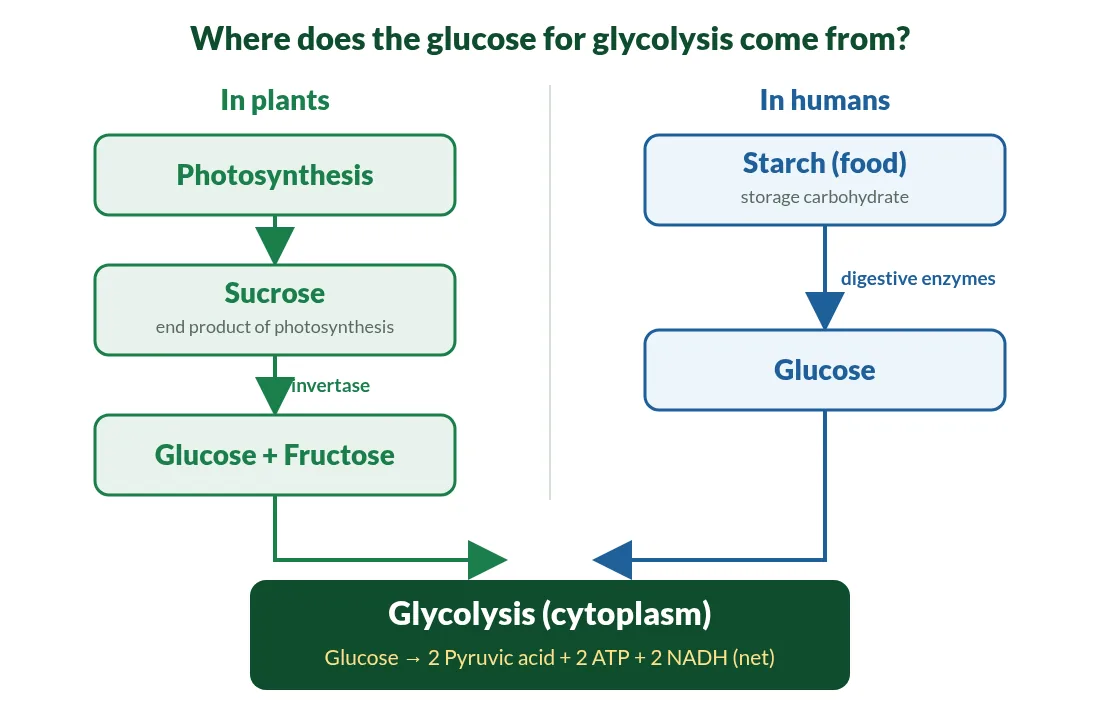
In plants, glucose comes from sucrose, the end product of photosynthesis, or from storage carbohydrates. The enzyme invertase splits sucrose into glucose and fructose, and both of these monosaccharides can enter the glycolytic pathway. In humans, starch from food is digested to glucose, which then enters glycolysis in our cells.
Important features of glycolysis
- It has 10 enzyme-catalysed reactions grouped into an energy-requiring phase and an energy-releasing phase.
- All the reactions take place in the cytoplasm of the cell.
- It is common to both aerobic and anaerobic respiration.
- The end products are 2 pyruvic acid, 2 ATP (net) and 2 NADH + H+.
- ATP is formed by substrate-level phosphorylation.
- No CO2 is released, because there is no decarboxylation.
Glycolysis NEET overview: the two phases
Glycolysis has ten steps. You may need every step for your exam, but it helps to first see the big picture before tracing every atom. Think of it as a small business: you invest money first, and then you earn more than you invested. For a short recap, see this Khan Academy glycolysis overview.
Energy-requiring phase (investment)
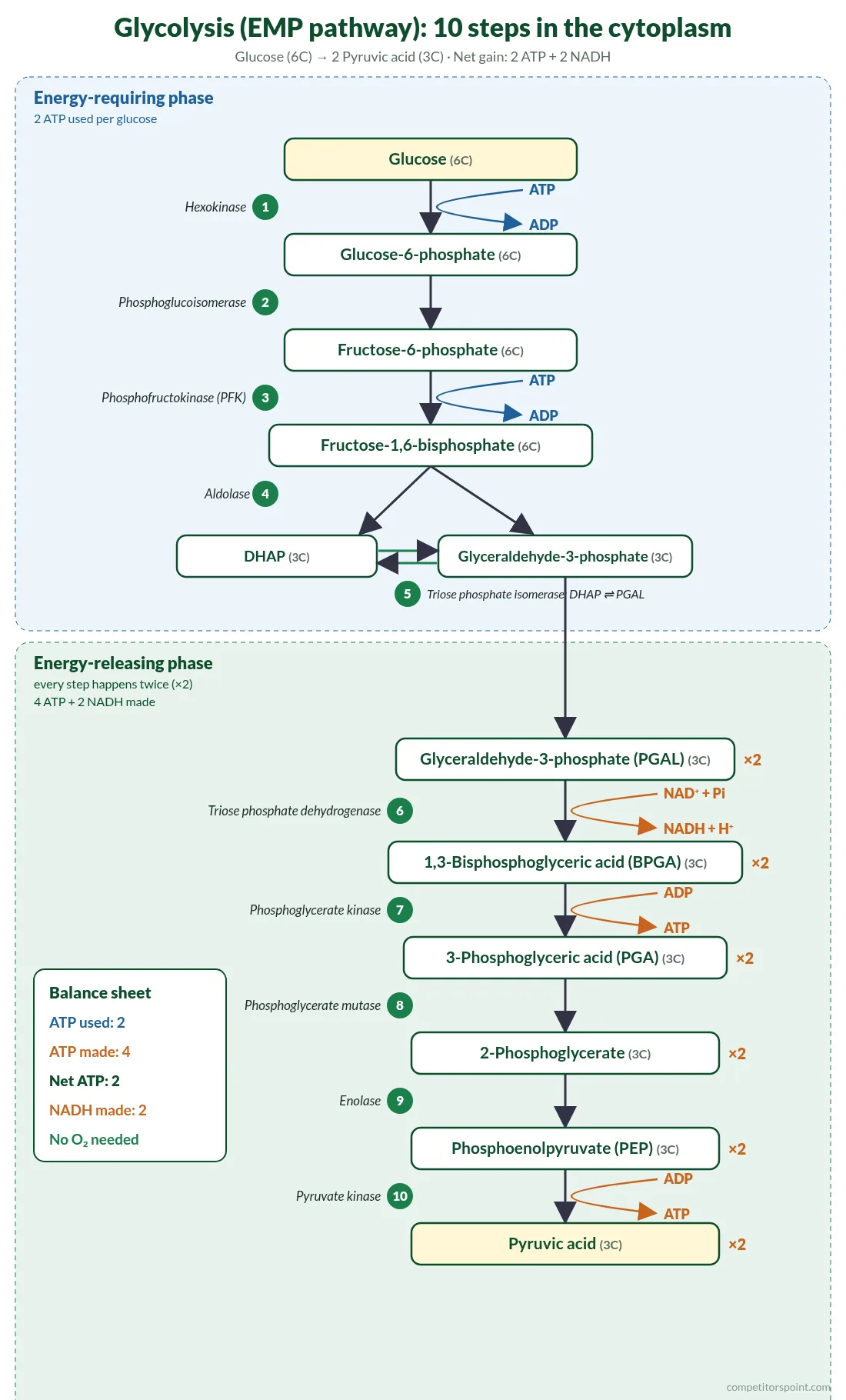
Glucose is a fairly stable molecule, so it has to be “activated” before it can be split. In this phase, the cell spends 2 ATP to add two phosphate groups, making glucose into fructose-1,6-bisphosphate. This unstable, two-phosphate sugar then splits into two 3-carbon sugars: dihydroxyacetone phosphate (DHAP) and glyceraldehyde-3-phosphate (PGAL). DHAP is then converted into PGAL, so the phase ends with two molecules of PGAL.
Energy-releasing phase (payoff)
Each PGAL is now converted into pyruvic acid. Along the way, each PGAL gives 2 ATP and 1 NADH. Because there are two PGAL molecules, this phase produces 4 ATP and 2 NADH in total.
Glycolysis NEET tip: ATP made (4) − ATP used (2) = net 2 ATP, plus 2 NADH + H+. Examiners often offer “4 ATP” as a trap option, so read whether the question says “gross” or “net”.
Detailed steps: energy-requiring phase
This phase has five steps and uses 2 ATP per glucose. For glycolysis NEET questions, remember the two ATP-using enzymes: hexokinase and phosphofructokinase.
Step 1: Glucose → glucose-6-phosphate. In the cytoplasm, glucose is phosphorylated with ATP as the phosphate donor. The enzyme is hexokinase. The phosphate makes glucose more reactive. It also gives the molecule a negative charge, so glucose-6-phosphate cannot slip back out across the hydrophobic interior of the plasma membrane. The sugar is now trapped inside the cell.
Step 2: Glucose-6-phosphate → fructose-6-phosphate. The enzyme phosphoglucose isomerase rearranges glucose-6-phosphate into its isomer, fructose-6-phosphate. This rearrangement sets the molecule up to be split evenly into two 3-carbon pieces later.
Step 3: Fructose-6-phosphate → fructose-1,6-bisphosphate. Phosphofructokinase (PFK) adds a second phosphate from another ATP. This is the second and last ATP spent. PFK is the main regulatory enzyme of glycolysis (see the regulation section below).
Step 4: Splitting the 6C sugar. Fructose-1,6-bisphosphate, with a phosphate at each end, is unstable. The enzyme aldolase splits it into two 3-carbon isomers: dihydroxyacetone phosphate (DHAP) and glyceraldehyde-3-phosphate (PGAL / 3-phosphoglyceraldehyde).
Step 5: DHAP → PGAL. Only PGAL can continue down the pathway. Triose phosphate isomerase converts DHAP into PGAL, so we now have two molecules of PGAL from one glucose.
Note: If we start with fructose instead of glucose, how many enzymes are involved? Fructose is phosphorylated directly to fructose-6-phosphate, so step 2 (the isomerase) is skipped. That makes 9 enzymes instead of 10, but the ATP investment is still the same: 2 ATP.
Detailed steps: energy-releasing phase
Each of the following steps happens twice per glucose, once for each PGAL. Most glycolysis NEET numericals are built on this doubling.
Step 6: PGAL → 1,3-bisphosphoglyceric acid (BPGA). This is the only oxidation step of glycolysis. The aldehyde group of PGAL is oxidised to an acid while an inorganic phosphate (Pi) is added, forming the high-energy compound 1,3-bisphosphoglyceric acid. The hydrogen removed from PGAL reduces NAD+ to NADH + H+. No molecular oxygen is involved: the oxidation happens through dehydrogenation. The enzyme is glyceraldehyde-3-phosphate (triose phosphate) dehydrogenase. Two PGAL give 2 BPGA and 2 NADH.
Step 7: BPGA → 3-phosphoglyceric acid (PGA). One phosphate group moves from BPGA to ADP, forming ATP. The enzyme is phosphoglycerate kinase. Because there are two BPGA molecules, 2 ATP are formed here. This is substrate-level phosphorylation, and at this point the 2 ATP invested earlier have been “paid back”.
Step 8: 3-PGA → 2-phosphoglycerate. Phosphoglycerate mutase (a type of isomerase) shifts the phosphate from carbon 3 to carbon 2.
Step 9: 2-phosphoglycerate → phosphoenolpyruvate (PEP). Enolase removes a molecule of water (dehydration), forming the high-energy compound PEP.
Step 10: PEP → pyruvic acid. Pyruvate kinase transfers the phosphate of PEP to ADP, forming ATP and pyruvic acid. Two PEP molecules give 2 ATP here, and these are the cell’s true profit.
| Step | Reaction | Enzyme | ATP / NADH (per glucose) |
|---|---|---|---|
| 1 | Glucose → Glucose-6-P | Hexokinase | −1 ATP |
| 2 | Glucose-6-P → Fructose-6-P | Phosphoglucose isomerase | — |
| 3 | Fructose-6-P → Fructose-1,6-bisP | Phosphofructokinase | −1 ATP |
| 4 | Fructose-1,6-bisP → DHAP + PGAL | Aldolase | — |
| 5 | DHAP → PGAL | Triose phosphate isomerase | — |
| 6 | PGAL → BPGA | Glyceraldehyde-3-P dehydrogenase | +2 NADH |
| 7 | BPGA → 3-PGA | Phosphoglycerate kinase | +2 ATP |
| 8 | 3-PGA → 2-PGA | Phosphoglycerate mutase | — |
| 9 | 2-PGA → PEP | Enolase | — (H₂O removed) |
| 10 | PEP → Pyruvic acid | Pyruvate kinase | +2 ATP |
| Net yield per glucose | 2 ATP + 2 NADH | ||
What happens to pyruvic acid and NADH?
At the end of glycolysis the cell holds 2 pyruvic acid, 2 ATP and 2 NADH, and all of this happened in the cytoplasm without oxygen. What happens next depends on the organism and on whether oxygen is available. There are three main fates of pyruvic acid, and glycolysis NEET questions often ask you to match them:
- Aerobic respiration: when oxygen is available, pyruvic acid enters the mitochondria. It is completely oxidised to CO2 and H2O through the Krebs cycle and the electron transport system, giving much more ATP. The NADH from glycolysis is also reoxidised in the ETS.
- Lactic acid fermentation: in some bacteria and in animal muscle cells during vigorous exercise (when oxygen is not enough), pyruvic acid is reduced directly to lactic acid by the enzyme lactate dehydrogenase. NADH + H+ is the reducing agent and is reoxidised to NAD+.
- Alcoholic fermentation: in yeast, pyruvic acid is first decarboxylated to acetaldehyde by pyruvic acid decarboxylase (which needs TPP and Mg2+), releasing CO2. Acetaldehyde is then reduced to ethanol by alcohol dehydrogenase, using NADH + H+.
Why bother making lactic acid or ethanol at all? Glycolysis needs a constant supply of NAD+ for step 6. Fermentation recycles NADH back to NAD+, so glycolysis can keep running and keep making its small amount of ATP.
Note: In both fermentations, less than 7% of the energy in glucose is released, and not all of it is trapped as ATP. Yeast poisons itself when the alcohol concentration reaches about 13%. That is why wine and beer can be made by fermentation alone, while stronger drinks such as whisky, rum and vodka need distillation.
Regulation of glycolysis: the role of PFK
Regulation is a favourite glycolysis NEET theme. A cell does not run glycolysis at full speed all the time. It speeds the pathway up when energy is low and slows it down when energy is plentiful. The main “control valve” is phosphofructokinase (PFK), the enzyme of step 3.
- High ATP inhibits PFK. When the cell already has plenty of ATP, ATP binds to a regulatory site on PFK and slows it down.
- High AMP/ADP activates PFK. A build-up of ADP and AMP signals that energy is running low, so PFK speeds up.
- Citrate inhibits PFK. Citrate is an intermediate of the Krebs cycle, so plenty of citrate means the later stages already have enough fuel.
- Low pH (acid) inhibits PFK. This prevents too much lactic acid from building up in hard-working muscles.
Why is PFK, and not hexokinase, the main control point? Step 3 is the first step that commits the sugar to glycolysis. Glucose-6-phosphate can still be used by other pathways, but fructose-1,6-bisphosphate can only go down the glycolytic route.
Glycolysis NEET: Common doubts
These glycolysis doubts come from real student questions asked on popular biology lessons.
Where does the extra phosphate in step 6 come from?
It comes from inorganic phosphate (Pi) already dissolved in the cytoplasm, not from ATP. Cells keep a pool of free phosphate released by many reactions. That is why the step 6 equation shows PGAL + NAD⁺ + Pi forming 1,3-bisphosphoglyceric acid.
If NAD⁺ is reduced to NADH, why is an extra H⁺ also written in step 6?
Two hydrogen atoms (2H⁺ + 2e⁻) are removed from the substrate. NAD⁺ accepts one proton and both electrons (as a hydride ion) to become NADH. The second proton is released into the medium. That is why NCERT writes NADH + H⁺.
Why is DHAP formed if it is just converted into glyceraldehyde-3-phosphate?
Aldolase splits fructose-1,6-bisphosphate into two different 3-carbon isomers, DHAP and PGAL; this is simply how the molecule breaks. Triose phosphate isomerase then converts DHAP into PGAL, so no carbon is wasted and both halves go on to make pyruvic acid. DHAP can also be used to make glycerol for fats.
Is the ATP formed in glycolysis made by substrate-level phosphorylation?
Yes. In steps 7 and 10, a phosphate group is transferred directly from a high-energy substrate (BPGA and PEP) to ADP. This is substrate-level phosphorylation. Oxidative phosphorylation happens only later, in the electron transport system.
Where do the 2 ATP used in steps 1 and 3 come from?
From the ATP already present in the cell, made earlier by glycolysis or other respiration and passed on during cell division. The cell spends 2 ATP and earns 4 ATP back, so it still makes a profit of 2 ATP.
Does one glucose molecule give one or two pyruvic acid molecules?
Two. After step 4, each 3-carbon sugar goes through steps 6–10 separately, so the energy-releasing phase runs twice per glucose and gives 2 pyruvic acid.
Why do some books write 2 H⁺ in the overall equation of glycolysis?
The 2 H⁺ come from the two step 6 reactions (one per PGAL), which each give NADH + H⁺. For NEET, use the NCERT style: glucose gives 2 pyruvic acid, 2 ATP (net) and 2 NADH + H⁺.
What would happen if a cell could not carry out glycolysis?
Glucose could not be broken down to pyruvic acid. Without pyruvic acid, the Krebs cycle and ETS would get no glucose-derived fuel, and anaerobic cells would make no ATP from glucose at all. ATP production from glucose would fall sharply.
Can fructose enter glycolysis?
Yes. In plants, invertase splits sucrose into glucose and fructose, and both are phosphorylated to enter the pathway. Fructose becomes fructose-6-phosphate directly, so it skips step 2.
Why is NADH called an energy carrier?
NADH carries high-energy electrons. In aerobic respiration, these electrons are passed to the electron transport system, where their energy is used to make ATP by oxidative phosphorylation.
Glycolysis NEET MCQs (25 questions)
Test yourself with these 25 glycolysis NEET practice questions. They mix easy recall, assertion–reason, statement-type and match-the-following questions.
Q1. Glycolysis takes place in the:
- (a) Mitochondrial matrix
- (b) Cytoplasm
- (c) Inner mitochondrial membrane
- (d) Chloroplast stroma
Show Answer
Answer: (b) Cytoplasm. All 10 reactions of the EMP pathway occur in the cytoplasm.
Q2. The EMP pathway is named after:
- (a) Embden, Meyerhof and Parnas
- (b) Emerson, Mitchell and Peter
- (c) Embden, Mendel and Pasteur
- (d) Engelmann, Meyerhof and Priestley
Show Answer
Answer: (a) Embden, Meyerhof and Parnas. Gustav Embden, Otto Meyerhof and J. Parnas worked out the scheme of glycolysis.
Q3. In plants, sucrose is converted into glucose and fructose by:
- (a) Amylase
- (b) Hexokinase
- (c) Invertase
- (d) Maltase
Show Answer
Answer: (c) Invertase. Invertase hydrolyses sucrose into glucose and fructose, which then enter glycolysis.
Q4. The first enzyme of glycolysis, which phosphorylates glucose, is:
- (a) Phosphofructokinase
- (b) Hexokinase
- (c) Aldolase
- (d) Enolase
Show Answer
Answer: (b) Hexokinase. Hexokinase converts glucose to glucose-6-phosphate using ATP.
Q5. How many ATP molecules are used in glycolysis per glucose?
- (a) 1
- (b) 2
- (c) 4
- (d) 6
Show Answer
Answer: (b) 2. One ATP at the hexokinase step and one at the phosphofructokinase step.
Q6. Net gain of ATP from one glucose during glycolysis is:
- (a) 4
- (b) 8
- (c) 2
- (d) 36
Show Answer
Answer: (c) 2. 4 ATP formed − 2 ATP used = 2 ATP net.
Q7. The step where NADH + H⁺ is formed in glycolysis is:
- (a) Glucose → Glucose-6-P
- (b) PGAL → BPGA
- (c) PEP → Pyruvic acid
- (d) 2-PGA → PEP
Show Answer
Answer: (b) PGAL → BPGA. Oxidation of PGAL to 1,3-bisphosphoglyceric acid reduces NAD⁺ to NADH + H⁺.
Q8. Fructose-1,6-bisphosphate is split into DHAP and PGAL by:
- (a) Aldolase
- (b) Enolase
- (c) Isomerase
- (d) Mutase
Show Answer
Answer: (a) Aldolase. Aldolase cleaves the 6C sugar into two 3C triose phosphates.
Q9. ATP is synthesised directly in glycolysis during the conversion of:
- (a) Glucose to G-6-P and F-6-P to F-1,6-bisP
- (b) BPGA to PGA and PEP to pyruvic acid
- (c) PGAL to BPGA and PGA to 2-PGA
- (d) DHAP to PGAL and 2-PGA to PEP
Show Answer
Answer: (b) BPGA to PGA and PEP to pyruvic acid. Both are substrate-level phosphorylation steps.
Q10. Water is removed in which step of glycolysis?
- (a) 3-PGA → 2-PGA
- (b) 2-PGA → PEP
- (c) BPGA → 3-PGA
- (d) PEP → Pyruvic acid
Show Answer
Answer: (b) 2-PGA → PEP. Enolase dehydrates 2-phosphoglycerate to form phosphoenolpyruvate.
Q11. The end product of glycolysis is:
- (a) Acetyl CoA
- (b) Lactic acid
- (c) Pyruvic acid
- (d) Ethanol
Show Answer
Answer: (c) Pyruvic acid. Glycolysis ends with 2 molecules of pyruvic acid; lactic acid and ethanol are products of fermentation.
Q12. The key regulatory (rate-limiting) enzyme of glycolysis is:
- (a) Hexokinase
- (b) Pyruvate kinase
- (c) Phosphofructokinase
- (d) Aldolase
Show Answer
Answer: (c) Phosphofructokinase. PFK is inhibited by ATP and citrate and activated by AMP/ADP.
Q13. How many molecules of CO₂ are released during glycolysis of one glucose?
- (a) 0
- (b) 2
- (c) 4
- (d) 6
Show Answer
Answer: (a) 0. Glycolysis has no decarboxylation step.
Q14. In animal muscle cells during vigorous exercise, pyruvic acid is converted to lactic acid by:
- (a) Pyruvate decarboxylase
- (b) Alcohol dehydrogenase
- (c) Lactate dehydrogenase
- (d) Pyruvate kinase
Show Answer
Answer: (c) Lactate dehydrogenase. Lactate dehydrogenase reduces pyruvic acid using NADH + H⁺.
Q15. Yeast cells die when the alcohol concentration reaches about:
- (a) 5%
- (b) 13%
- (c) 25%
- (d) 50%
Show Answer
Answer: (b) 13%. Yeast poisons itself at about 13% alcohol, so stronger drinks need distillation.
Q16. If fructose instead of glucose enters glycolysis, the number of enzymes involved is:
- (a) 10
- (b) 9
- (c) 8
- (d) 11
Show Answer
Answer: (b) 9. Fructose forms fructose-6-phosphate directly, so the isomerase step is skipped.
Q17. Assertion (A): Glycolysis occurs in both aerobic and anaerobic organisms.
Reason (R): Glycolysis does not require molecular oxygen.
- (a) Both A and R are true and R is the correct explanation of A
- (b) Both A and R are true but R is not the correct explanation of A
- (c) A is true but R is false
- (d) A is false but R is true
Show Answer
Answer: (a) Both A and R are true and R is the correct explanation of A. Because glycolysis is oxygen-independent, it is common to all organisms.
Q18. Assertion (A): Glucose-6-phosphate is trapped inside the cell.
Reason (R): The phosphate group gives it a negative charge, so it cannot cross the lipid bilayer.
- (a) Both A and R are true and R is the correct explanation of A
- (b) Both A and R are true but R is not the correct explanation of A
- (c) A is true but R is false
- (d) A is false but R is true
Show Answer
Answer: (a) Both A and R are true and R is the correct explanation of A. The charged phosphate prevents diffusion through the hydrophobic membrane interior.
Q19. Assertion (A): Net ATP gain in glycolysis is 4 per glucose.
Reason (R): Two ATP are formed at each of two substrate-level phosphorylation steps.
- (a) Both A and R are true and R is the correct explanation of A
- (b) Both A and R are true but R is not the correct explanation of A
- (c) A is false but R is true
- (d) Both A and R are false
Show Answer
Answer: (c) A is false but R is true. 4 ATP is the gross yield; after subtracting 2 ATP used, the net gain is 2.
Q20. Assertion (A): Fermentation helps glycolysis continue in the absence of oxygen.
Reason (R): Fermentation regenerates NAD⁺ from NADH.
- (a) Both A and R are true and R is the correct explanation of A
- (b) Both A and R are true but R is not the correct explanation of A
- (c) A is true but R is false
- (d) A is false but R is true
Show Answer
Answer: (a) Both A and R are true and R is the correct explanation of A. Step 6 needs NAD⁺; fermentation reoxidises NADH so the supply is maintained.
Q21. Consider the statements:
I. Glycolysis involves decarboxylation.
II. Glycolysis produces 2 NADH per glucose.
III. ATP in glycolysis forms by substrate-level phosphorylation.
Which are correct?
- (a) I and II
- (b) II and III
- (c) I and III
- (d) I, II and III
Show Answer
Answer: (b) II and III. There is no decarboxylation in glycolysis, so I is wrong.
Q22. Which of the following statements about phosphofructokinase is incorrect?
- (a) It uses ATP
- (b) It is activated by AMP
- (c) It is activated by high ATP
- (d) It is inhibited by citrate
Show Answer
Answer: (c) It is activated by high ATP. High ATP inhibits PFK, signalling the cell has enough energy.
Q23. Consider the statements:
I. DHAP is converted to PGAL by triose phosphate isomerase.
II. Pyruvate kinase converts PEP into pyruvic acid with ATP formation.
III. Glycolysis occurs inside mitochondria.
- (a) Only I
- (b) I and II
- (c) II and III
- (d) All three
Show Answer
Answer: (b) I and II. Glycolysis is cytoplasmic, so III is incorrect.
Q24. Match the enzymes with their reactions:
P. Enolase Q. Mutase R. Aldolase S. Pyruvate kinase
1. PEP → Pyruvic acid 2. 2-PGA → PEP 3. 3-PGA → 2-PGA 4. F-1,6-bisP → DHAP + PGAL
- (a) P-2, Q-3, R-4, S-1
- (b) P-3, Q-2, R-1, S-4
- (c) P-1, Q-4, R-2, S-3
- (d) P-2, Q-4, R-3, S-1
Show Answer
Answer: (a) P-2, Q-3, R-4, S-1. Enolase: dehydration; mutase: phosphate shift; aldolase: splitting; pyruvate kinase: final ATP.
Q25. In alcoholic fermentation, pyruvic acid decarboxylase requires:
- (a) NAD⁺ and Zn²⁺
- (b) TPP and Mg²⁺
- (c) FAD and Fe²⁺
- (d) CoA and Mn²⁺
Show Answer
Answer: (b) TPP and Mg²⁺. Thiamine pyrophosphate and Mg²⁺ assist decarboxylation of pyruvic acid to acetaldehyde.
Next: continue with the Krebs cycle and the electron transport system in our cellular respiration notes, our Respiration in Plants NEET chapter, for more glycolysis NEET follow-up topics, or browse all NEET Biology notes.