
Photosynthesis: IB Biology C1.3
Photosynthesis is the process that turns light energy into chemical energy stored in carbon compounds. Plants, algae and cyanobacteria use it to build sugars from carbon dioxide and water, and release oxygen as a by-product. These notes cover the full IB Biology C1.3 topic: pigments and spectra, limiting factors and CO2 enrichment for SL, then the light-dependent reactions, chemiosmosis and the Calvin cycle for HL.
1 What is photosynthesis? SL
Syllabus link: IB Biology C1.3 Photosynthesis (first assessment 2025). Understandings C1.3.1 to C1.3.8 are for all students; C1.3.9 to C1.3.19 are additional higher level.
SL = all IB students HL = additional higher level only
Almost every food chain on Earth starts with an organism that can capture light. Green plants, algae and cyanobacteria absorb sunlight and use its energy to make carbon compounds. Those compounds then feed the producer itself and every consumer that eats it.
At its simplest, photosynthesis is an energy transformation. Light energy goes in. Chemical energy, held in the bonds of glucose and other carbon compounds, comes out. Like every energy transfer, it is not 100% efficient, and some energy is lost as heat.
The overall equation
You should be able to write the word and symbol equations from memory.
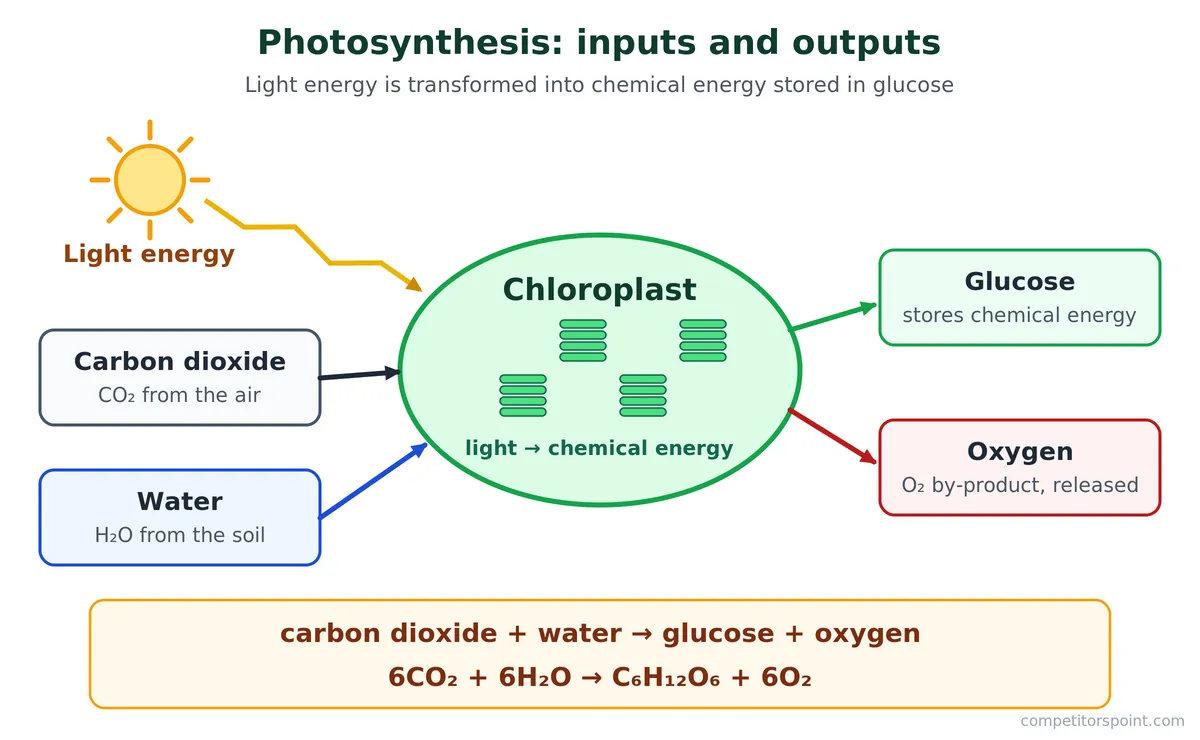
carbon dioxide + water → glucose + oxygen
6CO2 + 6H2O → C6H12O6 + 6O2
Light is written above the arrow, not as a reactant, because it is a form of energy rather than a substance. Chlorophyll is sometimes written there too, as it is needed but not used up.
Where the carbon and hydrogen come from
- Carbon comes from carbon dioxide, which enters leaves through stomata (see gas exchange in leaves).
- Hydrogen comes from water. Light energy is used to split water molecules, and the hydrogen is used to reduce carbon dioxide to sugar.
- Oxygen released into the air comes from the split water, not from carbon dioxide.
So the process is really two linked jobs: splitting water with light energy, and using the products to reduce CO2. HL students study both stages in detail below.
Inside the chloroplast
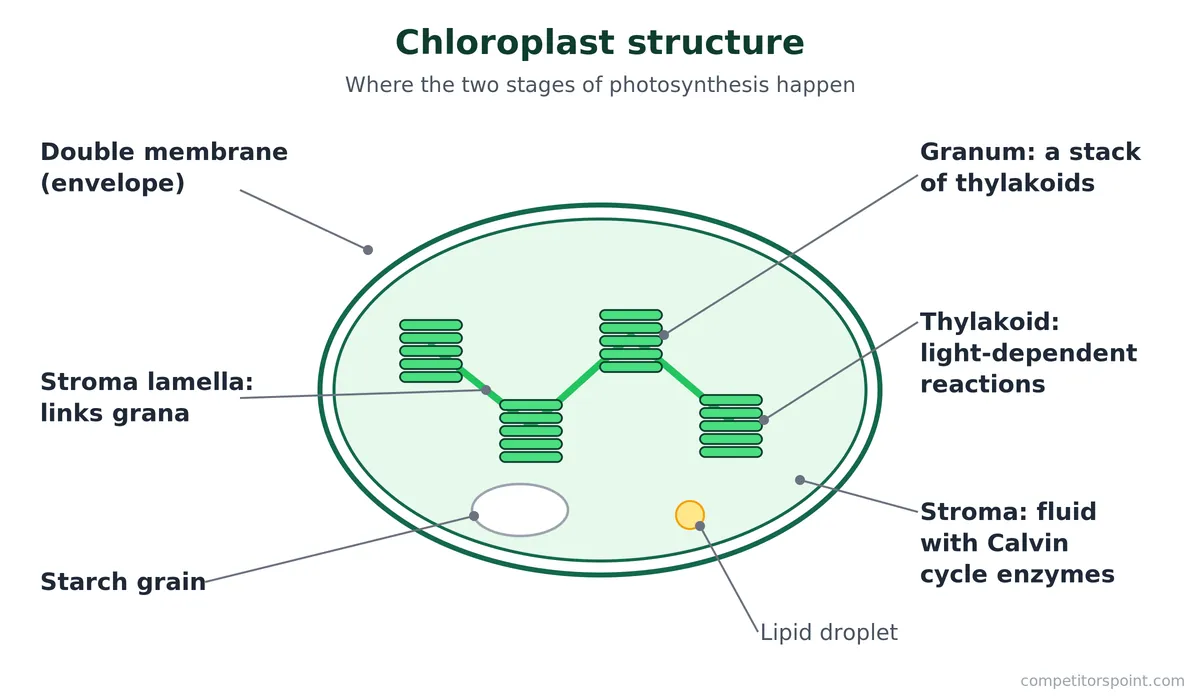
In plants and algae, the whole process happens inside chloroplasts. These organelles have a double membrane and an internal system of flattened sacs called thylakoids, stacked into grana. The fluid around them is the stroma. Cell structure is revised on our plant cells page.
Key idea
Light energy is used to split water. The hydrogen reduces carbon dioxide to make sugar. Oxygen is the waste product.
2 Oxygen: the by-product that changed the planet SL
C1.3.2 Conversion of carbon dioxide to glucose using hydrogen obtained by splitting water · C1.3.3 Oxygen as a by-product of photosynthesis in plants, algae and cyanobacteria
When water is split, each pair of water molecules gives up four electrons, four hydrogen ions and one molecule of oxygen. The cell needs the electrons and hydrogen. The oxygen is surplus, so it diffuses out of the cell and through the stomata.
Evidence that the oxygen comes from water
In 1941, Ruben and Kamen grew the alga Chlorella in water labelled with the heavy isotope oxygen-18. The oxygen gas given off contained the label. When the label was in the carbon dioxide instead, the released oxygen did not carry it. The conclusion: the O2 comes from H2O.
How this changed Earth
- The first organisms to split water were ancestors of today’s cyanobacteria. Chloroplasts later evolved from cyanobacteria taken in by endosymbiosis.
- Oxygen first reacted with dissolved iron in the oceans. Iron oxide settled out as banded iron formations, rock layers mostly laid down about 2.8 to 2.5 billion years ago.
- Once that iron was used up, oxygen built up in the air. This rise, about 2.4 billion years ago, is called the Great Oxidation Event.
- The oxygen-rich atmosphere made aerobic respiration possible, and an ozone layer formed that shields life from ultraviolet light.
Exam tip
If a question says “plants, algae and cyanobacteria”, remember that cyanobacteria are prokaryotes. They have no chloroplasts, but their internal membranes carry the same pigments and do the same job.
3 Photosynthetic pigments, absorption and action spectra SL
C1.3.4 Separation of pigments by chromatography · C1.3.5 Absorption of specific wavelengths of light by photosynthetic pigments · C1.3.6 Similarities and differences of absorption and action spectra
A pigment is a substance that absorbs some wavelengths of visible light and reflects or transmits the rest. The colour we see is the light that is not absorbed. Leaves look green because their main pigments absorb red and blue light strongly and reflect much of the green.
Swipe the table sideways to see every column.
| Pigment | Colour | Light absorbed best | Role |
|---|---|---|---|
| Chlorophyll a | Blue-green | Blue-violet (about 430 nm) and red (about 662 nm) | Main pigment; forms the reaction centres of both photosystems |
| Chlorophyll b | Yellow-green | Blue (about 453 nm) and orange-red (about 642 nm) | Accessory pigment; widens the range of light absorbed |
| Carotenoids (carotene, xanthophylls) | Orange, yellow | Blue and blue-green (about 400 to 500 nm) | Accessory pigments; also protect chlorophyll from damage in bright light |
Separating pigments by chromatography
Chromatography shows that a leaf holds several pigments, not one. The method below uses thin-layer chromatography (TLC); paper chromatography works the same way.
- Grind a leaf with a little sand and propanone to extract the pigments.
- Draw a pencil origin line about 1 cm from the bottom of the TLC strip. Ink would dissolve and run.
- Spot the extract onto the origin many times, letting each spot dry, to build a small, concentrated spot.
- Stand the strip in a sealed tube with solvent below the origin line, so the pigments are not washed off.
- Remove the strip when the solvent is near the top, and mark the solvent front at once before it evaporates.
Each pigment moves a different distance. That depends on how soluble it is in the solvent and how strongly it sticks to the stationary phase. It is not simply about molecule size.
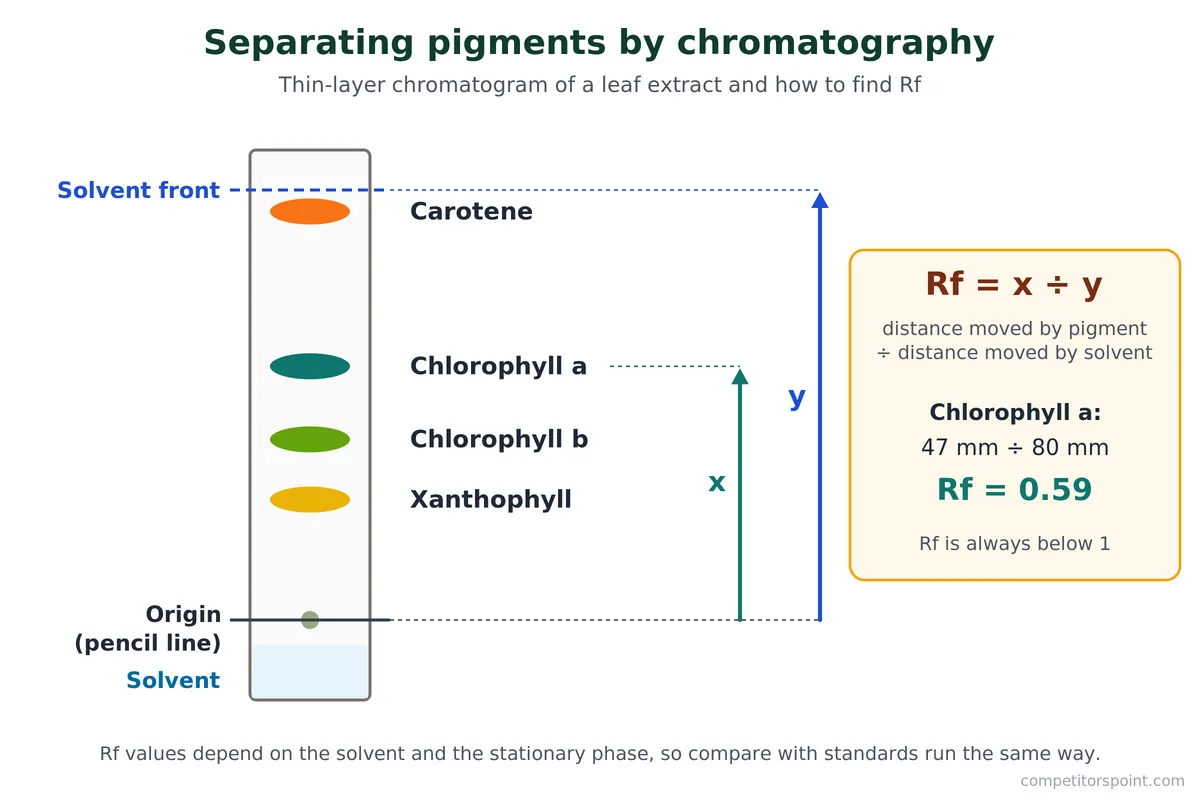
Rf = distance moved by pigment ÷ distance moved by solvent front
Worked example: Rf values
- The solvent front is 80 mm from the origin.
- Spots are at 76 mm, 47 mm, 34 mm and 22 mm.
- Rf = 76 ÷ 80 = 0.95 (carotene); 47 ÷ 80 = 0.59 (chlorophyll a); 34 ÷ 80 = 0.42 (chlorophyll b); 22 ÷ 80 = 0.28 (xanthophyll).
- Measure to the centre of each spot. Rf has no units and is always below 1.
Exam tip
Rf values change with the solvent and the stationary phase. On paper, xanthophyll often runs above chlorophyll a. Identify pigments by colour and by comparing with a published table for the same method.
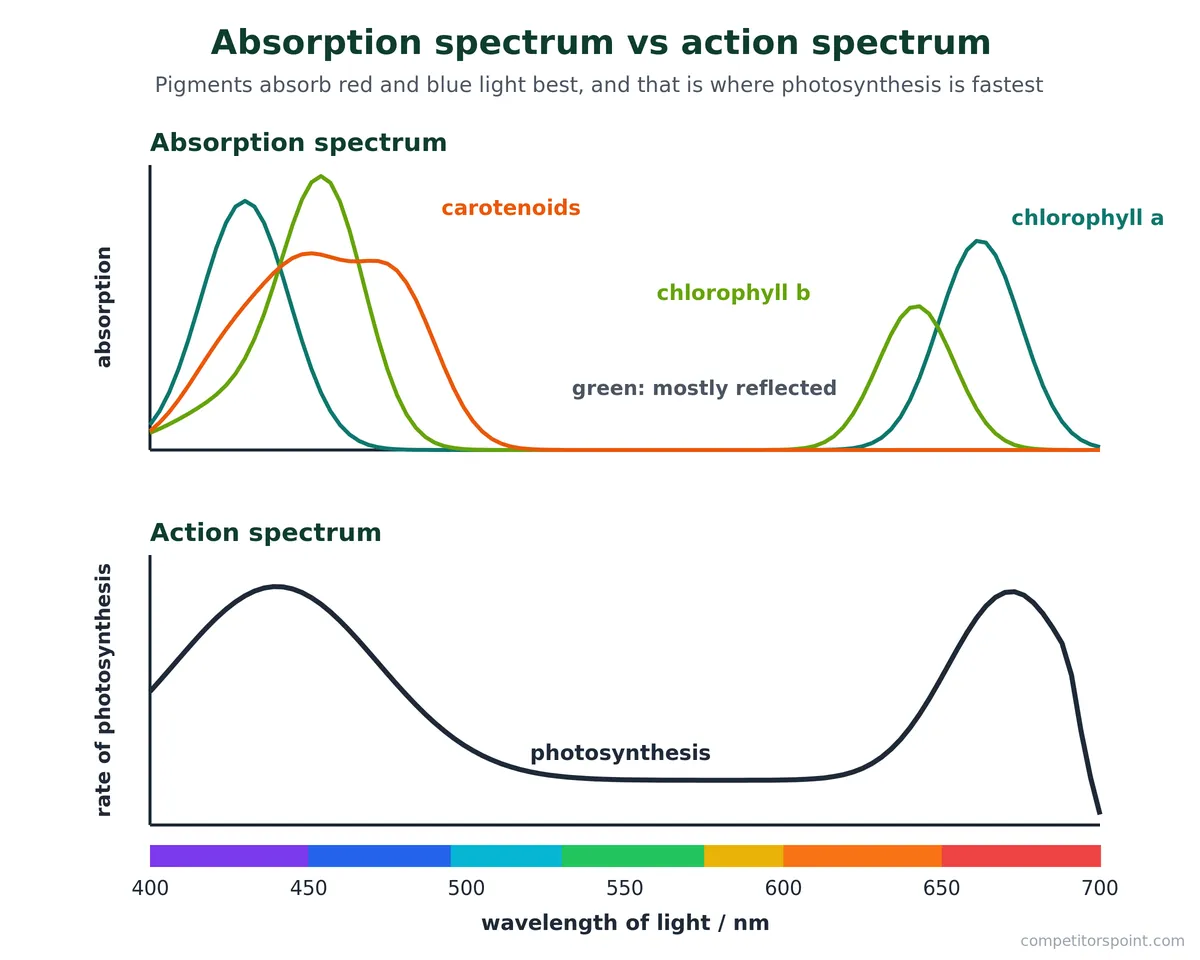
Absorption spectrum
An absorption spectrum is a graph of how much light a pigment absorbs at each wavelength. It is measured with a colorimeter or spectrophotometer on an extract of the pigment.
- Chlorophylls have two peaks: one in blue-violet and one in red.
- Carotenoids absorb only in the blue-green part of the spectrum.
- Very little green and yellow light (about 500 to 600 nm) is absorbed by any of them.
Action spectrum
An action spectrum shows the rate of photosynthesis at each wavelength of light. It is found by lighting a plant or alga with one wavelength at a time and measuring oxygen release or carbon dioxide uptake.
Swipe the table sideways to see every column.
| Absorption spectrum | Action spectrum | |
|---|---|---|
| y-axis | Percentage of light absorbed | Rate of photosynthesis |
| Measured on | One pigment (or a pigment extract) | A whole plant, leaf or alga |
| Peaks | Blue and red (chlorophylls); blue only (carotenoids) | Blue and red |
| Green light | Chlorophylls absorb very little | Rate is low but not zero |
The two curves have the same overall shape. That is the evidence that the light absorbed by these pigments is the light used for the process. The rate curve is a little wider, because accessory pigments pass energy on to chlorophyll a and a leaf scatters green light inside, giving it more chances to be absorbed.
Engelmann’s experiment
In 1882 Theodor Engelmann produced one of the first action spectra with a microscope and a prism. He shone a spectrum of light along a filament of the green alga Spirogyra in water with aerobic, motile bacteria.
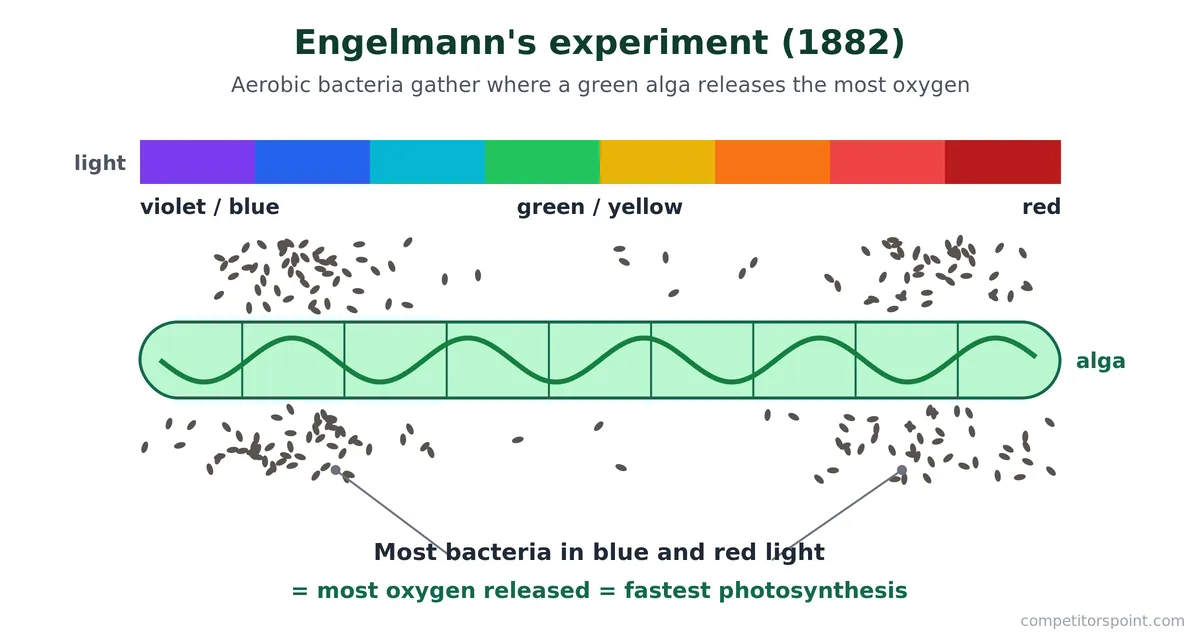
The bacteria gathered thickly in the blue and red regions and hardly at all in green. Engelmann used living bacteria as an oxygen detector, long before electronic sensors existed.
Key idea
Absorption = what the pigments take in. Action = what the plant actually uses. They match because absorbed light drives photosynthesis.
4 Limiting factors and the rate of photosynthesis SL
C1.3.7 Investigating the effects of limiting factors on the rate of photosynthesis · C1.3.8 Carbon dioxide enrichment experiments as a means of predicting future rates
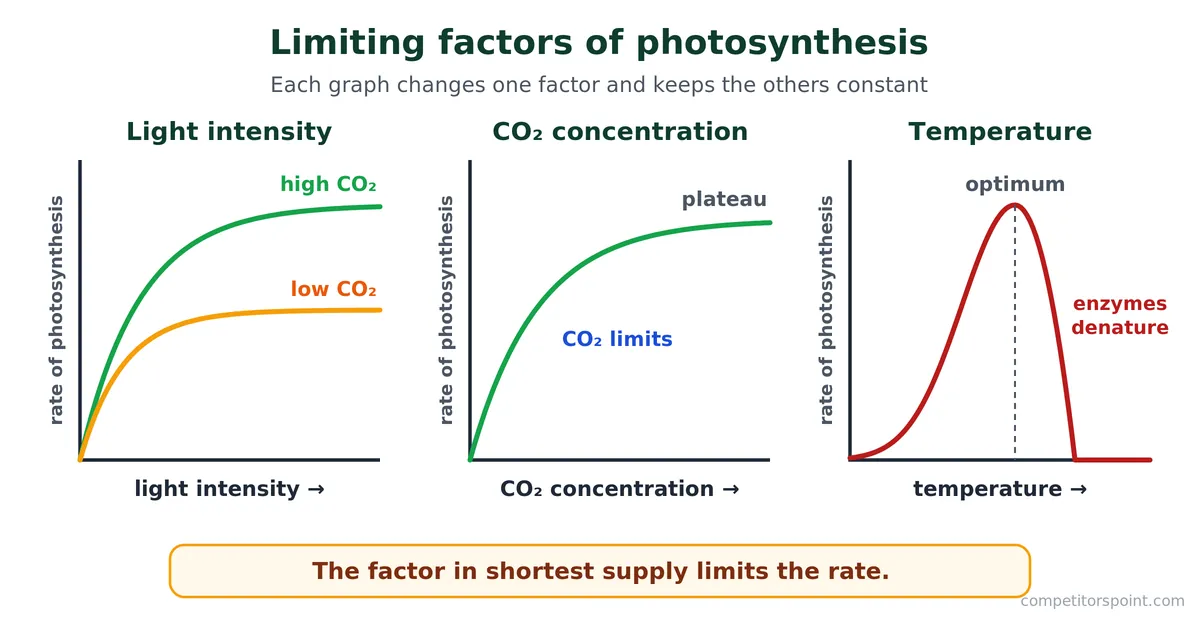
The rate of any process controlled by several factors is set by the one in shortest supply. That factor is the limiting factor. Raising it speeds things up, while raising the others has no effect until it stops being the limit.
For photosynthesis, IB expects you to know three external limiting factors: light intensity, carbon dioxide concentration and temperature.
Light intensity
At low light, the rate rises steadily as light increases, because light is the limit. Eventually the curve levels off. At that plateau something else, usually CO2 or temperature, is limiting. The two curves in Figure 6 prove it: with more CO2, the plateau is higher.
Carbon dioxide concentration
CO2 is the substrate for carbon fixation. The rate rises with CO2 concentration until the enzyme that fixes it is working as fast as it can, or until light limits the supply of ATP and reduced NADP.
Temperature
The light-independent reactions are catalysed by enzymes, so temperature matters. The rate rises to an optimum, often around 25 to 35 °C in temperate plants, then falls steeply as enzymes denature. Light absorption itself is hardly affected by temperature. Revise enzyme activity on our enzymes page.
Exam tip
To say which factor is limiting at a point on a graph, ask: “If I raised this factor, would the rate go up?” On a rising slope, the factor on the x-axis is limiting. On a plateau, it is not.
How to measure the rate
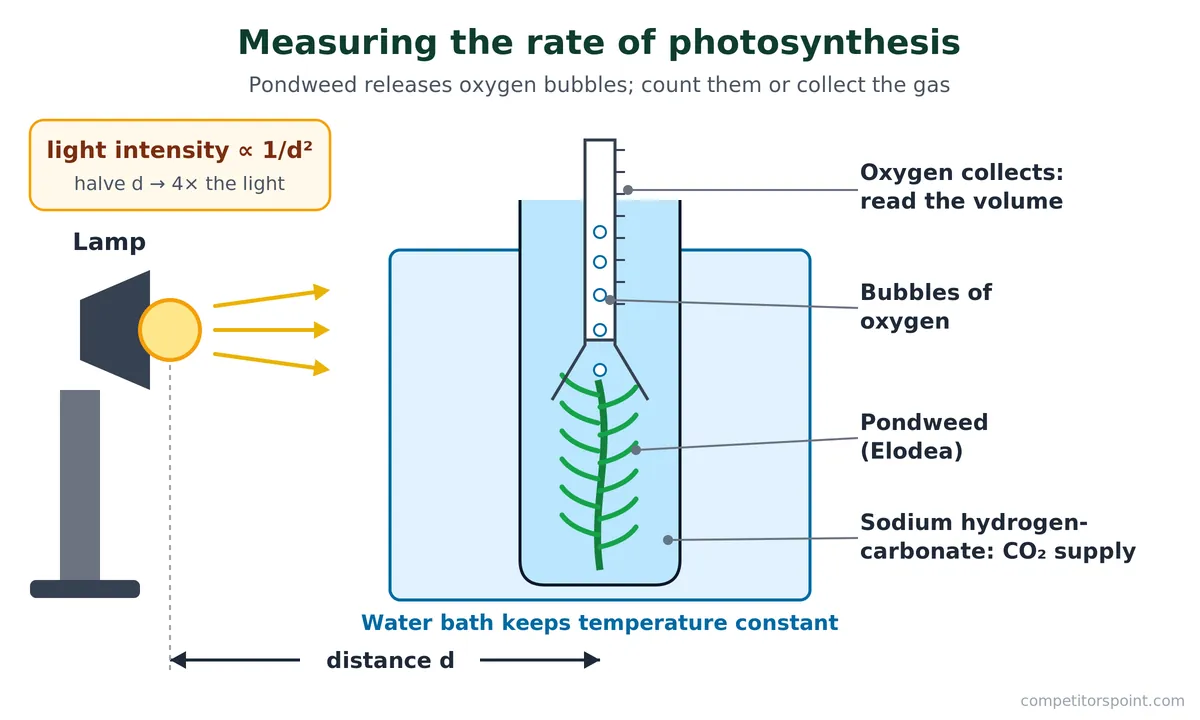
The rate can be measured by the production of oxygen, the uptake of carbon dioxide or the increase in biomass. Common school methods are:
- Counting bubbles or collecting gas from pondweed such as Elodea or Cabomba in a gas syringe or capillary tube.
- Floating leaf discs: discs with air removed sink, then float as oxygen builds up. Time how long until they float.
- Oxygen or CO2 sensors with a data logger, for example with a suspension of Chlorella.
- pH change: as CO2 is taken up, the water becomes less acidic. Hydrogencarbonate indicator shows this as a colour change.
Varying one factor at a time
Swipe the table sideways to see every column.
| Factor | How to vary it | How to keep it constant |
|---|---|---|
| Light intensity | Move the lamp to different distances, or use neutral filters | Fixed lamp distance in a dark room; same bulb |
| CO2 concentration | Different concentrations of sodium hydrogencarbonate solution | Same concentration, in excess, in every trial |
| Temperature | Thermostatic water baths at different temperatures | One water bath; LED lamps or a heat filter so the lamp does not warm the water |
Light intensity falls with the square of the distance from a point source. Relative light intensity can therefore be calculated as 1 ÷ d2. Halving the distance gives four times the light.
Worked example: rate of oxygen production
- A gas syringe collects 0.54 cm3 of oxygen from pondweed in 6 minutes.
- Rate = 0.54 ÷ 6 = 0.09 cm3 min−1.
- The lamp is moved from 20 cm to 10 cm. Relative light intensity = 1 ÷ 102 = 0.01, compared with 1 ÷ 202 = 0.0025. The light is 4 times brighter.
- If the rate does not rise fourfold, light was not the only limiting factor.
Practical skills
Let the plant acclimatise for a few minutes at each new condition before timing. Repeat each reading at least three times and take a mean. Bubbles vary in size, so collected gas volume is more reliable than a bubble count.
CO2 enrichment and the future
Atmospheric CO2 was about 280 ppm before the industrial revolution. It is now above 420 ppm, according to the NOAA Mauna Loa record, and could pass 550 ppm later this century. Will plants photosynthesise faster? Enrichment experiments test this.
- Greenhouses: growers of tomatoes and other crops raise CO2 to roughly 800 to 1000 ppm, along with extra light and warmth, to increase yield.
- Enclosed chambers: plants are grown in sealed chambers at set CO2 levels. These are easy to control but do not match field conditions.
- FACE (free-air CO2 enrichment): rings of pipes or towers release CO2 over plots of crops or forest in the open. Sensors and the wind direction control release so the air inside stays near a target, such as 550 ppm. Control rings release ordinary air. Examples include EucFACE in an Australian woodland and BIFoR FACE in an English oak forest.
Results show that extra CO2 usually increases the rate at first. The size of the gain is often limited by other factors, such as nitrogen and phosphorus supply, water, and higher temperatures. This is why long-term field trials are more reliable than short laboratory tests for predicting future food production and carbon uptake.
Going further: compensation point
At the compensation point, the rate of photosynthesis equals the rate of respiration, so there is no net gas exchange. Below this light intensity, a plant uses more sugar than it makes. This idea is useful for data questions but is not a named IB understanding.
5 Light-dependent reactions: photosystems and photolysis of water HL
C1.3.9 Photosystems as arrays of pigment molecules that can generate and emit excited electrons · C1.3.10 Advantages of the structured array · C1.3.11 Generation of oxygen by the photolysis of water in photosystem II · C1.3.14 Thylakoids as systems for performing the light-dependent reactions
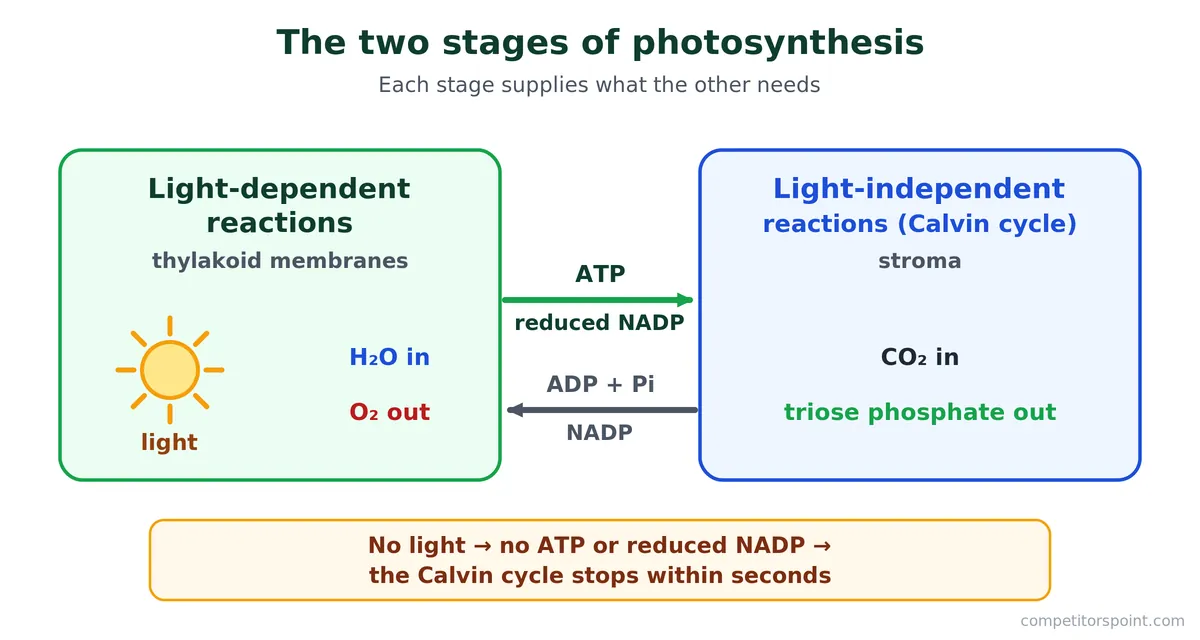
Photosynthesis happens in two stages. The light-dependent reactions take place on the thylakoid membranes. They use light energy to make ATP and reduced NADP, and release oxygen. The light-independent reactions take place in the stroma. They use that ATP and reduced NADP to fix carbon dioxide.
What a photosystem is
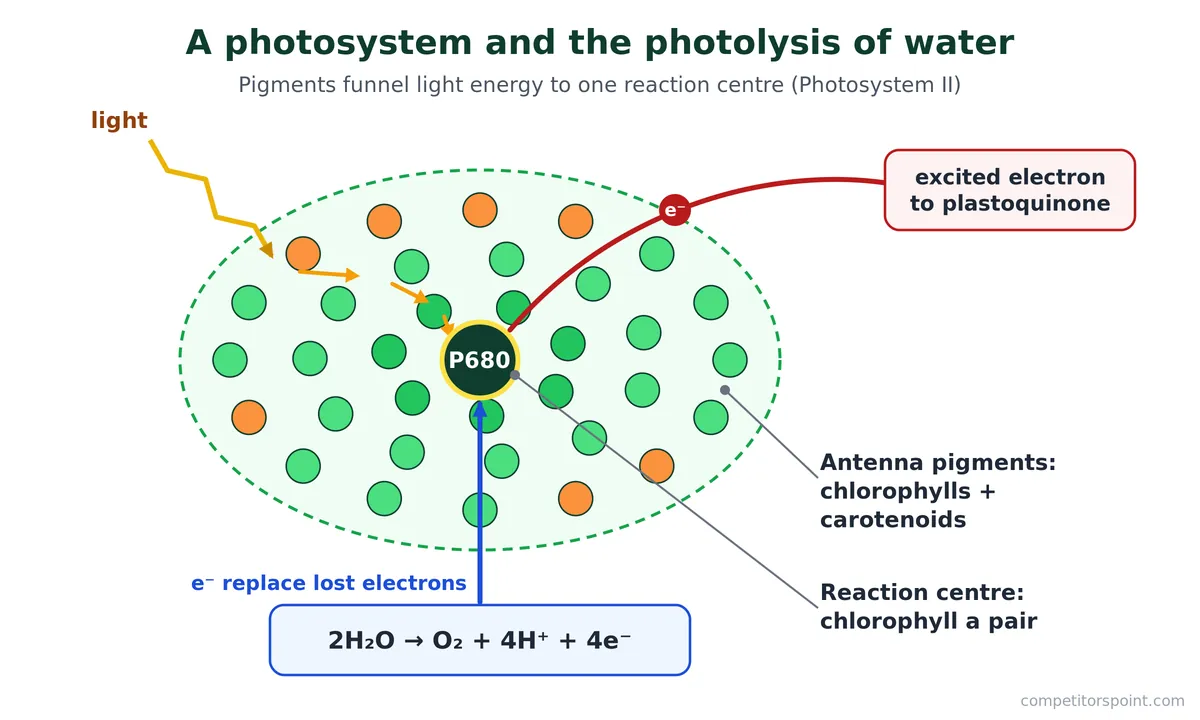
Pigments in the thylakoid membrane are not scattered at random. They are held by proteins in large clusters called photosystems. Each one contains more than a hundred pigment molecules: chlorophylls plus carotenoids.
- Most of the pigments form the light-harvesting (antenna) complex. When one absorbs a photon, the energy passes from molecule to molecule.
- The energy is funnelled to the reaction centre: a special pair of chlorophyll a molecules.
- Here the energy raises an electron to a high energy level, and the excited electron is passed to an electron acceptor. This is the step that turns light energy into chemical energy.
There are two types. Photosystem II (PSII) has a reaction centre called P680, because it absorbs best at 680 nm. Photosystem I (PSI) has P700. PSII was numbered second because it was discovered second, even though it acts first.
Why a structured array works better
- More photons caught: hundreds of pigments cover a large area and a wider range of wavelengths than one chlorophyll could.
- Energy reaches the right place: the array passes energy to the reaction centre quickly, before it is lost as heat or light.
- Electrons go somewhere useful: the acceptor sits right next to the reaction centre, so an excited electron is captured at once.
- Linked chain: fixed positions in the membrane let electrons flow in order from PSII to PSI to NADP.
A single chlorophyll molecule floating in solution just re-emits the energy as red fluorescence. It cannot do useful chemistry.
Photolysis of water
Each time PSII loses an excited electron, P680 is left short of one. It is a very strong oxidising agent, strong enough to pull electrons from water. An enzyme complex on the lumen side of PSII, the oxygen-evolving complex, holds a cluster of manganese and calcium. It splits water:
2H2O → O2 + 4H+ + 4e−
- The electrons replace those lost from P680.
- The hydrogen ions stay in the thylakoid lumen and add to the proton gradient.
- The oxygen diffuses out of the chloroplast as a by-product.
The thylakoid as a system
The thylakoid membrane holds everything needed, in order: PSII, the electron carriers, PSI and ATP synthase. It also encloses a small space, the lumen, in which protons collect. Large membrane area in the grana means many photosystems, and a small lumen means a steep gradient builds fast.
6 Z-scheme: cyclic and non-cyclic photophosphorylation HL
C1.3.13 Reduction of NADP by photosystem I · plus the cyclic route in which electrons return to photosystem I
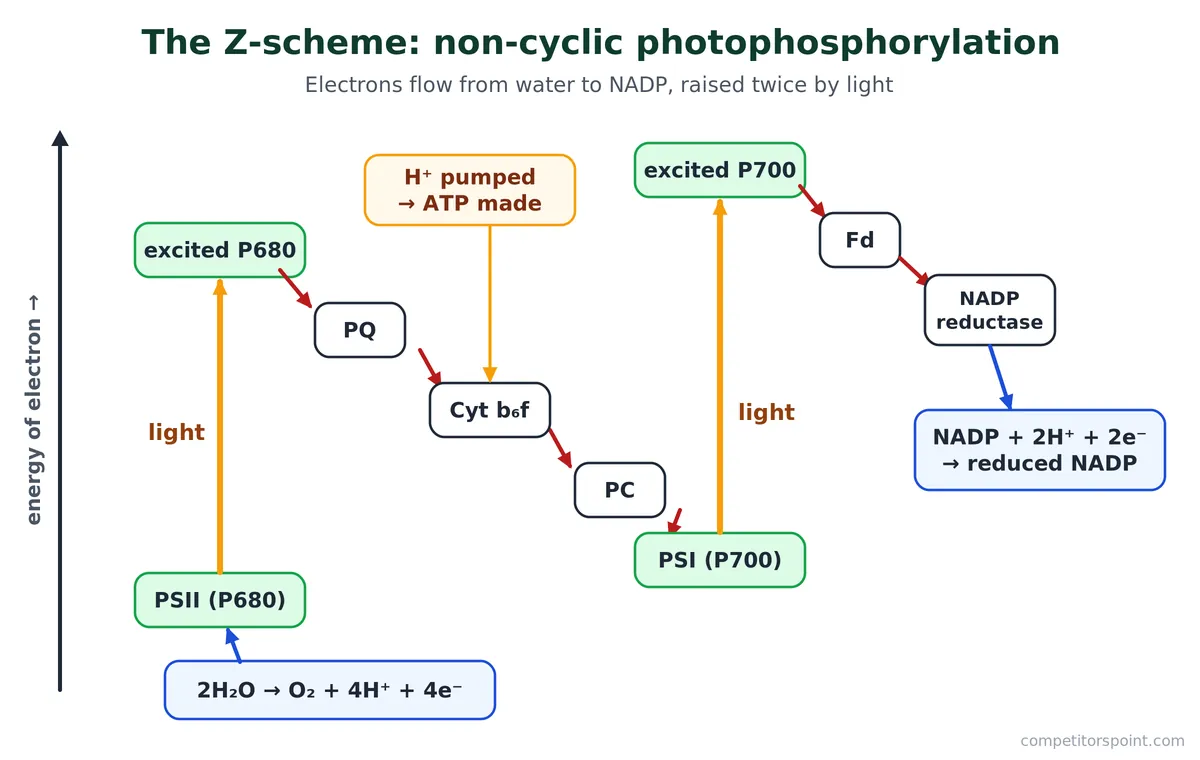
Making ATP using light energy is called photophosphorylation. There are two routes. The main one is non-cyclic, and its energy profile looks like a letter Z on its side, hence “Z-scheme”.
Non-cyclic photophosphorylation
- Light excites an electron in PSII. It passes to plastoquinone (PQ), a small mobile carrier in the membrane.
- PQ carries the electron to the cytochrome b6f complex. As electrons pass through, it pumps H+ from the stroma into the lumen.
- Plastocyanin (PC), a carrier in the lumen, takes the electron to PSI.
- Light excites the electron again in PSI. It passes to ferredoxin (Fd).
- The enzyme NADP reductase, on the stroma side, uses two electrons and an H+ to make reduced NADP.
- PSII refills its lost electrons from photolysis. PSI refills from plastocyanin.
The products of the non-cyclic route are ATP, reduced NADP and oxygen. The electrons travel one way, from water to NADP, and never return.
Cyclic photophosphorylation
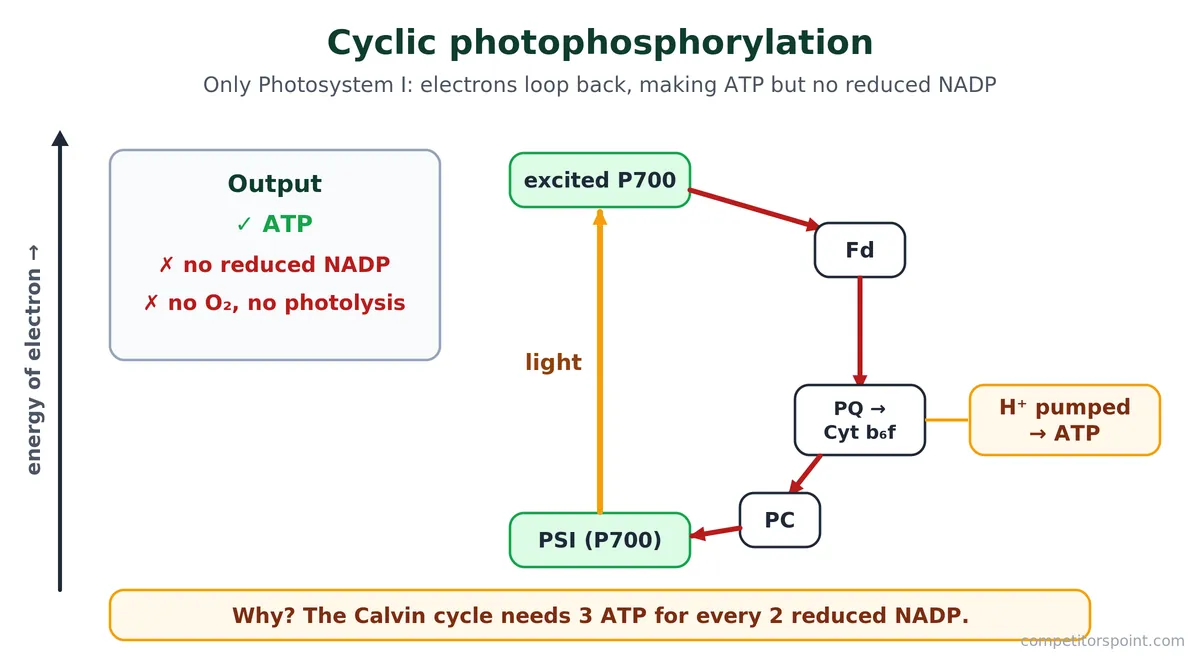
Sometimes electrons from ferredoxin go back to the cytochrome complex instead of to NADP. They then return through plastocyanin to PSI. Only PSI is involved.
Swipe the table sideways to see every column.
| Non-cyclic | Cyclic | |
|---|---|---|
| Photosystems | PSII and PSI | PSI only |
| Source of electrons | Water (photolysis) | PSI itself (they come back) |
| Final electron acceptor | NADP | PSI |
| Products | ATP, reduced NADP, O2 | ATP only |
Why bother with the cyclic route? Carbon fixation uses 3 ATP for every 2 reduced NADP. Non-cyclic flow alone makes slightly too little ATP for that ratio. The cyclic route tops up the ATP without making more reduced NADP.
7 Chemiosmosis and ATP synthase in chloroplasts HL
C1.3.12 Production of ATP by chemiosmosis in thylakoids
ATP is made in chloroplasts by the same mechanism as in mitochondria: chemiosmosis. Energy from electrons builds a proton gradient, and the gradient drives ATP synthase. If you have studied the electron transport chain in respiration, this will look familiar.
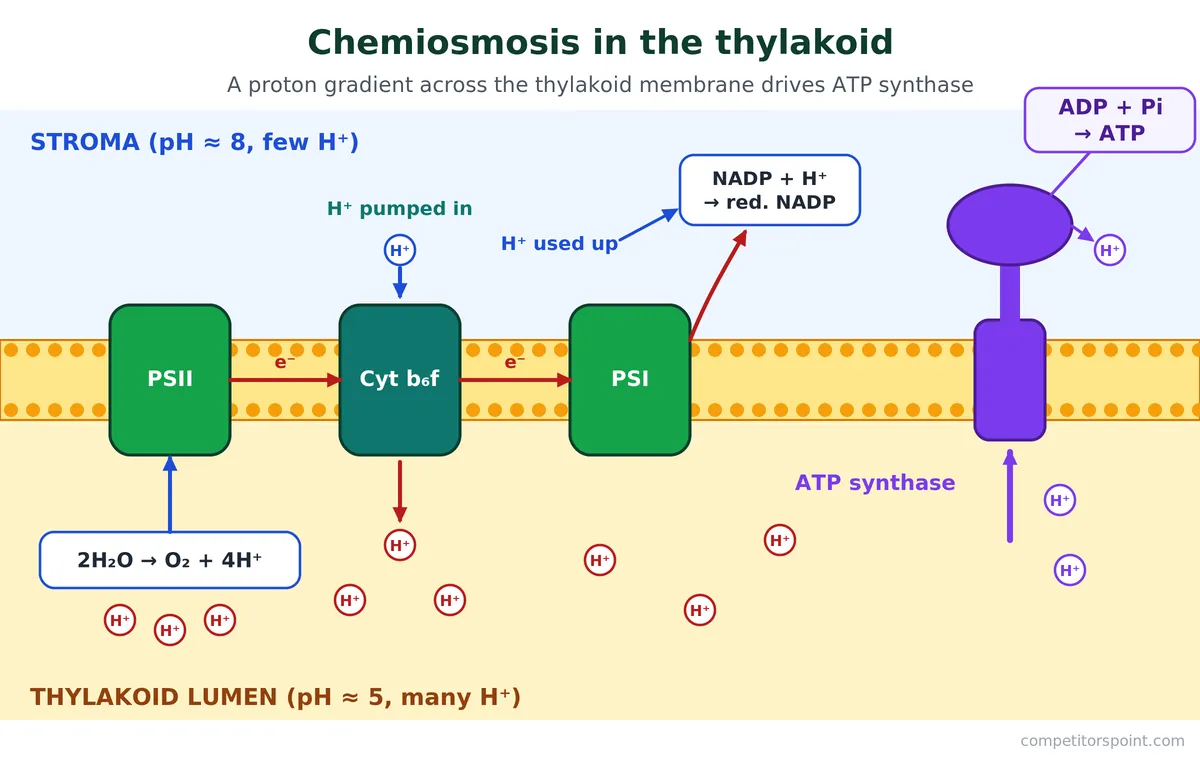
Building the proton gradient
- Photolysis releases H+ inside the lumen.
- Cytochrome b6f uses energy from passing electrons to pump H+ from the stroma into the lumen.
- NADP reductase removes H+ from the stroma when it makes reduced NADP.
In bright light, the lumen can reach about pH 5 while the stroma rises to about pH 8. That is roughly a thousandfold difference in H+ concentration.
ATP synthase
The thylakoid membrane is impermeable to H+, so the ions can only flow back to the stroma through ATP synthase. As they pass through, part of the enzyme rotates and the energy is used to join ADP and inorganic phosphate. ATP is released into the stroma, exactly where carbon fixation needs it.
Evidence: the acid-bath experiment
In 1966, Jagendorf soaked isolated thylakoids in an acid at pH 4 in the dark, then moved them into a buffer at pH 8 with ADP and phosphate. They made ATP, with no light at all. A proton gradient alone was enough to drive ATP synthase.
Chloroplast vs mitochondrion
Swipe the table sideways to see every column.
| Chloroplast | Mitochondrion | |
|---|---|---|
| Energy source for pumping | Light (excited electrons) | Oxidation of food (NADH, FADH2) |
| H+ pumped into | Thylakoid lumen | Intermembrane space |
| ATP made in | Stroma | Matrix |
| Final electron acceptor | NADP | Oxygen |
For a side-by-side diagram, see mitochondria vs chloroplasts. For how ATP is then used, see ATP as the energy currency.
8 Calvin cycle: carbon fixation by Rubisco HL
C1.3.15 Carbon fixation by Rubisco · C1.3.16 Synthesis of triose phosphate using reduced NADP and ATP · C1.3.17 Regeneration of RuBP using ATP
The Calvin cycle is the set of light-independent reactions in the stroma. It does not use light directly, but it needs a constant supply of ATP and reduced NADP from the light-dependent reactions. It has three stages.
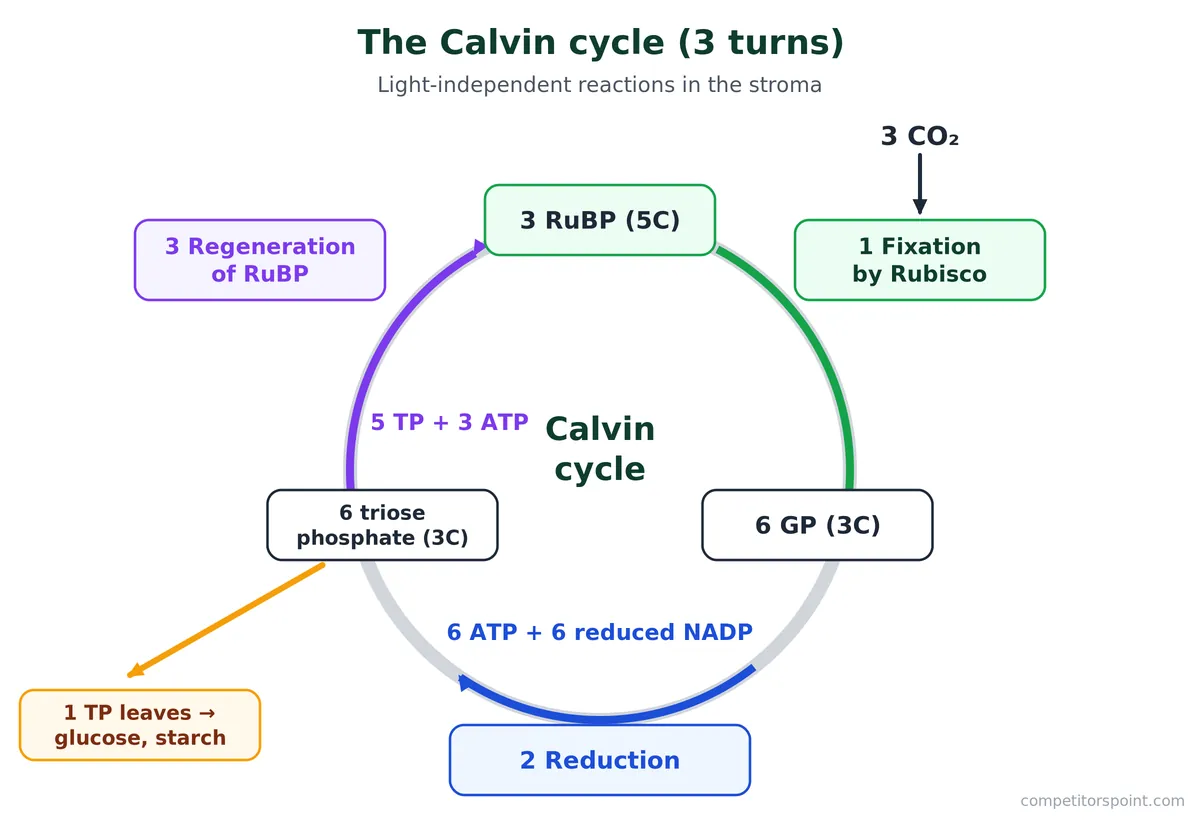
Stage 1: carbon fixation
Carbon dioxide combines with ribulose bisphosphate (RuBP), a five-carbon sugar. The six-carbon product is unstable and splits at once into two molecules of glycerate 3-phosphate (GP), each with three carbons.
CO2 + RuBP (5C) → 2 GP (3C)
The enzyme is Rubisco (ribulose bisphosphate carboxylase). It is slow, fixing only about three CO2 molecules per second. Chloroplasts make up for this by containing huge amounts of it. Rubisco is thought to be the most abundant enzyme on Earth.
Stage 2: reduction to triose phosphate
Each GP is phosphorylated by ATP and then reduced by reduced NADP to form triose phosphate (TP). This is the first carbohydrate made, and the step where energy from light is finally locked into sugar.
GP + ATP + reduced NADP → triose phosphate + ADP + Pi + NADP
Stage 3: regeneration of RuBP
For the cycle to continue, RuBP must be remade. Five out of every six triose phosphates are rearranged, using ATP, to rebuild three RuBP. Only one in six leaves the cycle as product.
Worked example: counting atoms and ATP
- Three turns: 3 CO2 + 3 RuBP (15 C) → 6 GP (18 C).
- Reduction: 6 GP use 6 ATP + 6 reduced NADP → 6 TP.
- Regeneration: 5 TP (15 C) + 3 ATP → 3 RuBP (15 C).
- Net: 1 TP made, using 9 ATP and 6 reduced NADP (a 3 : 2 ratio).
- One glucose (6 C) needs two TP, so six turns: 6 CO2, 18 ATP and 12 reduced NADP.
Exam tip
Name the stages and molecules exactly: fixation by Rubisco, reduction of GP to TP, regeneration of RuBP. Do not call GP “PGA” in an IB answer unless you also give the IB name.
Classic evidence came from Calvin, Benson and Bassham, who fed 14C-labelled CO2 to Chlorella and stopped the reactions in hot methanol after a few seconds. Chromatography of the extracts showed that GP was the first labelled compound. When the light was switched off, GP rose and RuBP fell, because GP could no longer be reduced but RuBP was still being used up.
9 From triose phosphate to everything a plant needs HL
C1.3.18 Synthesis of carbohydrates, amino acids and other products · C1.3.19 Interdependence of the light-dependent and light-independent reactions
Triose phosphate is the starting point for almost every organic molecule in a plant. Making many of them also needs mineral ions absorbed from the soil.
Swipe the table sideways to see every column.
| Product | Made from TP plus | Used for |
|---|---|---|
| Glucose, then starch | Nothing extra | Starch is stored in chloroplasts and storage organs |
| Sucrose | Nothing extra | Transported in phloem to the rest of the plant |
| Cellulose | Nothing extra | Cell walls |
| Fatty acids and glycerol | Nothing extra | Lipids for membranes and oil stores |
| Amino acids | Nitrogen (nitrate or ammonium); sulfur for some | Proteins, including Rubisco |
| Nucleotides | Nitrogen and phosphate | DNA, RNA and ATP |
Chlorophyll itself needs magnesium and nitrogen. That is why plants short of these minerals turn yellow.
The two stages depend on each other
- Carbon fixation needs ATP and reduced NADP, which only the light-dependent reactions make.
- The light-dependent reactions need ADP, phosphate and NADP. The cycle in the stroma returns these.
- In the dark, ATP and reduced NADP run out within seconds, so carbon fixation stops too.
- If CO2 runs out, NADP is not returned, so non-cyclic electron flow slows down.
Photosynthesis therefore behaves as one integrated system, even though its two halves run in different parts of the chloroplast.
10 Exam traps
- “Oxygen comes from CO2.” No. It comes from water, as shown with 18O.
- “The light-independent reactions happen at night.” No. They happen in the light, because they need ATP and reduced NADP that are only made in the light.
- “Plants don’t use green light.” They use a little. The rate in green light is low but not zero.
- “Smaller pigments travel further in chromatography.” No. Movement depends on solubility in the solvent and attraction to the stationary phase.
- “ATP synthase pumps protons.” No. H+ flows down its gradient through ATP synthase. The cytochrome complex does the pumping.
- “H+ builds up in the stroma.” No. It builds up in the thylakoid lumen.
- “NADPH”. IB uses reduced NADP. Either is accepted in markschemes, but stay consistent.
- “Glucose is the direct product of carbon fixation.” No. Triose phosphate is. Glucose is made from it.
11 Key terms
12 Common doubts about photosynthesis
These are the questions students ask most often about this topic.
What is photosynthesis in simple terms?
Photosynthesis is the way plants, algae and cyanobacteria use light energy to make sugar from carbon dioxide and water. Oxygen is released as a by-product. The light energy ends up stored as chemical energy in the sugar.
Why are leaves green?
Chlorophylls absorb red and blue light strongly but absorb little green light. Most green light is reflected or passes through the leaf, so that is the colour we see.
What is the difference between an absorption spectrum and an action spectrum?
The first shows how much light a pigment absorbs at each wavelength. The second shows the rate of photosynthesis at each wavelength. They have a similar shape, which shows that the absorbed light is the light used.
How do you calculate an Rf value?
Divide the distance moved by the pigment from the origin by the distance moved by the solvent front. Measure both from the origin line. For example, 47 mm divided by 80 mm gives an Rf of 0.59.
What are the limiting factors of photosynthesis?
The three external limiting factors are light intensity, carbon dioxide concentration and temperature. Whichever is in shortest supply sets the rate. Raising one of the others has no effect until the limiting one is increased.
Where does the oxygen released by plants come from?
It comes from water, which is split by photolysis in photosystem II. Experiments with water labelled with oxygen-18 showed that the label appears in the oxygen gas released.
What is the role of Rubisco?
Rubisco is the enzyme that fixes carbon dioxide. It joins CO2 to ribulose bisphosphate, and the product splits into two molecules of glycerate 3-phosphate. It is the first step of the cycle in the stroma.
Why does the Calvin cycle stop in the dark?
The Calvin cycle needs ATP and reduced NADP from the light-dependent reactions. In the dark these run out within seconds, so GP cannot be reduced and RuBP cannot be regenerated.
What is the difference between cyclic and non-cyclic photophosphorylation?
Non-cyclic photophosphorylation uses both photosystems, splits water and makes ATP, reduced NADP and oxygen. Cyclic photophosphorylation uses only photosystem I; electrons return to it, so only ATP is made.
How is chemiosmosis in chloroplasts different from mitochondria?
Both use a proton gradient and ATP synthase. In chloroplasts, light energy pumps protons into the thylakoid lumen and ATP is made in the stroma. In mitochondria, energy from food pumps protons into the intermembrane space and ATP is made in the matrix.
13 Self-check questions SL HL
Tap each question to reveal the answer. Questions 1 to 6 are for all students; 7 to 10 are HL.
Test yourself on photosynthesis
1. Write the balanced symbol equation for photosynthesis.
6CO2 + 6H2O → C6H12O6 + 6O2 (with light energy written above the arrow).
2. Why must the origin line on a chromatogram be drawn in pencil?
Graphite does not dissolve in the solvent. Ink would dissolve and separate, mixing with the pigment spots.
3. A pigment moves 30 mm while the solvent moves 75 mm. Calculate its Rf.
30 ÷ 75 = 0.40.
4. State one similarity and one difference between an absorption spectrum and an action spectrum.
Similarity: both peak in blue and red light. Difference: one plots light absorbed by a pigment, while the other plots the rate of photosynthesis (and is not zero in green).
5. A lamp is moved from 30 cm to 15 cm from a plant. By what factor does light intensity change?
It increases by a factor of 4, because intensity is proportional to 1 ÷ d2: (30 ÷ 15)2 = 4.
6. Explain why FACE experiments give more reliable predictions than greenhouse trials.
FACE raises CO2 over plants growing in natural field conditions, with normal soil, water, wind, pests and temperatures, over many years. Greenhouses keep other factors high, so they overestimate the effect of CO2 alone.
7. State the three products of photolysis and what happens to each.
Electrons replace those lost by P680 in PSII; H+ stays in the lumen and adds to the proton gradient; O2 diffuses out as a by-product.
8. Explain how ATP is made by chemiosmosis in a chloroplast.
Electron flow powers cytochrome b6f to pump H+ into the lumen, and photolysis adds more. The gradient makes H+ flow back to the stroma through ATP synthase, which uses the energy to make ATP from ADP and Pi.
9. How many turns of the cycle, ATP and reduced NADP are needed to make one glucose?
Six turns, 18 ATP and 12 reduced NADP.
10. Predict what happens to GP and RuBP levels when the CO2 supply is cut off. Explain.
RuBP rises and GP falls. RuBP is still regenerated from TP but is not used up in fixation, while GP is still converted to TP but no new GP is made.
Ready to practise? Download the Photosynthesis IB question set (SL + HL) with markscheme.
Further reading: the official IB Diploma Programme biology course page, and the open textbook chapter Chloroplasts and Photosynthesis (Alberts et al., Molecular Biology of the Cell, NCBI Bookshelf).
© competitorspoint.com · IB Biology notes. Diagrams are original to competitorspoint.com.