
Krebs Cycle (Citric Acid Cycle)
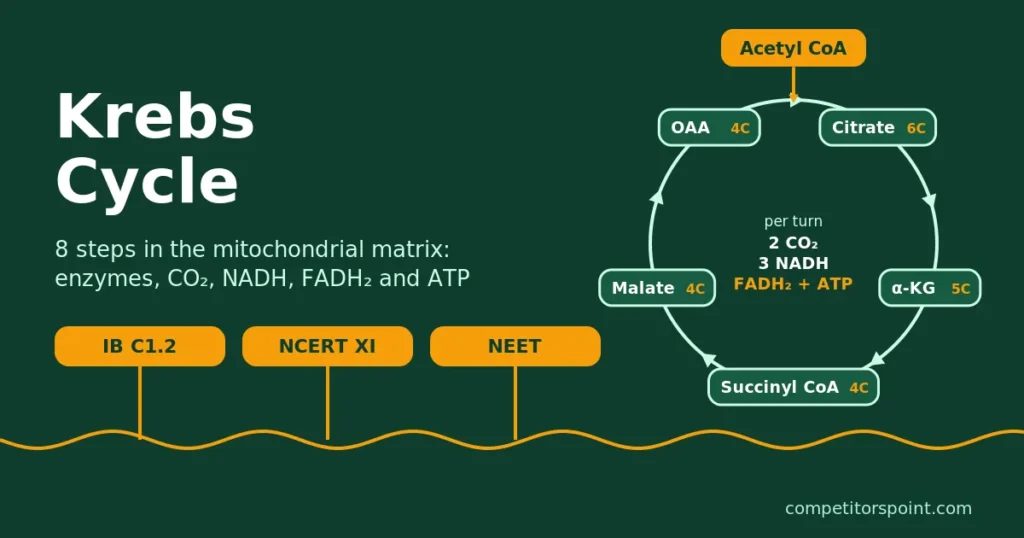
The Krebs cycle (citric acid or TCA cycle) is the third stage of aerobic respiration, in which the acetyl group of acetyl CoA is fully oxidised in the mitochondrial matrix through eight enzyme-controlled steps. Each turn releases 2 CO2 and makes 3 NADH, 1 FADH2 and 1 ATP (or GTP), regenerating oxaloacetate to restart the cycle.
1 Introduction to the Krebs cycle
Syllabus link: IB Biology C1.2 Cell respiration (first assessment 2025; the link reaction and Krebs cycle are C1.2.11 and C1.2.12, Higher Level); NCERT Class XI Respiration in Plants (tricarboxylic acid cycle)
NEET = point NCERT and NEET stress IB HL = detail the IB guide expects at Higher Level
Aerobic respiration releases energy from glucose in four stages: glycolysis in the cytoplasm, the link reaction, the Krebs cycle and the electron transport chain with oxidative phosphorylation. Glycolysis and the link reaction leave most of the energy of glucose still locked in the acetyl group of acetyl CoA. The Krebs cycle finishes the job of oxidation: it strips hydrogen (electrons) from the acetyl group, loads it onto the carriers NAD+ and FAD, and releases the carbon as CO2.
The cycle is named after Hans Krebs, who worked it out in 1937 and shared the 1953 Nobel Prize in Physiology or Medicine. It is also called the citric acid cycle, because citric acid (citrate) is the first product, and the tricarboxylic acid (TCA) cycle, because citrate and isocitrate each carry three carboxyl groups. All three names describe the same pathway.
This chapter covers where the cycle runs, how acetyl CoA is made, each of the eight steps with its enzyme and products, the yield per acetyl CoA and per glucose, the amphibolic role, regulation, a comparison with glycolysis, the NCERT points that NEET tests and the traps examiners set. For the bigger picture, start from the photosynthesis and cell respiration hub.
2 Where does the Krebs cycle happen?
In eukaryotes the Krebs cycle takes place in the mitochondrial matrix, the fluid-filled space inside the inner mitochondrial membrane (see mitochondria among the cell organelles). The matrix holds the soluble Krebs enzymes, the coenzymes NAD+ and FAD, and a pool of CoA.
- Exception inside the mitochondrion: succinate dehydrogenase (step 6) is the only Krebs enzyme bound to the inner mitochondrial membrane. It is also complex II of the electron transport chain, so its FADH2 passes electrons straight into the chain.
- Prokaryotes have no mitochondria. In aerobic bacteria the Krebs cycle runs in the cytoplasm and the electron transport chain sits in the plasma membrane, which fits the endosymbiotic origin of mitochondria from aerobic bacteria.
- Cells without mitochondria, such as mature mammalian red blood cells, cannot run the Krebs cycle at all and rely on glycolysis (see blood cells and circulation).
- The large internal volume of the matrix and the folded cristae of the inner membrane are adaptations of the mitochondrion for the Krebs cycle and the electron transport chain.
3 From pyruvate to acetyl CoA: the link reaction
Pyruvate (3C) made in glycolysis is carried into the matrix by membrane transport proteins. There, the link reaction (oxidative decarboxylation of pyruvate) is catalysed by the pyruvate dehydrogenase complex:
Pyruvate + CoA + NAD+ →(pyruvate dehydrogenase, Mg2+)→ Acetyl CoA + CO2 + NADH + H+
- One CO2 is removed (decarboxylation) and hydrogen is removed and passed to NAD+ (oxidation).
- The remaining 2C acetyl group is attached to coenzyme A, giving acetyl CoA, which feeds the Krebs cycle.
- Per glucose the link reaction runs twice: 2 CO2 and 2 NADH. These are not counted as Krebs cycle products.
IB HL The IB guide stresses that both carbohydrates and lipids are broken down to acetyl groups (2C), which coenzyme A transfers to the Krebs cycle. What happens to pyruvate when oxygen is absent, and more detail on the link reaction, is covered in fate of pyruvate after glycolysis.
4 The 8 steps of the Krebs cycle
The cycle has eight steps, each catalysed by a specific enzyme. Follow the carbon count: 2C + 4C → 6C → 6C → 5C → 4C, and the 4C compounds are then reshaped back into oxaloacetate.
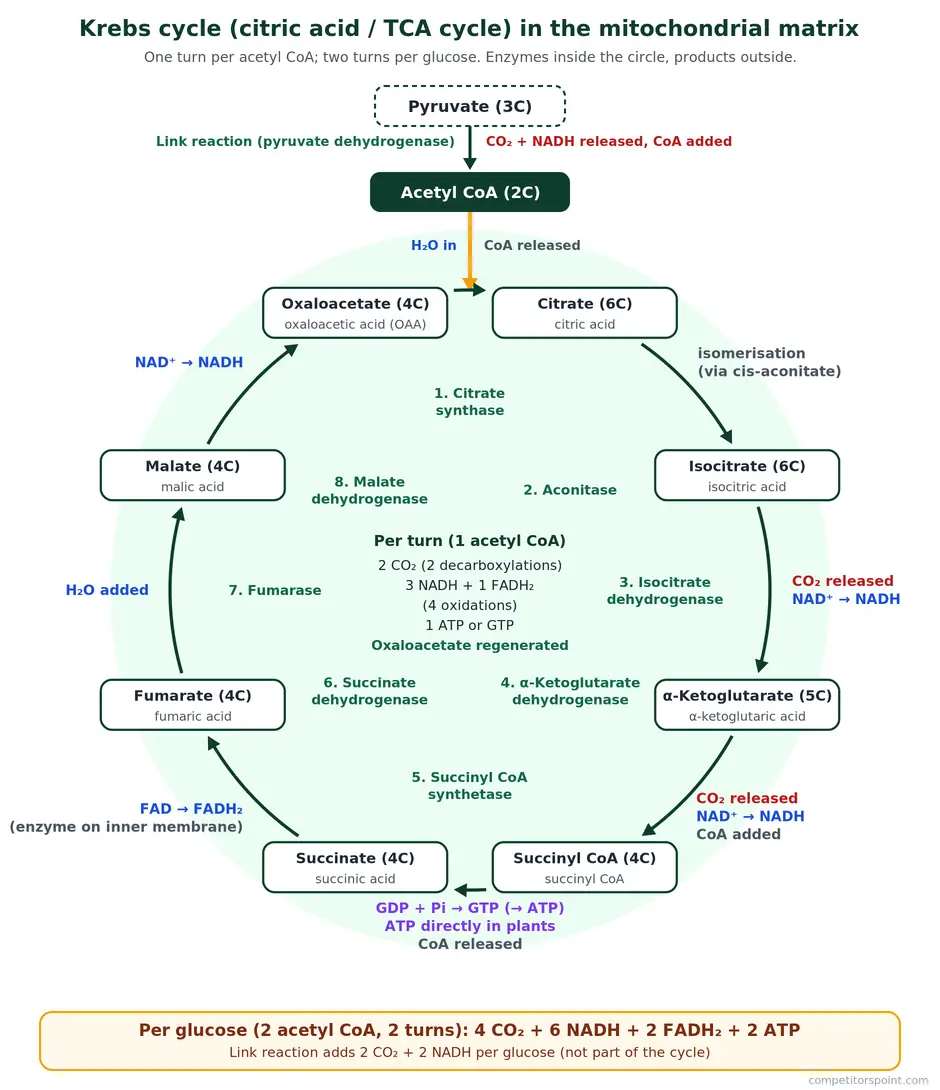
NEET NEET often asks you to match enzymes with steps, or to pick the steps that release CO2, reduce NAD+ or FAD, or make GTP. IB HL IB HL asks you to name only citrate (6C) and oxaloacetate (4C), and to know that the cycle includes two decarboxylations and four oxidations, and that the oxidations are dehydrogenation reactions.
Swipe the table sideways to see every column.
| Step | Substrate | Enzyme | Product | Reaction type | Released / made |
|---|---|---|---|---|---|
| 1 | Acetyl CoA (2C) + oxaloacetate (4C) + H2O | Citrate synthase | Citrate (6C) + CoA | Condensation | H2O used |
| 2 | Citrate (6C) | Aconitase | Isocitrate (6C) | Isomerisation | None |
| 3 | Isocitrate (6C) | Isocitrate dehydrogenase | α-Ketoglutarate (5C) | Oxidative decarboxylation | CO2 + NADH |
| 4 | α-Ketoglutarate (5C) + CoA | α-Ketoglutarate dehydrogenase complex | Succinyl CoA (4C) | Oxidative decarboxylation | CO2 + NADH |
| 5 | Succinyl CoA (4C) + GDP (or ADP) + Pi | Succinyl CoA synthetase (succinate thiokinase) | Succinate (4C) + CoA | Substrate-level phosphorylation | GTP (or ATP) |
| 6 | Succinate (4C) + FAD | Succinate dehydrogenase | Fumarate (4C) | Oxidation (dehydrogenation) | FADH2 |
| 7 | Fumarate (4C) + H2O | Fumarase (fumarate hydratase) | Malate (4C) | Hydration | H2O used |
| 8 | Malate (4C) | Malate dehydrogenase | Oxaloacetate (4C) | Oxidation (dehydrogenation) | NADH |
Step 1: formation of citrate (condensation)
The 2C acetyl group of acetyl CoA joins the 4C acceptor oxaloacetate to form the 6C compound citrate (citric acid). Water is used and coenzyme A is released, free to collect another acetyl group in the link reaction. The enzyme is citrate synthase. This is the step that gives the cycle its name.
Acetyl CoA + Oxaloacetate + H2O →(citrate synthase)→ Citrate + CoA
Step 2: isomerisation of citrate
Citrate is rearranged into its isomer isocitrate, moving the hydroxyl group so that it can be oxidised in the next step. The enzyme aconitase does this by removing and then adding back water, through the short-lived intermediate cis-aconitate. Carbon number stays at 6 and no carrier is reduced.
Citrate ↔(aconitase)↔ Isocitrate
Step 3: first oxidative decarboxylation
Isocitrate is oxidised and decarboxylated to the 5C compound α-ketoglutarate (α-ketoglutaric acid). Hydrogen is passed to NAD+, forming NADH, and the first CO2 of the cycle is released. The enzyme is isocitrate dehydrogenase, an important control point. Older texts show oxalosuccinate as a bound intermediate in this step.
Isocitrate + NAD+ →(isocitrate dehydrogenase)→ α-Ketoglutarate + CO2 + NADH + H+
Step 4: second oxidative decarboxylation
α-Ketoglutarate is oxidised and decarboxylated by the α-ketoglutarate dehydrogenase complex, which works like the pyruvate dehydrogenase complex. The second CO2 is released, a second NADH is formed and the 4C remainder is attached to CoA as succinyl CoA. After this step the cycle has released two carbons, as many as entered in acetyl CoA.
α-Ketoglutarate + CoA + NAD+ →(α-ketoglutarate dehydrogenase)→ Succinyl CoA + CO2 + NADH + H+
Step 5: substrate-level phosphorylation
The high-energy thioester bond of succinyl CoA is broken by succinyl CoA synthetase (succinate thiokinase), forming succinate (succinic acid) and releasing CoA. The energy is used to make GTP from GDP and Pi in animal cells; the GTP then transfers its phosphate to ADP to give ATP. Plant mitochondria make ATP directly. This is the only step of the cycle that makes ATP directly, by substrate-level phosphorylation.
Succinyl CoA + GDP + Pi →(succinyl CoA synthetase)→ Succinate + GTP + CoA; GTP + ADP → GDP + ATP
Step 6: oxidation of succinate
Succinate is oxidised to fumarate (fumaric acid) by removal of two hydrogen atoms. The hydrogen acceptor here is FAD, not NAD+, because the energy change is too small to reduce NAD+; FAD is reduced to FADH2. The enzyme, succinate dehydrogenase, is bound to the inner mitochondrial membrane. Malonate, which resembles succinate, is the classic competitive inhibitor of this enzyme.
Succinate + FAD →(succinate dehydrogenase)→ Fumarate + FADH2
Step 7: hydration of fumarate
Water is added across the double bond of fumarate to form malate (malic acid). The enzyme is fumarase (fumarate hydratase). This is the second step of the cycle that uses water.
Fumarate + H2O ↔(fumarase)↔ Malate
Step 8: regeneration of oxaloacetate
Malate is oxidised to oxaloacetate (oxaloacetic acid, OAA), reducing the third NAD+ of the turn to NADH. The enzyme is malate dehydrogenase. Oxaloacetate is now ready to accept another acetyl group, so the cycle can turn again. Because oxaloacetate is regenerated, a small amount can process a large number of acetyl groups.
Malate + NAD+ ↔(malate dehydrogenase)↔ Oxaloacetate + NADH + H+
IB HL The IB summary in four lines
- The acetyl group (2C) is transferred from CoA to oxaloacetate (4C), forming citrate (6C).
- Two decarboxylations release 2 CO2 as waste (steps 3 and 4).
- Four oxidations (dehydrogenations) reduce 3 NAD+ and 1 FAD (steps 3, 4, 6 and 8).
- One ATP is made by substrate-level phosphorylation, and oxaloacetate is regenerated.
5 Krebs cycle yield per acetyl CoA and per glucose
One glucose gives two pyruvate, so two acetyl CoA, so the Krebs cycle turns twice per glucose. Double every per-turn figure.
| Product | Per acetyl CoA (one turn) | Per glucose (two turns) | Link reaction per glucose (for comparison) |
|---|---|---|---|
| CO2 | 2 | 4 | 2 |
| NADH | 3 | 6 | 2 |
| FADH2 | 1 | 2 | 0 |
| ATP (via GTP), substrate level | 1 | 2 | 0 |
| Water used | 2 | 4 | 0 |
| Oxaloacetate | used and regenerated (net 0) | net 0 | – |
Acetyl CoA + 3 NAD+ + FAD + GDP + Pi + 2 H2O → 2 CO2 + 3 NADH + FADH2 + GTP + 2 H+ + CoA
Per pyruvate (link reaction plus one turn), NCERT gives: pyruvic acid + 4 NAD+ + FAD + 2 H2O + ADP + Pi → 3 CO2 + 4 NADH + 4 H+ + FADH2 + ATP. All six carbons of glucose leave as CO2 by the end of the cycle: 2 in the link reaction and 4 in the Krebs cycle. The CO2 diffuses out of the cell and is carried in the blood to the lungs (see how carbon dioxide is transported).
How much ATP does that make?
The cycle makes only 1 ATP per turn directly. Most of its value lies in the NADH and FADH2, which are reoxidised in the electron transport chain to make ATP by oxidative phosphorylation.
NEET How NCERT counts it
- NCERT counts 3 ATP per NADH and 2 ATP per FADH2. Per turn: 9 + 2 + 1 = 12 ATP. Per glucose: 18 + 4 + 2 = 24 ATP from the Krebs cycle.
- Whole aerobic respiration per glucose: glycolysis 8 + link reaction 6 + Krebs cycle 24 = 38 ATP, the NCERT figure to use in NEET.
IB HL Modern figures
- Current estimates are about 2.5 ATP per NADH and 1.5 ATP per FADH2, so one turn is worth about 10 ATP and the cycle about 20 ATP per glucose; whole aerobic respiration gives about 30 to 32 ATP. IB asks for the products of the cycle (CO2, reduced NAD, reduced FAD and ATP), not exact totals.
For the glycolysis side of the balance sheet see the net ATP yield of glycolysis.
6 Amphibolic nature of the Krebs cycle
A pathway that is both catabolic (breaking down) and anabolic (building up) is called amphibolic. The Krebs cycle is the hub of metabolism: many substrates are broken down into its intermediates, and its intermediates are drawn off to make new molecules.
Catabolic role: feeding the cycle
- Carbohydrates: glucose → pyruvate → acetyl CoA.
- Fats: fatty acids are broken down to acetyl CoA (by β-oxidation); glycerol enters glycolysis as PGAL (glyceraldehyde 3-phosphate).
- Proteins: amino acids are deaminated and their carbon skeletons enter as pyruvate, acetyl CoA or Krebs intermediates such as α-ketoglutarate and oxaloacetate. The removed amino groups become urea (see nitrogenous excretory products).
These substrates come from the absorption of digested food or from stored reserves.
Anabolic role: drawing intermediates off
- α-Ketoglutarate → glutamate and other amino acids.
- Oxaloacetate → aspartate, and → glucose by gluconeogenesis in the liver (stimulated by glucagon when blood glucose falls).
- Succinyl CoA → porphyrins, the ring of haem and of chlorophyll.
- Citrate is exported to the cytoplasm, where it gives acetyl CoA for fatty acid and sterol synthesis.
Withdrawing intermediates would stop the cycle, so they are topped up by anaplerotic (filling-up) reactions, mainly pyruvate carboxylase (pyruvate + CO2 → oxaloacetate) in animals and PEP carboxylase in plants. NEET NCERT concludes that the respiratory pathway is better described as amphibolic than catabolic, because fatty acids are broken down to acetyl CoA for respiration but acetyl CoA is also withdrawn to make fatty acids.
7 Regulation of the Krebs cycle
The cycle runs only as fast as the cell needs ATP. Control works through the ratio of energy molecules and through a few irreversible steps.
- Supply of NAD+ and FAD: the dehydrogenases need oxidised carriers, which are regenerated only when the electron transport chain passes electrons to oxygen. Without oxygen the carriers stay reduced and the cycle stops. This is why the Krebs cycle is aerobic even though no step uses O2.
- Citrate synthase is inhibited by ATP, NADH, succinyl CoA and its own product citrate.
- Isocitrate dehydrogenase is activated by ADP and Ca2+ and inhibited by ATP and NADH. It is usually described as the main rate-limiting step.
- α-Ketoglutarate dehydrogenase is inhibited by its products succinyl CoA and NADH and activated by Ca2+.
- Pyruvate dehydrogenase (link reaction) controls entry of carbohydrate carbon: it is inhibited by acetyl CoA, NADH and ATP.
For a deeper, university-level account of each enzyme and how it is controlled, see the StatPearls review of citric acid cycle biochemistry on NCBI Bookshelf.
When ATP is plentiful, citrate builds up, leaves the mitochondrion and inhibits phosphofructokinase, slowing glycolysis as well (see regulation of glycolysis by phosphofructokinase). These are examples of end-product (feedback) inhibition, which you meet in enzymes (IB C1.1). Ca2+ released during muscle contraction speeds the cycle up when demand rises.
8 Krebs cycle compared with glycolysis
Swipe the table sideways to see every column.
| Feature | Glycolysis | Krebs cycle |
|---|---|---|
| Site (eukaryotes) | Cytoplasm (cytosol) | Mitochondrial matrix |
| Shape of pathway | Linear, 10 steps | Cyclic, 8 steps |
| Starts with | Glucose (6C) | Acetyl CoA (2C) + oxaloacetate (4C) |
| End products | 2 pyruvate (3C) | CO2; oxaloacetate regenerated |
| Oxygen | Not needed; also runs in anaerobic respiration | Needed indirectly (to regenerate NAD+ and FAD) |
| CO2 per glucose | 0 | 4 |
| NADH per glucose | 2 | 6 |
| FADH2 per glucose | 0 | 2 |
| ATP per glucose (direct) | 4 made, 2 used, net 2 | 2 (via GTP), none used |
| Type of ATP synthesis | Substrate-level phosphorylation | Substrate-level phosphorylation |
| ATP invested | Yes, 2 ATP | No |
| Key control enzyme | Phosphofructokinase | Isocitrate dehydrogenase (and citrate synthase) |
| Found in | Almost all living cells | Cells with mitochondria and aerobic prokaryotes |
Glucose can also be oxidised by a side route, the pentose phosphate pathway, which makes NADPH and 5C sugars rather than ATP. For a step-by-step comparison with all four stages, see the comparison of respiration stages in the glycolysis chapter.
9 NEET favourite points (NCERT)
NEET Learn these exactly as NCERT puts them
- NCERT calls it the tricarboxylic acid (TCA) cycle or Krebs cycle, and uses acid names: citric acid, isocitric acid, α-ketoglutaric acid, succinyl CoA, succinic acid, fumaric acid, malic acid and oxaloacetic acid (OAA).
- The cycle starts with the condensation of the acetyl group with oxaloacetic acid and water to give citric acid, catalysed by citrate synthase, releasing CoA.
- Citric acid is the first product (6C); OAA (4C) is the acceptor of the acetyl group and the first member of the cycle.
- Citrate is isomerised to isocitrate, followed by two successive decarboxylations giving α-ketoglutaric acid and then succinyl CoA.
- During the conversion of succinyl CoA to succinic acid, a molecule of GTP is synthesised: substrate-level phosphorylation. In a coupled reaction GTP gives ATP from ADP.
- There are three points where NAD+ is reduced to NADH + H+ and one point where FAD is reduced to FADH2.
- The continued oxidation of acetyl CoA needs continued replenishment of OAA and regeneration of NAD+ and FAD.
- Pyruvate dehydrogenase (link reaction) needs Mg2+, NAD+ and coenzyme A.
- Totals per glucose: 6 CO2 in aerobic respiration (2 link + 4 Krebs), 8 NADH and 2 FADH2 in the mitochondrial matrix stages, 38 ATP overall by the NCERT count.
- NCERT writes FAD+; chemically the oxidised form is FAD, with no charge. Recognise both forms in NEET options.
Also revise the mitochondrion itself from Cell: The Unit of Life, because NEET likes to ask that the matrix is the site of the TCA cycle and the inner membrane the site of the electron transport chain.
10 Common exam traps
Watch out for these
- “The Krebs cycle uses oxygen.” No step uses O2. Oxygen is used only at the end of the electron transport chain, but the cycle stops without it because NAD+ and FAD are not regenerated.
- “Pyruvate enters the Krebs cycle.” Acetyl CoA enters. Pyruvate is first converted in the link reaction.
- “The Krebs cycle makes 6 CO2 per glucose.” It makes 4; the other 2 come from the link reaction. 6 is the total for aerobic respiration.
- “8 NADH come from the Krebs cycle.” 6 per glucose. The link reaction adds 2, and glycolysis 2 more, for 10 NADH in all.
- Per turn versus per glucose Read the question: per acetyl CoA (one turn) it is 2 CO2, 3 NADH, 1 FADH2, 1 ATP; per glucose double them.
- “Oxaloacetate is used up.” It is regenerated each turn and acts catalytically; only intermediates drawn off for synthesis must be replaced.
- “The CO2 released comes from the acetyl group that just entered.” Carbon-labelling shows that the two CO2 of a turn come from carbons that were part of oxaloacetate; the acetyl carbons are released in later turns. The net count (2 in, 2 out) is still correct.
- “Most ATP in the Krebs cycle is made by substrate-level phosphorylation.” Only 1 ATP per turn is made that way. Most of the energy is in NADH and FADH2, which make ATP by oxidative phosphorylation.
- FADH2 step Only succinate → fumarate reduces FAD. Do not count FADH2 in the link reaction or glycolysis.
- Succinate dehydrogenase location It is in the inner mitochondrial membrane, not free in the matrix.
- Decarboxylations and oxidations 2 decarboxylations and 4 oxidations per turn (steps 3 and 4 do both). Including the link reaction, 3 decarboxylations and 5 oxidations per pyruvate.
11 Key terms
| Term | Meaning |
|---|---|
| Krebs cycle | Cyclic pathway in the mitochondrial matrix that oxidises acetyl groups to CO2, making NADH, FADH2 and ATP. |
| Acetyl CoA | Acetyl group (2C) carried by coenzyme A; the fuel of the cycle. |
| Oxaloacetate (OAA) | 4C acceptor of the acetyl group, regenerated at step 8. |
| Citrate | 6C first product of the cycle (citric acid). |
| Decarboxylation | Removal of a carboxyl group as CO2 (steps 3 and 4). |
| Dehydrogenation | Oxidation by removal of hydrogen, passed to NAD+ or FAD. |
| Substrate-level phosphorylation | ATP (or GTP) made by direct transfer of a phosphate from a substrate; step 5. |
| FAD / FADH2 | Hydrogen carrier used by succinate dehydrogenase: oxidised / reduced form. |
| Amphibolic | Both catabolic and anabolic. |
| Anaplerotic reaction | Reaction that tops up cycle intermediates, e.g. pyruvate to oxaloacetate. |
12 Common doubts about the Krebs cycle
These are the questions students ask us most often about the Krebs cycle.
Where does the Krebs cycle take place?
In eukaryotes the Krebs cycle takes place in the mitochondrial matrix; only succinate dehydrogenase is bound to the inner mitochondrial membrane. In aerobic prokaryotes, which have no mitochondria, it takes place in the cytoplasm.
Does the Krebs cycle need oxygen?
No step of the cycle uses oxygen directly, but it is part of aerobic respiration. Oxygen is the final electron acceptor of the electron transport chain, which regenerates the NAD+ and FAD the cycle needs. Without oxygen the carriers stay reduced and the cycle stops.
How many ATP are produced in the Krebs cycle?
Directly, 1 ATP (via GTP) per turn and 2 per glucose, by substrate level phosphorylation. Counting the NADH and FADH2 at the NCERT values of 3 and 2 ATP, the cycle is worth 12 ATP per turn and 24 per glucose. Modern values give about 10 per turn.
How many CO2, NADH and FADH2 are produced per glucose?
The Krebs cycle turns twice per glucose and gives 4 CO2, 6 NADH and 2 FADH2. The link reaction adds a further 2 CO2 and 2 NADH, which are not part of the cycle.
Why is it called the citric acid cycle or TCA cycle?
Citric acid is the first product formed when the acetyl group joins oxaloacetic acid. Citric acid and isocitric acid have three carboxyl groups, so the pathway is also called the tricarboxylic acid or TCA cycle. Krebs cycle honours Hans Krebs, who discovered it.
Why is the Krebs cycle called a cycle?
Oxaloacetate, which accepts the acetyl group in step 1, is regenerated in step 8, so the same sequence of reactions can repeat. The carbon atoms that enter as acetyl groups leave as CO2.
Why is the Krebs cycle described as amphibolic?
It breaks down acetyl groups from carbohydrates, fats and proteins, which is catabolism, and its intermediates are also used to make amino acids, glucose, haem and fatty acids, which is anabolism. A pathway with both roles is amphibolic.
Which step of the Krebs cycle makes FADH2?
Step 6, the oxidation of succinate to fumarate by succinate dehydrogenase. It is the only step that uses FAD instead of NAD+ as the hydrogen acceptor.
13 Practice questions
Tap each question to reveal the answer.
Test yourself on the Krebs cycle
1. Name the 4C compound that accepts the acetyl group and the 6C compound formed.
Oxaloacetate (oxaloacetic acid, 4C) accepts it; citrate (citric acid, 6C) is formed, catalysed by citrate synthase.
2. State the number of CO2, NADH, FADH2 and ATP made per acetyl CoA.
2 CO2, 3 NADH, 1 FADH2 and 1 ATP (via GTP).
3. How many times does the Krebs cycle turn per glucose, and why?
Twice: one glucose gives two pyruvate, and so two acetyl CoA.
4. Name the two steps in which decarboxylation occurs.
Isocitrate → α-ketoglutarate (isocitrate dehydrogenase) and α-ketoglutarate → succinyl CoA (α-ketoglutarate dehydrogenase).
5. (NEET) During which conversion is GTP formed by substrate-level phosphorylation?
Succinyl CoA → succinic acid, catalysed by succinyl CoA synthetase.
6. Which enzyme reduces FAD, and where is it found?
Succinate dehydrogenase, bound to the inner mitochondrial membrane (complex II).
7. (IB HL) Explain why the Krebs cycle stops when oxygen is absent, even though no step uses oxygen. [3 marks]
Oxygen is the final electron acceptor of the electron transport chain; without it NADH and FADH2 are not reoxidised; NAD+ and FAD are not available as hydrogen acceptors for the dehydrogenation steps, so the cycle stops.
8. (NEET) Using the NCERT count, how many ATP are obtained from the Krebs cycle per glucose?
24 ATP: 6 NADH × 3 = 18, 2 FADH2 × 2 = 4, plus 2 ATP direct.
9. Give two examples that show the Krebs cycle is amphibolic.
Any two: α-ketoglutarate used to make glutamate; oxaloacetate used for aspartate or gluconeogenesis; succinyl CoA used for porphyrins (haem, chlorophyll); citrate used for fatty acid synthesis; fats and proteins broken down into cycle intermediates or acetyl CoA.
10. (IB HL) Outline the Krebs cycle. [4 marks]
Acetyl group (2C) transferred from CoA to oxaloacetate (4C) forming citrate (6C); two decarboxylations release 2 CO2; four oxidations / dehydrogenations reduce 3 NAD+ and 1 FAD; one ATP made by substrate-level phosphorylation; oxaloacetate regenerated; occurs in the mitochondrial matrix.
Ready to practise? Download the Krebs Cycle IB question set with markscheme.
© competitorspoint.com · Biology notes. Diagrams are original to competitorspoint.com.