
Cell Respiration and ATP
Cell respiration is the controlled release of energy from organic compounds, such as glucose and fatty acids, to make ATP. ATP then carries that energy to every process that needs it. This page covers the SL core of IB Biology C1.2: what ATP is and does, how aerobic and anaerobic respiration differ in humans, and how to measure its rate with a respirometer.
1 What is cell respiration? SL
Syllabus link: IB Biology C1.2 Cell respiration (first assessment 2025), understandings C1.2.1 to C1.2.6, which are taught at SL and HL. It builds on C1.1 enzymes and metabolism.
SL = all IB students HL = additional higher level only
Every living organism needs a steady supply of usable energy. Food molecules hold plenty of chemical energy, but glucose cannot be spent directly on pumping an ion or building a protein. The energy first has to be transferred into a molecule that can be used on the spot: ATP (adenosine triphosphate).
Respiration is the set of enzyme-controlled reactions that does this job. Carbon compounds are oxidised step by step, and the energy released is used to make ATP from ADP and phosphate. Because the reactions are small and controlled, the energy is not lost in one burst of heat, as it would be if the same glucose were burned.
- Who does it? All living organisms (plants, animals, fungi, protists and prokaryotes), at all times. It is one of the functions of life.
- What is it for? Producing ATP. Heat is a by-product, and mammals and birds use it to keep their body temperature up.
- What does it use? Mainly glucose and fatty acids. Animals get these from food. Plants use sugars and lipids they made earlier by photosynthesis.
This article is the SL foundation for the whole C1.2 chapter of the IB Diploma Programme biology course. HL students should read it first, then follow the pathway through glycolysis, the fate of pyruvate, the Krebs cycle and the electron transport chain. To see how the two energy pathways fit together, open the photosynthesis and cell respiration hub.
2 ATP: the universal energy currency SL
C1.2.1 ATP as the molecule that distributes energy within cells
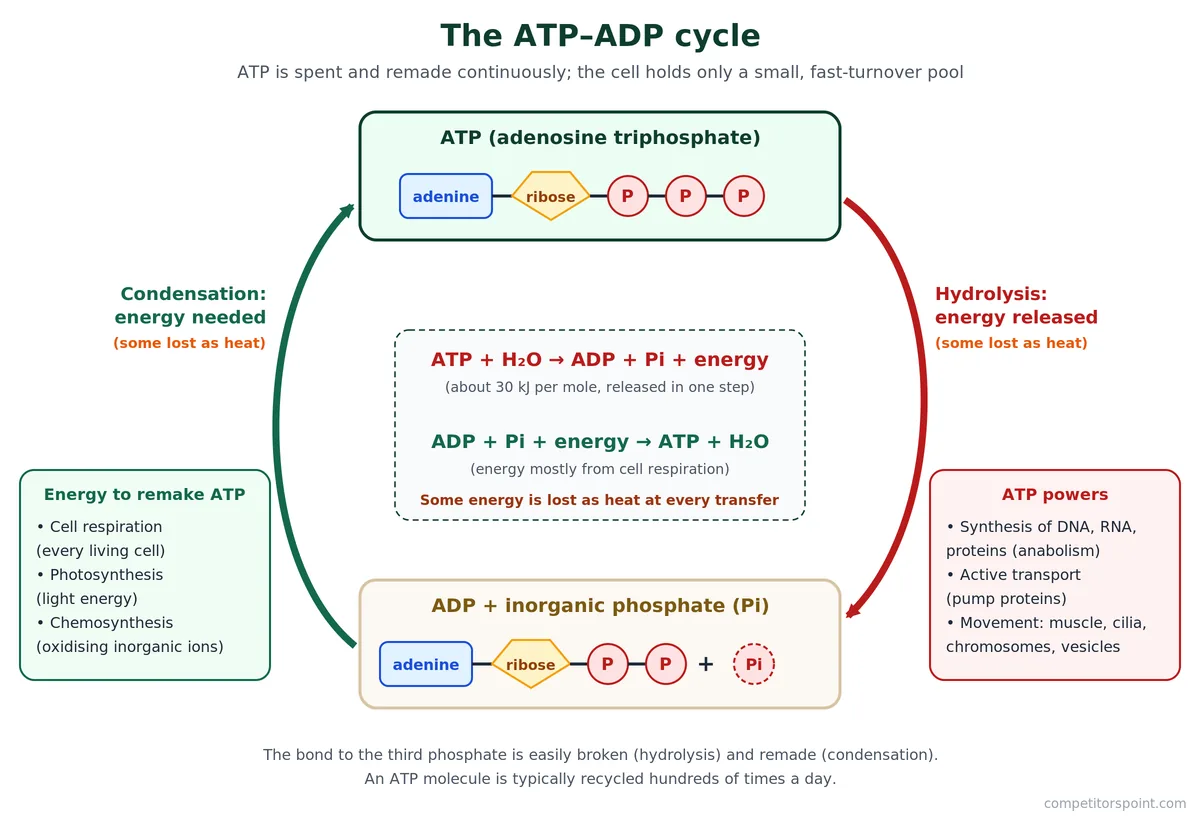
ATP is a nucleotide. Like the nucleotides in RNA, it has three parts: the base adenine, the five-carbon sugar ribose, and, in this case, a chain of three phosphate groups. Each phosphate carries a negative charge. (Nucleotide structure is revised on our biomolecules page.)
ATP is called the energy currency because it is the common “coin” that every energy-using process accepts. Energy from many different food molecules is changed into one standard form, and that form can be spent anywhere in the cytoplasm or organelles. Its properties suit this role.
Swipe the table sideways to see every column.
| Property of ATP | Why it matters |
|---|---|
| Soluble in water | It moves freely through the cytoplasm and the fluid inside organelles, so energy can be delivered wherever it is needed. |
| Stable at about pH 7 | It does not break down on its own in the near-neutral conditions inside cells. It only releases energy when an enzyme hydrolyses it. |
| Cannot cross the phospholipid bilayer | Being charged, it cannot leak out through the plasma membrane, and its movement between membrane-bound compartments can be controlled by transport proteins. |
| Third phosphate easily removed and re-added | Hydrolysis and condensation of the terminal phosphate let ATP be spent and remade quickly, thousands of times. |
| Releases a modest amount of energy per molecule | About 30 kJ per mole is enough for most single reactions or pump cycles without large waste as heat. A big “note” such as glucose would be impossible to break into change. |
Key idea: ATP is a carrier, not a store
- Long-term energy stores are glycogen, starch and fat. ATP is a short-term carrier.
- Only a few seconds’ to minutes’ worth of ATP is held at any moment, so it must be remade constantly.
- That is why ATP production never stops in living tissue.
3 What ATP is used for in cells SL
C1.2.2 Life processes within cells that ATP supplies with energy
The IB guide groups the energy-using processes in cells into three families. Learn one clear example of each.
1. Synthesis of macromolecules (anabolism)
Joining monomers into polymers is uphill (endergonic). Linking each new nucleotide during DNA replication and transcription, or each amino acid during translation, needs energy from ATP or a closely related nucleotide. Building glycogen, starch and cellulose is also ATP-dependent. Reactions that build molecules are covered in our notes on enzymes and metabolism (C1.1).
2. Active transport
Pump proteins move ions or molecules against their concentration gradient. ATP phosphorylates the pump, which switches it into a different shape. The pump picks up the particle on one side of the membrane in one shape and releases it on the other side in the other shape. The sodium–potassium pump in neurons is the classic example. See active transport.
3. Movement
Movement happens at every scale: muscle fibres contracting as actin and myosin filaments slide; cilia and flagella beating; chromosomes being pulled apart in mitosis; vesicles carried along the cytoskeleton; the cytoplasm pinching in two at cytokinesis; and phagocytes crawling towards bacteria. All of it is driven by ATP.
Exam tip
- “Explain how ATP is used in active transport” needs the mechanism: ATP phosphorylates the pump, the pump changes shape, and the particle is moved against its gradient.
- Do not write that ATP “gives energy to the ion”. The energy changes the protein’s conformation.
4 The ATP–ADP cycle and energy transfer SL
C1.2.3 Energy transfers during interconversions between ATP and ADP
ATP holds more chemical energy than ADP plus phosphate. When an enzyme removes the third phosphate by hydrolysis, energy is released. When the phosphate is put back by a condensation reaction, the same amount of energy has to be supplied.
ATP + H2O → ADP + Pi + energy | ADP + Pi + energy → ATP + H2O
The phosphate is often not released straight away. It is first transferred to another molecule, such as a pump protein or a substrate in a metabolic pathway. This phosphorylation makes the target molecule more reactive or changes its shape. When the phosphate leaves it again, the change happens.
Where the energy to remake ATP comes from
- Respiration: oxidation of carbohydrates, lipids or proteins. This happens in all living organisms.
- Photosynthesis: light energy in chloroplasts (see C1.3).
- Chemosynthesis: oxidation of inorganic substances such as hydrogen sulfide or iron(II) ions by some prokaryotes.
A very small pool with a very fast turnover
The amount of ATP in your body at any moment is tiny, roughly 50 to 100 g. Yet a resting adult makes and uses something close to their own body mass of ATP every day. So each ATP molecule is recycled hundreds of times a day. If regeneration stops, as it does when cyanide blocks aerobic ATP production, neurons stop firing and muscles lock up within minutes.
Worked example: ATP turnover
- A student’s body contains 0.15 mol of ATP and uses 90 mol in a day.
- Turnover = 90 ÷ 0.15 = 600 times per day, or about once every 2.4 minutes for each molecule.
No energy transfer is 100% efficient, so every time energy passes from food to ATP, or from ATP to a process, some is converted to heat.
5 A system for making ATP SL
C1.2.4 Cell respiration as a system for producing ATP within the cell using energy released from carbon compounds
Think of the whole process as a system with inputs, a controlled process and outputs. The input is a respiratory substrate. A series of enzyme-catalysed oxidation reactions releases its energy in small steps, and the output is ATP, together with waste products and heat.
- Glucose is the most common substrate. It comes from digested carbohydrate, from glycogen stores in liver and muscle, or from starch and sucrose in plants.
- Fatty acids, from fats and oils, are the other main substrate. Heart muscle and resting skeletal muscle rely heavily on them.
- Amino acids can be used after their amino group has been removed (deamination), mainly during starvation or on a very high-protein diet.
For glucose, the aerobic pathway can be summarised by one overall equation, although it actually happens in many separate steps:
C6H12O6 + 6 O2 → 6 CO2 + 6 H2O (energy released is used to make ATP)
Each step is catalysed by a specific enzyme, so the overall rate is affected by the same factors that affect enzymes, such as temperature and pH. The enzymes, like all enzymes, are covered in C1.1. For extra videos and practice on the stages, try Khan Academy’s unit on glycolysis, the Krebs cycle and fermentation.
6 Respiration vs gas exchange SL
Students often use “respiration” and “breathing” as if they meant the same thing. In IB Biology they are different processes, and a mark is regularly given for keeping them apart.
Swipe the table sideways to see every column.
| Feature | Respiration | Gas exchange |
|---|---|---|
| What it is | Chemical reactions that release energy from carbon compounds to make ATP | Physical movement of O2 into and CO2 out of cells or organisms, by diffusion |
| Where | Cytoplasm, and mitochondria in eukaryotes | Plasma membranes; at organism level, surfaces such as alveoli, gills or leaf mesophyll |
| Uses energy? | Releases energy | Diffusion itself is passive. Ventilation (breathing movements) uses ATP |
| Enzymes? | Many enzymes, one for each step | None needed for diffusion |
The two processes are interdependent. Respiration uses oxygen and produces carbon dioxide, which keeps the O2 concentration low and the CO2 concentration high inside respiring tissue. Those gradients are what make the gases diffuse. In turn, without gas exchange, tissues would soon run out of oxygen and build up harmful carbon dioxide, and the aerobic pathway would stop. Note that the two gases diffuse independently: it is not a one-for-one swap. The organ-level story is on our gas exchange page.
7 Aerobic vs anaerobic respiration in humans SL
C1.2.5 Differences between anaerobic and aerobic cell respiration in humans
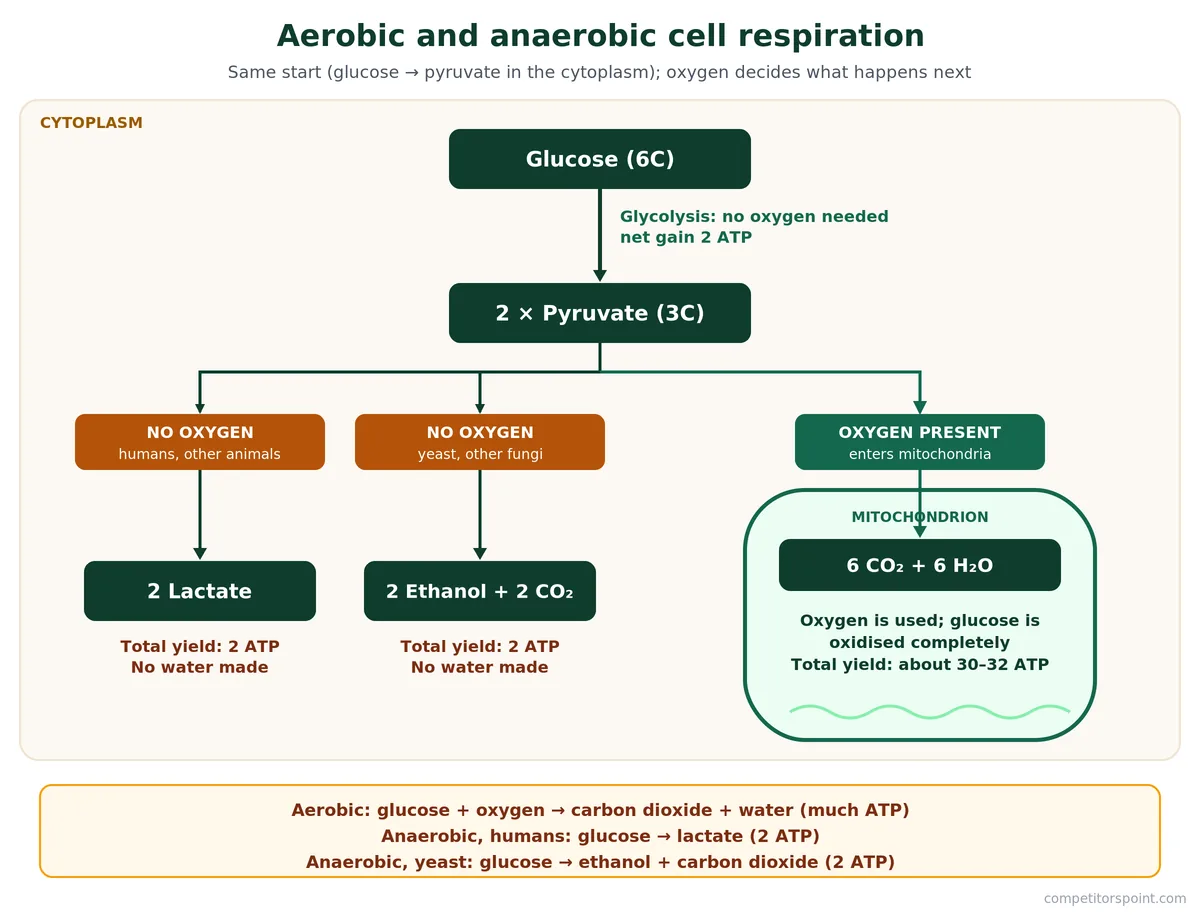
Aerobic respiration uses oxygen. Anaerobic respiration does not. Both begin the same way, with glucose split into pyruvate in the cytoplasm, but only the aerobic route continues into the mitochondria and releases most of the energy. The key difference between the two is what happens after pyruvate. Learn the word equations.
Aerobic: glucose + oxygen → carbon dioxide + water (ADP → ATP, large yield)
Anaerobic, humans: glucose → lactate (ADP → ATP, small yield)
Anaerobic, yeast: glucose → ethanol + carbon dioxide (ADP → ATP, small yield)
Swipe the table sideways to see every column.
| Feature | Aerobic | Anaerobic (humans) |
|---|---|---|
| Oxygen | Needed. It accepts electrons and hydrogen at the end of the pathway | Not used |
| Substrates | Carbohydrates, lipids, and amino acids after deamination | Carbohydrates (glucose) only |
| Products | Carbon dioxide and water | Lactate. No CO2, no water |
| ATP per glucose | Large: about 30 to 32 | Small: 2 |
| Location | Starts in the cytoplasm, then mitochondria | Cytoplasm only; no mitochondria needed |
| Speed of ATP supply | Slower, limited by oxygen delivery | Very fast, but only for a short time |
When do humans use anaerobic respiration?
The lungs and blood usually deliver enough oxygen for the aerobic pathway. During maximal effort, though, muscle fibres need ATP faster than oxygen can arrive. The anaerobic pathway fills the gap, supplying ATP very rapidly for short, powerful contractions: a 100 m or 400 m sprint, a heavy lift, a jump, or the sprint finish of a long race.
The cost is lactate. Blood and muscle tolerate only a limited concentration of it, which is why truly all-out effort lasts less than about a minute. Afterwards, extra oxygen is needed to break the lactate down. Breathing and heart rate stay raised until this is done. That extra demand is the oxygen debt.
Key idea: why the ATP yields of aerobic and anaerobic respiration differ
- The anaerobic pathway releases only a small part of the energy in glucose. Most of it stays locked in lactate or ethanol.
- The aerobic pathway oxidises glucose completely to CO2 and water, so far more ATP is made.
- HL students learn exactly where the extra ATP comes from: the Krebs cycle and the electron transport chain.
Yeast is a fungus that can respire either way. This is why it is used to raise bread (the CO2) and to brew beer and wine (the ethanol). The HL detail of both anaerobic routes, including how NAD is regenerated, is on the fermentation section of Fate of Pyruvate.
8 Variables affecting the rate of respiration SL
C1.2.6 Variables affecting the rate of cell respiration. Includes measuring rates with simple respirometers
The rate can be found by measuring any of the following over a fixed time:
- oxygen taken up (the usual measure for aerobic organisms)
- carbon dioxide released (data loggers with CO2 probes, limewater, or hydrogencarbonate indicator)
- substrate used up (for example glucose), or mass lost as CO2 escapes (useful for yeast)
Variables you could investigate include temperature, the type or concentration of substrate (with yeast), oxygen availability, the species or life stage of the organism (for example germinating vs dry seeds), and activity level (for example active vs resting woodlice).
How a simple respirometer works
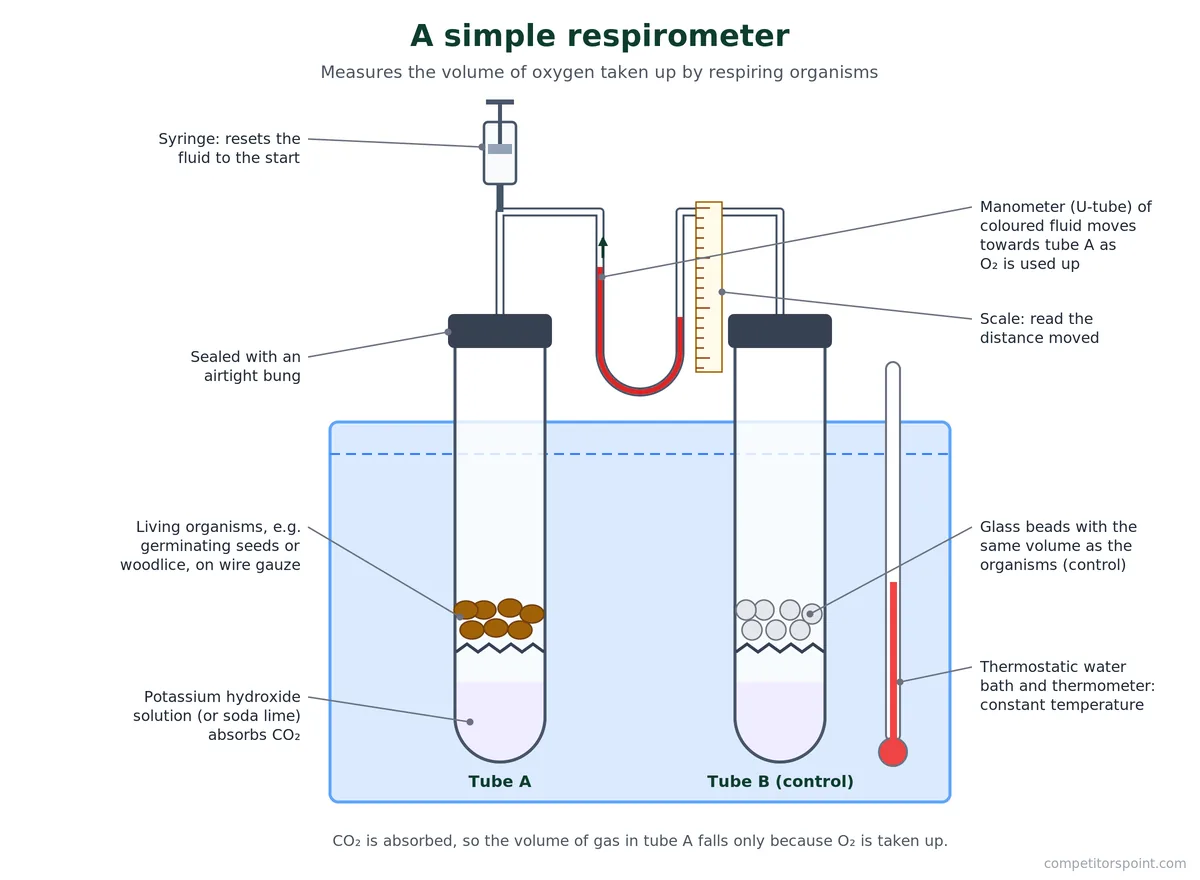
- Living organisms are sealed in a tube with an alkali (potassium hydroxide solution or soda lime), kept separate by wire gauze.
- The alkali absorbs every CO2 molecule the organisms release. Any change in gas volume must therefore be caused by oxygen uptake.
- As oxygen is used, the pressure in tube A falls and the coloured fluid in the capillary or U-tube moves towards the organisms.
- The distance moved in a fixed time is read off the scale. The syringe resets the fluid between readings.
Controlling variables
- Temperature: gas expands when warmed, so even a small change moves the fluid. Stand the apparatus in a thermostatically controlled water bath and let it equilibrate before timing.
- Atmospheric pressure: a control tube (B) with glass beads or dead organisms of the same volume, connected to the other arm, cancels out changes in room pressure and temperature.
- Same mass of organisms, the same volume of alkali, and the same time interval in every trial. Take at least three repeats at each value of the independent variable.
Calculating the rate of respiration
Rate is an amount per unit time. Convert the distance moved into a volume using the volume of a cylinder, πr2l, then divide by time and, ideally, by the mass of the organisms.
Worked example: respirometer rate
- 5.0 g of germinating mung beans at 25 °C. The fluid moves 36 mm in 12 minutes. Capillary internal diameter = 1.0 mm, so r = 0.50 mm.
- Volume of O2 = π × 0.502 × 36 = 28.3 mm3
- Rate = 28.3 ÷ 12 = 2.36 mm3 min−1, or 2.36 ÷ 5.0 = 0.47 mm3 min−1 g−1
Designing a fair investigation
Swipe the table sideways to see every column.
| Part of the design | Example: effect of temperature on germinating peas |
|---|---|
| Independent variable | Water bath temperature: 10, 15, 20, 25, 30 °C |
| Dependent variable | Rate of O2 uptake (mm3 min−1 g−1) |
| Controlled variables | Mass and age of seeds, species, volume of KOH, time interval, tube size |
| Control | Tube with glass beads (or boiled seeds) of equal volume |
| Expected trend | Rate rises with temperature up to an optimum, because the respiratory enzymes work faster. It falls at high temperatures as the enzymes denature |
Ethics and safety
- Seeds raise few ethical problems. If you use invertebrates such as woodlice or maggots, keep the time short, avoid extreme temperatures, never let them touch the alkali, and return them to their habitat.
- Potassium hydroxide is corrosive: wear eye protection and gloves.
For yeast, a simple alternative is to count CO2 bubbles, measure the gas collected in an inverted tube or syringe, or log the mass lost as CO2 escapes from a flask on a balance. Each of these measures how fast the yeast respires anaerobically.
9 Beyond SL: the four stages of aerobic respiration HL
SL students can skip this section. For HL, the summary equation hides four stages, each with its own article on this site:
Swipe the table sideways to see every column.
| Stage | Where | What it does | Read next |
|---|---|---|---|
| Glycolysis | Cytoplasm | Glucose to 2 pyruvate; net 2 ATP and 2 reduced NAD; no oxygen needed (C1.2.7, C1.2.8) | Glycolysis pathway |
| Link reaction, or anaerobic routes | Matrix, or cytoplasm | Pyruvate to acetyl groups, or to lactate or ethanol to regenerate NAD (C1.2.9 to C1.2.11) | Fate of pyruvate |
| Krebs cycle | Mitochondrial matrix | Acetyl groups oxidised and decarboxylated; reduced NAD and FAD made (C1.2.12) | Krebs cycle |
| Electron transport chain and chemiosmosis | Inner mitochondrial membrane | Proton gradient drives ATP synthase; oxygen is the terminal electron acceptor (C1.2.13 to C1.2.16) | Electron transport chain |
HL also compares lipids and carbohydrates as respiratory substrates (C1.2.17). Per gram, lipids release roughly twice as much energy, but they can only be respired aerobically. For a university-level account of all four stages, see the free NCBI Bookshelf chapter How Cells Obtain Energy from Food (Alberts et al.).
10 Common exam traps SL
Avoid these mistakes
- Writing that respiration “produces energy”. Energy cannot be created: it releases energy and uses it to produce ATP.
- Confusing respiration with breathing or gas exchange.
- Saying plants photosynthesise instead of respiring. Plant cells respire all the time, day and night.
- Giving CO2 as a product of anaerobic respiration in humans. Only lactate is made; yeast makes CO2.
- Forgetting that the anaerobic pathway still makes ATP (2 per glucose). It is fast, not efficient.
- In respirometer questions, forgetting that the alkali absorbs CO2, or that temperature changes alter gas volume.
- Quoting a rate without units or without dividing by time.
11 Key terms
12 Common doubts: quick answers
These are the questions IB students ask most often about this topic.
What is cell respiration?
Cell respiration is the controlled release of energy from organic compounds, mainly glucose and fatty acids, inside cells. The energy is used to make ATP from ADP and phosphate. It happens in all living cells and is catalysed by enzymes, one step at a time.
Is respiration the same as breathing?
No. Breathing (ventilation) moves air in and out of the lungs, and gas exchange is the diffusion of oxygen and carbon dioxide across a surface. Respiration is a set of chemical reactions inside cells. The processes depend on each other, but they are not the same.
Why is ATP called an energy currency?
ATP is the single, standard molecule that every energy-requiring process can use. It is soluble, stable at neutral pH and trapped inside cells. It also releases a small, useful amount of energy when its third phosphate is removed, and it can be remade quickly from ADP.
Why don’t cells use glucose directly for energy?
Glucose holds far more energy than any single reaction needs. Its energy can only be released through a long pathway, so it cannot be spent instantly. Transferring the energy to ATP gives small, ready-to-use packets that can be delivered wherever they are needed.
How many ATP are made by aerobic and anaerobic respiration?
The anaerobic pathway gives 2 ATP per glucose. The aerobic pathway gives about 30 to 32 ATP per glucose, because glucose is oxidised completely in the mitochondria. Older textbooks give 36 or 38; IB uses the lower modern estimate.
Why do muscles respire anaerobically if it makes so little ATP?
The anaerobic pathway supplies ATP very rapidly, without waiting for oxygen to arrive. This allows maximum power for a short burst, such as a sprint or a lift. It can only continue briefly because lactate builds up.
What is the oxygen debt?
The oxygen debt is the extra oxygen the body takes in after intense exercise to break down the lactate made anaerobically. It is why breathing rate and heart rate stay high for several minutes after you stop.
Why is potassium hydroxide used in a respirometer?
Potassium hydroxide (or soda lime) absorbs the carbon dioxide released by the organisms. Any change in gas volume is then caused only by oxygen uptake, so the movement of the fluid shows how fast the organisms respire aerobically.
Do plants carry out cell respiration?
Yes. Plant cells respire all the time, in light and in darkness, using sugars and lipids made by photosynthesis. In bright light, photosynthesis is usually faster than respiration, so the plant gives out oxygen overall.
Which parts of IB C1.2 are SL and which are HL?
SL covers C1.2.1 to C1.2.6: ATP, its uses, the ATP–ADP cycle, respiration as an ATP-making system, the aerobic and anaerobic pathways in humans, and measuring the rate. HL adds C1.2.7 to C1.2.17: NAD, glycolysis, fermentation, the link reaction, the Krebs cycle, the electron transport chain, chemiosmosis and respiratory substrates.
13 Self-check questions SL
Tap each question to reveal the answer.
Test yourself on ATP and energy release
1. Name the three components of an ATP molecule.
Adenine (a base), ribose (a five-carbon sugar) and three phosphate groups.
2. State two properties that make ATP suitable as an energy currency.
Any two: soluble in water; stable at near-neutral pH; cannot diffuse through membranes; terminal phosphate easily removed and replaced; releases a small, usable amount of energy.
3. Give one example of each of the three types of ATP use in cells.
Synthesis: e.g. joining amino acids in translation. Active transport: e.g. the sodium–potassium pump. Movement: e.g. muscle contraction, or chromosome movement in mitosis.
4. Distinguish between cell respiration and gas exchange. [2 marks]
Respiration is enzyme-controlled chemical reactions that release energy from organic compounds to make ATP. Gas exchange is the diffusion of O2 and CO2 across a surface or membrane.
5. What are the products of anaerobic respiration in human muscle and in yeast?
Muscle: lactate only. Yeast: ethanol and carbon dioxide. Both also make a small amount of ATP (2 per glucose).
6. Why can a 400 m sprinter not keep sprinting for 2 km?
Maximum power depends on the anaerobic pathway. Lactate builds up to a level the body cannot tolerate, so the effort has to drop to a pace the aerobic pathway can supply.
7. In a respirometer, why does the coloured fluid move towards the tube containing the organisms?
The organisms take up O2. The CO2 they release is absorbed by the alkali, so the gas volume and pressure in that tube fall, and the fluid is pushed towards it.
8. Fluid in a 2 mm diameter capillary moves 15 mm in 5 minutes. Calculate the rate of O2 uptake.
Volume = π × 12 × 15 = 47.1 mm3; rate = 47.1 ÷ 5 = 9.4 mm3 min−1.
© competitorspoint.com · IB Biology notes. Diagrams are original to competitorspoint.com.