
Glycolysis Pathway
Glycolysis is the first stage of cell respiration, in which one glucose molecule (6C) is broken down in the cytoplasm into two molecules of pyruvate (3C) through ten enzyme-controlled steps. It uses 2 ATP, makes 4 ATP by substrate-level phosphorylation and 2 NADH, giving a net yield of 2 ATP, and needs no oxygen.
1 Introduction to glycolysis
Syllabus link: IB Biology C1.2 Cell respiration (first assessment 2025; glycolysis detail is HL)
IB HL = detail the IB guide expects at Higher Level Extension = beyond the IB guide, for deeper understanding
SL SL? Start here
Glycolysis in this much detail is Higher Level. If you take IB Biology SL, begin with cell respiration and ATP, which covers ATP, respiration versus gas exchange, aerobic and anaerobic respiration and respirometers. Come back here when you move on to HL.
This article gives a detailed overview of glycolysis, a fundamental metabolic pathway in plants, animals and microorganisms. It covers where glycolysis happens in the cell, its two phases (energy investment and energy payoff), each of the ten steps with its enzyme and products, the irreversible steps and how the pathway is regulated, the use of glucose and fructose, and the net ATP yield with and without oxygen.
Both plants and animals require energy, which is released through the process of cellular respiration. Aerobic respiration uses oxygen, though the first stage, glycolysis, does not. Unlike animals, plants do not have specialized respiratory organs like lungs. This is because plants have lower energy requirements compared to animals, and the exchange of gases occurs mainly by diffusion through stomata, lenticels and cell surfaces. Plants also produce oxygen through photosynthesis.
Cellular respiration releases energy from organic molecules by a series of oxidation reactions. The energy is not created; it is transferred to two types of carrier:
- ATP (adenosine triphosphate): the immediate source of energy that the cell can use readily. In glycolysis ATP is made by substrate-level phosphorylation; most ATP in aerobic respiration is made later by oxidative phosphorylation.
- NADH (reduced NAD): carries high-energy electrons and hydrogen that are used later, in the electron transport chain, to make more ATP.
2 NAD and redox reactions IB HL
Syllabus link: IB Biology C1.2.7, NAD as the carrier of hydrogen and electrons in redox reactions (HL)
Respiration releases energy from glucose a little at a time, and almost every energy-releasing step is a redox reaction. Before following glycolysis step by step, it helps to be clear about what oxidation and reduction mean in biology and why the coenzyme NAD keeps appearing.
Oxidation and reduction
Chemists define oxidation and reduction in terms of electrons. Biologists usually see them as the movement of hydrogen, because a hydrogen atom is one proton plus one electron, so whatever loses hydrogen also loses electrons.
| Change to the molecule | Oxidation | Reduction |
|---|---|---|
| Electrons | Electrons lost | Electrons gained |
| Hydrogen | Hydrogen removed | Hydrogen added |
| Oxygen | Oxygen added | Oxygen removed |
| Energy held | Usually falls (energy released) | Usually rises (energy stored) |
The two processes are always coupled. Electrons cannot float free in a cell, so when one substance is oxidised another must be reduced at the same moment by accepting those electrons. That is why the reactions are called redox reactions. A short memory aid is OIL RIG: oxidation is loss, reduction is gain (of electrons).
NAD: the hydrogen carrier
NAD (nicotinamide adenine dinucleotide) is a coenzyme made from the vitamin niacin. Its job in respiration is to collect hydrogen from respiratory substrates and deliver it elsewhere. The enzymes that remove the hydrogen are called dehydrogenases.
- A dehydrogenase removes a pair of hydrogen atoms (two electrons and two protons) from a substrate, so the substrate is oxidised.
- NAD+ accepts both electrons and one proton and becomes NADH; the second proton is released into solution as H+. NAD is reduced.
- NADH is called reduced NAD in IB mark schemes. It carries energy in the form of high-energy electrons, not as a phosphate bond like ATP.
NAD+ + 2H (from the substrate) → NADH + H+
Each NAD molecule is used again and again. A cell holds only a small pool of NAD, so reduced NAD must be oxidised back to NAD+ for respiration to keep going: in the electron transport chain when oxygen is present, or by fermentation when it is not.
Where this happens in glycolysis
The oxidation stage of glycolysis is a clear example of a redox pair. Each triose phosphate is oxidised by a dehydrogenase, which passes hydrogen to NAD+. One glucose gives two triose phosphates, so glycolysis makes 2 reduced NAD. Some of the energy released is used to attach a phosphate that later makes ATP.
Triose phosphate + Pi + NAD+ → glycerate bisphosphate + NADH + H+
The same pattern returns later in respiration: the link reaction and the Krebs cycle are full of dehydrogenase steps that reduce NAD, and the electron transport chain is where reduced NAD is finally oxidised.
Seeing redox in the lab
- Methylene blue is a dye that is blue when oxidised and colourless when reduced. Add a few drops to a yeast suspension respiring glucose and the blue fades, because hydrogen removed by yeast dehydrogenases ends up reducing the dye.
- A tube of boiled yeast is a good control: its enzymes are denatured, so the dye stays blue. Timing how long the colour takes to fade at different temperatures turns this into a simple rate investigation.
Exam tip
- Say that a substrate is oxidised by removal of hydrogen and that NAD is reduced. Answers that only say NAD “picks up energy” usually lose the mark.
3 What is glycolysis?
Glycolysis is a metabolic pathway that breaks down one molecule of glucose into two molecules of pyruvate, generating ATP and NADH in the process. The word means sugar splitting (glykys = sweet, lysis = splitting). It occurs in both prokaryotic and eukaryotic cells. The site of glycolysis is the cytoplasm (cytosol) of the cell, not the mitochondria (see cell organelles). In humans, the blood glucose that feeds glycolysis is kept steady by the hormones insulin and glucagon, and glucose enters cells by facilitated diffusion through GLUT proteins (membrane transport).
Glycolysis is also called the EMP pathway, after Gustav Embden, Otto Meyerhof and J. Parnas, who worked out its steps. It is the only respiratory stage common to aerobic and anaerobic organisms.
IB HL The IB summary: four processes
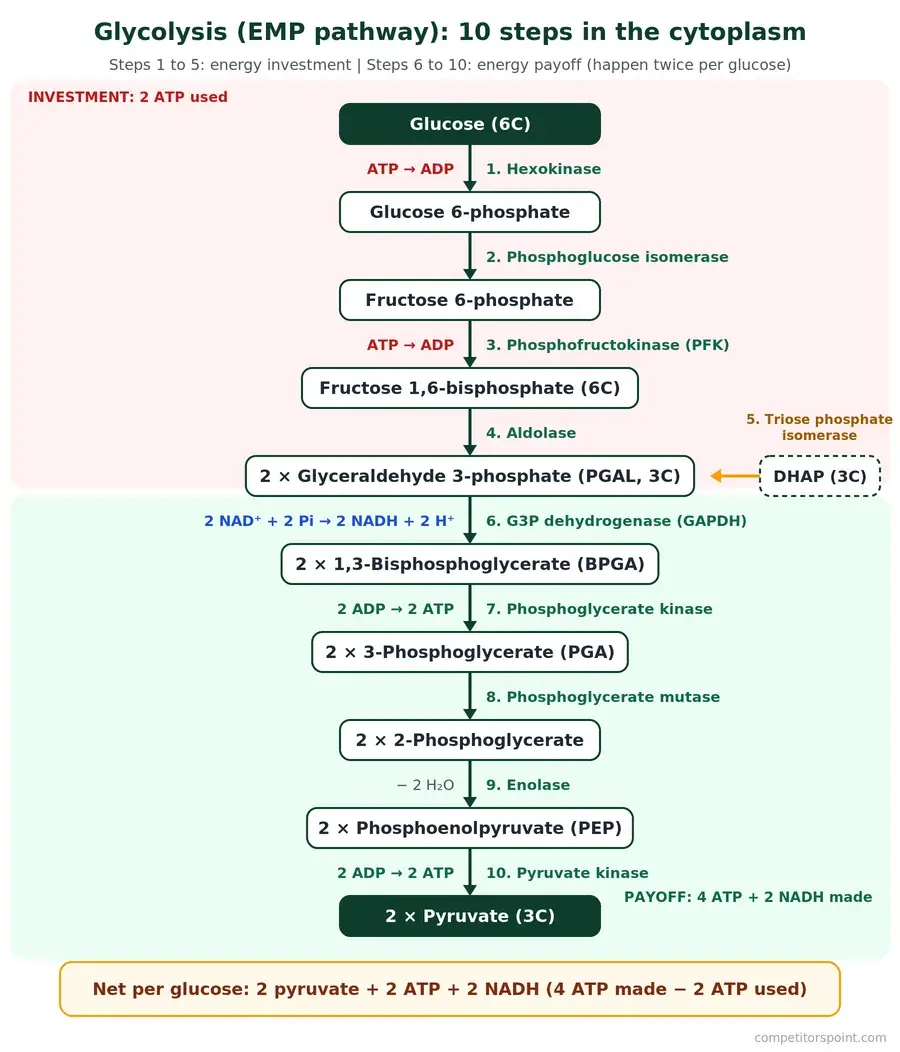
- Phosphorylation: two phosphate groups from 2 ATP are added to glucose, making fructose 1,6-bisphosphate (steps 1 to 3).
- Lysis: the 6C sugar phosphate splits into two 3C triose phosphates (steps 4 and 5).
- Oxidation: each triose phosphate is oxidised by removal of hydrogen; NAD is reduced to NADH (step 6).
- ATP formation: 4 ATP are made by substrate-level phosphorylation as each triose becomes pyruvate (steps 7 to 10).
Net yield per glucose: 2 ATP, 2 reduced NAD and 2 pyruvate.
4 The phases of glycolysis
Glycolysis is divided into two main phases:
- Energy-investment phase (preparatory phase): the first five steps of the pathway. Energy in the form of 2 ATP is consumed to phosphorylate glucose and convert it into a form that can be readily cleaved into two three-carbon molecules. This phase is also known as the glucose activation phase because it prepares the glucose molecule for breakdown.
- Energy-conserving phase (payoff phase): the last five steps of glycolysis. The two three-carbon molecules made in the preparatory phase are oxidised and processed to produce 4 ATP and 2 NADH. It is called the payoff phase because it pays back the 2 ATP invested and leaves a profit of 2 ATP.
Exam tip
- Every step after step 5 happens twice per glucose, because one glucose gives two molecules of glyceraldehyde 3-phosphate. Forgetting to double is the commonest error in yield questions.
5 The 10 steps of glycolysis Extension
Extension beyond the IB guide The IB guide does not ask for the ten individual steps, their enzymes or the names of the intermediates. For the exam, learn the four processes (phosphorylation, lysis, oxidation and ATP formation) and the net yield. The table and step notes below are here for deeper understanding.
Swipe the table sideways to see every column.
| Step | Substrate | Enzyme | Product | ATP / NADH |
|---|---|---|---|---|
| 1 | Glucose | Hexokinase | Glucose 6-phosphate | 1 ATP used |
| 2 | Glucose 6-phosphate | Phosphoglucose isomerase (phosphohexose isomerase) | Fructose 6-phosphate | None |
| 3 | Fructose 6-phosphate | Phosphofructokinase-1 (PFK) | Fructose 1,6-bisphosphate | 1 ATP used |
| 4 | Fructose 1,6-bisphosphate | Aldolase | DHAP + glyceraldehyde 3-phosphate (PGAL) | None |
| 5 | DHAP | Triose phosphate isomerase | Glyceraldehyde 3-phosphate | None (now 2 PGAL) |
| 6 | 2 Glyceraldehyde 3-phosphate + 2 Pi | Glyceraldehyde 3-phosphate dehydrogenase | 2 1,3-Bisphosphoglycerate (BPGA) | 2 NADH made |
| 7 | 2 1,3-Bisphosphoglycerate | Phosphoglycerate kinase | 2 3-Phosphoglycerate (PGA) | 2 ATP made |
| 8 | 2 3-Phosphoglycerate | Phosphoglycerate mutase | 2 2-Phosphoglycerate | None |
| 9 | 2 2-Phosphoglycerate | Enolase | 2 Phosphoenolpyruvate (PEP) + 2 H2O | None |
| 10 | 2 Phosphoenolpyruvate | Pyruvate kinase | 2 Pyruvate | 2 ATP made |
Step 1: phosphorylation of glucose
In this step, glucose is phosphorylated by ATP to form glucose 6-phosphate. ATP gives one phosphate group to glucose on its 6th carbon. When ATP is broken down to ADP, the energy released activates the glucose molecule, and the charged phosphate traps glucose inside the cell. The enzyme involved in this step is hexokinase (glucokinase in liver cells). Mg2+ is required for kinase activity. This step is irreversible.
Glucose + ATP →(hexokinase, Mg2+)→ Glucose 6-phosphate + ADP
Step 2: isomerisation
In this step, glucose 6-phosphate is converted into fructose 6-phosphate. This process is called isomerisation and the enzyme involved is phosphoglucose isomerase (also called phosphohexose isomerase). The six-membered glucose ring becomes the five-membered fructose ring.
Glucose 6-phosphate ↔(phosphoglucose isomerase)↔ Fructose 6-phosphate
Step 3: second phosphorylation
In this step, one more phosphate is added at the first carbon of fructose 6-phosphate to form fructose 1,6-bisphosphate. This means a second ATP is used; the first ATP was used in step 1. Again, this process is a phosphorylation and the enzyme involved is phosphofructokinase (PFK). Mg2+ is required for kinase activity. This irreversible step commits the sugar to glycolysis and is the main control point.
Fructose 6-phosphate + ATP →(phosphofructokinase)→ Fructose 1,6-bisphosphate + ADP
Step 4: lysis
In this step, the 6C fructose 1,6-bisphosphate splits into two 3C compounds, one with a ketone group and one with an aldehyde group. The 3C compound containing a ketone group is called dihydroxyacetone phosphate (DHAP), and the 3C compound containing an aldehyde group is called 3-phosphoglyceraldehyde (PGAL, also called glyceraldehyde 3-phosphate, G3P). This splitting of a 6C compound into two 3C compounds is catalysed by the enzyme aldolase.
Fructose 1,6-bisphosphate ↔(aldolase)↔ DHAP + PGAL
Step 5: isomerisation of DHAP
The DHAP formed gets converted into PGAL, and the next product forms from PGAL only. In other words, DHAP does not form any new product; instead it is converted into PGAL through a reversible reaction. This means two molecules of PGAL continue through the next steps of glycolysis. This reversible reaction is catalysed by triose phosphate isomerase.
DHAP ↔(triose phosphate isomerase)↔ PGAL
Step 6: oxidation of PGAL
In this step, the two molecules of PGAL are oxidised. PGAL is an aldehyde, and oxidising an aldehyde gives an acid. Hydrogen is removed from PGAL and accepted by NAD+, which is reduced to NADH + H+; the energy released is used to attach one inorganic phosphate (Pi) to the acid, forming 1,3-bisphosphoglycerate (BPGA). Since two molecules are formed, the products of step 6 are 2 molecules of 1,3-bisphosphoglycerate and 2 NADH. The enzyme is glyceraldehyde 3-phosphate dehydrogenase. No ATP is used to add this phosphate.
2 PGAL + 2 Pi + 2 NAD+ ↔(G3P dehydrogenase)↔ 2 1,3-bisphosphoglycerate + 2 NADH + 2 H+
Step 7: first ATP formation
In this step, the high-energy phosphate attached in step 6 is transferred to an ADP molecule to form ATP. This is substrate-level phosphorylation. In other words, 2 molecules of 1,3-bisphosphoglycerate are converted to 2 molecules of 3-phosphoglycerate (PGA) and 2 molecules of ATP. The enzyme is phosphoglycerate kinase. At this point the 2 ATP invested have been paid back.
2 1,3-bisphosphoglycerate + 2 ADP ↔(phosphoglycerate kinase)↔ 2 3-phosphoglycerate + 2 ATP
Step 8: phosphate shift
In this step, 3PGA isomerises to form 2PGA: the phosphate moves from carbon 3 to carbon 2. Since there are two molecules of 3PGA, 2 molecules of 2PGA are formed. This reaction is catalysed by the enzyme phosphoglycerate mutase.
2 3PGA ↔(phosphoglycerate mutase)↔ 2 2PGA
Step 9: dehydration
In this step, a water molecule is removed from 2PGA to form phosphoenolpyruvate (PEP). Since there are two molecules of 2PGA, two molecules of water are removed. The enzyme is enolase. Removing water redistributes energy within the molecule, so PEP has a very high-energy phosphate bond.
2 2PGA ↔(enolase, Mg2+)↔ 2 PEP + 2 H2O
Step 10: second ATP formation
PEP is an unstable, high-energy compound, so it readily gives its phosphate to ADP, forming ATP and leaving pyruvic acid (pyruvate). No free inorganic phosphate is needed; the phosphate comes from PEP itself. Since two molecules of PEP are converted into two molecules of pyruvate, two molecules of ATP are formed. The enzyme is pyruvate kinase, and this step is irreversible.
2 PEP + 2 ADP →(pyruvate kinase)→ 2 Pyruvate + 2 ATP
6 Net ATP yield of glycolysis
| Per glucose | Used | Made | Net |
|---|---|---|---|
| ATP | 2 (steps 1 and 3) | 4 (steps 7 and 10) | +2 ATP |
| NADH | 0 | 2 (step 6) | +2 NADH |
| Pyruvate | 2 | 2 pyruvate | |
| CO2 / O2 | No O2 used | No CO2 released | None |
Glucose + 2 NAD+ + 2 ADP + 2 Pi → 2 Pyruvate + 2 NADH + 2 H+ + 2 ATP + 2 H2O
Without oxygen (anaerobic respiration)
Under anaerobic conditions, the NADH made in step 6 cannot pass its electrons to an electron transport chain. Instead, pyruvate is reduced by NADH in a process called fermentation: to lactate (lactic acid) in human muscle and some bacteria, or to ethanol and CO2 in yeast and plant cells. This regenerates NAD+, which is essential for step 6, so glycolysis can continue.
ATP yield: the net ATP yield is only the 2 ATP made directly in glycolysis. The NADH is used to reduce pyruvate, so it does not contribute to further ATP production. In summary, anaerobic respiration yields a net of 2 ATP per glucose.
With oxygen (aerobic respiration)
In the presence of oxygen, pyruvate enters the mitochondria and is converted to acetyl-CoA in the link reaction, which then enters the Krebs (citric acid) cycle. The NADH made during glycolysis stays in the cytoplasm, but its electrons are carried into the mitochondria by shuttle systems and used in the electron transport chain to make more ATP by oxidative phosphorylation.
IB HL How much ATP in total?
- IB uses an approximate figure of 30 to 32 ATP per glucose for aerobic respiration, compared with only 2 ATP for anaerobic respiration.
- Each reduced NAD is worth roughly 2.5 ATP in the electron transport chain, and NADH from glycolysis may give a little less depending on how its electrons enter the mitochondrion. The totals are approximate because the coupling between proton pumping and ATP synthesis is not a whole-number ratio.
- What IB asks you to state exactly is the net yield of glycolysis itself: 2 ATP and 2 reduced NAD per glucose.
7 Irreversible steps and regulation
Irreversible and reversible reactions
Out of the 10 steps of glycolysis, three reactions are irreversible, while the remaining seven are reversible. The irreversible reactions are:
- Step 1: phosphorylation of glucose to glucose 6-phosphate by hexokinase.
- Step 3: phosphorylation of fructose 6-phosphate to fructose 1,6-bisphosphate by phosphofructokinase-1 (PFK-1).
- Step 10: conversion of phosphoenolpyruvate to pyruvate by pyruvate kinase.
The irreversibility of these reactions ensures that the pathway proceeds in one direction and allows tight regulation.
Phosphofructokinase: the control point
PFK is an allosteric enzyme. A high level of ATP (and of citrate from the Krebs cycle) binds to an allosteric site and inhibits PFK, slowing glycolysis when the cell has enough energy. A high level of AMP or ADP activates PFK, speeding glycolysis when energy is short. This is end-product inhibition, the regulation pattern you meet in enzymes (IB C1.1).
Decarboxylation
Glycolysis does not involve any decarboxylation reactions. Decarboxylation is the removal of carbon dioxide (CO2) from a substrate. In this pathway, all six carbon atoms of glucose are conserved and end up in the two pyruvate molecules. CO2 is first released in the link reaction.
Glucose and fructose use in glycolysis
In plants, glucose is synthesized in leaf cells during photosynthesis. However, glucose is not the main form of sugar transported through the plant. Instead, it is converted to sucrose, a disaccharide made of glucose and fructose, for transport in the phloem from the leaves to other parts of the plant, such as the roots.
In root cells, sucrose can be broken down into glucose and fructose by the enzyme invertase. Both glucose and fructose can then enter glycolysis.
8 Fate of pyruvate
Pyruvate is the branch point of respiration. What happens to it depends on oxygen and the organism; the full detail is in fate of pyruvate.
- Aerobic: pyruvate enters the mitochondrial matrix and is oxidatively decarboxylated to acetyl-CoA, releasing CO2 and making NADH.
- Lactic acid fermentation: in muscle during intense exercise and in some bacteria, pyruvate is reduced to lactate.
- Alcoholic fermentation: in yeast and plants under anaerobic conditions, pyruvate is converted to ethanol and CO2.
Lactate from muscle is carried in the blood to the liver, where it is converted back to glucose.
9 Glycolysis compared with the other stages
Swipe the table sideways to see every column.
| Feature | Glycolysis | Link reaction | Krebs cycle | Electron transport chain |
|---|---|---|---|---|
| Site (eukaryotes) | Cytoplasm | Mitochondrial matrix | Mitochondrial matrix | Inner mitochondrial membrane (cristae) |
| Oxygen needed? | No | Yes (indirectly) | Yes (indirectly) | Yes, final electron acceptor |
| Starts with | Glucose | 2 pyruvate | 2 acetyl-CoA | NADH and FADH2 |
| CO2 released | 0 | 2 | 4 | 0 |
| ATP per glucose | 2 net (substrate level) | 0 | 2 (substrate level) | Most (oxidative) |
| Reduced carriers | 2 NADH | 2 NADH | 6 NADH, 2 FADH2 | Reoxidised to NAD+ and FAD |
For how respiration links to photosynthesis, see the photosynthesis and cell respiration hub. Glycolysis also feeds the pentose phosphate pathway, which branches off at glucose 6-phosphate.
10 Key terms
| Term | Meaning |
|---|---|
| Glycolysis | Splitting of glucose into 2 pyruvate in the cytoplasm, with a net gain of 2 ATP and 2 NADH. |
| EMP pathway | Another name for glycolysis (Embden, Meyerhof, Parnas). |
| Phosphorylation | Addition of a phosphate group to a molecule. |
| Lysis | Splitting; here, the 6C sugar into two 3C trioses. |
| Substrate-level phosphorylation | ATP made by direct transfer of phosphate from a substrate (BPGA, PEP) to ADP. |
| Triose phosphate | 3C sugar phosphate: PGAL (G3P) or DHAP. |
| NAD+ / NADH | Hydrogen carrier: oxidised form / reduced form. |
| Redox reaction | A reaction in which one substance is oxidised (loses electrons or hydrogen) while another is reduced (gains them). |
| Dehydrogenase | Enzyme that removes hydrogen from a substrate and passes it to a carrier such as NAD+. |
| Kinase | Enzyme that transfers a phosphate group, usually to or from ATP. |
| Isomerase | Enzyme that rearranges a molecule into an isomer. |
| Allosteric inhibition | Inhibitor binds away from the active site and changes its shape, as ATP does to PFK. |
11 Common doubts about glycolysis
These are the questions students ask us most often about glycolysis.
Where does glycolysis occur?
Glycolysis occurs in the cytoplasm (cytosol) of every living cell, prokaryotic and eukaryotic. It does not need mitochondria or oxygen, which is why red blood cells, which have no mitochondria, rely on it completely.
If glycolysis needs ATP in its early steps, where do those first ATP molecules come from?
Your cells always keep a small supply of ATP on hand, even before they start breaking down glucose. Glycolysis does not begin from zero. The 2 ATP invested in steps 1 and 3 are paid back with interest, because 4 ATP are made in steps 7 and 10.
How many ATP are produced in glycolysis?
4 ATP are produced in the whole process of glycolysis, but since 2 ATP are invested, the net gain is 2 ATP per glucose, along with 2 NADH and 2 pyruvate.
How can NADH carry energy if making it already releases energy?
When NADH forms, the reaction that creates it does release some energy, but not all of the energy from the electrons is lost. A good amount is captured and held by NADH as high-energy electrons. Those electrons still have plenty of potential energy left, which is why NADH can hand them on to the electron transport chain later.
Does glycolysis need oxygen?
No. Glycolysis is anaerobic, and no step uses oxygen. Oxygen matters only for what happens next. Without oxygen, NADH must be reoxidised by fermentation so that NAD+ is available for step 6 and glycolysis can continue.
Is glycolysis the same as the EMP pathway?
Yes. EMP pathway is another name for glycolysis, after Embden, Meyerhof and Parnas, who worked out its steps. IB simply calls it glycolysis and describes it as phosphorylation, lysis, oxidation and ATP formation.
Why is phosphofructokinase called the key regulatory enzyme of glycolysis?
PFK catalyses the irreversible step that commits sugar to glycolysis. It is allosterically inhibited by high ATP and citrate and activated by AMP, so the pathway speeds up when the cell is short of energy and slows down when ATP is plentiful.
How much does glycolysis add to the total ATP yield of aerobic respiration?
Glycolysis itself always gives a net of 2 ATP by substrate-level phosphorylation. Its 2 reduced NAD can be used later in the electron transport chain to make a few more ATP, so glycolysis contributes a small share of the approximate total of 30 to 32 ATP per glucose. IB expects you to state the net 2 ATP and 2 reduced NAD for glycolysis and to treat whole-pathway totals as approximate.
Is NAD oxidised or reduced in glycolysis?
NAD is reduced. During the oxidation of triose phosphate a dehydrogenase removes hydrogen from the sugar, which is oxidised, and passes it to NAD+, which becomes reduced NAD (NADH + H+). The two changes always happen together, which is why they are called a redox reaction.
12 Practice questions
Tap each question to reveal the answer.
Test yourself on glycolysis
1. Name the three enzymes that catalyse the irreversible steps of glycolysis.
Hexokinase (step 1), phosphofructokinase (step 3) and pyruvate kinase (step 10).
2. How many ATP are used and how many are made per glucose in glycolysis?
2 ATP used (steps 1 and 3) and 4 ATP made (steps 7 and 10), so a net gain of 2 ATP.
3. In which step is NAD+ reduced, and which enzyme catalyses it?
Step 6, the oxidation of glyceraldehyde 3-phosphate to 1,3-bisphosphoglycerate, catalysed by glyceraldehyde 3-phosphate dehydrogenase.
4. (IB HL) Outline the four processes of glycolysis. [4 marks]
Phosphorylation of glucose using 2 ATP; lysis of the 6C hexose bisphosphate into two 3C triose phosphates; oxidation of triose phosphate by removal of hydrogen, reducing NAD to NADH; ATP formation, giving 4 ATP by substrate-level phosphorylation and a net yield of 2 ATP and 2 pyruvate.
5. Why must NAD+ be regenerated by fermentation when oxygen is absent?
NAD+ is needed as the hydrogen acceptor in step 6; without it glycolysis stops, so pyruvate is reduced to lactate or ethanol to reoxidise NADH.
6. How many CO2 molecules are released in glycolysis?
None. Glycolysis has no decarboxylation step; the first CO2 is released in the link reaction.
7. Name the type of phosphorylation that makes ATP in glycolysis and give the two substrates that donate phosphate.
Substrate-level phosphorylation; 1,3-bisphosphoglycerate (step 7) and phosphoenolpyruvate (step 10).
8. (IB HL) Explain, in terms of redox, what happens to triose phosphate and to NAD during glycolysis. [3 marks]
Triose phosphate is oxidised by removal of hydrogen (loss of electrons), catalysed by a dehydrogenase; NAD+ accepts the hydrogen and is reduced to NADH + H+; oxidation and reduction are coupled, and 2 reduced NAD are formed per glucose.
Ready to practise? Download the Glycolysis IB question set with markscheme.
© competitorspoint.com · Biology notes. Diagrams are original to competitorspoint.com.