
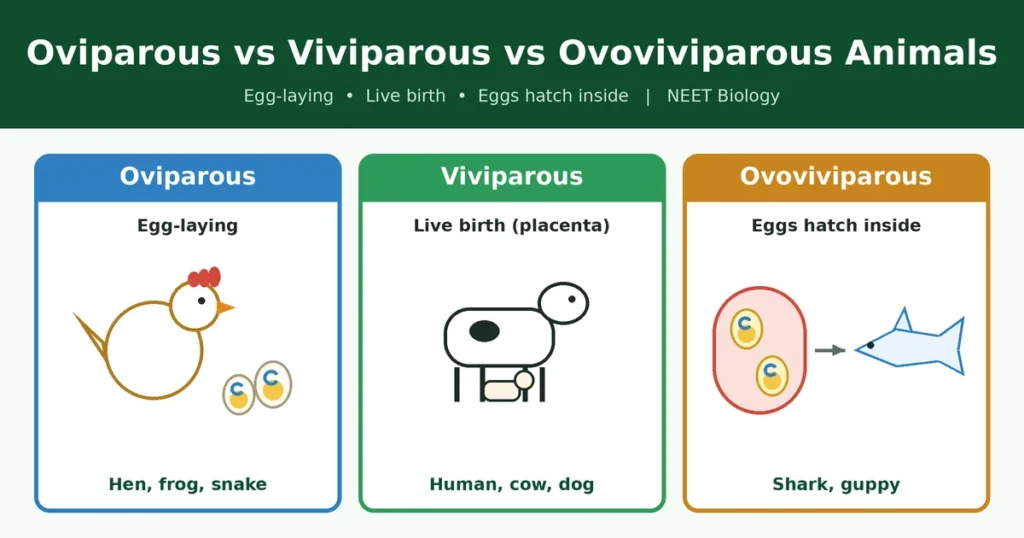
The difference between oviparous viviparous and ovoviviparous animals lies in where the embryo develops and how it is fed: in an egg outside the mother, inside the mother through a placenta, or in an egg kept inside the mother. This topic belongs to the NCERT chapter reproduction in organisms and is a favourite in NEET and board exams. Below you will find clear diagrams, a comparison table, examples, Hindi terms and 20 NEET MCQs.
Key points
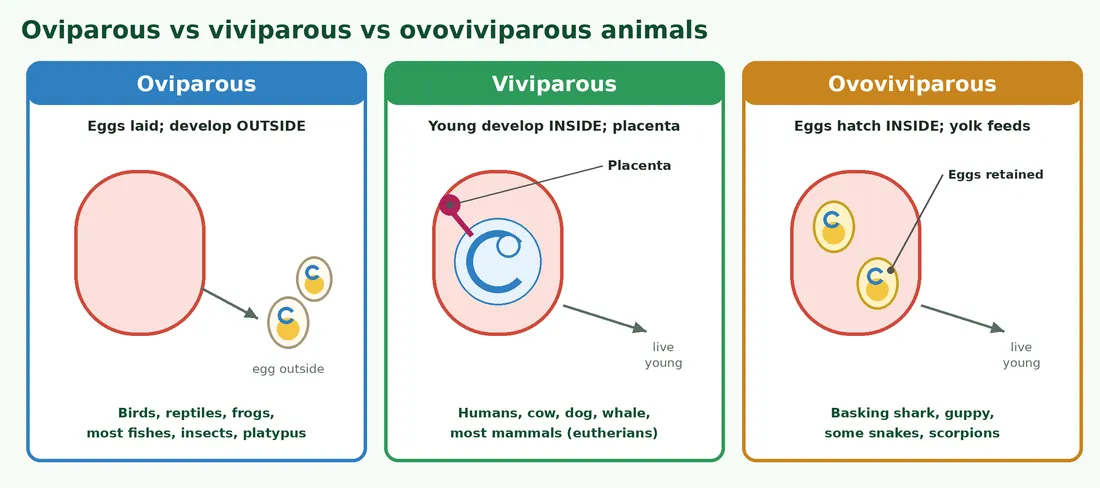
- Oviparous animals lay eggs; the embryo develops outside the mother and is fed by yolk. e.g. birds, reptiles, frogs.
- Viviparous animals give birth to live young; the embryo develops inside the mother and is fed through the placenta. e.g. humans, cows.
- Ovoviviparous animals keep eggs inside the body; the eggs hatch inside and the young are born alive, but the embryo is fed by yolk. e.g. basking shark.
- Chances of survival of the young are greater in viviparous animals.
Introduction: reproduction in organisms and the zygote
When male and female gametes are fused, zygote formation takes place. Zygote is considered as a vital link that ensures the continuity of species generation after generation. Every sexually reproducing organism, including human beings, starts life as a single cell, called the zygote. After zygote formation, the process of development of the embryo takes place. During embryogenesis, the zygote undergoes mitotic cell division and cell differentiation. On the basis of development of the zygote, animals are classified into different groups such as oviparous, viviparous and ovoviviparous. The following article discusses the meaning of oviparous, viviparous and ovoviviparous in brief, and then explains the difference between oviparous viviparous and ovoviviparous animals.
In the study of reproduction in organisms, where the zygote develops is one of the main post-fertilisation differences between animals. It is also a useful clue when you learn the basis of classification of the animal kingdom.
Difference between oviparous viviparous and ovoviviparous animals at a glance
If you are asked to differentiate oviparous, viviparous and ovoviviparous animals in one line each:
- Oviparous (Latin ovum = egg, parere = to bring forth): egg-laying.
- Viviparous (vivus = alive): live-bearing with placental nutrition.
- Ovoviviparous (egg + alive): eggs hatch inside the mother; live birth without a placenta.
So the whole difference between oviparous viviparous and ovoviviparous animals comes down to two questions: where does the embryo develop, and what feeds it?
Oviparous animals
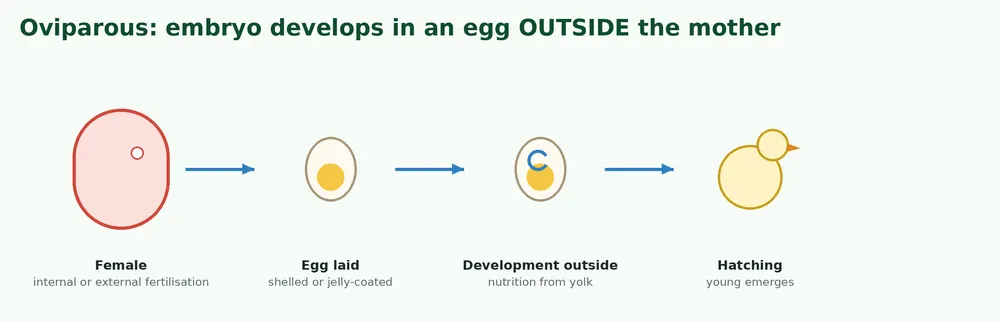
They are egg producing animals in which eggs mature and hatch outside the parent body. Eggs can either be fertilized or unfertilized before they are expelled from the parent body. For example, the frog is an oviparous animal, but external fertilization occurs in frogs. On the other hand, birds and reptiles are also oviparous, but they possess internal fertilization.
So, we can say that when an animal lays an egg – it could either be a fertilized egg or an unfertilized egg. For instance, eggs laid by chickens are not always fertilized eggs; they could also be unfertilized depending on whether the female hen has undergone mating with the male. So, when a chicken lays eggs without mating – eggs would be unfertilized. And if a female chicken undergoes mating before laying – eggs would be fertilized.
The development of the zygote occurs outside the body of the female. The embryo receives nutrition from the yolk. However, the chances of survival are very less because they are exposed to the external environment. In oviparous animals like reptiles and birds, the fertilised eggs are covered by a hard calcareous shell and are laid in a safe place in the environment; after a period of incubation, the young ones hatch out.
Examples: birds, reptiles, amphibians, most fishes, insects, etc. A few exceptions in mammals showing oviparous characters are – duck-billed platypus, echidna or spiny ant eaters, etc. (the egg-laying mammals, Prototheria).
Viviparous animals: reproduction in organisms that give live birth
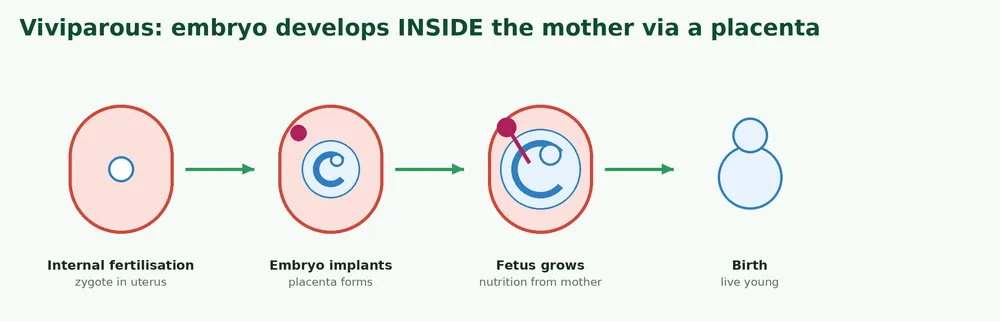
Animals that give birth to live young individuals are viviparous. In viviparous animals, fertilization takes place inside the female parent body. After fertilization, the zygote is formed and then the zygote undergoes the process of embryogenesis to form a new individual. In other words, in viviparous animals – fertilization, zygote formation and embryogenesis occur inside the body of the female parent. For example, mammals are viviparous.
True viviparity is shown by the formation of a chorioallantoic placenta. It is shown in a specific group of Mammalia i.e., Eutheria – placental mammals. In viviparous animals, the embryo receives nutrition directly from the mother through the placenta. However, the chances of survival are more as they are protected from the external environment. Because of proper embryonic care and protection, the chances of survival of young ones are greater in viviparous organisms.
Example: most mammals, including human beings, cows, dogs, whales and bats.
Ovoviviparous animals
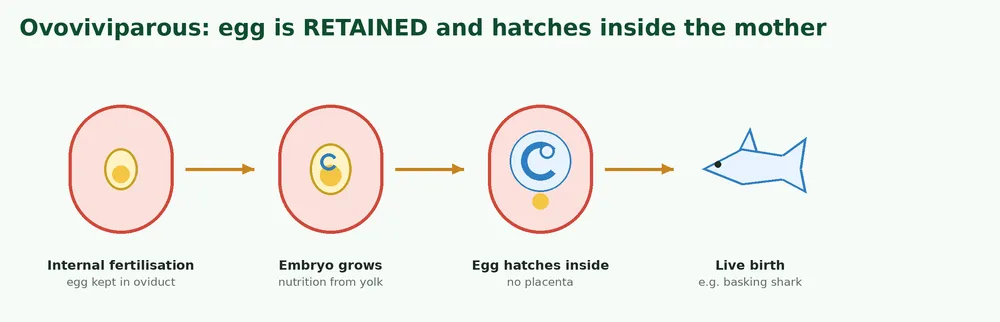
These animals show internal fertilization — they produce eggs, but instead of laying eggs outside the body, the eggs remain inside the mother’s body. Eggs hatch within the mother’s body. However, the embryo gets nutrition from the yolk stored in the egg. This is also known as ‘yolk-sac viviparity’. In other words, we can say that ovoviviparous animals are like viviparous animals but differ in the absence of a placental connection between the mother and the growing embryo.
However, if we compare ovoviviparous organisms with oviparous organisms – the former is the more advanced form, as the developing fetus gets the mother’s protection from external environmental adversities.
Examples include some sharks (basking shark) and scorpions, as well as guppies and some snakes such as vipers.
Differentiate oviparous viviparous and ovoviviparous animals: comparison table
| Feature | Oviparous | Viviparous | Ovoviviparous |
|---|---|---|---|
| Meaning | Lay eggs | Give birth to live young | Retain eggs; give birth to live young |
| Fertilisation | External or internal | Internal | Internal |
| Site of development | Outside the mother’s body | Inside the uterus | Inside the egg, within the mother’s body |
| Nutrition of embryo | Yolk | Mother, through the placenta | Yolk |
| Placenta | Absent | Present | Absent |
| Hatching | Outside the body | No hatching | Inside the body |
| Parental protection | Little | Maximum | Moderate |
| Chances of survival | Lowest | Highest | Intermediate |
| Number of offspring | Usually many eggs | Usually few | Fewer than oviparous |
| Examples | Hen, frog, snake, lizard, butterfly, platypus | Human, cow, dog, whale, bat | Basking shark, guppy, viper, scorpion |
This table sums up the difference between oviparous viviparous and ovoviviparous animals in ten points, the format examiners expect.
Exam tip: Live birth alone does not make an animal viviparous. Check for the placenta: no placenta plus live birth means ovoviviparous.
What are oviparous and viviparous animals? Give examples
A very common short-answer question is “What are oviparous and viviparous animals? Give examples.” Oviparous animals lay eggs that develop outside the body, while viviparous animals give birth to young ones that developed inside the mother.
- Oviparous examples: hen, duck, sparrow, crocodile, turtle, snake, lizard, frog, toad, most bony fishes, butterfly, housefly, mosquito, platypus, echidna.
- Viviparous examples: human, cow, goat, dog, cat, elephant, lion, whale, dolphin, bat.
- Ovoviviparous examples: basking shark, guppy, viper (some snakes), scorpion.
Oviparous viviparous and ovoviviparous animals in Hindi
Hindi-medium students often search for the difference between oviparous viviparous and ovoviviparous animals using these terms:
| English | Hindi term | Meaning (Hindi) | Examples (Hindi) |
|---|---|---|---|
| Oviparous | अंडज (Andaj) | अंडे देने वाले जंतु; भ्रूण शरीर के बाहर अंडे में विकसित होता है | मुर्गी, मेंढक, साँप, छिपकली, मछली, तितली |
| Viviparous | जरायुज (Jarayuj) | सीधे शिशु को जन्म देने वाले जंतु; भ्रूण को अपरा (placenta) से पोषण | मनुष्य, गाय, कुत्ता, बिल्ली, व्हेल, चमगादड़ |
| Ovoviviparous | अंडजरायुज (Andajarayuj) | अंडा माँ के शरीर के अंदर ही फूटता है; पोषण योक (पीतक) से | बास्किंग शार्क, गप्पी मछली, वाइपर साँप, बिच्छू |
Useful Hindi words: zygote = युग्मनज, embryo = भ्रूण, yolk = पीतक, placenta = अपरा, fertilisation = निषेचन.
Across animal phyla
Most invertebrates are oviparous. Members of Phylum Coelenterata (Cnidaria) and Phylum Ctenophora release gametes or lay eggs, and flatworms in Phylum Platyhelminthes lay eggs that pass through many larval stages. Viviparity in the strict, placental sense is a feature of eutherian mammals. Revise every phylum in our Animal Kingdom notes.
In short, the difference between oviparous viviparous and ovoviviparous animals is where the young develop and how they are nourished before birth or hatching.
Common doubts
What is the difference between oviparous viviparous and ovoviviparous animals?
Oviparous animals lay eggs that develop outside the body; viviparous animals give birth to live young nourished through a placenta; ovoviviparous animals retain eggs inside the body, where they hatch, and give birth to live young nourished by yolk.
Is a hen oviparous or viviparous?
A hen is oviparous. It lays eggs with a hard calcareous shell, and the chick develops outside the mother’s body.
Are all mammals viviparous?
No. The duck-billed platypus and echidna are egg-laying mammals, so they are oviparous.
Is a shark oviparous, viviparous or ovoviviparous?
It depends on the species. The basking shark is ovoviviparous, some sharks lay eggs, and a few have a placenta-like connection.
Is fertilisation always internal in oviparous animals?
No. Frogs and most fishes show external fertilisation; birds and reptiles show internal fertilisation.
Why do viviparous young have better survival?
Because the embryo develops inside the mother with proper care, protection and placental nutrition.
What is oviparous in Hindi?
Oviparous is अंडज, viviparous is जरायुज, and ovoviviparous is अंडजरायुज.
Now test how well you know the difference between oviparous viviparous and ovoviviparous animals.
20 NEET MCQs on oviparous, viviparous and ovoviviparous animals
Q1. Animals that lay eggs are called:
- (a) Viviparous
- (b) Oviparous
- (c) Ovoviviparous
- (d) Parthenogenetic
Q2. In viviparous animals the embryo is nourished by:
- (a) Yolk only
- (b) The placenta
- (c) Albumen
- (d) Water
Q3. Ovoviviparous animals give birth to live young, but the embryo is nourished by:
- (a) Placenta
- (b) Yolk
- (c) Mother’s blood
- (d) Milk
Q4. Which is an egg-laying mammal?
- (a) Kangaroo
- (b) Platypus
- (c) Bat
- (d) Whale
Q5. Basking shark is:
- (a) Oviparous
- (b) Viviparous
- (c) Ovoviviparous
- (d) Asexual
Q6. Chances of survival of young ones are greatest in:
- (a) Oviparous
- (b) Viviparous
- (c) Ovoviviparous
- (d) All equal
Q7. In reptiles and birds, fertilised eggs are covered by:
- (a) A jelly coat
- (b) A hard calcareous shell
- (c) A placenta
- (d) Chorion only
Q8. Fertilisation in frogs is:
- (a) Internal
- (b) External
- (c) Absent
- (d) Inside the egg shell
Q9. True viviparity is associated with the:
- (a) Yolk sac placenta
- (b) Chorioallantoic placenta
- (c) Egg shell
- (d) Amnion only
Q10. Which pair is correctly matched?
- (a) Hen – viviparous
- (b) Human – oviparous
- (c) Scorpion – ovoviviparous
- (d) Frog – viviparous
Q11. Echidna is:
- (a) Viviparous
- (b) Oviparous
- (c) Ovoviviparous
- (d) Placental
Q12. Hatching of eggs inside the mother’s body occurs in:
- (a) Oviparous animals
- (b) Ovoviviparous animals
- (c) Viviparous placental mammals
- (d) Birds
Q13. The placenta is absent in:
- (a) Humans
- (b) Cows
- (c) Ovoviviparous animals
- (d) Dogs
Q14. A hen laying eggs without mating produces:
- (a) Fertilised eggs
- (b) Unfertilised eggs
- (c) Embryos
- (d) Larvae
Q15. The single cell that starts the life of a sexually reproducing organism is:
- (a) Gamete
- (b) Zygote
- (c) Embryo
- (d) Spore
Q16. During embryogenesis the zygote undergoes:
- (a) Meiosis only
- (b) Mitotic division and cell differentiation
- (c) Fusion
- (d) Budding
Q17. Viviparous animals are best represented by:
- (a) Most mammals
- (b) Most fishes
- (c) Most reptiles
- (d) Insects
Q18. Which is the most protected developmental pattern for the embryo?
- (a) Oviparous with external fertilisation
- (b) Oviparous with internal fertilisation
- (c) Ovoviviparous
- (d) Viviparous
Q19. Hindi term जरायुज refers to:
- (a) Oviparous
- (b) Viviparous
- (c) Ovoviviparous
- (d) Hermaphrodite
Q20. Guppy fish is:
- (a) Oviparous
- (b) Viviparous
- (c) Ovoviviparous
- (d) Asexual
Practise more with our 40 NEET sample test papers and explore all NEET Biology notes.