
Phylum Coelenterata (also called Cnidaria) is one of the most scoring topics of the NEET chapter Animal Kingdom. In these notes, based on NCERT Class 11 Biology, we cover every line on coelenterates: cnidoblasts, tissue level of organisation, the gastrovascular cavity, polyp and medusa, metagenesis, corals, coral reefs and the key examples. A set of 25 NEET-style MCQs is given at the end.
Key points
- Aquatic, mostly marine, sessile or free-swimming, radially symmetrical animals.
- Named after cnidoblasts (cnidocytes), which contain stinging capsules called nematocysts.
- Tissue level of organisation and diploblastic (epidermis and gastrodermis, with mesoglea between).
- Central gastro-vascular cavity with a single opening, the mouth on the hypostome.
- Digestion is both extracellular and intracellular.
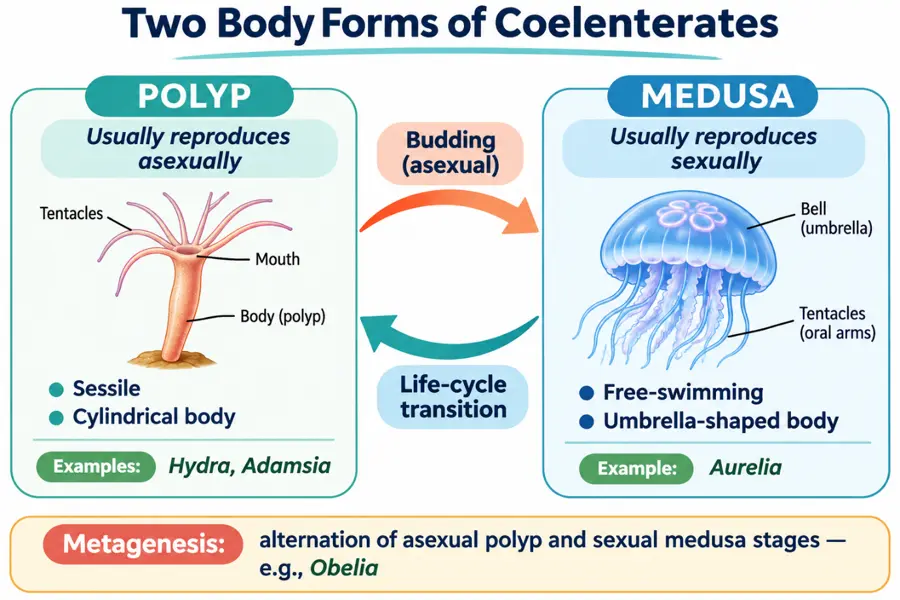
- Two body forms: polyp (sessile, cylindrical) and medusa (umbrella-shaped, free-swimming).
- Metagenesis: polyps produce medusae asexually and medusae form polyps sexually, e.g. Obelia.
- Corals have a skeleton of calcium carbonate.
Phylum Coelenterata at a glance
According to NCERT, coelenterates are aquatic, mostly marine, sessile or free-swimming, radially symmetrical animals. In Phylum Coelenterata the body has no true organs; cells are grouped into tissues. They are the simplest animals to show tissue-level organisation along with ctenophores, and they come right after Porifera (sponges) in the classification of the animal kingdom.
Why the name Coelenterata or Cnidaria?
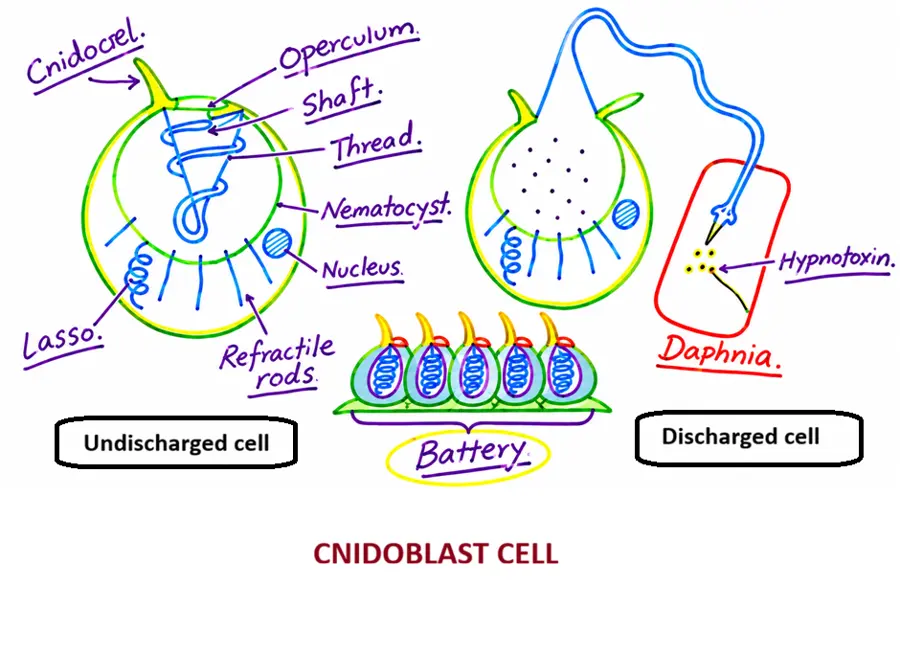
The term Coelenterata derives from coelenteron (gastrovascular cavity). This phylum is also called Cnidaria because it contains cnidoblasts – a specific type of cell called a sting cell or cnidocyte.
In NCERT words, the name cnidaria is derived from the cnidoblasts or cnidocytes (which contain the stinging capsules or nematocysts) present on the tentacles and the body. Note that the coelenteron is not a true coelom; members of Phylum Coelenterata are acoelomate.
General characteristics of Phylum Coelenterata
General Characteristics:
- Aquatic, mostly marine, solitary or colonial – tissue level of organisation.
- Radial symmetry, blind sac body plan
- Diploblastic (epidermis and gastrodermis)
- Coelenteron / gastrovascular cavity
- Digestion: extracellular as well as intracellular
- Respiration, excretion: diffusion
- Reproduction: asexual and sexual
- Fertilization: gametes are produced by the sexual stage (medusa in forms showing metagenesis)
- Development: Indirect (Planula larva)
- Examples: Sea anemone, Corallium (red coral), jellyfish, physalia (Portuguese man of war), aurelia, sea fan
Additional features to remember
- They can be sessile (attached, e.g. Hydra, Adamsia) or free-swimming (e.g. Aurelia).
- Body is radially symmetrical: any plane through the central axis divides it into identical halves.
- Blind sac body plan: the digestive system is incomplete, with one opening that works as both mouth and anus.
- There is no body cavity (coelom), no segmentation, and no circulatory or respiratory system.
- A simple nerve net is present.
Cnidoblasts and nematocysts
Cnidoblasts are the special cells that give the phylum its name. Each cnidoblast contains a stinging capsule (nematocyst) with a coiled thread. They are present on the tentacles and the body (NCERT Figure 4.7 shows a diagrammatic view of a cnidoblast).
NCERT lists three uses of cnidoblasts in Phylum Coelenterata:
- Anchorage – attaching to the substratum
- Defence – stinging enemies
- Capture of prey – paralysing small animals
Exam tip: Cnidoblasts are the distinctive feature of Coelenterata in NCERT Table 4.2. Comb plates are the distinctive feature of Ctenophora. Do not mix the two.
Body wall and organisation
Cnidarians exhibit tissue-level organization and are diploblastic. The outermost layer is called the epidermis, and the innermost layer is called the gastrodermis. Between the two layers is the mesoglea. They have a central gastrovascular cavity with a single opening (mouth on the hypostome). They exhibit two basic body forms called polyp and medusa. The former is sessile and cylindrical, such as hydra and Adamsia, while the latter is umbrella-shaped and free-swimming, such as Aurelia (jellyfish). Cnidarians that exist in both polyp and medusa forms show alternation of generations, or metagenesis; the classic example is Obelia. Physalia is a colonial form. Coelenterates have a simple nerve net.
Diploblastic body
In diploblastic animals the cells are arranged in two embryonic layers: an external ectoderm and an internal endoderm. An undifferentiated layer, the mesoglea, is present in between. (Triploblastic animals, from Platyhelminthes onwards, have a third layer, the mesoderm.)
Gastro-vascular cavity and digestion
The central gastro-vascular cavity (coelenteron) opens to the outside by a single opening, the mouth, located on a raised cone called the hypostome. Digestion is extracellular (enzymes act on food inside the cavity) and intracellular (food particles are taken into gastrodermal cells and digested in food vacuoles). The same cavity distributes food, which is why it is called gastro-vascular.
Polyp and medusa: the two body forms
Members of Phylum Coelenterata exhibit two basic body forms called polyp and medusa (NCERT Figure 4.6).
| Feature | Polyp | Medusa |
|---|---|---|
| Shape | Cylindrical | Umbrella-shaped |
| Habit | Sessile (attached) | Free-swimming |
| Reproduction (in metagenesis) | Produces medusae asexually (budding) | Forms polyps sexually (gametes) |
| Examples | Hydra, Adamsia | Aurelia (jelly fish) |
Metagenesis
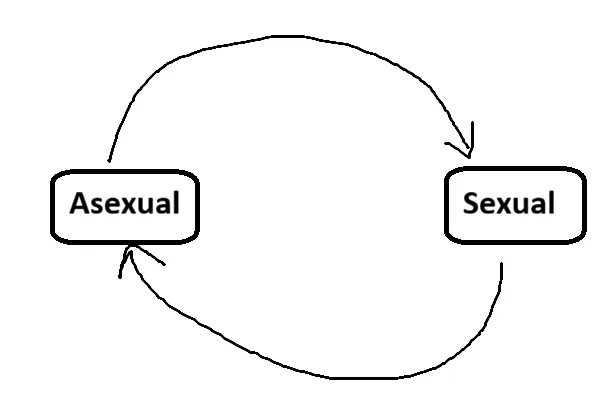
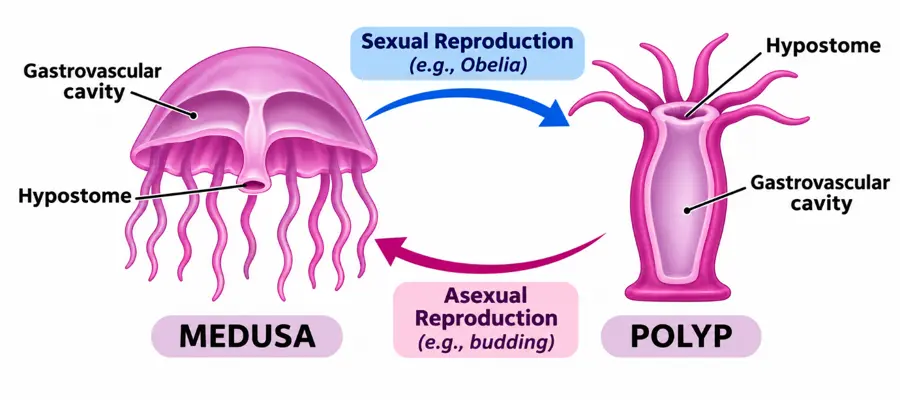
You might have read about alternation of generations in plants, where diploid and haploid stages interchange in the life cycle. However, in coelenterates, asexual and sexual stages alternate, which is called metagenesis. It is a characteristic feature of this phylum. The asexual stage is called a polyp, a cylindrical, sessile structure. The sexual stage is called a medusa, which is umbrella-shaped and shows movement. Example: Obelia (sea fur). Physalia (Portuguese man-of-war) is a colonial cnidarian, not the NCERT example of metagenesis.
NCERT states it precisely: those cnidarians which exist in both forms exhibit alternation of generations (Metagenesis), i.e., polyps produce medusae asexually and medusae form the polyps sexually (e.g., Obelia). In Phylum Coelenterata, the medusae release gametes; the zygote develops into a ciliated planula larva, which settles and grows into a new polyp colony.
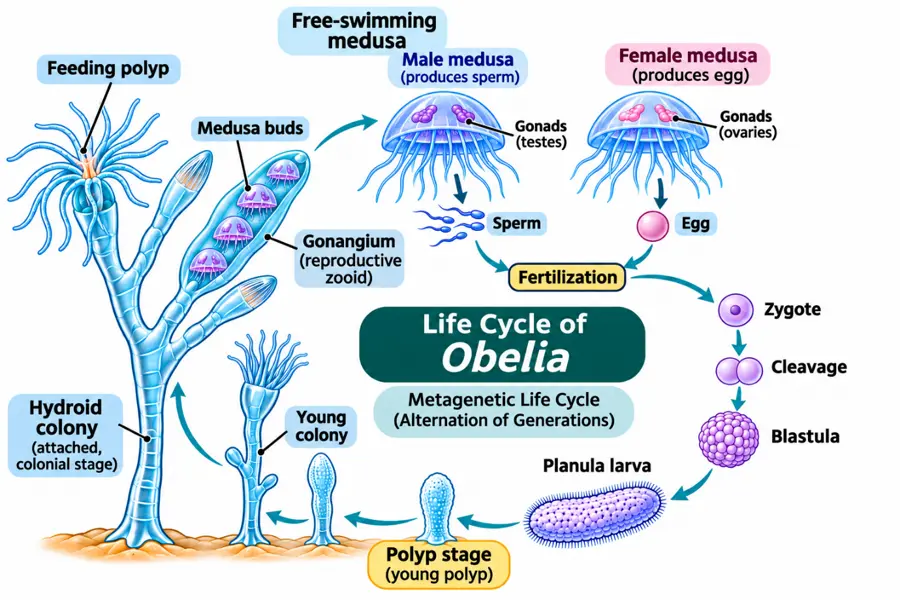
Note: Not all coelenterates show metagenesis. For instance, hydra and jellyfish do not show metagenesis. The best example is Obelia, where metagenesis occurs.
Draft reference: https://www.aakash.ac.in/important-concepts/biology/phylum-coelenterata-cnidaria
Corals and coral reefs
Coral is a generalized term for all kinds of coelenterates whose bodies (exoskeleton) are surrounded by a calcium carbonate structure. These corals form large colonies, which we call coral reefs. Coral reefs generally form around islands. For instance, the Great Barrier Reef surrounds Australia.
Some members of Phylum Coelenterata, e.g., corals, have a skeleton composed of calcium carbonate. Meandrina (brain coral) is the NCERT example of a coral.
Types of Coral Reefs

- Fringing reef: If the coral reef is present at the base of a mountainous island
- Barrier reef: If the coral reef is present around an island, but the distance between the island and the reef is about 2 to 4 km, then such a coral reef is called a barrier reef. The area between the island and the coral reef is filled with water, commonly called a lagoon.
- Atoll: If the island is submerged in water and the coral reef only encircles the water, such a coral reef is called an atoll.
Examples of Coelenterata
| Scientific name | Common name | Point to remember |
|---|---|---|
| Physalia | Portuguese man-of-war | Colonial, floating |
| Adamsia | Sea anemone | Polyp form (NCERT Fig. 4.6b) |
| Pennatula | Sea-pen | Colonial |
| Gorgonia | Sea-fan | Colonial |
| Meandrina | Brain coral | CaCO3 skeleton |
| Aurelia | Jelly fish | Medusa form (NCERT Fig. 4.6a) |
| Hydra | Hydra | Freshwater polyp |
| Obelia | Sea fur | Shows metagenesis |
| Corallium | Red coral | CaCO3 skeleton |
Common trap: Sea anemone (Adamsia), sea-pen, sea-fan and brain coral are cnidarians; sea walnut / comb jelly (Pleurobrachia) is a ctenophore; sea urchin and sea cucumber are echinoderms.
Coelenterata in the salient features table (NCERT Table 4.2)
| Phylum | Level of organisation | Symmetry | Coelom | Segmentation | Digestive system | Circulatory system | Respiratory system | Distinctive features |
|---|---|---|---|---|---|---|---|---|
| Porifera | Cellular | Various | Absent | Absent | Absent | Absent | Absent | Body with pores and canals in walls |
| Coelenterata (Cnidaria) | Tissue | Radial | Absent | Absent | Incomplete | Absent | Absent | Cnidoblasts present |
| Ctenophora | Tissue | Radial | Absent | Absent | Incomplete | Absent | Absent | Comb plates for locomotion |
Coelenterata vs Ctenophora
| Feature | Coelenterata | Ctenophora |
|---|---|---|
| Habitat | Aquatic, mostly marine | Exclusively marine |
| Distinctive feature | Cnidoblasts | Eight rows of ciliated comb plates |
| Body forms | Polyp and medusa | No polyp/medusa |
| Reproduction | Asexual and sexual | Only sexual |
| Bioluminescence | Not a key feature | Well-marked |
| Common feature | Both: radial symmetry, diploblastic, tissue level, extracellular + intracellular digestion | |
After Phylum Coelenterata, revise the full chapter with our NEET Biology notes and continue with Phylum Ctenophora next.
Phylum Coelenterata: Common doubts
Is the coelenteron a true coelom?
No. The coelenteron is the gastro-vascular (digestive) cavity. Coelenterates have no coelom and are acoelomate.
Why are coelenterates called diploblastic?
Their body develops from two layers, an outer ectoderm (epidermis) and an inner endoderm (gastrodermis), with an undifferentiated mesoglea between them.
Does Hydra show metagenesis?
No. Hydra exists only as a polyp. Obelia, which has both polyp and medusa stages, is the NCERT example of metagenesis.
What is the function of cnidoblasts?
Cnidoblasts contain nematocysts and are used for anchorage, defence and the capture of prey.
Is a jellyfish a fish?
No. Aurelia (jelly fish) is a cnidarian in the medusa form. True fishes are chordates.
Is digestion in coelenterates intracellular or extracellular?
Both. Food is partly digested in the gastro-vascular cavity (extracellular) and completed inside gastrodermal cells (intracellular).
Coelenterata NEET MCQs (25 questions)
Test yourself with these 25 NCERT-based NEET practice questions on Phylum Coelenterata. They cover every NCERT line on Phylum Coelenterata, from cnidoblasts to coral examples.
Q1. The name Cnidaria is derived from:
- (a) Coelenteron
- (b) Cnidoblasts
- (c) Comb plates
- (d) Collar cells
Show Answer
Answer: (b) Cnidoblasts. Cnidoblasts or cnidocytes, which contain nematocysts.
Q2. Cnidoblasts are used for all of the following EXCEPT:
- (a) Anchorage
- (b) Defence
- (c) Capture of prey
- (d) Excretion
Show Answer
Answer: (d) Excretion. NCERT lists anchorage, defence and capture of prey.
Q3. Stinging capsules present in cnidoblasts are called:
- (a) Spicules
- (b) Nematocysts
- (c) Ostia
- (d) Choanocytes
Show Answer
Answer: (b) Nematocysts. Nematocysts are the stinging capsules.
Q4. Coelenterates show which level of organisation?
- (a) Cellular
- (b) Tissue
- (c) Organ
- (d) Organ-system
Show Answer
Answer: (b) Tissue. Cnidarians exhibit tissue level of organisation.
Q5. Coelenterates are:
- (a) Triploblastic and bilateral
- (b) Diploblastic and radial
- (c) Diploblastic and bilateral
- (d) Triploblastic and radial
Show Answer
Answer: (b) Diploblastic and radial. They are diploblastic and radially symmetrical.
Q6. In Hydra, the mouth is located on the:
- (a) Basal disc
- (b) Hypostome
- (c) Tentacle
- (d) Mesoglea
Show Answer
Answer: (b) Hypostome. Gastro-vascular cavity has a single opening, mouth on hypostome.
Q7. Digestion in cnidarians is:
- (a) Only intracellular
- (b) Only extracellular
- (c) Extracellular and intracellular
- (d) Absent
Show Answer
Answer: (c) Extracellular and intracellular. NCERT: digestion is extracellular and intracellular.
Q8. Corals have a skeleton composed of:
- (a) Silica
- (b) Chitin
- (c) Calcium carbonate
- (d) Spongin fibres
Show Answer
Answer: (c) Calcium carbonate. Corals have a CaCO3 skeleton.
Q9. The polyp form is:
- (a) Umbrella-shaped and free-swimming
- (b) Sessile and cylindrical
- (c) Ciliated and free-swimming
- (d) Bilateral and flattened
Show Answer
Answer: (b) Sessile and cylindrical. Polyp: sessile, cylindrical, e.g. Hydra, Adamsia.
Q10. Which is a medusa form?
- (a) Hydra
- (b) Adamsia
- (c) Aurelia
- (d) Pennatula
Show Answer
Answer: (c) Aurelia. Aurelia (jelly fish) is umbrella-shaped and free-swimming.
Q11. In metagenesis:
- (a) Medusae produce polyps asexually
- (b) Polyps produce medusae asexually and medusae form polyps sexually
- (c) Polyps produce medusae sexually
- (d) Both forms reproduce only sexually
Show Answer
Answer: (b) Polyps produce medusae asexually and medusae form polyps sexually. NCERT definition of metagenesis.
Q12. Alternation of generations (metagenesis) is shown by:
- (a) Hydra
- (b) Obelia
- (c) Aurelia only
- (d) Pleurobrachia
Show Answer
Answer: (b) Obelia. Obelia is the NCERT example.
Q13. Portuguese man-of-war is:
- (a) Adamsia
- (b) Physalia
- (c) Gorgonia
- (d) Meandrina
Show Answer
Answer: (b) Physalia. Physalia.
Q14. Match: Sea-pen, Sea-fan, Brain coral
- (a) Pennatula, Gorgonia, Meandrina
- (b) Gorgonia, Pennatula, Meandrina
- (c) Meandrina, Gorgonia, Pennatula
- (d) Pennatula, Meandrina, Gorgonia
Show Answer
Answer: (a) Pennatula, Gorgonia, Meandrina. Sea-pen = Pennatula, Sea-fan = Gorgonia, Brain coral = Meandrina.
Q15. Adamsia is commonly called:
- (a) Sea walnut
- (b) Sea anemone
- (c) Sea fan
- (d) Sea urchin
Show Answer
Answer: (b) Sea anemone. Adamsia = sea anemone.
Q16. Which is NOT a coelenterate?
- (a) Gorgonia
- (b) Meandrina
- (c) Pleurobrachia
- (d) Physalia
Show Answer
Answer: (c) Pleurobrachia. Pleurobrachia is a ctenophore.
Q17. The gastro-vascular cavity of cnidarians has:
- (a) Two openings
- (b) A single opening
- (c) No opening
- (d) Many ostia
Show Answer
Answer: (b) A single opening. Single opening, the mouth.
Q18. According to NCERT Table 4.2, the digestive system of Coelenterata is:
- (a) Absent
- (b) Incomplete
- (c) Complete
- (d) Complete with anus
Show Answer
Answer: (b) Incomplete. Incomplete (blind sac).
Q19. Assertion: Coelenterates are acoelomate. Reason: The coelenteron is a gastro-vascular cavity, not a coelom.
- (a) Both true, R explains A
- (b) Both true, R does not explain A
- (c) A true, R false
- (d) A false, R true
Show Answer
Answer: (a) Both true, R explains A. Both are true and R is the correct explanation.
Q20. The undifferentiated layer between the two layers of cnidarians is:
- (a) Mesoderm
- (b) Mesoglea
- (c) Mesentery
- (d) Mesophyll
Show Answer
Answer: (b) Mesoglea. Mesoglea.
Q21. Which of the following statements is correct?
- (a) All cnidarians show metagenesis
- (b) Hydra shows metagenesis
- (c) Polyps are free-swimming
- (d) Cnidarians are mostly marine
Show Answer
Answer: (d) Cnidarians are mostly marine. They are aquatic, mostly marine.
Q22. Distinctive feature of Coelenterata in NCERT Table 4.2 is:
- (a) Comb plates
- (b) Cnidoblasts present
- (c) Pores and canals
- (d) Water vascular system
Show Answer
Answer: (b) Cnidoblasts present. Cnidoblasts present.
Q23. Cnidoblasts are present on:
- (a) Only the base
- (b) Tentacles and the body
- (c) Only the gastrodermis
- (d) Comb plates
Show Answer
Answer: (b) Tentacles and the body. Present on the tentacles and the body.
Q24. Choose the correct pair:
- (a) Meandrina – Sea fan
- (b) Physalia – Portuguese man-of-war
- (c) Pennatula – Brain coral
- (d) Aurelia – Sea anemone
Show Answer
Answer: (b) Physalia – Portuguese man-of-war. Physalia is the Portuguese man-of-war.
Q25. Coelenterates and ctenophores share all EXCEPT:
- (a) Radial symmetry
- (b) Diploblastic body
- (c) Tissue level organisation
- (d) Cnidoblasts
Show Answer
Answer: (d) Cnidoblasts. Cnidoblasts are unique to Coelenterata.