
Phylum Ctenophora is a short topic in the NEET chapter Animal Kingdom, but almost every word in it can be asked as a question. These notes follow NCERT Class 11 Biology section 4.2.3 and make it easier to remember with diagrams, a clickable Pleurobrachia figure, flip cards, a quick true/false check and 25 NEET MCQs.
Key points
- Commonly known as sea walnuts or comb jellies.
- Exclusively marine, radially symmetrical, diploblastic, with tissue level of organisation.
- Body bears eight external rows of ciliated comb plates that help in locomotion.
- Digestion is both extracellular and intracellular.
- Bioluminescence is well-marked.
- Sexes are not separate; reproduction is only sexual.
- Fertilisation is external with indirect development.
- Examples: Pleurobrachia and Ctenoplana.
Phylum Ctenophora at a glance
Ctenophora
Ctenophora is commonly known as sea walnuts or comb jellies. They are exclusively marine.
The name comes from the Greek ktenos (comb) and phoros (bearing), because the body carries rows of comb-like plates. In the classification of animals, Phylum Ctenophora comes right after Coelenterata (Cnidaria) and before Platyhelminthes. Like coelenterates, ctenophores are radially symmetrical, diploblastic animals with tissue level of organisation, but they have no cnidoblasts.
Habitat and size
Every member of Phylum Ctenophora lives in the sea; none is found in fresh water or on land. They occur from surface waters to the deep ocean, mostly drifting as part of the plankton, while a few, such as Ctenoplana, creep on the sea floor. Most are small, from a few millimetres to a few centimetres, although some ribbon-shaped forms grow much longer. The body is soft, transparent and jelly-like, which is why they are called comb jellies.
Characteristic features of the phylum Ctenophora
Characteristic features of the phylum Ctenophora
- Radially symmetrical
- Diploblastic
- Tissue level of organization
- The body bears 8 external rows of ciliated comb plates which help in locomotion
- Digestion: both extracellular and intracellular
- Shows bioluminescence (the property of a living organism to emit light)
- Sexes are not separate
- Reproduction by sexual means only
- Fertilization is external with indirect development
- Examples: Ctenoplana, Pleurobrachia
What these features mean
- Radially symmetrical: any plane passing through the central axis divides the body into two identical halves.
- Diploblastic: cells are arranged in two embryonic layers, an outer ectoderm and an inner endoderm, with an undifferentiated mesoglea between them.
- Body wall: the outer layer forms the epidermis and the inner layer lines the gut as the gastrodermis; the jelly-like mesoglea fills the space between them.
- Tissue level: cells performing the same function are grouped into tissues, but true organs are not formed.
- Sexes are not separate: each individual is bisexual (hermaphrodite), producing both kinds of gametes.
- Indirect development: there is a larval stage between the egg and the adult.
Comb plates and locomotion
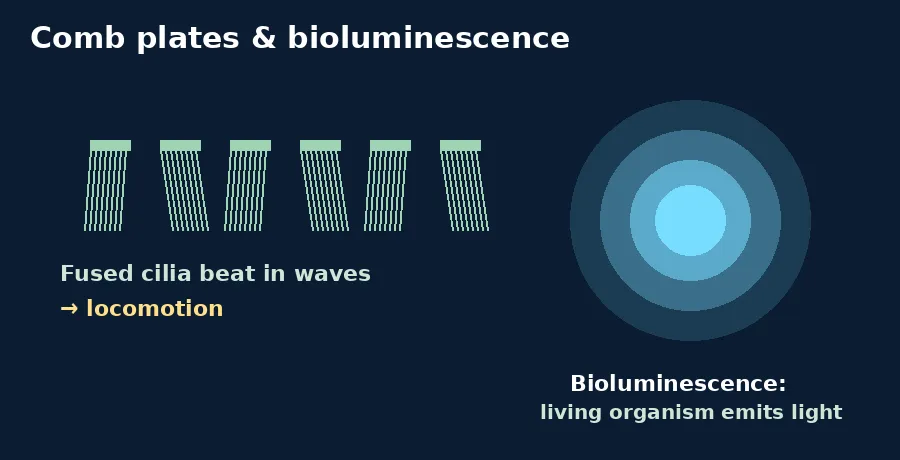
The body of members of Phylum Ctenophora bears eight external rows of ciliated comb plates, which help in locomotion. Each comb plate is made of many cilia fused at their bases. The cilia of successive plates beat in waves, rowing the animal slowly through sea water. Comb plates are the distinctive feature of Phylum Ctenophora in the NCERT table of salient features.
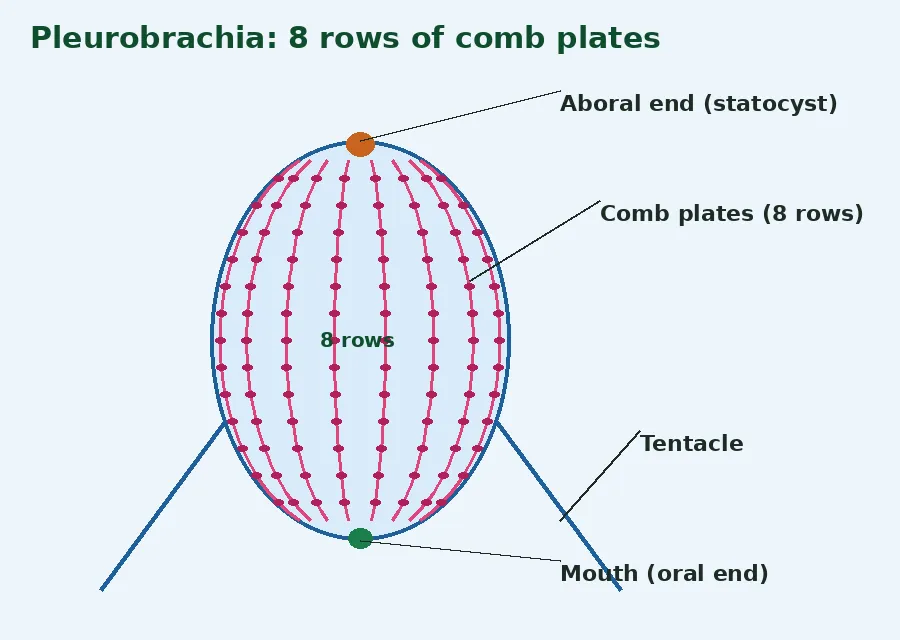
Interactive Pleurobrachia diagram
Click each numbered pin to reveal the part of Pleurobrachia.
Tap a pin to see its label.
Bioluminescence
Bioluminescence (the property of a living organism to emit light) is well-marked in ctenophores. In the dark sea, light produced by Phylum Ctenophora animals often shows up along the comb rows, and the beating comb plates also scatter light into rainbow-like colours.
The light is made by a chemical reaction inside special cells called photocytes, which lie along the canals running under the eight comb rows. Calcium-activated proteins called photoproteins release the energy as light, so the comb rows seem to glow in the dark. This is why comb jellies are sometimes called the fireflies of the sea.
Digestion and reproduction
Nutrition and colloblasts
Ctenophores are carnivores that feed on small planktonic animals. Instead of stinging cnidoblasts, the tentacles of many ctenophores carry sticky cells called colloblasts (lasso cells or glue cells). Prey touching a tentacle gets stuck to the colloblasts and is then carried to the mouth. Colloblasts and comb plates together are the two unique features that set Phylum Ctenophora apart from coelenterates.
Digestion
Digestion is both extracellular (food is broken down in the digestive cavity) and intracellular (digestion is completed inside cells). The digestive system is incomplete, as shown in NCERT Table 4.2.
Note for higher reading: many ctenophores also have small anal pores at the aboral end through which some waste leaves. For NEET, however, follow the NCERT table and mark the digestive system of Ctenophora as incomplete.
Excretion, respiration and nervous system
There are no special excretory, respiratory or circulatory organs. Gases and wastes are exchanged by simple diffusion across the body surface. A simple nerve net coordinates the body, and a statocyst at the aboral end acts as a balancing organ that controls the beating of the comb rows.
Reproduction
In Phylum Ctenophora, sexes are not separate. Reproduction takes place only by sexual means; there is no asexual reproduction and no polyp–medusa alternation. Fertilisation is external (in sea water) with indirect development.
Because each individual is a hermaphrodite, it releases both eggs and sperm into the water, where fertilisation takes place. The zygote develops into a free-swimming, ciliated, spherical larva called the cydippid larva, which gradually grows into the adult. Many ctenophores can also regenerate lost parts of the body.
Examples of Ctenophora
| Example | Point to remember |
|---|---|
| Pleurobrachia | Shown in NCERT Figure 4.8; sea walnut / comb jelly |
| Ctenoplana | Second NCERT example of Phylum Ctenophora |
| Beroe | Has no tentacles (class Nuda) |
| Mnemiopsis | Sea walnut; invasive in the Black Sea |
Exam tip: Remember the pair “Pleurobrachia and Ctenoplana“. A frequent trap is to offer Physalia or Aurelia, which are coelenterates.
Classification of Phylum Ctenophora
Phylum Ctenophora is divided into two classes depending on whether tentacles are present.
| Class | Tentacles | Examples |
|---|---|---|
| Tentaculata | Present | Pleurobrachia, Ctenoplana, Mnemiopsis |
| Nuda | Absent | Beroe |
Beroe has no tentacles and feeds by swallowing prey, often other comb jellies, through its wide mouth.
Ecological and economic importance
- Ctenophores are important plankton predators and are themselves eaten by fish, turtles and other animals, so they form a link in marine food chains.
- Some species can become pests. Mnemiopsis, carried accidentally to the Black Sea in ships’ ballast water, multiplied rapidly and harmed fisheries by eating fish eggs and larvae.
- Their photoproteins and light production are studied by scientists, and their simple body helps researchers understand the early evolution of animals.
Ctenophora in the salient features table (NCERT Table 4.2)
| Phylum | Level of organisation | Symmetry | Coelom | Segmentation | Digestive system | Circulatory system | Respiratory system | Distinctive features |
|---|---|---|---|---|---|---|---|---|
| Coelenterata (Cnidaria) | Tissue | Radial | Absent | Absent | Incomplete | Absent | Absent | Cnidoblasts present |
| Ctenophora | Tissue | Radial | Absent | Absent | Incomplete | Absent | Absent | Comb plates for locomotion |
The row shows that Phylum Ctenophora has no coelom, no segmentation, and no circulatory or respiratory system.
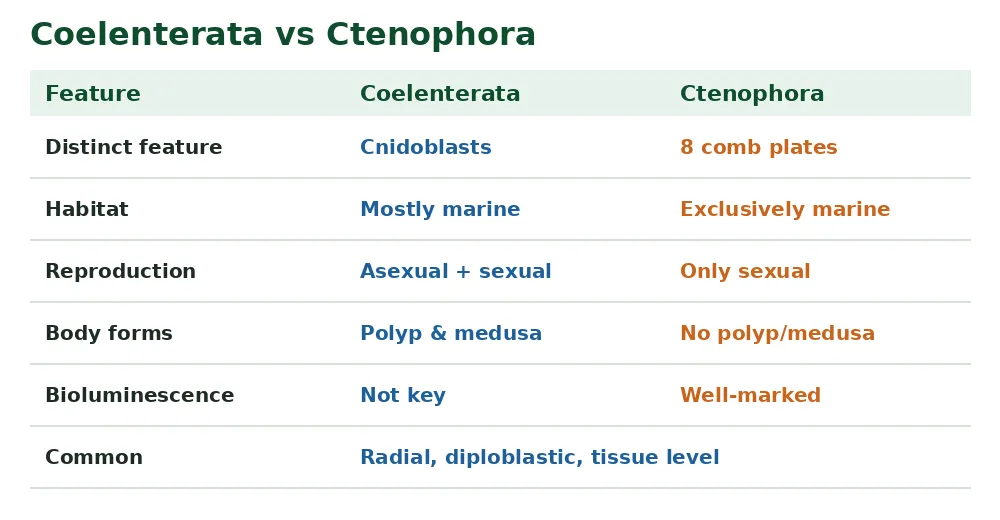
Ctenophora vs Coelenterata flip cards
Tap a card to flip it.
Coelenterata: cnidoblasts
Coelenterata: aquatic, mostly marine
Coelenterata: asexual and sexual
Coelenterata: polyp and medusa
Coelenterata: not a key feature
← Previous: Phylum CoelenterataNext: Phylum Platyhelminthes →
Quick check: true or false
Ctenophores are exclusively marine.
Ctenophores reproduce asexually by budding.
The body bears six rows of comb plates.
Bioluminescence is well-marked in ctenophores.
Ctenophores are triploblastic.
Colloblasts help ctenophores capture prey.
The larva of ctenophores is the planula larva.
Phylum Ctenophora: Common doubts
Why are ctenophores called comb jellies?
Their body bears eight external rows of ciliated comb plates, and the body is soft and jelly-like.
Do ctenophores have cnidoblasts?
No. Cnidoblasts are the distinctive feature of Coelenterata; ctenophores have comb plates instead.
How do ctenophores move?
By the beating of eight external rows of ciliated comb plates.
What is bioluminescence?
The property of a living organism to emit light. It is well-marked in ctenophores.
Are sexes separate in Phylum Ctenophora?
No. Sexes are not separate, and reproduction takes place only by sexual means.
What type of fertilisation and development do ctenophores show?
Fertilisation is external with indirect development.
Are ctenophores the same as jellyfish?
No. Jellyfish such as Aurelia belong to Coelenterata and have stinging cnidoblasts. Comb jellies belong to Phylum Ctenophora, have comb plates and colloblasts, and never form a polyp or medusa.
What are colloblasts?
Colloblasts (lasso or glue cells) are sticky cells on the tentacles of ctenophores that trap prey.
What are the two unique features of Phylum Ctenophora?
Eight rows of ciliated comb plates for swimming and colloblasts for capturing prey.
What is the larva of ctenophores called?
The cydippid larva, a ciliated, spherical larva.
Which ctenophore has no tentacles?
Beroe, which belongs to the class Nuda.
Phylum Ctenophora NEET MCQs (25 questions)
Test yourself with these 25 NCERT-based NEET practice questions on Phylum Ctenophora.
Q1. Ctenophores are commonly known as:
- (a) Sea anemones
- (b) Sea walnuts or comb jellies
- (c) Sea fans
- (d) Sea pens
Show Answer
Answer: (b) Sea walnuts or comb jellies. Sea walnuts or comb jellies.
Q2. Ctenophores are:
- (a) Freshwater only
- (b) Exclusively marine
- (c) Terrestrial
- (d) Mostly freshwater
Show Answer
Answer: (b) Exclusively marine. They are exclusively marine.
Q3. Symmetry in ctenophores is:
- (a) Bilateral
- (b) Radial
- (c) Asymmetrical
- (d) Biradial only in larva
Show Answer
Answer: (b) Radial. Radially symmetrical.
Q4. Ctenophores are:
- (a) Triploblastic
- (b) Diploblastic
- (c) Monoblastic
- (d) Pseudocoelomate
Show Answer
Answer: (b) Diploblastic. Diploblastic.
Q5. Level of organisation in Ctenophora is:
- (a) Cellular
- (b) Tissue
- (c) Organ
- (d) Organ-system
Show Answer
Answer: (b) Tissue. Tissue level.
Q6. Number of external rows of comb plates in ctenophores:
- (a) Four
- (b) Six
- (c) Eight
- (d) Ten
Show Answer
Answer: (c) Eight. Eight rows.
Q7. Comb plates in ctenophores help in:
- (a) Digestion
- (b) Locomotion
- (c) Excretion
- (d) Defence
Show Answer
Answer: (b) Locomotion. Locomotion.
Q8. Comb plates are:
- (a) Ciliated
- (b) Flagellated
- (c) Spicule-bearing
- (d) Made of chitin
Show Answer
Answer: (a) Ciliated. They are ciliated comb plates.
Q9. Digestion in ctenophores is:
- (a) Only intracellular
- (b) Only extracellular
- (c) Both extracellular and intracellular
- (d) Absent
Show Answer
Answer: (c) Both extracellular and intracellular. Both.
Q10. Bioluminescence is:
- (a) Emission of light by a living organism
- (b) Absorption of light
- (c) Reflection by cilia
- (d) Photosynthesis
Show Answer
Answer: (a) Emission of light by a living organism. Property of a living organism to emit light.
Q11. Bioluminescence is well-marked in:
- (a) Porifera
- (b) Ctenophora
- (c) Platyhelminthes
- (d) Aschelminthes
Show Answer
Answer: (b) Ctenophora. Ctenophora.
Q12. In ctenophores, sexes are:
- (a) Separate
- (b) Not separate
- (c) Absent
- (d) Changed seasonally
Show Answer
Answer: (b) Not separate. Sexes are not separate.
Q13. Reproduction in Ctenophora is:
- (a) Only asexual
- (b) Only sexual
- (c) Both asexual and sexual
- (d) By fragmentation only
Show Answer
Answer: (b) Only sexual. Only sexual means.
Q14. Fertilisation in ctenophores is:
- (a) Internal, direct development
- (b) External, indirect development
- (c) Internal, indirect development
- (d) External, direct development
Show Answer
Answer: (b) External, indirect development. External with indirect development.
Q15. Which is an example of Ctenophora?
- (a) Aurelia
- (b) Pleurobrachia
- (c) Physalia
- (d) Adamsia
Show Answer
Answer: (b) Pleurobrachia. Pleurobrachia (Fig. 4.8).
Q16. Ctenoplana belongs to:
- (a) Coelenterata
- (b) Ctenophora
- (c) Porifera
- (d) Platyhelminthes
Show Answer
Answer: (b) Ctenophora. Ctenophora.
Q17. Distinctive feature of Ctenophora in NCERT Table 4.2:
- (a) Cnidoblasts present
- (b) Comb plates for locomotion
- (c) Flat body, suckers
- (d) Water vascular system
Show Answer
Answer: (b) Comb plates for locomotion. Comb plates for locomotion.
Q18. According to Table 4.2, the digestive system of Ctenophora is:
- (a) Absent
- (b) Incomplete
- (c) Complete
- (d) Complete with anus
Show Answer
Answer: (b) Incomplete. Incomplete.
Q19. Coelom in Ctenophora is:
- (a) Present
- (b) Absent
- (c) Pseudocoelom
- (d) Schizocoelom
Show Answer
Answer: (b) Absent. Absent.
Q20. Match: (a) Comb plates (b) Cnidoblasts. Choose the correct pair:
- (a) (a) Ctenophora (b) Coelenterata
- (b) (a) Coelenterata (b) Ctenophora
- (c) (a) Porifera (b) Ctenophora
- (d) (a) Ctenophora (b) Porifera
Show Answer
Answer: (a) (a) Ctenophora (b) Coelenterata. Comb plates – Ctenophora; cnidoblasts – Coelenterata.
Q21. Assertion: Ctenophores show no alternation of generations. Reason: Reproduction in ctenophores takes place only by sexual means.
- (a) Both true, R explains A
- (b) Both true, R does not explain A
- (c) A true, R false
- (d) A false, R true
Show Answer
Answer: (a) Both true, R explains A. With only sexual reproduction, there is no polyp–medusa alternation.
Q22. Which feature is common to Coelenterata and Ctenophora?
- (a) Comb plates
- (b) Cnidoblasts
- (c) Tissue level of organisation
- (d) Only sexual reproduction
Show Answer
Answer: (c) Tissue level of organisation. Both have tissue level of organisation.
Q23. Which statement about ctenophores is INCORRECT?
- (a) They are exclusively marine
- (b) They show bioluminescence
- (c) They reproduce asexually
- (d) They are diploblastic
Show Answer
Answer: (c) They reproduce asexually. Reproduction is only sexual.
Q24. Circulatory and respiratory systems in Ctenophora are:
- (a) Both present
- (b) Both absent
- (c) Only circulatory present
- (d) Only respiratory present
Show Answer
Answer: (b) Both absent. Both absent (Table 4.2).
Q25. Pleurobrachia and Ctenoplana are:
- (a) Coelenterates
- (b) Ctenophores
- (c) Sponges
- (d) Flatworms
Show Answer
Answer: (b) Ctenophores. Both are NCERT examples of Ctenophora.
After Phylum Ctenophora, continue with Platyhelminthes in our NEET Biology notes.