
Phylum Annelida is the group of segmented worms: bilaterally symmetrical, triploblastic, metamerically segmented and coelomate animals. These NEET notes follow NCERT Class 11 Biology, Chapter 4 (Animal Kingdom) section 4.2.6 line by line, keep your supplied study points, add clear original diagrams, careful fertilisation distinctions, comparison tables and 90 practice questions (30 MCQs, 30 assertion-reason and 30 match-the-pair).
Key points
- May be aquatic (marine and fresh water) or terrestrial; free-living, and sometimes parasitic.
- Organ-system level of organisation; bilaterally symmetrical, triploblastic, metamerically segmented and coelomate.
- Body surface marked into segments or metameres; phylum name from Latin annulus (little ring).
- Longitudinal and circular muscles help in locomotion; aquatic forms like Nereis have parapodia.
- Closed circulatory system; nephridia for osmoregulation and excretion.
- Neural system: paired ganglia connected by lateral nerves to a double ventral nerve cord.
- Nereis is dioecious; earthworms and leeches are monoecious. Reproduction is sexual.
- Examples: Nereis, Pheretima (Earthworm) and Hirudinaria (Blood sucking leech).
What animals are Annelida?
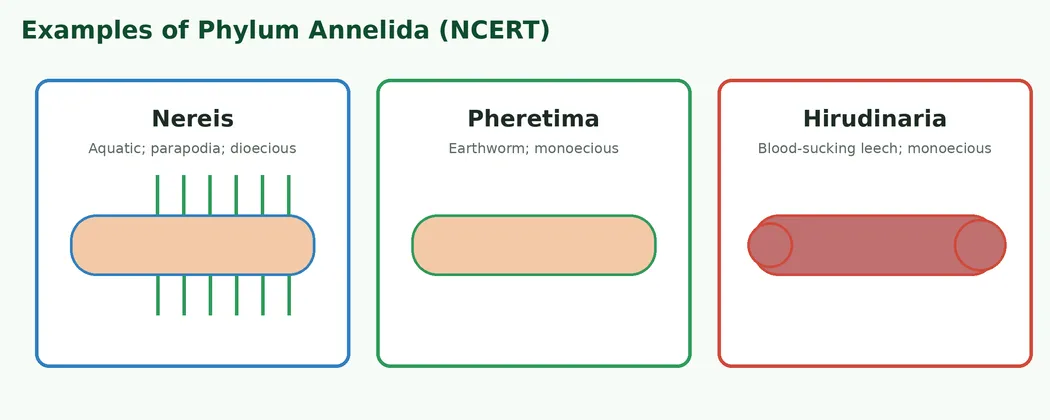
So, what animals are Annelida? They are the segmented worms: soft-bodied invertebrates whose ringed body is divided into repeating units called metameres. Familiar members include the earthworm that burrows in soil, the blood-sucking leech, and marine ragworms such as Nereis. The word Annelida comes from annulus, meaning rings, which is why textbooks introduce them as ringed or segmented worms.
NCERT places Phylum Annelida after Phylum Aschelminthes and before Arthropoda. Like higher phyla, annelids show organ-system organisation: organs work together as digestive, circulatory, excretory and nervous systems. Revise how these criteria fit the basis of classification of the animal kingdom before you memorise the phylum list.
Why Annelida means little rings: metamerism
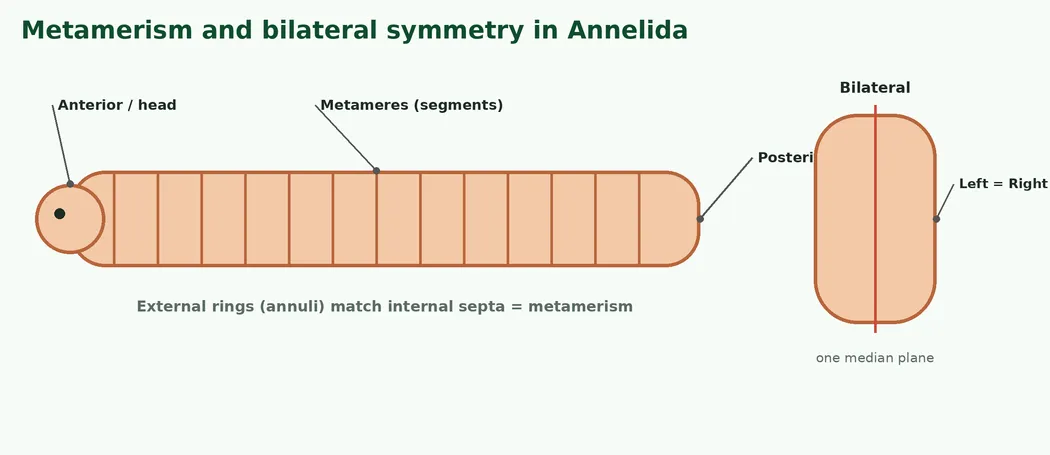
Their body surface is distinctly marked out into segments or metameres and, hence, the phylum name Annelida (Latin, annulus: little ring). Metamerism is not just skin-deep. In animals such as the earthworm, the body is externally and internally divided into segments with a serial repetition of at least some organs. That coincidence of external and internal segmentation is true metameric segmentation.
Annelids are bilaterally symmetrical: only one median (sagittal) plane divides the body into mirror-image left and right halves. The anterior end often forms a distinct head with sense organs. Cephalization itself started earlier in Phylum Platyhelminthes, but a clearer head with sensory structures is common in many annelids.
General characteristics of the phylum Annelida
General characteristics of the phylum Annelida
- Habit and habitat: aquatic (marine/freshwater) or terrestrial; free-living and sometimes parasitic
- Body soft, elongated, cylindrical or flattened; divided into segments by ring-like grooves (annuli)
- True segmentation: external segmentation coincides with internal segmentation
- Bilaterally symmetrical and triploblastic
- Organ-system level of organisation; tube-within-tube body plan
- Many forms have unjointed locomotory appendages called parapodia (extensions of the body wall), e.g. Nereis
- Body wall: thin moist cuticle, epidermis, well-developed musculature; setae (chitinous bristles) in most forms
- No mineralised skeleton; coelomic fluid serves as a hydrostatic skeleton
- True coelom lined by mesodermal coelomic epithelium; transverse septa divide it into compartments
- Digestive system straight and complete; digestion extracellular in the alimentary canal
- Gas exchange through moist skin (cutaneous respiration); Table 4.2 lists a special respiratory system as absent
- Closed blood vascular system; haemoglobin dissolved in plasma (blood appears red); some vessels enlarged and act as hearts
- Excretory organs: nephridia (excretion and osmoregulation)
- Nervous system: paired cerebral ganglia and a solid double mid-ventral nerve cord; sense organs may include taste receptors, photoreceptors and statocysts
- Sexes may be separate (dioecious) or united (monoecious): Nereis unisexual; earthworms and leeches bisexual
- Reproduction sexual; fertilisation mode is not the same in every group (see reproduction section)
- Unique exam hooks: metameric segmentation; nephridia; closed circulation with pigment in plasma; setae in most forms
NCERT checklist: Phylum Annelida
Tick off every Phylum Annelida point before your exam; every point from NCERT 4.2.6 and Table 4.2 is covered in these notes.
Body plan of Phylum Annelida: symmetry and body wall
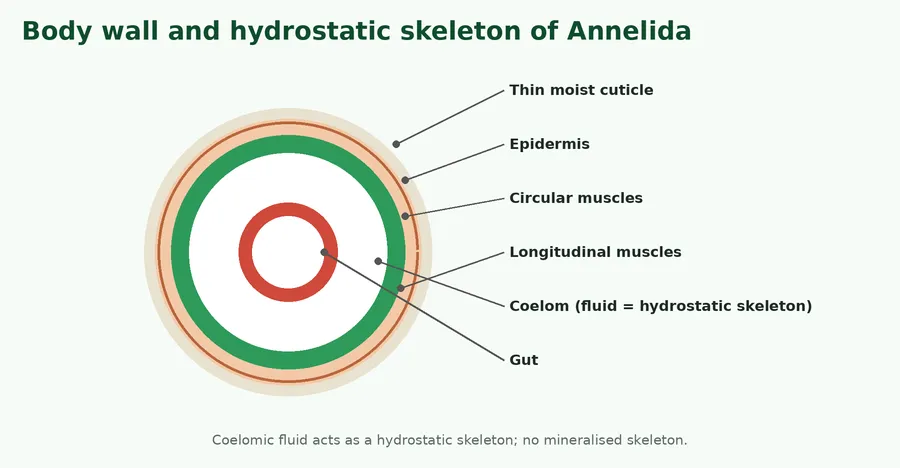
Annelids follow a tube-within-tube body plan: an outer body wall surrounds a complete digestive tube, with the coelom between them. The body wall has a thin moist cuticle, epidermis and well-developed circular and longitudinal muscles. Minute bristle-like chitinous setae are embedded in the body wall of most forms and help in locomotion. There is no mineralised skeleton; fluid in the coelom acts as a hydrostatic skeleton against which the muscles work.
Aquatic annelids like Nereis also possess lateral parapodia — unjointed extensions of the body wall that help in swimming. Earthworms lack parapodia but retain setae; leeches typically lack setae and instead use suckers.
True coelom: why Annelida differ from Aschelminthes
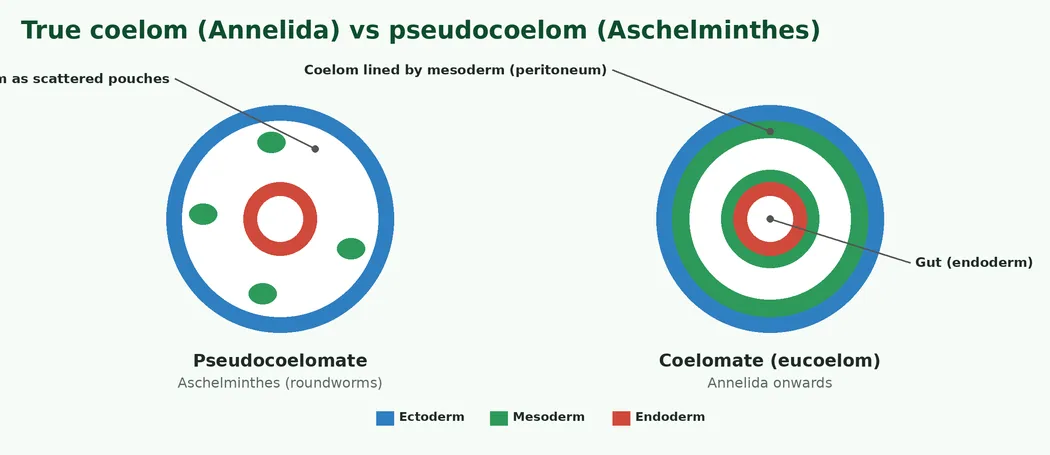
In Annelida the body cavity is a true coelom lined by mesodermal coelomic epithelium (peritoneum). Transverse septa divide it into compartments filled with coelomic fluid. That is the key difference between Annelida and Aschelminthes: roundworms in Phylum Aschelminthes are pseudocoelomate (mesoderm as scattered pouches), while annelids are eucoelomate. Flatworms in Phylum Platyhelminthes are acoelomate — another useful contrast when you revise coelom as a basis of classification.
Metamerism and parapodia
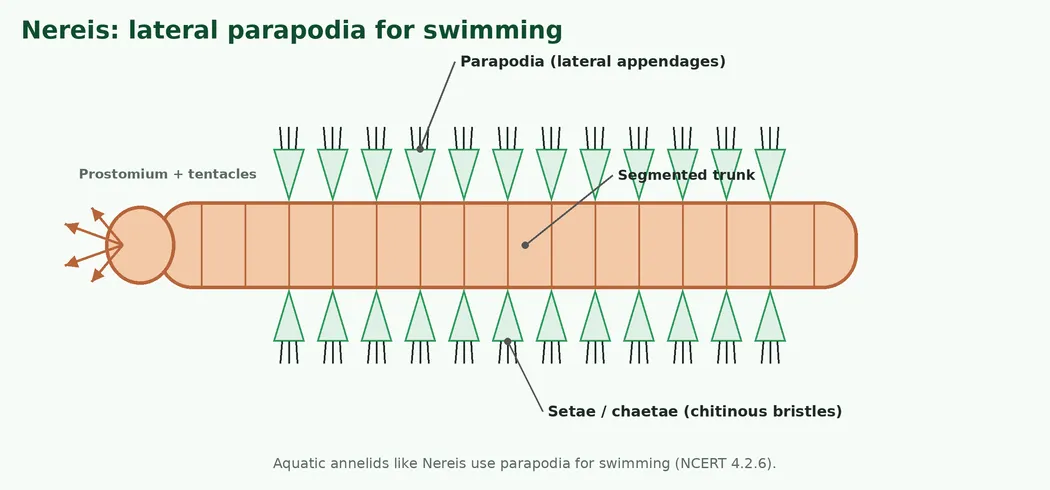
Metamerism means the body is built as a chain of similar segments. Each segment may repeat organs such as nephridia, ganglia or setae. NCERT’s exercise asks where segmentation in the body is first observed among the given options, and the answer is Annelida — true metamerism, not the proglottid-style pseudo-segmentation of tapeworms.
Parapodia are best remembered with Nereis. They are paired, unjointed lateral appendages bearing setae. Do not confuse them with the jointed legs of arthropods: parapodia are extensions of the body wall, not arthropod appendages.
Body systems in Phylum Annelida
Digestive system
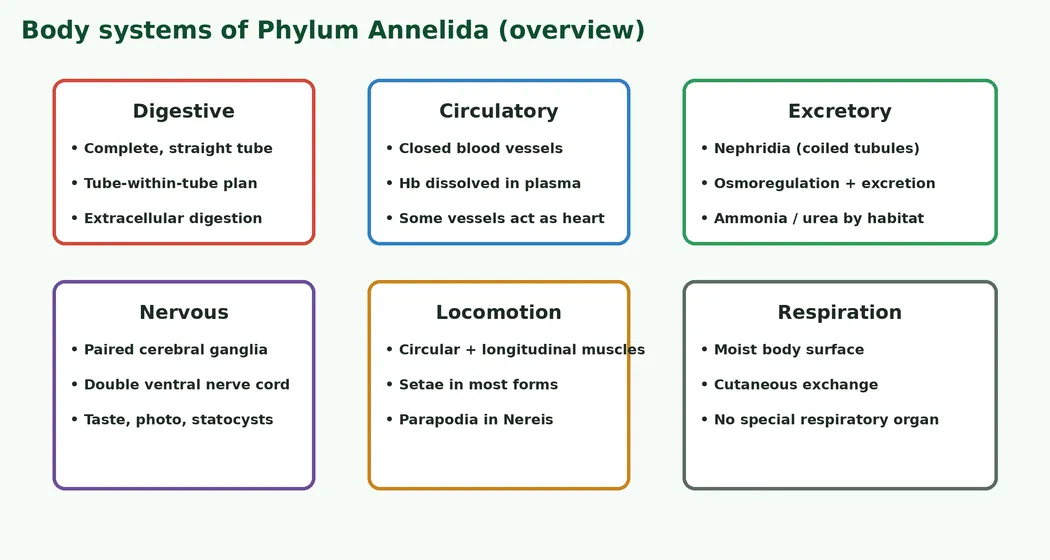
The alimentary canal is straight, complete and extends throughout the body. Digestion is extracellular inside the gut. Mouth and anus are separate openings — a complete digestive system — unlike the incomplete gut of Platyhelminthes.
Circulatory system
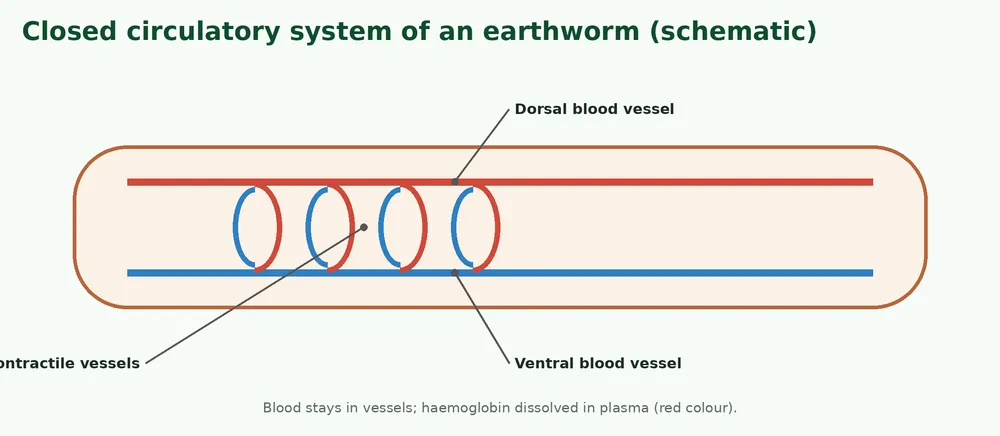
A closed circulatory system is present: blood flows through definite vessels rather than bathing the tissues directly. Some vessels are enlarged and act as hearts. Blood is red because haemoglobin is dissolved in the plasma; some annelids also have related pigments such as erythrocruorin. This closed plan is a classic contrast with many arthropods that have an open system.
Excretory system
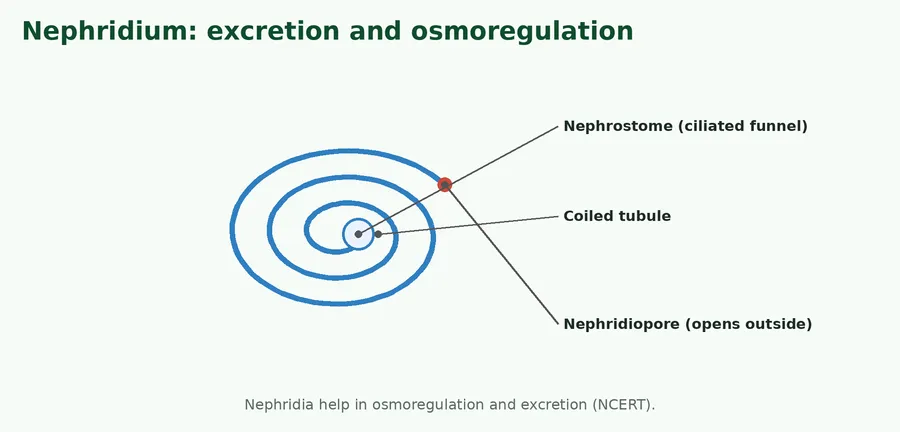
Excretion and osmoregulation are handled by nephridia — coiled tubules opening by nephridiopores. Aquatic forms are typically ammonotelic; terrestrial forms such as earthworms are largely ureotelic.
Nervous system and sense organs
The neural system consists of paired cerebral ganglia connected by lateral nerves to a double ventral nerve cord. Sense organs may include taste receptors, photoreceptor cells and statocysts for balance.
Respiration
There is no specialised respiratory organ in the NCERT Table 4.2 sense. Gas exchange occurs through the moist body surface (cutaneous respiration). That is why a dry cuticle is dangerous for an earthworm.
Reproduction in Annelida: internal or external fertilization?
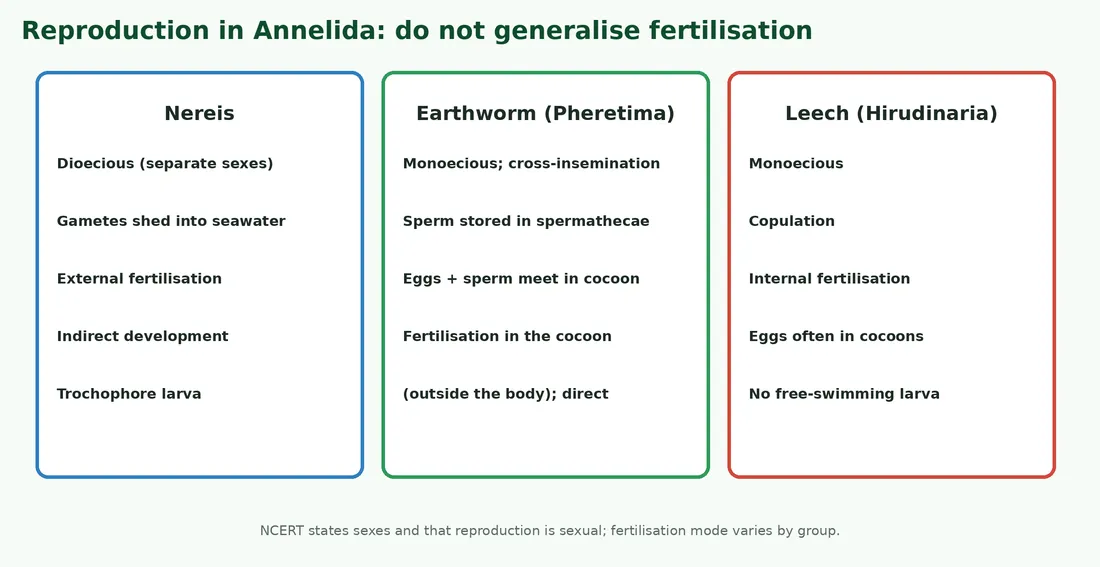
Students often search “annelida internal or external fertilization” or “annelida have internal or external fertilization” hoping for one word. NCERT is careful: it tells you that Nereis is dioecious, earthworms and leeches are monoecious, and reproduction is sexual — it does not force a single fertilisation mode on the entire phylum.
Use these distinctions:
- Nereis: separate sexes; gametes are typically released into seawater, so fertilisation is external; development is often indirect with a trochophore larva.
- Earthworm (Pheretima): monoecious but usually shows cross-insemination (mutual exchange of sperm). Received sperm is stored in spermathecae. Later, eggs, sperm and nutritive fluid are deposited in a cocoon formed by the clitellum. Fertilisation occurs inside the cocoon, which is outside the worm’s body; development is direct (see also NCERT Class 11 Biology, Structural Organisation in Animals (earthworm)).
- Leech (Hirudinaria): monoecious; fertilisation is generally described as internal; eggs are commonly laid in cocoons and there is no free-swimming larva.
Exam tip: If a question says “fertilisation in Annelida is…” without naming an animal, look for options that allow variation, or match the named example (Nereis / earthworm / leech).
Examples of Phylum Annelida: Nereis, Pheretima, Hirudinaria
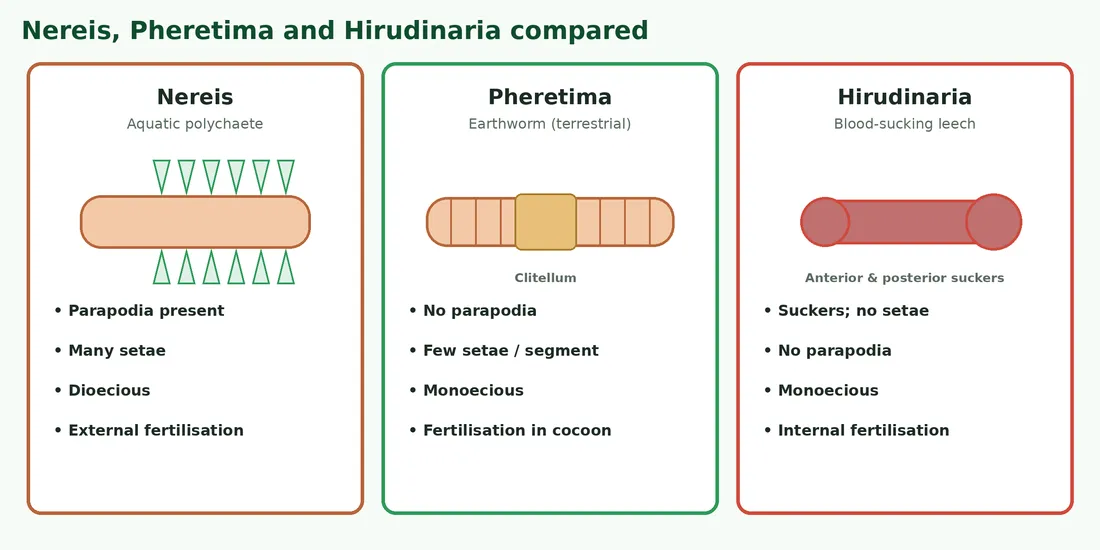
Examples of Phylum Annelida
- Nereis — aquatic polychaete with parapodia; dioecious
- Pheretima — earthworm; terrestrial burrower; monoecious; “friend of farmers” through soil aeration and vermicomposting
- Hirudinaria — blood-sucking leech; ectoparasite with suckers; monoecious
Classes of Phylum Annelida (older textbook scheme)
Many coaching notes still list four classes. NCERT section 4.2.6 does not require this class list, but the examples map cleanly onto three of them:
- Polychaeta: mostly marine; parapodia with many setae; usually dioecious; external fertilisation — e.g. Nereis
- Oligochaeta: freshwater and terrestrial; few setae per segment; no parapodia; clitellum; monoecious with cross-fertilisation — e.g. Pheretima, Tubifex
- Hirudinea: leeches; suckers; setae and parapodia absent; monoecious; internal fertilisation — e.g. Hirudinaria
- Archiannelida: small marine forms without setae/parapodia (older schemes); not emphasised in NCERT 4.2.6
Annelida vs Platyhelminthes, Aschelminthes and Arthropoda
These comparisons capture the exact search intents students type before exams.
Annelida vs Platyhelminthes
| Feature | Platyhelminthes | Annelida |
|---|---|---|
| Body | Dorsoventrally flat | Elongated, segmented (ringed) |
| Coelom | Acoelomate | True coelomate |
| Segmentation | Absent (true metamerism) | Present (metamerism) |
| Gut | Incomplete | Complete |
| Circulation | Absent | Present, closed |
| Excretion | Flame cells | Nephridia |
| Examples | Taenia, Fasciola | Nereis, Pheretima, Hirudinaria |
Difference between Annelida and Aschelminthes
| Feature | Aschelminthes | Annelida |
|---|---|---|
| Common name | Roundworms | Segmented worms |
| Coelom | Pseudocoelom | True coelom |
| Segmentation | Absent | Present |
| Circulation | Absent | Closed system present |
| Excretion | Excretory tube / pore | Nephridia |
| Muscles | Longitudinal only (Ascaris) | Circular + longitudinal |
| Examples | Ascaris, Wuchereria | Nereis, Pheretima, Hirudinaria |
Annelida and Arthropoda difference
| Feature | Annelida | Arthropoda |
|---|---|---|
| Skeleton / covering | Hydrostatic (coelomic fluid); thin cuticle | Chitinous exoskeleton |
| Appendages | Unjointed setae / parapodia | Jointed appendages |
| Body division | Many similar metameres | Often head, thorax, abdomen |
| Circulation | Closed | Usually open |
| Respiration (Table 4.2) | Absent (cutaneous) | Present (gills, book lungs, trachea, etc.) |
| Size of group | Large but not largest | Largest phylum of Animalia |
Phylum Annelida in NCERT Table 4.2
| Feature | Platyhelminthes | Aschelminthes | Annelida | Arthropoda |
|---|---|---|---|---|
| Level of organisation | Organ & organ-system | Organ-system | Organ-system | Organ-system |
| Symmetry | Bilateral | Bilateral | Bilateral | Bilateral |
| Coelom | Absent | Pseudocoelomate | Coelomate | Coelomate |
| Segmentation | Absent | Absent | Present | Present |
| Digestive system | Incomplete | Complete | Complete | Complete |
| Circulatory system | Absent | Absent | Present | Present |
| Respiratory system | Absent | Absent | Absent | Present |
| Distinctive features | Flat body, suckers | Often worm-shaped, elongated | Body segmentation like rings | Exoskeleton of cuticle, jointed appendages |
Explore the phyla: Phylum Porifera · Phylum Coelenterata (Cnidaria) · Phylum Ctenophora · Phylum Platyhelminthes · Phylum Aschelminthes · all Animal Kingdom notes. Practise with 40 NEET sample test papers and more NEET Biology notes.
Flip cards: Phylum Annelida recall
Tap a card to flip it.
Phylum Annelida: Common doubts
What animals are Annelida?
Annelida are segmented worms such as Nereis, earthworms (Pheretima) and leeches (Hirudinaria): bilaterally symmetrical, triploblastic, metamerically segmented coelomates.
What is the difference between Annelida and Aschelminthes?
Aschelminthes are unsegmented pseudocoelomates (roundworms) without a closed circulatory system; Annelida are metamerically segmented true coelomates with a closed circulatory system and nephridia.
Annelida vs Platyhelminthes — what is the key difference?
Flatworms are acoelomate with an incomplete gut and flame cells; annelids are coelomate, segmented, have a complete gut, closed circulation and nephridia.
Annelida and Arthropoda difference?
Both can be segmented coelomates, but arthropods have a chitinous exoskeleton and jointed appendages, usually an open circulation, and specialised respiratory organs; annelids rely on a hydrostatic skeleton, unjointed setae/parapodia and typically cutaneous respiration.
Do Annelida have internal or external fertilization?
It varies. Nereis typically shows external fertilization in water; leeches generally show internal fertilization; in earthworms, cross-insemination is followed by fertilization inside the cocoon outside the body.
Is fertilization in earthworm internal or external?
Earthworms exchange sperm during copulation, but fertilization of eggs occurs in the cocoon after it is formed — so fertilization takes place outside the body, in the cocoon.
Why are annelids called segmented worms?
Because the body is marked into ring-like metameres (Latin annulus = little ring), with true metamerism.
What are parapodia?
Unjointed lateral appendages of aquatic annelids such as Nereis that help in swimming.
Phylum Annelida: 30 NEET MCQs
Q1. The word Annelida comes from Latin annulus, which means
- (a) little ring
- (b) thread
- (c) cavity
- (d) joint
Q2. Members of Phylum Annelida may be
- (a) only marine
- (b) only terrestrial
- (c) aquatic (marine and fresh water) or terrestrial
- (d) only parasitic
Q3. The level of body organisation in Annelida is
- (a) cellular
- (b) tissue
- (c) organ
- (d) organ-system
Q4. Symmetry in Annelida is
- (a) radial
- (b) bilateral
- (c) biradial
- (d) asymmetrical
Q5. Annelids are
- (a) diploblastic and acoelomate
- (b) triploblastic, metamerically segmented and coelomate
- (c) pseudocoelomate and unsegmented
- (d) diploblastic and segmented
Q6. Metameric segmentation means
- (a) only external rings without internal division
- (b) body divided externally and internally into segments with serial repetition of organs
- (c) pseudometamerism of tapeworms
- (d) division only of the gut
Q7. Aquatic annelids like Nereis possess lateral appendages called
- (a) setae only
- (b) parapodia
- (c) jointed legs
- (d) cirrhi of arthropods
Q8. The circulatory system of Annelida is
- (a) absent
- (b) open type
- (c) closed type
- (d) present only in leeches
Q9. Nephridia in annelids help in
- (a) digestion only
- (b) osmoregulation and excretion
- (c) photosynthesis
- (d) capture of prey
Q10. The neural system of Annelida consists of
- (a) a dorsal hollow nerve cord
- (b) paired ganglia connected by lateral nerves to a double ventral nerve cord
- (c) a nerve net only
- (d) giant brain without cord
Q11. Nereis is
- (a) monoecious
- (b) dioecious
- (c) asexual only
- (d) hermaphrodite like earthworm
Q12. Earthworms and leeches are
- (a) dioecious
- (b) monoecious
- (c) always free-living parasites
- (d) radially symmetrical
Q13. Reproduction in Annelida is
- (a) only asexual
- (b) sexual
- (c) by budding only
- (d) by binary fission
Q14. NCERT examples of Annelida include
- (a) Ascaris, Wuchereria, Ancylostoma
- (b) Nereis, Pheretima and Hirudinaria
- (c) Hydra, Obelia, Aurelia
- (d) Taenia and Fasciola
Q15. Hirudinaria is commonly called
- (a) Earthworm
- (b) Filaria worm
- (c) Blood sucking leech
- (d) Sandworm
Q16. Pheretima is commonly called
- (a) Leech
- (b) Earthworm
- (c) Roundworm
- (d) Liver fluke
Q17. According to NCERT Table 4.2, segmentation in Annelida is
- (a) Absent
- (b) Present
- (c) Incomplete
- (d) Only external
Q18. Distinctive feature of Annelida in Table 4.2 is
- (a) Flat body, suckers
- (b) Often worm-shaped, elongated
- (c) Body segmentation like rings
- (d) Jointed appendages
Q19. Respiratory system in Annelida as per Table 4.2 is
- (a) Present
- (b) Absent
- (c) Present only in Nereis
- (d) Tracheal
Q20. What animals are Annelida?
- (a) Segmented worms such as earthworms, leeches and Nereis
- (b) Flatworms only
- (c) Roundworms only
- (d) Insects with jointed legs
Q21. Difference between Annelida and Aschelminthes: Annelida has
- (a) pseudocoelom and no segmentation
- (b) true coelom and metameric segmentation
- (c) acoelom and incomplete gut
- (d) radial symmetry
Q22. Annelida vs Platyhelminthes: flatworms are
- (a) coelomate and segmented
- (b) acoelomate with incomplete gut
- (c) pseudocoelomate with closed circulation
- (d) dioecious with parapodia
Q23. Annelida and Arthropoda difference: arthropods uniquely have
- (a) true coelom
- (b) metameric segmentation
- (c) chitinous exoskeleton and jointed appendages
- (d) bilateral symmetry
Q24. Do Annelida have internal or external fertilisation?
- (a) Always internal in the whole phylum
- (b) Always external in the whole phylum
- (c) It varies: e.g. Nereis external; leech internal; earthworm fertilisation in cocoon
- (d) Never sexual
Q25. In earthworm, after cross-insemination, fertilisation of eggs occurs
- (a) inside the ovary
- (b) in seawater by free spawning
- (c) inside the cocoon deposited outside the body
- (d) only by self-fertilisation
Q26. In Nereis, fertilisation is typically
- (a) internal in the clitellum
- (b) external in seawater
- (c) absent
- (d) by budding
Q27. Parapodia are absent in
- (a) Nereis
- (b) most polychaetes
- (c) earthworm and leech
- (d) all annelids
Q28. Setae are
- (a) jointed arthropod legs
- (b) minute chitinous bristles in the body wall of most annelids
- (c) flame cells
- (d) cnidoblasts
Q29. Coelomic fluid in annelids acts as
- (a) a mineralised endoskeleton
- (b) a hydrostatic skeleton
- (c) haemolymph in open sinuses only
- (d) mesoglea
Q30. Annelids possess which muscles that help in locomotion?
- (a) Only longitudinal
- (b) Only circular
- (c) Longitudinal and circular
- (d) Only oblique like nematodes
Phylum Annelida: 30 Assertion-Reason questions
Options for every question: (a) Both A and R are true and R is the correct explanation of A. (b) Both A and R are true but R is not the correct explanation of A. (c) A is true but R is false. (d) A is false but R is true.
Q1. Assertion (A): Annelids are called segmented worms.
Reason (R): Their body surface is marked into segments or metameres (annuli).
- (a) Both A and R true; R explains A
- (b) Both A and R true; R does not explain A
- (c) A true, R false
- (d) A false, R true
Q2. Assertion (A): Annelida are coelomate animals.
Reason (R): They possess a true coelom lined by mesoderm.
- (a) Both A and R true; R explains A
- (b) Both A and R true; R does not explain A
- (c) A true, R false
- (d) A false, R true
Q3. Assertion (A): Nereis uses parapodia for swimming.
Reason (R): Parapodia are lateral appendages of aquatic annelids.
- (a) Both A and R true; R explains A
- (b) Both A and R true; R does not explain A
- (c) A true, R false
- (d) A false, R true
Q4. Assertion (A): Earthworms are monoecious.
Reason (R): Testes and ovaries are present in the same individual.
- (a) Both A and R true; R explains A
- (b) Both A and R true; R does not explain A
- (c) A true, R false
- (d) A false, R true
Q5. Assertion (A): Nereis is monoecious.
Reason (R): Nereis is an aquatic annelid.
- (a) Both A and R true; R explains A
- (b) Both A and R true; R does not explain A
- (c) A true, R false
- (d) A false, R true
Q6. Assertion (A): Annelida have a closed circulatory system.
Reason (R): Blood circulates through vessels rather than bathing tissues directly.
- (a) Both A and R true; R explains A
- (b) Both A and R true; R does not explain A
- (c) A true, R false
- (d) A false, R true
Q7. Assertion (A): Nephridia remove nitrogenous wastes.
Reason (R): They also help in osmoregulation.
- (a) Both A and R true; R explains A
- (b) Both A and R true; R does not explain A
- (c) A true, R false
- (d) A false, R true
Q8. Assertion (A): All Annelida show external fertilisation.
Reason (R): Reproduction in Annelida is sexual.
- (a) Both A and R true; R explains A
- (b) Both A and R true; R does not explain A
- (c) A true, R false
- (d) A false, R true
Q9. Assertion (A): Earthworm shows cross-fertilisation.
Reason (R): Two worms exchange sperm during copulation; fertilisation later occurs in the cocoon.
- (a) Both A and R true; R explains A
- (b) Both A and R true; R does not explain A
- (c) A true, R false
- (d) A false, R true
Q10. Assertion (A): Hirudinaria is a blood-sucking leech.
Reason (R): It is listed as an NCERT example of Annelida.
- (a) Both A and R true; R explains A
- (b) Both A and R true; R does not explain A
- (c) A true, R false
- (d) A false, R true
Q11. Assertion (A): Annelida differ from Aschelminthes in coelom type.
Reason (R): Aschelminthes are pseudocoelomate while Annelida are coelomate.
- (a) Both A and R true; R explains A
- (b) Both A and R true; R does not explain A
- (c) A true, R false
- (d) A false, R true
Q12. Assertion (A): Annelida and Arthropoda both may be segmented.
Reason (R): Arthropods have a chitinous exoskeleton and jointed appendages.
- (a) Both A and R true; R explains A
- (b) Both A and R true; R does not explain A
- (c) A true, R false
- (d) A false, R true
Q13. Assertion (A): Metamerism is first clearly seen in Annelida among NCERT phyla listed in the exercise.
Reason (R): Segmentation in the body is first observed in Annelida as per NCERT exercise option.
- (a) Both A and R true; R explains A
- (b) Both A and R true; R does not explain A
- (c) A true, R false
- (d) A false, R true
Q14. Assertion (A): Respiratory organs are listed as absent in Table 4.2 for Annelida.
Reason (R): Gas exchange typically occurs through the moist body surface.
- (a) Both A and R true; R explains A
- (b) Both A and R true; R does not explain A
- (c) A true, R false
- (d) A false, R true
Q15. Assertion (A): Annelids are triploblastic.
Reason (R): They develop from three germ layers.
- (a) Both A and R true; R explains A
- (b) Both A and R true; R does not explain A
- (c) A true, R false
- (d) A false, R true
Q16. Assertion (A): Pheretima is free-living and terrestrial.
Reason (R): Hirudinaria may be parasitic (ectoparasite).
- (a) Both A and R true; R explains A
- (b) Both A and R true; R does not explain A
- (c) A true, R false
- (d) A false, R true
Q17. Assertion (A): Double ventral nerve cord is present in Annelida.
Reason (R): Neural system has paired ganglia connected to the cord.
- (a) Both A and R true; R explains A
- (b) Both A and R true; R does not explain A
- (c) A true, R false
- (d) A false, R true
Q18. Assertion (A): Parapodia help in locomotion of earthworm.
Reason (R): Earthworms have circular and longitudinal muscles.
- (a) Both A and R true; R explains A
- (b) Both A and R true; R does not explain A
- (c) A true, R false
- (d) A false, R true
Q19. Assertion (A): True coelom is divided by septa in annelids.
Reason (R): Transverse septa compartmentalise the coelom.
- (a) Both A and R true; R explains A
- (b) Both A and R true; R does not explain A
- (c) A true, R false
- (d) A false, R true
Q20. Assertion (A): Annelida show organ-system level of organisation.
Reason (R): Organs associate into functional systems.
- (a) Both A and R true; R explains A
- (b) Both A and R true; R does not explain A
- (c) A true, R false
- (d) A false, R true
Q21. Assertion (A): Leeches lack setae.
Reason (R): Hirudinaria has anterior and posterior suckers.
- (a) Both A and R true; R explains A
- (b) Both A and R true; R does not explain A
- (c) A true, R false
- (d) A false, R true
Q22. Assertion (A): Fertilisation in Nereis is external.
Reason (R): Gametes are released into water.
- (a) Both A and R true; R explains A
- (b) Both A and R true; R does not explain A
- (c) A true, R false
- (d) A false, R true
Q23. Assertion (A): Development of earthworm is direct.
Reason (R): There is no free larval stage; young emerge from cocoons.
- (a) Both A and R true; R explains A
- (b) Both A and R true; R does not explain A
- (c) A true, R false
- (d) A false, R true
Q24. Assertion (A): Annelida are pseudocoelomates.
Reason (R): Their body cavity is lined by mesoderm.
- (a) Both A and R true; R explains A
- (b) Both A and R true; R does not explain A
- (c) A true, R false
- (d) A false, R true
Q25. Assertion (A): Closed circulation means blood flows in definite vessels.
Reason (R): Some enlarged vessels act as hearts in earthworms.
- (a) Both A and R true; R explains A
- (b) Both A and R true; R does not explain A
- (c) A true, R false
- (d) A false, R true
Q26. Assertion (A): Annelida vs Platyhelminthes: Annelida have complete gut.
Reason (R): Platyhelminthes have incomplete digestive system.
- (a) Both A and R true; R explains A
- (b) Both A and R true; R does not explain A
- (c) A true, R false
- (d) A false, R true
Q27. Assertion (A): Sexes may be separate or united in Annelida.
Reason (R): Nereis is unisexual while earthworm and leech are bisexual.
- (a) Both A and R true; R explains A
- (b) Both A and R true; R does not explain A
- (c) A true, R false
- (d) A false, R true
Q28. Assertion (A): Haemoglobin gives red colour to annelid blood.
Reason (R): The pigment is dissolved in plasma, not in corpuscles.
- (a) Both A and R true; R explains A
- (b) Both A and R true; R does not explain A
- (c) A true, R false
- (d) A false, R true
Q29. Assertion (A): Archiannelida is emphasised in NCERT Animal Kingdom section 4.2.6.
Reason (R): NCERT lists Nereis, Pheretima and Hirudinaria as examples.
- (a) Both A and R true; R explains A
- (b) Both A and R true; R does not explain A
- (c) A true, R false
- (d) A false, R true
Q30. Assertion (A): Tube-within-tube body plan is seen in Annelida.
Reason (R): A complete gut lies inside the body wall with coelom between.
- (a) Both A and R true; R explains A
- (b) Both A and R true; R does not explain A
- (c) A true, R false
- (d) A false, R true
Phylum Annelida: 30 Match the pair questions
Q1. Match Column I with Column II.
| Column I | Column II |
|---|---|
| A. Nereis | i. Parapodia; dioecious |
| B. Pheretima | ii. Earthworm; monoecious |
| C. Hirudinaria | iii. Blood sucking leech |
| D. Annelida | iv. Little ring |
- (a) A-ii, B-i, C-iii, D-iv
- (b) A-iii, B-iv, C-i, D-ii
- (c) A-i, B-ii, C-iii, D-iv
- (d) A-i, B-iv, C-iii, D-ii
Q2. Match Column I with Column II.
| Column I | Column II |
|---|---|
| A. Parapodia | i. Cocoon formation in earthworm |
| B. Nephridia | ii. Osmoregulation and excretion |
| C. Setae | iii. Locomotory bristles |
| D. Clitellum | iv. Swimming in Nereis |
- (a) A-ii, B-iii, C-i, D-iv
- (b) A-iv, B-ii, C-iii, D-i
- (c) A-ii, B-i, C-iii, D-iv
- (d) A-ii, B-iv, C-iii, D-i
Q3. Match Column I with Column II.
| Column I | Column II |
|---|---|
| A. Annelida coelom | i. True coelom |
| B. Aschelminthes coelom | ii. Absent (acoelomate) |
| C. Platyhelminthes coelom | iii. Pseudocoelom |
| D. Arthropoda feature | iv. Jointed appendages |
- (a) A-iv, B-i, C-ii, D-iii
- (b) A-i, B-iii, C-ii, D-iv
- (c) A-iv, B-i, C-iii, D-ii
- (d) A-iv, B-ii, C-iii, D-i
Q4. Match Column I with Column II.
| Column I | Column II |
|---|---|
| A. Closed circulation | i. Echinodermata |
| B. Open circulation common | ii. Annelida |
| C. No circulation | iii. Many arthropods |
| D. Water vascular | iv. Aschelminthes (Table 4.2) |
- (a) A-iii, B-i, C-ii, D-iv
- (b) A-i, B-ii, C-iii, D-iv
- (c) A-iv, B-i, C-iii, D-ii
- (d) A-ii, B-iii, C-iv, D-i
Q5. Match Column I with Column II.
| Column I | Column II |
|---|---|
| A. Dioecious annelid | i. Earthworm |
| B. Monoecious annelids | ii. Nereis |
| C. External fertilisation example | iii. Nereis |
| D. Fertilisation in cocoon | iv. Earthworm and leech |
- (a) A-i, B-iii, C-iv, D-ii
- (b) A-iii, B-iv, C-ii, D-i
- (c) A-iii, B-ii, C-iv, D-i
- (d) A-iv, B-ii, C-iii, D-i
Q6. Match Column I with Column II.
| Column I | Column II |
|---|---|
| A. Metamerism | i. One median plane |
| B. Bilateral symmetry | ii. Three germ layers |
| C. Triploblastic | iii. Serial repetition of segments |
| D. Organ-system | iv. Annelida organisation |
- (a) A-iv, B-iii, C-ii, D-i
- (b) A-iii, B-i, C-ii, D-iv
- (c) A-ii, B-i, C-iv, D-iii
- (d) A-i, B-ii, C-iii, D-iv
Q7. Match Column I with Column II.
| Column I | Column II |
|---|---|
| A. Flame cells | i. Platyhelminthes |
| B. Excretory tube/pore | ii. Annelida |
| C. Nephridia | iii. Insects (Arthropoda) |
| D. Malpighian tubules | iv. Aschelminthes |
- (a) A-ii, B-iii, C-i, D-iv
- (b) A-i, B-iv, C-ii, D-iii
- (c) A-iv, B-iii, C-i, D-ii
- (d) A-iii, B-ii, C-iv, D-i
Q8. Match Column I with Column II.
| Column I | Column II |
|---|---|
| A. Longitudinal + circular muscles | i. Ascaris movement |
| B. Only longitudinal muscles | ii. Arthropoda |
| C. Jointed legs | iii. Ctenophora |
| D. Comb plates | iv. Annelid locomotion |
- (a) A-i, B-ii, C-iii, D-iv
- (b) A-iv, B-i, C-ii, D-iii
- (c) A-iv, B-iii, C-i, D-ii
- (d) A-ii, B-iv, C-i, D-iii
Q9. Match Column I with Column II.
| Column I | Column II |
|---|---|
| A. Trochophore | i. Earthworm mating |
| B. Direct development | ii. Earthworm |
| C. Internal fertilisation | iii. Leech |
| D. Cross-insemination | iv. Larva of Nereis |
- (a) A-iv, B-i, C-iii, D-ii
- (b) A-iv, B-ii, C-iii, D-i
- (c) A-iii, B-iv, C-i, D-ii
- (d) A-iv, B-ii, C-i, D-iii
Q10. Match Column I with Column II.
| Column I | Column II |
|---|---|
| A. Spermathecae | i. Anterior head region |
| B. Cocoon | ii. Store partner’s sperm |
| C. Suckers | iii. Hirudinaria |
| D. Prostomium | iv. Site of earthworm fertilisation |
- (a) A-iii, B-ii, C-iv, D-i
- (b) A-i, B-ii, C-iii, D-iv
- (c) A-iv, B-iii, C-ii, D-i
- (d) A-ii, B-iv, C-iii, D-i
Q11. Match Column I with Column II.
| Column I | Column II |
|---|---|
| A. Table 4.2 Annelida gut | i. Complete |
| B. Table 4.2 Annelida circulation | ii. Body segmentation like rings |
| C. Table 4.2 Annelida respiration | iii. Absent |
| D. Table 4.2 distinctive | iv. Present |
- (a) A-i, B-ii, C-iv, D-iii
- (b) A-i, B-iv, C-iii, D-ii
- (c) A-iv, B-i, C-ii, D-iii
- (d) A-iv, B-iii, C-ii, D-i
Q12. Match Column I with Column II.
| Column I | Column II |
|---|---|
| A. Marine/freshwater or land | i. Annelida |
| B. Sometimes parasitic | ii. Earthworm |
| C. Blood sucker | iii. Annelid habitats |
| D. Farmer’s friend | iv. Hirudinaria |
- (a) A-i, B-iv, C-ii, D-iii
- (b) A-iii, B-i, C-iv, D-ii
- (c) A-iv, B-i, C-ii, D-iii
- (d) A-iv, B-iii, C-i, D-ii
Q13. Match Column I with Column II.
| Column I | Column II |
|---|---|
| A. Paired cerebral ganglia | i. Balance organs |
| B. Double ventral nerve cord | ii. Light sense |
| C. Statocysts | iii. Annelid nerve cord |
| D. Photoreceptors | iv. Annelid brain |
- (a) A-i, B-iv, C-iii, D-ii
- (b) A-i, B-iii, C-ii, D-iv
- (c) A-iv, B-iii, C-ii, D-i
- (d) A-iv, B-iii, C-i, D-ii
Q14. Match Column I with Column II.
| Column I | Column II |
|---|---|
| A. Pseudocoelom vs coelom | i. Annelida vs Arthropoda |
| B. Acoelom vs coelom | ii. Platyhelminthes vs Annelida |
| C. Unjointed parapodia vs jointed legs | iii. Aschelminthes vs Annelida |
| D. Incomplete vs complete gut | iv. Platyhelminthes vs Annelida |
- (a) A-ii, B-iv, C-i, D-iii
- (b) A-iii, B-ii, C-i, D-iv
- (c) A-ii, B-iv, C-iii, D-i
- (d) A-iv, B-i, C-ii, D-iii
Q15. Match Column I with Column II.
| Column I | Column II |
|---|---|
| A. Polychaeta type example | i. Hirudinaria |
| B. Oligochaeta type example | ii. Pheretima |
| C. Hirudinea type example | iii. Nereis |
| D. Phylum name meaning | iv. Annulus = little ring |
- (a) A-ii, B-i, C-iv, D-iii
- (b) A-i, B-iii, C-ii, D-iv
- (c) A-i, B-iv, C-ii, D-iii
- (d) A-iii, B-ii, C-i, D-iv
Q16. Match Column I with Column II.
| Column I | Column II |
|---|---|
| A. Hydrostatic skeleton | i. Coelomic fluid |
| B. Cuticle | ii. Invertebrate annelids |
| C. Epidermis | iii. Thin moist covering |
| D. No mineral skeleton | iv. Single-layered |
- (a) A-iii, B-iv, C-i, D-ii
- (b) A-iv, B-ii, C-iii, D-i
- (c) A-iv, B-i, C-iii, D-ii
- (d) A-i, B-iii, C-iv, D-ii
Q17. Match Column I with Column II.
| Column I | Column II |
|---|---|
| A. Ammonia | i. Respiratory pigment in some |
| B. Urea | ii. Terrestrial annelid waste |
| C. Haemoglobin in plasma | iii. Aquatic annelid waste |
| D. Erythrocruorin | iv. Red blood |
- (a) A-iii, B-ii, C-iv, D-i
- (b) A-ii, B-i, C-iii, D-iv
- (c) A-iii, B-iv, C-i, D-ii
- (d) A-iv, B-ii, C-iii, D-i
Q18. Match Column I with Column II.
| Column I | Column II |
|---|---|
| A. Fig. 4.11 | i. Examples of Annelida |
| B. Section 4.2.6 | ii. Segmentation first in Annelida |
| C. Fig. 4.3(a) | iii. Coelomate sectional view |
| D. Exercise Q13 | iv. Phylum Annelida |
- (a) A-i, B-ii, C-iii, D-iv
- (b) A-i, B-iv, C-iii, D-ii
- (c) A-iii, B-ii, C-i, D-iv
- (d) A-ii, B-iii, C-i, D-iv
Q19. Match Column I with Column II.
| Column I | Column II |
|---|---|
| A. Free-living burrower | i. Hirudinaria |
| B. Swimming polychaete | ii. Ascaris (not Annelida) |
| C. Ectoparasitic leech | iii. Nereis |
| D. Roundworm parasite | iv. Pheretima |
- (a) A-ii, B-i, C-iii, D-iv
- (b) A-iv, B-iii, C-ii, D-i
- (c) A-iv, B-iii, C-i, D-ii
- (d) A-ii, B-iii, C-iv, D-i
Q20. Match Column I with Column II.
| Column I | Column II |
|---|---|
| A. Annelida segmentation | i. Absent |
| B. Aschelminthes segmentation | ii. Present |
| C. Platyhelminthes segmentation | iii. Present |
| D. Arthropoda segmentation | iv. Absent (true metamerism) |
- (a) A-i, B-ii, C-iii, D-iv
- (b) A-ii, B-iv, C-iii, D-i
- (c) A-ii, B-i, C-iv, D-iii
- (d) A-ii, B-i, C-iii, D-iv
Q21. Match Column I with Column II.
| Column I | Column II |
|---|---|
| A. Mouth and anus | i. Circular + longitudinal |
| B. Tube within tube | ii. In alimentary canal |
| C. Extracellular digestion | iii. Complete gut |
| D. Muscular body wall | iv. Annelid body plan |
- (a) A-iii, B-ii, C-i, D-iv
- (b) A-iii, B-iv, C-ii, D-i
- (c) A-iv, B-i, C-iii, D-ii
- (d) A-ii, B-i, C-iv, D-iii
Q22. Match Column I with Column II.
| Column I | Column II |
|---|---|
| A. Dorsal vessel | i. Part of closed system |
| B. Ventral vessel | ii. Part of closed system |
| C. Lateral hearts | iii. Contractile vessels |
| D. Haemocoel | iv. Not the annelid plan |
- (a) A-i, B-ii, C-iii, D-iv
- (b) A-i, B-ii, C-iv, D-iii
- (c) A-iii, B-iv, C-ii, D-i
- (d) A-ii, B-i, C-iii, D-iv
Q23. Match Column I with Column II.
| Column I | Column II |
|---|---|
| A. Nereis fertilisation | i. External |
| B. Earthworm fertilisation site | ii. Internal |
| C. Leech fertilisation | iii. Sexual |
| D. NCERT on reproduction | iv. Cocoon |
- (a) A-ii, B-i, C-iv, D-iii
- (b) A-iv, B-iii, C-ii, D-i
- (c) A-i, B-iv, C-ii, D-iii
- (d) A-iii, B-i, C-ii, D-iv
Q24. Match Column I with Column II.
| Column I | Column II |
|---|---|
| A. Annelida vs Arthropoda appendages | i. Largest phylum |
| B. Annelida vs Arthropoda skeleton | ii. Bilateral, triploblastic, segmented, coelomate |
| C. Shared feature | iii. Hydrostatic vs chitinous exoskeleton |
| D. Arthropoda size fact | iv. Unjointed parapodia / setae vs jointed legs |
- (a) A-iii, B-iv, C-i, D-ii
- (b) A-i, B-ii, C-iii, D-iv
- (c) A-iv, B-ii, C-iii, D-i
- (d) A-iv, B-iii, C-ii, D-i
Q25. Match Column I with Column II.
| Column I | Column II |
|---|---|
| A. Cephalization started | i. Annelida |
| B. True metamerism | ii. Arthropoda |
| C. Jointed appendages | iii. Platyhelminthes |
| D. Pseudocoelom | iv. Aschelminthes |
- (a) A-iii, B-i, C-ii, D-iv
- (b) A-ii, B-i, C-iii, D-iv
- (c) A-i, B-iii, C-ii, D-iv
- (d) A-i, B-iii, C-iv, D-ii
Q26. Match Column I with Column II.
| Column I | Column II |
|---|---|
| A. Taste buds / chemoreceptors | i. Annelid sense |
| B. Photoreceptor cells | ii. Nematode sense (not Annelida) |
| C. Statocysts | iii. Equilibrium |
| D. Amphids | iv. Light detection |
- (a) A-i, B-iv, C-ii, D-iii
- (b) A-ii, B-iv, C-iii, D-i
- (c) A-iii, B-i, C-ii, D-iv
- (d) A-i, B-iv, C-iii, D-ii
Q27. Match Column I with Column II.
| Column I | Column II |
|---|---|
| A. Body soft elongated | i. Annelid form |
| B. Cylindrical or flattened | ii. Annelid form |
| C. Annuli | iii. Ring-like grooves |
| D. Metameres | iv. Segments |
- (a) A-ii, B-i, C-iii, D-iv
- (b) A-iv, B-i, C-iii, D-ii
- (c) A-ii, B-iii, C-i, D-iv
- (d) A-i, B-iii, C-ii, D-iv
Q28. Match Column I with Column II.
| Column I | Column II |
|---|---|
| A. Organ systems present | i. Digestive, circulatory, excretory, nervous |
| B. Respiratory organ special | ii. Setae / parapodia / muscles |
| C. Locomotion helpers | iii. Direct or indirect by group |
| D. Development | iv. Generally absent (Table 4.2) |
- (a) A-iv, B-ii, C-iii, D-i
- (b) A-ii, B-iii, C-iv, D-i
- (c) A-i, B-iv, C-ii, D-iii
- (d) A-ii, B-iv, C-iii, D-i
Q29. Match Column I with Column II.
| Column I | Column II |
|---|---|
| A. Latin annulus | i. Little ring |
| B. Phylum Annelida | ii. Hirudinaria |
| C. Example earthworm | iii. Segmented worms |
| D. Example leech | iv. Pheretima |
- (a) A-iv, B-ii, C-iii, D-i
- (b) A-i, B-ii, C-iv, D-iii
- (c) A-i, B-iii, C-iv, D-ii
- (d) A-iii, B-i, C-ii, D-iv
Q30. Match Column I with Column II.
| Column I | Column II |
|---|---|
| A. Coelom lined by | i. Divide coelom |
| B. Septa | ii. Mesodermal epithelium |
| C. Setae composition | iii. Chitinous |
| D. Parapodia nature | iv. Unjointed extensions of body wall |
- (a) A-ii, B-iii, C-iv, D-i
- (b) A-ii, B-iv, C-iii, D-i
- (c) A-ii, B-i, C-iii, D-iv
- (d) A-iv, B-ii, C-iii, D-i
Previous: Phylum Aschelminthes. Done with Phylum Annelida? Next: continue to Phylum Arthropoda and then Phylum Mollusca in our Animal Kingdom notes.