
NEET Biology • NCERT Class XI • Chapter 4
Animal Kingdom NEET Notes: the whole chapter on one page
NTA NEET (UG) syllabusThese Animal Kingdom NEET notes follow the NCERT Class 11 Biology chapter line by line. Start with the six features used to classify animals, see how they branch into 11 phyla in one flowchart, then compare every phylum in a single table. Each phylum card opens its own detailed article with diagrams and practice questions. The page ends with chordate classes, NEET traps, 15 practice MCQs and FAQs.
- 11 phyla
- Figure 4.4 flowchart
- Table 4.1 & Table 4.2
- 7 vertebrate classes
- 15 MCQs
Basis of classification of the Animal Kingdom
Over a million animal species have been described, so NCERT groups them by fundamental features they share: the arrangement of cells, body symmetry, the nature of the coelom, and the patterns of the digestive, circulatory and reproductive systems. The six features below are enough to place any animal in its phylum. For the full explanation with diagrams, read Basis of Classification of the Animal Kingdom.
Levels of organisation
NCERT 4.1.1
Cellular: loose cell aggregates (sponges). Tissue: cells with the same function form tissues (coelenterates). Organ: Platyhelminthes. Organ-system: annelids, arthropods, molluscs, echinoderms, chordates. The digestive system is incomplete (one opening) in Platyhelminthes and complete (mouth and anus) in higher groups. Circulation is open (tissues bathed in blood) or closed (blood in vessels).
Symmetry
NCERT 4.1.2
Asymmetrical: no plane through the centre gives equal halves (most sponges). Radial: any plane through the central axis gives two identical halves (coelenterates, ctenophores, echinoderms). Bilateral: identical left and right halves in only one plane (annelids, arthropods and others).
Diploblastic and triploblastic
NCERT 4.1.3
Diploblastic: two embryonic layers, ectoderm and endoderm, with an undifferentiated mesoglea between them (coelenterates). Triploblastic: a third layer, mesoderm, lies between them (Platyhelminthes to chordates).
Coelom
NCERT 4.1.4
A coelom is a body cavity lined by mesoderm. Coelomates: annelids, molluscs, arthropods, echinoderms, hemichordates and chordates. Pseudocoelomates: mesoderm lies as scattered pouches, not as a lining (Aschelminthes). Acoelomates: no body cavity (Platyhelminthes).
Segmentation
NCERT 4.1.5
When the body is divided externally and internally into segments with serial repetition of at least some organs, it is metameric segmentation, and the phenomenon is metamerism. Example: earthworm.
Notochord
NCERT 4.1.6
A mesodermally derived rod-like structure formed on the dorsal side during embryonic development. Animals with it are chordates; those without it are non-chordates (Porifera to Echinodermata, and Hemichordata).
Animal Kingdom classification flowchart (NCERT Figure 4.4)
Read the chart from left to right. Sponges branch off first because they stay at the cellular level. The rest split by symmetry, then by germ layers and body cavity, until each phylum is reached. The notochord column on the right separates the ten non-chordate phyla from Chordata.
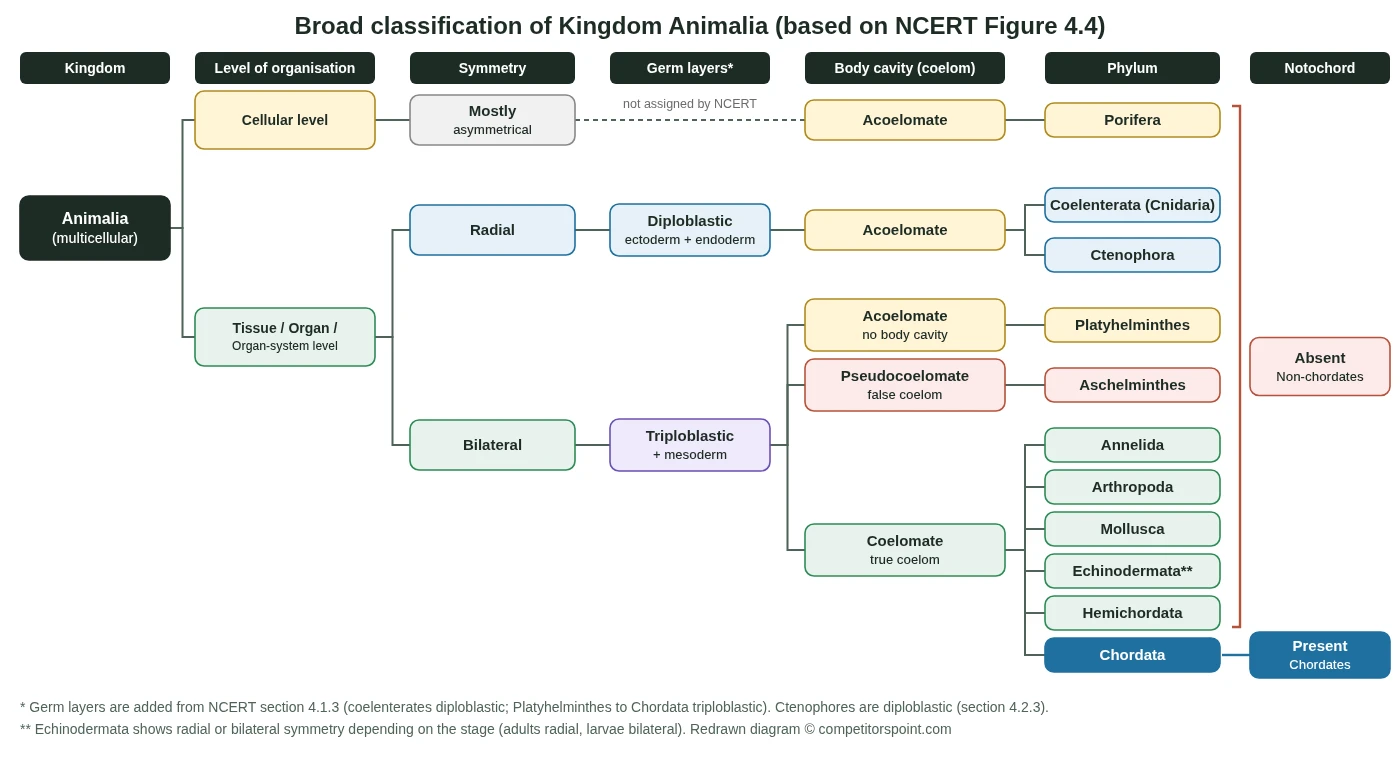
How to use it in the exam: if a question gives you three features, such as “bilateral, triploblastic, pseudocoelomate”, follow the branches. That trail can only end at Aschelminthes.
Animal Kingdom phyla: study one at a time
Each card gives the key feature, the fundamental characters and NCERT examples. Select a card to open the full notes. Cards marked “Coming soon” are being written.
Porifera
NCERT 4.2.1 • Sponges
Water canal system: water enters by ostia, passes through the spongocoel and leaves by the osculum. Choanocytes (collar cells) line the canals.
Examples: Sycon (Scypha), Spongilla, Euspongia
Read Porifera notesCoelenterata (Cnidaria)
NCERT 4.2.2 • Hydra, jellyfish, corals
Cnidoblasts with stinging nematocysts; polyp and medusa body forms; metagenesis in Obelia.
Examples: Physalia, Adamsia, Meandrina
Read Coelenterata notesCtenophora
NCERT 4.2.3 • Sea walnuts, comb jellies
Eight external rows of ciliated comb plates for locomotion; well-marked bioluminescence; only sexual reproduction.
Examples: Pleurobrachia, Ctenoplana
Read Ctenophora notesPlatyhelminthes
NCERT 4.2.4 • Flatworms
Dorso-ventrally flattened, mostly endoparasites; hooks and suckers; flame cells for osmoregulation and excretion.
Examples: Taenia, Fasciola (and Planaria for regeneration)
Read Platyhelminthes notesAschelminthes
NCERT 4.2.5 • Roundworms
Circular in cross-section; complete alimentary canal with a muscular pharynx; sexes separate, females often longer.
Examples: Ascaris, Wuchereria, Ancylostoma
Read Aschelminthes notesAnnelida
NCERT 4.2.6 • Segmented worms
Metameric segmentation; closed circulatory system; nephridia for excretion; parapodia in Nereis.
Examples: Nereis, Pheretima, Hirudinaria
Read Annelida notesArthropoda
NCERT 4.2.7 • Insects, crabs, spiders
Largest phylum: chitinous exoskeleton and jointed appendages; open circulation; Malpighian tubules.
Examples: Apis, Bombyx, Limulus (living fossil)
Read Arthropoda notesMollusca
NCERT 4.2.8 • Snails, oysters, octopus
Second largest phylum: head, muscular foot and visceral hump; mantle and calcareous shell; radula for feeding.
Examples: Pila, Pinctada, Octopus
Read Mollusca notesEchinodermata
NCERT 4.2.9 • Spiny-skinned animals
Calcareous ossicles; water vascular system; adults radial, larvae bilateral; no excretory system.
Examples: Asterias, Echinus, Antedon
Coming soonHemichordata
NCERT 4.2.10 • Acorn worms
Worm-like marine body of proboscis, collar and trunk; stomochord; proboscis gland for excretion.
Examples: Balanoglossus, Saccoglossus
Coming soonChordata
NCERT 4.2.11 • Protochordates and vertebrates
Notochord, dorsal hollow nerve cord, paired pharyngeal gill slits and a post-anal tail; closed circulation.
Examples: Ascidia, Branchiostoma, vertebrates
Coming soonClasses of Vertebrata
Chordata is the biggest topic in the chapter, so each vertebrate class will get its own article.
Class Cyclostomata
NCERT 4.2.11.1
Jawless, sucking circular mouth; 6–15 pairs of gill slits; no scales or paired fins.
Examples: Petromyzon, Myxine
Coming soonClass Chondrichthyes
NCERT 4.2.11.2
Cartilaginous marine fishes; placoid scales; no operculum and no air bladder.
Examples: Scoliodon, Pristis, Trygon
Coming soonClass Osteichthyes
NCERT 4.2.11.3
Bony fishes; four pairs of gills under an operculum; air bladder for buoyancy.
Examples: Labeo, Catla, Hippocampus
Coming soonClass Amphibia
NCERT 4.2.11.4
Moist skin without scales; cloaca; three-chambered heart; external fertilisation.
Examples: Rana, Bufo, Ichthyophis
Coming soonClass Reptilia
NCERT 4.2.11.5
Dry cornified skin with scales or scutes; no external ear opening; four-chambered heart only in crocodiles.
Examples: Chelone, Calotes, Naja
Coming soonClass Aves
NCERT 4.2.11.6
Feathers, beak and wings; pneumatic bones; crop and gizzard; air sacs; warm-blooded.
Examples: Columba, Psittacula, Struthio
Coming soonClass Mammalia
NCERT 4.2.11.7
Mammary glands, hair and pinnae; four-chambered heart; mostly viviparous.
Examples: Ornithorhynchus, Macropus, Pteropus
Coming soonRelated reading
Basis of Classification
Levels of organisation, symmetry, germ layers, coelom, segmentation and notochord in detail.
Read the articleOviparous, Viviparous and Ovoviviparous Animals
How animals give birth or lay eggs, with examples asked in NEET.
Read the articleMorphology and Anatomy of Cockroach
Periplaneta americana under Arthropoda: classification, external features and organ systems, with diagrams and MCQs.
Read morphology and anatomy of cockroachComparison table of all phyla (NCERT Table 4.2)
This is NCERT Table 4.2, “Salient Features of Different Phyla in the Animal Kingdom”, with one extra column for germ layers taken from the chapter text. Scroll sideways on a phone to see every column.
| Phylum | Level of organisation | Symmetry | Germ layers | Coelom | Segmentation | Digestive system | Circulatory system | Respiratory system | Distinctive features |
|---|---|---|---|---|---|---|---|---|---|
| Porifera | Cellular | Various | —* | Absent | Absent | Absent | Absent | Absent | Body with pores and canals in walls. |
| Coelenterata (Cnidaria) | Tissue | Radial | Diploblastic | Absent | Absent | Incomplete | Absent | Absent | Cnidoblasts present. |
| Ctenophora | Tissue | Radial | Diploblastic | Absent | Absent | Incomplete | Absent | Absent | Comb plates for locomotion. |
| Platyhelminthes | Organ & Organ-system | Bilateral | Triploblastic | Absent | Absent | Incomplete | Absent | Absent | Flat body, suckers. |
| Aschelminthes | Organ-system | Bilateral | Triploblastic | Pseudocoelomate | Absent | Complete | Absent | Absent | Often worm-shaped, elongated. |
| Annelida | Organ-system | Bilateral | Triploblastic | Coelomate | Present | Complete | Present | Absent | Body segmentation like rings. |
| Arthropoda | Organ-system | Bilateral | Triploblastic | Coelomate | Present | Complete | Present | Present | Exoskeleton of cuticle, jointed appendages. |
| Mollusca | Organ-system | Bilateral | Triploblastic | Coelomate | Absent | Complete | Present | Present | External skeleton of shell usually present. |
| Echinodermata | Organ-system | Radial | Triploblastic | Coelomate | Absent | Complete | Present | Present | Water vascular system, radial symmetry. |
| Hemichordata | Organ-system | Bilateral | Triploblastic | Coelomate | Absent | Complete | Present | Present | Worm-like with proboscis, collar and trunk. |
| Chordata | Organ-system | Bilateral | Triploblastic | Coelomate | Present | Complete | Present | Present | Notochord, dorsal hollow nerve cord, gill slits with limbs or fins. |
* NCERT does not call sponges diploblastic or triploblastic, so that cell is left blank. For Echinodermata, Table 4.2 gives radial symmetry because that is the adult form; the larvae are bilateral.
Where the chapter text adds detail, remember it too: circulation is closed in Annelida and Chordata and open in Arthropoda and Hemichordata. Digestion is intracellular in Porifera and both extracellular and intracellular in Coelenterata and Ctenophora.
Excretion, sexes and development at a glance
| Phylum | Excretion (NCERT) | Sexes | Fertilisation | Development |
|---|---|---|---|---|
| Porifera | Water current through the canal system removes waste | Hermaphrodite | Internal | Indirect (larva) |
| Ctenophora | Not described in NCERT | Not separate (hermaphrodite) | External | Indirect |
| Platyhelminthes | Flame cells | Not separate (hermaphrodite) | Internal | Through many larval stages |
| Aschelminthes | Excretory tube and excretory pore | Separate (dioecious) | Internal | Direct or indirect |
| Annelida | Nephridia | Nereis dioecious; earthworm and leech monoecious | Not described in NCERT | Not described in NCERT |
| Arthropoda | Malpighian tubules | Mostly dioecious | Usually internal | Direct or indirect; mostly oviparous |
| Mollusca | Feather-like gills in the mantle cavity have respiratory and excretory functions | Usually dioecious | Not described in NCERT | Indirect; oviparous |
| Echinodermata | Absent | Separate | Usually external | Indirect, free-swimming larva |
| Hemichordata | Proboscis gland | Separate | External | Indirect |
| Chordata (vertebrates) | Kidneys | Separate | Varies by class | Varies by class |
NCERT does not describe the sexes or fertilisation of Coelenterata, so it is left out of this table. Its key reproductive fact is metagenesis: in Obelia, polyps produce medusae asexually and medusae form polyps sexually.
Chordates vs non-chordates (NCERT Table 4.1)
Phylum Chordata is defined by four features: a notochord, a dorsal hollow nerve cord, paired pharyngeal gill slits and a post-anal tail. Chordates are also bilaterally symmetrical, triploblastic and coelomate, with an organ-system level of organisation and a closed circulatory system. All ten other phyla are non-chordates.
| S.No. | Chordates | Non-chordates |
|---|---|---|
| 1 | Notochord present. | Notochord absent. |
| 2 | Central nervous system is dorsal, hollow and single. | Central nervous system is ventral, solid and double. |
| 3 | Pharynx perforated by gill slits. | Gill slits are absent. |
| 4 | Heart is ventral. | Heart is dorsal (if present). |
| 5 | A post-anal part (tail) is present. | Post-anal tail is absent. |
Chordata subphyla and vertebrate classes
Chordata has three subphyla. Urochordata and Cephalochordata are called protochordates and are exclusively marine. Vertebrata is split by jaws into Agnatha and Gnathostomata. Gnathostomata is split by fins or limbs into the super classes Pisces and Tetrapoda.
| Subphylum | Notochord | Other features | NCERT examples |
|---|---|---|---|
| Urochordata (Tunicata) | Only in the larval tail | Exclusively marine; a protochordate | Ascidia, Salpa, Doliolum |
| Cephalochordata | From head to tail, persistent throughout life | Exclusively marine; a protochordate | Branchiostoma (Amphioxus or Lancelet) |
| Vertebrata | Present in the embryo; replaced by a cartilaginous or bony vertebral column in the adult | Ventral muscular heart with 2, 3 or 4 chambers; kidneys; paired fins or limbs | Cyclostomes, fishes, amphibians, reptiles, birds, mammals |
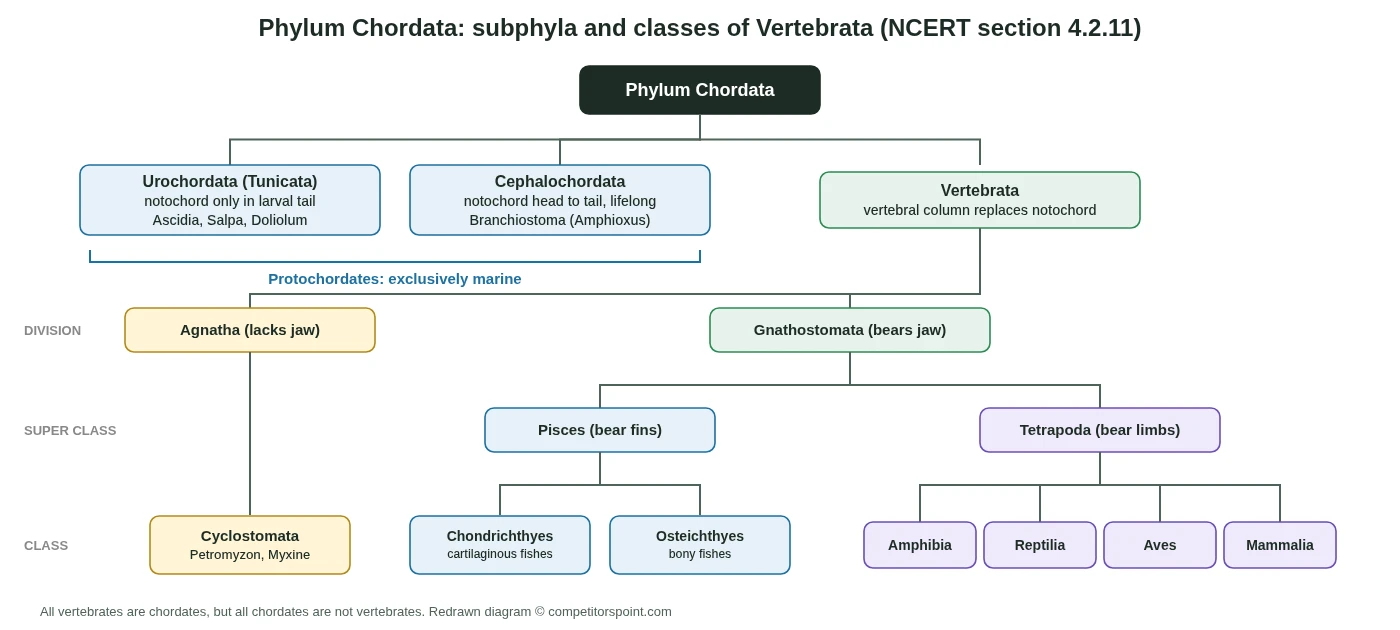
The seven vertebrate classes compared
| Class | Skeleton, skin and body | Respiration | Heart chambers | Body temperature | Reproduction | NCERT examples |
|---|---|---|---|---|---|---|
| Cyclostomata | Jawless; cartilaginous cranium and vertebral column; no scales, no paired fins | 6–15 pairs of gill slits | Not stated in NCERT (closed circulation) | Cold-blooded | Marine; migrate to fresh water to spawn and die within a few days; larvae return to the ocean after metamorphosis | Petromyzon (Lamprey), Myxine (Hagfish) |
| Chondrichthyes | Cartilaginous endoskeleton; minute placoid scales; ventral mouth; persistent notochord | Separate gill slits, no operculum; no air bladder | 2 (1 auricle + 1 ventricle) | Cold-blooded | Sexes separate; claspers on pelvic fins of males; internal fertilisation; many viviparous | Scoliodon, Pristis, Carcharodon, Trygon |
| Osteichthyes | Bony endoskeleton; cycloid or ctenoid scales; terminal mouth | 4 pairs of gills under an operculum; air bladder | 2 (1 auricle + 1 ventricle) | Cold-blooded | Fertilisation usually external; mostly oviparous; development direct | Exocoetus, Hippocampus, Labeo, Catla, Clarias, Betta, Pterophyllum |
| Amphibia | Moist skin without scales; eyelids; tympanum; cloaca | Gills, lungs and skin | 3 (2 auricles + 1 ventricle) | Cold-blooded | External fertilisation; oviparous; development indirect | Bufo, Rana, Hyla, Salamandra, Ichthyophis |
| Reptilia | Dry cornified skin, epidermal scales or scutes; no external ear opening (tympanum) | Lungs | Usually 3; 4 in crocodiles | Cold-blooded (poikilotherms) | Internal fertilisation; oviparous; development direct | Chelone, Testudo, Chameleon, Calotes, Crocodilus, Alligator, Hemidactylus, Naja, Bangarus, Vipera |
| Aves | Feathers; beak; dry skin with only an oil gland at the tail base; pneumatic long bones; crop and gizzard | Lungs, supplemented by air sacs | 4 (completely four-chambered) | Warm-blooded (homoiothermous) | Internal fertilisation; oviparous; development direct | Corvus, Columba, Psittacula, Struthio, Pavo, Aptenodytes, Neophron |
| Mammalia | Mammary glands; hair; external ears (pinnae); different types of teeth | Lungs | 4 | Warm-blooded (homoiothermous) | Internal fertilisation; viviparous with few exceptions; development direct | Ornithorhynchus (oviparous), Macropus, Pteropus, Balaenoptera, Delphinus, Panthera |
Fishes, amphibians and reptiles are cold-blooded (poikilothermous); birds and mammals are warm-blooded (homoiothermous). NCERT spells the krait as Bangarus; the accepted genus name is Bungarus.
Animal Kingdom NEET notes for quick revision: common traps
These are the lines students most often get wrong. Read them once more on the night before the exam.
- Sponges have internal fertilisation and indirect development with a larva, and they are hermaphrodite.
- Digestion is intracellular in Porifera, but both extracellular and intracellular in Coelenterata and Ctenophora.
- Ctenophores reproduce only sexually, with external fertilisation; bioluminescence is well-marked in them.
- Platyhelminthes have an incomplete gut with a single opening. A complete gut (mouth and anus) first appears in Aschelminthes.
- Metameric segmentation is first seen in Annelida (NCERT exercise 13), not in Arthropoda.
- In Table 4.2, Annelida have a circulatory system but the respiratory system is marked absent.
- Arthropoda is the largest phylum (over two-thirds of named species); Mollusca is the second largest.
- Echinoderm adults are radial, larvae bilateral. They have no excretory system; the mouth is ventral and the anus dorsal.
- Hemichordata was once a subphylum of Chordata; it is now a separate non-chordate phylum. Its stomochord only resembles a notochord.
- Notochord: only in the larval tail in Urochordata, but head to tail for life in Cephalochordata.
- Nereis is dioecious, but earthworms and leeches are monoecious.
- Chondrichthyes have no air bladder, so they swim constantly; their teeth are modified, backwardly directed placoid scales.
- Reptile hearts are usually three-chambered, but crocodiles have four chambers.
- Ornithorhynchus (platypus) is the NCERT example of an oviparous mammal.
- Misleading names: jellyfish is a cnidarian, starfish an echinoderm, cuttlefish (Sepia) and devil fish (Octopus) are molluscs, sea horse (Hippocampus) is a bony fish, and flying fox (Pteropus) is a mammal.
- Sea anemone (Adamsia) is a cnidarian, sea walnut a ctenophore, sea lily (Antedon) and sea cucumber (Cucumaria) echinoderms, sea hare (Aplysia) a mollusc.
15 Animal Kingdom NEET MCQs with answers
These are original practice questions based on NCERT, not previous-year questions. Try each one before you show the answer, and go back to the matching section of these Animal Kingdom NEET notes for any you get wrong.
Q1. Which phylum shows the tissue level of organisation?
- (a) Porifera
- (b) Coelenterata
- (c) Platyhelminthes
- (d) Annelida
Answer: (b) Coelenterata. In coelenterates, cells performing the same function are arranged into tissues. Sponges are at the cellular level and Platyhelminthes at the organ level.
Q2. Pseudocoelom is found in
- (a) Platyhelminthes
- (b) Aschelminthes
- (c) Annelida
- (d) Mollusca
Answer: (b) Aschelminthes. In Aschelminthes the mesoderm is present as scattered pouches between ectoderm and endoderm, so the body cavity is a pseudocoelom. Platyhelminthes are acoelomate; annelids and molluscs are coelomate.
Q3. Which pair of phyla is radially symmetrical (as adults)?
- (a) Ctenophora and Echinodermata
- (b) Annelida and Arthropoda
- (c) Platyhelminthes and Aschelminthes
- (d) Mollusca and Hemichordata
Answer: (a) Ctenophora and Echinodermata. NCERT lists coelenterates, ctenophores and echinoderms as radially symmetrical. Echinoderm larvae, however, are bilateral.
Q4. Metameric segmentation is first observed in
- (a) Platyhelminthes
- (b) Aschelminthes
- (c) Annelida
- (d) Arthropoda
Answer: (c) Annelida. Annelids are the first metamerically segmented animals; the name comes from the Latin annulus, little ring.
Q5. Water vascular system is characteristic of
- (a) Porifera
- (b) Ctenophora
- (c) Echinodermata
- (d) Chordata
Answer: (c) Echinodermata. The water vascular system is the most distinctive feature of echinoderms. It helps in locomotion, capture and transport of food, and respiration.
Q6. Flame cells for osmoregulation and excretion are found in
- (a) Ascaris
- (b) Fasciola
- (c) Pheretima
- (d) Pila
Answer: (b) Fasciola. Flame cells are the excretory cells of Platyhelminthes such as Fasciola (liver fluke). Ascaris has an excretory tube and Pheretima has nephridia.
Q7. Which pair is incorrectly matched?
- (a) Choanocytes – Porifera
- (b) Comb plates – Ctenophora
- (c) Radula – Mollusca
- (d) Parapodia – Arthropoda
Answer: (d) Parapodia – Arthropoda. Parapodia are lateral appendages of aquatic annelids such as Nereis, used in swimming. They belong with Annelida, not Arthropoda.
Q8. The excretory organ of Balanoglossus is the
- (a) Nephridium
- (b) Malpighian tubule
- (c) Proboscis gland
- (d) Flame cell
Answer: (c) Proboscis gland. Balanoglossus is a hemichordate, and the proboscis gland is the excretory organ of hemichordates.
Q9. In which group does the notochord extend from head to tail and persist throughout life?
- (a) Urochordata
- (b) Cephalochordata
- (c) Vertebrata
- (d) Hemichordata
Answer: (b) Cephalochordata. In Cephalochordata (e.g., Branchiostoma) the notochord runs head to tail for life. In Urochordata it is only in the larval tail, and in vertebrates it is replaced by the vertebral column.
Q10. Which fish lacks an air bladder and must swim constantly to avoid sinking?
- (a) Catla
- (b) Hippocampus
- (c) Scoliodon
- (d) Labeo
Answer: (c) Scoliodon. Scoliodon (dog fish) is a cartilaginous fish (Chondrichthyes), which has no air bladder. The other three are bony fishes with an air bladder.
Q11. A four-chambered heart is found in
- (a) Crocodilus
- (b) Chelone
- (c) Naja
- (d) Calotes
Answer: (a) Crocodilus. Reptiles usually have a three-chambered heart, but crocodiles have a four-chambered heart.
Q12. Assertion (A): All vertebrates are chordates but all chordates are not vertebrates. Reason (R): In vertebrates, the notochord is replaced by a cartilaginous or bony vertebral column in the adult.
- (a) Both A and R are true, and R is the correct explanation of A
- (b) Both A and R are true, but R is not the correct explanation of A
- (c) A is true but R is false
- (d) A is false but R is true
Answer: (a) Both A and R are true, and R is the correct explanation of A. NCERT links the two directly: because the notochord is replaced by a vertebral column only in vertebrates, protochordates remain chordates without being vertebrates.
Q13. Which of these mammals is oviparous?
- (a) Macropus
- (b) Ornithorhynchus
- (c) Pteropus
- (d) Delphinus
Answer: (b) Ornithorhynchus. NCERT lists Ornithorhynchus (platypus) as the oviparous mammal. Kangaroo, flying fox and dolphin are viviparous.
Q14. Which statement about Ctenophora is correct?
- (a) They reproduce asexually by budding
- (b) Bioluminescence is well-marked
- (c) Fertilisation is internal
- (d) They are triploblastic
Answer: (b) Bioluminescence is well-marked. Ctenophores show well-marked bioluminescence. They reproduce only sexually, fertilisation is external, and they are diploblastic.
Q15. According to NCERT Table 4.2, which phylum has a circulatory system but no respiratory system?
- (a) Annelida
- (b) Arthropoda
- (c) Mollusca
- (d) Chordata
Answer: (a) Annelida. Table 4.2 marks the circulatory system present but the respiratory system absent in Annelida. Arthropods, molluscs and chordates have both.
Animal Kingdom FAQs
Which phylum has the tube within tube body plan?
The tube within tube body plan, where a complete gut with a mouth and an anus lies inside the body wall, first appears in Aschelminthes (roundworms). All higher phyla, from Annelida to Chordata, also have it. Platyhelminthes have a blind-sac plan because their gut has only one opening.
Which is the largest phylum of the animal kingdom?
Arthropoda is the largest phylum. Over two-thirds of all named species on earth are arthropods. Mollusca is the second largest.
What is the basis of classification of the animal kingdom?
NCERT uses fundamental features: level of organisation, symmetry, diploblastic or triploblastic organisation, the nature of the coelom, segmentation and the notochord. Patterns of the digestive, circulatory and reproductive systems are also used.
Which animals are diploblastic?
Coelenterates (cnidarians) and ctenophores are diploblastic. They have an outer ectoderm and an inner endoderm with an undifferentiated mesoglea between them. Platyhelminthes to chordates are triploblastic.
Which phylum is acoelomate and which is pseudocoelomate?
Platyhelminthes are acoelomate, with no body cavity. Aschelminthes are pseudocoelomate, because their body cavity is not lined by mesoderm. Annelids to chordates are coelomates.
Is Echinodermata radial or bilateral?
Both, depending on the stage. Adult echinoderms are radially symmetrical, but their larvae are bilaterally symmetrical.
Why is Hemichordata not placed in Chordata?
Hemichordates have only a stomochord, a rudimentary structure in the collar region that is similar to a notochord but is not a true notochord. So Hemichordata, once a subphylum of Chordata, is now a separate phylum under non-chordates.
How many phyla are there in the NCERT Animal Kingdom chapter?
NCERT describes 11 phyla: Porifera, Coelenterata, Ctenophora, Platyhelminthes, Aschelminthes, Annelida, Arthropoda, Mollusca, Echinodermata, Hemichordata and Chordata.
Are these Animal Kingdom NEET notes based on the latest NCERT book?
Yes. These Animal Kingdom NEET notes follow Chapter 4 of the current NCERT Class XI Biology textbook (2026-27 reprint), including Figure 4.4, Table 4.1 and Table 4.2. Animal Kingdom is part of the Diversity in Living World unit of the NEET (UG) syllabus.