
Phylum Aschelminthes is the group of roundworms: bilaterally symmetrical, triploblastic and pseudocoelomate animals with a complete gut. These NEET notes follow NCERT Class 11 Biology, Chapter 4 (Animal Kingdom) section 4.2.5 line by line and add labelled diagrams of Ascaris, circular life cycles, a disease chart, an NCERT checklist and 90 practice questions (30 MCQs, 30 assertion-reason and 30 match-the-pair).
Key points
- Body is circular in cross-section, hence the name roundworms.
- May be free-living, aquatic and terrestrial, or parasitic in plants and animals.
- Organ-system level of organisation; bilaterally symmetrical, triploblastic and pseudocoelomate.
- Complete alimentary canal with a well-developed muscular pharynx.
- An excretory tube removes body wastes from the body cavity through the excretory pore.
- Dioecious; females are often longer than males. Internal fertilisation; development direct or indirect.
- Examples: Ascaris (Roundworm), Wuchereria (Filaria worm), Ancylostoma (Hookworm).
What is Aschelminthes? Phylum Aschelminthes (Roundworms)
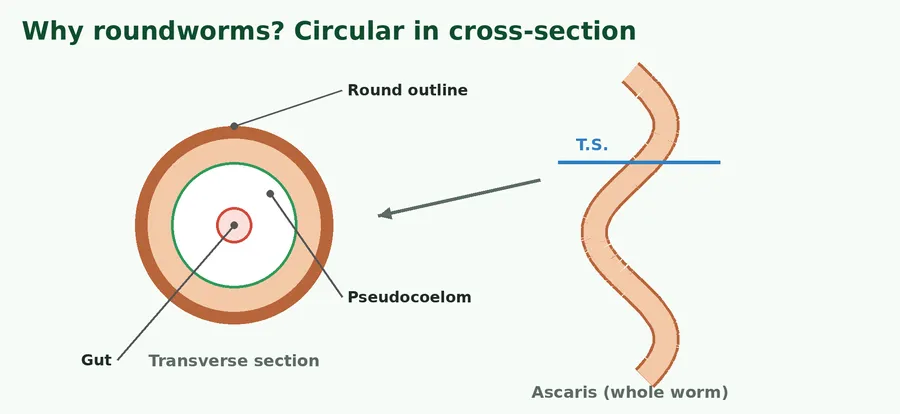
The phylum Aschelminthes is called roundworms, but they are not round on the outside. Then why are they called roundworms? When you take a transverse section of the worm, it is round, and that’s why they have this name. In other words, roundworms get their name from their cross-section.
So, what is Aschelminthes? NCERT puts it simply: the body of the aschelminthes is circular in cross-section, hence the name roundworms. They may be free-living, aquatic and terrestrial, or parasitic in plants and animals. The name comes from the Greek askos (cavity or bladder) and helminthes (worms), a reference to the fluid-filled body cavity.
Why Aschelminthes are called nematodes and roundworms
So, why Aschelminthes are called nematodes? The word comes from the Greek nema, meaning ‘thread’: most members are long, slender and thread-like, tapering at both ends. Nematodes form the largest and best-known class of the phylum, so the common members, such as Ascaris, hookworms and filarial worms, are all nematodes. They are called roundworms because the body is circular in transverse section, and threadworms because of their thread-like shape.
Difference between Aschelminthes and Nemathelminthes; are Aschelminthes and Nematoda the same?
Students often ask about the difference between Aschelminthes and Nemathelminthes. In NEET and NCERT usage the two names refer to the same phylum of roundworms. ‘Aschelminthes’ (cavity worms) highlights the pseudocoelom, while ‘Nemathelminthes’ (thread worms) highlights the thread-like body shape.
| Name | Meaning | What it covers |
|---|---|---|
| Aschelminthes | askos = cavity, helminthes = worms | NCERT name; a broad grouping of pseudocoelomate worms (nematodes and, in older schemes, rotifers and related groups) |
| Nemathelminthes | nema = thread, helminthes = worms | Older synonym used in many textbooks for the same roundworm phylum |
| Nematoda | nema = thread, eidos = form | The roundworms proper (Ascaris, Wuchereria, Ancylostoma); a class in older schemes, a separate phylum in modern classification |
Are Aschelminthes and Nematoda the same? Not exactly. For NEET you can treat roundworm, nematode and Aschelminthes as describing the same animals, because all the NCERT examples are nematodes. Strictly, though, Nematoda is one class within the broader Aschelminthes, which in older schemes also included Rotifera, Gastrotricha, Kinorhyncha and Nematomorpha.
General characteristics of the phylum Aschelminthes
General characteristics of the phylum Aschelminthes
- They are mostly endoparasites (NCERT: they may be free-living, aquatic and terrestrial, or parasitic in plants and animals)
- They are triploblastic and show bilateral symmetry
- Tube within the tube body plan
- Organ level system of organization (NCERT: organ-system level of body organisation)
- Pseudocoelomate – unique characteristic of this phylum
- Cuticle, syncytial epidermis
- Complete alimentary canal – seen for the first time in this phylum (with a well-developed muscular pharynx)
- Epidermal nervous system (a nerve ring around the pharynx with dorsal and ventral nerve cords running in the epidermal cords)
- H-shaped excretory organ (Renette cell); an excretory tube removes body wastes from the body cavity through the excretory pore
- Sensory structures are present (amphids and phasmids, papillae around the lips)
- Unisexual. Sexual dimorphism (males are smaller with a curved tail end, and females are longer with a straight tail end)
- Usually indirect development (NCERT: development may be direct, the young ones resemble the adult, or indirect)
- No circulatory and no respiratory system (Table 4.2); respiration by diffusion through the body surface, often anaerobic in gut parasites
- Body wall has only longitudinal muscles, so roundworms move with a whip-like, wriggling motion
- Fertilisation is internal
NCERT checklist: Phylum Aschelminthes
Tick off every Phylum Aschelminthes point before your exam; every point from NCERT 4.2.5 and Table 4.2 is covered in these notes.
Body plan of Phylum Aschelminthes: symmetry and germ layers
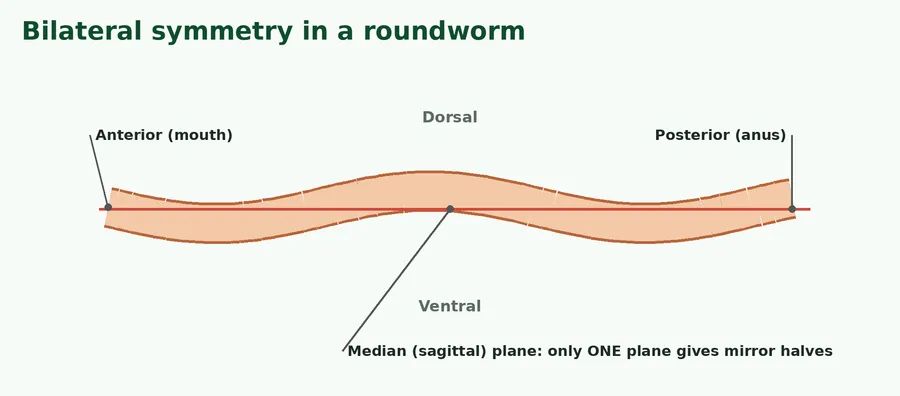
Roundworms are elongated, cylindrical, unsegmented and taper at both ends. They are bilaterally symmetrical: only the median (sagittal) plane divides the body into identical left and right halves. They follow the tube-within-tube body plan, in which the outer body wall surrounds an inner digestive tube with the body cavity in between.
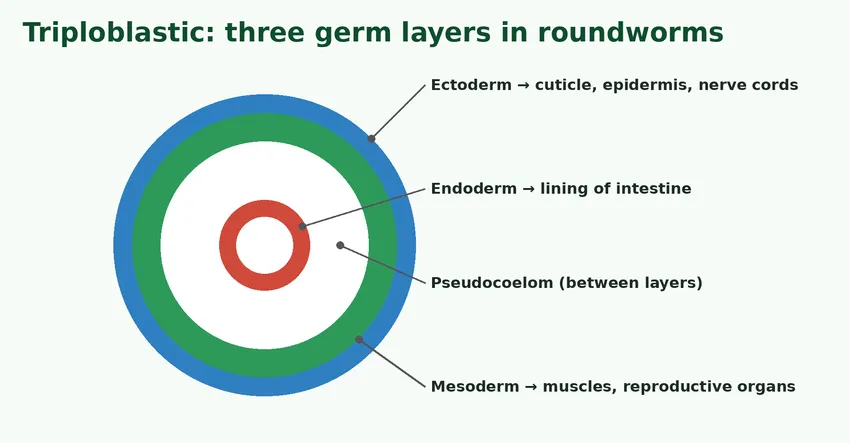
They are triploblastic: ectoderm, mesoderm and endoderm are all present. Revise how these criteria work in the basis of classification of the animal kingdom.
Pseudocoelom: the body cavity of Phylum Aschelminthes
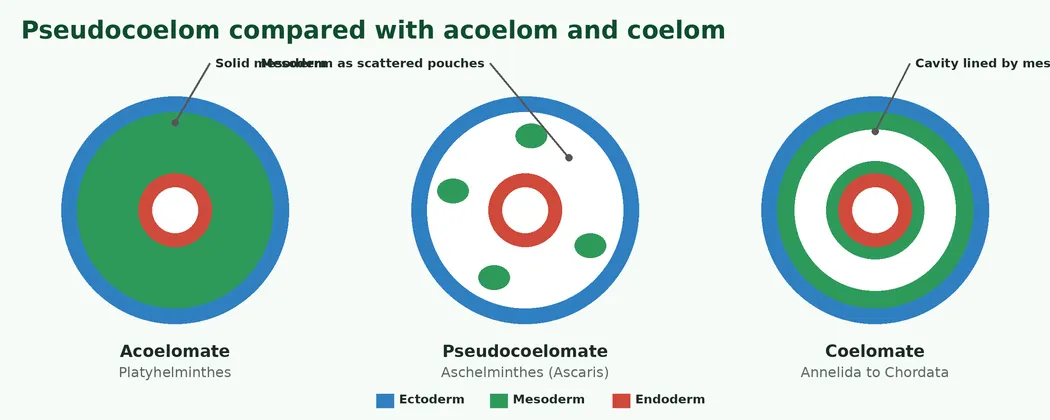
In Aschelminthes the body cavity is not lined by mesoderm; instead, the mesoderm is present as scattered pouches in between the ectoderm and endoderm. Such a body cavity is called a pseudocoelom, and roundworms are the NCERT example of pseudocoelomates. Flatworms in Phylum Platyhelminthes are acoelomate, while annelids onwards have a true coelom. The fluid in the pseudocoelom acts as a hydrostatic skeleton and helps distribute food and wastes.
T.S. of Ascaris: labelled diagram
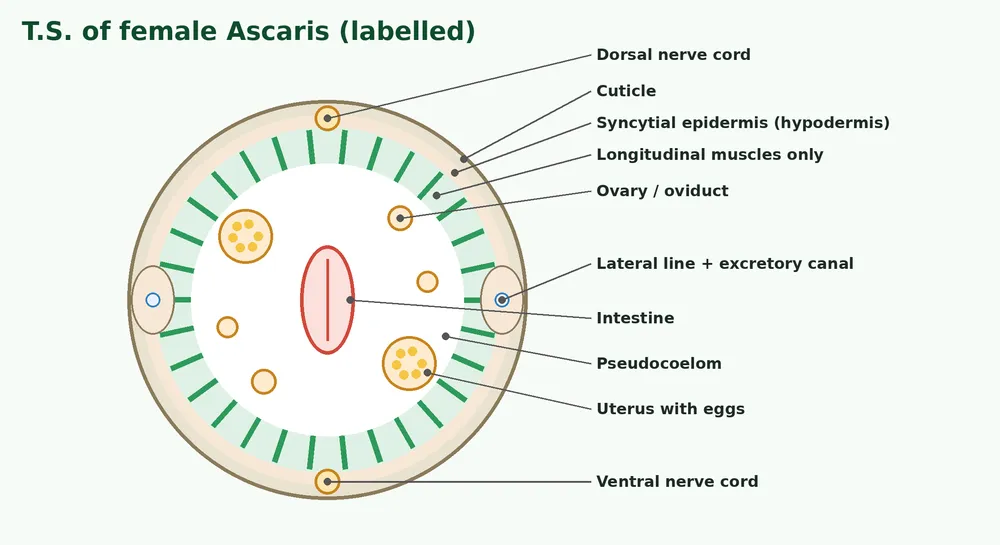
- Cuticle: tough, non-living outer layer that resists the host’s digestive enzymes.
- Epidermis: syncytial (cell boundaries not distinct), thickened into dorsal, ventral and two lateral cords.
- Muscles: only longitudinal muscles, arranged in four quadrants.
- Pseudocoelom: fluid-filled cavity containing the intestine and reproductive organs.
- Lateral lines: carry the excretory canals; dorsal and ventral cords carry nerve cords.
Body systems in Phylum Aschelminthes
Digestive system
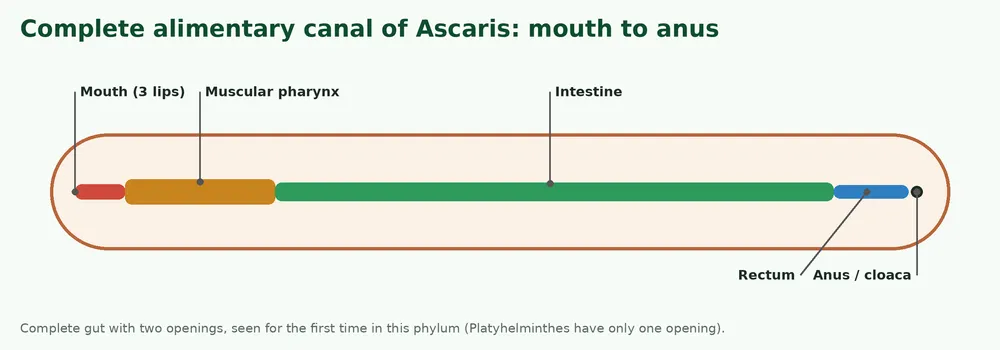
The alimentary canal is complete, with a mouth and an anus, and has a well-developed muscular pharynx used to suck food. In Ascaris, the mouth is surrounded by three lips, and the intestine is a simple, non-muscular tube that absorbs digested food from the host. A complete gut first appears in Phylum Aschelminthes.
Excretory system
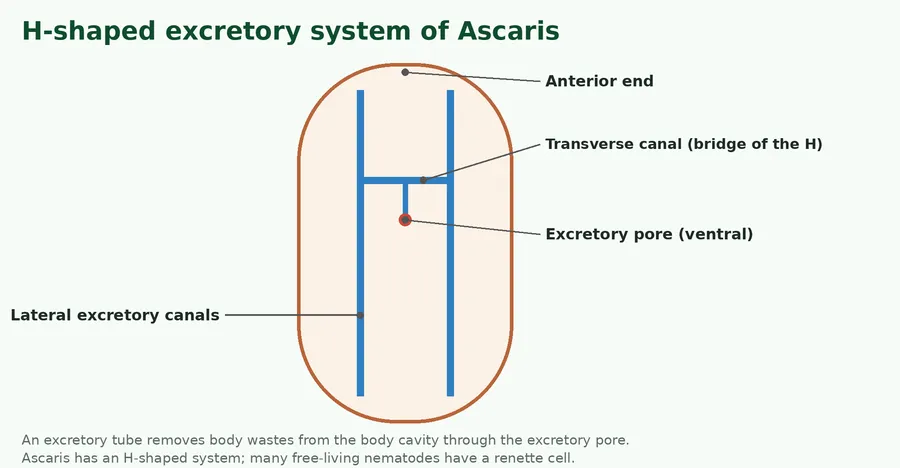
An excretory tube removes body wastes from the body cavity through the excretory pore. In Ascaris, two lateral excretory canals joined by a transverse canal form an H-shaped system that opens by a ventral excretory pore near the anterior end. Many free-living nematodes have a gland-like renette cell instead. Roundworms are mainly ammonotelic.
Nervous system and sense organs
A circum-pharyngeal nerve ring gives off dorsal and ventral nerve cords that lie in the epidermal cords. Sense organs include papillae on the lips, amphids (chemoreceptors at the front end) and phasmids (near the tail).
Respiration and circulation
Members of Phylum Aschelminthes have no special respiratory or circulatory organs (NCERT Table 4.2). Gases diffuse through the body surface, and intestinal parasites such as Ascaris respire largely anaerobically. The pseudocoelomic fluid circulates materials.
Reproduction in Phylum Aschelminthes and sexual dimorphism
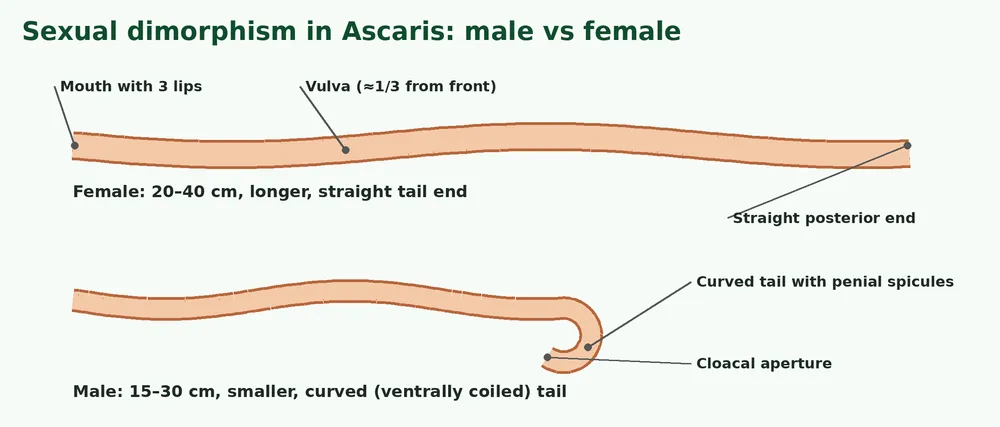
In Phylum Aschelminthes, sexes are separate (dioecious), i.e., males and females are distinct, and the phylum shows clear sexual dimorphism. Often females are longer than males. In Ascaris, the female is 20–40 cm long with a straight tail end, while the male is 15–30 cm long with a ventrally curved tail bearing a pair of penial spicules used during copulation. Fertilisation is internal and development may be direct (the young ones resemble the adult) or indirect, through larval stages. Like most invertebrates, roundworms are oviparous; see oviparous, viviparous and ovoviviparous animals.
Life cycle of Ascaris
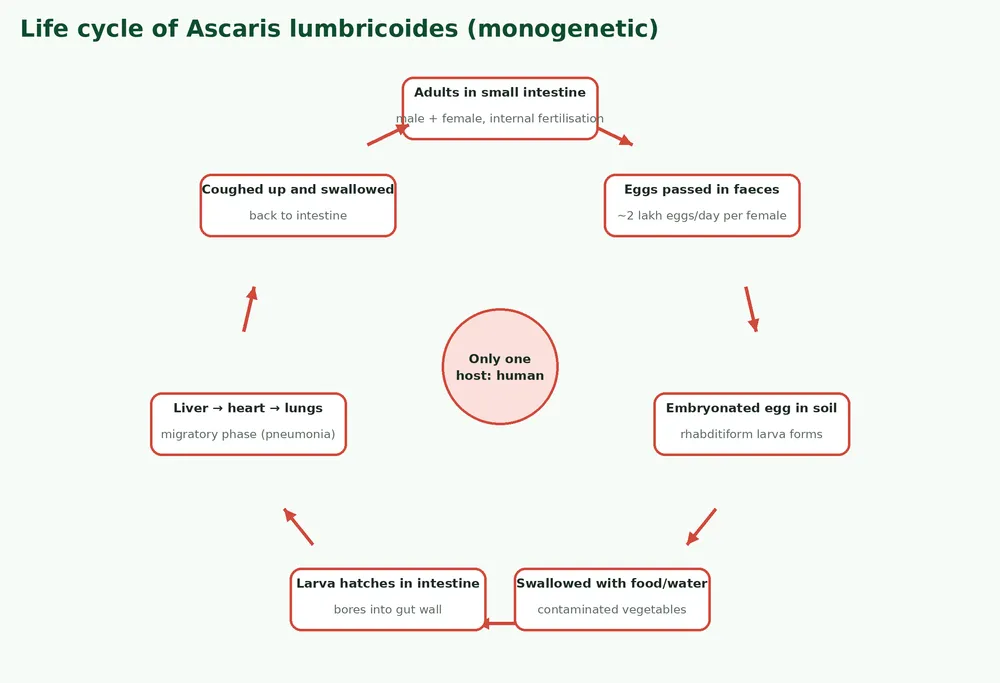
Ascaris lumbricoides is monogenetic: the whole life cycle is completed in one host, the human. A female lays about two lakh eggs a day, which pass out with the faeces. In moist soil a larva develops inside the egg, and the embryonated egg is the infective stage. When eggs are swallowed with contaminated food or water, larvae hatch in the intestine, bore into the gut wall and migrate through the liver, heart and lungs. From the lungs they are coughed up and swallowed, and mature into adults in the small intestine. Heavy infection causes ascariasis, with abdominal pain, indigestion and intestinal blockage.
Life cycle of Wuchereria (filarial worm)
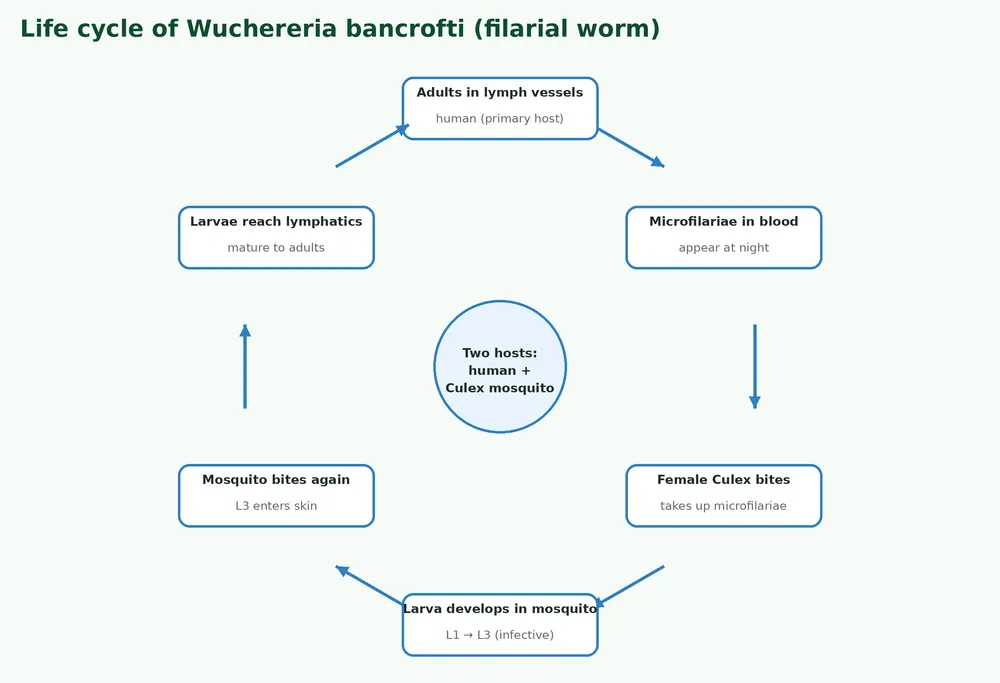
Wuchereria bancrofti, the filaria worm, lives in human lymph vessels and lymph nodes. Females release microfilariae, which circulate in the blood, especially at night. A female Culex mosquito picks them up while biting; the larvae develop in the mosquito into the infective stage and are passed to a new human at the next bite. Blocking of lymph vessels causes chronic swelling of the legs or scrotum, called filariasis or elephantiasis.
Examples of Phylum Aschelminthes and diseases
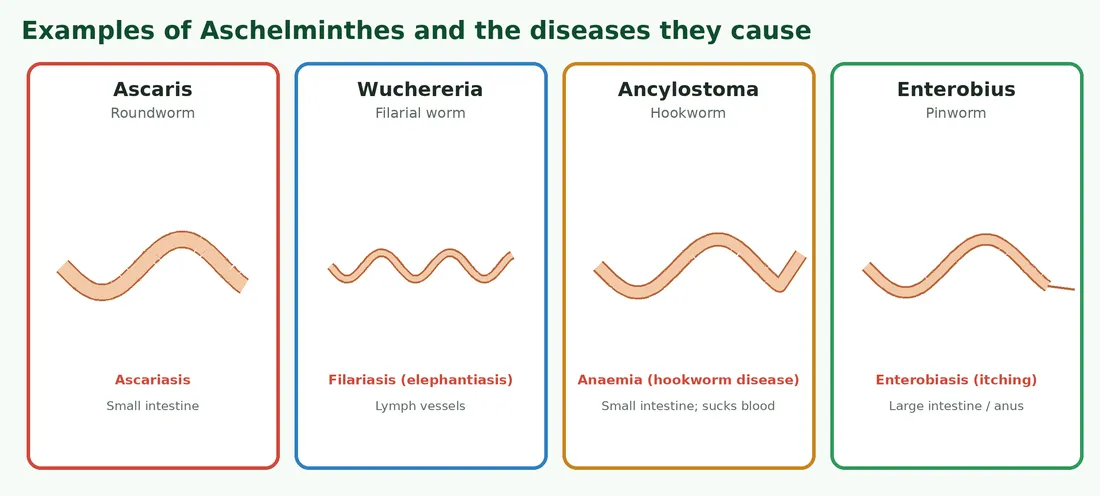
Examples of Phylum Aschelminthes
- Trichinella: Trichina worm
- Trichuris: whipworm
- Ascaris: common roundworm
- Wuchereria: Filarial worm
- Ancylostoma: Hookworm – it is a blood-sucking endoparasite
- Enterobius: Pinworm
- Loa: Eye worm
| Worm | Common name | Disease | Site / how infected |
|---|---|---|---|
| Ascaris lumbricoides | Roundworm | Ascariasis | Small intestine; eggs in food/water |
| Wuchereria bancrofti | Filaria worm | Filariasis (elephantiasis) | Lymphatics; bite of female Culex |
| Ancylostoma duodenale | Hookworm | Ancylostomiasis (anaemia) | Small intestine; larvae enter through skin of bare feet |
| Enterobius vermicularis | Pinworm | Enterobiasis (anal itching) | Large intestine; eggs swallowed, common in children |
| Trichinella spiralis | Trichina worm | Trichinosis | Muscles; undercooked pork |
| Trichuris trichiura | Whipworm | Trichuriasis | Large intestine |
| Loa loa | Eye worm | Loiasis | Under the skin and eye; deer-fly bite |
Some members of Phylum Aschelminthes are plant parasites, such as Meloidogyne (root-knot nematode), and many, like Caenorhabditis elegans, are free-living in soil.
Classes of Phylum Aschelminthes (older classification)
- Nematoda (Gr. nema = thread): true roundworms with cuticle and pseudocoelom, e.g. Ascaris, Wuchereria, Ancylostoma.
- Nematomorpha (horsehair worms): larvae parasitic in insects, adults free-living, e.g. Gordius.
- Rotifera (wheel animalcules): microscopic, with a ciliated crown (corona), e.g. Rotaria.
- Gastrotricha: microscopic, ventrally ciliated, e.g. Chaetonotus.
- Kinorhyncha: tiny marine worms with a spiny, retractile head, e.g. Echinoderes.
Exam tip: Modern classification splits Phylum Aschelminthes and treats these classes as separate phyla. NEET follows NCERT, where Aschelminthes means roundworms.
Phylum Aschelminthes in NCERT Table 4.2 and comparison with neighbouring phyla
| Feature | Platyhelminthes | Aschelminthes | Annelida |
|---|---|---|---|
| Level of organisation | Organ & organ-system | Organ-system | Organ-system |
| Symmetry | Bilateral | Bilateral | Bilateral |
| Coelom | Absent | Pseudocoelomate | Coelomate |
| Segmentation | Absent | Absent | Present |
| Digestive system | Incomplete | Complete | Complete |
| Circulatory system | Absent | Absent | Present (closed) |
| Respiratory system | Absent | Absent | Absent |
| Distinctive features | Flat body, suckers | Often worm-shaped, elongated | Body segmentation like rings |
| Sexes | Mostly hermaphrodite | Separate (dioecious) | Dioecious or monoecious |
Explore the phyla: Phylum Porifera · Phylum Coelenterata (Cnidaria) · Phylum Ctenophora · Phylum Platyhelminthes · all Animal Kingdom notes. Practise with 40 NEET sample test papers and more NEET Biology notes.
Flip cards: Phylum Aschelminthes recall
Tap a card to flip it.
Phylum Aschelminthes: Common doubts
What is Aschelminthes?
Aschelminthes is the phylum of roundworms: bilaterally symmetrical, triploblastic, pseudocoelomate animals with organ-system organisation and a complete gut, whose body is circular in cross-section.
Why are Aschelminthes called roundworms?
Because their body is circular in transverse section.
Why are Aschelminthes called nematodes?
From the Greek nema, meaning thread: most are slender and thread-like, and the main class of the phylum is Nematoda.
What is the difference between Aschelminthes and Nemathelminthes?
For NEET they are the same roundworm phylum. Aschelminthes (cavity worms) refers to the pseudocoelom; Nemathelminthes (thread worms) refers to the thread-like shape.
Are Aschelminthes and Nematoda the same?
Not strictly. Nematoda is the main class of Aschelminthes; older schemes also put rotifers and a few small groups in Aschelminthes. All NCERT examples are nematodes.
Do roundworms have a circulatory system?
No. NCERT Table 4.2 lists circulatory and respiratory systems as absent.
How does Ascaris infect humans?
By swallowing embryonated eggs in contaminated food or water.
Which mosquito spreads filariasis?
The female Culex mosquito transmits Wuchereria.
Phylum Aschelminthes: 30 NEET MCQs
Q1. Aschelminthes are called roundworms because their body is
- (a) flattened dorsoventrally
- (b) circular in cross-section
- (c) segmented into rings
- (d) radially symmetrical
Q2. The level of body organisation in Aschelminthes is
- (a) cellular
- (b) tissue
- (c) organ
- (d) organ-system
Q3. The body cavity of Ascaris is
- (a) true coelom
- (b) pseudocoelom
- (c) haemocoel
- (d) absent
Q4. In a pseudocoelomate, the mesoderm is
- (a) absent
- (b) lining the body cavity fully
- (c) present as scattered pouches between ectoderm and endoderm
- (d) only around the gut
Q5. Which is NOT a feature of Aschelminthes?
- (a) Triploblastic
- (b) Bilateral symmetry
- (c) Metameric segmentation
- (d) Complete alimentary canal
Q6. The alimentary canal of roundworms is
- (a) incomplete, with one opening
- (b) complete, with a well-developed muscular pharynx
- (c) absent
- (d) blind sac with gastrovascular cavity
Q7. In Aschelminthes, body wastes are removed from the body cavity through
- (a) flame cells
- (b) nephridia
- (c) the excretory pore by an excretory tube
- (d) Malpighian tubules
Q8. Sexes in Aschelminthes are
- (a) always united
- (b) separate (dioecious)
- (c) absent
- (d) changing with season
Q9. Which statement about Ascaris is correct?
- (a) Males are longer than females
- (b) Females are often longer than males
- (c) Both sexes are equal in size
- (d) Only females exist
Q10. Fertilisation in roundworms is
- (a) external
- (b) internal
- (c) absent
- (d) by budding
Q11. Development in Aschelminthes is
- (a) only direct
- (b) only indirect
- (c) direct or indirect
- (d) absent
Q12. Wuchereria is commonly called
- (a) Hookworm
- (b) Filaria worm
- (c) Pinworm
- (d) Whipworm
Q13. Ancylostoma is commonly called
- (a) Roundworm
- (b) Hookworm
- (c) Tapeworm
- (d) Liver fluke
Q14. Which system is absent in Aschelminthes according to Table 4.2?
- (a) Digestive
- (b) Circulatory
- (c) Excretory
- (d) Nervous
Q15. The distinctive feature listed for Aschelminthes in Table 4.2 is
- (a) Body with pores and canals
- (b) Often worm-shaped, elongated
- (c) Comb plates
- (d) Water vascular system
Q16. Aschelminthes may be
- (a) only free-living
- (b) only parasitic
- (c) free-living, aquatic and terrestrial, or parasitic in plants and animals
- (d) only marine
Q17. Number of germ layers in roundworms is
- (a) one
- (b) two
- (c) three
- (d) four
Q18. Symmetry in Aschelminthes is
- (a) radial
- (b) biradial
- (c) bilateral
- (d) asymmetrical
Q19. Which figure in NCERT shows the roundworm male and female?
- (a) Fig. 4.8
- (b) Fig. 4.10
- (c) Fig. 4.12
- (d) Fig. 4.14
Q20. The first phylum with a complete digestive tract is
- (a) Platyhelminthes
- (b) Aschelminthes
- (c) Ctenophora
- (d) Annelida
Q21. Elephantiasis is caused by
- (a) Ascaris
- (b) Wuchereria
- (c) Enterobius
- (d) Taenia
Q22. The vector of Wuchereria is
- (a) Anopheles
- (b) Aedes
- (c) female Culex
- (d) housefly
Q23. Infective stage of Ascaris for man is
- (a) adult worm
- (b) embryonated egg
- (c) microfilaria
- (d) cysticercus
Q24. Hookworm larvae usually enter the human body
- (a) through bare skin of feet
- (b) by mosquito bite
- (c) through eating pork
- (d) through inhalation
Q25. Body wall muscles of Ascaris are
- (a) only circular
- (b) only longitudinal
- (c) circular and longitudinal
- (d) absent
Q26. The epidermis of Ascaris is
- (a) cellular ciliated
- (b) syncytial
- (c) absent
- (d) chitinous
Q27. Male Ascaris can be identified by
- (a) straight tail
- (b) curved tail with penial spicules
- (c) larger size
- (d) vulva near front
Q28. Enterobius vermicularis is
- (a) Pinworm
- (b) Eye worm
- (c) Guinea worm
- (d) Whipworm
Q29. Which pair is correctly matched?
- (a) Loa – Eye worm
- (b) Trichuris – Hookworm
- (c) Trichinella – Pinworm
- (d) Ascaris – Filaria
Q30. Aschelminthes differ from Annelida in having
- (a) bilateral symmetry
- (b) pseudocoelom and no segmentation
- (c) triploblastic body
- (d) complete gut
Phylum Aschelminthes: 30 Assertion-Reason questions
Options for every question: (a) Both A and R are true and R is the correct explanation of A. (b) Both A and R are true but R is not the correct explanation of A. (c) A is true but R is false. (d) A is false but R is true.
Q1. Assertion (A): Aschelminthes are called roundworms.
Reason (R): Their body is circular in cross-section.
- (a) Both A and R true; R explains A
- (b) Both A and R true; R does not explain A
- (c) A true, R false
- (d) A false, R true
Q2. Assertion (A): Ascaris is a pseudocoelomate.
Reason (R): Its mesoderm is present as scattered pouches between ectoderm and endoderm.
- (a) Both A and R true; R explains A
- (b) Both A and R true; R does not explain A
- (c) A true, R false
- (d) A false, R true
Q3. Assertion (A): Roundworms have a complete alimentary canal.
Reason (R): They have both mouth and anus.
- (a) Both A and R true; R explains A
- (b) Both A and R true; R does not explain A
- (c) A true, R false
- (d) A false, R true
Q4. Assertion (A): Aschelminthes show organ-system level of organisation.
Reason (R): They are diploblastic.
- (a) Both A and R true; R explains A
- (b) Both A and R true; R does not explain A
- (c) A true, R false
- (d) A false, R true
Q5. Assertion (A): Roundworms are dioecious.
Reason (R): Males and females are distinct.
- (a) Both A and R true; R explains A
- (b) Both A and R true; R does not explain A
- (c) A true, R false
- (d) A false, R true
Q6. Assertion (A): In Ascaris, females are often longer than males.
Reason (R): Male has a curved posterior end.
- (a) Both A and R true; R explains A
- (b) Both A and R true; R does not explain A
- (c) A true, R false
- (d) A false, R true
Q7. Assertion (A): Fertilisation in Aschelminthes is external.
Reason (R): Sexes are separate.
- (a) Both A and R true; R explains A
- (b) Both A and R true; R does not explain A
- (c) A true, R false
- (d) A false, R true
Q8. Assertion (A): Aschelminthes lack a circulatory system.
Reason (R): Pseudocoelomic fluid distributes materials.
- (a) Both A and R true; R explains A
- (b) Both A and R true; R does not explain A
- (c) A true, R false
- (d) A false, R true
Q9. Assertion (A): Aschelminthes are segmented.
Reason (R): They are often worm-shaped and elongated.
- (a) Both A and R true; R explains A
- (b) Both A and R true; R does not explain A
- (c) A true, R false
- (d) A false, R true
Q10. Assertion (A): Wuchereria causes elephantiasis.
Reason (R): It blocks lymphatic vessels.
- (a) Both A and R true; R explains A
- (b) Both A and R true; R does not explain A
- (c) A true, R false
- (d) A false, R true
Q11. Assertion (A): Filariasis is transmitted by Anopheles.
Reason (R): Wuchereria lives in lymphatics.
- (a) Both A and R true; R explains A
- (b) Both A and R true; R does not explain A
- (c) A true, R false
- (d) A false, R true
Q12. Assertion (A): Ascaris life cycle is monogenetic.
Reason (R): It requires no intermediate host.
- (a) Both A and R true; R explains A
- (b) Both A and R true; R does not explain A
- (c) A true, R false
- (d) A false, R true
Q13. Assertion (A): Ancylostoma causes anaemia.
Reason (R): It is a blood-sucking endoparasite.
- (a) Both A and R true; R explains A
- (b) Both A and R true; R does not explain A
- (c) A true, R false
- (d) A false, R true
Q14. Assertion (A): Ascaris shows whip-like movement.
Reason (R): Its body wall has only longitudinal muscles.
- (a) Both A and R true; R explains A
- (b) Both A and R true; R does not explain A
- (c) A true, R false
- (d) A false, R true
Q15. Assertion (A): Roundworms are bilaterally symmetrical.
Reason (R): They are triploblastic.
- (a) Both A and R true; R explains A
- (b) Both A and R true; R does not explain A
- (c) A true, R false
- (d) A false, R true
Q16. Assertion (A): Development in Aschelminthes may be direct.
Reason (R): In direct development the young ones resemble the adult.
- (a) Both A and R true; R explains A
- (b) Both A and R true; R does not explain A
- (c) A true, R false
- (d) A false, R true
Q17. Assertion (A): Aschelminthes have a well-developed muscular pharynx.
Reason (R): The pharynx helps in sucking food.
- (a) Both A and R true; R explains A
- (b) Both A and R true; R does not explain A
- (c) A true, R false
- (d) A false, R true
Q18. Assertion (A): Excretory tube removes wastes through excretory pore.
Reason (R): Aschelminthes have flame cells.
- (a) Both A and R true; R explains A
- (b) Both A and R true; R does not explain A
- (c) A true, R false
- (d) A false, R true
Q19. Assertion (A): Cuticle protects Ascaris in the host intestine.
Reason (R): Cuticle resists digestive enzymes of the host.
- (a) Both A and R true; R explains A
- (b) Both A and R true; R does not explain A
- (c) A true, R false
- (d) A false, R true
Q20. Assertion (A): Aschelminthes are all parasitic.
Reason (R): Some roundworms are free-living in soil and water.
- (a) Both A and R true; R explains A
- (b) Both A and R true; R does not explain A
- (c) A true, R false
- (d) A false, R true
Q21. Assertion (A): Aschelminthes are acoelomates.
Reason (R): Their body cavity is not lined by mesoderm.
- (a) Both A and R true; R explains A
- (b) Both A and R true; R does not explain A
- (c) A true, R false
- (d) A false, R true
Q22. Assertion (A): Respiratory organs are absent in roundworms.
Reason (R): Gas exchange occurs through the body surface or anaerobically.
- (a) Both A and R true; R explains A
- (b) Both A and R true; R does not explain A
- (c) A true, R false
- (d) A false, R true
Q23. Assertion (A): Roundworms are also called nematodes.
Reason (R): Nema means thread.
- (a) Both A and R true; R explains A
- (b) Both A and R true; R does not explain A
- (c) A true, R false
- (d) A false, R true
Q24. Assertion (A): Enterobius infection is common in children.
Reason (R): Eggs are spread by contaminated fingers.
- (a) Both A and R true; R explains A
- (b) Both A and R true; R does not explain A
- (c) A true, R false
- (d) A false, R true
Q25. Assertion (A): Hookworm infection can be prevented by wearing footwear.
Reason (R): Hookworm larvae penetrate the skin.
- (a) Both A and R true; R explains A
- (b) Both A and R true; R does not explain A
- (c) A true, R false
- (d) A false, R true
Q26. Assertion (A): Trichinosis is caused by eating undercooked pork.
Reason (R): Larvae of Trichinella encyst in pig muscles.
- (a) Both A and R true; R explains A
- (b) Both A and R true; R does not explain A
- (c) A true, R false
- (d) A false, R true
Q27. Assertion (A): Platyhelminthes and Aschelminthes both have complete gut.
Reason (R): Both are bilaterally symmetrical.
- (a) Both A and R true; R explains A
- (b) Both A and R true; R does not explain A
- (c) A true, R false
- (d) A false, R true
Q28. Assertion (A): Table 4.2 lists Aschelminthes as pseudocoelomate.
Reason (R): They show segmentation.
- (a) Both A and R true; R explains A
- (b) Both A and R true; R does not explain A
- (c) A true, R false
- (d) A false, R true
Q29. Assertion (A): Ascaris eggs need soil to become infective.
Reason (R): Larva develops inside egg in moist soil.
- (a) Both A and R true; R explains A
- (b) Both A and R true; R does not explain A
- (c) A true, R false
- (d) A false, R true
Q30. Assertion (A): Aschelminthes have tissue level organisation.
Reason (R): They show germ layers.
- (a) Both A and R true; R explains A
- (b) Both A and R true; R does not explain A
- (c) A true, R false
- (d) A false, R true
Phylum Aschelminthes: 30 Match the pair questions
Q1. Match Column I with Column II.
| Column I | Column II |
|---|---|
| A. Ascaris | i. Pinworm |
| B. Wuchereria | ii. Filaria worm |
| C. Ancylostoma | iii. Roundworm |
| D. Enterobius | iv. Hookworm |
- (a) A-ii, B-iii, C-i, D-iv
- (b) A-iii, B-ii, C-iv, D-i
- (c) A-ii, B-iv, C-i, D-iii
- (d) A-i, B-iv, C-iii, D-ii
Q2. Match Column I with Column II.
| Column I | Column II |
|---|---|
| A. Trichinella | i. Eye worm |
| B. Trichuris | ii. Common roundworm |
| C. Loa | iii. Trichina worm |
| D. Ascaris | iv. Whipworm |
- (a) A-iv, B-ii, C-i, D-iii
- (b) A-iv, B-i, C-iii, D-ii
- (c) A-ii, B-iii, C-i, D-iv
- (d) A-iii, B-iv, C-i, D-ii
Q3. Match Column I with Column II.
| Column I | Column II |
|---|---|
| A. Wuchereria | i. Trichinosis |
| B. Ancylostoma | ii. Elephantiasis |
| C. Enterobius | iii. Anaemia |
| D. Trichinella | iv. Anal itching |
- (a) A-i, B-iii, C-iv, D-ii
- (b) A-iii, B-i, C-ii, D-iv
- (c) A-i, B-iv, C-ii, D-iii
- (d) A-ii, B-iii, C-iv, D-i
Q4. Match Column I with Column II.
| Column I | Column II |
|---|---|
| A. Body cavity | i. Pseudocoelom |
| B. Symmetry | ii. Bilateral |
| C. Germ layers | iii. Triploblastic |
| D. Organisation | iv. Organ-system |
- (a) A-iv, B-i, C-iii, D-ii
- (b) A-i, B-iv, C-ii, D-iii
- (c) A-iv, B-i, C-ii, D-iii
- (d) A-i, B-ii, C-iii, D-iv
Q5. Match Column I with Column II.
| Column I | Column II |
|---|---|
| A. Digestive system | i. Complete |
| B. Circulatory system | ii. Absent |
| C. Respiratory system | iii. Absent |
| D. Segmentation | iv. Absent |
- (a) A-iv, B-iii, C-ii, D-i
- (b) A-i, B-iii, C-ii, D-iv
- (c) A-iii, B-i, C-iv, D-ii
- (d) A-ii, B-i, C-iv, D-iii
Q6. Match Column I with Column II.
| Column I | Column II |
|---|---|
| A. Platyhelminthes | i. Diploblastic |
| B. Aschelminthes | ii. Pseudocoelomate |
| C. Annelida | iii. Coelomate |
| D. Ctenophora | iv. Acoelomate |
- (a) A-ii, B-iv, C-iii, D-i
- (b) A-iv, B-ii, C-i, D-iii
- (c) A-iii, B-ii, C-i, D-iv
- (d) A-iv, B-ii, C-iii, D-i
Q7. Match Column I with Column II.
| Column I | Column II |
|---|---|
| A. Cuticle | i. Protects from enzymes |
| B. Syncytial epidermis | ii. Whip-like movement |
| C. Longitudinal muscles | iii. Cell boundaries absent |
| D. Pseudocoelomic fluid | iv. Hydrostatic skeleton |
- (a) A-iv, B-iii, C-i, D-ii
- (b) A-iii, B-ii, C-i, D-iv
- (c) A-i, B-iii, C-ii, D-iv
- (d) A-iii, B-iv, C-i, D-ii
Q8. Match Column I with Column II.
| Column I | Column II |
|---|---|
| A. Excretory pore | i. Removes wastes |
| B. Muscular pharynx | ii. Copulation in male |
| C. Penial spicules | iii. Sucking food |
| D. Vulva | iv. Female genital opening |
- (a) A-i, B-ii, C-iii, D-iv
- (b) A-i, B-ii, C-iv, D-iii
- (c) A-i, B-iii, C-ii, D-iv
- (d) A-ii, B-iii, C-iv, D-i
Q9. Match Column I with Column II.
| Column I | Column II |
|---|---|
| A. Wuchereria vector | i. Undercooked pork |
| B. Ascaris infection | ii. Skin of bare feet |
| C. Hookworm infection | iii. Female Culex |
| D. Trichinella infection | iv. Contaminated food/water |
- (a) A-iii, B-iv, C-ii, D-i
- (b) A-ii, B-i, C-iii, D-iv
- (c) A-ii, B-iv, C-i, D-iii
- (d) A-iii, B-ii, C-i, D-iv
Q10. Match Column I with Column II.
| Column I | Column II |
|---|---|
| A. Male Ascaris | i. Separate |
| B. Female Ascaris | ii. Curved tail |
| C. Females | iii. Often longer |
| D. Sexes | iv. Straight tail |
- (a) A-i, B-iii, C-iv, D-ii
- (b) A-ii, B-iv, C-iii, D-i
- (c) A-iv, B-iii, C-i, D-ii
- (d) A-ii, B-iii, C-iv, D-i
Q11. Match Column I with Column II.
| Column I | Column II |
|---|---|
| A. Direct development | i. Internal |
| B. Indirect development | ii. Dioecious |
| C. Fertilisation | iii. Larval stage |
| D. Sexes | iv. Young resemble adult |
- (a) A-iv, B-iii, C-i, D-ii
- (b) A-i, B-iii, C-ii, D-iv
- (c) A-i, B-ii, C-iii, D-iv
- (d) A-iii, B-i, C-ii, D-iv
Q12. Match Column I with Column II.
| Column I | Column II |
|---|---|
| A. Nematoda | i. Ascaris |
| B. Rotifera | ii. Rotaria |
| C. Nematomorpha | iii. Echinoderes |
| D. Kinorhyncha | iv. Gordius |
- (a) A-i, B-iv, C-ii, D-iii
- (b) A-iv, B-i, C-ii, D-iii
- (c) A-i, B-ii, C-iv, D-iii
- (d) A-ii, B-iv, C-i, D-iii
Q13. Match Column I with Column II.
| Column I | Column II |
|---|---|
| A. Askos | i. False |
| B. Nema | ii. Cavity |
| C. Helminthes | iii. Thread |
| D. Pseudo | iv. Worms |
- (a) A-ii, B-iii, C-iv, D-i
- (b) A-iv, B-iii, C-i, D-ii
- (c) A-iii, B-ii, C-i, D-iv
- (d) A-i, B-ii, C-iv, D-iii
Q14. Match Column I with Column II.
| Column I | Column II |
|---|---|
| A. Porifera | i. Organ-system level |
| B. Coelenterata | ii. Cellular level |
| C. Aschelminthes | iii. Organ level |
| D. Platyhelminthes | iv. Tissue level |
- (a) A-iii, B-i, C-iv, D-ii
- (b) A-iv, B-ii, C-iii, D-i
- (c) A-ii, B-iv, C-i, D-iii
- (d) A-i, B-iii, C-ii, D-iv
Q15. Match Column I with Column II.
| Column I | Column II |
|---|---|
| A. Fig. 4.10 | i. Roundworm male and female |
| B. Fig. 4.3(b) | ii. Pseudocoelom |
| C. Table 4.2 | iii. Salient features |
| D. Section 4.2.5 | iv. Phylum Aschelminthes |
- (a) A-ii, B-iv, C-i, D-iii
- (b) A-i, B-ii, C-iii, D-iv
- (c) A-iii, B-ii, C-iv, D-i
- (d) A-iii, B-i, C-iv, D-ii
Q16. Match Column I with Column II.
| Column I | Column II |
|---|---|
| A. Microfilariae | i. Blood of human |
| B. Adult Wuchereria | ii. Lymphatics |
| C. Adult Ascaris | iii. Small intestine |
| D. Enterobius adult | iv. Large intestine |
- (a) A-iii, B-ii, C-i, D-iv
- (b) A-ii, B-iv, C-iii, D-i
- (c) A-i, B-ii, C-iii, D-iv
- (d) A-ii, B-i, C-iii, D-iv
Q17. Match Column I with Column II.
| Column I | Column II |
|---|---|
| A. Ascaris larva path | i. Infective stage |
| B. Ascaris eggs | ii. Liver, heart, lungs |
| C. Embryonated egg | iii. Passed in faeces |
| D. Adult | iv. Small intestine |
- (a) A-iv, B-i, C-ii, D-iii
- (b) A-ii, B-iv, C-i, D-iii
- (c) A-ii, B-iii, C-i, D-iv
- (d) A-i, B-iii, C-iv, D-ii
Q18. Match Column I with Column II.
| Column I | Column II |
|---|---|
| A. Flatworm gut | i. Complete |
| B. Roundworm gut | ii. Canal system |
| C. Sponge | iii. Gastrovascular cavity |
| D. Cnidarian | iv. Incomplete |
- (a) A-ii, B-iii, C-iv, D-i
- (b) A-iv, B-iii, C-i, D-ii
- (c) A-iv, B-i, C-ii, D-iii
- (d) A-ii, B-iv, C-iii, D-i
Q19. Match Column I with Column II.
| Column I | Column II |
|---|---|
| A. Flame cells | i. Platyhelminthes |
| B. Excretory tube | ii. Aschelminthes |
| C. Nephridia | iii. Annelida |
| D. Malpighian tubules | iv. Arthropoda |
- (a) A-iii, B-iv, C-ii, D-i
- (b) A-i, B-ii, C-iii, D-iv
- (c) A-ii, B-iii, C-iv, D-i
- (d) A-iv, B-i, C-iii, D-ii
Q20. Match Column I with Column II.
| Column I | Column II |
|---|---|
| A. Amphids | i. Dorsal and ventral |
| B. Phasmids | ii. Around pharynx |
| C. Nerve ring | iii. Posterior sense organs |
| D. Nerve cords | iv. Anterior chemoreceptors |
- (a) A-ii, B-i, C-iv, D-iii
- (b) A-iii, B-i, C-ii, D-iv
- (c) A-ii, B-iii, C-i, D-iv
- (d) A-iv, B-iii, C-ii, D-i
Q21. Match Column I with Column II.
| Column I | Column II |
|---|---|
| A. Ascaris | i. Digenetic |
| B. Wuchereria | ii. Monogenetic |
| C. Culex | iii. Definitive host of filaria |
| D. Human | iv. Vector |
- (a) A-ii, B-iii, C-iv, D-i
- (b) A-ii, B-iii, C-i, D-iv
- (c) A-ii, B-i, C-iv, D-iii
- (d) A-iv, B-ii, C-iii, D-i
Q22. Match Column I with Column II.
| Column I | Column II |
|---|---|
| A. Meloidogyne | i. Blood-sucking parasite |
| B. Caenorhabditis | ii. Root-knot nematode |
| C. Ancylostoma | iii. Free-living soil nematode |
| D. Loa | iv. Eye worm |
- (a) A-ii, B-iv, C-i, D-iii
- (b) A-ii, B-iii, C-i, D-iv
- (c) A-i, B-iii, C-iv, D-ii
- (d) A-i, B-ii, C-iv, D-iii
Q23. Match Column I with Column II.
| Column I | Column II |
|---|---|
| A. Ascaris disease | i. Ancylostomiasis |
| B. Hookworm disease | ii. Enterobiasis |
| C. Pinworm disease | iii. Ascariasis |
| D. Whipworm disease | iv. Trichuriasis |
- (a) A-iii, B-i, C-ii, D-iv
- (b) A-ii, B-iv, C-iii, D-i
- (c) A-iii, B-ii, C-i, D-iv
- (d) A-ii, B-iii, C-i, D-iv
Q24. Match Column I with Column II.
| Column I | Column II |
|---|---|
| A. Body shape | i. Often worm-shaped, elongated |
| B. Body in T.S. | ii. Circular |
| C. Segmentation | iii. None |
| D. Table 4.2 feature | iv. Cylindrical, tapering |
- (a) A-i, B-iii, C-ii, D-iv
- (b) A-ii, B-iv, C-iii, D-i
- (c) A-iv, B-iii, C-ii, D-i
- (d) A-iv, B-ii, C-iii, D-i
Q25. Match Column I with Column II.
| Column I | Column II |
|---|---|
| A. Ectoderm | i. Intestine lining |
| B. Mesoderm | ii. Muscles |
| C. Endoderm | iii. Between gut and body wall |
| D. Pseudocoelom | iv. Cuticle and epidermis |
- (a) A-iv, B-ii, C-i, D-iii
- (b) A-ii, B-iii, C-iv, D-i
- (c) A-iii, B-ii, C-iv, D-i
- (d) A-iii, B-iv, C-ii, D-i
Q26. Match Column I with Column II.
| Column I | Column II |
|---|---|
| A. Annelida | i. Flat, acoelomate |
| B. Aschelminthes | ii. Comb plates |
| C. Platyhelminthes | iii. Unsegmented, pseudocoelomate |
| D. Ctenophora | iv. Segmented, coelomate |
- (a) A-iii, B-ii, C-iv, D-i
- (b) A-i, B-iv, C-ii, D-iii
- (c) A-iv, B-iii, C-i, D-ii
- (d) A-i, B-ii, C-iii, D-iv
Q27. Match Column I with Column II.
| Column I | Column II |
|---|---|
| A. Ascaris male length | i. About 2 lakh |
| B. Ascaris female length | ii. 15–30 cm |
| C. Eggs per day | iii. 20–40 cm |
| D. Lips around mouth | iv. Three |
- (a) A-ii, B-iii, C-i, D-iv
- (b) A-iii, B-iv, C-i, D-ii
- (c) A-iii, B-i, C-iv, D-ii
- (d) A-i, B-iii, C-iv, D-ii
Q28. Match Column I with Column II.
| Column I | Column II |
|---|---|
| A. Free-living aquatic | i. Some nematodes in water |
| B. Terrestrial | ii. Root-knot nematode |
| C. Plant parasite | iii. Ascaris |
| D. Animal parasite | iv. Soil nematodes |
- (a) A-ii, B-iii, C-iv, D-i
- (b) A-i, B-ii, C-iii, D-iv
- (c) A-i, B-iv, C-ii, D-iii
- (d) A-iv, B-ii, C-iii, D-i
Q29. Match Column I with Column II.
| Column I | Column II |
|---|---|
| A. Bilateral symmetry | i. Ctenophores |
| B. Radial symmetry | ii. Many planes |
| C. Asymmetry | iii. No plane |
| D. Biradial | iv. One median plane |
- (a) A-ii, B-iv, C-i, D-iii
- (b) A-iii, B-iv, C-i, D-ii
- (c) A-iv, B-iii, C-i, D-ii
- (d) A-iv, B-ii, C-iii, D-i
Q30. Match Column I with Column II.
| Column I | Column II |
|---|---|
| A. Respiration | i. Nerve ring with cords |
| B. Circulation | ii. Absent |
| C. Excretion | iii. Excretory canals |
| D. Nervous system | iv. Diffusion / anaerobic |
- (a) A-ii, B-iv, C-i, D-iii
- (b) A-ii, B-iii, C-iv, D-i
- (c) A-iv, B-ii, C-iii, D-i
- (d) A-i, B-ii, C-iii, D-iv
Done with Phylum Aschelminthes? Next: continue to Annelida in our Animal Kingdom notes.