
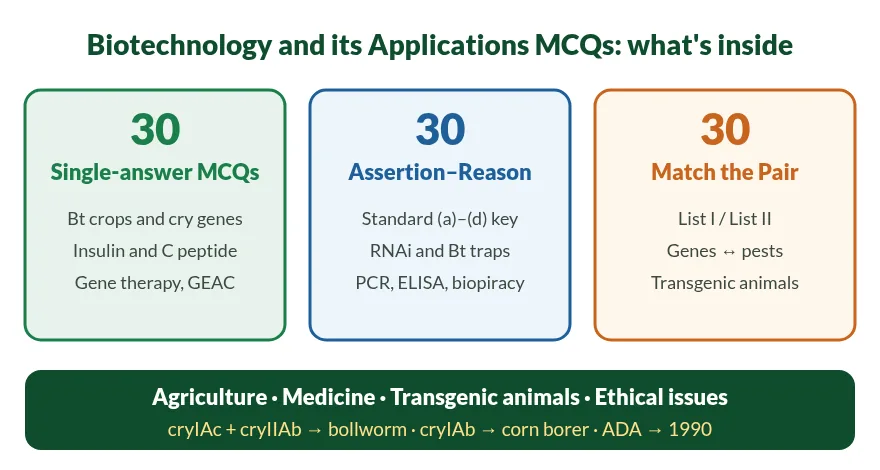
These 90 biotechnology and its applications MCQs cover the full NCERT Class 12 chapter: Bt crops and cry genes, RNAi against nematodes, genetically engineered insulin, ADA gene therapy, PCR and ELISA, transgenic animals and ethical issues such as GEAC and biopiracy. They are split into three sections: 30 single-answer MCQs, 30 assertion–reason questions and 30 match-the-pair questions in NEET style. Every question has a Show Answer button with a short explanation. Use these biotechnology and its applications MCQs after reading the notes, as a timed test, or for last-minute revision.
How to use this practice set
- Revise the Biotechnology and its Applications notes first, or keep them open in another tab.
- For the tools behind these applications, see the basic concept of biotechnology and plant tissue culture.
- Attempt each section of these biotechnology and its applications MCQs without peeking, then check your answers and read the explanations.
- The questions follow the NCERT Class 12 Biology chapter Biotechnology and its Applications; for gene therapy terms, see the NCBI MeSH entry on gene therapy.
Quick recap for these biotechnology and its applications MCQs: Bt toxin is an inactive protoxin activated by the alkaline insect gut; cryIAc and cryIIAb control cotton bollworms and cryIAb the corn borer. RNAi protects tobacco from Meloidogyne incognitia. Eli Lilly made human insulin in 1983, the first gene therapy (1990) treated ADA deficiency, over 95% of transgenic animals are mice, and GEAC regulates GM research in India.
Biotechnology and its applications MCQs: 30 single-answer questions
Start with these 30 single-answer biotechnology and its applications MCQs. They cover GM crops, Bt cotton, RNAi, insulin, gene therapy, molecular diagnosis, transgenic animals and ethical issues. Each of these biotechnology and its applications MCQs has one correct option.
Biotechnology and its applications MCQs 1–10: GM crops and Bt
The first ten biotechnology and its applications MCQs cover the Green Revolution, GM plant benefits, golden rice and Bt cry genes.
Q1. Which of the following factors contributed to the Green Revolution?
- (a) Use of improved crop varieties
- (b) Use of agrochemicals
- (c) Both (a) and (b)
- (d) Only (b)
Show Answer
Answer: (c) Both (a) and (b)
Yields rose partly from improved crop varieties but mainly from better management and agrochemicals (fertilisers and pesticides).
Q2. Which of the following are advantages of GM plants?
- (a) More tolerance to abiotic stresses (cold, drought, salt, heat)
- (b) Reduced post-harvest losses
- (c) Increased efficiency of mineral usage and enhanced nutritional value of food
- (d) All of the above
Show Answer
Answer: (d) All of the above
Genetic modification has given all these benefits, besides reducing reliance on chemical pesticides.
Q3. Golden rice is genetically modified rice that is enriched in:
- (a) Vitamin A
- (b) Vitamin B
- (c) Vitamin C
- (d) Vitamin D
Show Answer
Answer: (a) Vitamin A
Golden rice is Vitamin ‘A’ enriched rice, an example of enhanced nutritional value.
Q4. Agrobacterium tumefaciens causes crown gall in:
- (a) Dicot plants
- (b) Monocot plants
- (c) Both (a) and (b)
- (d) Gymnosperms only
Show Answer
Answer: (a) Dicot plants
Agrobacterium tumefaciens is a pathogen of several dicot plants; its Ti plasmid is used as a cloning vector.
Q5. Which of the following is true for Bacillus thuringiensis?
- (a) It is a soil bacterium that forms protein crystals containing an insecticidal protein
- (b) Its toxin kills lepidopterans (bollworms), coleopterans (beetles) and dipterans (flies)
- (c) Its toxin exists as an inactive protoxin that becomes active only in alkaline conditions
- (d) All of the above
Show Answer
Answer: (d) All of the above
Bt forms toxin crystals during a growth phase; the protoxin is activated by the alkaline pH of the insect gut.
Q6. Which cry genes are responsible for controlling cotton bollworms?
- (a) cryIAc and cryIIAb
- (b) cryIAc
- (c) cryIIAb
- (d) cryIAb
Show Answer
Answer: (a) cryIAc and cryIIAb
Proteins encoded by cryIAc and cryIIAb control cotton bollworms.
Q7. Which cry gene is responsible for controlling the corn borer?
- (a) cryIAc
- (b) cryIAb
- (c) cryIIAb
- (d) cryIAc and cryIIAb
Show Answer
Answer: (b) cryIAb
The protein encoded by cryIAb controls the corn borer.
Q8. Which of the following steps is NOT involved in the formation of a transgenic animal?
- (a) Transfer of the recombinant vector to the animal’s somatic cells
- (b) Isolation of the gene and transfer to a suitable vector
- (c) Transfer of the recombinant vector to the animal’s germ cells
- (d) Selection of the desirable gene
Show Answer
Answer: (a) Transfer of the recombinant vector to the animal’s somatic cells
The foreign gene must enter germ cells (or the early embryo) so that it is passed on; somatic-cell transfer does not make a transgenic animal.
Q9. Which of the following options for increasing food production can be harmful?
- (a) Agro-chemical based agriculture
- (b) Genetically engineered crop-based agriculture
- (c) Both (a) and (b)
- (d) Organic agriculture
Show Answer
Answer: (a) Agro-chemical based agriculture
Fertilisers and pesticides are expensive and harmful to the environment, which GM crops aim to reduce.
Q10. Bt protoxin swallowed by an insect is converted into an active toxin because of the:
- (a) Acidic pH of the gut
- (b) Alkaline pH of the gut
- (c) Neutral pH of the gut
- (d) None of the above
Show Answer
Answer: (b) Alkaline pH of the gut
The alkaline pH of the insect gut solubilises the crystals and activates the toxin.
Biotechnology and its applications MCQs 11–20: RNAi and insulin
In this block of biotechnology and its applications MCQs, focus on RNAi, recombinant therapeutics and the structure of insulin.
Q11. RNA interference (RNAi) is used to protect tobacco roots from nematodes. Which statement about RNAi is true?
- (a) RNAi takes place in all eukaryotic organisms as a method of cellular defence
- (b) RNAi silences a specific mRNA using a complementary dsRNA
- (c) Nematode-specific genes are introduced into the host plant using Agrobacterium vectors
- (d) All of the above
Show Answer
Answer: (d) All of the above
All three statements describe how RNAi protected tobacco from Meloidogyne incognitia.
Q12. About 30 recombinant therapeutics have been approved for human use worldwide. How many are presently marketed in India?
- (a) Thirty
- (b) Twelve
- (c) Twenty-five
- (d) Twenty
Show Answer
Answer: (b) Twelve
Of about 30 approved recombinant therapeutics, 12 are being marketed in India.
Q13. How many disulphide bonds are found in pro-insulin?
- (a) Three
- (b) Two
- (c) One
- (d) Four
Show Answer
Answer: (a) Three
Pro-insulin has three disulphide bonds: two between chains A and B and one within chain A.
Q14. How many disulphide bonds are present in mature insulin?
- (a) One
- (b) Three
- (c) Two
- (d) Four
Show Answer
Answer: (b) Three
Mature insulin keeps all three disulphide bonds; only the C peptide is removed.
Q15. How many different polypeptide chains make up pro-insulin?
- (a) 4
- (b) 3
- (c) 2
- (d) 5
Show Answer
Answer: (b) 3
Pro-insulin has chains A, B and the extra C peptide.
Q16. In active insulin, the extra stretch of polypeptide is removed. Which is it?
- (a) Polypeptide A
- (b) Polypeptide B
- (c) Polypeptide C (C peptide)
- (d) Polypeptide D
Show Answer
Answer: (c) Polypeptide C (C peptide)
The C peptide is not present in mature insulin; it is removed during maturation.
Q17. Which statement about the polypeptides of insulin is incorrect?
- (a) Polypeptide C is made up of 51 amino acids
- (b) Polypeptide B is made up of 30 amino acids
- (c) Mature insulin contains 51 amino acids
- (d) Polypeptide A is made up of 21 amino acids
Show Answer
Answer: (a) Polypeptide C is made up of 51 amino acids
Chain A (21) + chain B (30) = 51 amino acids in insulin; the C peptide is far shorter.
Q18. Which statement is true for the structure of pro-insulin?
- (a) Pro-insulin is made up of three polypeptides: A, B and C
- (b) Polypeptides A and B are linked by disulphide bridges
- (c) Polypeptide C connects polypeptide B to polypeptide A
- (d) All of the above
Show Answer
Answer: (d) All of the above
Pro-insulin is a pro-hormone with an extra C peptide that is removed during maturation.
Q19. Eli Lilly, an American company, prepared human insulin in 1983. Which rDNA step was used?
- (a) Two DNA sequences corresponding to chains A and B of human insulin were prepared
- (b) The two DNA sequences were introduced into plasmids of E. coli to produce insulin chains
- (c) Chains A and B were produced separately, extracted and combined by creating disulphide bonds
- (d) All of the above
Show Answer
Answer: (d) All of the above
These three steps together gave human insulin made in bacteria.
Q20. The first clinical gene therapy was given in 1990 to a 4-year-old girl with:
- (a) ADA deficiency
- (b) PKU
- (c) Sickle-cell anaemia
- (d) Thalassaemia
Show Answer
Answer: (a) ADA deficiency
She had adenosine deaminase (ADA) deficiency, an enzyme crucial for the immune system.
Biotechnology and its applications MCQs 21–30: gene therapy to ethics
The last single-answer biotechnology and its applications MCQs cover ADA gene therapy, diagnosis, transgenic animals, GEAC and rice.
Q21. Other than gene therapy, which methods are used to treat ADA deficiency?
- (a) Blood transfusion
- (b) Bone marrow transplantation
- (c) Enzyme replacement therapy
- (d) Both (b) and (c)
Show Answer
Answer: (d) Both (b) and (c)
Bone marrow transplantation and enzyme replacement therapy are used, but neither is completely curative.
Q22. Which gene therapy technique is used to treat ADA deficiency?
- (a) A functional ADA gene is introduced into the somatic cells of the baby
- (b) A functional ADA cDNA is introduced into cultured lymphocytes, which are returned to the patient
- (c) A functional ADA cDNA is introduced into cultured monocytes, which are returned to the patient
- (d) A functional ADA cDNA is introduced into cultured neutrophils, which are returned to the patient
Show Answer
Answer: (b) A functional ADA cDNA is introduced into cultured lymphocytes, which are returned to the patient
Lymphocytes are grown outside the body, given ADA cDNA through a retroviral vector and returned to the patient.
Q23. Which of the following techniques can be used for early detection of a disease?
- (a) Recombinant DNA technology
- (b) Polymerase Chain Reaction (PCR)
- (c) Enzyme Linked Immuno-sorbent Assay (ELISA)
- (d) All of the above
Show Answer
Answer: (d) All of the above
All three serve the purpose of early diagnosis, which serum and urine analysis cannot.
Q24. Among transgenic rats, rabbits, pigs, sheep, cows, fish and mice, which make up over 95% of all existing transgenic animals?
- (a) Rats
- (b) Pigs
- (c) Mice
- (d) Sheep
Show Answer
Answer: (c) Mice
Over 95 per cent of all existing transgenic animals are mice.
Q25. Transgenic models exist for which of the following human diseases?
- (a) Cancer and cystic fibrosis
- (b) Rheumatoid arthritis
- (c) Alzheimer’s disease
- (d) All of the above
Show Answer
Answer: (d) All of the above
Transgenic models exist for cancer, cystic fibrosis, rheumatoid arthritis and Alzheimer’s.
Q26. Human α-1-antitrypsin, produced by transgenic animals, is used to treat:
- (a) PKU
- (b) Emphysema
- (c) Cystic fibrosis
- (d) Sickle-cell anaemia
Show Answer
Answer: (b) Emphysema
α-1-antitrypsin treats emphysema; similar attempts are being made for PKU and cystic fibrosis.
Q27. In 1997, the first transgenic cow produced human protein-enriched milk (2.4 g per litre) containing human alpha-lactalbumin. What was the cow’s name?
- (a) Sony
- (b) Myria
- (c) Rosie
- (d) Jasmine
Show Answer
Answer: (c) Rosie
Rosie’s milk was nutritionally more balanced for human babies than natural cow milk.
Q28. GEAC stands for:
- (a) Genetic Engineering Address Committee
- (b) Genetic Engineering Authority Committee
- (c) Genetic Engineering Approval Committee
- (d) Genetic Engineering Action Council
Show Answer
Answer: (c) Genetic Engineering Approval Committee
GEAC is the Genetic Engineering Approval Committee set up by the Indian Government.
Q29. Which of the following is the function of GEAC?
- (a) It grants patents for products made by genetic engineering
- (b) It provides funds for genetic engineering research
- (c) It decides on the validity of GM research and the safety of introducing GM organisms for public services
- (d) It is a private organisation that checks GM research
Show Answer
Answer: (c) It decides on the validity of GM research and the safety of introducing GM organisms for public services
GEAC is a government body that decides on GM research validity and the safety of GM organisms.
Q30. How many varieties of rice are estimated to exist in India alone?
- (a) 100,000
- (b) 50,000
- (c) 200,000
- (d) 25,000
Show Answer
Answer: (c) 200,000
There are an estimated 200,000 varieties of rice in India; 27 documented Basmati varieties are grown here.
Assertion–Reason biotechnology and its applications MCQs (30)
These assertion–reason biotechnology and its applications MCQs follow the NEET pattern. Attempting biotechnology and its applications MCQs in this format trains you to judge two statements at once. Each question has an Assertion (A) and a Reason (R). Choose:
- (a) Both A and R are true and R is the correct explanation of A
- (b) Both A and R are true but R is not the correct explanation of A
- (c) A is true but R is false
- (d) A is false but R is true
Assertion–reason biotechnology and its applications MCQs 31–40
Check each statement on its own first; these biotechnology and its applications MCQs often have both statements true.
Q31.
Assertion (A): GM plants have reduced reliance on chemical pesticides.
Reason (R): Pest-resistant GM crops such as Bt cotton make their own insecticidal protein.
- (a) Both A and R are true and R is the correct explanation of A
- (b) Both A and R are true but R is not the correct explanation of A
- (c) A is true but R is false
- (d) A is false but R is true
Show Answer
Answer: (a) Both A and R are true and R is the correct explanation of A
Because the plant makes the toxin, less pesticide is sprayed.
Q32.
Assertion (A): Bt cotton is protected against cotton bollworms.
Reason (R): Proteins encoded by cryIAc and cryIIAb control cotton bollworms.
- (a) Both A and R are true and R is the correct explanation of A
- (b) Both A and R are true but R is not the correct explanation of A
- (c) A is true but R is false
- (d) A is false but R is true
Show Answer
Answer: (a) Both A and R are true and R is the correct explanation of A
These cry genes are expressed in Bt cotton.
Q33.
Assertion (A): Bt corn resists the corn borer.
Reason (R): The protein encoded by cryIAb controls the corn borer.
- (a) Both A and R are true and R is the correct explanation of A
- (b) Both A and R are true but R is not the correct explanation of A
- (c) A is true but R is false
- (d) A is false but R is true
Show Answer
Answer: (a) Both A and R are true and R is the correct explanation of A
Bt corn carries the cryIAb gene.
Q34.
Assertion (A): Bt toxin does not kill Bacillus thuringiensis itself.
Reason (R): In the bacterium, the toxin exists as an inactive protoxin.
- (a) Both A and R are true and R is the correct explanation of A
- (b) Both A and R are true but R is not the correct explanation of A
- (c) A is true but R is false
- (d) A is false but R is true
Show Answer
Answer: (a) Both A and R are true and R is the correct explanation of A
It becomes active only in the alkaline gut of the insect.
Q35.
Assertion (A): Meristem culture is used to obtain virus-free plants.
Reason (R): Apical and axillary meristems are free of virus even in an infected plant.
- (a) Both A and R are true and R is the correct explanation of A
- (b) Both A and R are true but R is not the correct explanation of A
- (c) A is true but R is false
- (d) A is false but R is true
Show Answer
Answer: (a) Both A and R are true and R is the correct explanation of A
Culturing the virus-free meristem gives healthy plants.
Q36.
Assertion (A): Plants produced by micropropagation are called somaclones.
Reason (R): They are genetically identical to the original plant.
- (a) Both A and R are true and R is the correct explanation of A
- (b) Both A and R are true but R is not the correct explanation of A
- (c) A is true but R is false
- (d) A is false but R is true
Show Answer
Answer: (a) Both A and R are true and R is the correct explanation of A
Somaclones are genetically identical copies.
Q37.
Assertion (A): Recombinant human insulin does not cause the allergies seen with animal insulin.
Reason (R): Recombinant therapeutics are identical to human proteins.
- (a) Both A and R are true and R is the correct explanation of A
- (b) Both A and R are true but R is not the correct explanation of A
- (c) A is true but R is false
- (d) A is false but R is true
Show Answer
Answer: (a) Both A and R are true and R is the correct explanation of A
Proteins from non-human sources trigger immune reactions; identical human proteins do not.
Q38.
Assertion (A): PCR can detect a pathogen before disease symptoms appear.
Reason (R): PCR amplifies very low amounts of the pathogen’s nucleic acid.
- (a) Both A and R are true and R is the correct explanation of A
- (b) Both A and R are true but R is not the correct explanation of A
- (c) A is true but R is false
- (d) A is false but R is true
Show Answer
Answer: (a) Both A and R are true and R is the correct explanation of A
Amplification makes even a very low pathogen concentration detectable.
Q39.
Assertion (A): Golden rice is enriched in vitamin A.
Reason (R): GM crops can be made tolerant to abiotic stresses such as drought.
- (a) Both A and R are true and R is the correct explanation of A
- (b) Both A and R are true but R is not the correct explanation of A
- (c) A is true but R is false
- (d) A is false but R is true
Show Answer
Answer: (b) Both A and R are true but R is not the correct explanation of A
Both are true, but stress tolerance does not explain vitamin A enrichment.
Q40.
Assertion (A): Transgenic mice are being used to test the safety of the polio vaccine.
Reason (R): Over 95 per cent of existing transgenic animals are mice.
- (a) Both A and R are true and R is the correct explanation of A
- (b) Both A and R are true but R is not the correct explanation of A
- (c) A is true but R is false
- (d) A is false but R is true
Show Answer
Answer: (b) Both A and R are true but R is not the correct explanation of A
Both are true, but the share of mice does not explain their use in vaccine testing.
Assertion–reason biotechnology and its applications MCQs 41–50
This set of biotechnology and its applications MCQs mixes true statements with false reasons on Bt, insulin and GEAC.
Q41.
Assertion (A): Pomato was not used commercially.
Reason (R): Pomato was produced by fusing protoplasts of tomato and potato.
- (a) Both A and R are true and R is the correct explanation of A
- (b) Both A and R are true but R is not the correct explanation of A
- (c) A is true but R is false
- (d) A is false but R is true
Show Answer
Answer: (b) Both A and R are true but R is not the correct explanation of A
Both are true; pomato failed because it lacked the desired combination of characters.
Q42.
Assertion (A): ELISA can detect an infection.
Reason (R): PCR is routinely used to detect HIV in suspected AIDS patients.
- (a) Both A and R are true and R is the correct explanation of A
- (b) Both A and R are true but R is not the correct explanation of A
- (c) A is true but R is false
- (d) A is false but R is true
Show Answer
Answer: (b) Both A and R are true but R is not the correct explanation of A
Both are true, but ELISA works by antigen–antibody interaction, not PCR.
Q43.
Assertion (A): Rosie’s milk was nutritionally more balanced for human babies than natural cow milk.
Reason (R): Rosie, the first transgenic cow, was produced in 1997.
- (a) Both A and R are true and R is the correct explanation of A
- (b) Both A and R are true but R is not the correct explanation of A
- (c) A is true but R is false
- (d) A is false but R is true
Show Answer
Answer: (b) Both A and R are true but R is not the correct explanation of A
Both are true; the milk was better because it contained human alpha-lactalbumin.
Q44.
Assertion (A): The diversity of rice in India is one of the richest in the world.
Reason (R): Basmati rice is distinct for its unique aroma and flavour.
- (a) Both A and R are true and R is the correct explanation of A
- (b) Both A and R are true but R is not the correct explanation of A
- (c) A is true but R is false
- (d) A is false but R is true
Show Answer
Answer: (b) Both A and R are true but R is not the correct explanation of A
Both are true, but Basmati’s aroma does not explain overall rice diversity (about 200,000 varieties).
Q45.
Assertion (A): The meaning of totipotency is the capacity to generate a whole plant from any cell or explant.
Reason (R): Tissue culture was developed after traditional breeding failed to keep pace with demand.
- (a) Both A and R are true and R is the correct explanation of A
- (b) Both A and R are true but R is not the correct explanation of A
- (c) A is true but R is false
- (d) A is false but R is true
Show Answer
Answer: (b) Both A and R are true but R is not the correct explanation of A
Both are true, but R explains why tissue culture developed, not what totipotency means.
Q46.
Assertion (A): The tissue culture medium must provide a carbon source.
Reason (R): Sucrose is never used as the carbon source in tissue culture media.
- (a) Both A and R are true and R is the correct explanation of A
- (b) Both A and R are true but R is not the correct explanation of A
- (c) A is true but R is false
- (d) A is false but R is true
Show Answer
Answer: (c) A is true but R is false
Sucrose is the usual carbon source, along with salts, vitamins, amino acids and growth regulators.
Q47.
Assertion (A): Activated Bt toxin kills the insect by lysing midgut cells.
Reason (R): Bt protoxin is activated by the acidic pH of the insect gut.
- (a) Both A and R are true and R is the correct explanation of A
- (b) Both A and R are true but R is not the correct explanation of A
- (c) A is true but R is false
- (d) A is false but R is true
Show Answer
Answer: (c) A is true but R is false
The protoxin is activated by alkaline pH.
Q48.
Assertion (A): In mammals, insulin is synthesised as a pro-hormone.
Reason (R): The C peptide is present in mature insulin.
- (a) Both A and R are true and R is the correct explanation of A
- (b) Both A and R are true but R is not the correct explanation of A
- (c) A is true but R is false
- (d) A is false but R is true
Show Answer
Answer: (c) A is true but R is false
The C peptide is removed during maturation.
Q49.
Assertion (A): ADA patients given engineered lymphocytes need periodic infusions.
Reason (R): Genetically engineered lymphocytes are immortal.
- (a) Both A and R are true and R is the correct explanation of A
- (b) Both A and R are true but R is not the correct explanation of A
- (c) A is true but R is false
- (d) A is false but R is true
Show Answer
Answer: (c) A is true but R is false
The cells are not immortal, which is why infusions are repeated.
Q50.
Assertion (A): GEAC was set up by the Indian Government.
Reason (R): GEAC grants patents for GM products.
- (a) Both A and R are true and R is the correct explanation of A
- (b) Both A and R are true but R is not the correct explanation of A
- (c) A is true but R is false
- (d) A is false but R is true
Show Answer
Answer: (c) A is true but R is false
GEAC decides on GM research validity and safety; it does not grant patents.
Assertion–reason biotechnology and its applications MCQs 51–60
These biotechnology and its applications MCQs end the section with false assertions on gene therapy, RNAi and biopiracy.
Q51.
Assertion (A): ELISA detects infection through antigens or antibodies.
Reason (R): ELISA is based on amplification of nucleic acids.
- (a) Both A and R are true and R is the correct explanation of A
- (b) Both A and R are true but R is not the correct explanation of A
- (c) A is true but R is false
- (d) A is false but R is true
Show Answer
Answer: (c) A is true but R is false
ELISA is based on antigen–antibody interaction; PCR amplifies nucleic acids.
Q52.
Assertion (A): In 1983, Eli Lilly produced human insulin using E. coli.
Reason (R): Chains A and B were produced together as one chain in E. coli.
- (a) Both A and R are true and R is the correct explanation of A
- (b) Both A and R are true but R is not the correct explanation of A
- (c) A is true but R is false
- (d) A is false but R is true
Show Answer
Answer: (c) A is true but R is false
Chains A and B were produced separately and then joined by disulphide bonds.
Q53.
Assertion (A): The first clinical gene therapy, in 1990, treated cystic fibrosis.
Reason (R): Adenosine deaminase is crucial for the immune system to function.
- (a) Both A and R are true and R is the correct explanation of A
- (b) Both A and R are true but R is not the correct explanation of A
- (c) A is true but R is false
- (d) A is false but R is true
Show Answer
Answer: (d) A is false but R is true
The 1990 gene therapy treated ADA deficiency; R is true.
Q54.
Assertion (A): The Green Revolution increased food supply enough to feed the growing population.
Reason (R): The Green Revolution tripled the food supply.
- (a) Both A and R are true and R is the correct explanation of A
- (b) Both A and R are true but R is not the correct explanation of A
- (c) A is true but R is false
- (d) A is false but R is true
Show Answer
Answer: (d) A is false but R is true
It tripled supply but was still not enough to feed the growing population.
Q55.
Assertion (A): Meloidogyne incognitia infects the leaves of tobacco plants.
Reason (R): RNAi silences a specific mRNA using a complementary dsRNA.
- (a) Both A and R are true and R is the correct explanation of A
- (b) Both A and R are true but R is not the correct explanation of A
- (c) A is true but R is false
- (d) A is false but R is true
Show Answer
Answer: (d) A is false but R is true
The nematode infects the roots of tobacco.
Q56.
Assertion (A): A clone with a mutated gene appears on the photographic film after probing.
Reason (R): A probe hybridises only with its complementary DNA.
- (a) Both A and R are true and R is the correct explanation of A
- (b) Both A and R are true but R is not the correct explanation of A
- (c) A is true but R is false
- (d) A is false but R is true
Show Answer
Answer: (d) A is false but R is true
The probe does not bind the mutated gene, so that clone does not appear on the film.
Q57.
Assertion (A): For chemical safety testing, transgenic animals are made less sensitive to toxic substances.
Reason (R): Toxicity testing in transgenic animals gives results in less time.
- (a) Both A and R are true and R is the correct explanation of A
- (b) Both A and R are true but R is not the correct explanation of A
- (c) A is true but R is false
- (d) A is false but R is true
Show Answer
Answer: (d) A is false but R is true
They are made more sensitive to toxic substances.
Q58.
Assertion (A): Biopiracy is the authorised use of bio-resources with compensatory payment.
Reason (R): Most industrialised nations are rich financially but poor in biodiversity.
- (a) Both A and R are true and R is the correct explanation of A
- (b) Both A and R are true but R is not the correct explanation of A
- (c) A is true but R is false
- (d) A is false but R is true
Show Answer
Answer: (d) A is false but R is true
Biopiracy is use without proper authorisation or compensatory payment.
Q59.
Assertion (A): The 1997 patent on Basmati rice was granted by the Indian Patent Office.
Reason (R): The ‘new’ Basmati was derived from Indian farmers’ varieties crossed with semi-dwarf varieties.
- (a) Both A and R are true and R is the correct explanation of A
- (b) Both A and R are true but R is not the correct explanation of A
- (c) A is true but R is false
- (d) A is false but R is true
Show Answer
Answer: (d) A is false but R is true
The patent was granted through the US Patent and Trademark Office.
Q60.
Assertion (A): Bt toxins are effective against all insect groups.
Reason (R): The choice of cry gene depends on the crop and the targeted pest.
- (a) Both A and R are true and R is the correct explanation of A
- (b) Both A and R are true but R is not the correct explanation of A
- (c) A is true but R is false
- (d) A is false but R is true
Show Answer
Answer: (d) A is false but R is true
Most Bt toxins are insect-group specific.
Match the pair biotechnology and its applications MCQs (30)
The last 30 biotechnology and its applications MCQs are match-the-pair questions. Match List I with List II and choose the correct code. These biotechnology and its applications MCQs reward knowing each example, gene and number from the chapter.
Match the pair biotechnology and its applications MCQs 61–70
Organisms, genes, techniques and numbers are paired in these biotechnology and its applications MCQs.
Q61. Match the organism with its role in the chapter:
| List I | List II |
|---|---|
| P. Bacillus thuringiensis | 1. Vector for nematode-specific genes |
| Q. Meloidogyne incognitia | 2. Infects roots of tobacco |
| R. Agrobacterium | 3. Plasmids used to make insulin chains |
| S. E. coli | 4. Source of Bt toxin |
- (a) P-4, Q-1, R-2, S-3
- (b) P-4, Q-2, R-1, S-3
- (c) P-3, Q-4, R-1, S-2
- (d) P-2, Q-4, R-1, S-3
Show Answer
Answer: (b) P-4, Q-2, R-1, S-3
Bacillus thuringiensis → Source of Bt toxin; Meloidogyne incognitia → Infects roots of tobacco; Agrobacterium → Vector for nematode-specific genes; E. coli → Plasmids used to make insulin chains.
Q62. Match the gene with what it is used for:
| List I | List II |
|---|---|
| P. cryIAb | 1. Control cotton bollworms |
| Q. cryIAc and cryIIAb | 2. Treatment of emphysema |
| R. ADA cDNA | 3. Controls corn borer |
| S. α-1-antitrypsin gene | 4. Gene therapy of ADA deficiency |
- (a) P-1, Q-3, R-2, S-4
- (b) P-4, Q-3, R-1, S-2
- (c) P-3, Q-1, R-4, S-2
- (d) P-3, Q-1, R-2, S-4
Show Answer
Answer: (c) P-3, Q-1, R-4, S-2
cryIAb → Controls corn borer; cryIAc and cryIIAb → Control cotton bollworms; ADA cDNA → Gene therapy of ADA deficiency; α-1-antitrypsin gene → Treatment of emphysema.
Q63. Match the pest group with its example:
| List I | List II |
|---|---|
| P. Lepidopterans | 1. Tobacco budworm, armyworm |
| Q. Coleopterans | 2. Beetles |
| R. Dipterans | 3. Meloidogyne incognitia |
| S. Nematodes | 4. Flies, mosquitoes |
- (a) P-2, Q-4, R-3, S-1
- (b) P-1, Q-4, R-2, S-3
- (c) P-3, Q-1, R-2, S-4
- (d) P-1, Q-2, R-4, S-3
Show Answer
Answer: (d) P-1, Q-2, R-4, S-3
Lepidopterans → Tobacco budworm, armyworm; Coleopterans → Beetles; Dipterans → Flies, mosquitoes; Nematodes → Meloidogyne incognitia.
Q64. Match the technique with its principle:
| List I | List II |
|---|---|
| P. PCR | 1. Silencing of mRNA by dsRNA |
| Q. ELISA | 2. Hybridisation detected by autoradiography |
| R. RNAi | 3. Amplification of nucleic acid |
| S. Radioactive probe | 4. Antigen–antibody interaction |
- (a) P-3, Q-4, R-1, S-2
- (b) P-3, Q-2, R-1, S-4
- (c) P-3, Q-2, R-4, S-1
- (d) P-4, Q-2, R-1, S-3
Show Answer
Answer: (a) P-3, Q-4, R-1, S-2
PCR → Amplification of nucleic acid; ELISA → Antigen–antibody interaction; RNAi → Silencing of mRNA by dsRNA; Radioactive probe → Hybridisation detected by autoradiography.
Q65. Match the year with the event:
| List I | List II |
|---|---|
| P. 1990 | 1. Rosie, the first transgenic cow |
| Q. 1983 | 2. First clinical gene therapy |
| R. 1997 | 3. Whole plants regenerated from explants |
| S. 1950s | 4. Eli Lilly prepares human insulin |
- (a) P-1, Q-4, R-2, S-3
- (b) P-2, Q-4, R-1, S-3
- (c) P-3, Q-4, R-1, S-2
- (d) P-2, Q-1, R-3, S-4
Show Answer
Answer: (b) P-2, Q-4, R-1, S-3
1990 → First clinical gene therapy; 1983 → Eli Lilly prepares human insulin; 1997 → Rosie, the first transgenic cow; 1950s → Whole plants regenerated from explants.
Q66. Match the tissue culture term with its meaning:
| List I | List II |
|---|---|
| P. Totipotency | 1. Producing thousands of plants through tissue culture |
| Q. Micropropagation | 2. Plant part grown in a test tube |
| R. Somaclones | 3. Plants genetically identical to the original |
| S. Explant | 4. Capacity to generate a whole plant from any cell |
- (a) P-4, Q-2, R-1, S-3
- (b) P-4, Q-1, R-2, S-3
- (c) P-4, Q-1, R-3, S-2
- (d) P-3, Q-4, R-1, S-2
Show Answer
Answer: (c) P-4, Q-1, R-3, S-2
Totipotency → Capacity to generate a whole plant from any cell; Micropropagation → Producing thousands of plants through tissue culture; Somaclones → Plants genetically identical to the original; Explant → Plant part grown in a test tube.
Q67. Match the term with its description:
| List I | List II |
|---|---|
| P. Somatic hybrid | 1. Virus-free plants |
| Q. Pomato | 2. Plant grown from fused protoplasts |
| R. Protoplast | 3. Naked cell surrounded by a plasma membrane |
| S. Meristem culture | 4. Tomato–potato somatic hybrid |
- (a) P-3, Q-2, R-4, S-1
- (b) P-3, Q-1, R-4, S-2
- (c) P-1, Q-4, R-2, S-3
- (d) P-2, Q-4, R-3, S-1
Show Answer
Answer: (d) P-2, Q-4, R-3, S-1
Somatic hybrid → Plant grown from fused protoplasts; Pomato → Tomato–potato somatic hybrid; Protoplast → Naked cell surrounded by a plasma membrane; Meristem culture → Virus-free plants.
Q68. Match the disease or problem with its biotechnological answer:
| List I | List II |
|---|---|
| P. Emphysema | 1. Transgenic mice |
| Q. Diabetes | 2. α-1-antitrypsin |
| R. ADA deficiency | 3. Gene therapy with lymphocytes |
| S. Polio vaccine safety | 4. Recombinant insulin |
- (a) P-2, Q-4, R-3, S-1
- (b) P-4, Q-2, R-1, S-3
- (c) P-2, Q-1, R-4, S-3
- (d) P-1, Q-3, R-2, S-4
Show Answer
Answer: (a) P-2, Q-4, R-3, S-1
Emphysema → α-1-antitrypsin; Diabetes → Recombinant insulin; ADA deficiency → Gene therapy with lymphocytes; Polio vaccine safety → Transgenic mice.
Q69. Match the number with the fact:
| List I | List II |
|---|---|
| P. 30 | 1. Human protein in Rosie’s milk |
| Q. 12 | 2. Share of transgenic animals that are mice |
| R. 95% | 3. Recombinant therapeutics approved worldwide |
| S. 2.4 g per litre | 4. Recombinant therapeutics marketed in India |
- (a) P-1, Q-4, R-3, S-2
- (b) P-3, Q-4, R-2, S-1
- (c) P-4, Q-1, R-2, S-3
- (d) P-1, Q-2, R-4, S-3
Show Answer
Answer: (b) P-3, Q-4, R-2, S-1
30 → Recombinant therapeutics approved worldwide; 12 → Recombinant therapeutics marketed in India; 95% → Share of transgenic animals that are mice; 2.4 g per litre → Human protein in Rosie’s milk.
Q70. Match the number with the fact:
| List I | List II |
|---|---|
| P. 200,000 | 1. Documented Basmati varieties grown in India |
| Q. 27 | 2. Estimated rice varieties in India |
| R. 4 years | 3. Age of the first gene therapy patient |
| S. 3 | 4. Disulphide bonds in insulin |
- (a) P-3, Q-1, R-2, S-4
- (b) P-1, Q-4, R-3, S-2
- (c) P-2, Q-1, R-3, S-4
- (d) P-1, Q-4, R-2, S-3
Show Answer
Answer: (c) P-2, Q-1, R-3, S-4
200,000 → Estimated rice varieties in India; 27 → Documented Basmati varieties grown in India; 4 years → Age of the first gene therapy patient; 3 → Disulphide bonds in insulin.
Match the pair biotechnology and its applications MCQs 71–80
GM benefits, insulin, transgenic animals and diagnosis drive these biotechnology and its applications MCQs.
Q71. Match the term with its meaning:
| List I | List II |
|---|---|
| P. GEAC | 1. Use of bio-resources without authorisation or compensation |
| Q. Biopiracy | 2. Considers patent terms, emergency provisions and R&D |
| R. Patent extends to functional equivalents | 3. Others selling Basmati could be restricted |
| S. Second amendment of the Indian Patents Bill | 4. Decides validity of GM research and GM safety |
- (a) P-1, Q-2, R-4, S-3
- (b) P-2, Q-3, R-4, S-1
- (c) P-2, Q-4, R-1, S-3
- (d) P-4, Q-1, R-3, S-2
Show Answer
Answer: (d) P-4, Q-1, R-3, S-2
GEAC → Decides validity of GM research and GM safety; Biopiracy → Use of bio-resources without authorisation or compensation; Patent extends to functional equivalents → Others selling Basmati could be restricted; Second amendment of the Indian Patents Bill → Considers patent terms, emergency provisions and R&D.
Q72. Match the product with the related fact:
| List I | List II |
|---|---|
| P. Turmeric and neem | 1. US patent granted in 1997 |
| Q. Basmati rice | 2. Pest resistance from cry genes |
| R. Golden rice | 3. Patent attempts on traditional herbal medicine |
| S. Bt cotton | 4. Vitamin A enriched |
- (a) P-3, Q-1, R-4, S-2
- (b) P-2, Q-1, R-3, S-4
- (c) P-3, Q-4, R-2, S-1
- (d) P-2, Q-4, R-3, S-1
Show Answer
Answer: (a) P-3, Q-1, R-4, S-2
Turmeric and neem → Patent attempts on traditional herbal medicine; Basmati rice → US patent granted in 1997; Golden rice → Vitamin A enriched; Bt cotton → Pest resistance from cry genes.
Q73. Match the GM benefit with its description:
| List I | List II |
|---|---|
| P. Abiotic stress tolerance | 1. Prevents early exhaustion of soil fertility |
| Q. Enhanced nutritional value | 2. Pest-resistant crops |
| R. Reduced pesticide use | 3. Golden rice |
| S. Efficient mineral usage | 4. Cold, drought, salt and heat |
- (a) P-1, Q-3, R-4, S-2
- (b) P-4, Q-3, R-2, S-1
- (c) P-3, Q-1, R-4, S-2
- (d) P-4, Q-2, R-1, S-3
Show Answer
Answer: (b) P-4, Q-3, R-2, S-1
Abiotic stress tolerance → Cold, drought, salt and heat; Enhanced nutritional value → Golden rice; Reduced pesticide use → Pest-resistant crops; Efficient mineral usage → Prevents early exhaustion of soil fertility.
Q74. Match the insulin term with its description:
| List I | List II |
|---|---|
| P. Chains A and B | 1. Pro-hormone form of insulin |
| Q. C peptide | 2. Removed during maturation |
| R. Pro-insulin | 3. Pancreas of slaughtered cattle and pigs |
| S. Earlier source of insulin | 4. Linked by disulphide bridges |
- (a) P-4, Q-1, R-3, S-2
- (b) P-1, Q-3, R-4, S-2
- (c) P-4, Q-2, R-1, S-3
- (d) P-4, Q-3, R-1, S-2
Show Answer
Answer: (c) P-4, Q-2, R-1, S-3
Chains A and B → Linked by disulphide bridges; C peptide → Removed during maturation; Pro-insulin → Pro-hormone form of insulin; Earlier source of insulin → Pancreas of slaughtered cattle and pigs.
Q75. Match the purpose of transgenic animals with its example:
| List I | List II |
|---|---|
| P. Normal physiology and development | 1. Insulin-like growth factor |
| Q. Study of disease | 2. Polio vaccine testing |
| R. Biological products | 3. α-1-antitrypsin |
| S. Vaccine safety | 4. Models for cancer and cystic fibrosis |
- (a) P-4, Q-3, R-1, S-2
- (b) P-4, Q-3, R-2, S-1
- (c) P-2, Q-1, R-4, S-3
- (d) P-1, Q-4, R-3, S-2
Show Answer
Answer: (d) P-1, Q-4, R-3, S-2
Normal physiology and development → Insulin-like growth factor; Study of disease → Models for cancer and cystic fibrosis; Biological products → α-1-antitrypsin; Vaccine safety → Polio vaccine testing.
Q76. Match the diagnostic method with its use:
| List I | List II |
|---|---|
| P. PCR | 1. Conventional; no early detection |
| Q. ELISA | 2. Detects HIV in suspected AIDS patients |
| R. Probe and autoradiography | 3. Finds a clone with a mutated gene |
| S. Serum and urine analysis | 4. Detects antigens or antibodies of a pathogen |
- (a) P-2, Q-4, R-3, S-1
- (b) P-2, Q-1, R-4, S-3
- (c) P-1, Q-3, R-2, S-4
- (d) P-4, Q-3, R-1, S-2
Show Answer
Answer: (a) P-2, Q-4, R-3, S-1
PCR → Detects HIV in suspected AIDS patients; ELISA → Detects antigens or antibodies of a pathogen; Probe and autoradiography → Finds a clone with a mutated gene; Serum and urine analysis → Conventional; no early detection.
Q77. Match the ADA deficiency treatment with its feature:
| List I | List II |
|---|---|
| P. Bone marrow transplantation | 1. Carries ADA cDNA into lymphocytes |
| Q. Enzyme replacement therapy | 2. Cures some children |
| R. Retroviral vector | 3. Could be a permanent cure |
| S. Gene put into early embryonic cells | 4. Functional ADA given by injection |
- (a) P-2, Q-3, R-4, S-1
- (b) P-2, Q-4, R-1, S-3
- (c) P-4, Q-3, R-1, S-2
- (d) P-1, Q-3, R-2, S-4
Show Answer
Answer: (b) P-2, Q-4, R-1, S-3
Bone marrow transplantation → Cures some children; Enzyme replacement therapy → Functional ADA given by injection; Retroviral vector → Carries ADA cDNA into lymphocytes; Gene put into early embryonic cells → Could be a permanent cure.
Q78. Match the step of Bt toxin action with its description:
| List I | List II |
|---|---|
| P. Protein crystals | 1. Formed in a particular growth phase |
| Q. Protoxin | 2. Solubilises the crystals |
| R. Alkaline gut pH | 3. Inactive form inside the bacterium |
| S. Midgut epithelial cells | 4. Pores, swelling and lysis |
- (a) P-4, Q-3, R-1, S-2
- (b) P-4, Q-2, R-3, S-1
- (c) P-1, Q-3, R-2, S-4
- (d) P-4, Q-2, R-1, S-3
Show Answer
Answer: (c) P-1, Q-3, R-2, S-4
Protein crystals → Formed in a particular growth phase; Protoxin → Inactive form inside the bacterium; Alkaline gut pH → Solubilises the crystals; Midgut epithelial cells → Pores, swelling and lysis.
Q79. Match the RNAi term with its description:
| List I | List II |
|---|---|
| P. dsRNA | 1. Complementary pair made in the host |
| Q. Sense and anti-sense RNA | 2. Initiates RNAi |
| R. Transposons | 3. Mobile elements that replicate via RNA |
| S. Agrobacterium vector | 4. Introduces nematode-specific genes |
- (a) P-4, Q-2, R-1, S-3
- (b) P-3, Q-2, R-4, S-1
- (c) P-4, Q-3, R-2, S-1
- (d) P-2, Q-1, R-3, S-4
Show Answer
Answer: (d) P-2, Q-1, R-3, S-4
dsRNA → Initiates RNAi; Sense and anti-sense RNA → Complementary pair made in the host; Transposons → Mobile elements that replicate via RNA; Agrobacterium vector → Introduces nematode-specific genes.
Q80. Match the critical research area of biotechnology with its meaning:
| List I | List II |
|---|---|
| P. Best catalyst | 1. Purifying the protein or organic compound |
| Q. Optimal conditions | 2. Organism with genes altered by manipulation |
| R. Downstream processing | 3. Improved organism or pure enzyme |
| S. GMO | 4. Engineering for the catalyst to act |
- (a) P-3, Q-4, R-1, S-2
- (b) P-3, Q-1, R-4, S-2
- (c) P-3, Q-2, R-4, S-1
- (d) P-1, Q-3, R-2, S-4
Show Answer
Answer: (a) P-3, Q-4, R-1, S-2
Best catalyst → Improved organism or pure enzyme; Optimal conditions → Engineering for the catalyst to act; Downstream processing → Purifying the protein or organic compound; GMO → Organism with genes altered by manipulation.
Match the pair biotechnology and its applications MCQs 81–90
The final biotechnology and its applications MCQs pair products, bodies, exercises and ethical issues.
Q81. Match the biological product with its use:
| List I | List II |
|---|---|
| P. α-1-antitrypsin | 1. Enzyme replacement therapy |
| Q. Human insulin | 2. Balanced milk for human babies |
| R. Human alpha-lactalbumin | 3. Diabetes |
| S. Functional ADA enzyme | 4. Emphysema |
- (a) P-1, Q-4, R-3, S-2
- (b) P-4, Q-3, R-2, S-1
- (c) P-3, Q-4, R-1, S-2
- (d) P-4, Q-3, R-1, S-2
Show Answer
Answer: (b) P-4, Q-3, R-2, S-1
α-1-antitrypsin → Emphysema; Human insulin → Diabetes; Human alpha-lactalbumin → Balanced milk for human babies; Functional ADA enzyme → Enzyme replacement therapy.
Q82. Match the body with its action:
| List I | List II |
|---|---|
| P. Eli Lilly | 1. Set up GEAC |
| Q. An American company | 2. Cleared the second amendment of the Patents Bill |
| R. Indian Government | 3. Got Basmati patent rights in 1997 |
| S. Indian Parliament | 4. Prepared human insulin in 1983 |
- (a) P-1, Q-2, R-3, S-4
- (b) P-4, Q-1, R-3, S-2
- (c) P-4, Q-3, R-1, S-2
- (d) P-3, Q-2, R-4, S-1
Show Answer
Answer: (c) P-4, Q-3, R-1, S-2
Eli Lilly → Prepared human insulin in 1983; An American company → Got Basmati patent rights in 1997; Indian Government → Set up GEAC; Indian Parliament → Cleared the second amendment of the Patents Bill.
Q83. Match the organism with what it is:
| List I | List II |
|---|---|
| P. Rosie | 1. Transgenic cow |
| Q. Pomato | 2. Bt toxin-producing crop |
| R. Golden rice | 3. Vitamin A enriched GM rice |
| S. Bt cotton | 4. Somatic hybrid |
- (a) P-1, Q-3, R-2, S-4
- (b) P-2, Q-4, R-3, S-1
- (c) P-4, Q-3, R-2, S-1
- (d) P-1, Q-4, R-3, S-2
Show Answer
Answer: (d) P-1, Q-4, R-3, S-2
Rosie → Transgenic cow; Pomato → Somatic hybrid; Golden rice → Vitamin A enriched GM rice; Bt cotton → Bt toxin-producing crop.
Q84. Match the term with its definition:
| List I | List II |
|---|---|
| P. GMO | 1. Do not induce unwanted immune responses |
| Q. Transgenic animal | 2. Organism whose genes are altered by manipulation |
| R. Gene therapy | 3. Delivering a normal gene to correct a defect |
| S. Recombinant therapeutics | 4. Animal expressing an extra (foreign) gene |
- (a) P-2, Q-4, R-3, S-1
- (b) P-1, Q-4, R-2, S-3
- (c) P-2, Q-3, R-1, S-4
- (d) P-3, Q-4, R-1, S-2
Show Answer
Answer: (a) P-2, Q-4, R-3, S-1
GMO → Organism whose genes are altered by manipulation; Transgenic animal → Animal expressing an extra (foreign) gene; Gene therapy → Delivering a normal gene to correct a defect; Recombinant therapeutics → Do not induce unwanted immune responses.
Q85. Match the chapter section with its example:
| List I | List II |
|---|---|
| P. Agriculture | 1. Rosie |
| Q. Medicine | 2. Genetically engineered insulin |
| R. Transgenic animals | 3. Bt cotton |
| S. Ethical issues | 4. GEAC |
- (a) P-1, Q-4, R-2, S-3
- (b) P-3, Q-2, R-1, S-4
- (c) P-4, Q-3, R-2, S-1
- (d) P-2, Q-4, R-3, S-1
Show Answer
Answer: (b) P-3, Q-2, R-1, S-4
Agriculture → Bt cotton; Medicine → Genetically engineered insulin; Transgenic animals → Rosie; Ethical issues → GEAC.
Q86. Match the NCERT exercise question with its answer:
| List I | List II |
|---|---|
| P. Plant part for virus-free plants | 1. Meristem |
| Q. Major advantage of micropropagation | 2. Bacillus thuringiensis |
| R. Why Bt crystals spare the bacterium | 3. Many identical plants in a short time |
| S. Organism that produces Cry proteins | 4. Toxin is inactive |
- (a) P-4, Q-3, R-1, S-2
- (b) P-1, Q-3, R-2, S-4
- (c) P-1, Q-3, R-4, S-2
- (d) P-4, Q-1, R-3, S-2
Show Answer
Answer: (c) P-1, Q-3, R-4, S-2
Plant part for virus-free plants → Meristem; Major advantage of micropropagation → Many identical plants in a short time; Why Bt crystals spare the bacterium → Toxin is inactive; Organism that produces Cry proteins → Bacillus thuringiensis.
Q87. Match the insulin feature with its number:
| List I | List II |
|---|---|
| P. Polypeptide chains in mature insulin | 1. 3 |
| Q. Disulphide bonds in insulin | 2. 30 |
| R. Amino acids in chain A | 3. 21 |
| S. Amino acids in chain B | 4. 2 |
- (a) P-3, Q-1, R-4, S-2
- (b) P-2, Q-4, R-1, S-3
- (c) P-4, Q-2, R-1, S-3
- (d) P-4, Q-1, R-3, S-2
Show Answer
Answer: (d) P-4, Q-1, R-3, S-2
Polypeptide chains in mature insulin → 2; Disulphide bonds in insulin → 3; Amino acids in chain A → 21; Amino acids in chain B → 30.
Q88. Match the problem with its biotechnological solution:
| List I | List II |
|---|---|
| P. Nematodes in tobacco roots | 1. Bt cotton |
| Q. Bollworms in cotton | 2. RNA interference |
| R. Vitamin A deficiency | 3. Golden rice |
| S. Virus-infected plant | 4. Meristem culture |
- (a) P-2, Q-1, R-3, S-4
- (b) P-1, Q-4, R-2, S-3
- (c) P-4, Q-3, R-2, S-1
- (d) P-4, Q-1, R-2, S-3
Show Answer
Answer: (a) P-2, Q-1, R-3, S-4
Nematodes in tobacco roots → RNA interference; Bollworms in cotton → Bt cotton; Vitamin A deficiency → Golden rice; Virus-infected plant → Meristem culture.
Q89. Match the condition with its feature:
| List I | List II |
|---|---|
| P. ADA deficiency | 1. Managed by insulin at regular intervals |
| Q. Adult-onset diabetes | 2. Deletion of the ADA gene |
| R. Crown gall | 3. Caused by Agrobacterium tumefaciens |
| S. Nematode infestation of tobacco | 4. Great reduction in yield |
- (a) P-1, Q-3, R-2, S-4
- (b) P-2, Q-1, R-3, S-4
- (c) P-1, Q-2, R-3, S-4
- (d) P-2, Q-4, R-3, S-1
Show Answer
Answer: (b) P-2, Q-1, R-3, S-4
ADA deficiency → Deletion of the ADA gene; Adult-onset diabetes → Managed by insulin at regular intervals; Crown gall → Caused by Agrobacterium tumefaciens; Nematode infestation of tobacco → Great reduction in yield.
Q90. Match the statement with its meaning in the ethics debate:
| List I | List II |
|---|---|
| P. Industrialised nations | 1. Saves time, effort and expenditure in commercialisation |
| Q. Developing world | 2. Rich financially, poor in biodiversity |
| R. Traditional knowledge | 3. Rich in biodiversity and traditional knowledge |
| S. Laws on bio-resources | 4. Prevent unauthorised exploitation |
- (a) P-3, Q-1, R-4, S-2
- (b) P-1, Q-3, R-2, S-4
- (c) P-2, Q-3, R-1, S-4
- (d) P-4, Q-3, R-2, S-1
Show Answer
Answer: (c) P-2, Q-3, R-1, S-4
Industrialised nations → Rich financially, poor in biodiversity; Developing world → Rich in biodiversity and traditional knowledge; Traditional knowledge → Saves time, effort and expenditure in commercialisation; Laws on bio-resources → Prevent unauthorised exploitation.
Common doubts
These are the doubts students most often have when practising biotechnology and its applications MCQs.
How many questions come from Biotechnology and its Applications in NEET?
Usually 2–3. Bt cotton and cry genes, RNAi, insulin, ADA gene therapy and GEAC are the most common, and these biotechnology and its applications MCQs cover all of them.
Which cry genes are asked most often?
cryIAc and cryIIAb control cotton bollworms, and cryIAb controls the corn borer. Many biotechnology and its applications MCQs test exactly this pairing.
Why is Bt toxin harmless to the bacterium that makes it?
The toxin is stored as an inactive protoxin. It becomes active only in the alkaline gut of the insect, where it lyses midgut cells. Expect this in biotechnology and its applications MCQs as an assertion–reason item.
How do I solve assertion–reason questions quickly?
Check whether A and R are each true on their own. Only if both are true, ask whether R explains A: if yes choose (a), if not choose (b). This works for every assertion–reason item in these biotechnology and its applications MCQs.
Should I read the notes before attempting these biotechnology and its applications MCQs?
Yes. Read the Biotechnology and its Applications notes once, attempt all 90 questions without looking at the answers, then revise the topics you got wrong.
Finished these biotechnology and its applications MCQs? Revise the full chapter in our Biotechnology and its Applications notes. Come back to these biotechnology and its applications MCQs a week later to check what you have retained.