
Phylum Arthropoda includes insects, spiders, scorpions, centipedes, millipedes, prawns and crabs. Its defining combination is a segmented body, jointed appendages and a chitinous exoskeleton. These NEET notes explain NCERT Class 11 Biology: Animal Kingdom section 4.2.7, connect the body plan to familiar animals, and provide original diagrams plus 90 practice questions with explained answers.
Quick revision
- Largest phylum of Animalia; includes insects.
- Bilateral, triploblastic, segmented, coelomate; organ-system organisation.
- Chitinous exoskeleton and jointed appendages; open circulation.
- Respiration by gills, book gills, book lungs or tracheae.
- Antennae, simple and compound eyes, and statocysts are sensory structures.
- Mostly dioecious, usually internal fertilisation, mostly oviparous; development direct or indirect.
What is Arthropoda in biology?
Arthropoda is a phylum, not a class or a synonym for insects. Insecta is only one class within it. A spider is therefore an arthropod without being an insect, and a crab is an arthropod without being a spider. The Greek roots arthros (joint) and poda (appendages or feet) point to the articulated appendages that give the phylum its name.
NCERT calls it the largest phylum of Animalia and states that over two-thirds of all named species on earth are arthropods. The second largest is Phylum Mollusca. Treat this as the textbook statement for revision rather than a live census or an estimate of unnamed species. Their distribution is cosmopolitan: marine, freshwater and terrestrial representatives occur, and some are parasites. No single species occupies every habitat.
How to say Arthropoda: pronunciation and meaning
For “how to say Arthropoda” and “Arthropoda how to pronounce”, use one pronunciation guide rather than two different definitions. Collins gives the American pronunciation /ɑːrˈθrɑpədə/, approximately ar-THROP-uh-duh, with stress on THROP. The th is the sound in thin. Pronunciation varies across dictionaries and accents; the biological meaning remains jointed appendages.
Jointed appendages and a chitinous exoskeleton
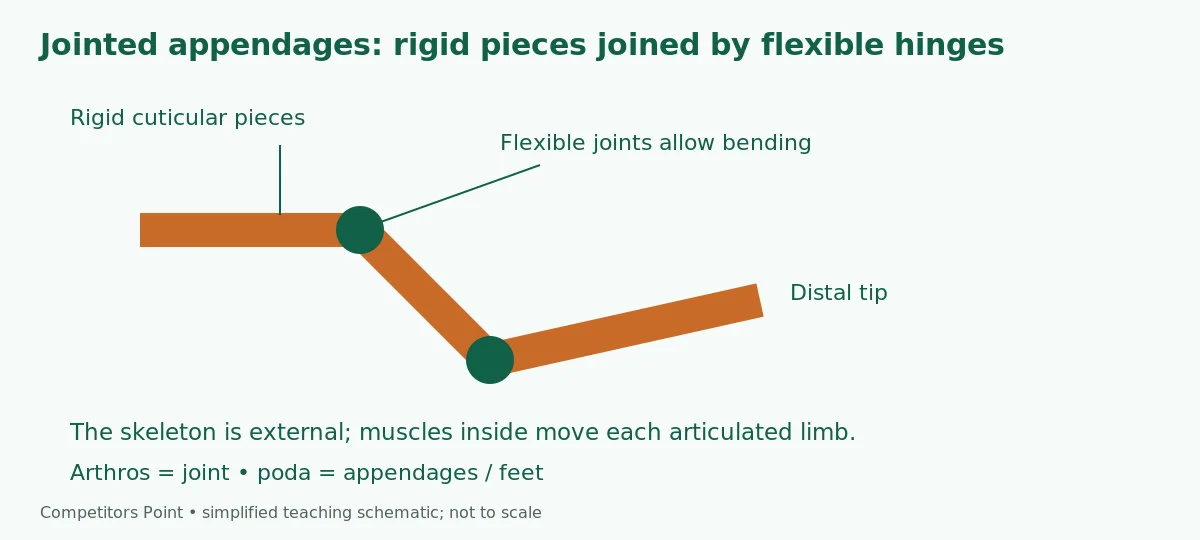
Think of a limb as several rigid pieces connected by flexible hinges. Muscles pull against the internal surfaces of the external skeleton, allowing different sections of a limb to bend. Appendages are not limited to walking legs: antennae, mouthparts and swimming limbs are modifications of the same broad appendage plan. Articulation supports controlled movement, feeding and sensory exploration; it does not mean every arthropod runs faster than every annelid.
The familiar comparison with a human elbow helps explain the word jointed, but the skeletons are different. Humans move an internal bony skeleton; arthropods move a limb enclosed by cuticle. The arthropod covering is a chitin-containing cuticular exoskeleton, often reinforced in crustaceans. Chitin is a polysaccharide, not a protein. The outer covering protects the animal, provides muscle attachment and can reduce water loss on land.
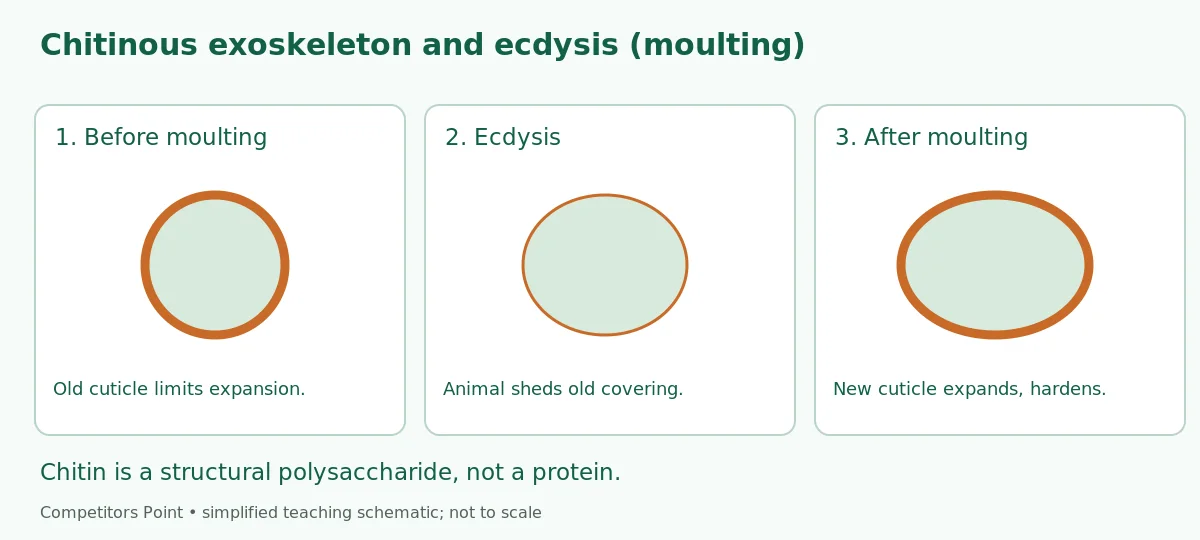
The exoskeleton also creates a growth problem: rigid cuticle cannot stretch continuously. During ecdysis, the old covering is shed; a new cuticle expands and hardens. The newly emerged animal is vulnerable until the covering becomes protective. Endocrine signals coordinate moulting and development. Jointed limbs, segment specialisation, diverse feeding structures and reproductive strategies help explain the group’s success without treating evolution as a ladder toward a single “most advanced” animal.
Phylum Arthropoda: body organisation and tagmata
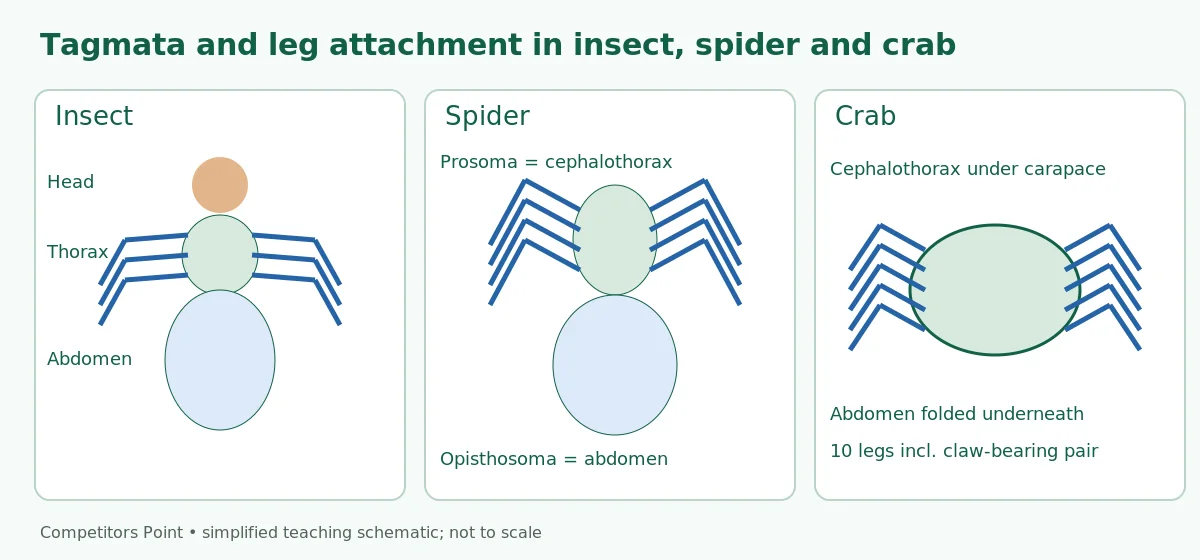
Arthropods have organ-system organisation, bilateral symmetry and three embryonic germ layers. Their bodies are segmented, but adjacent segments often cooperate or fuse into specialised regions called tagmata. NCERT gives head, thorax and abdomen as the body plan; this is especially clear in insects. In many arachnids and crustaceans, a cephalothorax and abdomen are more useful visible regions. Centipedes and millipedes have a head and long trunk.
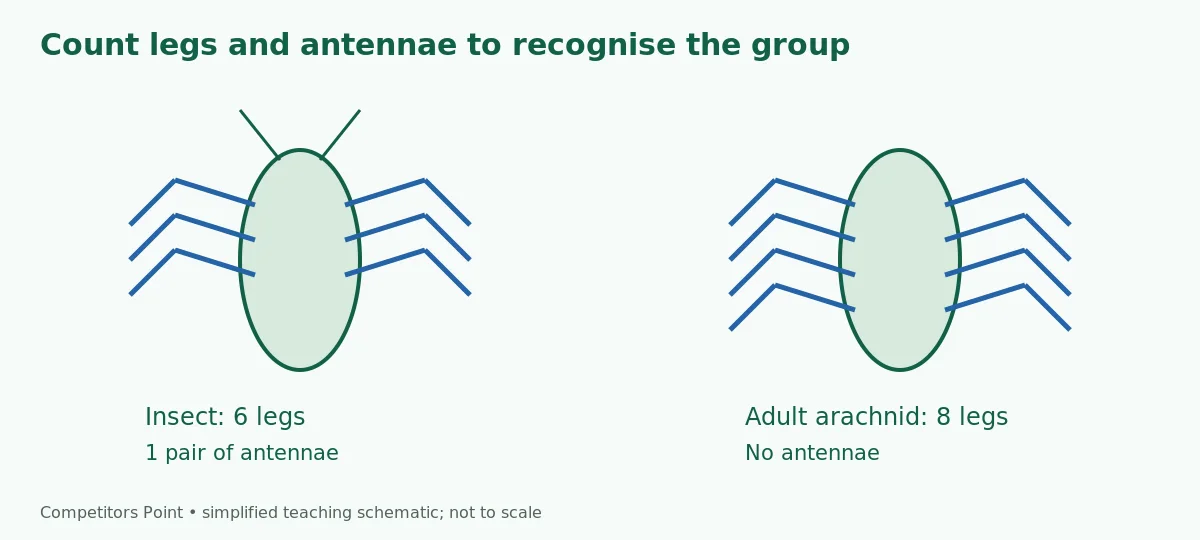
In an insect, the head carries antennae and mouthparts; the thorax bears three pairs of legs and wings when present; the abdomen contains much of the digestive, excretory and reproductive machinery. Not all insects have wings. A spider has neither wings nor antennae. Use the actual specimen rather than forcing every arthropod into an insect outline.
Coelom, haemocoel and open circulation
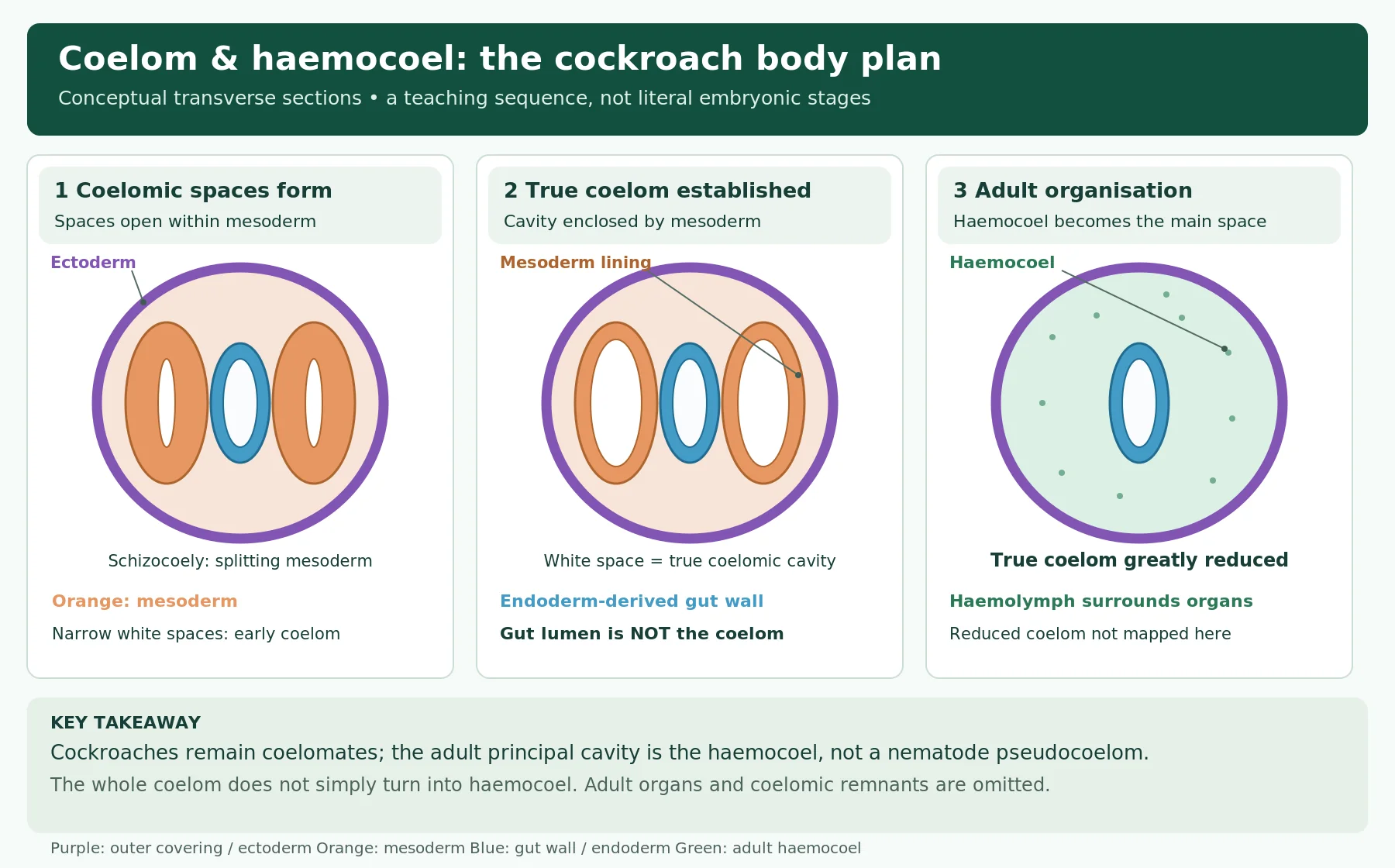
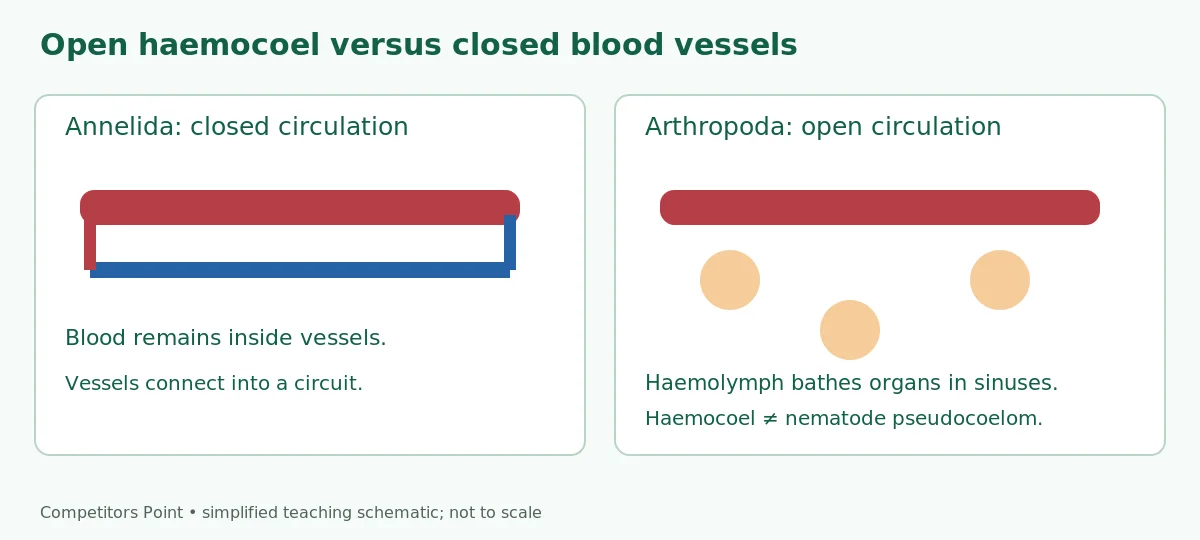
Arthropods are classified as coelomates, but the true coelom is reduced in the adult. The dominant body spaces are the haemocoel: sinuses into which haemolymph is pumped. Haemolymph bathes organs and returns toward the heart through inlet openings called ostia. An open system can contain a heart and vessels; “open” means the circulating fluid does not remain confined to a continuous vessel network.
The supplied cockroach diagram contrasts a developing coelomic space with an adult haemocoel. Its useful lesson is the reduced adult coelom, not that an arthropod becomes a pseudocoelomate or that the haemocoel is simply a false cavity identical to that in a nematode. Schizocoely describes coelom formation by splitting mesoderm; haemocoel describes the principal adult blood spaces. These terms describe different things.
By comparison, Phylum Annelida has a closed circulatory plan: blood remains within vessels. In insects, the tracheal system brings air directly close to tissues, so do not assume haemolymph performs the same oxygen-transport role as vertebrate blood.
Body systems of Phylum Arthropoda
Complete gut and modified insect mouthparts
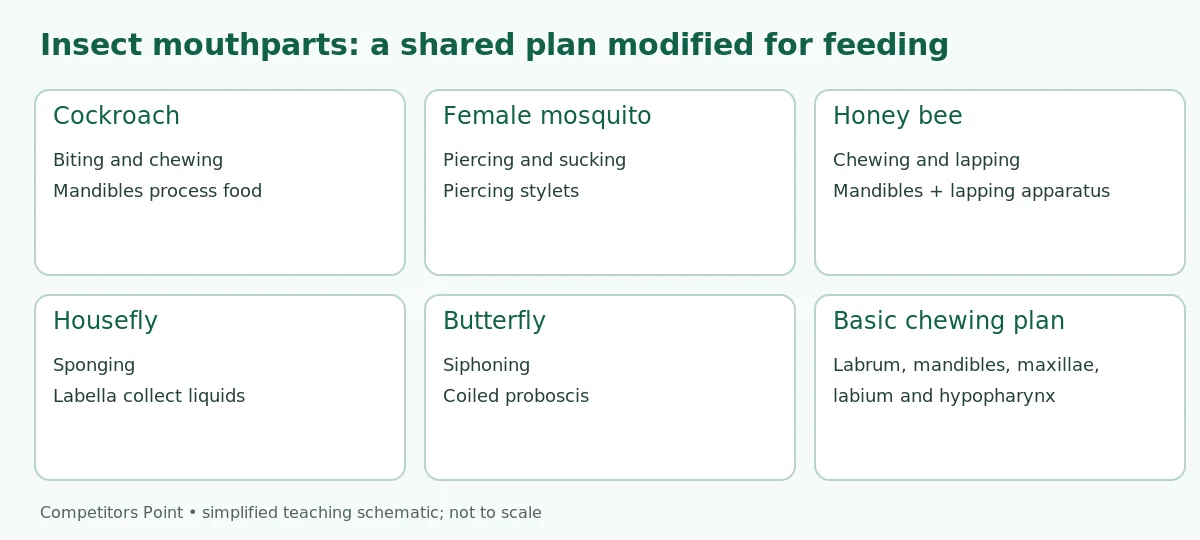
The digestive system is complete, with a mouth and anus. Feeding structures vary with diet. A basic chewing insect has a labrum (upper lip), paired mandibles, one pair of maxillae, a labium (lower lip, derived from fused second maxillae) and a tongue-like hypopharynx. These are anatomical comparisons, not literal vertebrate lips, teeth or tongue.
| Feeding type | Example | Teaching point |
|---|---|---|
| Biting and chewing | Cockroach | Mandibles cut and crush |
| Piercing and sucking | Female mosquito | Many females pierce skin for blood; males generally take plant sugars |
| Chewing and lapping | Honey bee | Combines manipulation and lapping |
| Sponging | Housefly | Labella collect liquid food |
| Siphoning | Butterfly | Coiled proboscis takes up liquids |
These modified structures illustrate homologous components adapted to different feeding functions. The resemblance of an appendage to a tooth does not make it a vertebrate tooth. Aphids and bed bugs are additional insect examples with piercing-sucking feeding specialisations.
Four respiratory arrangements
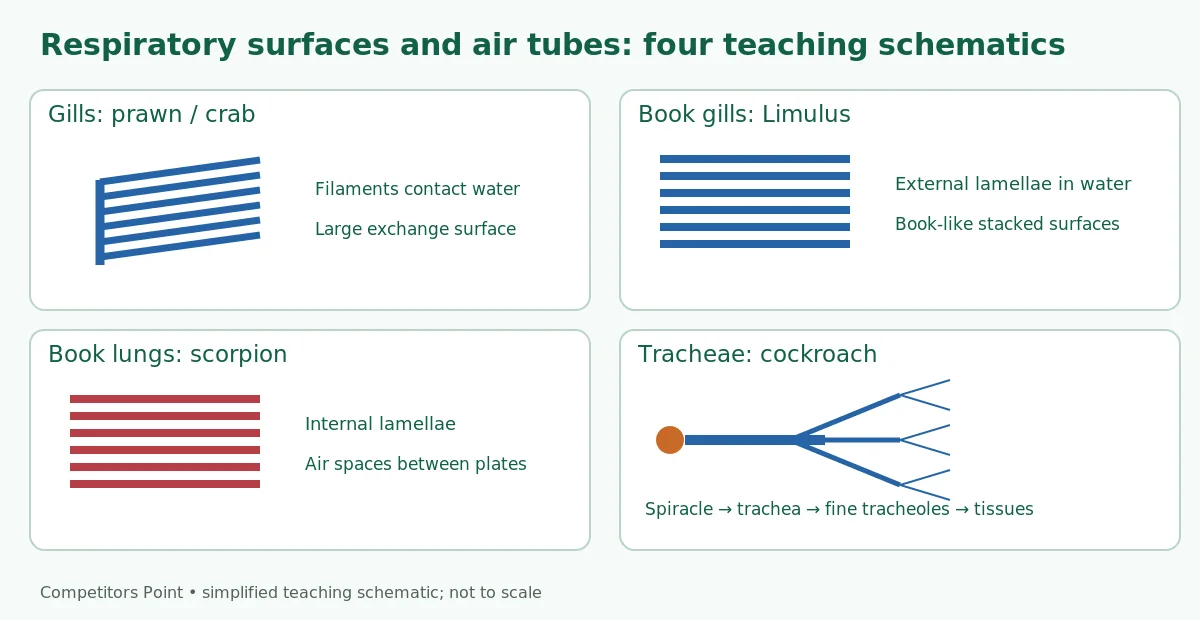
NCERT lists gills, book gills, book lungs or a tracheal system. Aquatic crustaceans such as crabs and prawns use gills; Limulus has book gills. Scorpions and many spiders have book lungs, whose stacked surfaces resemble pages. Insects such as cockroaches use branching tracheae opening through spiracles. Fine tracheoles bring air close to cells. Arachnid respiratory arrangements vary: book lungs are not the only possibility in the whole group.
Excretion: keep the NCERT statement and the exceptions distinct
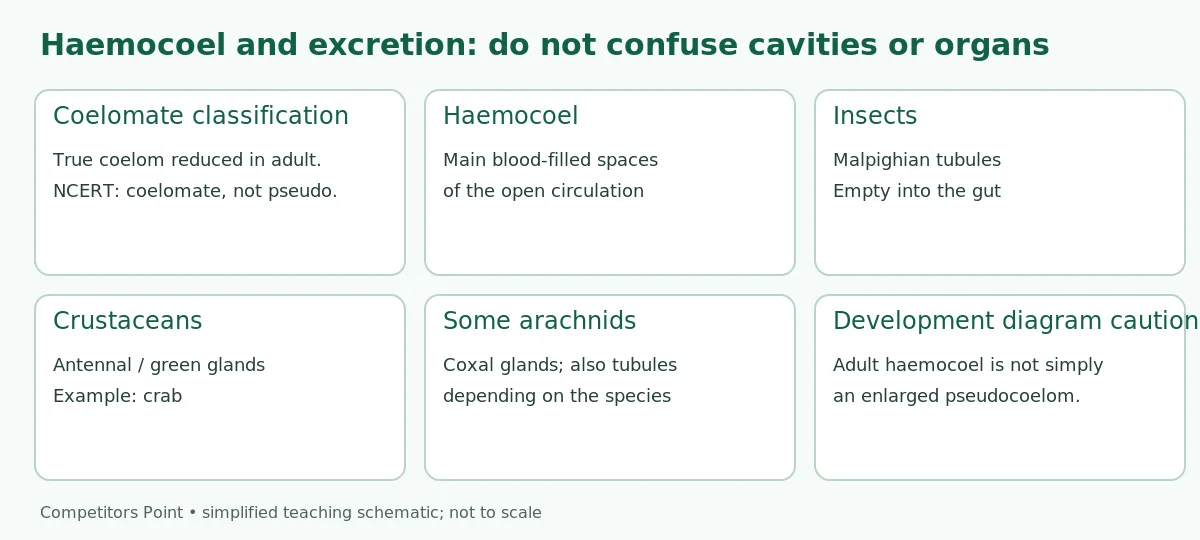
NCERT’s phylum account names Malpighian tubules. This is essential for NEET recall, especially for insects. It is not a universal organ in every arthropod: crustaceans have antennal or green glands (and related maxillary glands in some groups), while coxal glands occur in some arachnids. Tubules in insects work with the gut and help conserve water while eliminating nitrogenous waste. Match an organ to a named animal rather than assuming all arthropods have the same excretory anatomy.
Neural coordination and sense organs
A brain and ventral nerve cord with segmental ganglia coordinate movement and sensation, broadly resembling the ventral ganglionated plan seen in annelids. Antennae, sensory hairs, simple eyes, compound eyes and statocysts are important receptors. Compound eyes comprise repeated visual units called ommatidia; simple eyes are not miniature compound eyes. Statocysts assist balance.
Arthropods did not invent all visual sensitivity. Other invertebrate groups possess photoreceptors or eyespots. Nor do all arthropods possess compound eyes: eye type and reduction vary with the animal and its habitat. This distinction prevents an attractive but incorrect “all earlier phyla were blind” shortcut.
Reproduction and development in Phylum Arthropoda
The qualifying words in NCERT matter: arthropods are mostly dioecious, fertilisation is usually internal, and they are mostly oviparous. Male and female individuals may differ in size or external structures, producing sexual dimorphism. Do not rewrite these statements as “all” or “always”. Fertilisation and development vary among groups; the phylum contains exceptions.
Development may be direct or indirect. Direct development lacks a distinct larval form; indirect development includes larvae and transformation. Insects provide familiar developmental contrasts: cockroaches develop through nymphal stages without a pupal stage, whereas butterflies undergo complete metamorphosis with larva, pupa and adult. Moulting occurs in both patterns; ecdysis and metamorphosis are not interchangeable words.
Classes of Arthropoda with examples: separate rank from recognition
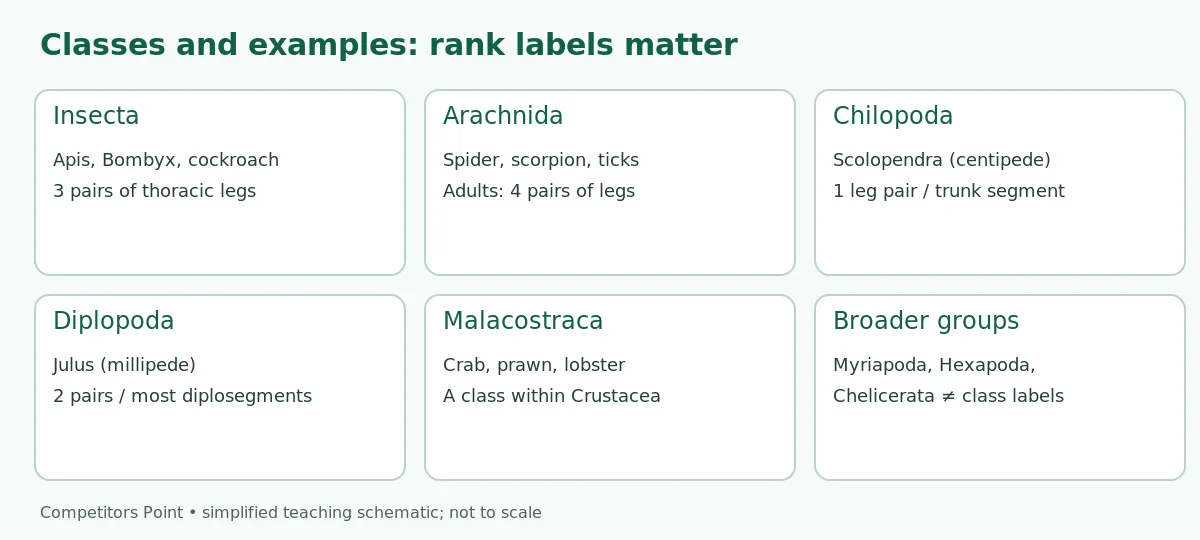
“Classes of Arthropoda with examples” is a classification query, but many online tables mix classes with subphyla. For NEET, first master NCERT’s phylum characteristics and examples; use the table below to recognise animals without confusing ranks. Taxonomic systems are revised, especially for crustacean relationships.
| Class | Examples | Recognition clues |
|---|---|---|
| Insecta | Cockroach, Apis, Bombyx, silverfish, mosquito, termite, aphid, bed bug | Usually 3 pairs of thoracic legs; 1 antenna pair |
| Arachnida | Spider, scorpion, ticks, mites | Adults typically 4 walking-leg pairs; no antennae |
| Chilopoda | Scolopendra, other centipedes | 1 leg pair per leg-bearing trunk segment; anterior forcipules |
| Diplopoda | Julus, other millipedes | 2 leg pairs on most diplosegments, not literally every segment |
| Malacostraca | Prawn, shrimp, crab, lobster, crayfish, hermit crab | A crustacean class; includes familiar decapods |
| Branchiopoda | Daphnia | A crustacean class; small aquatic forms |
Crustacea is traditionally called a class in some older teaching schemes, but is commonly treated as a subphylum or broader grouping in modern accounts. It is not interchangeable with Malacostraca. Chelicerata, Myriapoda and Hexapoda are broader group names, commonly subphyla, not parallel class labels alongside Insecta. Hexapoda includes Insecta but is not exactly the same taxon in modern usage. Limulus is a chelicerate horseshoe crab, not a true decapod crab. Onychophora (velvet worms) is treated as a separate phylum, not included here as a modern arthropod class.
Centipedes and millipedes are particularly easy to confuse. A centipede has one leg pair per leg-bearing trunk segment; its first trunk appendages form venom-bearing forcipules. A millipede usually has two pairs on each diplosegment, formed from fused segment pairs. The anterior and terminal segments are exceptions to a blanket “two pairs on every segment” rule.
NCERT examples and which animals belong to Arthropoda
| NCERT category | Examples | What to remember |
|---|---|---|
| Economically important insects | Apis, Bombyx, Laccifer | Honey bee, silkworm, lac insect respectively |
| Vectors | Anopheles, Culex, Aedes | All are mosquito genera; diseases transmitted differ |
| Gregarious pest | Locusta | Locust |
| Living fossil | Limulus | NCERT common name king crab; horseshoe crab |
| Figure 4.12 | Locust, butterfly, scorpion, prawn | Examples across insect, arachnid and crustacean groups |
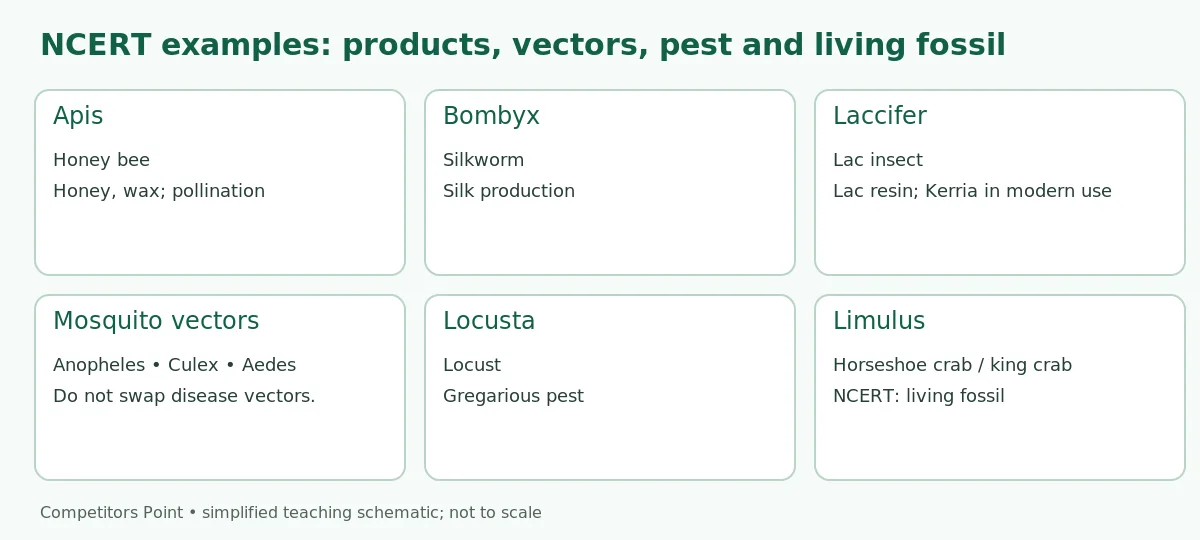
Laccifer is the name used in NCERT; the familiar lac insect is commonly placed in Kerria in modern usage. Retain NCERT’s name for its example list rather than silently replacing it. “Living fossil” is a descriptive label for a lineage retaining recognisable ancient features; it does not mean the living species has stopped evolving.
Which of the following belongs to Arthropoda?
Look for the whole trait combination, not simply a worm-like body or the presence of legs. Tick, spider, prawn, crab, centipede, millipede, mosquito, butterfly and Limulus are arthropods. Nereis, Pheretima and Hirudinaria are annelids; Ascaris is an aschelminth; Taenia and Fasciola are flatworms. A snail is a mollusc. In a mixed set of options, the scientific name may be the clue that tests recognition rather than definition.
Arthropoda and Annelida difference
Both groups are bilateral, triploblastic, segmented animals with organ-system organisation and a coelomate classification. A table is useful only if it highlights differences instead of presenting these shared traits as opposites.
| Feature | Arthropoda | Annelida |
|---|---|---|
| Appendages | Jointed limbs; often specialised | Setae and unjointed parapodia in appropriate forms |
| Skeleton | Chitinous exoskeleton | Hydrostatic support from coelomic fluid |
| Body regions | Segments often grouped into tagmata | Metameres often conspicuous; specialisation also occurs |
| Principal adult cavity | Haemocoel; true coelom reduced | Well-developed true coelom in the typical plan |
| Circulation | Open | Closed in NCERT account |
| Respiration | Gills, book gills, book lungs or tracheae | Body surface in the NCERT comparison |
| Excretion | Malpighian tubules; other organs in particular groups | Nephridia |
| Examples | Apis, prawn, spider, Limulus | Nereis, Pheretima, Hirudinaria |
Continue the comparison with Phylum Annelida. For the preceding worm groups, see Aschelminthes NEET notes and Platyhelminthes NEET notes. These are animal-kingdom comparisons, not an evolutionary ladder in which every living group is a step toward humans.
Phylum Arthropoda: NCERT checklist and Table 4.2
- Largest phylum; includes insects; over two-thirds statement
- Organ-system organisation; bilateral, triploblastic, segmented, coelomate
- Chitinous exoskeleton; head, thorax and abdomen; jointed appendages
- Gills, book gills, book lungs or tracheal system
- Open circulation; antennae, compound and simple eyes, statocysts
- Malpighian tubules in the phylum account
- Mostly dioecious; usually internal fertilisation; mostly oviparous
- Direct or indirect development; all economic, vector, pest and living-fossil examples
| Table 4.2 field | Arthropoda entry |
|---|---|
| Organisation | Organ-system |
| Symmetry | Bilateral |
| Coelom | Coelomate |
| Segmentation | Present |
| Digestive system | Complete |
| Circulatory system | Present |
| Respiratory system | Present |
| Distinctive features | Exoskeleton of cuticle; jointed appendages |
Eight quick-recall flip cards
Common doubts about Arthropoda
What is Arthropoda in biology?
Arthropoda is the animal phylum characterised by jointed appendages, a segmented body and a chitinous exoskeleton. It includes insects, arachnids, crustaceans and myriapods.
How to say Arthropoda?
Collins gives American /ɑːrˈθrɑpədə/, approximately ar-THROP-uh-duh. Stress THROP; the th is as in thin.
What are the classes of Arthropoda with examples?
Examples include Insecta—Apis, Arachnida—spider, Chilopoda—Scolopendra, Diplopoda—Julus, and Malacostraca—prawn. Crustacea is a broader grouping in many modern classifications, although older schemes may call it a class.
What is the Arthropoda and Annelida difference?
Arthropods have jointed appendages, a chitinous exoskeleton and open circulation. Annelids have a typical hydrostatic coelomic skeleton, unjointed setae or parapodia where present, and closed circulation in the NCERT account.
Which of the following belongs to Arthropoda: Limulus, Nereis, Ascaris or Taenia?
Limulus belongs to Arthropoda. Nereis is an annelid, Ascaris an aschelminth and Taenia a flatworm.
Are Malpighian tubules universal in arthropods?
No. NCERT names them in the phylum account and they are characteristic of insects; crustaceans have green or antennal glands and some arachnids have coxal glands.
Are all arthropods insects?
No. Spiders, ticks, crabs, centipedes and millipedes are arthropods but not insects.
Do all arthropods have compound eyes?
No. Arthropods include simple and compound eyes and reduced eyes; eye type varies among groups.
30 Arthropoda NEET MCQs
These are original practice questions, not labelled previous-year questions. Attempt each before revealing its explanation.
Q1. What is Arthropoda in biology?
- (a) A phylum of jointed-appendage animals
- (b) A class of worms
- (c) A plant division
- (d) A vertebrate order
Q2. The largest animal phylum in NCERT is
- (a) Mollusca
- (b) Arthropoda
- (c) Annelida
- (d) Chordata
Q3. NCERT describes arthropods as over what fraction of named species on earth?
- (a) One-tenth
- (b) One-quarter
- (c) Two-thirds
- (d) One-half
Q4. A specimen has a chitinous exoskeleton and jointed legs. Its likely phylum is
- (a) Porifera
- (b) Annelida
- (c) Mollusca
- (d) Arthropoda
Q5. Arthropods have which body organisation?
- (a) Organ-system
- (b) Cellular only
- (c) Tissue only
- (d) No organs
Q6. Which combination describes Arthropoda?
- (a) Radial and diploblastic
- (b) Bilateral, triploblastic and segmented
- (c) Acoelomate and radial
- (d) Unsegmented and diploblastic
Q7. The main blood-filled spaces of an adult arthropod form the
- (a) Pseudocoelom of a nematode
- (b) Gastrovascular cavity
- (c) Haemocoel
- (d) Notochord
Q8. An arthropod growing out of its cuticle must undergo
- (a) Budding
- (b) Conjugation
- (c) Fission
- (d) Ecdysis
Q9. Chitin is a
- (a) Structural polysaccharide
- (b) Respiratory pigment
- (c) Protein hormone
- (d) Mineral salt
Q10. Which respiratory pairing is correct?
- (a) Crab—tracheae only
- (b) Limulus—book gills
- (c) Cockroach—book lungs
- (d) Scorpion—fish gills
Q11. Cockroach air tubes open through
- (a) Ostia
- (b) Nephridiopores
- (c) Spiracles
- (d) Flame cells
Q12. Book lungs are associated with
- (a) Earthworms
- (b) Crabs only
- (c) Butterflies only
- (d) Scorpions and many spiders
Q13. Which excretory pairing is appropriate?
- (a) Cockroach—Malpighian tubules
- (b) Crab—flame cells
- (c) Earthworm—green glands
- (d) Spider—kidneys
Q14. The circulatory system of Arthropoda is
- (a) Closed
- (b) Open
- (c) Absent in every species
- (d) Water vascular
Q15. NCERT sensory structures include
- (a) Only compound eyes
- (b) Only antennae
- (c) Simple and compound eyes, antennae and statocysts
- (d) Only a lateral line
Q16. Reproduction in arthropods is best summarised as
- (a) All self-fertilising
- (b) Always external and viviparous
- (c) Only asexual
- (d) Mostly dioecious; fertilisation usually internal
Q17. Development in Arthropoda may be
- (a) Direct or indirect
- (b) Only indirect
- (c) Only direct
- (d) Absent
Q18. Which is the NCERT silk-producing insect?
- (a) Apis
- (b) Bombyx
- (c) Locusta
- (d) Limulus
Q19. The lac insect is named in NCERT as
- (a) Culex
- (b) Apis
- (c) Laccifer
- (d) Aedes
Q20. The gregarious pest is
- (a) Pheretima
- (b) Hirudinaria
- (c) Bombyx
- (d) Locusta
Q21. Which of the following belongs to Arthropoda?
- (a) Limulus
- (b) Nereis
- (c) Ascaris
- (d) Fasciola
Q22. Which set contains only arthropods?
- (a) Earthworm, leech, prawn
- (b) Tick, crab, centipede
- (c) Snail, butterfly, hydra
- (d) Tapeworm, spider, locust
Q23. An adult spider normally has
- (a) Three pairs of legs
- (b) Five pairs of antennae
- (c) Four pairs of walking legs
- (d) One pair of wings
Q24. An insect normally bears its three leg pairs on the
- (a) Head
- (b) Abdomen only
- (c) Antennae
- (d) Thorax
Q25. Centipedes belong to class
- (a) Chilopoda
- (b) Diplopoda
- (c) Arachnida
- (d) Insecta
Q26. Most millipede diplosegments bear
- (a) One pair of legs
- (b) Two pairs of legs
- (c) Three pairs of wings
- (d) No appendages
Q27. Which class includes crabs and prawns?
- (a) Insecta
- (b) Diplopoda
- (c) Malacostraca
- (d) Arachnida
Q28. A butterfly feeds using which mouthpart type?
- (a) Sponging
- (b) Biting only
- (c) Chewing and lapping
- (d) Siphoning
Q29. A key Arthropoda and Annelida difference is
- (a) Open versus closed circulation
- (b) Bilateral versus radial symmetry
- (c) Three versus two germ layers
- (d) Presence versus absence of all segmentation
Q30. Which statement corrects an overgeneralisation?
- (a) All arthropods are insects
- (b) Malpighian tubules are not the only arthropod excretory organs
- (c) All arthropods have compound eyes
- (d) All arthropods have identical tagmata
30 assertion–reason questions
Use the same four options for every assertion–reason item. Read the explanatory relationship, not just the truth of the two statements.
Q1. Assertion: Arthropods can bend their limbs at joints.
Reason: Flexible membranes connect rigid cuticular pieces.
- (a) Both true; R correctly explains A
- (b) Both true; R does not explain A
- (c) A true; R false
- (d) A false; R true
Q2. Assertion: Ecdysis is necessary for growth in arthropods.
Reason: A rigid exoskeleton cannot continuously expand with the animal.
- (a) Both true; R correctly explains A
- (b) Both true; R does not explain A
- (c) A true; R false
- (d) A false; R true
Q3. Assertion: Arthropods are coelomate in NCERT.
Reason: Their main adult cavity is a nematode pseudocoelom.
- (a) Both true; R correctly explains A
- (b) Both true; R does not explain A
- (c) A true; R false
- (d) A false; R true
Q4. Assertion: Arthropod circulation is closed.
Reason: Haemolymph bathes organs in sinuses.
- (a) Both true; R correctly explains A
- (b) Both true; R does not explain A
- (c) A true; R false
- (d) A false; R true
Q5. Assertion: Arthropods are triploblastic.
Reason: Their development involves three germ layers.
- (a) Both true; R correctly explains A
- (b) Both true; R does not explain A
- (c) A true; R false
- (d) A false; R true
Q6. Assertion: Antennae may serve sensory functions.
Reason: Arthropods have a complete digestive tract.
- (a) Both true; R correctly explains A
- (b) Both true; R does not explain A
- (c) A true; R false
- (d) A false; R true
Q7. Assertion: Every arthropod has three separate body regions.
Reason: Segments may fuse into functional tagmata.
- (a) Both true; R correctly explains A
- (b) Both true; R does not explain A
- (c) A true; R false
- (d) A false; R true
Q8. Assertion: An adult tick is an insect.
Reason: Adult ticks normally possess four leg pairs.
- (a) Both true; R correctly explains A
- (b) Both true; R does not explain A
- (c) A true; R false
- (d) A false; R true
Q9. Assertion: An insect typically has three pairs of legs.
Reason: Its thorax has three leg-bearing segments.
- (a) Both true; R correctly explains A
- (b) Both true; R does not explain A
- (c) A true; R false
- (d) A false; R true
Q10. Assertion: Adult spiders lack antennae.
Reason: Spiders belong to Arachnida.
- (a) Both true; R correctly explains A
- (b) Both true; R does not explain A
- (c) A true; R false
- (d) A false; R true
Q11. Assertion: Limulus is a true crab like a decapod.
Reason: NCERT lists Limulus as a living fossil.
- (a) Both true; R correctly explains A
- (b) Both true; R does not explain A
- (c) A true; R false
- (d) A false; R true
Q12. Assertion: Malpighian tubules occur in cockroach.
Reason: All crustaceans excrete exclusively through those tubules.
- (a) Both true; R correctly explains A
- (b) Both true; R does not explain A
- (c) A true; R false
- (d) A false; R true
Q13. Assertion: Statocysts help maintain balance.
Reason: NCERT lists statocysts among sensory structures.
- (a) Both true; R correctly explains A
- (b) Both true; R does not explain A
- (c) A true; R false
- (d) A false; R true
Q14. Assertion: Book gills function in aquatic gas exchange.
Reason: Limulus bears book gills.
- (a) Both true; R correctly explains A
- (b) Both true; R does not explain A
- (c) A true; R false
- (d) A false; R true
Q15. Assertion: Tracheae deliver air within an insect body.
Reason: Spiracles connect the tracheal system to the exterior.
- (a) Both true; R correctly explains A
- (b) Both true; R does not explain A
- (c) A true; R false
- (d) A false; R true
Q16. Assertion: All arachnids respire only through book lungs.
Reason: Some arachnids possess tracheae.
- (a) Both true; R correctly explains A
- (b) Both true; R does not explain A
- (c) A true; R false
- (d) A false; R true
Q17. Assertion: Fertilisation in Arthropoda is usually internal.
Reason: Arthropods are mostly dioecious.
- (a) Both true; R correctly explains A
- (b) Both true; R does not explain A
- (c) A true; R false
- (d) A false; R true
Q18. Assertion: Arthropod development is always indirect.
Reason: NCERT allows direct or indirect development.
- (a) Both true; R correctly explains A
- (b) Both true; R does not explain A
- (c) A true; R false
- (d) A false; R true
Q19. Assertion: Most arthropods lay eggs.
Reason: Oviparous means egg-laying.
- (a) Both true; R correctly explains A
- (b) Both true; R does not explain A
- (c) A true; R false
- (d) A false; R true
Q20. Assertion: Apis is economically useful.
Reason: Honey bees provide products and pollination services.
- (a) Both true; R correctly explains A
- (b) Both true; R does not explain A
- (c) A true; R false
- (d) A false; R true
Q21. Assertion: Bombyx is the lac insect.
Reason: Laccifer is the lac insect name used by NCERT.
- (a) Both true; R correctly explains A
- (b) Both true; R does not explain A
- (c) A true; R false
- (d) A false; R true
Q22. Assertion: Locusta is described as gregarious.
Reason: Gregarious animals aggregate in groups.
- (a) Both true; R correctly explains A
- (b) Both true; R does not explain A
- (c) A true; R false
- (d) A false; R true
Q23. Assertion: Chilopoda includes centipedes.
Reason: Their anterior trunk appendages form venom-bearing forcipules.
- (a) Both true; R correctly explains A
- (b) Both true; R does not explain A
- (c) A true; R false
- (d) A false; R true
Q24. Assertion: Millipedes typically have two leg pairs per diplosegment.
Reason: Most diplosegments represent fused pairs of segments.
- (a) Both true; R correctly explains A
- (b) Both true; R does not explain A
- (c) A true; R false
- (d) A false; R true
Q25. Assertion: Crustacea is always a class in every modern system.
Reason: Traditional teaching schemes use Crustacea broadly.
- (a) Both true; R correctly explains A
- (b) Both true; R does not explain A
- (c) A true; R false
- (d) A false; R true
Q26. Assertion: Arthropods were the first animals with any light sensitivity.
Reason: Simple and compound eyes occur among arthropods.
- (a) Both true; R correctly explains A
- (b) Both true; R does not explain A
- (c) A true; R false
- (d) A false; R true
Q27. Assertion: Arthropoda and Annelida share bilateral symmetry.
Reason: Annelids have a closed circulatory plan.
- (a) Both true; R correctly explains A
- (b) Both true; R does not explain A
- (c) A true; R false
- (d) A false; R true
Q28. Assertion: Housefly mouthparts are adapted for sponging.
Reason: They collect liquid food using labella.
- (a) Both true; R correctly explains A
- (b) Both true; R does not explain A
- (c) A true; R false
- (d) A false; R true
Q29. Assertion: All mosquitoes feed by piercing human skin.
Reason: Female mosquitoes of many species take blood meals.
- (a) Both true; R correctly explains A
- (b) Both true; R does not explain A
- (c) A true; R false
- (d) A false; R true
Q30. Assertion: Arthropods have organ-system organisation.
Reason: Specialised organs cooperate in functional systems.
- (a) Both true; R correctly explains A
- (b) Both true; R does not explain A
- (c) A true; R false
- (d) A false; R true
30 match-the-following questions
Q1. Match the two columns.
| Column I | Column II |
|---|---|
| A. Apis | i. Honey bee |
| B. Bombyx | ii. Lac insect |
| C. Laccifer | iii. Locust |
| D. Locusta | iv. Silkworm |
- (a) A–i, B–iv, C–ii, D–iii
- (b) A–i, B–iii, C–ii, D–iv
- (c) A–i, B–ii, C–iv, D–iii
- (d) A–i, B–iii, C–iv, D–ii
Q2. Match the two columns.
| Column I | Column II |
|---|---|
| A. Anopheles | i. Living fossil in NCERT |
| B. Culex | ii. Another mosquito vector |
| C. Aedes | iii. Mosquito genus |
| D. Limulus | iv. Mosquito vector |
- (a) A–ii, B–iii, C–i, D–iv
- (b) A–ii, B–i, C–iii, D–iv
- (c) A–i, B–iii, C–iv, D–ii
- (d) A–iii, B–iv, C–ii, D–i
Q3. Match the two columns.
| Column I | Column II |
|---|---|
| A. Insecta | i. Scorpion |
| B. Arachnida | ii. Millipede |
| C. Chilopoda | iii. Centipede |
| D. Diplopoda | iv. Cockroach |
- (a) A–iv, B–i, C–ii, D–iii
- (b) A–ii, B–iv, C–i, D–iii
- (c) A–i, B–iv, C–iii, D–ii
- (d) A–iv, B–i, C–iii, D–ii
Q4. Match the two columns.
| Column I | Column II |
|---|---|
| A. Gills | i. Limulus |
| B. Book gills | ii. Scorpion |
| C. Book lungs | iii. Prawn |
| D. Tracheae | iv. Cockroach |
- (a) A–i, B–iv, C–iii, D–ii
- (b) A–i, B–iii, C–ii, D–iv
- (c) A–iii, B–i, C–ii, D–iv
- (d) A–iv, B–ii, C–i, D–iii
Q5. Match the two columns.
| Column I | Column II |
|---|---|
| A. Malpighian tubules | i. Some arachnids |
| B. Green glands | ii. Annelids |
| C. Coxal glands | iii. Insects |
| D. Nephridia | iv. Crustaceans |
- (a) A–iii, B–iv, C–i, D–ii
- (b) A–i, B–ii, C–iii, D–iv
- (c) A–iv, B–i, C–iii, D–ii
- (d) A–iii, B–i, C–iv, D–ii
Q6. Match the two columns.
| Column I | Column II |
|---|---|
| A. Labrum | i. Lower lip |
| B. Mandibles | ii. Chewing jaws |
| C. Labium | iii. Tongue-like structure |
| D. Hypopharynx | iv. Upper lip |
- (a) A–ii, B–iv, C–i, D–iii
- (b) A–ii, B–i, C–iii, D–iv
- (c) A–iv, B–ii, C–i, D–iii
- (d) A–iv, B–i, C–ii, D–iii
Q7. Match the two columns.
| Column I | Column II |
|---|---|
| A. Cockroach | i. Chewing and lapping |
| B. Honey bee | ii. Biting and chewing |
| C. Housefly | iii. Siphoning |
| D. Butterfly | iv. Sponging |
- (a) A–iv, B–ii, C–i, D–iii
- (b) A–ii, B–iii, C–iv, D–i
- (c) A–ii, B–i, C–iii, D–iv
- (d) A–ii, B–i, C–iv, D–iii
Q8. Match the two columns.
| Column I | Column II |
|---|---|
| A. Chitin | i. Functional body regions |
| B. Ecdysis | ii. Blood-filled spaces |
| C. Haemocoel | iii. Polysaccharide |
| D. Tagmata | iv. Shedding cuticle |
- (a) A–i, B–iii, C–iv, D–ii
- (b) A–ii, B–iii, C–i, D–iv
- (c) A–iii, B–iv, C–ii, D–i
- (d) A–ii, B–iv, C–i, D–iii
Q9. Match the two columns.
| Column I | Column II |
|---|---|
| A. Insect legs | i. One pair per leg-bearing segment |
| B. Adult arachnid legs | ii. Five pairs |
| C. Typical decapod legs | iii. Four pairs |
| D. Centipede trunk | iv. Three pairs |
- (a) A–iv, B–iii, C–ii, D–i
- (b) A–iv, B–ii, C–iii, D–i
- (c) A–iv, B–iii, C–i, D–ii
- (d) A–ii, B–iv, C–iii, D–i
Q10. Match the two columns.
| Column I | Column II |
|---|---|
| A. Arthropoda | i. Acoelomate flatworms |
| B. Annelida | ii. Pseudocoelomate worms |
| C. Aschelminthes | iii. Jointed appendages |
| D. Platyhelminthes | iv. Nephridia and metameres |
- (a) A–ii, B–iv, C–i, D–iii
- (b) A–ii, B–i, C–iii, D–iv
- (c) A–iii, B–iv, C–ii, D–i
- (d) A–iv, B–i, C–iii, D–ii
Q11. Match the two columns.
| Column I | Column II |
|---|---|
| A. Arthropod circulation | i. Open |
| B. Annelid circulation | ii. Air tubes |
| C. Insect breathing | iii. Closed |
| D. Crab breathing | iv. Aquatic gills |
- (a) A–i, B–iii, C–ii, D–iv
- (b) A–iii, B–i, C–ii, D–iv
- (c) A–iv, B–ii, C–iii, D–i
- (d) A–ii, B–i, C–iv, D–iii
Q12. Match the two columns.
| Column I | Column II |
|---|---|
| A. Antennae | i. Many ommatidia |
| B. Compound eye | ii. Sensory appendages |
| C. Simple eye | iii. Balancing organ |
| D. Statocyst | iv. Ocellus |
- (a) A–ii, B–iii, C–iv, D–i
- (b) A–ii, B–i, C–iv, D–iii
- (c) A–iii, B–i, C–iv, D–ii
- (d) A–i, B–ii, C–iii, D–iv
Q13. Match the two columns.
| Column I | Column II |
|---|---|
| A. Head | i. Combined head and thoracic region |
| B. Thorax in insect | ii. Sensory and feeding region |
| C. Abdomen | iii. Leg-bearing region |
| D. Cephalothorax | iv. Posterior tagma |
- (a) A–ii, B–iv, C–iii, D–i
- (b) A–ii, B–iii, C–iv, D–i
- (c) A–ii, B–iv, C–i, D–iii
- (d) A–i, B–iii, C–ii, D–iv
Q14. Match the two columns.
| Column I | Column II |
|---|---|
| A. Mostly dioecious | i. Separate sexes typical |
| B. Usually internal | ii. Egg-laying typical |
| C. Mostly oviparous | iii. NCERT developmental alternatives |
| D. Direct or indirect | iv. NCERT fertilisation qualifier |
- (a) A–i, B–ii, C–iv, D–iii
- (b) A–i, B–iv, C–ii, D–iii
- (c) A–i, B–iv, C–iii, D–ii
- (d) A–iii, B–ii, C–i, D–iv
Q15. Match the two columns.
| Column I | Column II |
|---|---|
| A. Insecta class | i. Apis |
| B. Malacostraca class | ii. Centipedes and millipedes |
| C. Myriapoda broad group | iii. Spiders and Limulus |
| D. Chelicerata broad group | iv. Prawn |
- (a) A–ii, B–iii, C–i, D–iv
- (b) A–ii, B–i, C–iv, D–iii
- (c) A–i, B–iv, C–iii, D–ii
- (d) A–i, B–iv, C–ii, D–iii
Q16. Match the two columns.
| Column I | Column II |
|---|---|
| A. Crab | i. Crustacean |
| B. Tick | ii. Arachnid |
| C. Silverfish | iii. Wingless insect |
| D. Scolopendra | iv. Centipede |
- (a) A–i, B–ii, C–iii, D–iv
- (b) A–i, B–iv, C–iii, D–ii
- (c) A–i, B–iii, C–iv, D–ii
- (d) A–i, B–iv, C–ii, D–iii
Q17. Match the two columns.
| Column I | Column II |
|---|---|
| A. Julus | i. Roundworm: not an arthropod |
| B. Pheretima | ii. Flatworm: not an arthropod |
| C. Fasciola | iii. Millipede |
| D. Ascaris | iv. Earthworm: not an arthropod |
- (a) A–i, B–ii, C–iii, D–iv
- (b) A–ii, B–iii, C–i, D–iv
- (c) A–iv, B–i, C–iii, D–ii
- (d) A–iii, B–iv, C–ii, D–i
Q18. Match the two columns.
| Column I | Column II |
|---|---|
| A. Poison claws | i. External air opening |
| B. Diplosegment | ii. Fused segment pair |
| C. Spiracle | iii. Centipede forcipules |
| D. Ostia | iv. Heart inlet openings |
- (a) A–iv, B–iii, C–ii, D–i
- (b) A–ii, B–iv, C–i, D–iii
- (c) A–iii, B–ii, C–i, D–iv
- (d) A–iii, B–i, C–iv, D–ii
Q19. Match the two columns.
| Column I | Column II |
|---|---|
| A. Silk | i. Locusta association |
| B. Lac resin | ii. Apis products |
| C. Honey and wax | iii. Lac insect product |
| D. Crop swarms | iv. Bombyx product |
- (a) A–iv, B–iii, C–ii, D–i
- (b) A–iii, B–ii, C–iv, D–i
- (c) A–iv, B–i, C–ii, D–iii
- (d) A–iv, B–iii, C–i, D–ii
Q20. Match the two columns.
| Column I | Column II |
|---|---|
| A. No antennae | i. Adult arachnid character |
| B. One antenna pair | ii. Typical insect |
| C. Two antenna pairs | iii. Insect plan |
| D. Three thoracic segments | iv. Typical crustacean |
- (a) A–iv, B–iii, C–ii, D–i
- (b) A–ii, B–iii, C–i, D–iv
- (c) A–iv, B–ii, C–iii, D–i
- (d) A–i, B–ii, C–iv, D–iii
Q21. Match the two columns.
| Column I | Column II |
|---|---|
| A. Arthros | i. Phylum |
| B. Poda | ii. Joint |
| C. Arthropoda rank | iii. Appendages or feet |
| D. Insecta rank | iv. Class |
- (a) A–iv, B–iii, C–ii, D–i
- (b) A–i, B–iv, C–iii, D–ii
- (c) A–ii, B–iii, C–i, D–iv
- (d) A–iii, B–iv, C–i, D–ii
Q22. Match the two columns.
| Column I | Column II |
|---|---|
| A. Largest phylum | i. Mouth and anus |
| B. Complete gut | ii. Arthropoda |
| C. Organ-system level | iii. One median plane |
| D. Bilateral symmetry | iv. Organs working together |
- (a) A–ii, B–iv, C–i, D–iii
- (b) A–ii, B–i, C–iv, D–iii
- (c) A–iii, B–ii, C–iv, D–i
- (d) A–i, B–iii, C–ii, D–iv
Q23. Match the two columns.
| Column I | Column II |
|---|---|
| A. Female mosquito | i. Piercing-sucking blood-feeding example |
| B. Aphid | ii. Plant-sap feeding insect |
| C. Bed bug | iii. Blood-feeding insect |
| D. Termite | iv. Social insect |
- (a) A–i, B–ii, C–iii, D–iv
- (b) A–i, B–iii, C–ii, D–iv
- (c) A–ii, B–iii, C–i, D–iv
- (d) A–ii, B–i, C–iii, D–iv
Q24. Match the two columns.
| Column I | Column II |
|---|---|
| A. Tracheole | i. Stacked internal exchange surfaces |
| B. Book lung lamellae | ii. Flexible articulation points |
| C. Gill filaments | iii. Fine terminal air tube |
| D. Exoskeleton joints | iv. Water exchange surfaces |
- (a) A–iii, B–iv, C–ii, D–i
- (b) A–ii, B–iii, C–iv, D–i
- (c) A–iii, B–i, C–iv, D–ii
- (d) A–i, B–iii, C–ii, D–iv
Q25. Match the two columns.
| Column I | Column II |
|---|---|
| A. Nymph | i. Immature form in incomplete metamorphosis |
| B. Pupa | ii. Cuticle replacement |
| C. Caterpillar | iii. Stage in complete metamorphosis |
| D. Moult | iv. Butterfly larva |
- (a) A–ii, B–iii, C–iv, D–i
- (b) A–i, B–iii, C–iv, D–ii
- (c) A–iv, B–i, C–iii, D–ii
- (d) A–iii, B–iv, C–ii, D–i
Q26. Match the two columns.
| Column I | Column II |
|---|---|
| A. Chilopoda legs | i. One pair per leg-bearing trunk segment |
| B. Diplopoda legs | ii. Thorax when present |
| C. Insect wing location | iii. Two pairs on most diplosegments |
| D. Spider wings | iv. Absent |
- (a) A–ii, B–iii, C–iv, D–i
- (b) A–i, B–iv, C–ii, D–iii
- (c) A–i, B–iii, C–ii, D–iv
- (d) A–ii, B–iv, C–i, D–iii
Q27. Match the two columns.
| Column I | Column II |
|---|---|
| A. Cosmopolitan distribution | i. Prawn |
| B. Aquatic arthropod | ii. Cockroach |
| C. Terrestrial arthropod | iii. Broad geographic occurrence |
| D. Parasitic arthropod | iv. Tick |
- (a) A–i, B–ii, C–iv, D–iii
- (b) A–i, B–iii, C–ii, D–iv
- (c) A–iii, B–i, C–ii, D–iv
- (d) A–iv, B–i, C–ii, D–iii
Q28. Match the two columns.
| Column I | Column II |
|---|---|
| A. Brain and ventral cord | i. Regulates moulting and development |
| B. Endocrine control | ii. Newly emerged animal vulnerable |
| C. Cuticle functions | iii. Arthropod neural plan |
| D. Moulting risk | iv. Protection and muscle attachment |
- (a) A–i, B–iii, C–iv, D–ii
- (b) A–iii, B–i, C–iv, D–ii
- (c) A–ii, B–iii, C–i, D–iv
- (d) A–iv, B–ii, C–iii, D–i
Q29. Match the two columns.
| Column I | Column II |
|---|---|
| A. Haemolymph | i. Adult arthropod condition |
| B. Reduced true coelom | ii. Pseudocoelom |
| C. Nematode cavity | iii. Fluid in open circulation |
| D. Annelid cavity | iv. True coelom |
- (a) A–iv, B–iii, C–i, D–ii
- (b) A–i, B–iv, C–iii, D–ii
- (c) A–iii, B–iv, C–i, D–ii
- (d) A–iii, B–i, C–ii, D–iv
Q30. Match the two columns.
| Column I | Column II |
|---|---|
| A. NCERT Figure 4.12a | i. Scorpion |
| B. NCERT Figure 4.12b | ii. Locust |
| C. NCERT Figure 4.12c | iii. Butterfly |
| D. NCERT Figure 4.12d | iv. Prawn |
- (a) A–iv, B–i, C–ii, D–iii
- (b) A–ii, B–iii, C–i, D–iv
- (c) A–i, B–ii, C–iii, D–iv
- (d) A–iv, B–i, C–iii, D–ii
Previous chapter: Phylum Annelida. Next chapter: Phylum Mollusca. Browse Animal Kingdom notes or the NEET Biology hub.
Sources and further reading
- NCERT Class 11 Biology: Animal Kingdom
- OpenStax Biology 2e: Arthropods — tagmata, haemocoel, respiration and classification
- Collins: Arthropoda — dictionary pronunciation