
Phylum Platyhelminthes is the group of flatworms, and it is one of the most diagram-heavy topics of the NEET chapter Animal Kingdom. These notes follow NCERT Class 11 Biology section 4.2.4 line by line and add labelled diagrams of Taenia and Fasciola, circular life-cycle charts, a flame cell diagram, clickable figures, flip cards, a true/false check and 25 NEET MCQs.
Key points
- Dorso-ventrally flattened body, so they are called flatworms.
- Mostly endoparasites found in animals including human beings.
- Bilaterally symmetrical, triploblastic and acoelomate, with organ level of organisation.
- Hooks and suckers are present in the parasitic forms.
- Some absorb nutrients from the host directly through their body surface.
- Flame cells help in osmoregulation and excretion.
- Sexes are not separate; fertilisation is internal; development is through many larval stages.
- Planaria has high regeneration capacity.
- Examples: Taenia (Tapeworm), Fasciola (Liver fluke).
Phylum Platyhelminthes at a glance
Phylum Platyhelminthes
Platyhelminthes (plate-like; dorsoventrally flat) are most commonly called flatworms. The phylum Platyhelminthes is evolutionarily significant because many features first appeared in this group. It was the first to show three distinct germ layers (ectoderm, mesoderm, and endoderm). The term is used here for the first time, even though Platyhelminthes are acoelomate. This phylum is also the first to have an alimentary canal, though it is incomplete. The excretory organ appears here for the first time, with specific excretory organs such as solenocytes, protonephridia, or flame cells. Bilateral symmetry also appeared first in this phylum. The term segmentation first appeared in this phylum, even though Platyhelminthes show pseudo-segmentation.
The name comes from the Greek platys (flat) and helminth (worm). Flatworms have a dorso-ventrally flattened body, which means the body is pressed flat from the upper (dorsal) side to the lower (ventral) side, hence the common name flatworms. Members of Phylum Platyhelminthes are mostly endoparasites found in animals including human beings, though a few, like Planaria, are free-living in fresh water.
Why flatworms matter in evolution
| Feature that appears in flatworms | What it means |
|---|---|
| Three germ layers (triploblastic) | Ectoderm, mesoderm and endoderm are present |
| Bilateral symmetry | Only one plane divides the body into identical left and right halves |
| Organ level of organisation | Tissues are grouped into organs, each for a particular function |
| Excretory organs | Flame cells (protonephridia) for osmoregulation and excretion |
| Head end (cephalisation) | Nerve ganglia and sense organs gather at the front end |
Exam tip: Flatworms show the first organ level of organisation and the first bilateral symmetry, but they still have no coelom and an incomplete digestive system. True metameric segmentation is first seen in Annelida; the proglottids of tapeworms are only a pseudo-segmentation.
General characteristics of the phylum Platyhelminthes
General Characteristics of the phylum Platyhelminthes
- Mostly endoparasites, few free-living
- Tissue-organ level of organization
- Hooks and suckers are present
- Blind-sac body plan, triploblastic
- Acoelomate, bilateral symmetry
- Respiration through diffusion
- Excretion and osmoregulation through flame cells
- Ladder-like nervous system
- Mostly hermaphroditic
- Only sexual reproduction
- Indirect development
- Planaria possess a high capacity for regeneration
- Multiple hosts are involved in the life cycle
- Many larval stages in the life cycle
- Tapeworms are exclusively intestinal parasites (gut parasites), and they themselves lack an intestine, as they live in the intestine where they already get digested food to eat.
- Examples: Dugesia/Planaria (free-living), Fasciola (Sheep liver fluke), Schistosoma (Blood fluke) — unisexual, Paragonimus (lung fluke), Clonorchis (Chinese liver fluke), Taenia solium (Pork tapeworm), Taenia saginata (Beef tapeworm), Echinococcus (Dog tapeworm)
Note: Primary hosts are those in which the worm reproduces sexually, and secondary hosts are those in which it reproduces asexually.
Features explained in simple words
- Organ level of organisation: in Phylum Platyhelminthes, tissues are grouped together to form organs, each specialised for a particular function.
- Hooks and suckers are present in the parasitic forms. They hold the worm firmly to the host’s gut or bile duct so it is not swept away.
- Absorption through the body surface: some of them, such as tapeworms, absorb nutrients from the host directly through their body surface.
- Sexes are not separate: each worm is a hermaphrodite with both male and female organs (Schistosoma is an exception with separate sexes).
- Fertilisation is internal and development is through many larval stages.
Body plan: triploblastic and acoelomate
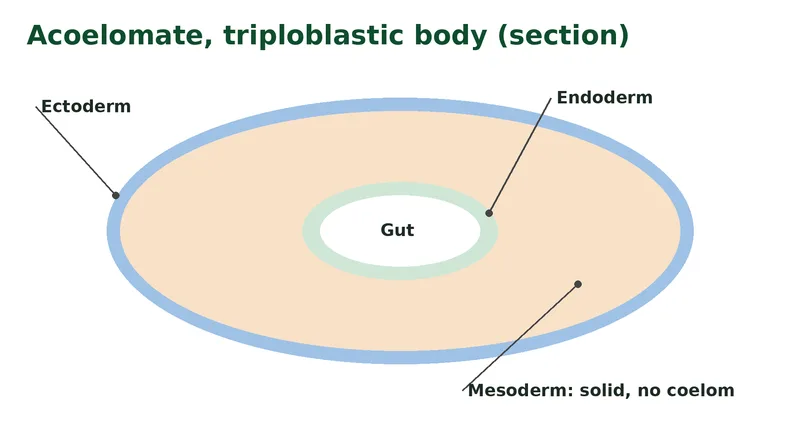
Flatworms are triploblastic: the embryo has an outer ectoderm, a middle mesoderm and an inner endoderm. They are also acoelomate, meaning there is no body cavity between the body wall and the gut. The space is filled with a solid mesodermal tissue called parenchyma (mesenchyme). Because there is no circulatory or respiratory system, every cell must stay close to the surface for diffusion, which is one reason the body stays thin and flat.
Body systems of flatworms
Body wall and tegument
Free-living flatworms have a ciliated epidermis on the lower surface that helps them glide. Parasitic flukes and tapeworms have a tough, non-ciliated covering called the tegument, which resists the host’s digestive enzymes and, in tapeworms, absorbs food. Below it lie layers of circular and longitudinal muscles.
Digestive system
The digestive system of Phylum Platyhelminthes is incomplete: there is a single opening to the outside that serves as both mouth and anus. In Planaria and flukes the mouth leads to a muscular pharynx and a branched, blind intestine. Free-living forms are predators or scavengers. Tapeworms have no mouth or gut at all and absorb digested food from the host’s intestine.
Respiration and circulation
There are no respiratory or circulatory organs. Gases diffuse across the body surface; parasites living in the oxygen-poor gut respire mainly anaerobically.
Nervous system and sense organs
A pair of cerebral ganglia (a simple brain) lies at the front end. From it, longitudinal nerve cords run backward and are joined by cross connections, forming a ladder-like nervous system. Free-living forms such as Planaria have eye spots (ocelli) that sense light, and chemoreceptors that sense food. Parasites have reduced sense organs.
Flame cells and excretion
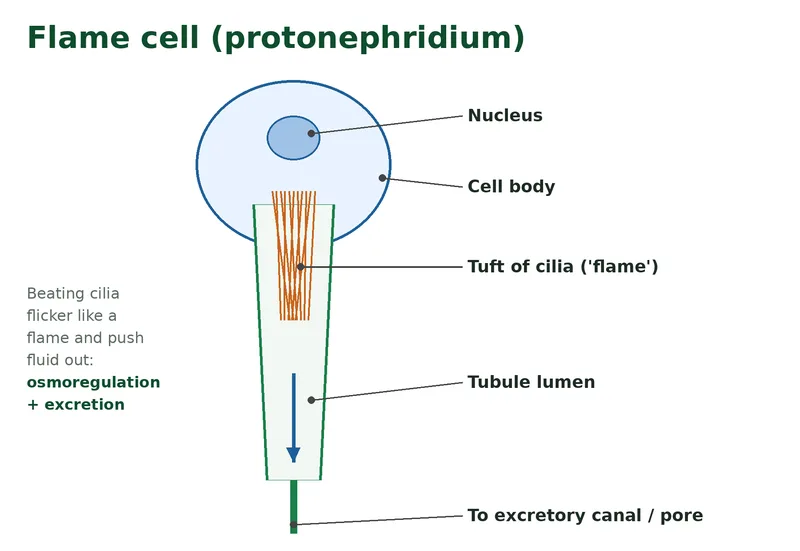
Specialised cells called flame cells help in osmoregulation and excretion. Each flame cell is a cup-shaped cell with a tuft of cilia inside. When the cilia beat, they flicker like a candle flame, which gives the cell its name. The beating draws water and wastes into a network of fine tubules (protonephridia), which open to the outside through excretory pores. Because they remove excess water, flame cells are especially important in freshwater flatworms.
Reproduction and life cycles
Sexes are not separate in most members of Phylum Platyhelminthes; each individual is a hermaphrodite. Fertilisation is internal and development is through many larval stages. Parasitic flatworms often need more than one host: the primary (definitive) host carries the adult worm that reproduces sexually, and the secondary (intermediate) host carries the larval stages. Free-living Planaria can also reproduce asexually by splitting across the body (transverse fission).
Regeneration in Planaria
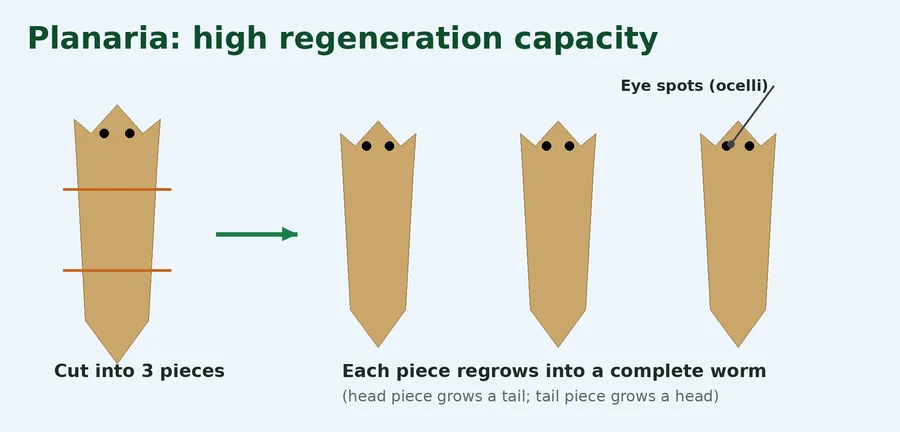
Some members like Planaria possess high regeneration capacity. If a planarian is cut into pieces, each piece can grow the missing parts and form a complete worm. This is possible because its body contains many undifferentiated stem cells called neoblasts.
Classes of Platyhelminthes
| Class | Lifestyle | Key features | Examples |
|---|---|---|---|
| Turbellaria | Free-living (fresh water, sea, moist soil) | Ciliated epidermis, eye spots, high regeneration | Dugesia (Planaria) |
| Monogenea | Mostly external parasites of fish | Simple life cycle with one host | Gyrodactylus |
| Trematoda (flukes) | Internal parasites | Oral and ventral suckers, branched gut, two or more hosts | Fasciola, Schistosoma, Paragonimus, Clonorchis |
| Cestoda (tapeworms) | Intestinal parasites of vertebrates | Scolex with hooks and suckers, proglottids, no gut | Taenia, Echinococcus |
Taenia (tapeworm)
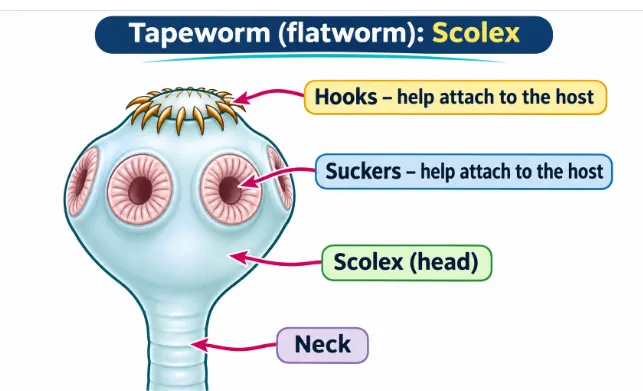
Taenia solium, the pork tapeworm, lives in the small intestine of humans and can grow several metres long. Its ribbon-like body has three regions: a small head called the scolex, a short neck, and a long chain of segments called proglottids (the strobila). The scolex bears a crown of hooks on the rostellum and four suckers. New proglottids bud from the neck, so the oldest, egg-filled (gravid) proglottids are at the far end.
Scolex: hooks and suckers
Labelled diagram of Taenia
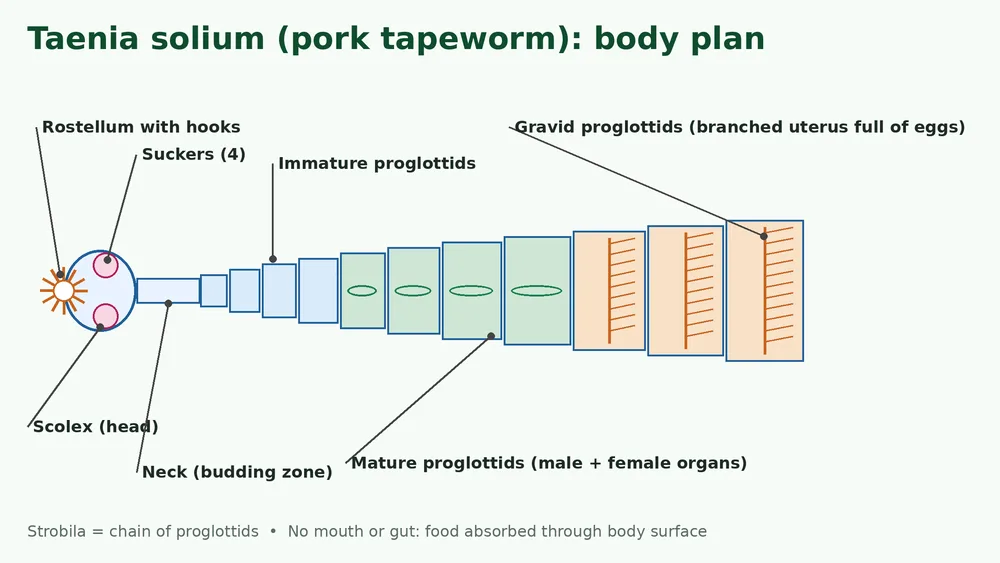
Click a pin on the tapeworm to identify each region.
Tap a numbered pin to see what that part is.
Life cycle of Taenia solium
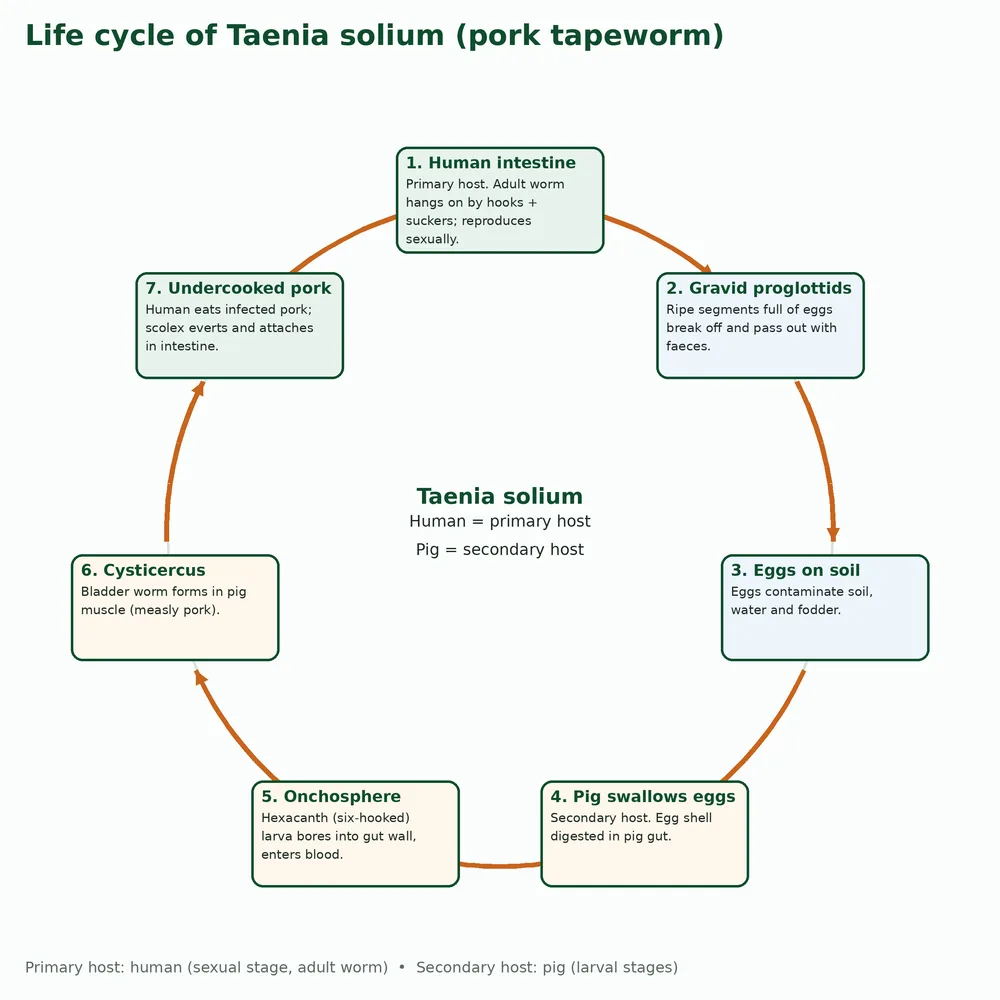
- Human (primary host): the adult tapeworm lives in the intestine, attached by hooks and suckers. It self-fertilises inside its own mature proglottids.
- Eggs leave: gravid proglottids full of eggs detach and pass out with human faeces.
- Pig (secondary host): the pig swallows eggs from contaminated soil or food. In its gut, a six-hooked larva (onchosphere or hexacanth) hatches.
- Into the muscles: the larva bores through the gut wall, travels in the blood and settles in muscle, forming a fluid-filled cysticercus (bladder worm).
- Back to humans: a person who eats raw or undercooked infected pork swallows the cysticercus; its scolex turns out and attaches to the intestine, and a new adult grows.
- If a human swallows the eggs directly, cysticerci can form in human muscles or brain (cysticercosis), which is a dangerous condition.
Fasciola (liver fluke)
Fasciola hepatica, the sheep liver fluke, lives in the bile ducts of the liver of sheep and cattle. Its body is flat and leaf-shaped. It has an oral sucker around the mouth at the front and a ventral sucker (acetabulum) just behind it for attachment. The mouth leads to a muscular pharynx and a forked, highly branched intestine that ends blindly. Branched testes, an ovary and a coiled uterus fill much of the body, since each fluke is a hermaphrodite.
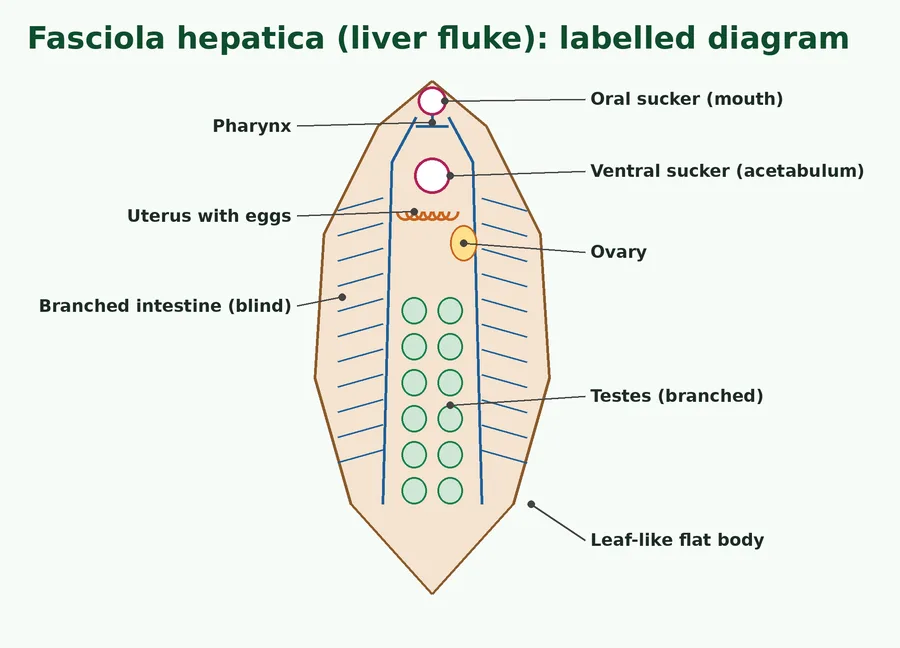
Click a pin on the liver fluke to identify each part.
Tap a numbered pin to see what that part is.
Life cycle of Fasciola hepatica
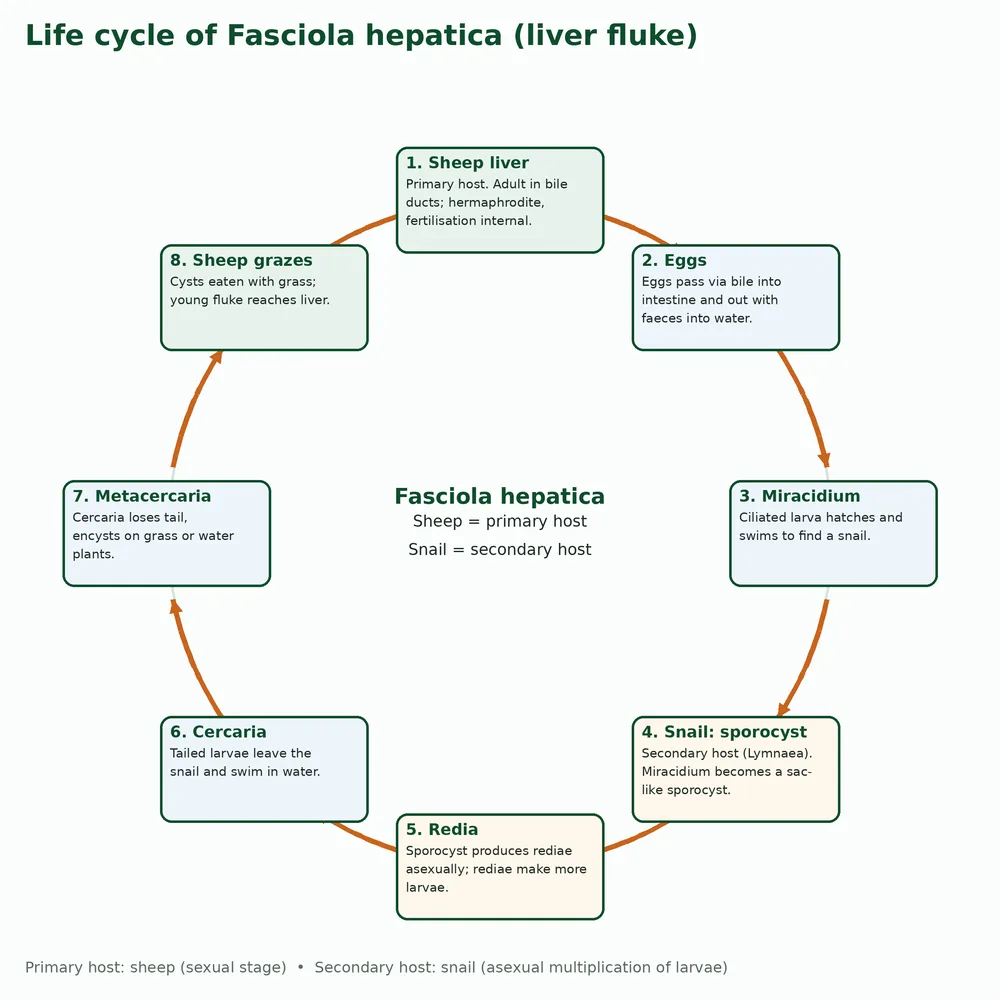
- Sheep (primary host): adult flukes in the bile ducts reproduce sexually; fertilisation is internal.
- Eggs: eggs pass with bile into the intestine and leave with the faeces. In water, each egg hatches.
- Miracidium: a ciliated, free-swimming larva that must find a freshwater snail (Lymnaea) within hours.
- Snail (secondary host): inside the snail, the miracidium becomes a sac-like sporocyst, which produces rediae; rediae produce many tailed cercariae. This asexual multiplication makes thousands of larvae from one egg.
- Metacercaria: cercariae leave the snail, swim, lose their tails and form cysts (metacercariae) on grass or water plants.
- Back to sheep: sheep eat the cysts while grazing; young flukes leave the gut and reach the liver, causing liver rot (fascioliasis).
Memory trick for the Fasciola larvae: My Sister Ran Cross Market = Miracidium, Sporocyst, Redia, Cercaria, Metacercaria.
Examples of Platyhelminthes and the diseases they cause
| Example | Common name | Host / disease |
|---|---|---|
| Taenia solium | Pork tapeworm | Human (primary), pig (secondary); taeniasis, cysticercosis |
| Taenia saginata | Beef tapeworm | Human (primary), cattle (secondary) |
| Fasciola hepatica | Sheep liver fluke | Sheep (primary), snail (secondary); liver rot |
| Schistosoma | Blood fluke | Separate sexes; schistosomiasis |
| Paragonimus | Lung fluke | Lungs of humans |
| Clonorchis | Chinese liver fluke | Bile ducts of humans |
| Echinococcus | Dog tapeworm | Dog (primary); hydatid cyst in humans |
| Dugesia / Planaria | Planarian | Free-living; high regeneration |
Platyhelminthes in the salient features table (NCERT Table 4.2)
| Phylum | Level of organisation | Symmetry | Coelom | Segmentation | Digestive system | Circulatory system | Respiratory system | Distinctive features |
|---|---|---|---|---|---|---|---|---|
| Ctenophora | Tissue | Radial | Absent | Absent | Incomplete | Absent | Absent | Comb plates for locomotion |
| Platyhelminthes | Organ & Organ-system | Bilateral | Absent | Absent | Incomplete | Absent | Absent | Flat body, suckers |
| Aschelminthes | Organ-system | Bilateral | Pseudocoelomate | Absent | Complete | Absent | Absent | Often worm-shaped, elongated |
In the summary of the chapter, the platyhelminths are described as having a flat body and bilateral symmetry, with distinct suckers and hooks in the parasitic forms. Platyhelminthes are also the textbook example of acoelomates (Figure 4.3c), and their digestive system, with only a single opening that serves as both mouth and anus, is the textbook example of an incomplete digestive system.
Flip cards: compare and recall
Tap a card to flip it.
Quick check: true or false
Flatworms are triploblastic and acoelomate.
Fertilisation in flatworms is external.
Tapeworms have a branched intestine.
Flame cells help in osmoregulation and excretion.
The pig is the primary host of Taenia solium.
Planaria shows high regeneration capacity.
Phylum Platyhelminthes: Common doubts
Why are Platyhelminthes called flatworms?
Because their body is dorso-ventrally flattened, that is, flat from the upper to the lower side.
Are flatworms coelomate?
No. Members of Phylum Platyhelminthes are acoelomate; the space between the body wall and gut is filled with solid mesodermal tissue.
What is the function of flame cells?
Flame cells help in osmoregulation and excretion. Their beating cilia drive water and wastes into excretory tubules.
How does a tapeworm feed without a mouth?
It absorbs digested food from the host’s intestine directly through its body surface.
What are the primary and secondary hosts of Taenia solium?
Human is the primary host and pig is the secondary host.
What are the primary and secondary hosts of Fasciola hepatica?
Sheep is the primary host and a freshwater snail is the secondary host.
Is segmentation in tapeworms true segmentation?
No. Tapeworm proglottids are a pseudo-segmentation. True metameric segmentation first appears in Annelida.
Which flatworm shows high regeneration?
Planaria.
Phylum Platyhelminthes NEET MCQs (25 questions)
Test yourself with these 25 NCERT-based NEET practice questions on Phylum Platyhelminthes.
Q1. Platyhelminthes are called flatworms because their body is:
- (a) Laterally flattened
- (b) Dorso-ventrally flattened
- (c) Cylindrical
- (d) Segmented
Show Answer
Answer: (b) Dorso-ventrally flattened. Their body is dorso-ventrally flattened.
Q2. Most platyhelminthes are:
- (a) Free-living marine
- (b) Endoparasites
- (c) Ectoparasites of plants
- (d) Terrestrial
Show Answer
Answer: (b) Endoparasites. They are mostly endoparasites found in animals including humans.
Q3. Symmetry in flatworms is:
- (a) Radial
- (b) Bilateral
- (c) Asymmetrical
- (d) Biradial
Show Answer
Answer: (b) Bilateral. Bilaterally symmetrical.
Q4. Flatworms are:
- (a) Diploblastic and acoelomate
- (b) Triploblastic and acoelomate
- (c) Triploblastic and pseudocoelomate
- (d) Triploblastic and coelomate
Show Answer
Answer: (b) Triploblastic and acoelomate. Triploblastic and acoelomate.
Q5. Level of organisation in Platyhelminthes is:
- (a) Cellular
- (b) Tissue
- (c) Organ
- (d) Cell-tissue
Show Answer
Answer: (c) Organ. Organ level of organisation.
Q6. Hooks and suckers are present in:
- (a) Free-living flatworms
- (b) Parasitic flatworms
- (c) Ctenophores
- (d) Sponges
Show Answer
Answer: (b) Parasitic flatworms. In the parasitic forms.
Q7. Some flatworms absorb nutrients from the host:
- (a) Through the mouth only
- (b) Directly through their body surface
- (c) Through gills
- (d) By phagocytosis in collar cells
Show Answer
Answer: (b) Directly through their body surface. Directly through their body surface.
Q8. Flame cells help in:
- (a) Locomotion
- (b) Digestion
- (c) Osmoregulation and excretion
- (d) Respiration
Show Answer
Answer: (c) Osmoregulation and excretion. Osmoregulation and excretion.
Q9. In flatworms, sexes are:
- (a) Separate
- (b) Not separate
- (c) Absent
- (d) Alternating
Show Answer
Answer: (b) Not separate. Sexes are not separate.
Q10. Fertilisation in flatworms is:
- (a) External
- (b) Internal
- (c) Absent
- (d) Only in water
Show Answer
Answer: (b) Internal. Fertilisation is internal.
Q11. Development in flatworms is:
- (a) Direct
- (b) Through many larval stages
- (c) Absent
- (d) Only by budding
Show Answer
Answer: (b) Through many larval stages. Through many larval stages.
Q12. High regeneration capacity is shown by:
- (a) Taenia
- (b) Fasciola
- (c) Planaria
- (d) Ascaris
Show Answer
Answer: (c) Planaria. Planaria.
Q13. Taenia is commonly called:
- (a) Liver fluke
- (b) Tapeworm
- (c) Roundworm
- (d) Blood fluke
Show Answer
Answer: (b) Tapeworm. Tapeworm.
Q14. Fasciola is commonly called:
- (a) Liver fluke
- (b) Tapeworm
- (c) Hookworm
- (d) Flatworm of lungs
Show Answer
Answer: (a) Liver fluke. Liver fluke.
Q15. Distinctive feature of Platyhelminthes in NCERT Table 4.2:
- (a) Comb plates
- (b) Flat body, suckers
- (c) Cnidoblasts
- (d) Jointed appendages
Show Answer
Answer: (b) Flat body, suckers. Flat body, suckers.
Q16. Digestive system of Platyhelminthes is:
- (a) Complete
- (b) Incomplete
- (c) Absent in all
- (d) With two openings
Show Answer
Answer: (b) Incomplete. Incomplete: a single opening serves as both mouth and anus.
Q17. Which of these is an acoelomate?
- (a) Ascaris
- (b) Earthworm
- (c) Planaria
- (d) Cockroach
Show Answer
Answer: (c) Planaria. Platyhelminthes such as Planaria are acoelomates.
Q18. The primary host of Taenia solium is:
- (a) Pig
- (b) Human
- (c) Snail
- (d) Dog
Show Answer
Answer: (b) Human. Human.
Q19. The infective stage of Taenia solium for humans is:
- (a) Onchosphere
- (b) Cysticercus in undercooked pork
- (c) Miracidium
- (d) Cercaria
Show Answer
Answer: (b) Cysticercus in undercooked pork. Cysticercus (bladder worm) in measly pork.
Q20. The secondary host of Fasciola hepatica is:
- (a) Sheep
- (b) Snail
- (c) Pig
- (d) Mosquito
Show Answer
Answer: (b) Snail. A freshwater snail.
Q21. Correct sequence of larval stages of Fasciola:
- (a) Miracidium → Redia → Sporocyst → Cercaria → Metacercaria
- (b) Miracidium → Sporocyst → Redia → Cercaria → Metacercaria
- (c) Cercaria → Redia → Miracidium → Sporocyst
- (d) Sporocyst → Miracidium → Cercaria → Redia
Show Answer
Answer: (b) Miracidium → Sporocyst → Redia → Cercaria → Metacercaria. Miracidium, sporocyst, redia, cercaria, metacercaria.
Q22. Tapeworms lack:
- (a) Suckers
- (b) Hooks
- (c) Digestive system
- (d) Flame cells
Show Answer
Answer: (c) Digestive system. They absorb food through the body surface.
Q23. Assertion: Tapeworms do not need a gut. Reason: They live in the host’s intestine and absorb digested food through their body surface.
- (a) Both true, R explains A
- (b) Both true, R does not explain A
- (c) A true, R false
- (d) A false, R true
Show Answer
Answer: (a) Both true, R explains A. R correctly explains A.
Q24. Segmentation in the body is first observed in:
- (a) Platyhelminthes
- (b) Aschelminthes
- (c) Annelida
- (d) Arthropoda
Show Answer
Answer: (c) Annelida. True metameric segmentation first appears in Annelida.
Q25. Which pair is correctly matched?
- (a) Taenia – Liver fluke
- (b) Fasciola – Tapeworm
- (c) Planaria – Regeneration
- (d) Pleurobrachia – Flatworm
Show Answer
Answer: (c) Planaria – Regeneration. Planaria shows high regeneration.
After Phylum Platyhelminthes, continue with Aschelminthes in our NEET Biology notes.