
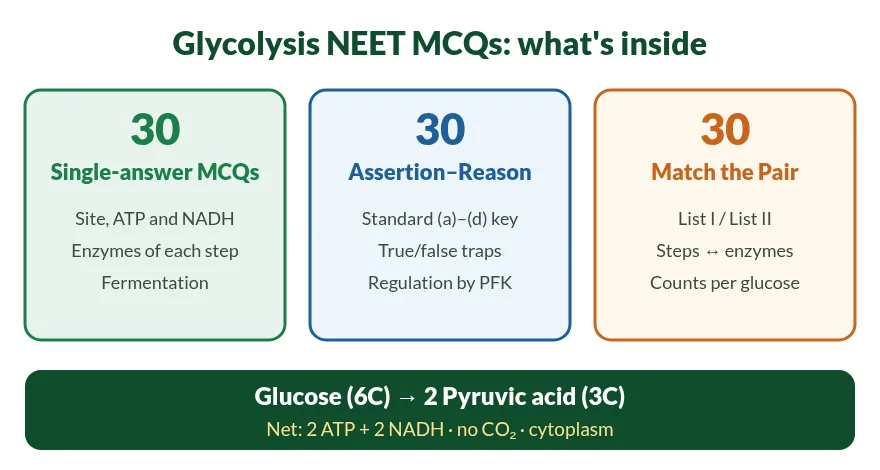
These 90 glycolysis NEET MCQs test every part of the EMP pathway, from the hexokinase step to pyruvic acid and its fates. They are split into three sections: 30 single-answer MCQs, 30 assertion–reason questions and 30 match-the-pair questions. Every question has a Show Answer button with a short explanation. Use these glycolysis NEET MCQs after reading the notes, as a timed test before the exam, or for last-minute revision.
How to use this practice set
- Revise the glycolysis NEET notes first, or keep them open in another tab.
- Attempt each section without peeking, then check your answers and read the explanations.
- For the full chapter, visit the Respiration in Plants NEET hub.
- The questions follow the NCERT Class 11 Biology textbook, chapter Respiration in Plants.
Quick recap: glycolysis takes place in the cytoplasm. It uses 2 ATP and forms 4 ATP and 2 NADH + H⁺ per glucose, so the net gain is 2 ATP and 2 NADH. ATP is made by substrate-level phosphorylation, and no CO₂ is released.
Glycolysis NEET MCQs: 30 single-answer questions
Start with these 30 single-answer glycolysis NEET MCQs. They cover the EMP pathway, enzymes, ATP and NADH counts, and the fates of pyruvic acid. Each of these glycolysis NEET MCQs has one correct option.
Glycolysis NEET MCQs 1–10: site, name and ATP balance
The first ten glycolysis NEET MCQs check where the pathway runs, why it is called the EMP pathway and how the ATP count works.
Q1. Glycolysis is also known as the:
- (a) Krebs cycle
- (b) Calvin cycle
- (c) HMP shunt
- (d) EMP pathway
Show Answer
Answer: (d) EMP pathway
Embden, Meyerhof and Parnas worked out the scheme, so glycolysis is called the EMP pathway.
Q2. Which scientist is NOT associated with working out the scheme of glycolysis?
- (a) Gustav Embden
- (b) Otto Meyerhof
- (c) J. Parnas
- (d) Hans Krebs
Show Answer
Answer: (d) Hans Krebs
Krebs is linked with the TCA cycle, not glycolysis.
Q3. In a cell, glycolysis takes place in the:
- (a) Cytoplasm
- (b) Mitochondrial matrix
- (c) Inner mitochondrial membrane
- (d) Nucleus
Show Answer
Answer: (a) Cytoplasm
All the reactions of glycolysis occur in the cytoplasm.
Q4. One molecule of glucose gives how many molecules of pyruvic acid in glycolysis?
- (a) 1
- (b) 3
- (c) 4
- (d) 2
Show Answer
Answer: (d) 2
The 6C glucose is split into two 3C units, so 2 pyruvic acid are formed.
Q5. Net ATP gained by glycolysis of 5 glucose molecules is:
- (a) 5
- (b) 10
- (c) 20
- (d) 40
Show Answer
Answer: (b) 10
Net gain is 2 ATP per glucose, so 5 × 2 = 10 ATP.
Q6. In plants, the enzyme invertase converts:
- (a) Starch into glucose
- (b) Glucose into fructose
- (c) Maltose into two glucose
- (d) Sucrose into glucose and fructose
Show Answer
Answer: (d) Sucrose into glucose and fructose
Invertase splits sucrose into glucose and fructose, which then enter glycolysis.
Q7. Glucose is phosphorylated to glucose-6-phosphate by:
- (a) Aldolase
- (b) Enolase
- (c) Hexokinase
- (d) Pyruvate kinase
Show Answer
Answer: (c) Hexokinase
Hexokinase transfers a phosphate from ATP to glucose.
Q8. ATP is consumed at how many steps of glycolysis?
- (a) One
- (b) Two
- (c) Three
- (d) Four
Show Answer
Answer: (b) Two
ATP is used at the hexokinase step and the phosphofructokinase step.
Q9. Gross number of ATP produced per glucose in glycolysis is:
- (a) 8
- (b) 6
- (c) 4
- (d) 2
Show Answer
Answer: (c) 4
2 ATP are formed at the BPGA → PGA step and 2 at the PEP → pyruvic acid step, a total of 4.
Q10. Net gain of ATP per glucose in glycolysis is:
- (a) 2
- (b) 4
- (c) 0
- (d) 1
Show Answer
Answer: (a) 2
4 ATP made − 2 ATP used = 2 ATP.
Glycolysis NEET MCQs 11–20: enzymes, NADH and regulation
In this block of glycolysis NEET MCQs, focus on which enzyme acts at each step and where ATP and NADH form.
Q11. Number of NADH + H⁺ formed per glucose during glycolysis is:
- (a) 1
- (b) 2
- (c) 4
- (d) 0
Show Answer
Answer: (b) 2
One NADH forms per PGAL oxidised, and there are 2 PGAL per glucose.
Q12. NADH + H⁺ is formed during the conversion of:
- (a) Glucose-6-phosphate to fructose-6-phosphate
- (b) Fructose-6-phosphate to fructose-1,6-bisphosphate
- (c) PEP to pyruvic acid
- (d) PGAL to BPGA
Show Answer
Answer: (d) PGAL to BPGA
PGAL is oxidised to 1,3-bisphosphoglyceric acid, and NAD⁺ is reduced.
Q13. Aldolase splits fructose-1,6-bisphosphate into:
- (a) DHAP and PGAL
- (b) Two pyruvic acid
- (c) Glucose and fructose
- (d) PGA and PEP
Show Answer
Answer: (a) DHAP and PGAL
The 6C sugar is split into two triose phosphates: DHAP and PGAL.
Q14. ATP is formed directly during the conversion of:
- (a) Glucose to glucose-6-phosphate
- (b) BPGA to 3-PGA
- (c) PGAL to BPGA
- (d) 3-PGA to 2-PGA
Show Answer
Answer: (b) BPGA to 3-PGA
Phosphoglycerate kinase transfers a phosphate from BPGA to ADP.
Q15. The last enzyme of glycolysis is:
- (a) Enolase
- (b) Aldolase
- (c) Phosphofructokinase
- (d) Pyruvate kinase
Show Answer
Answer: (d) Pyruvate kinase
Pyruvate kinase converts PEP into pyruvic acid and forms ATP.
Q16. Phosphoenolpyruvate (PEP) is formed from:
- (a) PGAL
- (b) BPGA
- (c) 2-phosphoglycerate
- (d) Pyruvic acid
Show Answer
Answer: (c) 2-phosphoglycerate
Enolase removes water from 2-phosphoglycerate to form PEP.
Q17. In glycolysis, the oxidation of the substrate takes place by:
- (a) Decarboxylation
- (b) Dehydrogenation
- (c) Hydration
- (d) Direct use of molecular oxygen
Show Answer
Answer: (b) Dehydrogenation
Hydrogen is removed and accepted by NAD⁺; no O₂ is used.
Q18. The ATP formed in glycolysis is produced by:
- (a) Oxidative phosphorylation
- (b) Photophosphorylation
- (c) Substrate-level phosphorylation
- (d) Chemiosmosis
Show Answer
Answer: (c) Substrate-level phosphorylation
The phosphate is transferred directly from BPGA and PEP to ADP.
Q19. How many molecules of CO₂ are released when one glucose undergoes glycolysis?
- (a) 0
- (b) 1
- (c) 2
- (d) 6
Show Answer
Answer: (a) 0
Glycolysis has no decarboxylation step.
Q20. The main regulatory enzyme of glycolysis is:
- (a) Phosphofructokinase
- (b) Hexokinase
- (c) Enolase
- (d) Aldolase
Show Answer
Answer: (a) Phosphofructokinase
PFK catalyses the committed step and is controlled by ATP, AMP/ADP and citrate.
Glycolysis NEET MCQs 21–30: fermentation and fates of pyruvic acid
The last single-answer glycolysis NEET MCQs link the pathway to fermentation and to aerobic respiration in mitochondria.
Q21. Phosphofructokinase is inhibited by:
- (a) High AMP
- (b) High ADP
- (c) Low ATP
- (d) High ATP
Show Answer
Answer: (d) High ATP
Plenty of ATP signals enough energy, so PFK slows down.
Q22. In yeast, under anaerobic conditions, pyruvic acid is converted into:
- (a) Lactic acid
- (b) Ethanol and CO₂
- (c) Acetyl CoA
- (d) Glucose
Show Answer
Answer: (b) Ethanol and CO₂
Alcoholic fermentation forms ethanol and CO₂.
Q23. In muscle cells during vigorous exercise, pyruvic acid is reduced to lactic acid by:
- (a) Lactate dehydrogenase
- (b) Alcohol dehydrogenase
- (c) Pyruvic acid decarboxylase
- (d) Hexokinase
Show Answer
Answer: (a) Lactate dehydrogenase
Lactate dehydrogenase uses NADH + H⁺ to reduce pyruvic acid.
Q24. Yeasts poison themselves to death when the alcohol concentration reaches about:
- (a) 5 per cent
- (b) 7 per cent
- (c) 13 per cent
- (d) 30 per cent
Show Answer
Answer: (c) 13 per cent
At about 13% alcohol, yeast cells die.
Q25. In fermentation, the energy released from glucose is:
- (a) Less than 2 per cent
- (b) Less than 7 per cent
- (c) About 25 per cent
- (d) About 40 per cent
Show Answer
Answer: (b) Less than 7 per cent
Less than 7% of the energy in glucose is released, and not all of it is trapped as ATP.
Q26. In anaerobic organisms, glycolysis is:
- (a) Absent
- (b) Carried out inside mitochondria
- (c) Dependent on oxygen
- (d) The only process of respiration
Show Answer
Answer: (d) The only process of respiration
Glycolysis needs no oxygen, so it is the only respiratory process in anaerobes.
Q27. Glucose-6-phosphate is isomerised to:
- (a) Fructose-6-phosphate
- (b) Fructose-1,6-bisphosphate
- (c) DHAP
- (d) PGAL
Show Answer
Answer: (a) Fructose-6-phosphate
Phosphoglucose isomerase converts glucose-6-phosphate into fructose-6-phosphate.
Q28. The enzyme enolase removes ______ from 2-phosphoglycerate.
- (a) CO₂
- (b) NADH
- (c) Water
- (d) ATP
Show Answer
Answer: (c) Water
Enolase catalyses a dehydration that forms PEP.
Q29. Under aerobic conditions, pyruvic acid formed in glycolysis enters the:
- (a) Nucleus
- (b) Mitochondria
- (c) Chloroplast
- (d) Ribosome
Show Answer
Answer: (b) Mitochondria
Pyruvic acid is completely oxidised inside mitochondria in aerobic respiration.
Q30. Which statement about glycolysis is incorrect?
- (a) It occurs in the cytoplasm
- (b) Its net gain is 2 ATP per glucose
- (c) It requires molecular oxygen
- (d) It has no decarboxylation step
Show Answer
Answer: (c) It requires molecular oxygen
Glycolysis is oxygen-independent and occurs in both aerobes and anaerobes.
Assertion–Reason questions on glycolysis (30)
These assertion–reason glycolysis NEET MCQs follow the exam pattern. Attempting glycolysis NEET MCQs in this format trains you to judge two statements at once. Each question has an Assertion (A) and a Reason (R). Choose:
- (a) Both A and R are true and R is the correct explanation of A
- (b) Both A and R are true but R is not the correct explanation of A
- (c) A is true but R is false
- (d) A is false but R is true
Assertion–reason glycolysis NEET MCQs 31–40
Check each statement on its own first; these glycolysis NEET MCQs often pair a true assertion with a false reason.
Q31.
Assertion (A): Glycolysis occurs in both aerobic and anaerobic organisms.
Reason (R): Glycolysis does not require molecular oxygen.
- (a) Both A and R are true and R is the correct explanation of A
- (b) Both A and R are true but R is not the correct explanation of A
- (c) A is true but R is false
- (d) A is false but R is true
Show Answer
Answer: (a) Both A and R are true and R is the correct explanation of A
Because no O₂ is needed, every organism can run glycolysis.
Q32.
Assertion (A): Glycolysis takes place inside mitochondria.
Reason (R): Mitochondria are the site of the Krebs cycle.
- (a) Both A and R are true and R is the correct explanation of A
- (b) Both A and R are true but R is not the correct explanation of A
- (c) A is true but R is false
- (d) A is false but R is true
Show Answer
Answer: (d) A is false but R is true
Glycolysis is cytoplasmic; R is a true statement.
Q33.
Assertion (A): The net gain of ATP in glycolysis is 2 per glucose.
Reason (R): 2 ATP are used and 4 ATP are produced per glucose.
- (a) Both A and R are true and R is the correct explanation of A
- (b) Both A and R are true but R is not the correct explanation of A
- (c) A is true but R is false
- (d) A is false but R is true
Show Answer
Answer: (a) Both A and R are true and R is the correct explanation of A
4 − 2 = 2, so R explains A.
Q34.
Assertion (A): CO₂ is released during glycolysis.
Reason (R): Glycolysis has no decarboxylation step.
- (a) Both A and R are true and R is the correct explanation of A
- (b) Both A and R are true but R is not the correct explanation of A
- (c) A is true but R is false
- (d) A is false but R is true
Show Answer
Answer: (d) A is false but R is true
With no decarboxylation step, glycolysis releases no CO₂, so A is false and R is true.
Q35.
Assertion (A): Glucose-6-phosphate is trapped inside the cell.
Reason (R): Hexokinase catalyses the first step of glycolysis.
- (a) Both A and R are true and R is the correct explanation of A
- (b) Both A and R are true but R is not the correct explanation of A
- (c) A is true but R is false
- (d) A is false but R is true
Show Answer
Answer: (b) Both A and R are true but R is not the correct explanation of A
Both are true, but A is due to the charged phosphate group, not to which step hexokinase catalyses.
Q36.
Assertion (A): Phosphofructokinase is the key regulatory enzyme of glycolysis.
Reason (R): High ATP activates phosphofructokinase.
- (a) Both A and R are true and R is the correct explanation of A
- (b) Both A and R are true but R is not the correct explanation of A
- (c) A is true but R is false
- (d) A is false but R is true
Show Answer
Answer: (c) A is true but R is false
High ATP inhibits PFK; it is activated by AMP/ADP.
Q37.
Assertion (A): Conversion of PGAL to BPGA is an oxidation step.
Reason (R): NAD⁺ is reduced to NADH + H⁺ in this step.
- (a) Both A and R are true and R is the correct explanation of A
- (b) Both A and R are true but R is not the correct explanation of A
- (c) A is true but R is false
- (d) A is false but R is true
Show Answer
Answer: (a) Both A and R are true and R is the correct explanation of A
Hydrogen removed from PGAL reduces NAD⁺, so the substrate is oxidised.
Q38.
Assertion (A): ATP in glycolysis is formed by substrate-level phosphorylation.
Reason (R): Phosphate is transferred directly from BPGA and PEP to ADP.
- (a) Both A and R are true and R is the correct explanation of A
- (b) Both A and R are true but R is not the correct explanation of A
- (c) A is true but R is false
- (d) A is false but R is true
Show Answer
Answer: (a) Both A and R are true and R is the correct explanation of A
Direct transfer from a substrate is substrate-level phosphorylation.
Q39.
Assertion (A): DHAP is converted into PGAL during glycolysis.
Reason (R): DHAP is converted into PGAL by aldolase.
- (a) Both A and R are true and R is the correct explanation of A
- (b) Both A and R are true but R is not the correct explanation of A
- (c) A is true but R is false
- (d) A is false but R is true
Show Answer
Answer: (c) A is true but R is false
The conversion is done by triose phosphate isomerase; aldolase splits fructose-1,6-bisphosphate.
Q40.
Assertion (A): In plants, sucrose is split before it enters glycolysis.
Reason (R): Invertase converts sucrose into glucose and galactose.
- (a) Both A and R are true and R is the correct explanation of A
- (b) Both A and R are true but R is not the correct explanation of A
- (c) A is true but R is false
- (d) A is false but R is true
Show Answer
Answer: (c) A is true but R is false
Invertase gives glucose and fructose, not galactose.
Assertion–reason glycolysis NEET MCQs 41–50
This set of glycolysis NEET MCQs mixes traps on enzymes, ATP, NADH and the energy-requiring phase.
Q41.
Assertion (A): Alcoholic beverages above about 13% alcohol cannot be made by fermentation alone.
Reason (R): Yeast belongs to kingdom Fungi.
- (a) Both A and R are true and R is the correct explanation of A
- (b) Both A and R are true but R is not the correct explanation of A
- (c) A is true but R is false
- (d) A is false but R is true
Show Answer
Answer: (b) Both A and R are true but R is not the correct explanation of A
Both are true, but A is explained by yeast dying at about 13% alcohol, not by its kingdom.
Q42.
Assertion (A): Fermentation allows glycolysis to continue without oxygen.
Reason (R): Fermentation regenerates NAD⁺ from NADH + H⁺.
- (a) Both A and R are true and R is the correct explanation of A
- (b) Both A and R are true but R is not the correct explanation of A
- (c) A is true but R is false
- (d) A is false but R is true
Show Answer
Answer: (a) Both A and R are true and R is the correct explanation of A
Step 6 needs NAD⁺, which fermentation recycles.
Q43.
Assertion (A): Lactic acid fermentation releases CO₂.
Reason (R): In lactic acid fermentation, pyruvic acid is reduced directly to lactic acid by lactate dehydrogenase.
- (a) Both A and R are true and R is the correct explanation of A
- (b) Both A and R are true but R is not the correct explanation of A
- (c) A is true but R is false
- (d) A is false but R is true
Show Answer
Answer: (d) A is false but R is true
No decarboxylation occurs in lactic acid fermentation, so no CO₂ is released.
Q44.
Assertion (A): Glycolysis is the only process of respiration in anaerobic organisms.
Reason (R): Glycolysis yields 38 ATP per glucose.
- (a) Both A and R are true and R is the correct explanation of A
- (b) Both A and R are true but R is not the correct explanation of A
- (c) A is true but R is false
- (d) A is false but R is true
Show Answer
Answer: (c) A is true but R is false
Glycolysis gives only a net 2 ATP; 38 ATP is the figure for complete aerobic respiration.
Q45.
Assertion (A): Fructose-1,6-bisphosphate is split by aldolase.
Reason (R): Aldolase forms two 3-carbon molecules, DHAP and PGAL.
- (a) Both A and R are true and R is the correct explanation of A
- (b) Both A and R are true but R is not the correct explanation of A
- (c) A is true but R is false
- (d) A is false but R is true
Show Answer
Answer: (a) Both A and R are true and R is the correct explanation of A
R describes exactly what the aldolase step does.
Q46.
Assertion (A): The step catalysed by enolase forms ATP.
Reason (R): Enolase removes water from 2-phosphoglycerate.
- (a) Both A and R are true and R is the correct explanation of A
- (b) Both A and R are true but R is not the correct explanation of A
- (c) A is true but R is false
- (d) A is false but R is true
Show Answer
Answer: (d) A is false but R is true
Enolase forms PEP by dehydration; ATP is formed in the next step.
Q47.
Assertion (A): Two molecules of pyruvic acid are formed from one glucose.
Reason (R): Glycolysis takes place in the cytoplasm.
- (a) Both A and R are true and R is the correct explanation of A
- (b) Both A and R are true but R is not the correct explanation of A
- (c) A is true but R is false
- (d) A is false but R is true
Show Answer
Answer: (b) Both A and R are true but R is not the correct explanation of A
Both are true, but A results from glucose being split into two 3C units.
Q48.
Assertion (A): The hexokinase step uses ATP.
Reason (R): ATP is the energy currency of the cell.
- (a) Both A and R are true and R is the correct explanation of A
- (b) Both A and R are true but R is not the correct explanation of A
- (c) A is true but R is false
- (d) A is false but R is true
Show Answer
Answer: (b) Both A and R are true but R is not the correct explanation of A
Both are true, but A is because hexokinase uses ATP as the phosphate donor.
Q49.
Assertion (A): Glycolysis is called the EMP pathway.
Reason (R): Glycolysis takes place in the cytoplasm of the cell.
- (a) Both A and R are true and R is the correct explanation of A
- (b) Both A and R are true but R is not the correct explanation of A
- (c) A is true but R is false
- (d) A is false but R is true
Show Answer
Answer: (b) Both A and R are true but R is not the correct explanation of A
Both are true, but the name comes from Embden, Meyerhof and Parnas, not from the location.
Q50.
Assertion (A): NADH is produced in the energy-requiring phase of glycolysis.
Reason (R): ATP is invested to phosphorylate sugars in the energy-requiring phase.
- (a) Both A and R are true and R is the correct explanation of A
- (b) Both A and R are true but R is not the correct explanation of A
- (c) A is true but R is false
- (d) A is false but R is true
Show Answer
Answer: (d) A is false but R is true
NADH forms only in the energy-releasing phase (step 6).
Assertion–reason glycolysis NEET MCQs 51–60
These glycolysis NEET MCQs close the assertion–reason section with fermentation and energy-yield statements.
Q51.
Assertion (A): ATP is formed when PEP is converted into pyruvic acid.
Reason (R): Enolase transfers the phosphate of PEP to ADP.
- (a) Both A and R are true and R is the correct explanation of A
- (b) Both A and R are true but R is not the correct explanation of A
- (c) A is true but R is false
- (d) A is false but R is true
Show Answer
Answer: (c) A is true but R is false
The phosphate transfer is done by pyruvate kinase; enolase forms PEP from 2-phosphoglycerate.
Q52.
Assertion (A): In lactic acid fermentation, pyruvic acid is first decarboxylated.
Reason (R): Pyruvic acid decarboxylase converts pyruvic acid into acetaldehyde and CO₂.
- (a) Both A and R are true and R is the correct explanation of A
- (b) Both A and R are true but R is not the correct explanation of A
- (c) A is true but R is false
- (d) A is false but R is true
Show Answer
Answer: (d) A is false but R is true
Lactic acid fermentation has no decarboxylation; R correctly describes alcoholic fermentation.
Q53.
Assertion (A): Glycolysis completely oxidises glucose to CO₂ and H₂O.
Reason (R): Glycolysis ends with the formation of pyruvic acid.
- (a) Both A and R are true and R is the correct explanation of A
- (b) Both A and R are true but R is not the correct explanation of A
- (c) A is true but R is false
- (d) A is false but R is true
Show Answer
Answer: (d) A is false but R is true
Glycolysis only partially oxidises glucose to pyruvic acid.
Q54.
Assertion (A): The phosphofructokinase step commits the sugar to glycolysis.
Reason (R): Glycolysis takes place in the cytoplasm.
- (a) Both A and R are true and R is the correct explanation of A
- (b) Both A and R are true but R is not the correct explanation of A
- (c) A is true but R is false
- (d) A is false but R is true
Show Answer
Answer: (b) Both A and R are true but R is not the correct explanation of A
Both are true, but the location does not explain why the PFK step is committing.
Q55.
Assertion (A): Lactic acid accumulates in muscles during vigorous exercise.
Reason (R): Oxygen supply is inadequate, so pyruvic acid is reduced to lactic acid.
- (a) Both A and R are true and R is the correct explanation of A
- (b) Both A and R are true but R is not the correct explanation of A
- (c) A is true but R is false
- (d) A is false but R is true
Show Answer
Answer: (a) Both A and R are true and R is the correct explanation of A
An O₂ shortage shifts muscle cells to lactic acid fermentation.
Q56.
Assertion (A): Glycolysis yields 4 NADH + H⁺ per glucose.
Reason (R): One NADH + H⁺ is formed per molecule of PGAL oxidised.
- (a) Both A and R are true and R is the correct explanation of A
- (b) Both A and R are true but R is not the correct explanation of A
- (c) A is true but R is false
- (d) A is false but R is true
Show Answer
Answer: (d) A is false but R is true
There are 2 PGAL per glucose, so only 2 NADH form.
Q57.
Assertion (A): Glycolysis occurs in almost all living organisms.
Reason (R): ATP in glycolysis is formed by oxidative phosphorylation.
- (a) Both A and R are true and R is the correct explanation of A
- (b) Both A and R are true but R is not the correct explanation of A
- (c) A is true but R is false
- (d) A is false but R is true
Show Answer
Answer: (c) A is true but R is false
ATP in glycolysis comes from substrate-level phosphorylation.
Q58.
Assertion (A): 3-Phosphoglycerate is converted to 2-phosphoglycerate by a mutase.
Reason (R): In this step, a molecule of water is removed.
- (a) Both A and R are true and R is the correct explanation of A
- (b) Both A and R are true but R is not the correct explanation of A
- (c) A is true but R is false
- (d) A is false but R is true
Show Answer
Answer: (c) A is true but R is false
The mutase only shifts the phosphate from C-3 to C-2; water is removed in the next step by enolase.
Q59.
Assertion (A): Less than 7% of the energy in glucose is released in fermentation.
Reason (R): Fermentation occurs in yeast and some bacteria.
- (a) Both A and R are true and R is the correct explanation of A
- (b) Both A and R are true but R is not the correct explanation of A
- (c) A is true but R is false
- (d) A is false but R is true
Show Answer
Answer: (b) Both A and R are true but R is not the correct explanation of A
Both are true, but the low yield is due to only partial oxidation of glucose.
Q60.
Assertion (A): NADH + H⁺ formed in glycolysis is used up in alcoholic fermentation.
Reason (R): Alcohol dehydrogenase reduces acetaldehyde to ethanol using NADH + H⁺.
- (a) Both A and R are true and R is the correct explanation of A
- (b) Both A and R are true but R is not the correct explanation of A
- (c) A is true but R is false
- (d) A is false but R is true
Show Answer
Answer: (a) Both A and R are true and R is the correct explanation of A
R shows where the NADH is reoxidised.
Match the pair questions on glycolysis (30)
The last 30 glycolysis NEET MCQs are match-the-pair questions. Match List I with List II and choose the correct code. Matching glycolysis NEET MCQs reward knowing each step and enzyme cold.
Match the pair glycolysis NEET MCQs 61–70
Use one certain pair to eliminate codes quickly in these glycolysis NEET MCQs.
Q61. Match the reaction with the enzyme:
| List I | List II |
|---|---|
| P. Glucose → Glucose-6-phosphate | 1. Aldolase |
| Q. Fructose-6-phosphate → Fructose-1,6-bisphosphate | 2. Phosphofructokinase |
| R. Fructose-1,6-bisphosphate → DHAP + PGAL | 3. Pyruvate kinase |
| S. PEP → Pyruvic acid | 4. Hexokinase |
- (a) P-4, Q-1, R-2, S-3
- (b) P-4, Q-2, R-1, S-3
- (c) P-3, Q-4, R-1, S-2
- (d) P-2, Q-4, R-1, S-3
Show Answer
Answer: (b) P-4, Q-2, R-1, S-3
Glucose → Glucose-6-phosphate → Hexokinase; Fructose-6-phosphate → Fructose-1,6-bisphosphate → Phosphofructokinase; Fructose-1,6-bisphosphate → DHAP + PGAL → Aldolase; PEP → Pyruvic acid → Pyruvate kinase.
Q62. Match the enzyme with the type of reaction it catalyses:
| List I | List II |
|---|---|
| P. Enolase | 1. Shift of phosphate within the molecule |
| Q. Phosphoglycerate mutase | 2. Oxidation with NAD⁺ reduction |
| R. Phosphoglucose isomerase | 3. Dehydration |
| S. Glyceraldehyde-3-phosphate dehydrogenase | 4. Glucose-6-phosphate to fructose-6-phosphate |
- (a) P-1, Q-3, R-2, S-4
- (b) P-4, Q-3, R-1, S-2
- (c) P-3, Q-1, R-4, S-2
- (d) P-3, Q-1, R-2, S-4
Show Answer
Answer: (c) P-3, Q-1, R-4, S-2
Enolase → Dehydration; Phosphoglycerate mutase → Shift of phosphate within the molecule; Phosphoglucose isomerase → Glucose-6-phosphate to fructose-6-phosphate; Glyceraldehyde-3-phosphate dehydrogenase → Oxidation with NAD⁺ reduction.
Q63. Match the substrate with the product it forms in glycolysis:
| List I | List II |
|---|---|
| P. PGAL | 1. BPGA |
| Q. BPGA | 2. 3-PGA |
| R. 3-PGA | 3. PEP |
| S. 2-PGA | 4. 2-PGA |
- (a) P-2, Q-4, R-3, S-1
- (b) P-1, Q-4, R-2, S-3
- (c) P-3, Q-1, R-2, S-4
- (d) P-1, Q-2, R-4, S-3
Show Answer
Answer: (d) P-1, Q-2, R-4, S-3
PGAL → BPGA; BPGA → 3-PGA; 3-PGA → 2-PGA; 2-PGA → PEP.
Q64. Match the item with its number per glucose:
| List I | List II |
|---|---|
| P. ATP used | 1. 3 |
| Q. Gross ATP produced | 2. 10 |
| R. Carbon atoms in pyruvic acid | 3. 2 |
| S. Steps (reactions) in glycolysis | 4. 4 |
- (a) P-3, Q-4, R-1, S-2
- (b) P-3, Q-2, R-1, S-4
- (c) P-3, Q-2, R-4, S-1
- (d) P-4, Q-2, R-1, S-3
Show Answer
Answer: (a) P-3, Q-4, R-1, S-2
ATP used → 2; Gross ATP produced → 4; Carbon atoms in pyruvic acid → 3; Steps (reactions) in glycolysis → 10.
Q65. Match the product with the pathway that forms it:
| List I | List II |
|---|---|
| P. Pyruvic acid | 1. Lactic acid fermentation |
| Q. Ethanol | 2. Glycolysis |
| R. Lactic acid | 3. Aerobic respiration |
| S. CO₂ and H₂O (complete oxidation) | 4. Alcoholic fermentation |
- (a) P-1, Q-4, R-2, S-3
- (b) P-2, Q-4, R-1, S-3
- (c) P-3, Q-4, R-1, S-2
- (d) P-2, Q-1, R-3, S-4
Show Answer
Answer: (b) P-2, Q-4, R-1, S-3
Pyruvic acid → Glycolysis; Ethanol → Alcoholic fermentation; Lactic acid → Lactic acid fermentation; CO₂ and H₂O (complete oxidation) → Aerobic respiration.
Q66. Match the enzyme with its reaction:
| List I | List II |
|---|---|
| P. Pyruvic acid decarboxylase | 1. Acetaldehyde → ethanol |
| Q. Alcohol dehydrogenase | 2. Sucrose → glucose + fructose |
| R. Lactate dehydrogenase | 3. Pyruvic acid → lactic acid |
| S. Invertase | 4. Pyruvic acid → acetaldehyde + CO₂ |
- (a) P-4, Q-2, R-1, S-3
- (b) P-4, Q-1, R-2, S-3
- (c) P-4, Q-1, R-3, S-2
- (d) P-3, Q-4, R-1, S-2
Show Answer
Answer: (c) P-4, Q-1, R-3, S-2
Pyruvic acid decarboxylase → Pyruvic acid → acetaldehyde + CO₂; Alcohol dehydrogenase → Acetaldehyde → ethanol; Lactate dehydrogenase → Pyruvic acid → lactic acid; Invertase → Sucrose → glucose + fructose.
Q67. Match the process with its site in the cell:
| List I | List II |
|---|---|
| P. Glycolysis | 1. Chloroplast stroma |
| Q. Krebs cycle | 2. Cytoplasm |
| R. Electron transport system | 3. Inner mitochondrial membrane |
| S. Calvin cycle | 4. Mitochondrial matrix |
- (a) P-3, Q-2, R-4, S-1
- (b) P-3, Q-1, R-4, S-2
- (c) P-1, Q-4, R-2, S-3
- (d) P-2, Q-4, R-3, S-1
Show Answer
Answer: (d) P-2, Q-4, R-3, S-1
Glycolysis → Cytoplasm; Krebs cycle → Mitochondrial matrix; Electron transport system → Inner mitochondrial membrane; Calvin cycle → Chloroplast stroma.
Q68. Match the abbreviation with the full name:
| List I | List II |
|---|---|
| P. PGAL | 1. Dihydroxyacetone phosphate |
| Q. BPGA | 2. Glyceraldehyde-3-phosphate |
| R. PEP | 3. Phosphoenolpyruvate |
| S. DHAP | 4. 1,3-Bisphosphoglyceric acid |
- (a) P-2, Q-4, R-3, S-1
- (b) P-4, Q-2, R-1, S-3
- (c) P-2, Q-1, R-4, S-3
- (d) P-1, Q-3, R-2, S-4
Show Answer
Answer: (a) P-2, Q-4, R-3, S-1
PGAL → Glyceraldehyde-3-phosphate; BPGA → 1,3-Bisphosphoglyceric acid; PEP → Phosphoenolpyruvate; DHAP → Dihydroxyacetone phosphate.
Q69. Match the enzyme with the event at its step:
| List I | List II |
|---|---|
| P. Hexokinase | 1. Water removed |
| Q. Glyceraldehyde-3-phosphate dehydrogenase | 2. ATP formed from BPGA |
| R. Phosphoglycerate kinase | 3. ATP consumed |
| S. Enolase | 4. NADH + H⁺ formed |
- (a) P-1, Q-4, R-3, S-2
- (b) P-3, Q-4, R-2, S-1
- (c) P-4, Q-1, R-2, S-3
- (d) P-1, Q-2, R-4, S-3
Show Answer
Answer: (b) P-3, Q-4, R-2, S-1
Hexokinase → ATP consumed; Glyceraldehyde-3-phosphate dehydrogenase → NADH + H⁺ formed; Phosphoglycerate kinase → ATP formed from BPGA; Enolase → Water removed.
Q70. Match the term with its meaning:
| List I | List II |
|---|---|
| P. Glycolysis | 1. Direct transfer of phosphate from a substrate to ADP |
| Q. Substrate-level phosphorylation | 2. Splitting of sugar |
| R. Dehydrogenation | 3. Removal of hydrogen |
| S. Decarboxylation | 4. Removal of CO₂ |
- (a) P-3, Q-1, R-2, S-4
- (b) P-1, Q-4, R-3, S-2
- (c) P-2, Q-1, R-3, S-4
- (d) P-1, Q-4, R-2, S-3
Show Answer
Answer: (c) P-2, Q-1, R-3, S-4
Glycolysis → Splitting of sugar; Substrate-level phosphorylation → Direct transfer of phosphate from a substrate to ADP; Dehydrogenation → Removal of hydrogen; Decarboxylation → Removal of CO₂.
Match the pair glycolysis NEET MCQs 71–80
Step numbers, enzymes and reaction types are the core of these glycolysis NEET MCQs.
Q71. Match the molecule with its number of carbon atoms:
| List I | List II |
|---|---|
| P. Glucose | 1. 3 |
| Q. PGAL | 2. 1 |
| R. Acetaldehyde | 3. 2 |
| S. Carbon dioxide | 4. 6 |
- (a) P-1, Q-2, R-4, S-3
- (b) P-2, Q-3, R-4, S-1
- (c) P-2, Q-4, R-1, S-3
- (d) P-4, Q-1, R-3, S-2
Show Answer
Answer: (d) P-4, Q-1, R-3, S-2
Glucose → 6; PGAL → 3; Acetaldehyde → 2; Carbon dioxide → 1.
Q72. Match the process with its feature:
| List I | List II |
|---|---|
| P. Energy-requiring phase | 1. 4 ATP and 2 NADH formed |
| Q. Energy-releasing phase | 2. Complete oxidation to CO₂ and H₂O |
| R. Fermentation | 3. 2 ATP consumed |
| S. Aerobic respiration | 4. NAD⁺ regenerated without O₂ |
- (a) P-3, Q-1, R-4, S-2
- (b) P-2, Q-1, R-3, S-4
- (c) P-3, Q-4, R-2, S-1
- (d) P-2, Q-4, R-3, S-1
Show Answer
Answer: (a) P-3, Q-1, R-4, S-2
Energy-requiring phase → 2 ATP consumed; Energy-releasing phase → 4 ATP and 2 NADH formed; Fermentation → NAD⁺ regenerated without O₂; Aerobic respiration → Complete oxidation to CO₂ and H₂O.
Q73. Match the molecule with its role in glycolysis:
| List I | List II |
|---|---|
| P. ATP | 1. Accepts phosphate from PEP |
| Q. NAD⁺ | 2. Added to PGAL to form BPGA |
| R. Inorganic phosphate (Pi) | 3. Hydrogen acceptor in the PGAL → BPGA step |
| S. ADP | 4. Phosphate donor in the hexokinase step |
- (a) P-1, Q-3, R-4, S-2
- (b) P-4, Q-3, R-2, S-1
- (c) P-3, Q-1, R-4, S-2
- (d) P-4, Q-2, R-1, S-3
Show Answer
Answer: (b) P-4, Q-3, R-2, S-1
ATP → Phosphate donor in the hexokinase step; NAD⁺ → Hydrogen acceptor in the PGAL → BPGA step; Inorganic phosphate (Pi) → Added to PGAL to form BPGA; ADP → Accepts phosphate from PEP.
Q74. Match the step number with its reaction:
| List I | List II |
|---|---|
| P. Step 1 | 1. PGAL → BPGA |
| Q. Step 3 | 2. Fructose-6-phosphate → Fructose-1,6-bisphosphate |
| R. Step 6 | 3. PEP → Pyruvic acid |
| S. Step 10 | 4. Glucose → Glucose-6-phosphate |
- (a) P-4, Q-1, R-3, S-2
- (b) P-1, Q-3, R-4, S-2
- (c) P-4, Q-2, R-1, S-3
- (d) P-4, Q-3, R-1, S-2
Show Answer
Answer: (c) P-4, Q-2, R-1, S-3
Step 1 → Glucose → Glucose-6-phosphate; Step 3 → Fructose-6-phosphate → Fructose-1,6-bisphosphate; Step 6 → PGAL → BPGA; Step 10 → PEP → Pyruvic acid.
Q75. Match the step number with its enzyme:
| List I | List II |
|---|---|
| P. Step 2 | 1. Phosphoglucose isomerase |
| Q. Step 4 | 2. Enolase |
| R. Step 5 | 3. Triose phosphate isomerase |
| S. Step 9 | 4. Aldolase |
- (a) P-4, Q-3, R-1, S-2
- (b) P-4, Q-3, R-2, S-1
- (c) P-2, Q-1, R-4, S-3
- (d) P-1, Q-4, R-3, S-2
Show Answer
Answer: (d) P-1, Q-4, R-3, S-2
Step 2 → Phosphoglucose isomerase; Step 4 → Aldolase; Step 5 → Triose phosphate isomerase; Step 9 → Enolase.
Q76. Match the item with its count per glucose in glycolysis:
| List I | List II |
|---|---|
| P. Pyruvic acid molecules | 1. 10 |
| Q. Gross ATP formed | 2. 2 |
| R. CO₂ molecules released | 3. 0 |
| S. Total steps | 4. 4 |
- (a) P-2, Q-4, R-3, S-1
- (b) P-2, Q-1, R-4, S-3
- (c) P-1, Q-3, R-2, S-4
- (d) P-4, Q-3, R-1, S-2
Show Answer
Answer: (a) P-2, Q-4, R-3, S-1
Pyruvic acid molecules → 2; Gross ATP formed → 4; CO₂ molecules released → 0; Total steps → 10.
Q77. Match the conversion with the type of reaction:
| List I | List II |
|---|---|
| P. Glucose-6-phosphate → Fructose-6-phosphate | 1. Dehydration |
| Q. PGAL → BPGA | 2. Isomerisation |
| R. 2-PGA → PEP | 3. Phosphorylation |
| S. Glucose → Glucose-6-phosphate | 4. Oxidation |
- (a) P-2, Q-3, R-4, S-1
- (b) P-2, Q-4, R-1, S-3
- (c) P-4, Q-3, R-1, S-2
- (d) P-1, Q-3, R-2, S-4
Show Answer
Answer: (b) P-2, Q-4, R-1, S-3
Glucose-6-phosphate → Fructose-6-phosphate → Isomerisation; PGAL → BPGA → Oxidation; 2-PGA → PEP → Dehydration; Glucose → Glucose-6-phosphate → Phosphorylation.
Q78. Match the item with its value:
| List I | List II |
|---|---|
| P. Alcohol concentration that poisons yeast | 1. About 13% |
| Q. Energy of glucose released in fermentation | 2. 2 |
| R. Net ATP from glycolysis of one glucose | 3. Less than 7% |
| S. Carbon atoms in glucose | 4. 6 |
- (a) P-4, Q-3, R-1, S-2
- (b) P-4, Q-2, R-3, S-1
- (c) P-1, Q-3, R-2, S-4
- (d) P-4, Q-2, R-1, S-3
Show Answer
Answer: (c) P-1, Q-3, R-2, S-4
Alcohol concentration that poisons yeast → About 13%; Energy of glucose released in fermentation → Less than 7%; Net ATP from glycolysis of one glucose → 2; Carbon atoms in glucose → 6.
Q79. Match the substrate with the enzyme that acts on it:
| List I | List II |
|---|---|
| P. BPGA | 1. Phosphoglycerate mutase |
| Q. 3-PGA | 2. Phosphoglycerate kinase |
| R. 2-PGA | 3. Enolase |
| S. PGAL | 4. Glyceraldehyde-3-phosphate dehydrogenase |
- (a) P-4, Q-2, R-1, S-3
- (b) P-3, Q-2, R-4, S-1
- (c) P-4, Q-3, R-2, S-1
- (d) P-2, Q-1, R-3, S-4
Show Answer
Answer: (d) P-2, Q-1, R-3, S-4
BPGA → Phosphoglycerate kinase; 3-PGA → Phosphoglycerate mutase; 2-PGA → Enolase; PGAL → Glyceraldehyde-3-phosphate dehydrogenase.
Q80. Match the enzyme with the molecule it needs:
| List I | List II |
|---|---|
| P. Pyruvic acid decarboxylase | 1. NADH + H⁺ |
| Q. Glyceraldehyde-3-phosphate dehydrogenase | 2. ATP |
| R. Alcohol dehydrogenase | 3. TPP and Mg²⁺ |
| S. Hexokinase | 4. NAD⁺ |
- (a) P-3, Q-4, R-1, S-2
- (b) P-3, Q-1, R-4, S-2
- (c) P-3, Q-2, R-4, S-1
- (d) P-1, Q-3, R-2, S-4
Show Answer
Answer: (a) P-3, Q-4, R-1, S-2
Pyruvic acid decarboxylase → TPP and Mg²⁺; Glyceraldehyde-3-phosphate dehydrogenase → NAD⁺; Alcohol dehydrogenase → NADH + H⁺; Hexokinase → ATP.
Match the pair glycolysis NEET MCQs 81–90
The final glycolysis NEET MCQs pair counts, products and processes from the whole chapter.
Q81. Match the term with its description:
| List I | List II |
|---|---|
| P. Respiratory substrate | 1. End product of glycolysis |
| Q. ATP | 2. Hydrogen acceptor |
| R. NAD⁺ | 3. Energy currency of the cell |
| S. Pyruvic acid | 4. Molecule oxidised to release energy |
- (a) P-1, Q-4, R-3, S-2
- (b) P-4, Q-3, R-2, S-1
- (c) P-3, Q-4, R-1, S-2
- (d) P-4, Q-3, R-1, S-2
Show Answer
Answer: (b) P-4, Q-3, R-2, S-1
Respiratory substrate → Molecule oxidised to release energy; ATP → Energy currency of the cell; NAD⁺ → Hydrogen acceptor; Pyruvic acid → End product of glycolysis.
Q82. Match the compound with what happens to it:
| List I | List II |
|---|---|
| P. BPGA | 1. Split by aldolase |
| Q. PEP | 2. Isomerised to fructose-6-phosphate |
| R. Fructose-1,6-bisphosphate | 3. Donates phosphate to ADP in step 10 |
| S. Glucose-6-phosphate | 4. Donates phosphate to ADP in step 7 |
- (a) P-1, Q-2, R-3, S-4
- (b) P-4, Q-1, R-3, S-2
- (c) P-4, Q-3, R-1, S-2
- (d) P-3, Q-2, R-4, S-1
Show Answer
Answer: (c) P-4, Q-3, R-1, S-2
BPGA → Donates phosphate to ADP in step 7; PEP → Donates phosphate to ADP in step 10; Fructose-1,6-bisphosphate → Split by aldolase; Glucose-6-phosphate → Isomerised to fructose-6-phosphate.
Q83. Match the part of glycolysis with the steps:
| List I | List II |
|---|---|
| P. Energy-requiring phase | 1. Steps 1–5 |
| Q. Energy-releasing phase | 2. Step 9 |
| R. NADH-forming step | 3. Step 6 |
| S. Dehydration step | 4. Steps 6–10 |
- (a) P-1, Q-3, R-2, S-4
- (b) P-2, Q-4, R-3, S-1
- (c) P-4, Q-3, R-2, S-1
- (d) P-1, Q-4, R-3, S-2
Show Answer
Answer: (d) P-1, Q-4, R-3, S-2
Energy-requiring phase → Steps 1–5; Energy-releasing phase → Steps 6–10; NADH-forming step → Step 6; Dehydration step → Step 9.
Q84. Match the term with its meaning:
| List I | List II |
|---|---|
| P. Glycos | 1. Adenosine triphosphate |
| Q. Lysis | 2. Sugar |
| R. EMP | 3. Embden, Meyerhof and Parnas |
| S. ATP | 4. Splitting |
- (a) P-2, Q-4, R-3, S-1
- (b) P-1, Q-4, R-2, S-3
- (c) P-2, Q-3, R-1, S-4
- (d) P-3, Q-4, R-1, S-2
Show Answer
Answer: (a) P-2, Q-4, R-3, S-1
Glycos → Sugar; Lysis → Splitting; EMP → Embden, Meyerhof and Parnas; ATP → Adenosine triphosphate.
Q85. Match the molecule with its structure:
| List I | List II |
|---|---|
| P. Glucose | 1. 6C, two phosphates |
| Q. Glucose-6-phosphate | 2. 6C, one phosphate |
| R. Fructose-1,6-bisphosphate | 3. 6C, no phosphate |
| S. PGAL | 4. 3C, one phosphate |
- (a) P-1, Q-4, R-2, S-3
- (b) P-3, Q-2, R-1, S-4
- (c) P-4, Q-3, R-2, S-1
- (d) P-2, Q-4, R-3, S-1
Show Answer
Answer: (b) P-3, Q-2, R-1, S-4
Glucose → 6C, no phosphate; Glucose-6-phosphate → 6C, one phosphate; Fructose-1,6-bisphosphate → 6C, two phosphates; PGAL → 3C, one phosphate.
Q86. Match the feature of glycolysis with the correct answer:
| List I | List II |
|---|---|
| P. Site | 1. Cytoplasm |
| Q. Oxygen requirement | 2. Dehydrogenation |
| R. Type of ATP synthesis | 3. Not required |
| S. Method of oxidation | 4. Substrate-level phosphorylation |
- (a) P-4, Q-3, R-1, S-2
- (b) P-1, Q-3, R-2, S-4
- (c) P-1, Q-3, R-4, S-2
- (d) P-4, Q-1, R-3, S-2
Show Answer
Answer: (c) P-1, Q-3, R-4, S-2
Site → Cytoplasm; Oxygen requirement → Not required; Type of ATP synthesis → Substrate-level phosphorylation; Method of oxidation → Dehydrogenation.
Q87. Match the condition with the fate of pyruvic acid or the pathway:
| List I | List II |
|---|---|
| P. Oxygen available | 1. Ethanol and CO₂ formed |
| Q. Yeast without oxygen | 2. Glycolysis slows down (PFK inhibited) |
| R. Muscle with oxygen shortage | 3. Lactic acid formed |
| S. Very high ATP in the cell | 4. Enters mitochondria for complete oxidation |
- (a) P-3, Q-1, R-4, S-2
- (b) P-2, Q-4, R-1, S-3
- (c) P-4, Q-2, R-1, S-3
- (d) P-4, Q-1, R-3, S-2
Show Answer
Answer: (d) P-4, Q-1, R-3, S-2
Oxygen available → Enters mitochondria for complete oxidation; Yeast without oxygen → Ethanol and CO₂ formed; Muscle with oxygen shortage → Lactic acid formed; Very high ATP in the cell → Glycolysis slows down (PFK inhibited).
Q88. Match the glycolysis numerical with the answer:
| List I | List II |
|---|---|
| P. Net ATP from 1 glucose | 1. 6 |
| Q. Net ATP from 3 glucose | 2. 2 |
| R. NADH from 2 glucose | 3. 4 |
| S. Pyruvic acid from 5 glucose | 4. 10 |
- (a) P-2, Q-1, R-3, S-4
- (b) P-1, Q-4, R-2, S-3
- (c) P-4, Q-3, R-2, S-1
- (d) P-4, Q-1, R-2, S-3
Show Answer
Answer: (a) P-2, Q-1, R-3, S-4
Net ATP from 1 glucose → 2; Net ATP from 3 glucose → 6; NADH from 2 glucose → 4; Pyruvic acid from 5 glucose → 10.
Q89. Match the glycolysis numerical with the answer:
| List I | List II |
|---|---|
| P. Gross ATP from 2 glucose | 1. 6 |
| Q. ATP used for 3 glucose | 2. 8 |
| R. CO₂ released from 4 glucose | 3. 0 |
| S. PGAL formed from 1 glucose | 4. 2 |
- (a) P-1, Q-3, R-2, S-4
- (b) P-2, Q-1, R-3, S-4
- (c) P-1, Q-2, R-3, S-4
- (d) P-2, Q-4, R-3, S-1
Show Answer
Answer: (b) P-2, Q-1, R-3, S-4
Gross ATP from 2 glucose → 8; ATP used for 3 glucose → 6; CO₂ released from 4 glucose → 0; PGAL formed from 1 glucose → 2.
Q90. Match the carbohydrate with the correct statement:
| List I | List II |
|---|---|
| P. Sucrose | 1. Can enter glycolysis after phosphorylation |
| Q. Glucose | 2. Split by invertase |
| R. Fructose | 3. Phosphorylated by hexokinase |
| S. Starch | 4. Storage carbohydrate |
- (a) P-3, Q-1, R-4, S-2
- (b) P-1, Q-3, R-2, S-4
- (c) P-2, Q-3, R-1, S-4
- (d) P-4, Q-3, R-2, S-1
Show Answer
Answer: (c) P-2, Q-3, R-1, S-4
Sucrose → Split by invertase; Glucose → Phosphorylated by hexokinase; Fructose → Can enter glycolysis after phosphorylation; Starch → Storage carbohydrate.
Common doubts
These are the doubts students most often have when practising glycolysis NEET MCQs.
How many questions from glycolysis come in NEET?
Respiration in Plants usually carries 1–2 questions, and glycolysis facts such as net ATP, NADH count, enzymes and the site of the pathway are among the most frequently tested. Practising glycolysis NEET MCQs like these covers all of them.
What is the net ATP gain in glycolysis for NEET?
The net gain is 2 ATP per glucose: 4 ATP are formed and 2 ATP are used. The gross yield is 4 ATP. Many glycolysis NEET MCQs test the difference between gross and net yield.
How do I solve assertion–reason questions quickly?
First check whether A and R are each true on their own. Only if both are true, ask whether R gives the reason for A. If it does, choose (a); if not, choose (b). This works for the 30 assertion–reason glycolysis NEET MCQs on this page.
Which enzymes of glycolysis are asked most in NEET?
Hexokinase, phosphofructokinase, aldolase, glyceraldehyde-3-phosphate dehydrogenase, enolase and pyruvate kinase are asked most often, along with the steps where ATP and NADH form. Most glycolysis NEET MCQs on enzymes come from this list.
Should I read the notes before attempting these glycolysis NEET MCQs?
Yes. Read the glycolysis notes once, attempt all 90 questions without looking at the answers, then revise the steps you got wrong.
Finished these glycolysis NEET MCQs? Revise the full pathway in our glycolysis NEET notes, then continue with the other topics in the Respiration in Plants NEET hub. Come back to these glycolysis NEET MCQs a week later to check what you have retained.