
Phylum Mollusca is the phylum of snails, slugs, oysters, mussels, squids, cuttlefish and octopuses. These are soft-bodied animals, usually protected by a shell of calcium carbonate. These NEET notes teach every line of NCERT Class 11 Biology: Animal Kingdom section 4.2.8 and then go further, the way a classroom teacher would: the body plan, the shell layers, the radula, ctenidia and osphradium, torsion, circulation and haemocyanin, kidneys, larvae, the classes, Pila, and economic importance. There are 10 original diagrams and 90 practice questions with explained answers. They sit with our other Animal Kingdom notes.
What is Phylum Mollusca?
Mollusca (commonly pronounced muh-LUS-kuh) comes from the Latin mollis, meaning soft. The name describes the animal inside the shell, not the shell itself. A snail without its shell, an octopus and a squid are all soft, muscular animals. The study of molluscs is called malacology. The study of shells alone is conchology, and an exam can test the difference.
NCERT calls Mollusca the second largest animal phylum. Only Phylum Arthropoda has more species. Reference sources put the number of described living species at roughly 90,000 to over 100,000, depending on how they count. For NEET, learn the rank, not a number. Molluscs are also the largest group of marine animals, and they range from tiny snails to the giant and colossal squids, the largest invertebrates alive.
What unites such different animals is a shared body plan, not a shared appearance: a head, a muscular foot, a visceral hump and a mantle. Once you can see these four regions in a snail, you can find them, modified, in an oyster, a tusk shell and a squid. That is the thinking NEET tests when it gives you an unfamiliar animal.
Quick revision: Mollusca at a glance
Phylum Mollusca is the second largest animal phylum: soft-bodied, unsegmented, bilaterally symmetrical, triploblastic coelomates with a head, a muscular foot, a visceral hump and a mantle, usually protected by a calcareous shell.
- Second largest animal phylum (Arthropoda is the largest).
- Terrestrial or aquatic (marine or freshwater); organ-system level of organisation.
- Bilaterally symmetrical, triploblastic, coelomate; gastropods become asymmetrical through torsion.
- Unsegmented body with a distinct head, muscular foot and visceral hump, usually covered by a calcareous shell.
- The mantle is a soft, spongy fold of skin over the visceral hump; the mantle cavity lies between the hump and the mantle.
- Feather-like gills (ctenidia) in the mantle cavity have respiratory and excretory functions.
- The head has sensory tentacles; the mouth has a radula, a file-like rasping organ for feeding (absent in bivalves).
- Open circulation with haemocyanin (copper) in most; closed circulation in cephalopods.
- Usually dioecious and oviparous, with indirect development (trochophore and veliger larvae).
- NCERT examples: Pila, Pinctada, Sepia, Loligo, Octopus, Aplysia, Dentalium, Chaetopleura.
| Class | Identifying feature | Example |
|---|---|---|
| Aplacophora | Worm-like body with spicules | Neomenia |
| Monoplacophora | Single cap-like shell | Neopilina |
| Polyplacophora | Eight dorsal plates | Chiton (Chaetopleura) |
| Gastropoda | Coiled shell and torsion | Pila |
| Scaphopoda | Tusk-shaped shell | Dentalium |
| Bivalvia | Two valves | Pinctada, Unio |
| Cephalopoda | Arms and a funnel | Octopus, Sepia, Loligo |
Mollusca characteristics: the NCERT general characters
Learn these characters as NCERT words them, because NEET statement questions are built from them. Each point is followed by what it means in practice.
| Character | NCERT statement | What it means |
|---|---|---|
| Rank | Second largest animal phylum | Only Arthropoda is larger |
| Habitat | Terrestrial or aquatic (marine or freshwater) | Land snails and slugs; Pila in ponds; Pinctada and Sepia in the sea |
| Organisation | Organ-system level | Organs work together in digestive, circulatory, excretory and nervous systems |
| Symmetry | Bilaterally symmetrical | Larvae and most classes are bilateral; adult gastropods are asymmetrical because of torsion |
| Germ layers | Triploblastic | Ectoderm, mesoderm and endoderm |
| Body cavity | Coelomate | A true coelom (schizocoel), reduced in adults |
| Segmentation | Unsegmented | No metameres, unlike annelids and arthropods |
| Body regions | Distinct head, muscular foot and visceral hump | The four-part body plan, with the mantle |
| Covering | Calcareous shell | CaCO3 secreted by the mantle; reduced or absent in some |
| Mantle | Soft and spongy layer of skin over the visceral hump | Secretes the shell and encloses the mantle cavity |
| Gills | Feather-like gills in the mantle cavity | Respiratory and excretory functions |
| Head | Sensory tentacles on the anterior head | Touch and chemical senses; eyes often present |
| Feeding | Radula, a file-like rasping organ | Absent in bivalves |
| Reproduction | Usually dioecious and oviparous | Sexes separate; eggs laid; some are hermaphrodite |
| Development | Indirect | Trochophore and veliger larvae; cephalopods develop directly |
Some further characters are not stated in NCERT but are taught in every coaching class and come up in assertion–reason questions. The digestive tract is complete, with mouth and anus. Circulation is open (a haemocoel) except in cephalopods. The blood pigment is haemocyanin. Excretion is by metanephridia, usually called kidneys. The nervous system is made of paired ganglia. Sense organs include tentacles, eyes, statocysts and the osphradium. Each of these is explained in its own section below.
Body plan of a mollusc: head, foot, visceral hump and mantle
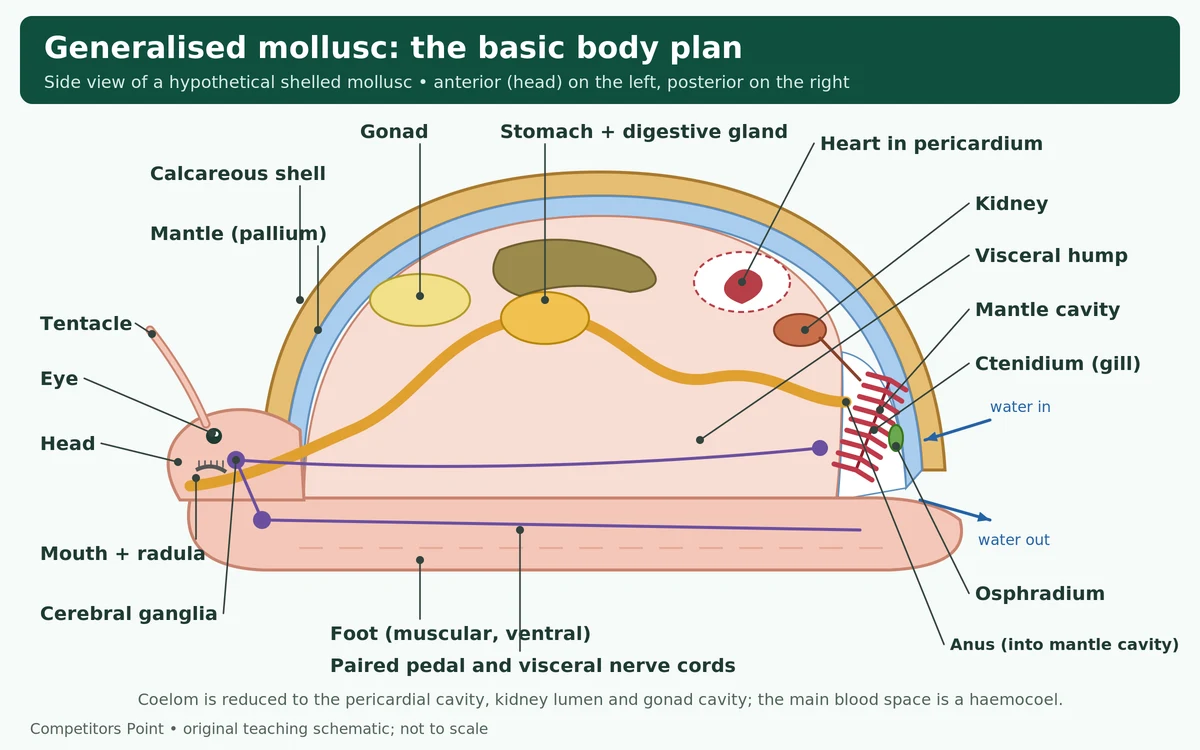
Textbooks teach molluscs through a generalised, or hypothetical, mollusc: a limpet-like animal with one shell on top and a creeping foot below. No living species looks exactly like it, but every class is a variation on it. In the diagram the head is on the left (anterior) and the mantle cavity is on the right (posterior).
1. Head
The head is at the anterior end. It carries sensory tentacles, often eyes (in Pila on short stalks called ommatophores), and the mouth with the radula inside. The head is well developed in gastropods and cephalopods, small in chitons, and absent in bivalves. That is why bivalves are also called Acephala, meaning headless. A cephalopod head is so prominent that the class is named after it: cephalo means head and poda means foot.
2. Muscular foot
The foot is the ventral, muscular part of the body and is used for locomotion. Its shape changes with lifestyle. It is a broad creeping sole in Pila and chitons, a hatchet-shaped burrowing foot in bivalves (hence Pelecypoda, hatchet foot), and a small digging foot in Dentalium. In cephalopods it is changed into arms and a siphon (funnel) used for jet propulsion. NEET likes to ask what the cephalopod foot became.
3. Visceral hump (visceral mass)
The visceral hump lies dorsally, above the foot. It holds most of the internal organs: the stomach and digestive gland, intestine, heart in its pericardium, kidneys and gonads. Your notes make a useful point here. In invertebrates the heart lies on the dorsal side, and in molluscs it sits in the visceral hump next to the kidney. In gastropods the hump is coiled and twisted (see torsion below).
4. Mantle (pallium) and mantle cavity
NCERT defines the mantle as a soft and spongy layer of skin over the visceral hump. Its epithelium secretes the shell. Where the mantle hangs free of the body it encloses a space. NCERT is precise: the mantle cavity is the space between the hump and the mantle. Do not confuse it with the space between the shell and the mantle, which is a classic wrong option.
The mantle cavity is the working chamber of a mollusc. It holds the ctenidia (gills) and the osphradium, and receives the openings of the anus, kidneys and gonads. Cilia drive a water current in over the gills and out again, carrying away faeces and nitrogenous waste. This is the logic behind NCERT’s statement that the gills have respiratory and excretory functions. In land snails, the vascular wall of the mantle cavity becomes a lung (pulmonary sac). In cephalopods, muscular contraction of the mantle forces water out through the siphon.
A correction to watch for: some diagrams, including the one in the supplied notes, label a “ventral nerve cord” under the gut as in annelids. Molluscs do not have a single solid ventral nerve cord. They have paired ganglia joined by paired nerve cords, described under the nervous system below.
Molluscan shell: three layers and pearl formation
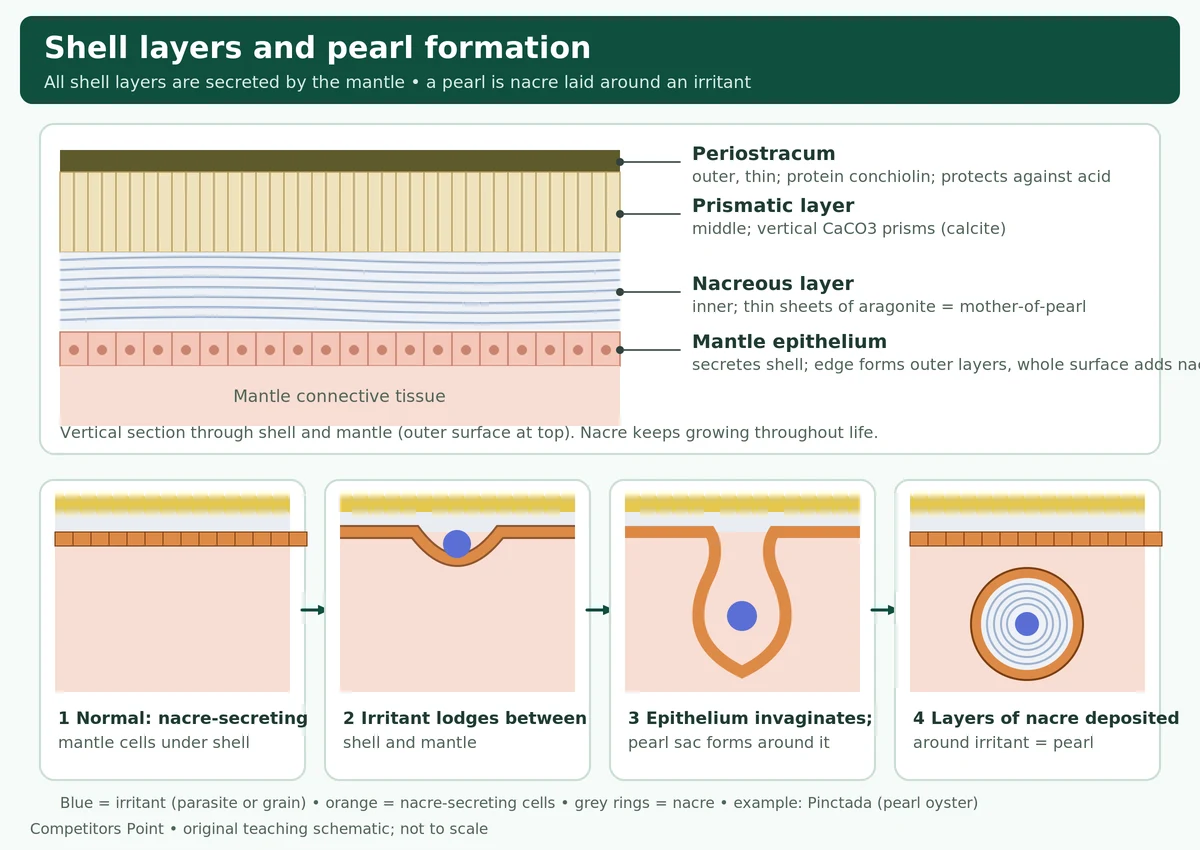
NCERT says the body is covered by a calcareous shell, and Table 4.2 records “external skeleton of shell usually present”. The word usually matters, as the exceptions below show. The shell is made of calcium carbonate laid on a protein framework called conchiolin, and it is secreted entirely by the mantle. It is not chitin; chitin is the arthropod exoskeleton. Three layers are seen in a vertical section:
| Layer | Position | Composition | Secreted by |
|---|---|---|---|
| Periostracum | Outermost, thin | Horny protein (conchiolin); protects the lime from acid water | Mantle edge |
| Prismatic layer | Middle | Vertical crystals (prisms) of calcium carbonate, mainly calcite | Mantle edge |
| Nacreous layer | Innermost | Thin sheets of calcium carbonate (aragonite) giving mother-of-pearl lustre | Whole mantle surface, throughout life |
Because the mantle edge adds new periostracum and prisms at the margin, the shell grows in size and leaves growth lines. The whole mantle surface keeps adding nacre on the inside, so the shell also grows thicker. The layered shine of nacre comes from light reflecting between the very thin aragonite sheets.
Shell variations to remember
- One coiled shell: Pila and most gastropods. Pila also has a calcareous plate, the operculum, that closes the shell opening.
- Two hinged valves: bivalves such as Pinctada, Unio and Mytilus.
- Eight overlapping plates: chitons (Chaetopleura).
- A tusk-shaped tube open at both ends: Dentalium.
- An internal shell: Sepia (calcareous cuttlebone), Loligo (a horny pen or gladius) and Aplysia (a small, thin shell hidden by the mantle).
- No shell: Octopus, most nudibranchs such as Doris, and slugs (Limax keeps only a tiny internal plate).
- External chambered shell in a cephalopod: Nautilus.
Mechanism of pearl formation
A pearl is the mollusc’s defence against an irritant. Normally the nacre-secreting cells of the mantle lie flat against the shell. When a foreign particle (often a parasite or a bit of debris; sand is the popular example) gets trapped between the shell and the mantle, the epithelium invaginates around it. The pocket pinches off to form a closed pearl sac. The cells keep secreting concentric layers of nacre (calcium carbonate with conchiolin), and the particle ends up sealed inside a pearl. The pearl oyster Pinctada is the classic example. In cultured pearls, technicians insert a shell bead with a small piece of mantle tissue, so the animal forms a pearl sac on purpose. Freshwater mussels can also make pearls.
Coelom, haemocoel and symmetry in Mollusca
NCERT classifies molluscs as coelomates. The coelom forms by splitting of the mesoderm, so it is a schizocoel, as in annelids and arthropods. In adults the coelom is greatly reduced and survives mainly as the pericardial cavity around the heart, plus the cavities of the kidneys and gonads. The large spaces through which blood moves form a haemocoel, part of the open circulatory system. Do not call molluscs pseudocoelomates just because the adult coelom is small: the haemocoel is a blood space, not a false coelom.
Molluscs are bilaterally symmetrical in the NCERT account, and their larvae are bilateral. Your notes rightly flag the exception: adult gastropods are asymmetrical, because torsion and coiling twist the visceral mass. If a question asks whether Pila is bilaterally symmetrical as an adult, the answer is no. If it asks about the phylum, the answer is bilateral.
Body systems of Phylum Mollusca
Digestive system and the radula
The alimentary canal is complete. It runs mouth → buccal cavity → oesophagus → stomach → intestine → anus, and the anus opens into the mantle cavity. A large digestive gland (often called the hepatopancreas) opens into the stomach. Bivalves have a gelatinous rod called the crystalline style in the stomach, which releases enzymes as it rotates.
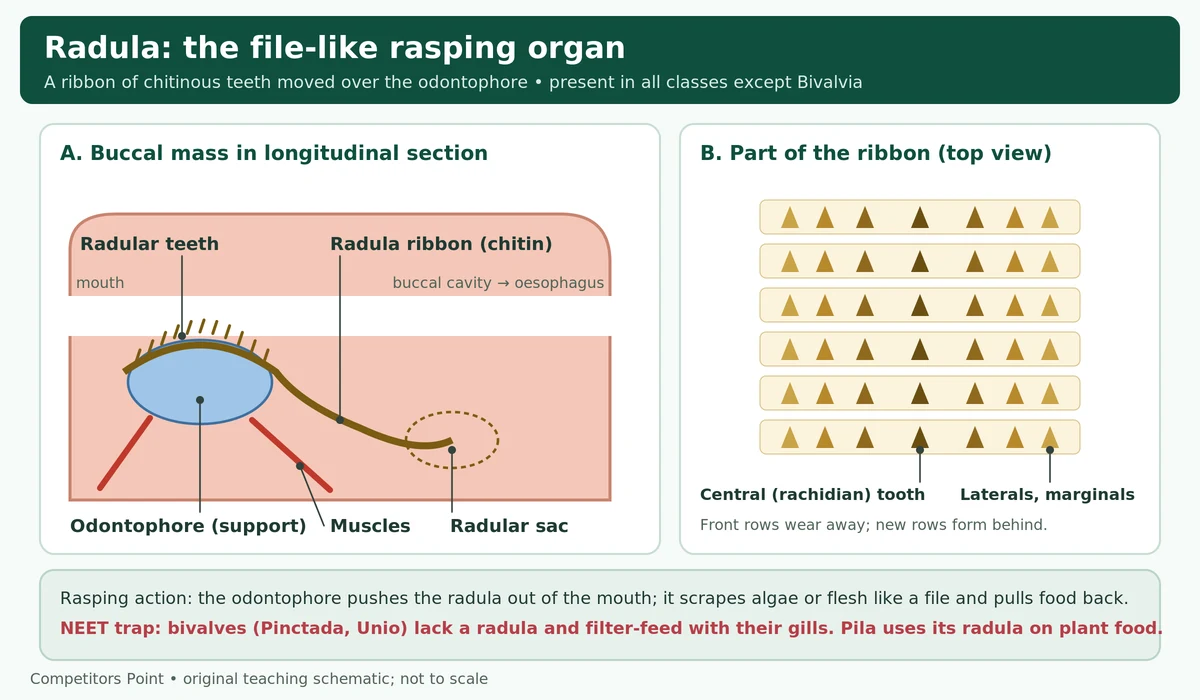
The radula is the feeding organ NEET asks about most often. NCERT calls it a file-like rasping organ for feeding. It is a ribbon carrying many transverse rows of tiny chitinous teeth, supported by a cartilage-like odontophore and moved by muscles. The odontophore pushes the radula out through the mouth, the teeth scrape algae, plant tissue or flesh, and the ribbon pulls the food back in. Teeth wear away at the front and are replaced from the radular sac at the back, like a conveyor belt. Pila rasps plant food; some predatory cone snails have changed radular teeth into venom-injecting harpoons.
Exam point: the radula is present in all classes except Bivalvia. Pinctada, Unio and Mytilus filter food particles from water with their ciliated gills instead. NCERT Exercise 14 pairs Radula with Mollusca.
Respiration: ctenidia, pulmonary sac and body surface
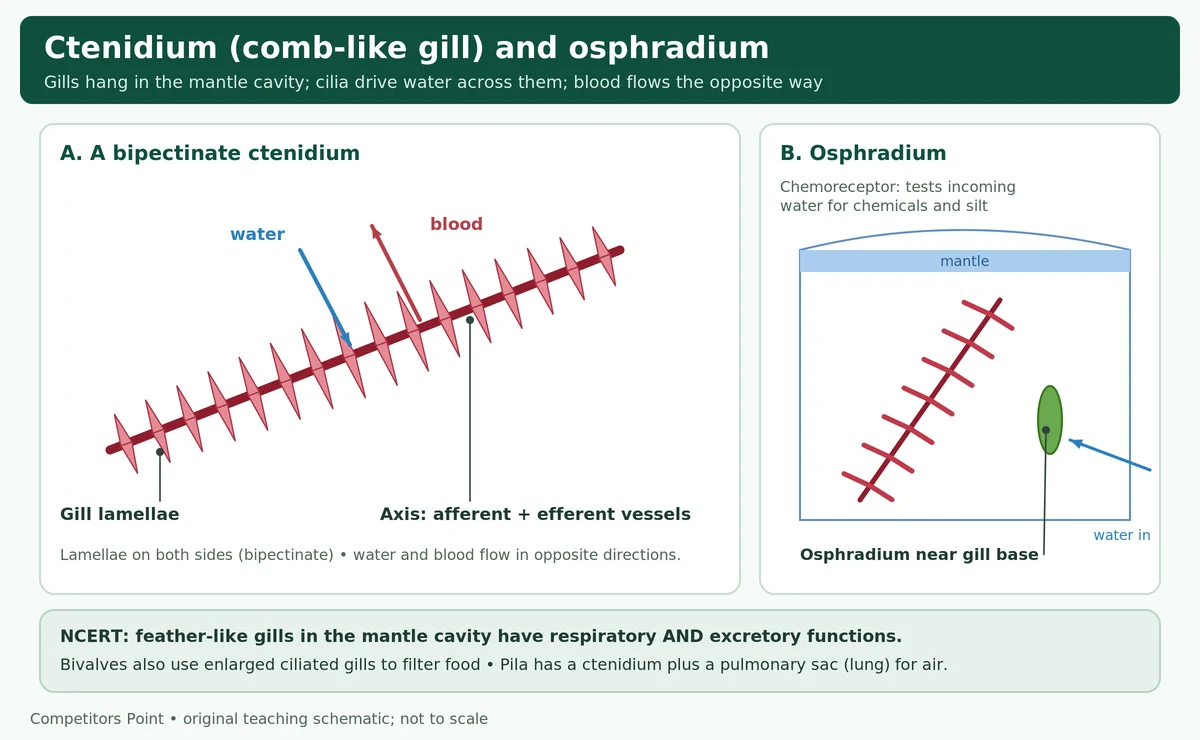
The gills of molluscs are called ctenidia (singular ctenidium, from the Greek for comb). Each ctenidium has a central axis carrying afferent and efferent blood vessels, with flat gill lamellae on one side (monopectinate) or both sides (bipectinate). NCERT calls them feather-like. Cilia on the lamellae drive water in one direction while blood flows the other way. This counter-current flow makes gas exchange efficient.
- Ctenidia only: most aquatic molluscs (Pinctada, Unio, Sepia, Loligo, Octopus).
- Ctenidium plus pulmonary sac: Pila, which is amphibious. A nuchal lobe can roll into a siphon to draw air into the lung while the snail rests near the water surface.
- Pulmonary sac (lung) only: land snails and slugs such as Helix and Limax. The mantle cavity wall is rich in blood vessels.
- Mantle surface, no gills: Dentalium.
- Secondary gills: nudibranchs such as Doris, which have lost the original ctenidia.
In bivalves the large gills are also feeding organs: mucus and cilia trap food particles and move them to the mouth. One structure, the gill, therefore serves respiration, feeding and the movement of water that carries away waste.
Circulation and the respiratory pigment
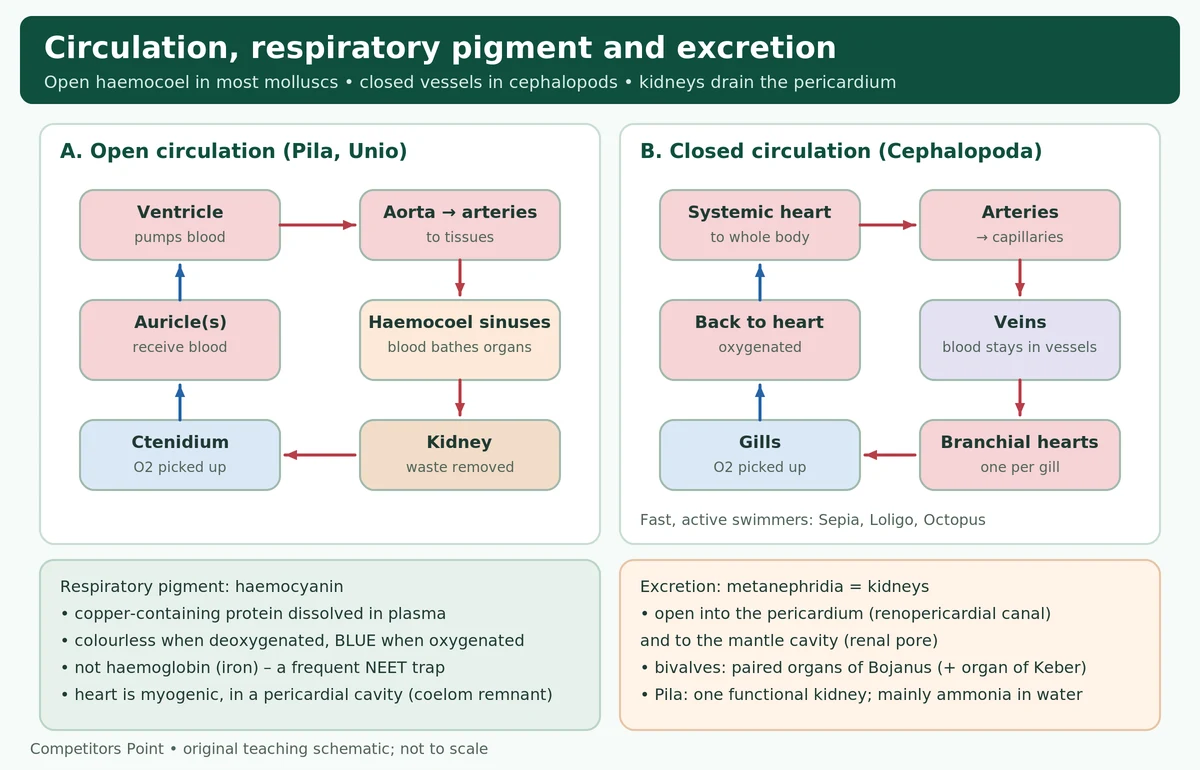
Most molluscs have an open circulatory system. A muscular, myogenic heart lies dorsally in the pericardial cavity. Its ventricle pumps blood through the aorta and arteries, but the blood then leaves the vessels and flows through tissue spaces called haemocoel sinuses, bathing the organs directly. It collects in veins, passes through the kidney and the gills, and returns to the auricles. The number of auricles varies: bivalves have two auricles and one ventricle (and in Unio the rectum passes right through the ventricle), whereas Pila has one auricle and one ventricle, partly as a result of torsion.
Cephalopods have a closed circulatory system, as your notes point out with Octopus. Blood stays inside arteries, capillaries and veins. Besides the main (systemic) heart, there is a branchial heart at the base of each gill, so Octopus has three hearts. Closed circulation keeps blood pressure high enough for the fast swimming and hunting of squids, cuttlefish and octopuses.
The respiratory pigment is haemocyanin, a copper-containing protein dissolved in the plasma. It has no red blood cells. Haemocyanin is colourless when deoxygenated and blue when oxygenated, which is why octopus blood looks blue. Do not write haemoglobin, which is iron-based. A rare exception, the ram’s horn snail Planorbis, uses haemoglobin, but for NEET the answer is haemocyanin.
Excretion: kidneys (metanephridia)
Molluscan kidneys are metanephridia. Each one opens at one end into the pericardial cavity (a coelomic space) through a renopericardial canal, and at the other end into the mantle cavity through a renal pore. Fluid filtered from the blood into the pericardium is changed as it passes through the kidney, and the waste is flushed out with the exhalant water current. Kidneys lie close to the heart, as your notes show.
- Bivalves: one pair of kidneys called the organs of Bojanus, with pericardial glands called the organs of Keber.
- Gastropods: torsion often leaves only one functional kidney, as in Pila.
- Number: usually one pair. Nautilus has two pairs and Neopilina has several pairs. The supplied notes say “2 pairs of sac-like kidneys”; that applies to Nautilus, not to molluscs in general.
- Waste: aquatic molluscs excrete mainly ammonia (ammonotelic). Land snails save water by excreting uric acid. Pila is usually taught as switching toward uric acid while it aestivates.
- NCERT link: the gills also help in excretion, which is why NCERT gives them respiratory and excretory functions.
Nervous system and sense organs
The molluscan nervous system is built from paired ganglia joined by nerve cords: cerebral ganglia above the oesophagus serve the head and sense organs, pedal ganglia serve the foot, pleural ganglia the mantle, and visceral ganglia the visceral organs. Together they form a nerve ring around the oesophagus. In chitons and Neopilina the cords form a simple ladder; in gastropods the visceral cords are twisted into a figure of eight by torsion (streptoneury). Cephalopods concentrate their ganglia into a large brain inside a cartilaginous cranium. It is the most complex brain of any invertebrate, which is why octopuses learn and solve problems so well. The squid Loligo has giant nerve fibres (axons), which made the classic studies of nerve impulses possible.
| Sense organ | Location | Function |
|---|---|---|
| Tentacles | Head | Touch and chemical sense (NCERT: sensory tentacles) |
| Eyes | Head; on ommatophores in Pila | Light detection; a camera-type eye in cephalopods |
| Osphradium | Mantle cavity, near the base of the gill | Chemoreceptor: tests the chemical nature (and silt content) of incoming water |
| Statocysts | Near the pedal ganglia, in the foot | Balance (equilibrium) and orientation |
The cephalopod eye has a cornea, lens and retina and forms images like a vertebrate eye, but it evolved separately. That makes it an analogous structure, a textbook case of convergent evolution. Unlike our eye, it has no blind spot, because its nerve fibres leave from behind the retina.
Torsion in gastropods
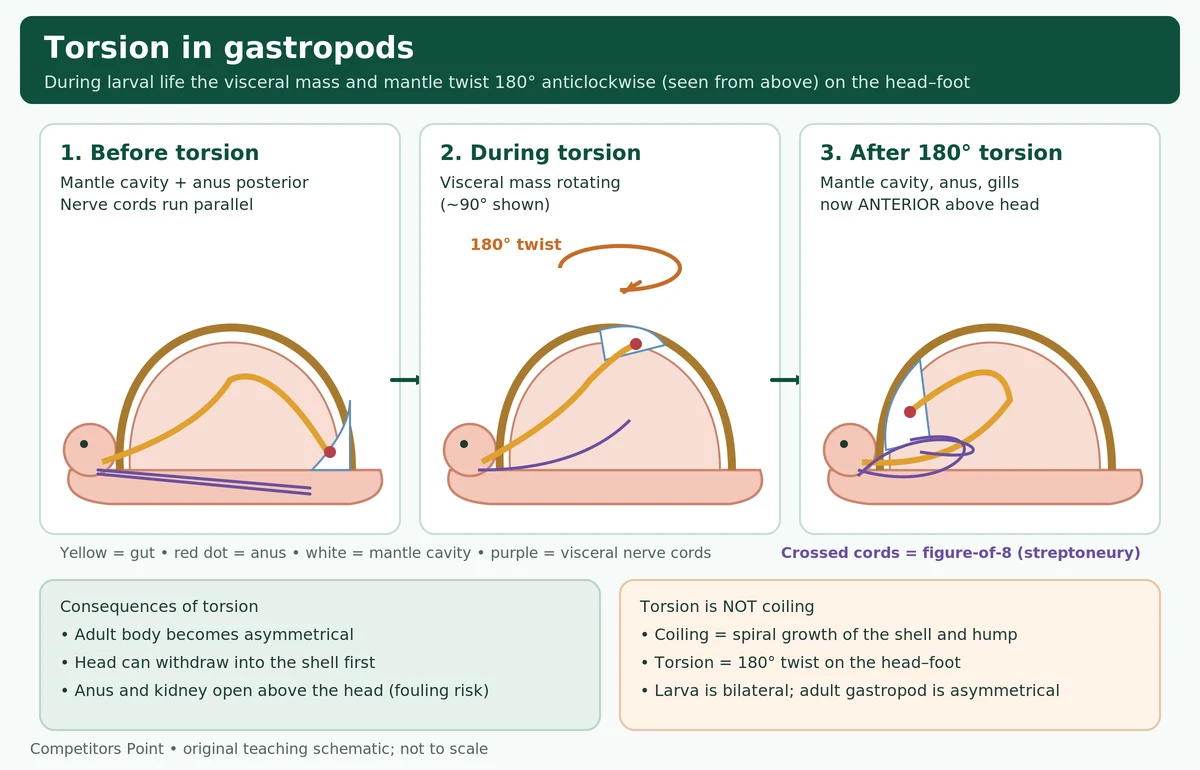
Torsion happens in the veliger larva of gastropods. Before torsion the larva is bilaterally symmetrical, and its mantle cavity, gills and anus face backwards (posterior). Then the visceral mass and mantle rotate 180° anticlockwise (viewed from above) on the head and foot. Part of the turn is caused by an unequal muscle that grows on one side only; the rest comes from uneven growth. Your notes describe this disproportionate development: the visceral part grows and turns while the head and foot stay in place.
- The mantle cavity, gills, anus and kidney openings move from posterior to anterior, above the head.
- The gut becomes U-shaped, so the anus opens near the head.
- The visceral nerve cords cross into a figure of eight (streptoneury).
- Organs on one side are often reduced, so Pila has one ctenidium, one kidney and one auricle.
- The adult body becomes asymmetrical.
Biologists still debate why torsion evolved. Common explanations are that the head can now be pulled into the shell first, and that the osphradium faces forward to sample the water ahead. The cost is that waste is released above the head, and various snails have ways of moving it aside. Do not confuse torsion with coiling. Coiling is the spiral growth of the shell and visceral hump; torsion is the 180° twist. Some sea slugs and sea hares, including Aplysia, partly untwist as adults, which is called detorsion.
Reproduction and development: trochophore, veliger and glochidium
NCERT says molluscs are usually dioecious and oviparous with indirect development. All three qualifiers matter:
- Usually dioecious: sexes are separate in Pila, Pinctada, Unio and cephalopods. Aplysia, Helix and Limax are hermaphrodite.
- Fertilisation: external in many marine bivalves and internal in most gastropods and in cephalopods. In Octopus a modified arm, the hectocotylus, transfers sperm packets to the female.
- Oviparous: eggs are laid. Pila lays clusters of eggs above the water line.
- Indirect development: a larval stage is present in most marine forms.
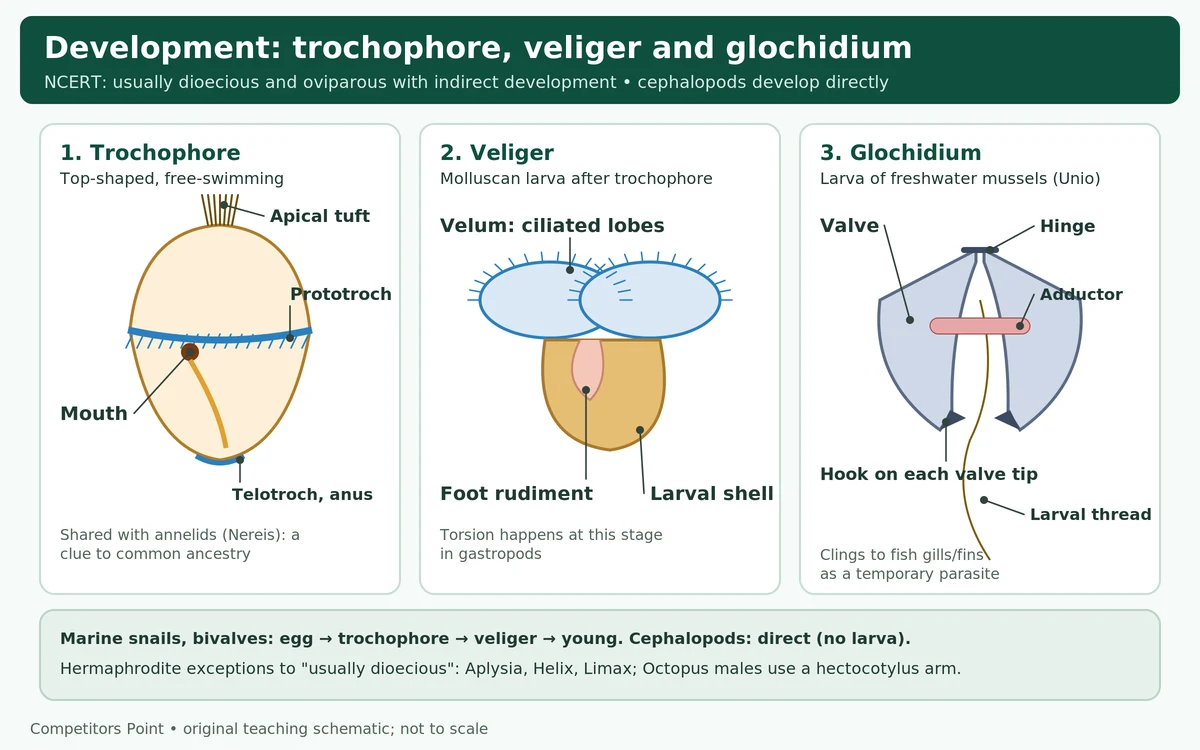
| Larva | Found in | Key features |
|---|---|---|
| Trochophore | Many marine molluscs (also polychaete annelids such as Nereis) | Top-shaped, free-swimming; ring of cilia (prototroch) around the middle; apical tuft |
| Veliger | Marine gastropods and bivalves (follows the trochophore) | Ciliated velum lobes for swimming and feeding; larval shell and foot; torsion occurs at this stage in gastropods |
| Glochidium | Freshwater mussels such as Unio and Lamellidens | Tiny bivalved larva with hooked valves; clings to fish gills or fins as a temporary parasite before dropping off as a young mussel |
Development is direct in cephalopods, which hatch as miniature adults, and in many land and freshwater snails. Pila’s young pass their larval stages inside the egg and hatch as tiny snails. This explains why NCERT says development is usually indirect. A shared trochophore larva is one of the main pieces of evidence that molluscs and annelids are closely related (both are placed in the Lophotrochozoa).
Pila globosa: the NCERT example of Mollusca
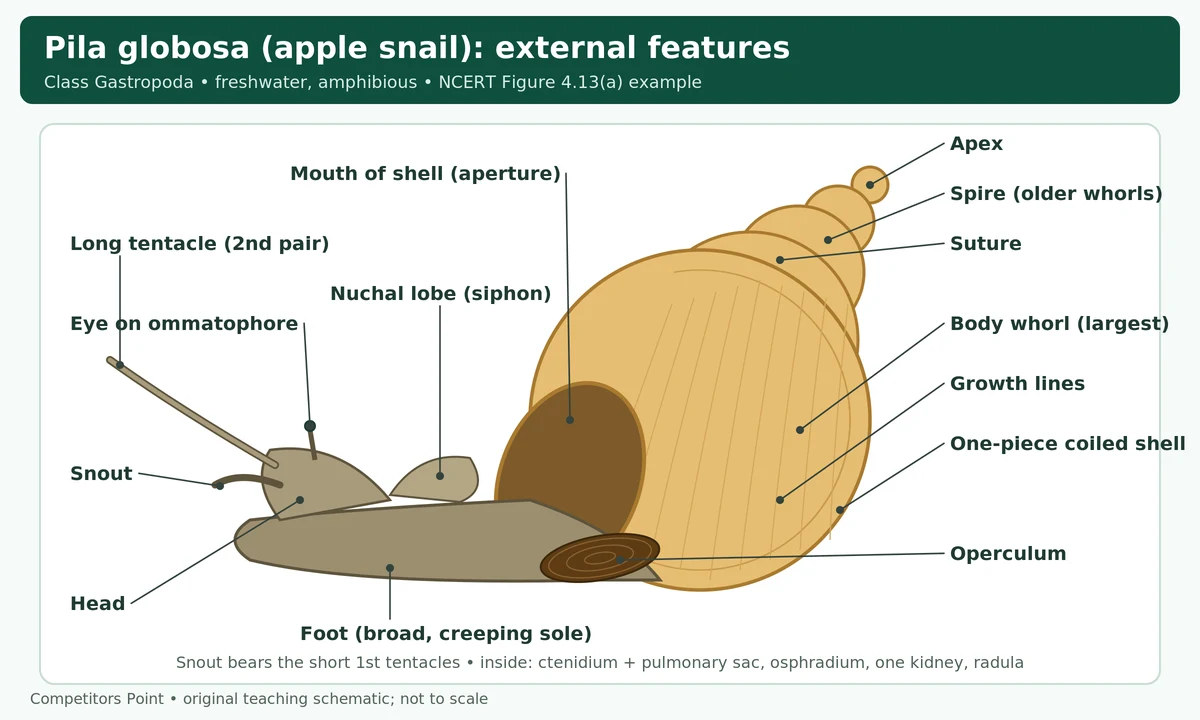
Pila globosa, the Indian apple snail, is the first mollusc in NCERT Figure 4.13 and the standard specimen in the NCERT laboratory manual. It lives in ponds, paddy fields and slow streams, and it comes out in large numbers in the rainy season. It belongs to class Gastropoda.
- Shell: a one-piece, spirally coiled, calcareous shell. It has a pointed apex, the older whorls forming the spire, a large body whorl, sutures between whorls, growth lines, and an opening called the mouth (aperture).
- Operculum: a calcareous plate carried on the back of the foot. It closes the aperture when the snail withdraws.
- Head: a snout with a pair of short tentacles, a pair of long tentacles, and eyes on short stalks (ommatophores) at the base of the long tentacles.
- Nuchal lobes: two folds beside the head. One forms a siphon for drawing air into the pulmonary sac.
- Foot: broad and muscular, with a flat creeping sole.
- Respiration: both a ctenidium (in water) and a pulmonary sac (in air), so it is amphibious.
- Other features: a radula for rasping plants, an osphradium, one functional kidney, a heart with one auricle and one ventricle, haemocyanin in the blood, and an asymmetrical adult body because of torsion.
- Aestivation: in dry summers Pila buries itself in mud, closes the operculum and becomes dormant until the rains return.
- Sexes: separate, with internal fertilisation; eggs are laid on land near water and development is direct.
NEET trap: NCERT Exercise 14 pairs Operculum with Osteichthyes, meaning the gill cover of bony fish. Pila’s operculum is a different structure that happens to share the name. In that NCERT match, Radula is the Mollusca option.
Classification of Mollusca: seven classes with examples
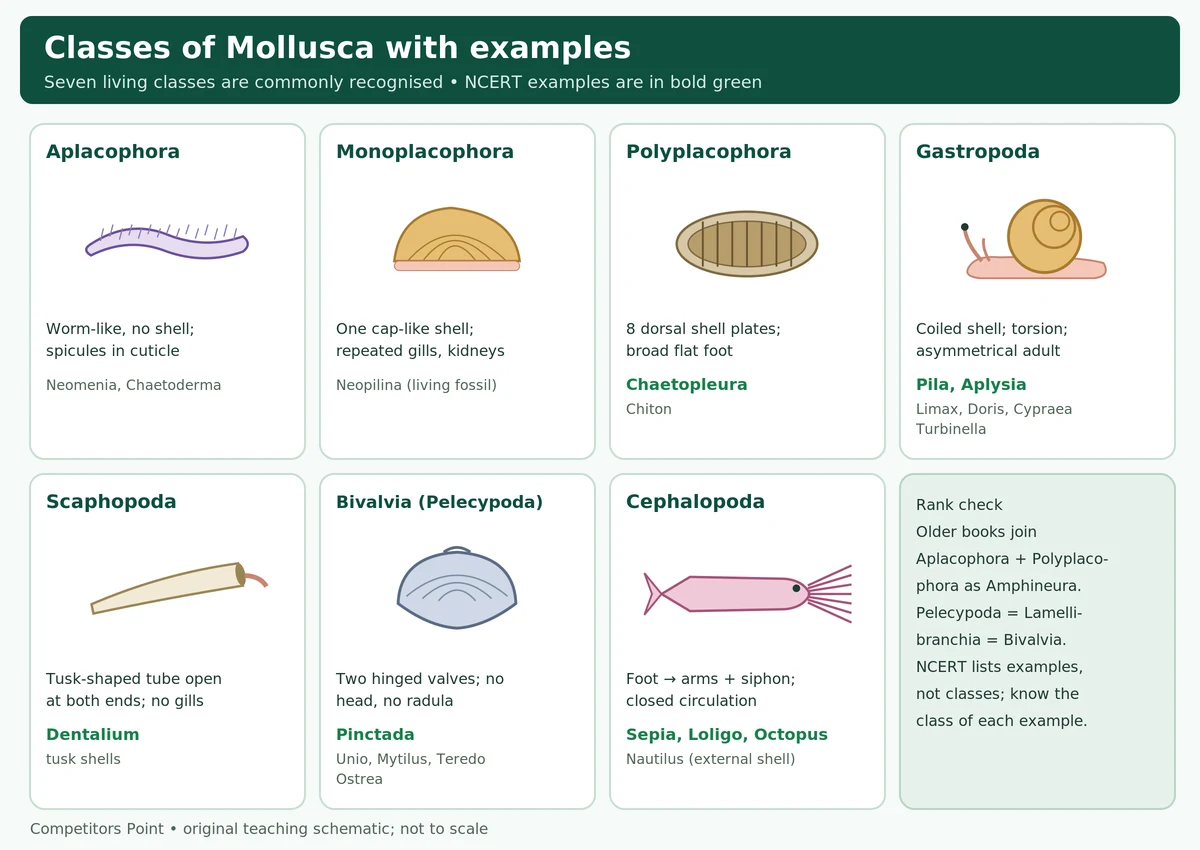
NCERT gives the phylum characters and eight examples but does not list classes. NEET can still ask which class an NCERT example belongs to, so a class table is worth learning. Most modern sources recognise seven living classes. Older books join Aplacophora and Polyplacophora as Amphineura, and Bivalvia is also called Pelecypoda or Lamellibranchia.
| Class | Key features | Examples (NCERT in bold) |
|---|---|---|
| Aplacophora | Worm-like; no shell; body covered by calcareous spicules; foot reduced or absent | Neomenia, Chaetoderma |
| Monoplacophora | Single cap-like shell; serially repeated gills, kidneys and muscles | Neopilina, a living fossil |
| Polyplacophora | Eight overlapping dorsal shell plates; broad flat foot; radula present | Chaetopleura (chiton) |
| Gastropoda | Coiled shell (sometimes reduced or lost); torsion; asymmetrical adult; distinct head with tentacles | Pila, Aplysia, Doris, Cypraea, Turbinella, Limax, Helix, Patella |
| Scaphopoda | Tusk-shaped shell open at both ends; no gills, no eyes; feeding tentacles (captacula) | Dentalium (tusk shell) |
| Bivalvia (Pelecypoda) | Two hinged valves; laterally compressed; no head and no radula; hatchet-shaped foot; filter-feeding gills | Pinctada, Unio, Mytilus, Teredo, Ostrea |
| Cephalopoda | Foot changed into arms and siphon; large brain; camera eyes; closed circulation; ink gland; shell external, internal or absent; direct development | Sepia, Loligo, Octopus, Nautilus |
Neopilina needs special mention. It was known only from fossils until living specimens were dredged from the deep Pacific in the 1950s, so it is called a living fossil. Its repeated gills, kidneys and muscles led to the view that it is a connecting link between Annelida and Mollusca. The supplied notes say “between Annelida and Arthropoda”, which is a common slip. That link is Peripatus (Onychophora). Also, the repetition in Neopilina is not true metamerism, so molluscs are still treated as unsegmented.
Mollusca examples: the eight NCERT animals and more
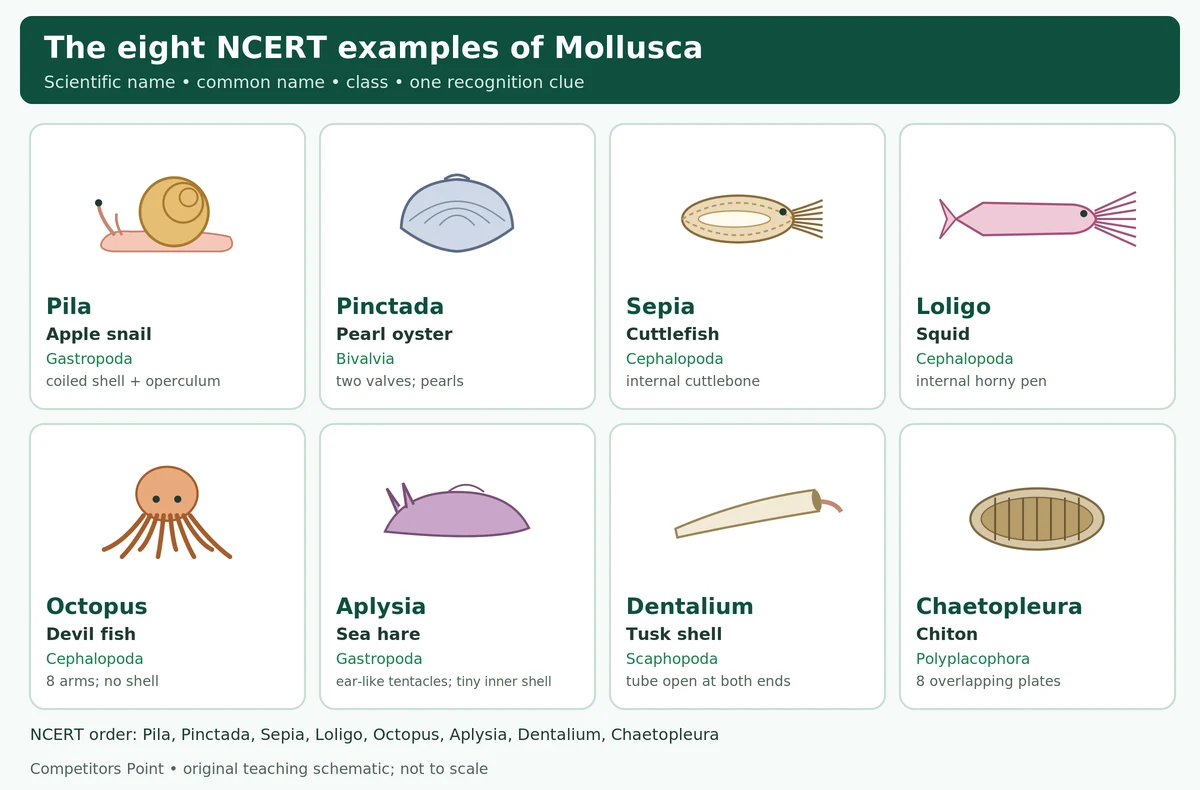
| Scientific name | Common name (NCERT) | Class | Recognition clue |
|---|---|---|---|
| Pila | Apple snail | Gastropoda | Coiled shell with operculum; amphibious |
| Pinctada | Pearl oyster | Bivalvia | Two valves; source of natural and cultured pearls |
| Sepia | Cuttlefish | Cephalopoda | Internal calcareous cuttlebone; 8 arms + 2 tentacles; ink |
| Loligo | Squid | Cephalopoda | Torpedo-shaped; internal horny pen; giant axons |
| Octopus | Devil fish | Cephalopoda | 8 arms with suckers; no shell; three hearts |
| Aplysia | Sea hare | Gastropoda | Ear-like head tentacles; small internal shell; hermaphrodite |
| Dentalium | Tusk shell | Scaphopoda | Tubular shell open at both ends |
| Chaetopleura | Chiton | Polyplacophora | Eight overlapping shell plates |
One way to remember them is by body form. Pila and Aplysia are snail-like gastropods. Pinctada is the bivalve. Sepia, Loligo and Octopus are the three cephalopods. Dentalium and Chaetopleura are the odd shapes, a tube and a plated oval. The examples in the supplied notes also come up in NEET questions:
| Example | Common name | Class |
|---|---|---|
| Neopilina | Living fossil | Monoplacophora |
| Unio | Freshwater mussel | Bivalvia |
| Mytilus | Marine mussel | Bivalvia |
| Teredo | Shipworm | Bivalvia |
| Cypraea | Cowrie | Gastropoda |
| Doris | Sea lemon | Gastropoda |
| Turbinella | Sacred chank (shankh) | Gastropoda |
| Limax / Helix | Slug / garden snail | Gastropoda |
| Nautilus | Pearly nautilus | Cephalopoda |
Mollusc or not? Names that mislead
NEET likes names that hide the phylum. Cuttlefish (Sepia) and devil fish (Octopus) are molluscs, not fish. Silverfish is an insect, starfish an echinoderm and jellyfish a cnidarian. A shipworm (Teredo) is a bivalve mollusc, not a worm, while a sea mouse (Aphrodite) is an annelid. Pila is an apple snail, not an apple-eating pest. When the options mix scientific names, look for the molluscan clues: a shell of CaCO3, a mantle, a radula or a muscular foot.
Economic importance of molluscs
| Use or effect | Molluscs involved | Notes |
|---|---|---|
| Food | Oysters, mussels, clams, squid (Loligo), cuttlefish (Sepia), octopus | A major protein source in coastal regions |
| Pearls | Pinctada (marine pearl oyster); freshwater mussels such as Lamellidens | Natural and cultured pearls; Indian pearl fisheries in the Gulf of Mannar |
| Mother-of-pearl, ornaments, lime | Nacreous shells, cowries (Cypraea), conchs | Buttons, inlay work, bangles; shells burnt to make lime and poultry grit |
| Culture and history | Cypraea moneta, Turbinella | Cowries were once used as money; the sacred chank is the shankh used in worship |
| Research | Loligo (giant axon), Aplysia (simple nervous system) | Nerve impulse studies; Nobel Prize-winning studies of learning and memory |
| Medicine | Conus (cone snails) | A painkiller (ziconotide) is based on a cone-snail venom peptide |
| Sepia products | Sepia | Ink gave the brown pigment called sepia; cuttlebone is a calcium supplement for cage birds |
| Water monitoring | Mussels and oysters | Filter feeders accumulate pollutants, so they are used as bioindicators |
| Harmful: boring | Teredo (shipworm) | Bores into wooden ships, jetties and piers |
| Harmful: pests | Achatina fulica (giant African snail), slugs | Invasive crop and garden pests in India |
| Harmful: disease | Lymnaea and other freshwater snails | Intermediate hosts of the liver fluke Fasciola and of blood flukes (Schistosoma) |
The link to flukes connects this chapter with Platyhelminthes. A parasite that needs a snail as intermediate host cannot finish its life cycle where the snail is absent, which is why snail control is part of fluke control.
Mollusca vs Annelida vs Arthropoda
These three phyla are all bilateral, triploblastic, coelomate and organised at the organ-system level, and NEET often puts them side by side. A good comparison table brings out the differences:
| Feature | Mollusca | Annelida | Arthropoda |
|---|---|---|---|
| Rank | Second largest phylum | Smaller | Largest phylum |
| Segmentation | Absent | Metameric (true segmentation) | Present; segments grouped into tagmata |
| Body covering | Calcareous shell secreted by the mantle | Moist cuticle; no shell | Chitinous exoskeleton; moulting |
| Locomotion | Muscular foot (arms and siphon in cephalopods) | Setae, parapodia, body-wall muscles | Jointed appendages |
| Adult coelom | Reduced; pericardial cavity | Large, fluid-filled; hydrostatic skeleton | Reduced; haemocoel |
| Circulation | Open (closed in cephalopods) | Closed | Open |
| Blood pigment | Haemocyanin (copper) | Haemoglobin dissolved in plasma (earthworm) | Haemocyanin in many crustaceans; little role in insects |
| Respiration | Ctenidia, pulmonary sac | Body surface (gills in some, e.g. parapodial gills in Nereis) | Gills, book gills, book lungs, tracheae |
| Excretion | Metanephridia (kidneys); gills help | Nephridia | Malpighian tubules (green glands in crustaceans) |
| Feeding structure | Radula (except bivalves) | Pharynx, jaws in leeches | Mouthparts from appendages |
| Larva | Trochophore, veliger, glochidium | Trochophore (polychaetes) | Varied, e.g. caterpillars and nymphs in insects |
| NCERT examples | Pila, Pinctada, Sepia, Octopus | Nereis, Pheretima, Hirudinaria | Apis, Bombyx, Anopheles, Limulus |
For the full details, see Phylum Annelida and Phylum Arthropoda, or browse all Animal Kingdom notes. Echinodermata comes next in NCERT. Note how the radula and the calcareous shell mark molluscs out, while jointed appendages and metamerism mark out the other two.
NEET exam traps on Mollusca
- Rank: Mollusca is the second largest phylum. Arthropoda is the largest.
- Mantle cavity: the space between the visceral hump and the mantle, not between the shell and the mantle.
- Gill functions: NCERT says respiratory and excretory.
- Radula: a file-like rasping organ, absent in bivalves (Pinctada, Unio).
- Segmentation: molluscs are unsegmented. Table 4.2 records segmentation as absent.
- Shell material: calcium carbonate with conchiolin, not chitin. Shell is “usually present”: Octopus has none.
- Pigment: haemocyanin (copper), blue when oxygenated, not haemoglobin.
- Circulation: open in most, closed in cephalopods (Octopus, Sepia, Loligo).
- Symmetry: bilateral for the phylum; adult gastropods (Pila) are asymmetrical because of torsion.
- Torsion is not coiling; torsion is a 180° twist in the gastropod veliger.
- Neopilina links Annelida and Mollusca; Peripatus links Annelida and Arthropoda.
- Common names: Octopus = devil fish; Sepia = cuttlefish; Loligo = squid; Aplysia = sea hare (not “sea hair”); Dentalium = tusk shell; Chaetopleura = chiton.
- Misleading names: cuttlefish, devil fish and shipworm are molluscs; silverfish, starfish and jellyfish are not.
- Operculum: in NCERT Exercise 14 it matches Osteichthyes; Radula matches Mollusca.
- Development: usually indirect (trochophore → veliger), but direct in cephalopods and in Pila; the glochidium belongs to Unio.
- Osphradium tests water (chemoreceptor); the statocyst controls balance; do not swap them.
- Organ of Bojanus = kidney of bivalves; organ of Keber = pericardial gland.
NCERT checklist and Table 4.2 entry for Mollusca
Tick each NCERT statement after you can explain it in your own words:
- Second largest animal phylum (Figure 4.13: Pila, Octopus)
- Terrestrial or aquatic (marine or fresh water); organ-system level of organisation
- Bilaterally symmetrical, triploblastic and coelomate
- Body covered by a calcareous shell; unsegmented, with a distinct head, muscular foot and visceral hump
- Soft and spongy layer of skin forms a mantle over the visceral hump
- Mantle cavity is the space between the hump and the mantle; feather-like gills in it have respiratory and excretory functions
- Anterior head region has sensory tentacles
- Mouth contains a file-like rasping organ for feeding, called radula
- Usually dioecious and oviparous with indirect development
- Examples: Pila (Apple snail), Pinctada (Pearl oyster), Sepia (Cuttlefish), Loligo (Squid), Octopus (Devil fish), Aplysia (Sea hare), Dentalium (Tusk shell), Chaetopleura (Chiton)
- Summary line: soft body surrounded by an external calcareous shell
- Exercise 14: Radula → Mollusca
| Table 4.2 field | Mollusca entry |
|---|---|
| Level of organisation | Organ-system |
| Symmetry | Bilateral |
| Coelom | Coelomate |
| Segmentation | Absent |
| Digestive system | Complete |
| Circulatory system | Present |
| Respiratory system | Present |
| Distinctive features | External skeleton of shell usually present |
Eight quick-recall flip cards
Mollusca FAQs
What is phylum Mollusca?
Phylum Mollusca is the second largest animal phylum. It contains soft-bodied, unsegmented, bilaterally symmetrical, triploblastic coelomates with a head, a muscular foot, a visceral hump and a mantle, usually protected by a calcareous shell. Snails, oysters, squids and octopuses are molluscs.
What are the main characteristics of Mollusca?
They are organised at the organ-system level, with a calcareous shell, an unsegmented body (head, foot, visceral hump), a mantle and mantle cavity, feather-like gills with respiratory and excretory functions, sensory tentacles, a radula, open circulation with haemocyanin (closed in cephalopods), kidneys (metanephridia), and usually separate sexes with indirect development.
What are the NCERT examples of Mollusca?
Pila (apple snail), Pinctada (pearl oyster), Sepia (cuttlefish), Loligo (squid), Octopus (devil fish), Aplysia (sea hare), Dentalium (tusk shell) and Chaetopleura (chiton).
What are the classes of Mollusca?
Seven living classes are commonly recognised: Aplacophora, Monoplacophora, Polyplacophora, Gastropoda, Scaphopoda, Bivalvia (Pelecypoda) and Cephalopoda.
What is the radula?
The radula is a file-like rasping organ in the mouth of molluscs. It is a ribbon of chitinous teeth moved over a supporting odontophore. Bivalves do not have one.
What is torsion in Mollusca?
Torsion is the 180 degree anticlockwise rotation of the visceral mass and mantle on the head and foot during the larval development of gastropods. It brings the mantle cavity and anus to the front and makes the adult asymmetrical.
What is the function of the osphradium?
The osphradium is a chemoreceptor near the gills in the mantle cavity. It tests the chemical nature of the water entering the cavity.
Which respiratory pigment is found in molluscs?
Haemocyanin, a copper-containing pigment dissolved in plasma, which turns blue when oxygenated.
Do all molluscs have a shell?
No. Octopus has no shell, Sepia and Loligo have internal shells, and slugs have a reduced shell or none. This is why NCERT says the shell is usually present.
Which mollusc is called a living fossil?
Neopilina, a monoplacophoran, is called a living fossil and is regarded as a connecting link between Annelida and Mollusca.
30 Mollusca NEET MCQs
These are original practice questions, not previous-year questions. Try each one before you reveal the explanation.
Q1. According to NCERT, Mollusca is the
- (a) largest animal phylum
- (b) second largest animal phylum
- (c) third largest animal phylum
- (d) smallest coelomate phylum
Q2. The mantle cavity of a mollusc is the space between the
- (a) shell and the mantle
- (b) visceral hump and the mantle
- (c) head and the foot
- (d) gut and the body wall
Q3. The radula is best described as a
- (a) file-like rasping organ for feeding
- (b) chemoreceptor near the gill
- (c) balancing organ in the foot
- (d) calcareous plate closing the shell
Q4. A radula is absent in
- (a) Pila
- (b) Sepia
- (c) Pinctada
- (d) Chaetopleura
Q5. NCERT states that the feather-like gills of molluscs have
- (a) respiratory function only
- (b) respiratory and excretory functions
- (c) excretory function only
- (d) a locomotory function
Q6. The osphradium of a snail is a
- (a) photoreceptor
- (b) chemoreceptor that tests incoming water
- (c) balancing organ
- (d) excretory organ
Q7. Statocysts in molluscs help in
- (a) excretion
- (b) balance (equilibrium)
- (c) digestion
- (d) pearl formation
Q8. The respiratory pigment in the blood of most molluscs is
- (a) haemoglobin
- (b) haemocyanin
- (c) chlorocruorin
- (d) myoglobin
Q9. Haemocyanin contains
- (a) iron
- (b) copper
- (c) magnesium
- (d) zinc
Q10. A closed circulatory system is found in
- (a) Pila
- (b) Unio
- (c) Octopus
- (d) Dentalium
Q11. The organ of Bojanus is the
- (a) gill of a snail
- (b) kidney of a bivalve
- (c) statocyst of a squid
- (d) gonad of a chiton
Q12. Torsion is characteristic of
- (a) Bivalvia
- (b) Cephalopoda
- (c) Gastropoda
- (d) Scaphopoda
Q13. During torsion, the visceral mass and mantle rotate through
- (a) 90°
- (b) 180°
- (c) 270°
- (d) 360°
Q14. After torsion, the mantle cavity of a gastropod lies
- (a) posteriorly
- (b) anteriorly, above the head
- (c) ventrally, below the foot
- (d) inside the visceral hump
Q15. The larva of the freshwater mussel Unio is the
- (a) trochophore
- (b) veliger
- (c) glochidium
- (d) nauplius
Q16. A veliger larva is identified by its
- (a) prototroch only
- (b) ciliated velum lobes
- (c) jointed appendages
- (d) water vascular system
Q17. The larva shared by many annelids and molluscs is the
- (a) trochophore
- (b) glochidium
- (c) tadpole
- (d) planula
Q18. Neopilina is regarded as a connecting link between
- (a) Annelida and Arthropoda
- (b) Annelida and Mollusca
- (c) Mollusca and Echinodermata
- (d) Arthropoda and Mollusca
Q19. The common name of Chaetopleura is
- (a) tusk shell
- (b) chiton
- (c) sea hare
- (d) apple snail
Q20. Dentalium is commonly called
- (a) tusk shell
- (b) pearl oyster
- (c) sea lemon
- (d) shipworm
Q21. Aplysia is commonly called
- (a) devil fish
- (b) sea hare
- (c) cuttlefish
- (d) cowrie
Q22. In NCERT, the name devil fish refers to
- (a) Sepia
- (b) Loligo
- (c) Octopus
- (d) Pila
Q23. Which animal is a mollusc despite its name?
- (a) Silverfish
- (b) Starfish
- (c) Cuttlefish
- (d) Jellyfish
Q24. A pearl is formed by layers of
- (a) chitin secreted by the foot
- (b) nacre secreted by the mantle epithelium
- (c) mucus secreted by the gills
- (d) periostracum secreted by the radula
Q25. The innermost layer of a molluscan shell is the
- (a) periostracum
- (b) prismatic layer
- (c) nacreous layer
- (d) cuticle
Q26. Which mollusc has no shell?
- (a) Octopus
- (b) Pila
- (c) Pinctada
- (d) Dentalium
Q27. The molluscan body is
- (a) segmented with jointed appendages
- (b) unsegmented, with a head, muscular foot and visceral hump
- (c) segmented into metameres
- (d) radially symmetrical
Q28. In adult molluscs, the coelom is mainly reduced to the
- (a) pericardial cavity
- (b) pseudocoelom
- (c) spongocoel
- (d) gastrovascular cavity
Q29. Pila breathes using
- (a) a ctenidium only
- (b) a pulmonary sac only
- (c) both a ctenidium and a pulmonary sac
- (d) book lungs
Q30. Which statement matches NCERT for Mollusca?
- (a) Usually monoecious and viviparous
- (b) Usually dioecious and oviparous with indirect development
- (c) Always hermaphrodite with direct development
- (d) Asexual reproduction by budding
30 assertion–reason questions
Every assertion–reason item uses these same four options. Decide whether R actually explains A, not just whether both statements are true.
Q1. Assertion: Adult gastropods are asymmetrical.
Reason: During development, torsion rotates the visceral mass 180° on the head and foot.
- (a) Both true; R correctly explains A
- (b) Both true; R does not explain A
- (c) A true; R false
- (d) A false; R true
Q2. Assertion: Bivalves cannot rasp food.
Reason: Bivalves lack a radula.
- (a) Both true; R correctly explains A
- (b) Both true; R does not explain A
- (c) A true; R false
- (d) A false; R true
Q3. Assertion: Octopus has a closed circulatory system.
Reason: Octopus blood contains haemocyanin.
- (a) Both true; R correctly explains A
- (b) Both true; R does not explain A
- (c) A true; R false
- (d) A false; R true
Q4. Assertion: Molluscan blood looks blue when oxygenated.
Reason: Haemocyanin contains copper.
- (a) Both true; R correctly explains A
- (b) Both true; R does not explain A
- (c) A true; R false
- (d) A false; R true
Q5. Assertion: Molluscs are coelomates.
Reason: In adults, the coelom is reduced mainly to the pericardial cavity.
- (a) Both true; R correctly explains A
- (b) Both true; R does not explain A
- (c) A true; R false
- (d) A false; R true
Q6. Assertion: Molluscs are metamerically segmented like annelids.
Reason: Neopilina shows serial repetition of some organs.
- (a) Both true; R correctly explains A
- (b) Both true; R does not explain A
- (c) A true; R false
- (d) A false; R true
Q7. Assertion: The osphradium is a chemoreceptor.
Reason: It tests the water entering the mantle cavity.
- (a) Both true; R correctly explains A
- (b) Both true; R does not explain A
- (c) A true; R false
- (d) A false; R true
Q8. Assertion: Pinctada produces pearls.
Reason: Its mantle epithelium secretes nacre around irritants.
- (a) Both true; R correctly explains A
- (b) Both true; R does not explain A
- (c) A true; R false
- (d) A false; R true
Q9. Assertion: Sepia is a fish.
Reason: Sepia has an internal cuttlebone.
- (a) Both true; R correctly explains A
- (b) Both true; R does not explain A
- (c) A true; R false
- (d) A false; R true
Q10. Assertion: NCERT states that molluscan gills have respiratory and excretory functions.
Reason: The gills lie in the mantle cavity.
- (a) Both true; R correctly explains A
- (b) Both true; R does not explain A
- (c) A true; R false
- (d) A false; R true
Q11. Assertion: Torsion and coiling are the same process.
Reason: Coiling is the spiral growth of the shell and visceral hump.
- (a) Both true; R correctly explains A
- (b) Both true; R does not explain A
- (c) A true; R false
- (d) A false; R true
Q12. Assertion: Unio has a glochidium larva.
Reason: A glochidium attaches to fish as a temporary parasite.
- (a) Both true; R correctly explains A
- (b) Both true; R does not explain A
- (c) A true; R false
- (d) A false; R true
Q13. Assertion: Trochophore larvae suggest a relationship between annelids and molluscs.
Reason: Both groups include species with trochophore larvae.
- (a) Both true; R correctly explains A
- (b) Both true; R does not explain A
- (c) A true; R false
- (d) A false; R true
Q14. Assertion: Dentalium belongs to Gastropoda.
Reason: Dentalium has a tubular shell open at both ends.
- (a) Both true; R correctly explains A
- (b) Both true; R does not explain A
- (c) A true; R false
- (d) A false; R true
Q15. Assertion: The radula works like a file.
Reason: It carries rows of chitinous teeth.
- (a) Both true; R correctly explains A
- (b) Both true; R does not explain A
- (c) A true; R false
- (d) A false; R true
Q16. Assertion: Pila can survive dry summers.
Reason: It aestivates in mud with its operculum closing the shell aperture.
- (a) Both true; R correctly explains A
- (b) Both true; R does not explain A
- (c) A true; R false
- (d) A false; R true
Q17. Assertion: Molluscs have a muscular foot.
Reason: In cephalopods, the foot is modified into arms and a siphon.
- (a) Both true; R correctly explains A
- (b) Both true; R does not explain A
- (c) A true; R false
- (d) A false; R true
Q18. Assertion: All molluscs are dioecious.
Reason: Aplysia is hermaphrodite.
- (a) Both true; R correctly explains A
- (b) Both true; R does not explain A
- (c) A true; R false
- (d) A false; R true
Q19. Assertion: The mantle secretes the shell.
Reason: The mantle is a soft, spongy fold of skin over the visceral hump.
- (a) Both true; R correctly explains A
- (b) Both true; R does not explain A
- (c) A true; R false
- (d) A false; R true
Q20. Assertion: After torsion, the anus of a gastropod opens above the head.
Reason: Torsion moves the mantle cavity forward.
- (a) Both true; R correctly explains A
- (b) Both true; R does not explain A
- (c) A true; R false
- (d) A false; R true
Q21. Assertion: Octopus has an external calcareous shell.
Reason: Octopus is a cephalopod.
- (a) Both true; R correctly explains A
- (b) Both true; R does not explain A
- (c) A true; R false
- (d) A false; R true
Q22. Assertion: Circulation in most molluscs is open.
Reason: Blood flows through haemocoel sinuses that bathe the organs.
- (a) Both true; R correctly explains A
- (b) Both true; R does not explain A
- (c) A true; R false
- (d) A false; R true
Q23. Assertion: Mollusca is the largest animal phylum.
Reason: Arthropoda includes over two-thirds of all named species.
- (a) Both true; R correctly explains A
- (b) Both true; R does not explain A
- (c) A true; R false
- (d) A false; R true
Q24. Assertion: Cephalopods show direct development.
Reason: Cephalopods have a veliger larva.
- (a) Both true; R correctly explains A
- (b) Both true; R does not explain A
- (c) A true; R false
- (d) A false; R true
Q25. Assertion: Adult Pila is bilaterally symmetrical.
Reason: Pila is a gastropod that undergoes torsion.
- (a) Both true; R correctly explains A
- (b) Both true; R does not explain A
- (c) A true; R false
- (d) A false; R true
Q26. Assertion: Molluscan kidneys are metanephridia.
Reason: They open internally into the pericardial (coelomic) cavity.
- (a) Both true; R correctly explains A
- (b) Both true; R does not explain A
- (c) A true; R false
- (d) A false; R true
Q27. Assertion: The nacreous layer has a mother-of-pearl shine.
Reason: It is built of thin sheets of aragonite.
- (a) Both true; R correctly explains A
- (b) Both true; R does not explain A
- (c) A true; R false
- (d) A false; R true
Q28. Assertion: Chiton is placed in Polyplacophora.
Reason: Its shell has eight dorsal plates.
- (a) Both true; R correctly explains A
- (b) Both true; R does not explain A
- (c) A true; R false
- (d) A false; R true
Q29. Assertion: Squid giant axons are used in nerve research.
Reason: Loligo is a cephalopod mollusc.
- (a) Both true; R correctly explains A
- (b) Both true; R does not explain A
- (c) A true; R false
- (d) A false; R true
Q30. Assertion: The molluscan shell is a chitinous exoskeleton.
Reason: The molluscan shell is calcareous.
- (a) Both true; R correctly explains A
- (b) Both true; R does not explain A
- (c) A true; R false
- (d) A false; R true
30 match-the-following questions
Q1. Match Column I with Column II.
| Column I | Column II |
|---|---|
| A. Pila | i. Squid |
| B. Pinctada | ii. Apple snail |
| C. Sepia | iii. Cuttlefish |
| D. Loligo | iv. Pearl oyster |
- (a) A–i, B–iv, C–iii, D–ii
- (b) A–iv, B–iii, C–ii, D–i
- (c) A–ii, B–i, C–iv, D–iii
- (d) A–ii, B–iv, C–iii, D–i
Q2. Match Column I with Column II.
| Column I | Column II |
|---|---|
| A. Octopus | i. Sea hare |
| B. Aplysia | ii. Tusk shell |
| C. Dentalium | iii. Devil fish |
| D. Chaetopleura | iv. Chiton |
- (a) A–ii, B–i, C–iv, D–iii
- (b) A–iv, B–i, C–ii, D–iii
- (c) A–iii, B–i, C–ii, D–iv
- (d) A–i, B–iv, C–ii, D–iii
Q3. Match Column I with Column II.
| Column I | Column II |
|---|---|
| A. Radula | i. Rasping organ |
| B. Osphradium | ii. Gill |
| C. Statocyst | iii. Balance |
| D. Ctenidium | iv. Chemoreceptor |
- (a) A–ii, B–iii, C–iv, D–i
- (b) A–iii, B–iv, C–i, D–ii
- (c) A–i, B–iv, C–iii, D–ii
- (d) A–i, B–ii, C–iv, D–iii
Q4. Match Column I with Column II.
| Column I | Column II |
|---|---|
| A. Periostracum | i. Calcite prisms |
| B. Prismatic layer | ii. Secretes the shell |
| C. Nacreous layer | iii. Mother-of-pearl |
| D. Mantle epithelium | iv. Outer protein layer |
- (a) A–iv, B–i, C–iii, D–ii
- (b) A–i, B–iii, C–ii, D–iv
- (c) A–ii, B–iv, C–iii, D–i
- (d) A–iv, B–iii, C–i, D–ii
Q5. Match Column I with Column II.
| Column I | Column II |
|---|---|
| A. Trochophore | i. Unio |
| B. Veliger | ii. Velum |
| C. Glochidium | iii. Prototroch ring |
| D. Direct development | iv. Cephalopods |
- (a) A–ii, B–iv, C–i, D–iii
- (b) A–iv, B–i, C–ii, D–iii
- (c) A–iii, B–ii, C–i, D–iv
- (d) A–ii, B–i, C–iii, D–iv
Q6. Match Column I with Column II.
| Column I | Column II |
|---|---|
| A. Gastropoda | i. Closed circulation |
| B. Bivalvia | ii. No radula |
| C. Cephalopoda | iii. Torsion |
| D. Polyplacophora | iv. Eight shell plates |
- (a) A–iii, B–ii, C–i, D–iv
- (b) A–i, B–iii, C–iv, D–ii
- (c) A–i, B–iv, C–iii, D–ii
- (d) A–iii, B–ii, C–iv, D–i
Q7. Match Column I with Column II.
| Column I | Column II |
|---|---|
| A. Neopilina | i. Shipworm |
| B. Teredo | ii. Cowrie |
| C. Turbinella | iii. Sacred chank (shankh) |
| D. Cypraea | iv. Living fossil |
- (a) A–i, B–iv, C–ii, D–iii
- (b) A–iv, B–iii, C–i, D–ii
- (c) A–iv, B–i, C–ii, D–iii
- (d) A–iv, B–i, C–iii, D–ii
Q8. Match Column I with Column II.
| Column I | Column II |
|---|---|
| A. Unio | i. Slug |
| B. Mytilus | ii. Sea lemon |
| C. Doris | iii. Marine mussel |
| D. Limax | iv. Freshwater mussel |
- (a) A–i, B–iii, C–iv, D–ii
- (b) A–ii, B–i, C–iv, D–iii
- (c) A–iv, B–iii, C–ii, D–i
- (d) A–ii, B–iii, C–iv, D–i
Q9. Match Column I with Column II.
| Column I | Column II |
|---|---|
| A. Haemocyanin | i. Iron pigment |
| B. Haemoglobin | ii. Pericardial gland |
| C. Organ of Bojanus | iii. Copper pigment |
| D. Organ of Keber | iv. Bivalve kidney |
- (a) A–iii, B–i, C–iv, D–ii
- (b) A–iv, B–i, C–ii, D–iii
- (c) A–iii, B–ii, C–i, D–iv
- (d) A–ii, B–iv, C–i, D–iii
Q10. Match Column I with Column II.
| Column I | Column II |
|---|---|
| A. Mollusca | i. Water vascular system |
| B. Arthropoda | ii. Calcareous shell |
| C. Annelida | iii. Chitinous exoskeleton |
| D. Echinodermata | iv. Metameric segmentation |
- (a) A–iii, B–i, C–iv, D–ii
- (b) A–ii, B–iii, C–i, D–iv
- (c) A–ii, B–iii, C–iv, D–i
- (d) A–iv, B–ii, C–iii, D–i
Q11. Match Column I with Column II.
| Column I | Column II |
|---|---|
| A. Radula | i. Porifera |
| B. Parapodia | ii. Mollusca |
| C. Comb plates | iii. Annelida |
| D. Choanocytes | iv. Ctenophora |
- (a) A–ii, B–iii, C–iv, D–i
- (b) A–ii, B–iv, C–i, D–iii
- (c) A–iv, B–iii, C–i, D–ii
- (d) A–iii, B–iv, C–ii, D–i
Q12. Match Column I with Column II.
| Column I | Column II |
|---|---|
| A. Sepia | i. Horny pen (gladius) |
| B. Loligo | ii. External chambered shell |
| C. Octopus | iii. Cuttlebone |
| D. Nautilus | iv. Shell absent |
- (a) A–iv, B–ii, C–iii, D–i
- (b) A–iv, B–iii, C–ii, D–i
- (c) A–iv, B–iii, C–i, D–ii
- (d) A–iii, B–i, C–iv, D–ii
Q13. Match Column I with Column II.
| Column I | Column II |
|---|---|
| A. Pila | i. Pulmonary sac only |
| B. Helix | ii. Ctenidium + pulmonary sac |
| C. Unio | iii. Gills that also filter food |
| D. Dentalium | iv. Mantle surface; no gills |
- (a) A–iv, B–i, C–iii, D–ii
- (b) A–iv, B–ii, C–iii, D–i
- (c) A–i, B–iii, C–iv, D–ii
- (d) A–ii, B–i, C–iii, D–iv
Q14. Match Column I with Column II.
| Column I | Column II |
|---|---|
| A. Head | i. Tentacles and eyes |
| B. Foot | ii. Locomotion |
| C. Visceral hump | iii. Secretes shell |
| D. Mantle | iv. Most internal organs |
- (a) A–iii, B–ii, C–i, D–iv
- (b) A–ii, B–i, C–iv, D–iii
- (c) A–iii, B–ii, C–iv, D–i
- (d) A–i, B–ii, C–iv, D–iii
Q15. Match Column I with Column II.
| Column I | Column II |
|---|---|
| A. Torsion | i. Spiral growth of shell |
| B. Coiling | ii. Crossed visceral nerve cords |
| C. Streptoneury | iii. Partial untwisting in Aplysia |
| D. Detorsion | iv. 180° twist |
- (a) A–iv, B–iii, C–i, D–ii
- (b) A–iv, B–i, C–ii, D–iii
- (c) A–iv, B–iii, C–ii, D–i
- (d) A–iii, B–ii, C–i, D–iv
Q16. Match Column I with Column II.
| Column I | Column II |
|---|---|
| A. Pinctada | i. Host of liver fluke |
| B. Sepia | ii. Pearls |
| C. Teredo | iii. Ink and cuttlebone |
| D. Lymnaea | iv. Damages wooden ships |
- (a) A–iii, B–ii, C–i, D–iv
- (b) A–iii, B–i, C–ii, D–iv
- (c) A–ii, B–iii, C–iv, D–i
- (d) A–ii, B–i, C–iv, D–iii
Q17. Match Column I with Column II.
| Column I | Column II |
|---|---|
| A. Loligo | i. Giant axon research |
| B. Aplysia | ii. Memory research |
| C. Conus | iii. Venom-derived painkiller |
| D. Achatina | iv. Invasive crop pest |
- (a) A–iv, B–i, C–ii, D–iii
- (b) A–i, B–ii, C–iii, D–iv
- (c) A–ii, B–iv, C–iii, D–i
- (d) A–ii, B–i, C–iii, D–iv
Q18. Match Column I with Column II.
| Column I | Column II |
|---|---|
| A. Cerebral ganglia | i. Visceral organs |
| B. Pedal ganglia | ii. Foot |
| C. Pleural ganglia | iii. Mantle |
| D. Visceral ganglia | iv. Head and sense organs |
- (a) A–iv, B–ii, C–i, D–iii
- (b) A–i, B–iv, C–ii, D–iii
- (c) A–iv, B–ii, C–iii, D–i
- (d) A–ii, B–i, C–iv, D–iii
Q19. Match Column I with Column II.
| Column I | Column II |
|---|---|
| A. Malacology | i. Mantle |
| B. Conchology | ii. Study of shells |
| C. Mollis | iii. Study of molluscs |
| D. Pallium | iv. Soft |
- (a) A–iii, B–ii, C–iv, D–i
- (b) A–ii, B–iii, C–i, D–iv
- (c) A–iv, B–iii, C–ii, D–i
- (d) A–i, B–iv, C–ii, D–iii
Q20. Match Column I with Column II.
| Column I | Column II |
|---|---|
| A. Monoplacophora | i. Two hinged valves |
| B. Scaphopoda | ii. No shell; spicules |
| C. Bivalvia | iii. Single cap-like shell |
| D. Aplacophora | iv. Tusk-shaped tube |
- (a) A–ii, B–i, C–iv, D–iii
- (b) A–iii, B–iv, C–i, D–ii
- (c) A–ii, B–iv, C–i, D–iii
- (d) A–iv, B–ii, C–i, D–iii
Q21. Match Column I with Column II.
| Column I | Column II |
|---|---|
| A. Sepia | i. Polyplacophora |
| B. Pinctada | ii. Bivalvia |
| C. Aplysia | iii. Cephalopoda |
| D. Chaetopleura | iv. Gastropoda |
- (a) A–ii, B–i, C–iv, D–iii
- (b) A–iv, B–ii, C–i, D–iii
- (c) A–iv, B–i, C–iii, D–ii
- (d) A–iii, B–ii, C–iv, D–i
Q22. Match Column I with Column II.
| Column I | Column II |
|---|---|
| A. Dentalium | i. Monoplacophora |
| B. Pila | ii. Scaphopoda |
| C. Loligo | iii. Cephalopoda |
| D. Neopilina | iv. Gastropoda |
- (a) A–i, B–ii, C–iii, D–iv
- (b) A–iii, B–ii, C–iv, D–i
- (c) A–ii, B–iv, C–iii, D–i
- (d) A–iv, B–i, C–iii, D–ii
Q23. Match Column I with Column II.
| Column I | Column II |
|---|---|
| A. Ventricle | i. Pump blood to gills |
| B. Haemocoel sinuses | ii. Remnant of coelom |
| C. Branchial hearts | iii. Blood bathes organs |
| D. Pericardial cavity | iv. Pumps blood into aorta |
- (a) A–iii, B–ii, C–i, D–iv
- (b) A–ii, B–iii, C–iv, D–i
- (c) A–i, B–iv, C–ii, D–iii
- (d) A–iv, B–iii, C–i, D–ii
Q24. Match Column I with Column II.
| Column I | Column II |
|---|---|
| A. Octopus | i. 8 arms |
| B. Loligo | ii. Two pairs of tentacles |
| C. Nautilus | iii. Many tentacles, no suckers |
| D. Pila | iv. 8 arms + 2 tentacles |
- (a) A–i, B–iv, C–iii, D–ii
- (b) A–iv, B–ii, C–iii, D–i
- (c) A–ii, B–i, C–iv, D–iii
- (d) A–i, B–ii, C–iii, D–iv
Q25. Match Column I with Column II.
| Column I | Column II |
|---|---|
| A. Pila | i. Bores into wood |
| B. Pinctada | ii. Freshwater, amphibious |
| C. Helix | iii. Marine pearl beds |
| D. Teredo | iv. Garden land snail |
- (a) A–iii, B–iv, C–i, D–ii
- (b) A–ii, B–iii, C–iv, D–i
- (c) A–iii, B–i, C–ii, D–iv
- (d) A–iv, B–ii, C–iii, D–i
Q26. Match Column I with Column II.
| Column I | Column II |
|---|---|
| A. Arthropoda | i. Flame cells |
| B. Annelida | ii. Malpighian tubules |
| C. Mollusca | iii. Kidneys (metanephridia) |
| D. Platyhelminthes | iv. Nephridia |
- (a) A–i, B–iv, C–iii, D–ii
- (b) A–ii, B–iv, C–iii, D–i
- (c) A–ii, B–iii, C–iv, D–i
- (d) A–iv, B–i, C–iii, D–ii
Q27. Match Column I with Column II.
| Column I | Column II |
|---|---|
| A. Most molluscs | i. No circulatory system |
| B. Annelida | ii. Open circulation |
| C. Cephalopoda | iii. Closed, with branchial hearts |
| D. Platyhelminthes | iv. Closed circulation |
- (a) A–ii, B–iv, C–iii, D–i
- (b) A–ii, B–iii, C–i, D–iv
- (c) A–i, B–ii, C–iv, D–iii
- (d) A–iv, B–i, C–ii, D–iii
Q28. Match Column I with Column II.
| Column I | Column II |
|---|---|
| A. Arthropoda | i. Muscular foot |
| B. Mollusca | ii. Parapodia |
| C. Annelida (Nereis) | iii. Tube feet |
| D. Echinodermata | iv. Jointed appendages |
- (a) A–i, B–ii, C–iv, D–iii
- (b) A–iii, B–i, C–ii, D–iv
- (c) A–i, B–ii, C–iii, D–iv
- (d) A–iv, B–i, C–ii, D–iii
Q29. Match Column I with Column II.
| Column I | Column II |
|---|---|
| A. Gastropoda | i. Dentalium |
| B. Cephalopoda | ii. Sepia, Octopus |
| C. Bivalvia | iii. Pila, Aplysia |
| D. Scaphopoda | iv. Pinctada, Unio |
- (a) A–iii, B–ii, C–iv, D–i
- (b) A–ii, B–i, C–iii, D–iv
- (c) A–ii, B–i, C–iv, D–iii
- (d) A–i, B–ii, C–iv, D–iii
Q30. Match Column I with Column II.
| Column I | Column II |
|---|---|
| A. Ink gland | i. Colour change |
| B. Hectocotylus | ii. Jet propulsion |
| C. Siphon (funnel) | iii. Sperm-transfer arm |
| D. Chromatophores | iv. Defence |
- (a) A–ii, B–i, C–iv, D–iii
- (b) A–i, B–iv, C–ii, D–iii
- (c) A–iv, B–iii, C–ii, D–i
- (d) A–ii, B–iii, C–i, D–iv
Related Animal Kingdom chapters: Phylum Annelida · Phylum Arthropoda · Basis of classification · Animal Kingdom notes · NEET Biology hub.
Sources and further reading
- NCERT Class 11 Biology: Animal Kingdom, section 4.2.8, Figure 4.13, Table 4.2 and Exercise 14
- NCERT Class XI Biology Laboratory Manual, Exercise 3: Pila globosa specimen features
- OpenStax Biology 2e: Mollusks and Annelids: body plan, reduced coelom, classes and torsion
- Oxford University Museum of Natural History: Molluscs: diversity and the seven classes