
Home › NEET Biology › Biodiversity and Conservation › Full chapter notes
Biodiversity and Conservation NEET: Complete Notes + 22 MCQs
Biodiversity is the combined diversity at all levels of biological organisation, most importantly genetic, species and ecological diversity. This chapter explains how many species exist, why the tropics are richest, the species-area relationship, why biodiversity is being lost (the “Evil Quartet”) and how we conserve it in situ and ex situ.
1At a glance: what biodiversity means
Definition: the term biodiversity refers to the totality of genes, species and ecosystems of a region. NCERT opens the biodiversity and conservation chapter with the scale of this diversity: more than 20,000 species of ants, 3,00,000 species of beetles, 28,000 species of fishes and nearly 20,000 species of orchids.
Ecologists and evolutionary biologists try to understand this diversity by asking six questions:
- Why are there so many species?
- Did such great diversity exist throughout earth’s history?
- How did this diversification come about?
- How and why is this biodiversity important to the biosphere?
- Would it function any differently if the diversity was much less?
- How do humans benefit from the diversity of life?
Syllabus note
This page follows the current rationalised NCERT Class 12 Biology textbook, Chapter 13 “Biodiversity and Conservation” (Chapter 15 in the pre-2023 book; 2026-27 reprint). No part of this chapter was removed in the rationalisation. The NMC NEET (UG) 2026 syllabus lists: concept, patterns and importance of biodiversity; loss of biodiversity; biodiversity conservation; hotspots, endangered organisms, extinction, Red Data Book, biosphere reserves, national parks and sanctuaries, sacred groves. Points marked BEYOND NCERT come from the notes and are useful background, but NEET answers should follow the NCERT text.
Quick facts from the notes
- International Day for Biological Diversity: 22 May BEYOND NCERT
- India’s Biological Diversity Act was passed by Parliament in 2002 BEYOND NCERT
- Wildlife Week is observed in India in the first week of October (2–8 October) BEYOND NCERT
This chapter belongs to Unit 10 (Ecology) on our NEET Biology hub. The first unit of Class 11, The Living World, introduces biodiversity as the number and types of organisms on earth.
2Levels of biodiversity
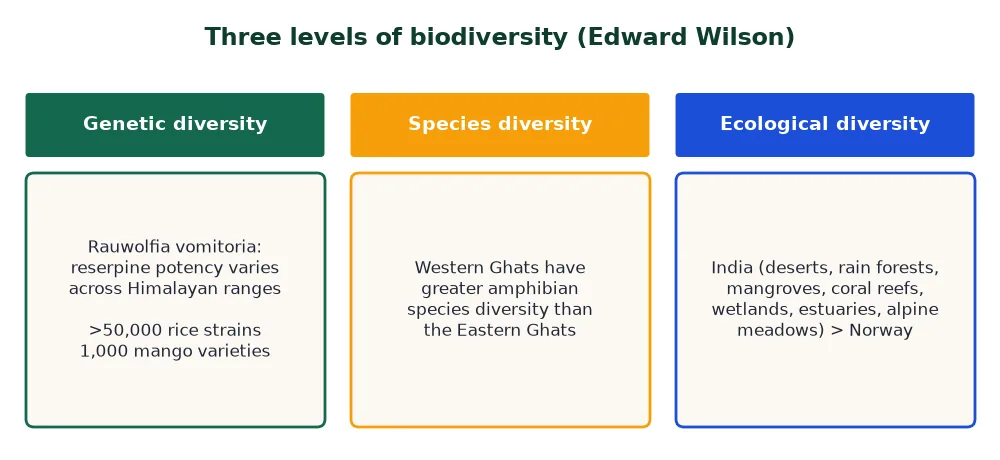
In our biosphere immense diversity (heterogeneity) exists not only at the species level but at all levels of biological organisation, from macromolecules within cells to biomes. Biodiversity is the term popularised by the sociobiologist Edward Wilson to describe the combined diversity at all the levels of biological organisation. The most important of them are genetic, species and ecological diversity.
1. Genetic diversity
A single species may show high diversity at the genetic level (variation in nucleotides, genes, chromosomes or whole genomes) over its distributional range. In other words, genetic diversity is the sum total of genetic information contained in the genes of individual plants, animals and microorganisms. A species needs it to maintain reproductive vitality, resistance to diseases and the ability to adapt to changing conditions.
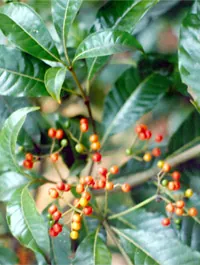
Example: the medicinal plant Rauwolfia vomitoria growing in different Himalayan ranges shows variation in the potency and concentration of the active chemical reserpine that the plant produces (mainly in its roots). Reserpine is an alkaloid used to treat high blood pressure.
Key line
India has more than 50,000 genetically different strains of rice and 1,000 varieties of mango.
2. Species diversity
A species is a group of organisms so similar genetically that they can interbreed and produce fertile offspring. Species diversity is the diversity at the species level, usually measured as the total number of species within discrete geographical boundaries. The simplest measure is species richness, the number of species per unit area.
NCERT example: the Western Ghats have a greater amphibian species diversity than the Eastern Ghats.
3. Ecological diversity
At the ecosystem level, India, with its deserts, rain forests, mangroves, coral reefs, wetlands, estuaries and alpine meadows, has a greater ecosystem diversity than a Scandinavian country like Norway. (Scandinavia is in northern Europe and includes Norway, Sweden and Denmark; these countries put strong emphasis on conservation, but their range of ecosystems is narrower than India’s.)
It has taken millions of years of evolution to accumulate this rich diversity, but we could lose all that wealth in less than two centuries if the present rates of species losses continue.
Alpha, beta and gamma diversity BEYOND NCERT
Diversity at the community and ecosystem level is often described from three perspectives. These terms are not in the NCERT chapter but appear in some reference books:
- Alpha (α) diversity, within-community diversity: the diversity of organisms sharing the same community or habitat. It combines species richness and evenness (equitability), i.e. how evenly individuals are spread among species. Example: peacocks, parrots and crows present in equal numbers in a sample area show high evenness. In nature, species are rarely evenly distributed.
- Beta (β) diversity, between-community diversity: the change (replacement) of species from one community or habitat to another, due to different microhabitats, niches and environmental conditions.
- Gamma (γ) diversity: the diversity of habitats over a total landscape or geographical area.
3How many species are there on Earth?
Published records tell us how many species have been recorded, but not how many exist. According to the International Union for Conservation of Nature and Natural Resources (IUCN) (2004), the total number of plant and animal species described so far is slightly more than 1.5 million.
For many taxonomic groups, species inventories are more complete in temperate than in tropical countries. Since most undiscovered species are in the tropics, biologists compare the temperate-tropical species richness of an exhaustively studied group of insects and extrapolate this ratio to other groups of animals and plants to estimate the total.
- Some extreme estimates range from 20 to 50 million.
- Robert May’s more conservative and scientifically sound estimate places global species diversity at about 7 million.
Earth’s biodiversity from current inventories
- More than 70 per cent of all recorded species are animals.
- Plants (including algae, fungi, bryophytes, gymnosperms and angiosperms) are no more than 22 per cent.
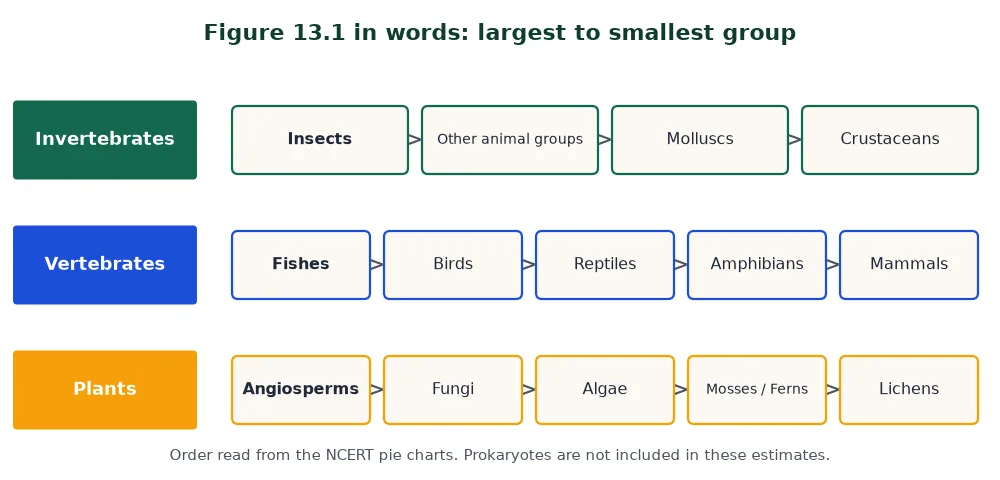
- Among animals, insects are the most species-rich group, making up more than 70 per cent of all animals: out of every 10 animals, 7 are insects.
- The number of fungi species is more than the combined total of fishes, amphibians, reptiles and mammals (hook: FARM).
Swipe the table sideways on mobile →
| Group | Order (largest → smallest) | Memory hook |
|---|---|---|
| Invertebrates | Insects > other animal groups > molluscs > crustaceans | IOMC |
| Vertebrates | Fishes > birds > reptiles > amphibians > mammals | FBRAM |
| Plants | Angiosperms > fungi > algae > mosses > ferns and allies > lichens | AFAMFL |
Exam tip (NEET 2013 pattern)
Angiosperms are the largest plant group. Fungi come second, so among fungi, algae, mosses and ferns, fungi have the highest species diversity.
Prokaryotes are not included in these estimates. Biologists are not sure how many prokaryotic species there might be: conventional taxonomic methods are not suitable for identifying microbial species, and many species cannot be cultured in the laboratory. If biochemical or molecular criteria are used, their diversity alone might run into millions.
4India’s biodiversity
- India has only 2.4 per cent of the world’s land area.
- Its share of global species diversity is an impressive 8.1 per cent.
- This makes India one of the 12 mega diversity countries of the world (NCERT).
- Nearly 45,000 species of plants and twice as many (about 90,000) animals have been recorded from India.
- If we accept May’s global estimate, only 22 per cent of all species have been recorded so far. Applied to India, there are probably more than 1,00,000 plant species and more than 3,00,000 animal species yet to be discovered and described.
Completing this inventory would need immense trained manpower (taxonomists) and time, and many species may become extinct before we discover them. In NCERT’s words, “Nature’s biological library is burning even before we catalogued the titles of all the books stocked there.”
5Patterns of biodiversity: latitudinal gradients
Diversity is not uniform across the world. The best-known pattern is the latitudinal gradient: in general, species diversity decreases as we move away from the equator towards the poles. With very few exceptions, the tropics (23.5° N to 23.5° S) harbour more species than temperate or polar areas.
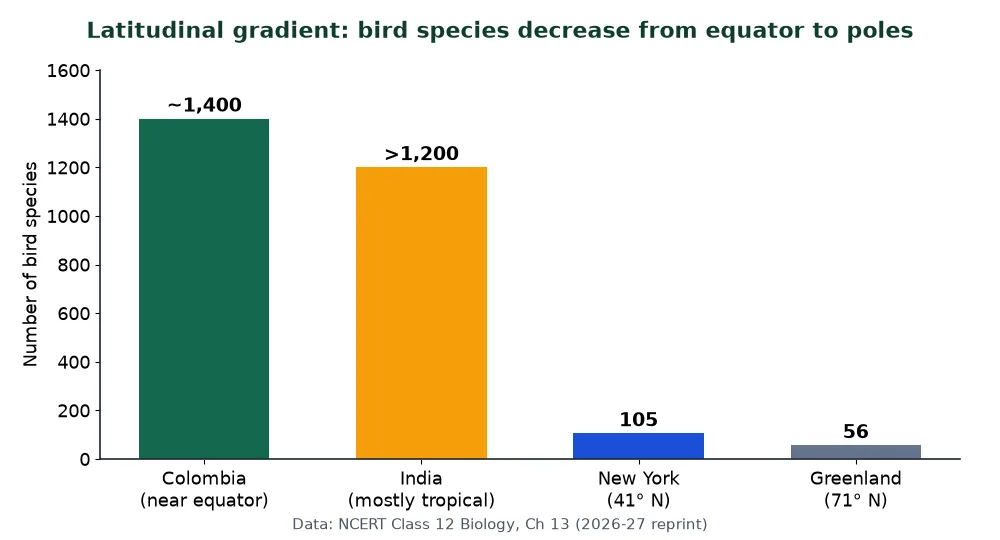
- Colombia, near the equator: nearly 1,400 species of birds.
- New York (41° N): 105 species; Greenland (71° N): only 56 species.
- India, with much of its land in tropical latitudes: more than 1,200 species of birds.
- A forest in a tropical region like Ecuador has up to 10 times as many species of vascular plants as a forest of equal area in a temperate region like the Midwest of the USA.
A similar decrease is seen from lower to higher altitudes on a mountain. BEYOND NCERT An increase of 1,000 m in altitude lowers temperature by about 6.5 °C; this drop and the greater seasonal variability at higher altitudes reduce diversity.
Amazonian rain forest
The largely tropical Amazonian rain forest in South America has the greatest biodiversity on earth. It is home to more than 40,000 species of plants, 3,000 of fishes, 1,300 of birds, 427 of mammals, 427 of amphibians, 378 of reptiles and more than 1,25,000 invertebrates. Scientists estimate there might be at least two million insect species there waiting to be discovered. (Hook from the notes: FBPRIMA.)
Why are the tropics so rich?
- More evolutionary time: speciation is generally a function of time. Unlike temperate regions, subjected to frequent glaciations in the past, tropical latitudes have remained relatively undisturbed for millions of years and had a long evolutionary time for species diversification.
- Constant environment: tropical environments are less seasonal, relatively more constant and predictable. Such constant environments promote niche specialisation and lead to greater species diversity.
- More solar energy: more solar energy is available in the tropics, which contributes to higher productivity; this in turn might contribute indirectly to greater diversity.
6Species-area relationship
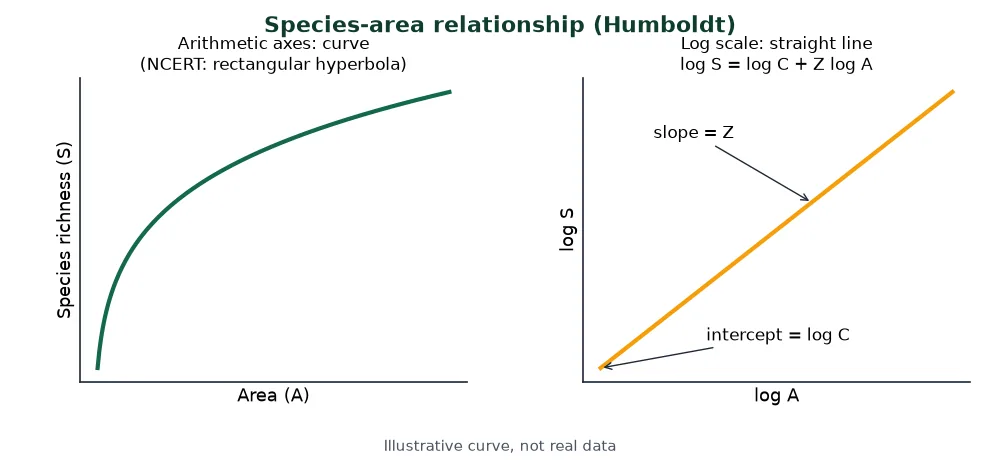
During his explorations of South American jungles, the German naturalist and geographer Alexander von Humboldt observed that within a region species richness increased with increasing explored area, but only up to a limit. For a wide variety of taxa (angiosperm plants, birds, bats, freshwater fishes) the relation between species richness and area is a rectangular hyperbola. On a logarithmic scale the species-area relationship becomes a straight line:
Equation
S = CAZ → log S = log C + Z log A
- S = species richness
- A = area
- Z = slope of the line (regression coefficient)
- C = Y-intercept (strictly, on the log graph the intercept is log C). C depends on the group of organisms sampled and their relative species richness in the region.
Values of Z
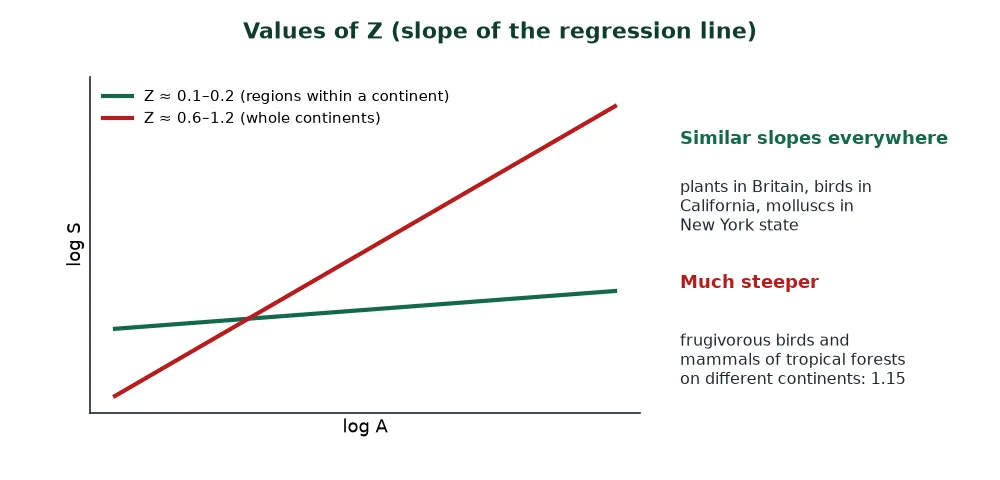
Ecologists have found that Z lies in the range of 0.1 to 0.2 regardless of the taxonomic group or the region: whether plants in Britain, birds in California or molluscs in New York state, the slopes of the regression lines are amazingly similar.
For very large areas like entire continents, the slope becomes much steeper, with Z values of 0.6 to 1.2. For frugivorous (fruit-eating) birds and mammals in the tropical forests of different continents, the slope is 1.15. A steeper line (more inclined towards the Y-axis) means species richness rises faster with area.
Regression coefficient in brief
In biology, regression measures how one variable (the dependent variable, on the Y-axis) changes with another (the independent variable, on the X-axis). The raw species-area data form a curve, and a straight line cannot be fitted to it. Taking logarithms turns the curve into a straight line; its slope gives Z and its intercept gives log C. Slope is “rise over run”: if every 3 extra hours of study added 2 marks, the slope would be 2/3. (The correlation coefficient r, which ranges from −1.0 to +1.0, is a different measure: it shows how closely two variables are related, with r = 0 meaning no relationship.)
Two hypotheses are often given for the relationship BEYOND NCERT: larger areas contain more kinds of habitats, and species number reflects a balance between colonisation and extinction (island biogeography).
Read the full topic
For the curve, the log-log graph, the meaning of C and Z and the uses of this relationship, read our detailed article: Species-area relationship: curve, equation and Z value.
7Importance of species diversity to the ecosystem
Does the number of species in a community really matter to the functioning of the ecosystem? Ecologists have not been able to give a definitive answer. For many decades they believed that communities with more species generally tend to be more stable than those with fewer species.
What is a stable community?
- It should not show too much variation in productivity from year to year.
- It must be either resistant or resilient to occasional disturbances (natural or man-made).
- It must be resistant to invasions by alien species.
David Tilman’s experiments
David Tilman’s long-term ecosystem experiments using outdoor plots gave some tentative answers. Plots with more species showed less year-to-year variation in total biomass, and increased diversity contributed to higher productivity. We may not understand fully how species richness contributes to the well-being of an ecosystem, but rich biodiversity is essential for ecosystem health and imperative for the survival of the human race.
Rivet popper hypothesis (Paul Ehrlich)
Would Western Ghats ecosystems be less functional if one of its tree frog species were lost forever? Would it matter if, instead of 20,000, we had only 15,000 species of ants? There are no direct answers, but the Stanford ecologist Paul Ehrlich gave an analogy:

Swipe the table sideways on mobile →
| Airplane | Ecosystem |
|---|---|
| Rivets (thousands) | Species |
| Passenger popping a rivet to take home | A species becoming extinct |
| Flight safety | Proper functioning of the ecosystem |
| Rivets on the wings | Key species that drive major ecosystem functions |
| Rivets on seats or windows | Species with minor roles |
A rivet is a short metal pin that holds two metal plates together. Losing a few rivets may not affect flight safety at first, but as more are removed the plane becomes dangerously weak. Which rivet is removed also matters: losing rivets on the wings is far more serious than losing a few on the seats or windows.
8Loss of biodiversity
It is doubtful whether new species are being added through speciation, but there is no doubt about continuing losses. The biological wealth of our planet is declining rapidly, and the accusing finger points to human activities. The colonisation of the tropical Pacific Islands by humans is said to have led to the extinction of more than 2,000 species of native birds.
Types of extinction BEYOND NCERT
- Natural (background) extinction: as environmental conditions change, some species disappear and better-adapted ones take their place. In the geological past this happened at a very slow rate.
- Mass extinction: episodes in earth’s geological history when large numbers of species were lost together, because of catastrophes.
- Anthropogenic extinction: species disappearing because of human activities. This man-made extinction is a very severe depletion of biodiversity because it is happening within a short period.
Numbers to remember (IUCN Red List 2004, NCERT)
- 784 species extinct in the last 500 years: 338 vertebrates, 359 invertebrates and 87 plants.
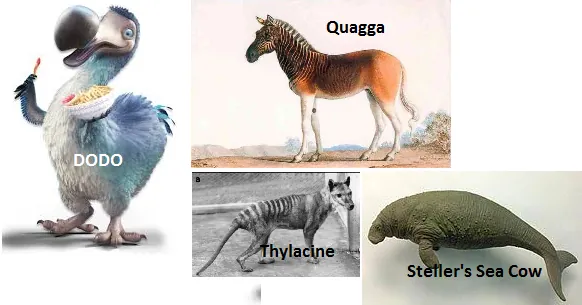
- Recent extinctions: dodo (Mauritius), quagga (Africa), thylacine (Australia), Steller’s sea cow (Russia) and three subspecies of tiger (Bali, Javan, Caspian).
- The last 20 years alone saw the disappearance of 27 species.
- Extinctions are not random: amphibians appear more vulnerable.
- More than 15,500 species worldwide face the threat of extinction (more than 650 of them from India, per the NCERT summary).
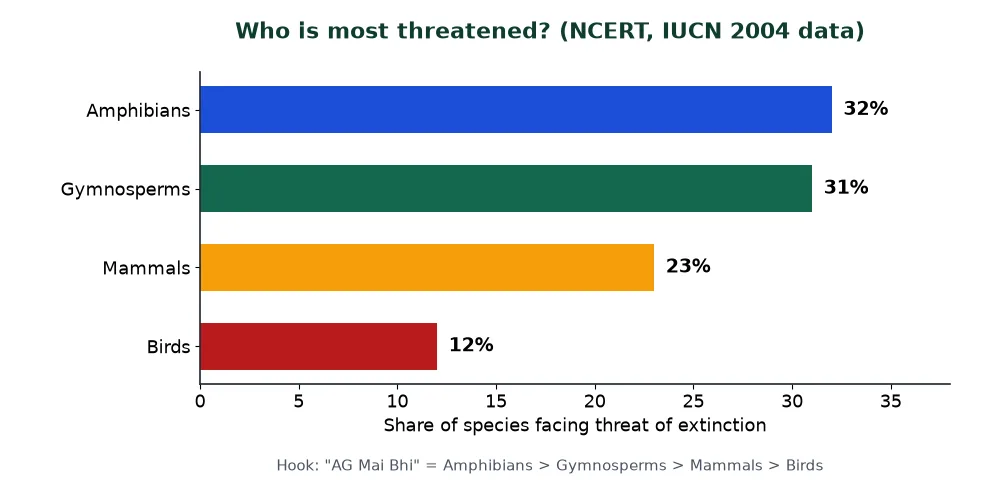
- Threatened today: 12% of birds, 23% of mammals, 32% of amphibians and 31% of gymnosperms.
Swipe the table sideways on mobile →
| Extinct animal | Region |
|---|---|
| Dodo | Mauritius |
| Quagga | Africa |
| Thylacine | Australia |
| Steller’s sea cow | Russia |
The sixth extinction
Fossil records show that during the long period (more than 3 billion years) since the origin and diversification of life, there were five episodes of mass extinction, all before humans appeared. The “Sixth Extinction” now in progress differs in its rate: current extinction rates are estimated to be 100 to 1,000 times faster than in pre-human times, and our activities are responsible. If present trends continue, nearly half of all species on earth might be wiped out within the next 100 years.
Consequences of biodiversity loss
In general, loss of biodiversity in a region may lead to:
- a decline in plant production;
- lowered resistance to environmental perturbations such as drought; and
- increased variability in certain ecosystem processes such as plant productivity, water use, and pest and disease cycles.
9IUCN Red List and Red Data Book
The NEET syllabus for biodiversity and conservation names endangered organisms, extinction and the Red Data Book. The NCERT text uses IUCN Red List data but does not list the categories, so this section is background BEYOND NCERT.
The IUCN Red List, started in 1964, is a catalogue of taxa facing a risk of extinction. It informs the public and policy makers about the urgency and scale of conservation problems. Its uses are:
- developing awareness about the importance of threatened biodiversity;
- identifying and documenting endangered species;
- providing a global index of the decline of biodiversity;
- defining conservation priorities at the local level and guiding conservation action.
The current system (IUCN Categories version 3.1) has nine categories. The notes used the older 1994 system, which had eight, with a single “Lower Risk” category.
Swipe the table sideways on mobile →
| Category | Meaning | Examples (current IUCN status) |
|---|---|---|
| Extinct (EX) | No reasonable doubt that the last individual has died. | Dodo. The cheetah is extinct in India (not globally; it was reintroduced in Kuno National Park in 2022). |
| Extinct in the Wild (EW) | Exhaustive surveys in known or expected habitats have failed to record an individual; survives only in captivity or cultivation. | — |
| Critically Endangered (CR) | Extremely high risk of extinction in the wild in the immediate future. | Indri (Indri indri), the largest lemur of Madagascar; Great Indian Bustard |
| Endangered (EN) | Not CR, but a very high risk of extinction in the wild in the near future. | Red panda, blue whale, pygmy hog (Porcula salvania, formerly Sus salvanius; moved from CR to EN in 2019) |
| Vulnerable (VU) | Not CR or EN, but a high risk of extinction in the wild in the medium-term future. | Snow leopard, great hornbill |
| Near Threatened (NT) | Close to qualifying for a threatened category. | Tibetan antelope (chiru), moved from EN in 2016 |
| Least Concern (LC) | Evaluated and does not qualify for the categories above. | Blackbuck (Antilope cervicapra), moved to LC in 2017 |
| Data Deficient (DD) | Inadequate information to assess extinction risk. | — |
| Not Evaluated (NE) | Not yet assessed against the criteria. | — |
Key lines
- Critically endangered, endangered and vulnerable together are called threatened.
- In the US Endangered Species Act sense, “endangered” means in danger of extinction throughout all or a significant portion of its range; “threatened” means likely to become endangered in the foreseeable future.
- In India, the Red Data Book of Indian plants is prepared by the Botanical Survey of India.
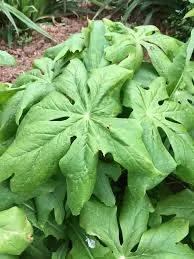
Threatened animals of India named in the notes: Himalayan musk deer, Great Indian Bustard, snow leopard, Kashmir stag (hangul) and Indian wild ass. Threatened plants: the medicinal plant Podophyllum and the pitcher plant Nepenthes (Nepenthes khasiana of Meghalaya).
10Causes of biodiversity loss: the Evil Quartet
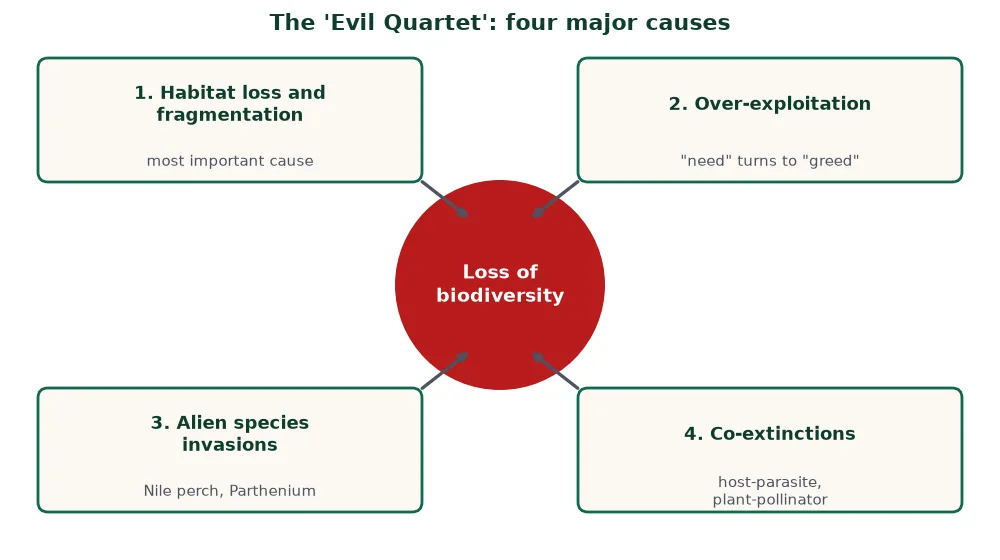
The accelerated rates of species extinction today are largely due to human activities. There are four major causes; “The Evil Quartet” is the sobriquet used to describe them.
1. Habitat loss and fragmentation
This is the most important cause driving animals and plants to extinction (NEET 2019). When people cut down trees, fill a wetland, plough grassland or burn a forest, the natural habitat of a species is changed or destroyed.
- The most dramatic examples come from tropical rain forests. Once covering more than 14 per cent of the earth’s land surface, they now cover no more than 6 per cent. By the time you finish reading this chapter, 1,000 more hectares of rain forest would have been lost.
- The Amazon rain forest, called the “lungs of the planet”, harbouring probably millions of species, is being cut and cleared for cultivating soya beans or for conversion to grasslands for raising beef cattle (cattle raised for meat, unlike dairy cattle).
- Besides total loss, degradation of habitats by pollution also threatens many species.
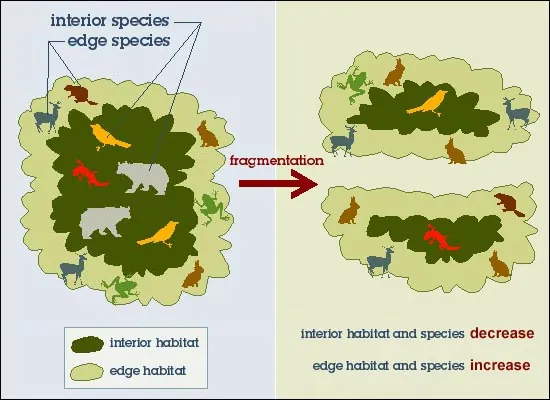
- Fragmentation: when large habitats are broken into small fragments, mammals and birds requiring large territories and animals with migratory habits are badly affected, leading to population declines. A forest patch surrounded by croplands, orchards, plantations or urban areas is a fragmented habitat.
Background from the old Environmental Issues chapter
BEYOND NCERT At the beginning of the 20th century, forests covered about 30 per cent of India’s land; by the end of the century this had shrunk to 19.4 per cent. The National Forest Policy (1988) recommends 33 per cent forest cover for the plains and 67 per cent for the hills. This was in the old NCERT chapter “Environmental Issues”, which has been removed from the rationalised book.
2. Over-exploitation
Humans have always depended on nature for food and shelter, but when “need” turns to “greed”, it leads to over-exploitation of natural resources. Many extinctions in the last 500 years, such as Steller’s sea cow and the passenger pigeon, were due to over-exploitation. Today many marine fish populations are over-harvested, endangering some commercially important species.
3. Alien species invasions
When alien species are introduced, unintentionally or deliberately, some become invasive and cause decline or extinction of indigenous species.
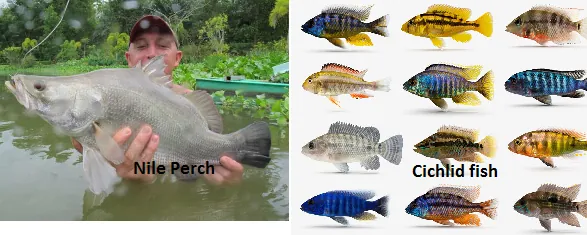
- Nile perch, a predatory fish introduced into Lake Victoria in east Africa, fed on cichlids and eventually caused the extinction of an ecologically unique assemblage of more than 200 species of cichlid fish.
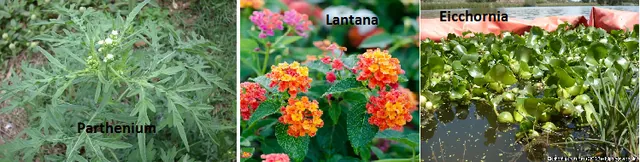
- Invasive weeds such as carrot grass (Parthenium), Lantana and water hyacinth (Eichhornia) damage the environment and threaten native species. (NCERT spells it Eicchornia; the accepted spelling is Eichhornia.)
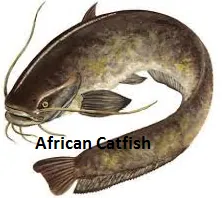
- The recent illegal introduction of the African catfish Clarias gariepinus for aquaculture threatens the indigenous catfishes of our rivers. Its high fecundity, rapid growth, wide habitat preferences, tolerance to extreme water conditions and ability to feed on a wide variety of prey can devastate native fish and aquatic invertebrates.
4. Co-extinctions
When a species becomes extinct, the plant and animal species associated with it in an obligatory way also become extinct.
- When a host fish species becomes extinct, its unique assemblage of parasites meets the same fate.
- In a coevolved plant-pollinator mutualism, extinction of one invariably leads to extinction of the other. In such mutualism, pollinators (bees, butterflies) get pollen or nectar as food; some bees also use waxes and resins from flowers to build hives.
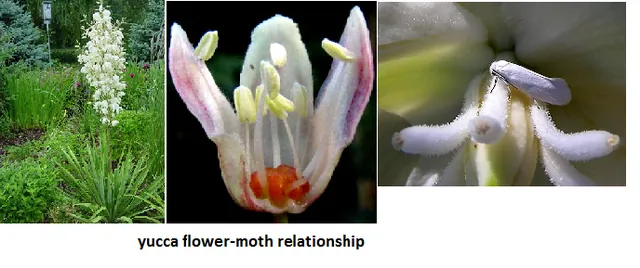
Obligate mutualism: a mutualism is obligate when one species relies completely on another. Yucca moths and yucca plants depend on each other: the plant cannot make seeds without the moth, which lays its eggs in the yucca flowers it pollinates, and the moth larvae reach maturity only by eating developing yucca seeds.
11Why should we conserve biodiversity?
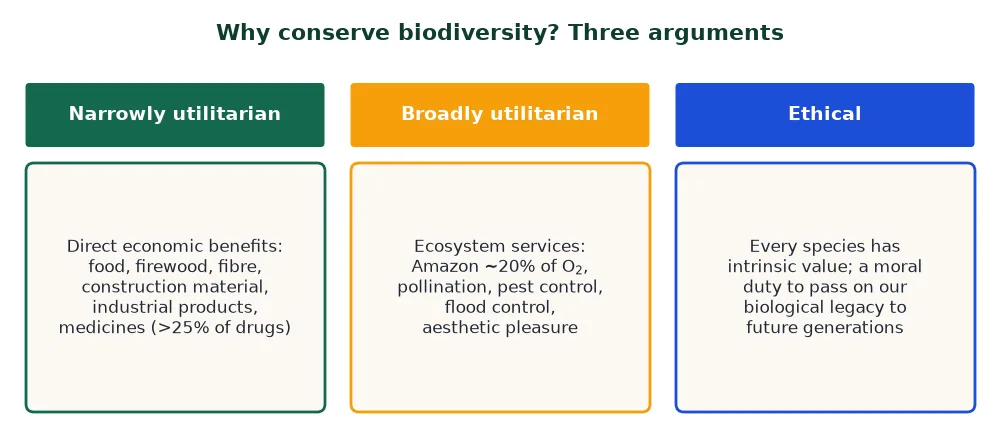
The arguments for biodiversity and conservation are grouped into three categories: narrowly utilitarian, broadly utilitarian and ethical.
1. Narrowly utilitarian
Humans derive countless direct economic benefits from nature:
- food (cereals, pulses, fruits)
- firewood
- fibre
- construction material
- industrial products (tannins, lubricants, dyes, resins, perfumes)
- products of medicinal importance
More than 25 per cent of the drugs sold worldwide are derived from plants, and 25,000 species of plants contribute to the traditional medicines of native peoples. With increasing resources put into bioprospecting (exploring molecular, genetic and species-level diversity for products of economic importance in medicine, agriculture and industry), nations with rich biodiversity can expect enormous benefits.
2. Broadly utilitarian
Biodiversity plays a major role in many ecosystem services:
- The fast-dwindling Amazon forest is estimated to produce, through photosynthesis, 20 per cent of the total oxygen in the earth’s atmosphere.
- Pollination, without which plants cannot give us fruits or seeds, is provided by pollinators: bees, bumblebees, birds and bats.
- Intangible benefits: the aesthetic pleasure of walking through thick woods, watching spring flowers or waking up to a bulbul’s song.
3. Ethical
We share this planet with millions of plant, animal and microbe species. Every species has an intrinsic value, even if it has no current economic value to us. We have a moral duty to care for their well-being and pass on our biological legacy in good order to future generations.
12How do we conserve biodiversity? In situ conservation
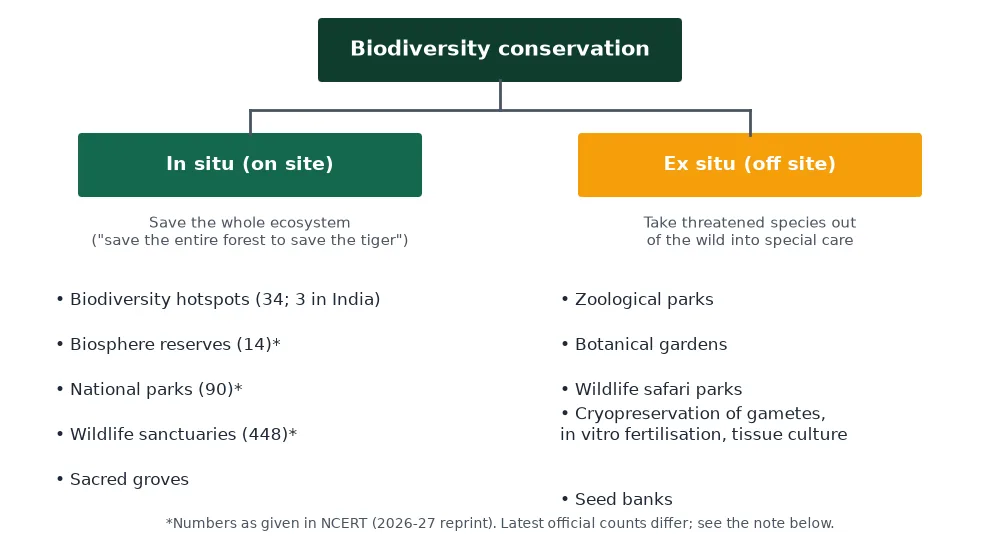
When we conserve and protect the whole ecosystem, its biodiversity at all levels is protected: we save the entire forest to save the tiger. This is in situ (on site) conservation. When a species is endangered or threatened and needs urgent measures, ex situ (off site) conservation is the desirable approach. Together, in situ and ex situ conservation are the two pillars of biodiversity and conservation in NCERT.
Biodiversity hotspots
Many nations cannot afford to conserve all their biological wealth, so conservationists identified biodiversity hotspots for maximum protection: regions with very high species richness and a high degree of endemism (species confined to that region and found nowhere else). Norman Myers developed the hotspot concept in 1988 BEYOND NCERT.
- Initially 25 hotspots were identified; nine more were added, bringing the total to 34.
- Hotspots are also regions of accelerated habitat loss.
- All hotspots together cover less than 2 per cent of earth’s land area, yet harbour an extremely high number of species. Strict protection could reduce ongoing mass extinctions by almost 30 per cent.
India’s three hotspots:
- Western Ghats and Sri Lanka, treated as one unit because of their shared biogeographical history
- Indo-Burma
- Himalaya
Current count
BEYOND NCERT Conservation International now lists 36 hotspots (two added in 2016). For NEET, answer 34 as in NCERT.
13National parks, sanctuaries and biosphere reserves
In India, ecologically unique and biodiversity-rich regions are legally protected as biosphere reserves, national parks and sanctuaries. NCERT: India has 14 biosphere reserves, 90 national parks and 448 wildlife sanctuaries (the NCERT summary says more than 450).
Latest official numbers
BEYOND NCERT India’s 2025 national report to the CBD lists 18 biosphere reserves, 106 national parks, 574 wildlife sanctuaries and 58 tiger reserves. NEET follows the NCERT figures (14, 90, 448), so use those in the exam.
National parks
- A legally protected area where flora, fauna and even objects of historical significance are conserved.
- Declared by the state government by notification (the central government can also declare one) under the Wild Life (Protection) Act, 1972.
- Boundaries are well defined at the time of declaration and can be altered only on a resolution passed by the state legislature.
- Grazing is not permitted.
- A national park cannot be downgraded to a sanctuary.
- India’s first national park: Jim Corbett (1936, then Hailey National Park).
Swipe the table sideways on mobile →
| National park | State | Known for |
|---|---|---|
| Gir | Gujarat | Asiatic lion |
| Sundarbans | West Bengal | Bengal tiger |
| Jim Corbett | Uttarakhand | Tiger |
| Ranthambore | Rajasthan | Tiger |
| Kaziranga | Assam | One-horned rhinoceros |
| Keoladeo | Bharatpur, Rajasthan | Birds (formerly a bird sanctuary) |
| Dudhwa | Uttar Pradesh | Tiger reserve; one-horned rhinoceros |
| Periyar | Kerala | Elephant and tiger reserve |
| Dachigam | Jammu and Kashmir | Hangul (Kashmir stag) |
| Keibul Lamjao | Manipur | World’s only floating national park; brow-antlered deer (sangai) |
| Bandipur | Karnataka | Project Tiger |
| Silent Valley | Kerala | Tropical evergreen forest |
| Manas | Assam | Tiger reserve |
| Kanha | Madhya Pradesh | Tiger reserve |
Nagarjunsagar-Srisailam (Andhra Pradesh) is a tiger reserve, one of the largest in India, rather than a national park. Project Tiger began in 1973 BEYOND NCERT; India now has 58 tiger reserves.
Wildlife sanctuaries
- Protected areas where particular species of birds and animals are conserved; flora and fauna are both protected.
- Notified by the central or state government.
- Boundaries are less strictly fixed than those of national parks.
- A sanctuary can be upgraded to a national park.
- Grazing of livestock and some private ownership or rights may be allowed.
Examples: Indian Wild Ass Sanctuary (Little Rann of Kutch, Gujarat); Ranganathittu Bird Sanctuary (near Mysore, Karnataka).
Biosphere reserves
Biosphere reserves are a special category of protected areas of land and/or coastal environments in which people are an integral component of the system. They represent natural biomes and contain unique biological communities. They come under UNESCO’s Man and Biosphere (MAB) Programme (launched 1971; the first biosphere reserves were designated in 1976) BEYOND NCERT.
- Large protected areas for conserving wildlife, plant and animal resources and the traditional life of tribal people living there.
- Cover terrestrial and coastal ecosystems.
- Internationally recognised, nominated by national governments, and remain under the jurisdiction of the country where they are located.
- India’s biosphere reserve programme began in 1986; Nilgiri was the first biosphere reserve.
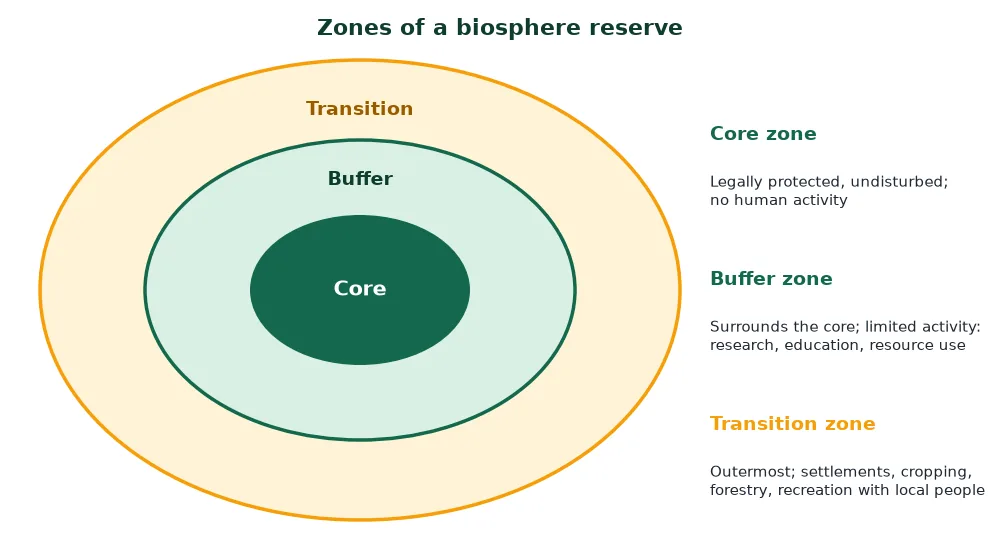
- Core (natural) zone: an undisturbed, legally protected ecosystem; no human activity.
- Buffer zone: surrounds the core; limited activities such as research, education and resource use.
- Transition zone: the outermost part, where reserve managers and local people cooperate in settlement, cropping, recreation, forestry and other economic uses without disturbing the ecology. It may include a restoration region, a degraded area selected for restoration to a near-natural form.
Examples: Nilgiri, Nanda Devi, Nokrek, Manas, Dibru-Saikhowa, Dihang-Dibang, Sundarbans, Gulf of Mannar, Great Nicobar, Similipal, Khangchendzonga, Pachmarhi and Agasthyamala.
The World Conservation Union (IUCN) and the World Wide Fund for Nature (WWF) support projects worldwide to promote conservation and appropriate development of biosphere reserves.
14Sacred groves
India has a history of religious and cultural traditions that protected nature. In many cultures, tracts of forest were set aside, and all the trees and wildlife within were venerated and given total protection. These sacred groves are tracts of virgin forest with rich biodiversity, protected by local people because of beliefs, culture, religion and taboos (often because deities are believed to reside there). They are remnants of primary forest and repositories of rare and endemic species. Sacred groves show how closely biodiversity and conservation have long been linked in Indian culture.
Swipe the table sideways on mobile →
| Region (NCERT) | State |
|---|---|
| Khasi and Jaintia Hills | Meghalaya |
| Aravalli Hills | Rajasthan |
| Western Ghat regions | Karnataka and Maharashtra |
| Sarguja, Chanda and Bastar areas | Madhya Pradesh (as in NCERT; these areas now lie in Chhattisgarh and Maharashtra) |
Key line
In Meghalaya, the sacred groves are the last refuges for a large number of rare and threatened plants.
15Ex situ conservation
In this second half of in situ and ex situ conservation, threatened animals and plants are taken out of their natural habitat and placed in special settings where they can be protected and given special care.
- Zoological parks, botanical gardens and wildlife safari parks serve this purpose. Many animals that have become extinct in the wild continue to be maintained in zoological parks.
- Arboreta are botanical gardens where specific trees and shrubs are cultivated.
- A wildlife safari park is a zoo-like drive-in attraction where visitors observe freely roaming animals from vehicles.
Modern ex situ methods
- Cryopreservation: gametes of threatened species can be preserved in viable and fertile condition for long periods. Material is stored at ultra-low temperature, typically in liquid nitrogen at −196 °C, in compact, low-maintenance units. It is particularly useful for vegetatively propagated crops such as potato.
- In vitro fertilisation: eggs can be fertilised in vitro.
- Tissue culture: plants can be propagated using tissue culture methods.
- Seed banks: seeds of different genetic strains of commercially important plants can be kept for long periods.
16Earth Summit 1992 and WSSD 2002
Biodiversity knows no political boundaries, so its conservation is a collective responsibility of all nations. Two global meetings shaped biodiversity and conservation at the international level; the first produced the Convention on Biological Diversity.
Swipe the table sideways on mobile →
| Event | Where and when | Outcome |
|---|---|---|
| Convention on Biological Diversity (“The Earth Summit”) | Rio de Janeiro, Brazil, 1992 | Called on all nations to take appropriate measures to conserve biodiversity and use its benefits sustainably |
| World Summit on Sustainable Development (WSSD) | Johannesburg, South Africa, 2002 | 190 countries pledged to achieve, by 2010, a significant reduction in the current rate of biodiversity loss at global, regional and local levels |
The CBD has three objectives BEYOND NCERT: conservation of biological diversity, sustainable use of its components, and fair and equitable sharing of benefits arising from the use of genetic resources. Brazil is often cited as the most biodiverse country in the world.
17Biodiversity and conservation: NCERT summary and exercises
- Life originated nearly 3.8 billion years ago; biodiversity is the sum total of diversity at all levels of biological organisation.
- More than 1.5 million species are recorded, but nearly 6 million more may await discovery. Over 70 per cent of named species are animals, of which 70 per cent are insects. Fungi have more species than all vertebrates combined.
- Species richness is highest in the tropics and decreases towards the poles; it is also a function of area (rectangular hyperbola).
- Diverse communities tend to be less variable, more productive and more resistant to biological invasions.
- Present extinction rates are 100 to 1,000 times higher than before humans. Nearly 700 species have become extinct in recent times and more than 15,500 (over 650 from India) face extinction.
- Reasons to conserve are narrowly utilitarian, broadly utilitarian and ethical. Conservation is in situ or ex situ.
NCERT exercises with short answers
1. Name the three important components of biodiversity.
Genetic diversity, species diversity and ecological diversity.
2. How do ecologists estimate the total number of species present in the world?
They compare the temperate-tropical species richness of an exhaustively studied group of insects and extrapolate this ratio to other groups of animals and plants.
3. Give three hypotheses for explaining why tropics show greatest levels of species richness.
Longer evolutionary time (no frequent glaciations), a less seasonal, more constant and predictable environment that promotes niche specialisation, and more solar energy giving higher productivity.
4. What is the significance of the slope of regression in a species–area relationship?
The slope Z shows how fast species richness rises with area. It is 0.1–0.2 within regions of a continent and much steeper (0.6–1.2) for whole continents.
5. What are the major causes of species losses in a geographical region?
The Evil Quartet: habitat loss and fragmentation, over-exploitation, alien species invasions and co-extinctions.
6. How is biodiversity important for ecosystem functioning?
Communities with more species tend to be more stable, less variable in productivity, more productive and more resistant to invasions (Tilman). The rivet popper analogy shows that losing key species can make an ecosystem collapse.
7. What are sacred groves? What is their role in conservation?
Tracts of forest protected by local communities for religious and cultural reasons. They preserve rare and threatened species; in Meghalaya they are the last refuges for many rare plants.
8. Among the ecosystem services are control of floods and soil erosion. How is this achieved by the biotic components of the ecosystem?
Plant cover intercepts rain and slows run-off, and roots bind soil and increase infiltration, which reduces flooding and soil erosion.
9. The species diversity of plants (22 per cent) is much less than that of animals (72 per cent). What could be the explanations to how animals achieved greater diversification?
Animals, especially insects, can move, occupy many specialised niches and have short generation times with complex adaptations, which allows more speciation.
10. Can you think of a situation where we deliberately want to make a species extinct? How would you justify it?
Disease-causing organisms such as viruses. Eradicating them protects human health; smallpox eradication is an example.
18High-yield lines for biodiversity and conservation NEET
- Biodiversity term popularised by sociobiologist Edward Wilson.
- Rauwolfia vomitoria → reserpine → genetic diversity.
- India: >50,000 rice strains, 1,000 mango varieties.
- Western Ghats > Eastern Ghats in amphibian diversity.
- IUCN (2004): slightly more than 1.5 million species described; Robert May: about 7 million.
- Animals >70%; plants ≤22%; insects >70% of animals.
- India: 2.4% of land, 8.1% of species; one of 12 mega diversity countries.
- Colombia ~1,400, India >1,200, New York 105, Greenland 56 bird species.
- Amazon: 40,000 plants, 3,000 fishes, 1,300 birds, 427 mammals, 427 amphibians, 378 reptiles, 1,25,000 invertebrates.
- log S = log C + Z log A; Z = 0.1–0.2 (regions), 0.6–1.2 (continents), 1.15 frugivorous birds and mammals.
- Tilman: more species → less year-to-year variation in biomass, higher productivity.
- Rivet popper hypothesis: Paul Ehrlich.
- 784 extinctions in 500 years: 338 vertebrates, 359 invertebrates, 87 plants.
- Threatened: amphibians 32%, gymnosperms 31%, mammals 23%, birds 12%.
- Extinction rate now 100–1,000 times pre-human; five past mass extinctions.
- Evil Quartet: habitat loss and fragmentation (most important), over-exploitation, alien species, co-extinctions.
- Rain forests: from 14% to 6% of land surface.
- Nile perch → >200 cichlid species lost in Lake Victoria.
- Amazon: 20% of atmospheric oxygen; >25% of drugs from plants; 25,000 medicinal plant species.
- 34 hotspots, <2% of land; protection could cut mass extinctions by ~30%.
- India (NCERT): 14 biosphere reserves, 90 national parks, 448 sanctuaries.
- Earth Summit: Rio 1992. WSSD: Johannesburg 2002, 190 countries, target 2010.
19MCQs from the notes
These are the biodiversity and conservation questions from the chapter notes, with answers checked against NCERT.
Choose your answer, then tap “Show answer”
- Which of the following shows maximum genetic diversity in India?
- (a) Rice
- (b) Mango
- (c) Banana
- (d) Maize
Show answer
(a) Rice. India has more than 50,000 genetically different strains of rice.
- Which of the following shows maximum genetic diversity in India?
- (a) Mango
- (b) Teak
- (c) Tea
- (d) Wheat
Show answer
(a) Mango. NCERT cites 1,000 varieties of mango; none of the other options is given as an example of high genetic diversity.
- Which of the following relationships is associated with Alexander von Humboldt?
- (a) Law of limiting factor
- (b) Species-area relationship
- (c) Population growth equation
- (d) Ecological biodiversity
Show answer
(b) Species-area relationship.
- Which animal is the symbol of WWF (World Wide Fund for Nature)?
- (a) Dolphin
- (b) Tiger
- (c) Giant panda
- (d) Great Indian Bustard
Show answer
(c) Giant panda.
- Which endangered animal is the source of shahtoosh, the world’s finest, lightest, warmest and most expensive wool?
- (a) Nilgiri tahr
- (b) Cheetah
- (c) Kashmiri goat
- (d) Chiru
Show answer
(d) Chiru (Tibetan antelope). Shahtoosh, a Persian word meaning “king of fine wools”, is a shawl woven by Kashmiri craftspeople from the down hair of the chiru.
- The fruit of which plant is used to produce biodiesel?
- (a) Ficus
- (b) Zizyphus
- (c) Pongamia
- (d) Jatropha
Show answer
(d) Jatropha (ratanjot). Oil from its seeds is used to make biodiesel and has been tested as an aviation biofuel. (Pongamia seed oil is also used for biodiesel, but Jatropha is the expected answer.)
20Practice MCQs (NCERT-based)
Biodiversity and conservation NEET-pattern questions written directly from the NCERT text.
Choose your answer, then tap “Show answer”
- The term biodiversity was popularised by:
- (a) Robert May
- (b) Edward Wilson
- (c) Paul Ehrlich
- (d) David Tilman
Show answer
(b) Edward Wilson.
- Robert May’s estimate of global species diversity is about:
- (a) 1.5 million
- (b) 7 million
- (c) 20 million
- (d) 50 million
Show answer
(b) 7 million.
- India’s share of global species diversity is:
- (a) 2.4%
- (b) 8.1%
- (c) 12%
- (d) 22%
Show answer
(b) 8.1%, on 2.4% of the world’s land area.
- In the species-area relationship, Z for frugivorous birds and mammals in tropical forests of different continents is:
- (a) 0.1
- (b) 0.2
- (c) 0.6
- (d) 1.15
Show answer
(d) 1.15.
- Which is NOT a reason given for greater biodiversity in the tropics?
- (a) More evolutionary time
- (b) Constant, predictable environment
- (c) More solar energy
- (d) Frequent glaciations
Show answer
(d) Frequent glaciations affected temperate regions, not the tropics.
- The rivet popper hypothesis was used by:
- (a) David Tilman
- (b) Paul Ehrlich
- (c) Alexander von Humboldt
- (d) Norman Myers
Show answer
(b) Paul Ehrlich, a Stanford ecologist.
- David Tilman found that plots with more species showed:
- (a) more year-to-year variation in biomass
- (b) less year-to-year variation in total biomass
- (c) lower productivity
- (d) more invasion by aliens
Show answer
(b) Less variation; diversity also increased productivity.
- The most important cause of biodiversity loss is:
- (a) Over-exploitation
- (b) Alien species invasion
- (c) Habitat loss and fragmentation
- (d) Co-extinction
Show answer
(c) Habitat loss and fragmentation (NEET 2019).
- Extinction of more than 200 cichlid species in Lake Victoria was caused by:
- (a) African catfish
- (b) Nile perch
- (c) Water hyacinth
- (d) Over-fishing
Show answer
(b) Nile perch, an alien species.
- Which pair shows an obligate plant-pollinator mutualism?
- (a) Yucca and yucca moth
- (b) Ficus and cichlid
- (c) Lantana and honeybee
- (d) Parthenium and butterfly
Show answer
(a) Yucca and yucca moth.
- The ethical argument for conserving biodiversity says that:
- (a) biodiversity gives us drugs
- (b) every species has intrinsic value
- (c) ecosystems give oxygen
- (d) bioprospecting earns money
Show answer
(b) Every species has intrinsic value.
- Which of these is NOT one of India’s biodiversity hotspots?
- (a) Western Ghats and Sri Lanka
- (b) Indo-Burma
- (c) Himalaya
- (d) Eastern Ghats
Show answer
(d) Eastern Ghats.
- Sacred groves are the last refuges of rare and threatened plants in:
- (a) Rajasthan
- (b) Meghalaya
- (c) Karnataka
- (d) Maharashtra
Show answer
(b) Meghalaya (Khasi and Jaintia Hills).
- Which is an ex situ method of conservation?
- (a) National park
- (b) Sacred grove
- (c) Cryopreservation
- (d) Biosphere reserve
Show answer
(c) Cryopreservation.
- At the WSSD 2002 in Johannesburg, the number of countries that pledged to reduce biodiversity loss by 2010 was:
- (a) 150
- (b) 170
- (c) 190
- (d) 196
Show answer
(c) 190.
- Assertion: Species extinction rates now are 100–1,000 times faster than in pre-human times. Reason: Human activities are responsible for the faster rates.
- (a) Both true; Reason explains Assertion
- (b) Both true; Reason does not explain
- (c) Assertion true, Reason false
- (d) Both false
Show answer
(a) Both are true, and the Reason correctly explains the Assertion.
21Common mistakes
- Writing “longitudinal gradient”. The pattern is a latitudinal gradient.
- Writing 17 mega diversity countries. NCERT says India is one of the 12.
- Saying fungi are the largest plant group. Angiosperms are; fungi come second.
- Mixing up Z values: 0.1–0.2 within regions, 0.6–1.2 for continents.
- Giving two reasons for conservation. NCERT gives three, including the ethical one.
- Calling sacred groves ex situ. They are in situ.
- Saying the Earth Summit was in Johannesburg. Rio de Janeiro was 1992; Johannesburg was WSSD 2002.
- Quoting current counts (18, 106, 574) in NEET. Use NCERT’s 14, 90, 448.
- Listing the cheetah as globally extinct. It became extinct in India only.
- Writing the rivet popper “tree” example. NCERT’s example is a Western Ghats tree frog.
22Common doubts on biodiversity and conservation
What are the three levels of biodiversity in NCERT?
Genetic diversity, species diversity and ecological (ecosystem) diversity. Example: Rauwolfia vomitoria shows genetic diversity in reserpine; the Western Ghats have greater amphibian species diversity than the Eastern Ghats; India has greater ecosystem diversity than Norway.
Who popularised the term biodiversity?
The sociobiologist Edward Wilson popularised the term biodiversity to describe the combined diversity at all the levels of biological organisation.
How many species are there on Earth according to NCERT?
IUCN (2004) puts the described plant and animal species at slightly more than 1.5 million. Robert May’s conservative and scientifically sound estimate of global species diversity is about 7 million. Extreme estimates range from 20 to 50 million.
What is India’s share of global biodiversity?
India has only 2.4 per cent of the world’s land area but 8.1 per cent of global species diversity, making it one of the 12 mega diversity countries (NCERT). Nearly 45,000 plant species and twice as many animal species have been recorded.
Why do the tropics have more species?
Three hypotheses: tropics had more evolutionary time because they were not subjected to frequent glaciations; tropical environments are less seasonal, more constant and predictable, which promotes niche specialisation; and tropics receive more solar energy, giving higher productivity.
What is the value of Z in the species-area relationship?
Z (the slope of the regression line) lies between 0.1 and 0.2 for regions within a continent, whatever the taxon or region. For very large areas such as entire continents, Z is 0.6 to 1.2; for frugivorous birds and mammals of tropical forests of different continents it is 1.15.
What is the rivet popper hypothesis?
An analogy by Stanford ecologist Paul Ehrlich. The airplane is the ecosystem and the rivets are species. Losing a few rivets may not affect flight safety at first, but losing more weakens the plane, and losing rivets on the wings (key species) is more serious than losing rivets on seats or windows.
What is the Evil Quartet?
The Evil Quartet names the four major causes of biodiversity loss: habitat loss and fragmentation (the most important cause), over-exploitation, alien species invasions and co-extinctions.
What are the three reasons for conserving biodiversity?
Narrowly utilitarian (direct economic benefits such as food, fibre, firewood and medicines), broadly utilitarian (ecosystem services such as oxygen production and pollination) and ethical (every species has intrinsic value).
Which biodiversity hotspots are in India?
Three of the 34 hotspots cover India: Western Ghats and Sri Lanka, Indo-Burma and Himalaya. All hotspots together cover less than 2 per cent of Earth’s land area.
What is the difference between in situ and ex situ conservation?
In situ (on site) conservation protects the whole ecosystem, for example hotspots, biosphere reserves, national parks, sanctuaries and sacred groves. Ex situ (off site) conservation takes threatened species out of their habitat into zoos, botanical gardens, safari parks, cryopreservation and seed banks.
What did the Earth Summit 1992 and WSSD 2002 do?
The Convention on Biological Diversity (the Earth Summit) at Rio de Janeiro in 1992 called on all nations to conserve biodiversity and use its benefits sustainably. At the World Summit on Sustainable Development in Johannesburg in 2002, 190 countries pledged to significantly reduce the rate of biodiversity loss by 2010.
Source: NCERT Class 12 Biology, Chapter 13 “Biodiversity and Conservation” (2026-27 reprint) and the NMC NEET (UG) 2026 syllabus.