
Home › NEET Biology › The Living World › Full chapter notes
The Living World NEET: What is Living, Taxonomy, Table 1.1
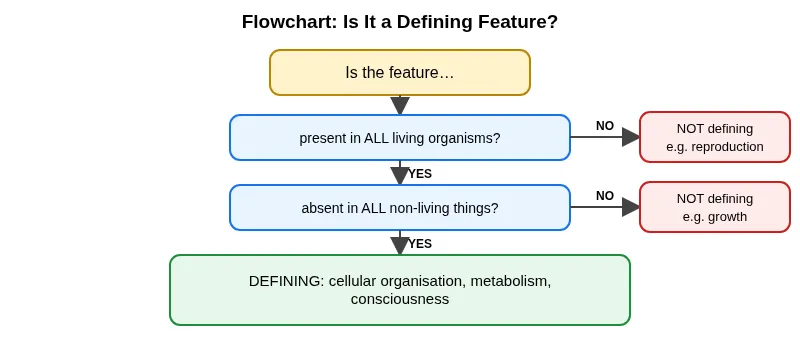
Living organisms are self-replicating, evolving and self-regulating interactive systems capable of responding to external stimuli. Cellular organisation, metabolism and consciousness are their defining features. Growth and reproduction are characteristic of life but are not defining, because each has exceptions or also occurs in non-living objects.
1The Living World NEET at a glance: is it a defining feature?
Syllabus note
“What is living?” is the first topic of Unit 1: Diversity in Living World in the official NMC NEET (UG) 2026 syllabus (notice dated 22 December 2025). This page follows NCERT Class 11 Biology, Chapter 1 “The Living World”. That covers the passages in the 2026-27 reprint plus the standard textbook treatment of the characteristics of living organisms.
2What indeed is life?
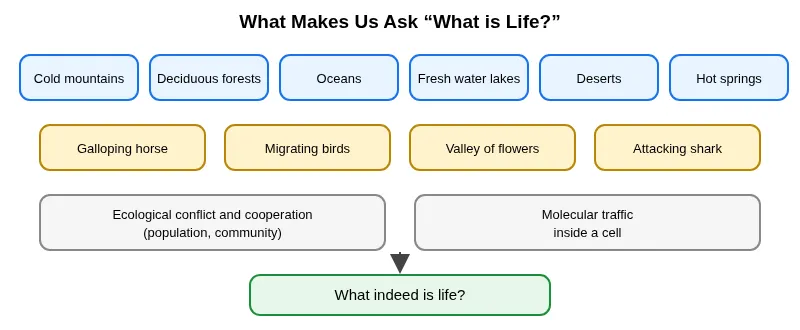
“How wonderful is the living world!” Living organisms occupy extraordinary habitats: cold mountains, deciduous forests, oceans, fresh water lakes, deserts or hot springs. The beauty of a galloping horse, migrating birds, the valley of flowers or an attacking shark evokes awe and a deep sense of wonder. So do the ecological conflict and cooperation among members of a population and among populations of a community, and even the molecular traffic inside a cell. All of this makes us reflect: what indeed is life?
Two implicit questions
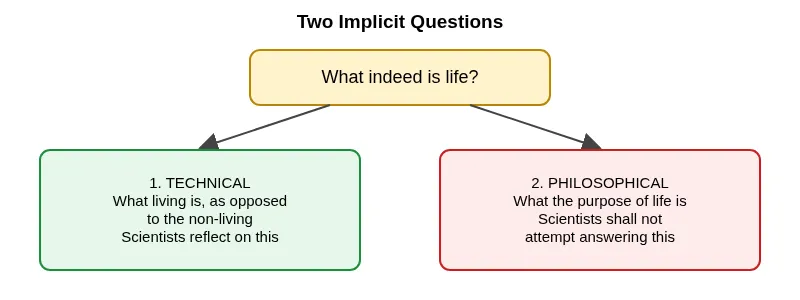
| Question | Nature | Seeks answer to | Attempted by scientists? |
|---|---|---|---|
| First | Technical | What living is, as opposed to the non-living | Yes: we reflect on “what is living?” |
| Second | Philosophical | What the purpose of life is | No: “As scientists, we shall not attempt answering the second question.” |
3Living vs inanimate: how biology began
Biology is the science of life forms and living processes. The living world comprises an amazing diversity of living organisms.
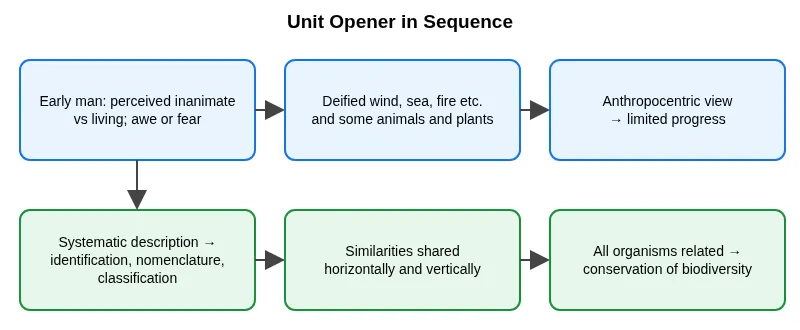
- Early man could easily perceive the difference between inanimate matter and living organisms.
- He deified some inanimate matter (wind, sea, fire etc.) and some animals and plants. The common feature was the sense of awe or fear they evoked.
- The description of living organisms, including human beings, began much later in human history.
- Societies with an anthropocentric view of biology could register only limited progress in biological knowledge.
- Systematic and monumental description of life forms brought in, out of necessity, detailed systems of identification, nomenclature and classification.
- The biggest spin-off was the recognition of the sharing of similarities among living organisms both horizontally and vertically.
- That all present-day organisms are related to each other, and to all organisms that ever lived on earth, humbled man and led to cultural movements for conservation of biodiversity.
4Diversity and the search for defining traits
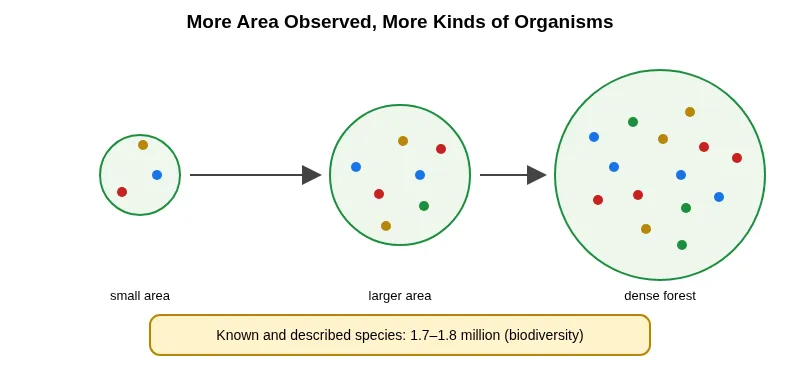
Look around and you see a large variety of living organisms, and several more you cannot see with the naked eye. The larger the area you observe, the greater the range and variety, so a dense forest shows far more kinds. Each different kind represents a species. 1.7–1.8 million species are known and described; this refers to biodiversity, the number and types of organisms on earth. As we explore new areas, and even old ones, new organisms are continuously being identified.
Key line
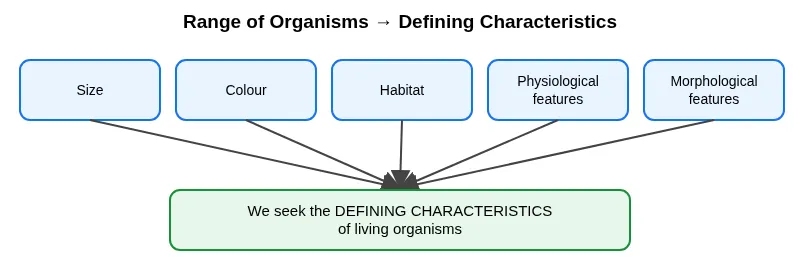
The very range of organisms in terms of size, colour, habitat, physiological and morphological features makes us seek the defining characteristics of living organisms.
When we try to define “living”, we conventionally look for distinctive characteristics. Growth, reproduction, and the ability to sense the environment and mount a suitable response come to mind immediately. One can add metabolism, ability to self-replicate, self-organise, interact and emergence to this list. Each one is tested below.
5Growth
Key line
Increase in mass and increase in number of individuals are twin characteristics of growth.
How organisms grow
- A multicellular organism grows by cell division.
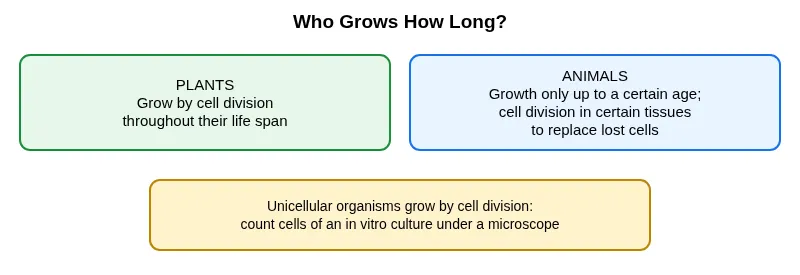
- In plants, growth by cell division occurs continuously throughout their life span.
- In animals, this growth is seen only up to a certain age. However, cell division occurs in certain tissues to replace lost cells.
- Unicellular organisms grow by cell division. This is easily seen in in vitro cultures by simply counting the number of cells under the microscope.
Key line
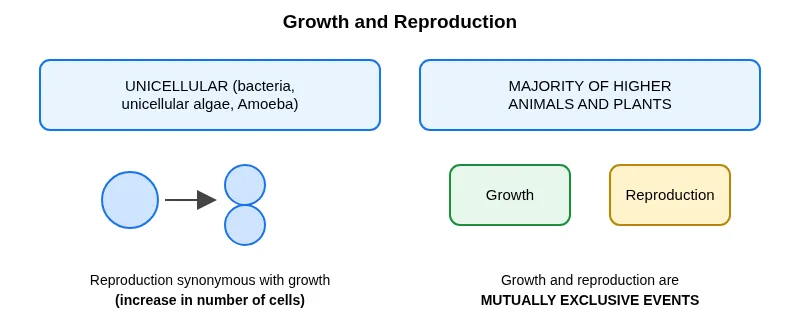
In majority of higher animals and plants, growth and reproduction are mutually exclusive events.
Why growth is not a defining property
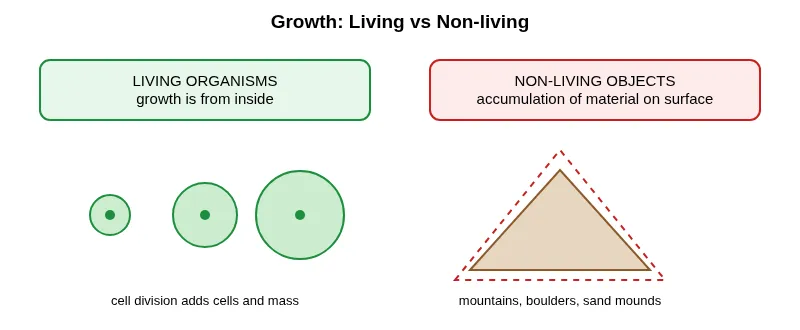
If we take increase in body mass as a criterion for growth, non-living objects also grow. Mountains, boulders and sand mounds do grow. This growth, however, is by accumulation of material on the surface. In living organisms, growth is from inside. Growth, therefore, cannot be taken as a defining property of living organisms.
Exam tip
Assertion–Reason questions often swap the two modes. Non-living objects grow by surface accumulation; living organisms grow from inside.
Tap: Does cell division stop in adult animals?
No. Overall growth is seen only up to a certain age, but cell division occurs in certain tissues to replace lost cells.
6Reproduction
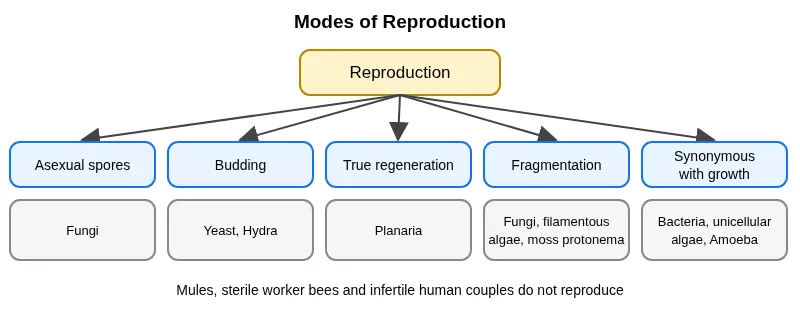
In multicellular organisms, reproduction refers to the production of progeny possessing features more or less similar to those of the parents. Invariably and implicitly we refer to sexual reproduction. Organisms reproduce by asexual means also.
| Mode / feature | Organisms |
|---|---|
| Millions of asexual spores | Fungi |
| Budding | Yeast, Hydra (lower organisms) |
| True regeneration (a fragmented organism regenerates the lost part of its body and becomes a new organism) | Planaria (flatworms) |
| Fragmentation | Fungi, filamentous algae, protonema of mosses |
| Reproduction synonymous with growth (increase in number of cells) | Bacteria, unicellular algae, Amoeba |
| Do not reproduce | Mules, sterile worker bees, infertile human couples |
Growth has been defined as an increase in cell number or mass. So in single-celled organisms we are not very clear about the usage of the two terms, growth and reproduction.
Key line
Reproduction cannot be an all-inclusive defining characteristic of living organisms. Of course, no non-living object is capable of reproducing or replicating by itself.
Exam tip
Match the examples exactly: yeast and Hydra = budding; Planaria = true regeneration; fungi, filamentous algae and moss protonema = fragmentation.
7Metabolism
All living organisms are made of chemicals. These chemicals, small and big, belonging to various classes, sizes and functions, are constantly being made and changed into some other biomolecules. These conversions are chemical reactions, or metabolic reactions. Thousands of them occur simultaneously inside all living organisms, unicellular or multicellular. All plants, animals, fungi and microbes show metabolism.
Key line
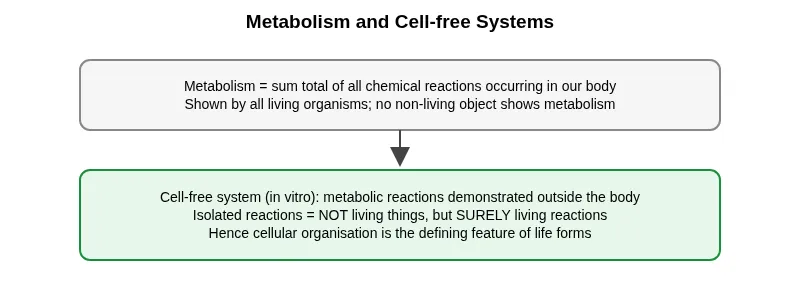
The sum total of all the chemical reactions occurring in our body is metabolism. No non-living object exhibits metabolism.
Cell-free systems
Metabolic reactions can be demonstrated outside the body in cell-free systems.
Key line
While metabolism is a defining feature of all living organisms without exception, isolated metabolic reactions in vitro are not living things but surely living reactions.
Tap: A metabolic reaction runs in a test tube. Living thing or living reaction?
A living reaction, but not a living thing.
8Cellular organisation
A metabolic reaction can run outside the body, yet the test tube does not become alive. The organisation of reactions within the body’s cells is what life requires. The conclusion follows directly:
Key line
Hence, cellular organisation of the body is the defining feature of life forms.
Exam tip
If a question asks for the defining feature of life forms, the answer is cellular organisation.
9Consciousness: sensing and responding
Key line
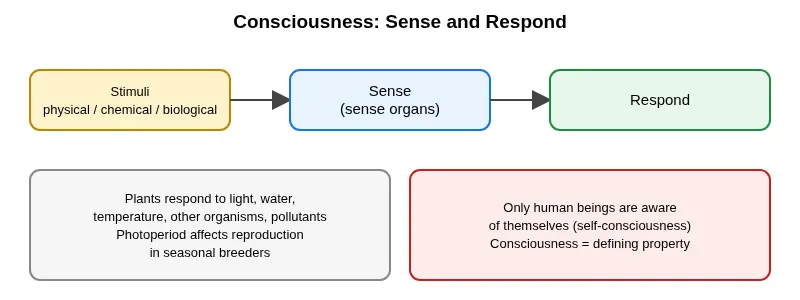
Perhaps the most obvious and also the most technically complicated feature of all living organisms is the ability to sense their surroundings or environment and respond to these environmental stimuli, which could be physical, chemical or biological.
- We sense our environment through our sense organs.
- Plants respond to external factors like light, water, temperature, other organisms, pollutants, etc.
- All organisms, from the prokaryotes to the most complex eukaryotes, can sense and respond to environmental cues.
- Photoperiod affects reproduction in seasonal breeders, both plants and animals.
- All organisms handle the chemicals entering their bodies.
- All organisms, therefore, are “aware” of their surroundings.
- Human being is the only organism who is aware of himself, i.e. has self-consciousness.
Key line
Consciousness therefore becomes the defining property of living organisms.
10The coma case
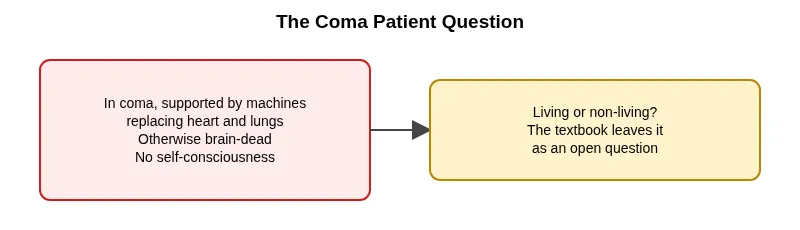
When it comes to human beings, it is all the more difficult to define the living state. We observe patients lying in coma in hospitals, virtually supported by machines which replace heart and lungs. The patient is otherwise brain-dead and has no self-consciousness. Are such patients, who never come back to normal life, living or non-living?
Exam tip
This is asked as a reasoning point: the case shows why self-consciousness alone is hard to use for defining life in humans.
11Defining vs non-defining features
A feature is defining when it is present in all living organisms and absent in all non-living things.
| Feature | In all living organisms? | In non-living objects? | Exception / evidence | Verdict |
|---|---|---|---|---|
| Growth | Yes (twin characteristics: mass and number) | Yes, by accumulation on the surface | Mountains, boulders, sand mounds grow | Not defining |
| Reproduction | No | No (cannot reproduce or replicate by themselves) | Mules, sterile worker bees, infertile human couples | Not defining (not all-inclusive) |
| Metabolism | Yes, without exception | No | In vitro reactions = living reactions, not living things | Defining |
| Cellular organisation | Yes | No | Explains why in vitro reactions are not alive | THE defining feature of life forms |
| Consciousness | Yes (prokaryotes to complex eukaryotes) | No | Only humans have self-consciousness | Defining property |
| Self-consciousness | No (only human beings) | No | Absent in all other organisms | Not defining |
12Emergent properties and the definition of living
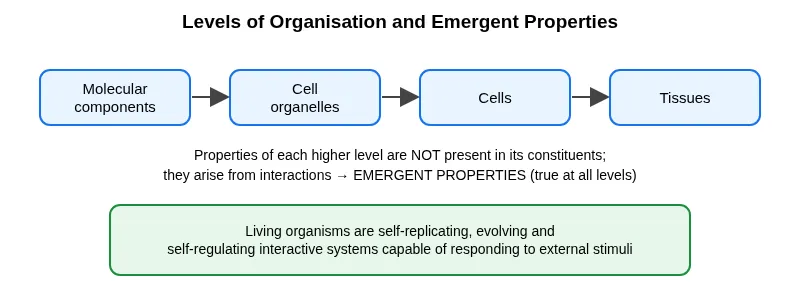
All living phenomena are due to underlying interactions:
- Properties of tissues are not present in the constituent cells; they arise from interactions among the constituent cells.
- Properties of cellular organelles are not present in their molecular constituents; they arise from interactions among the molecular components of the organelle.
- These interactions result in emergent properties at a higher level of organisation. This holds true in the hierarchy of organisational complexity at all levels.
Key line
Therefore, we can say that living organisms are self-replicating, evolving and self-regulating interactive systems capable of responding to external stimuli.
Biology is the story of life on earth: the story of the evolution of living organisms. All living organisms, present, past and future, are linked to one another by the sharing of common genetic material, but to varying degrees.
13Need for naming: nomenclature and identification
There are millions of plants and animals in the world; we know the plants and animals in our own area by their local names. These local names would vary from place to place, even within a country, and would create confusion if we did not find ways and means to refer to the organisms we are talking about.
Hence, there is a need to standardise the naming of living organisms such that a particular organism is known by the same name all over the world. This process is called nomenclature. Nomenclature is only possible when the organism is described correctly and we know to what organism the name is attached to. This is identification.
| Term | Meaning | Exam point |
|---|---|---|
| Identification | Describing the organism correctly so that we know to what organism a name is attached | Comes before naming |
| Nomenclature | Standardised naming so an organism has the same name all over the world | Possible only after correct identification |
| Local (vernacular) name | Name used in one area | Varies from place to place, even within a country |
International codes
| Group | Code | What it provides |
|---|---|---|
| Plants | International Code for Botanical Nomenclature (ICBN) | Agreed principles and criteria for scientific names of plants |
| Animals | International Code of Zoological Nomenclature (ICZN) | Evolved by animal taxonomists for naming animals |
Key line
The scientific names ensure that each organism has only one name. Description of any organism should enable the people (in any part of the world) to arrive at the same name. They also ensure that such a name has not been used for any other known organism.
14Binomial nomenclature
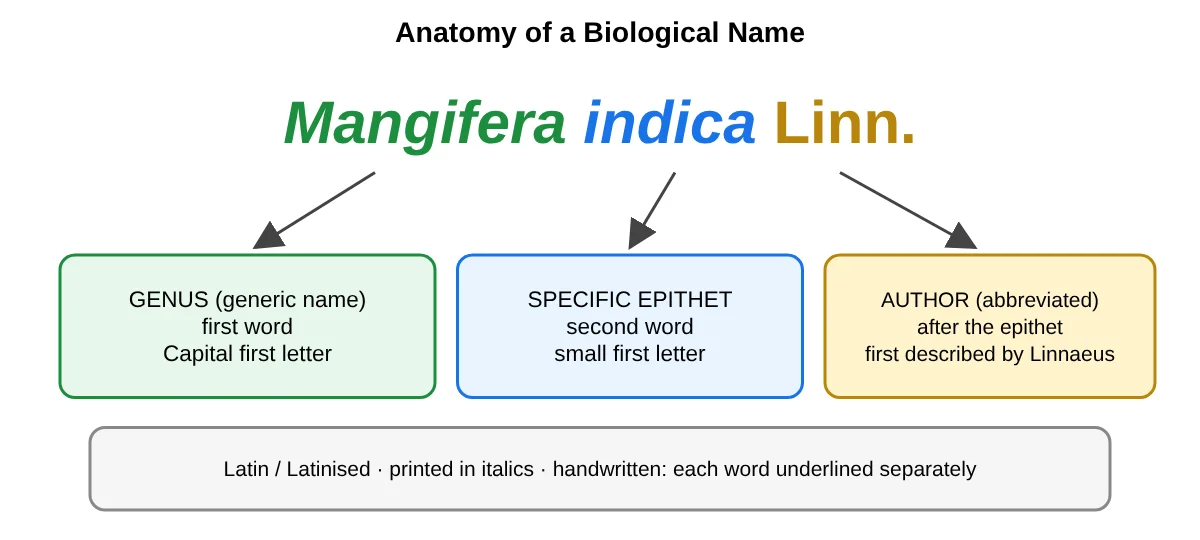
Each scientific name has two components: the generic name and the specific epithet. This system of providing a name with two components is called binomial nomenclature. It was given by Carolus Linnaeus and is practised by biologists all over the world; the two-word format was found convenient.
Universal rules of nomenclature
- Biological names are generally in Latin and written in italics. They are Latinised or derived from Latin irrespective of their origin.
- The first word represents the genus; the second denotes the specific epithet.
- Both words, when handwritten, are separately underlined, or printed in italics to indicate their Latin origin.
- The genus starts with a capital letter; the specific epithet starts with a small letter (e.g. Mangifera indica).
The name of the author appears after the specific epithet, at the end of the biological name, and is written in an abbreviated form, e.g. Mangifera indica Linn. It indicates that this species was first described by Linnaeus.
| Written as | Correct? | Why |
|---|---|---|
| Mangifera indica | Correct | Genus capital, epithet small, italics |
| Mangifera Indica | Wrong | Specific epithet must start with a small letter |
| Mangifera indica (handwritten) | Correct | Each word underlined separately |
| Mangifera indica (one line under both) | Wrong | Words must be underlined separately |
| Mangifera indica Linn. | Correct | Author abbreviated, after the epithet |
| mangifera indica | Wrong | Genus must start with a capital letter |
Exam tip
The textbook exercise asks you to pick the correctly written name of mango from “Mangifera Indica” and “Mangifera indica”. The answer is Mangifera indica.
15Classification, taxa and taxonomy
Since it is nearly impossible to study all the living organisms, we need a means to make this possible. This process is classification: the process by which anything is grouped into convenient categories based on some easily observable characters.
We easily recognise groups such as plants, animals, dogs, cats or insects, and the moment we use any of these terms we associate certain characters with the organism in that group. Think of ‘dogs’ and you see dogs, not cats; think of ‘Alsatians’ and you know exactly what is meant. Say ‘mammals’ and you think of animals with external ears and body hair. Say ‘wheat’ and you picture wheat plants, not rice.
All these, ‘Dogs’, ‘Cats’, ‘Mammals’, ‘Wheat’, ‘Rice’, ‘Plants’, ‘Animals’, are convenient categories. The scientific term for these categories is taxa. Taxa can indicate categories at very different levels.
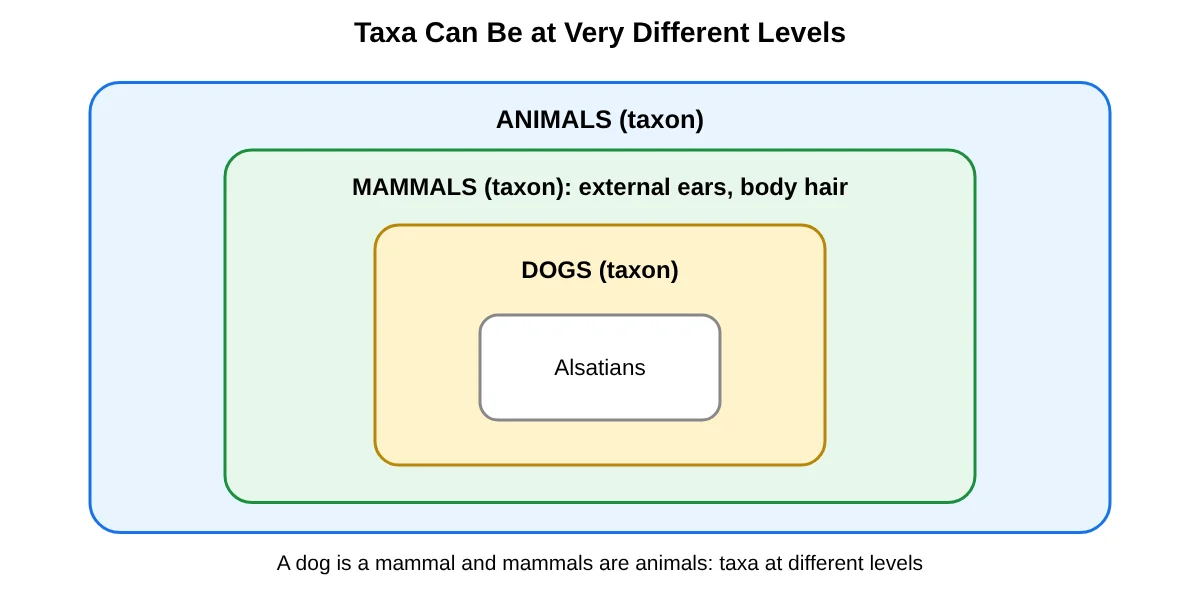
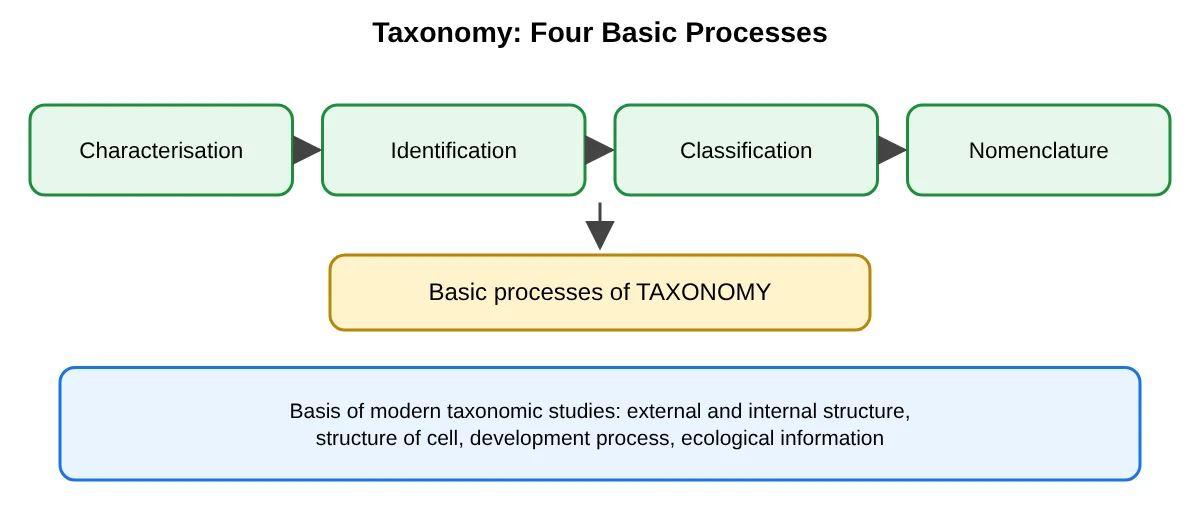
Based on characteristics, all living organisms can be classified into different taxa. This process of classification is taxonomy.
Key line
External and internal structure, along with the structure of cell, development process and ecological information of organisms are essential and form the basis of modern taxonomic studies.
Earliest classifications
Human beings have always been interested in knowing more about the various kinds of organisms, particularly with reference to their own use. In early days they needed sources for food, clothing and shelter. Hence, the earliest classifications were based on the ‘uses’ of various organisms.
Is ‘Plants’ a taxon?
Yes. ‘Plants’ form a taxon, and ‘Wheat’ is also a taxon, at a different level.
What do you picture for ‘mammals’?
Animals with external ears and body hair.
Basis of the earliest classifications?
The ‘uses’ of organisms: food, clothing and shelter.
16Systematics
Human beings were interested not only in different kinds of organisms and their diversities, but also in the relationships among them. This branch of study was referred to as systematics. The word is derived from the Latin word ‘systema’, which means systematic arrangement of organisms. Linnaeus used Systema Naturae as the title of his publication.
| Point | Taxonomy | Systematics |
|---|---|---|
| Meaning | Process of classifying organisms into taxa based on characteristics | Study of kinds, diversity and relationships among organisms |
| Includes | Characterisation, identification, classification, nomenclature | Scope enlarged to include identification, nomenclature and classification |
| Evolution | Not stated in its definition | Takes into account evolutionary relationships between organisms |
| Origin of word | – | Latin ‘systema’ (systematic arrangement); Linnaeus’ Systema Naturae |
Exam tip
“Takes into account evolutionary relationships” is the phrase that identifies systematics in statement-type questions.
17Taxonomic categories and hierarchy
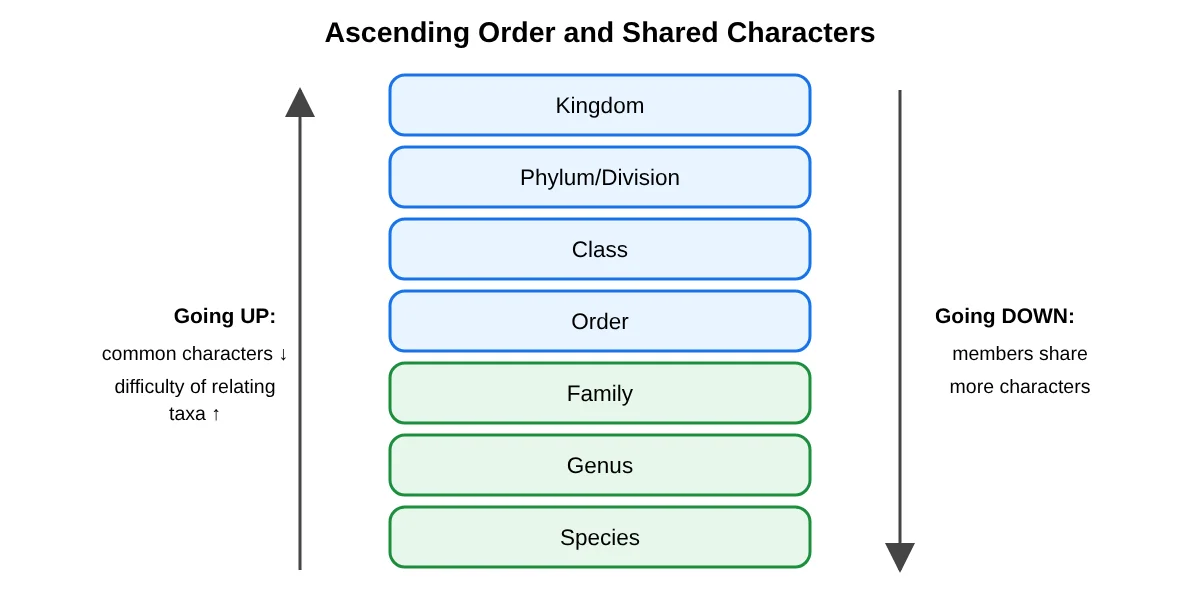
Classification is not a single step process but involves a hierarchy of steps in which each step represents a rank or category. Since the category is part of the overall taxonomic arrangement, it is called the taxonomic category, and all categories together constitute the taxonomic hierarchy. Each category, referred to as a unit of classification, represents a rank and is commonly termed a taxon (pl. taxa).
Example: insects share common features like three pairs of jointed legs. Insects are recognisable concrete objects which can be classified, and thus were given a rank or category. Groups represent category; category denotes rank; each rank or taxon represents a unit of classification. These taxonomic groups are distinct biological entities and not merely morphological aggregates.
Taxonomical studies of all known organisms have led to the common categories: kingdom, phylum or division (for plants), class, order, family, genus and species. All organisms, including those in the plant and animal kingdoms, have species as the lowest category. To place an organism in these categories, the basic requirement is knowledge of its characters, which helps identify similarities and dissimilarities.
Species
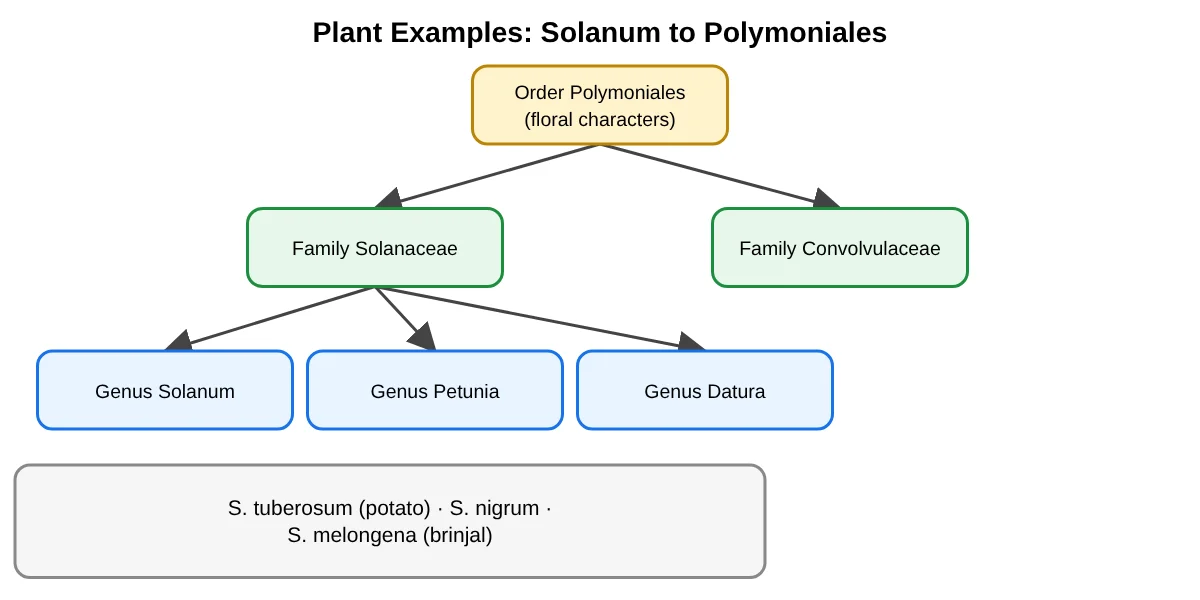
A group of individual organisms with fundamental similarities is a species. One should be able to distinguish one species from closely related species based on distinct morphological differences. In Mangifera indica, Solanum tuberosum (potato) and Panthera leo (lion), the words indica, tuberosum and leo are specific epithets; Mangifera, Solanum and Panthera are genera, a higher taxon. A genus may have one or more specific epithets: Panthera also has tigris; Solanum includes nigrum and melongena. Human beings belong to the species sapiens in the genus Homo: Homo sapiens.
Genus
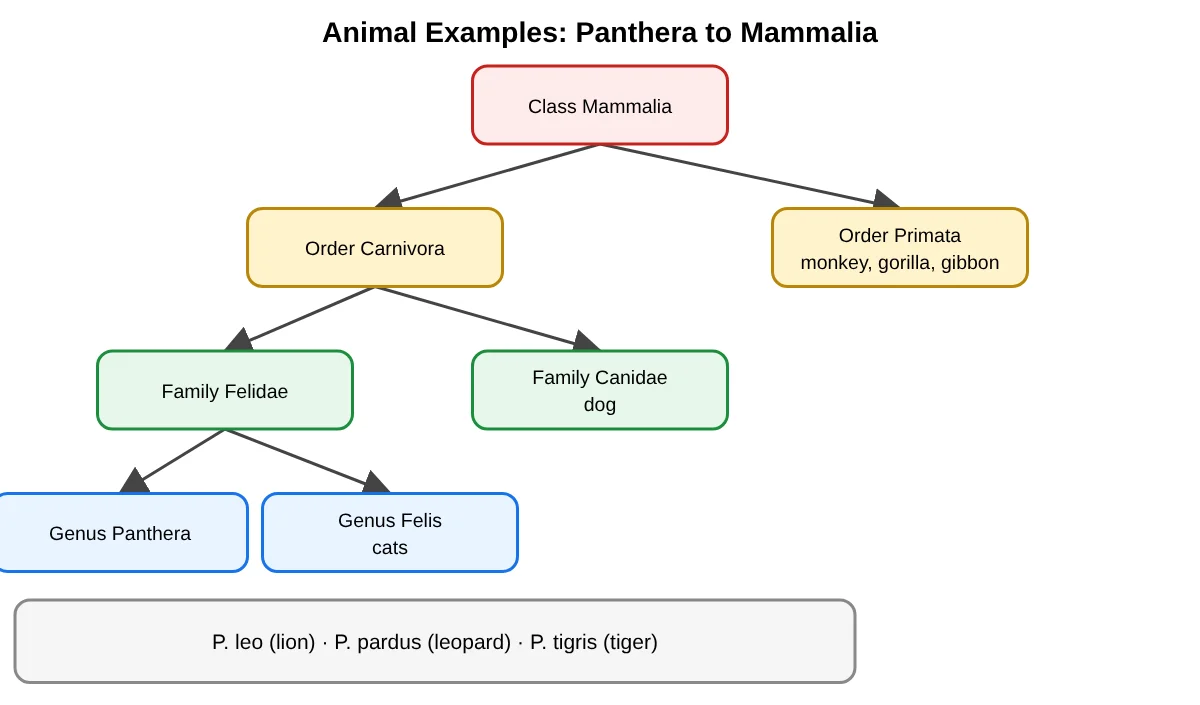
A group of related species which has more characters in common in comparison to species of other genera; genera are aggregates of closely related species. Potato and brinjal are different species of Solanum. Lion (Panthera leo), leopard (P. pardus) and tiger (P. tigris) are species of Panthera, which differs from the genus Felis (cats).
Family
A group of related genera with still less number of similarities as compared to genus and species. Plant families are characterised on the basis of both vegetative and reproductive features. Solanum, Petunia and Datura are in family Solanaceae. Panthera and Felis are in family Felidae. Cat and dog show some similarities and some differences, so they are in Felidae and Canidae respectively.
Order
Order and higher categories are identified on the basis of aggregates of characters. An order is an assemblage of families which exhibit a few similar characters, fewer than among genera of a family. Plant families Convolvulaceae and Solanaceae are in the order Polymoniales, mainly on floral characters. The animal order Carnivora includes Felidae and Canidae.
Class
Includes related orders. Order Primata (monkey, gorilla, gibbon) is placed in class Mammalia along with order Carnivora (tiger, cat, dog). Class Mammalia has other orders also.
Phylum (Division in plants)
Classes such as fishes, amphibians, reptiles, birds and mammals constitute the phylum. Based on common features like the presence of notochord and dorsal hollow neural system, they are included in phylum Chordata. In plants, classes with a few similar characters are assigned to a higher category called Division.
Kingdom
All animals of various phyla are in the highest category, Kingdom Animalia. Kingdom Plantae is distinct and comprises all plants from various divisions. Taxonomists have also developed sub-categories in this hierarchy to facilitate more sound and scientific placement of taxa.
Every textbook example at a glance
| Category | Groups together | Plant example | Animal example |
|---|---|---|---|
| Species | Individuals with fundamental similarities | Mangifera indica, Solanum tuberosum, S. nigrum, S. melongena | Panthera leo, P. tigris, P. pardus, Homo sapiens |
| Genus | Closely related species | Solanum (potato, brinjal) | Panthera (lion, leopard, tiger); Felis (cats) |
| Family | Related genera (vegetative + reproductive features in plants) | Solanaceae (Solanum, Petunia, Datura) | Felidae (Panthera, Felis); Canidae (dog) |
| Order | Families with a few similar characters | Polymoniales (Convolvulaceae, Solanaceae; floral characters) | Carnivora (Felidae, Canidae); Primata (monkey, gorilla, gibbon) |
| Class | Related orders | – | Mammalia (Primata, Carnivora and others) |
| Phylum / Division | Classes | Division (classes with a few similar characters) | Chordata (fishes, amphibians, reptiles, birds, mammals: notochord, dorsal hollow neural system) |
| Kingdom | Phyla / divisions | Plantae | Animalia |
Exam tip
Ascending order starts with species: species → genus → family → order → class → phylum/division → kingdom. Read whether the question says ascending or descending.
18Table 1.1, memory hook and Ernst Mayr
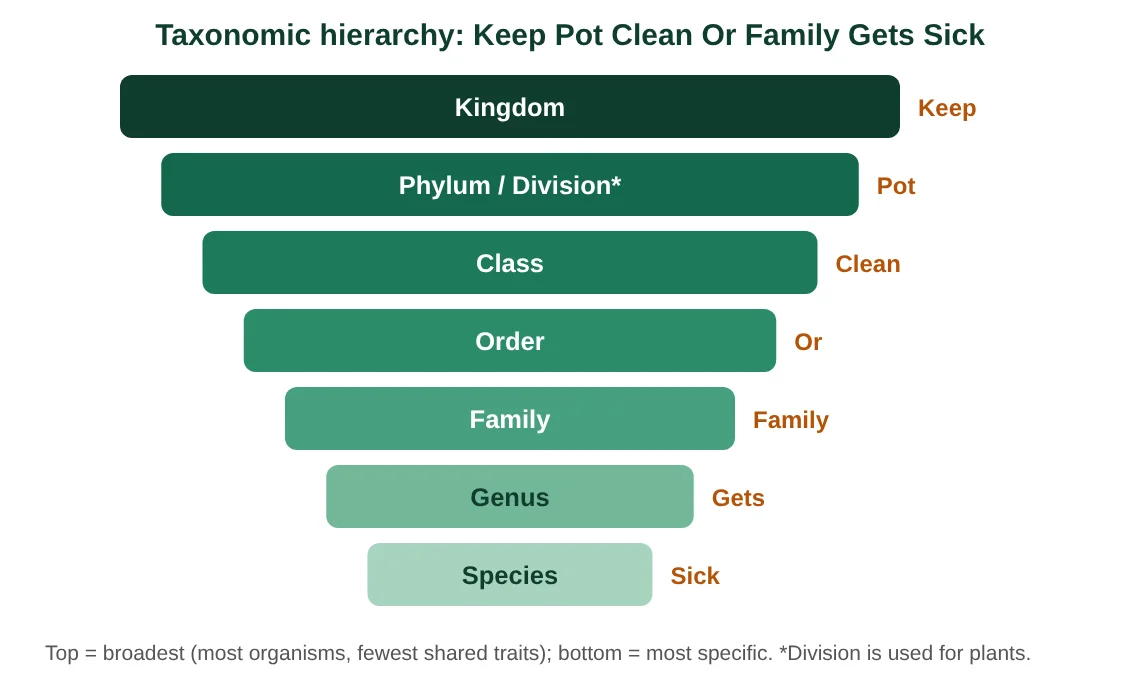
Use the mnemonic to fix the order of the ranks, then learn Table 1.1 row by row: many questions are set directly from it.
Memory hook
Keep Pot Clean Or Family Gets Sick = Kingdom → Phylum (Division for plants) → Class → Order → Family → Genus → Species.
Key line
As we go higher from species to kingdom, the number of common characteristics goes on decreasing. Lower the taxa, more are the characteristics that the members within the taxon share. Higher the category, greater is the difficulty of determining the relationship to other taxa at the same level.
Table 1.1 Organisms with their Taxonomic Categories
Table 1.1 indicates the taxonomic categories to which some common organisms like housefly, man, mango and wheat belong.
| Common Name | Biological Name | Genus | Family | Order | Class | Phylum/ Division |
|---|---|---|---|---|---|---|
| Man | Homo sapiens | Homo | Hominidae | Primata | Mammalia | Chordata |
| Housefly | Musca domestica | Musca | Muscidae | Diptera | Insecta | Arthropoda |
| Mango | Mangifera indica | Mangifera | Anacardiaceae | Sapindales | Dicotyledonae | Angiospermae |
| Wheat | Triticum aestivum | Triticum | Poaceae | Poales | Monocotyledonae | Angiospermae |
Exam tip
Orders: Primata, Diptera, Sapindales, Poales. Mango and wheat share division Angiospermae but differ in class (Dicotyledonae vs Monocotyledonae). Plants: Division; animals: Phylum.
MCQs on Table 1.1
Choose your answer, then tap “Show answer”
- Housefly belongs to the order:
- (a) Diptera
- (b) Primata
- (c) Poales
- (d) Sapindales
Show answer
(a) Diptera. Family Muscidae, class Insecta, phylum Arthropoda.
- Mangifera indica belongs to the family:
- (a) Poaceae
- (b) Anacardiaceae
- (c) Muscidae
- (d) Hominidae
Show answer
(b) Anacardiaceae, order Sapindales.
- Which pair is correctly matched with its order?
- (a) Wheat – Sapindales
- (b) Man – Primata
- (c) Mango – Poales
- (d) Housefly – Insecta
Show answer
(b) Man – Primata. Wheat is Poales, mango is Sapindales, and Insecta is a class.
- Which two organisms in Table 1.1 share the same division?
- (a) Man and housefly
- (b) Mango and wheat
- (c) Housefly and wheat
- (d) Man and mango
Show answer
(b) Mango and wheat: both Angiospermae (classes Dicotyledonae and Monocotyledonae).
- Class Mammalia and phylum Chordata are the categories of:
- (a) Musca domestica
- (b) Homo sapiens
- (c) Triticum aestivum
- (d) Mangifera indica
Show answer
(b) Homo sapiens (family Hominidae, order Primata).
- Wheat (Triticum aestivum) belongs to the class:
- (a) Dicotyledonae
- (b) Monocotyledonae
- (c) Insecta
- (d) Mammalia
Show answer
(b) Monocotyledonae; family Poaceae, order Poales.
- Muscidae is the family of:
- (a) Man
- (b) Mango
- (c) Housefly
- (d) Wheat
Show answer
(c) Housefly, Musca domestica.
- Which is the correct descending sequence for mango?
- (a) Angiospermae → Dicotyledonae → Sapindales → Anacardiaceae → Mangifera
- (b) Angiospermae → Sapindales → Dicotyledonae → Anacardiaceae → Mangifera
- (c) Dicotyledonae → Angiospermae → Sapindales → Anacardiaceae → Mangifera
- (d) Angiospermae → Dicotyledonae → Anacardiaceae → Sapindales → Mangifera
Show answer
(a) Division → Class → Order → Family → Genus.
Ernst Mayr (1904 – 2004)
Born on 5 July 1904, in Kempten, Germany, ERNST MAYR, the Harvard University evolutionary biologist who has been called ‘The Darwin of the 20th century’, was one of the 100 greatest scientists of all time. Mayr joined Harvard’s Faculty of Arts and Sciences in 1953 and retired in 1975, assuming the title Alexander Agassiz Professor of Zoology Emeritus. Throughout his nearly 80-year career, his research spanned ornithology, taxonomy, zoogeography, evolution, systematics, and the history and philosophy of biology.
He almost single-handedly made the origin of species diversity the central question of evolutionary biology that it is today. He also pioneered the currently accepted definition of a biological species.
Mayr was awarded the three prizes widely regarded as the triple crown of biology: the Balzan Prize in 1983, the International Prize for Biology in 1994, and the Crafoord Prize in 1999. Mayr died at the age of 100 in the year 2004.
19Chapter summary and textbook exercises
Summary
The living world is rich in variety. Millions of plants and animals have been identified and described but a large number still remains unknown. The range of organisms in size, colour, habitat, physiological and morphological features makes us seek the defining characteristics of living organisms.
Biologists have evolved rules and principles for identification, nomenclature and classification; this branch is taxonomy. Taxonomic studies are useful in agriculture, forestry, industry and for knowing our bio-resources and their diversity.
Identification, naming and classification are universally evolved under international codes. Each organism is assigned a two-word scientific name as per the binomial system and occupies a place in the system of classification. All the categories (taxa) constitute a taxonomic hierarchy.
Exercises (tap for model answers)
1. Why are living organisms classified?
It is nearly impossible to study all living organisms individually; classification groups them into convenient categories based on easily observable characters, making study possible.
2. Why are the classification systems changing every now and then?
New organisms are continuously being identified, and the basis of taxonomy now includes internal structure, cell structure, development, ecological information and evolutionary relationships, so placements are revised.
3. What criteria would you choose to classify people you meet often?
Easily observable characters, e.g. age group, place of work or study, relationship to you; each criterion forms a category, just as taxa do.
4. What do we learn from identification of individuals and populations?
Their correct description, similarities and differences, so that the correct name can be attached and they can be placed in the right taxa.
5. Correctly written name of mango: Mangifera Indica or Mangifera indica?
Mangifera indica: the specific epithet starts with a small letter.
6. Define a taxon, with examples at different levels.
A taxon is a category/rank that is a unit of classification. Examples: dogs (lower), mammals, animals (higher); wheat and plants.
7. Correct sequence: (a) Species Order Phylum Kingdom (b) Genus Species Order Kingdom (c) Species Genus Order Phylum
(a) and (c) are both in correct ascending order; (b) is wrong because species is below genus.
8. Meanings of ‘species’: higher organisms vs bacteria?
The textbook meaning is a group of individuals with fundamental similarities, distinguished by distinct morphological differences. Discuss with your teacher how this applies to bacteria (an open discussion exercise).
9. Define phylum, class, family, order, genus.
Phylum: group of classes (Division in plants). Class: related orders. Order: families with a few similar characters. Family: related genera. Genus: closely related species.
10. Illustrate the hierarchy with a plant and an animal.
Use Table 1.1: wheat: Triticum → Poaceae → Poales → Monocotyledonae → Angiospermae → Plantae; man: Homo → Hominidae → Primata → Mammalia → Chordata → Animalia.
20High-yield NCERT lines
- Biology is the science of life forms and living processes.
- “What indeed is life?” has a technical question (living vs non-living) and a philosophical question (purpose of life); scientists do not attempt the second.
- Societies with an anthropocentric view of biology registered limited progress.
- Species known and described: 1.7–1.8 million.
- Increase in mass and increase in number of individuals are twin characteristics of growth.
- Plants grow throughout life; in animals growth is seen up to a certain age, and cell division in certain tissues replaces lost cells.
- In majority of higher animals and plants, growth and reproduction are mutually exclusive events.
- Mountains, boulders and sand mounds grow by accumulation of material on the surface; living organisms grow from inside.
- Yeast and Hydra: budding. Planaria: true regeneration. Fungi, filamentous algae, protonema of mosses: fragmentation.
- In bacteria, unicellular algae and Amoeba, reproduction is synonymous with growth.
- Mules, sterile worker bees and infertile human couples do not reproduce.
- Metabolism is the sum total of all chemical reactions in the body; no non-living object exhibits it.
- Isolated metabolic reactions in vitro are not living things but surely living reactions.
- Cellular organisation of the body is the defining feature of life forms.
- Photoperiod affects reproduction in seasonal breeders, both plants and animals.
- Only human beings have self-consciousness; consciousness is the defining property of living organisms.
- Living organisms are self-replicating, evolving and self-regulating interactive systems capable of responding to external stimuli.
- Local names vary from place to place, even within a country; hence standardised naming (nomenclature).
- Nomenclature is only possible when the organism is described correctly: identification.
- Plants: ICBN. Animals: ICZN.
- Binomial nomenclature: generic name + specific epithet; given by Carolus Linnaeus.
- Genus starts with a capital, specific epithet with a small letter; handwritten words underlined separately.
- Mangifera indica Linn.: author name abbreviated, after the epithet.
- Characterisation, identification, classification and nomenclature are basic to taxonomy.
- Earliest classifications were based on ‘uses’ of organisms.
- Systematics (Latin ‘systema’) takes into account evolutionary relationships; Linnaeus wrote Systema Naturae.
- Taxonomic groups are distinct biological entities and not merely morphological aggregates.
- Species is the lowest category in all organisms.
- Plant families: vegetative + reproductive features; Polymoniales grouped on floral characters.
- Chordata: notochord and dorsal hollow neural system.
- Taxonomic studies are useful in agriculture, forestry and industry.
21MCQs: what is living
Choose your answer, then tap “Show answer”
- The defining feature of life forms is:
- (a) growth
- (b) reproduction
- (c) increase in mass
- (d) cellular organisation
Show answer
(d)
- Reproduction is synonymous with growth in:
- (a) Hydra
- (b) Amoeba
- (c) Planaria
- (d) mule
Show answer
(b) Amoeba
- True regeneration is seen in:
- (a) Hydra
- (b) yeast
- (c) Planaria
- (d) fungi
Show answer
(c) Planaria
- 4. Assertion: Growth cannot be a defining property. Reason: Non-living objects grow from inside.
Show answer
Assertion true, Reason false. Non-living objects grow by accumulation of material on the surface.
- Budding is observed in:
- (a) yeast and Hydra
- (b) Planaria and Hydra
- (c) bacteria and Amoeba
- (d) fungi and mosses
Show answer
(a)
- Isolated metabolic reactions in vitro are:
- (a) living things
- (b) not living things but surely living reactions
- (c) non-living reactions
- (d) organisms
Show answer
(b)
- Which organism is aware of itself?
- (a) chimpanzee
- (b) human being
- (c) dolphin
- (d) all mammals
Show answer
(b) human being
- Reproduction is not an all-inclusive characteristic because of:
- (a) mules
- (b) sterile worker bees
- (c) infertile human couples
- (d) all of these
Show answer
(d)
- Photoperiod affects reproduction in:
- (a) seasonal breeders, plants and animals
- (b) only plants
- (c) only animals
- (d) none
Show answer
(a)
- In the majority of higher animals and plants, growth and reproduction are:
- (a) synonymous
- (b) mutually exclusive events
- (c) identical
- (d) absent
Show answer
(b)
- Fragmentation is NOT the listed mode for:
- (a) fungi
- (b) filamentous algae
- (c) protonema of mosses
- (d) yeast
Show answer
(d) yeast, which shows budding.
- Plants grow by cell division:
- (a) up to a certain age
- (b) throughout their life span
- (c) only in seedlings
- (d) never
Show answer
(b)
- Twin characteristics of growth are:
- (a) increase in mass and number of individuals
- (b) metabolism and reproduction
- (c) sensing and responding
- (d) budding and fission
Show answer
(a)
- The question scientists do not attempt is:
- (a) what is living
- (b) the purpose of life
- (c) the number of species
- (d) how organisms grow
Show answer
(b)
- Which is the most obvious and technically complicated feature of living organisms?
- (a) growth
- (b) reproduction
- (c) ability to sense and respond to the environment
- (d) cell division
Show answer
(c)
22MCQs: nomenclature, taxonomy and hierarchy
Choose your answer, then tap “Show answer”
- The code for naming plants is:
- (a) ICZN
- (b) ICBN
- (c) Linnaeus code
- (d) Systema Naturae
Show answer
(b) ICBN, International Code for Botanical Nomenclature.
- Binomial nomenclature was given by:
- (a) Ernst Mayr
- (b) Carolus Linnaeus
- (c) Darwin
- (d) Virchow
Show answer
(b) Carolus Linnaeus.
- In Mangifera indica Linn., ‘Linn.’ indicates:
- (a) the genus
- (b) the family
- (c) that Linnaeus first described the species
- (d) the order
Show answer
(c) Author name, abbreviated, after the epithet.
- Which is NOT a basic process of taxonomy?
- (a) Characterisation
- (b) Identification
- (c) Nomenclature
- (d) Fertilisation
Show answer
(d) The four are characterisation, identification, classification, nomenclature.
- Systematics takes into account:
- (a) only uses of organisms
- (b) evolutionary relationships
- (c) only nomenclature
- (d) only local names
Show answer
(b) Evolutionary relationships between organisms.
- The lowest taxonomic category in all organisms is:
- (a) genus
- (b) family
- (c) species
- (d) kingdom
Show answer
(c) Species.
- Solanum, Petunia and Datura belong to the family:
- (a) Felidae
- (b) Solanaceae
- (c) Convolvulaceae
- (d) Poaceae
Show answer
(b) Solanaceae.
- Convolvulaceae and Solanaceae are placed in order Polymoniales mainly on:
- (a) vegetative characters
- (b) floral characters
- (c) habitat
- (d) uses
Show answer
(b) Floral characters.
- The order Carnivora includes:
- (a) Felidae and Canidae
- (b) Hominidae and Muscidae
- (c) Solanaceae and Poaceae
- (d) Primata
Show answer
(a) Felidae and Canidae.
- Phylum Chordata is based on the presence of:
- (a) three pairs of jointed legs
- (b) notochord and dorsal hollow neural system
- (c) body hair
- (d) floral characters
Show answer
(b) Notochord and dorsal hollow neural system.
- As we go from species to kingdom, the number of common characteristics:
- (a) increases
- (b) decreases
- (c) remains the same
- (d) first increases then decreases
Show answer
(b) Decreases.
- Earliest classifications were based on:
- (a) evolution
- (b) uses of organisms
- (c) cell structure
- (d) DNA
Show answer
(b) The ‘uses’ of organisms.
23Common mistakes
- Calling growth or reproduction a defining feature.
- Saying non-living things never grow. Mountains, boulders and sand mounds do, by surface accumulation.
- Calling an in vitro reaction a “living thing”. It is a living reaction.
- Swapping examples: yeast/Hydra = budding; Planaria = true regeneration.
- Forgetting that plants also sense and respond (light, water, temperature, other organisms, pollutants).
- Saying cell division stops completely in adult animals.
- Thinking all organisms have self-consciousness. Only human beings do.
- Writing Mangifera Indica (capital epithet) or underlining both words with one line.
- Calling taxonomy and systematics identical: systematics adds evolutionary relationships.
- Confusing ascending (species first) with descending (kingdom first) order.
- Using ‘phylum’ for plants: plants use Division.
- Placing order Primata or Carnivora in the wrong class: both are in Mammalia.
- Mixing up families: dog is Canidae, cat is Felidae, housefly is Muscidae, wheat is Poaceae.
Download NEET Practice Questions
24Common doubts
Is growth a defining property of living organisms?
No. If increase in body mass is the criterion, non-living objects such as mountains, boulders and sand mounds also grow, by accumulation of material on the surface. Living organisms grow from inside, but growth cannot be taken as a defining property.
Why is reproduction not a defining feature?
Many organisms do not reproduce, e.g. mules, sterile worker bees and infertile human couples, so reproduction cannot be an all-inclusive defining characteristic. Still, no non-living object can reproduce or replicate by itself.
Is a metabolic reaction in a test tube living?
Metabolic reactions can be demonstrated outside the body in cell-free systems. Isolated metabolic reactions in vitro are not living things but surely living reactions.
What are the defining features of life?
Cellular organisation of the body is the defining feature of life forms. Metabolism is a defining feature of all living organisms without exception. Consciousness becomes the defining property of living organisms.
Is a brain-dead patient on life support living or non-living?
It is left as an open question. Such patients lie in coma supported by machines which replace heart and lungs, are otherwise brain-dead and have no self-consciousness. The case shows how difficult it is to define the living state in human beings.
Which organism has self-consciousness?
Human being is the only organism who is aware of himself, i.e. has self-consciousness. All organisms, from prokaryotes to the most complex eukaryotes, can sense and respond to environmental cues.
In which organisms is reproduction synonymous with growth?
In unicellular organisms such as bacteria, unicellular algae and Amoeba, reproduction is synonymous with growth, i.e. increase in number of cells. In the majority of higher animals and plants, growth and reproduction are mutually exclusive events.
What is the technical and the philosophical question about life?
‘What indeed is life?’ has two implicit questions. The technical one asks what living is as opposed to the non-living. The philosophical one asks the purpose of life, which scientists do not attempt to answer.
What is binomial nomenclature?
A system of giving each organism a name with two components, the generic name and the specific epithet, given by Carolus Linnaeus, e.g. Mangifera indica.
What is the difference between taxonomy and systematics?
Taxonomy is the process of classifying organisms into taxa based on characteristics; its basic processes are characterisation, identification, classification and nomenclature. Systematics deals with kinds, diversity and relationships of organisms and takes into account evolutionary relationships.
What is the correct ascending order of taxonomic categories?
Species, genus, family, order, class, phylum (division for plants), kingdom. Species is the lowest category.
What are the taxonomic categories of wheat?
Triticum aestivum: genus Triticum, family Poaceae, order Poales, class Monocotyledonae, division Angiospermae.