
Plant Tropisms and Hormones IB Biology: 12 Notes (C3.1 HL)
In plant tropisms and hormones IB Biology notes, a tropism is a directional growth response of a plant organ to a stimulus from one direction, such as light or gravity. For the official syllabus, see the IB Biology subject guide. Plants have no nerves, so phytohormones such as auxin, cytokinin and ethylene coordinate growth and responses (C3.1.17 to C3.1.23, HL).
1 How plants respond without a nervous system (C3.1.17 to C3.1.23)
Syllabus link: IB Biology (first assessment 2025) C3.1 Integration of body systems, Additional Higher Level: C3.1.17 to C3.1.23. SL students do not need this chapter; the SL part of C3.1 is in the integration of body systems notes.
IB HL = everything on this page is Higher Level only
Plants must also integrate their organs, and plant tropisms are one example: shoots must grow towards light for photosynthesis and roots must grow down into soil for water and anchorage. With no nerves and no muscles, they respond mainly by changing growth, which is slower than an animal response but long-lasting. The signals are phytohormones (plant hormones), and the integration is by chemical signalling and transport between cells.
Swipe the table sideways to see every column.
| Tropism | Stimulus | Shoot | Root |
|---|---|---|---|
| Phototropism | Light from one side | Positive (towards) | Weakly negative or none |
| Gravitropism | Gravity | Negative (upwards) | Positive (downwards) |
| Thigmotropism | Touch | Tendrils coil around supports | Grow around obstacles |
Among plant tropisms, the guide only requires phototropism in detail; other plant tropisms are useful context.
2 Observations of tropic responses in seedlings (C3.1.17)
Experiments on plant tropisms are a classic place to practise IB skills. Grow seedlings such as oats, cress or maize in the dark, then expose them to light from one side.
IB HL Qualitative and quantitative data
- Qualitative observations describe without numbers: labelled diagrams or photos showing that shoots bend towards the light.
- Quantitative observations use numbers: the angle of curvature measured with a protractor from the vertical, or the length of the shoot.
- Record both: diagrams show the pattern, angles allow means, error bars and statistical tests.
Swipe the table sideways to see every column.
| Time / h | Mean angle of curvature / ° (n = 10) | Range / ° |
|---|---|---|
| 0 | 0 | 0 |
| 2 | 8 | 4 to 13 |
| 4 | 21 | 14 to 29 |
| 8 | 37 | 28 to 45 |
Illustrative data constructed for practice.
Nature of science: precision, accuracy and reliability
- Precision is limited by the protractor (about ±1°) and by deciding where the bend starts; photograph seedlings against a grid to improve it.
- Accuracy improves by measuring every seedling the same way and calibrating the light source and its distance.
- Reliability improves with many seedlings per group, repeats and a control group lit from above or kept in uniform light.
- Control variables: temperature, water, seedling age and species, light intensity and wavelength.
3 Positive phototropism as a directional growth response (C3.1.18)
Positive phototropism, the best-known of the plant tropisms, is growth of a plant shoot towards light coming from one side (lateral light). It places leaves where they can absorb the most light for photosynthesis.
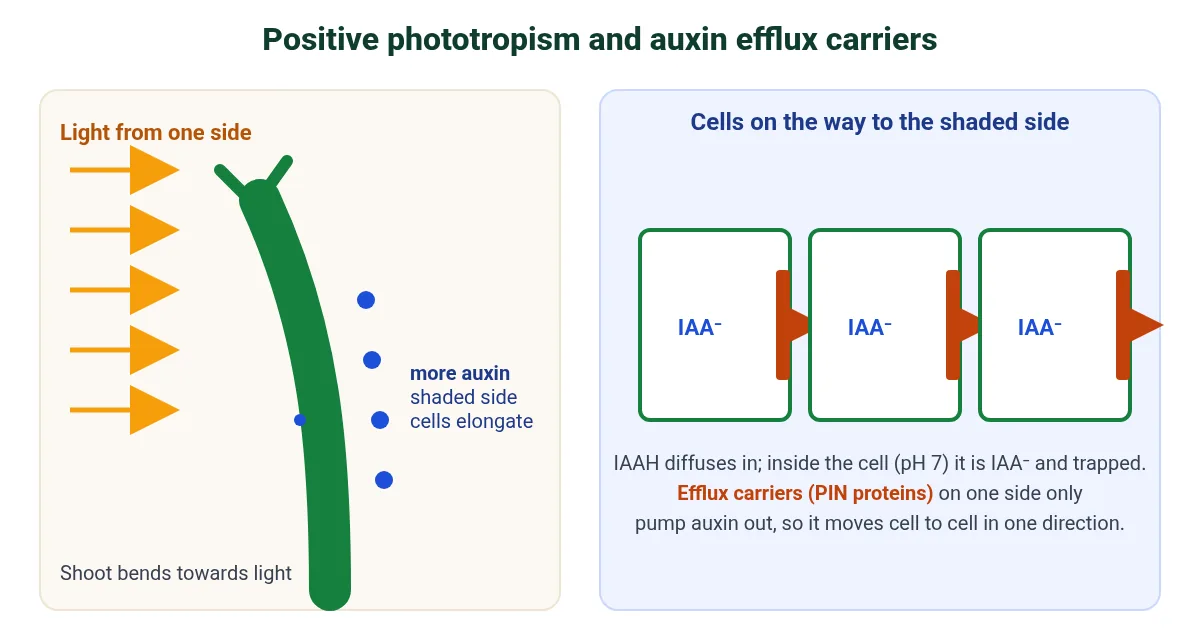
- Detection: the shoot tip detects light from one side using photoreceptor proteins called phototropins.
- Redistribution: auxin efflux carriers are moved to the shaded side of cells, so auxin is transported to the shaded side.
- Unequal growth: the higher auxin concentration makes cells on the shaded side elongate faster.
- Bending: the shaded side grows longer, so the shoot curves towards the light.
Nature of science: the classic experiments
- Darwin (1880): covering the coleoptile tip stopped bending, so the tip detects light.
- Boysen-Jensen (1913): a chemical could pass through gelatin but not mica, so the signal is a chemical.
- Went (1928): agar blocks that had held tips made decapitated coleoptiles bend, and the bend was proportional to auxin concentration.
4 Phytohormones as signalling chemicals (C3.1.19)
Phytohormones are signalling chemicals produced in small amounts in one part of a plant that control growth, development and responses to stimuli in target cells, often elsewhere in the plant. Unlike animal hormones they are not made in dedicated glands, and one hormone can have several effects depending on its concentration and the tissue.
Swipe the table sideways to see every column.
| Phytohormone | Main site of production | Main effects |
|---|---|---|
| Auxin (IAA) | Shoot tips, young leaves | Cell elongation, phototropism, apical dominance, root initiation |
| Cytokinins | Root tips | Cell division, shoot growth, delay leaf ageing |
| Gibberellins | Young leaves, seeds | Stem elongation, seed germination |
| Abscisic acid (ABA) | Leaves, roots under stress | Stomatal closure, seed dormancy |
| Ethylene (ethene) | Ripening fruit, ageing tissues | Fruit ripening, leaf fall |
The guide only asks you to appreciate that a variety of chemicals act as phytohormones; auxin, cytokinin and ethylene are the ones you must use in detail (C3.1.20 to C3.1.23).
5 Auxin efflux carriers and concentration gradients (C3.1.20)
Auxin moves from cell to cell in one direction, a process called polar transport. It depends on where carrier proteins sit in the plasma membrane:
- Outside the cell, in the acidic cell wall (about pH 5), much auxin is uncharged (IAAH) and diffuses freely into cells.
- Inside, the cytoplasm is about pH 7, so auxin loses H+ and becomes the ion IAA−, which cannot diffuse out through the membrane.
- IAA− leaves only through auxin efflux carriers (PIN proteins), which can be placed on one side of the cell.
- If neighbouring cells all place their carriers on the same side, auxin is pumped from cell to cell and becomes concentrated in one part of the plant.
Exporting auxin uses energy indirectly: proton pumps that use ATP keep the wall acidic and the cytoplasm neutral (see active transport and proton pumps across membranes). By moving carriers to the shaded side, a shoot can create the auxin gradient that drives phototropism within an hour.
IB HL Key point
- Auxin gets in by diffusion but out only through efflux carriers. Their position controls the direction of transport and so the concentration gradient.
6 Promotion of cell growth by auxin (C3.1.21)
Plant cells grow mostly by elongation, taking in water. The cellulose wall normally resists expansion. Auxin makes the wall more extensible by the acid growth mechanism:
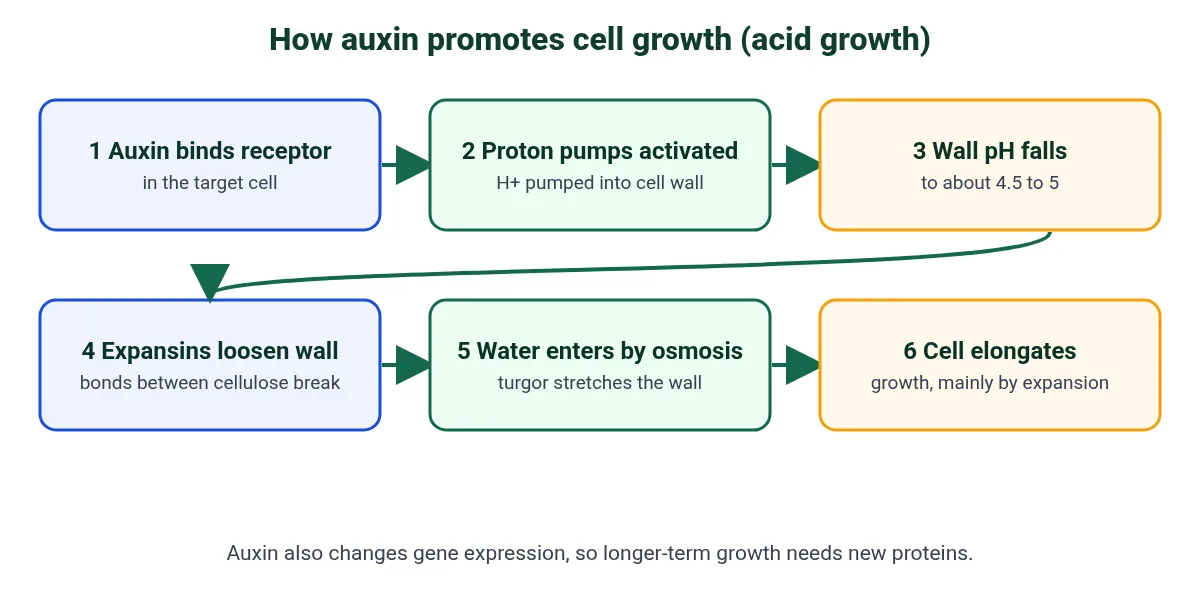
- Auxin binds to receptors in the target cell.
- This activates proton pumps in the plasma membrane, which pump H+ ions from the cytoplasm into the cell wall.
- The wall becomes acidic (about pH 4.5 to 5).
- Low pH activates proteins called expansins that break hydrogen bonds between cellulose microfibrils, loosening the wall.
- Water enters by osmosis; turgor pressure stretches the loosened wall and the cell elongates.
- Auxin also changes gene expression, producing proteins needed for longer-term growth.
Too much auxin inhibits growth, and roots are far more sensitive than shoots: a concentration that speeds shoot growth can slow root growth.
Cell wall structure is covered in plant and animal cell structure notes.
7 Auxin and cytokinin interactions in root and shoot growth (C3.1.22)
Root and shoot growth are integrated by two hormones made at opposite ends of the plant:
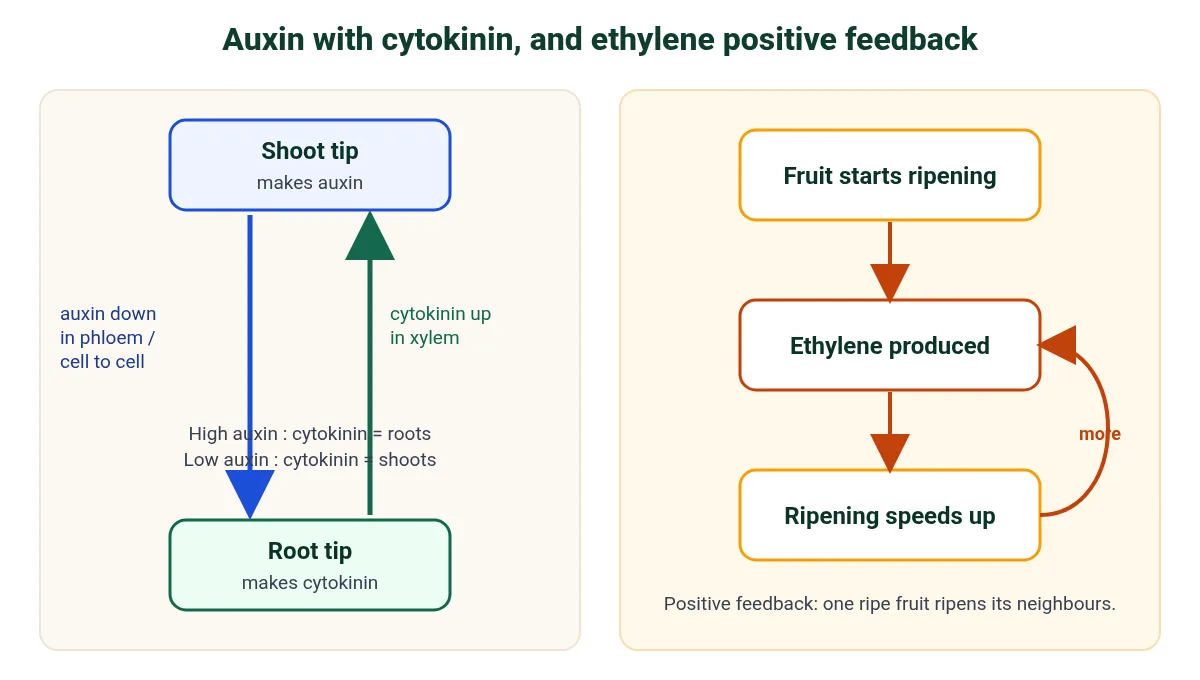
- Auxin is made in the shoot tip and moves down towards the roots.
- Cytokinin is made in the root tip and travels up to the shoots in the xylem.
- Each hormone tells one end of the plant how the other end is growing, so growth of roots and shoots stays balanced.
Swipe the table sideways to see every column.
| Situation | Role of auxin | Role of cytokinin |
|---|---|---|
| Apical dominance | Auxin from the shoot tip inhibits growth of side (lateral) buds | Cytokinin stimulates lateral buds to grow, opposing auxin |
| Root branching | Stimulates lateral root formation | Inhibits lateral root formation |
| Tissue culture | High auxin : cytokinin ratio gives roots | Low auxin : cytokinin ratio gives shoots |
Removing the shoot tip removes the source of auxin, so cytokinin wins and side buds grow: gardeners use this to make bushy plants. The same ratio rule is used to grow whole plants from tissue, as shown in plant tissue culture using auxin and cytokinin.
8 Positive feedback in fruit ripening and ethylene production (C3.1.23)
Ethylene (ethene, C2H4) is a gaseous phytohormone. In many fruits, such as bananas, apples and tomatoes, ripening is controlled by positive feedback:
- Ripening begins and the fruit starts to make ethylene.
- Ethylene stimulates ripening: starch is converted to sugars, cell walls soften, chlorophyll breaks down and colour and aroma develop.
- Ethylene also stimulates more ethylene production, so ripening speeds up.
- Because ethylene is a gas it diffuses to neighbouring fruit, so ripening spreads: “one bad apple spoils the barrel”.
IB HL Why positive feedback suits ripening
- Negative feedback keeps a variable stable; positive feedback drives a change rapidly to completion.
- All the fruit on a plant ripen together, which attracts animals that eat the fruit and disperse the seeds.
Growers use this: fruit is picked unripe and stored cold with low O2 to slow ethylene production, then ripened in ethylene gas before sale.
9 Common exam traps
Watch out for these
- “Light destroys auxin on the lit side.” Auxin is transported to the shaded side by efflux carriers.
- “Auxin makes cells divide on the shaded side.” Phototropism, like other plant tropisms, is mainly cell elongation, not division.
- “Auxin is actively pumped into cells.” It diffuses in; efflux carriers move it out.
- “H+ ions break the cellulose.” Low pH activates expansins that loosen bonds between microfibrils; cellulose is not digested.
- Mixing up the ratio High auxin to cytokinin gives roots; low gives shoots.
- Calling ripening negative feedback Ethylene stimulates more ethylene: positive feedback.
- Plant content is HL only Do not expect questions on plant tropisms (C3.1.17 to C3.1.23) on SL papers.
10 Key terms
| Term | Meaning |
|---|---|
| Tropism | Directional growth response of a plant organ to a stimulus from one direction; plant tropisms include phototropism and gravitropism. |
| Positive phototropism | Growth of a shoot towards light from one side. |
| Phytohormone | Signalling chemical controlling plant growth, development and responses. |
| Auxin (IAA) | Phytohormone made in shoot tips that promotes cell elongation. |
| Auxin efflux carrier | Membrane protein (PIN) that moves auxin out of a cell on one side only. |
| Acid growth | Auxin-induced H+ secretion that loosens cell walls so cells elongate. |
| Expansin | Wall protein activated by low pH that loosens cellulose microfibrils. |
| Cytokinin | Phytohormone made in root tips that promotes cell division and shoot growth. |
| Apical dominance | Inhibition of side buds by auxin from the shoot tip. |
| Ethylene | Gaseous phytohormone that promotes fruit ripening by positive feedback. |
11 Common doubts
Questions students ask us most often about plant tropisms in this IB topic.
Is plant tropisms and hormones on the IB Biology SL syllabus?
No. C3.1.17 to C3.1.23, covering tropisms, phytohormones, auxin, cytokinin and ethylene, are Additional Higher Level statements, so only HL students are examined on them.
Why does a shoot bend towards light?
Light from one side is detected by the tip, auxin efflux carriers move auxin to the shaded side, and the higher auxin concentration there makes cells elongate faster. The shaded side grows longer, so the shoot curves towards the light.
How does auxin make plant cells grow?
Auxin activates proton pumps that move H+ ions into the cell wall. The acidic wall activates expansins, which loosen the bonds between cellulose microfibrils. Water then enters by osmosis and turgor pressure stretches the wall, so the cell elongates.
What is the role of auxin efflux carriers?
Auxin diffuses into cells but, once inside as an ion, can leave only through efflux carriers. When cells place these carriers on the same side, auxin is pumped from cell to cell in one direction, building a concentration gradient.
Why is fruit ripening an example of positive feedback?
Ethylene speeds up ripening, and ripening fruit makes more ethylene, which speeds ripening further. The change is amplified rather than reversed, and because ethylene is a gas it spreads to nearby fruit.
12 Practice questions
Tap each question to reveal the answer.
Test yourself
1. (IB HL) Distinguish between qualitative and quantitative observations of seedlings in a phototropism experiment. [2 marks]
Qualitative: descriptions/diagrams of the direction of bending; quantitative: numerical measurements such as angle of curvature in degrees.
2. (IB HL) Explain how auxin causes positive phototropism. [4 marks]
Tip detects light from one side; efflux carriers move auxin to the shaded side; higher auxin concentration there; cells on shaded side elongate more; shoot bends towards light.
3. (IB HL) Explain why auxin can enter a cell by diffusion but needs a carrier to leave. [2 marks]
Uncharged IAAH in the acidic wall crosses the membrane; at pH 7 inside it ionises to IAA-, which cannot cross the membrane, so it leaves only through efflux carriers.
4. (IB HL) Outline the acid growth mechanism. [3 marks]
Auxin activates proton pumps; H+ pumped into cell wall, lowering pH; expansins loosen cellulose cross-links; water uptake/turgor stretches wall; cell elongates.
5. (IB HL) State the effect of removing the shoot tip on lateral buds and explain why.
Lateral buds grow; the source of auxin that inhibited them is removed, so cytokinin effect dominates (apical dominance lost).
6. (IB HL) Predict the outcome of culturing plant tissue in a medium with a high auxin to cytokinin ratio.
Roots form (rather than shoots).
7. (IB HL) Explain why ripening of bananas is an example of positive feedback. [2 marks]
Ripening fruit produces ethylene; ethylene stimulates ripening and more ethylene production, so the change is amplified.
8. (IB HL) Suggest two ways to improve the reliability of a seedling experiment on plant tropisms.
Use many seedlings per group / repeat the experiment; keep temperature, water and light intensity constant / include a control lit uniformly.
Ready to practise? Download the Plant Tropisms and Hormones IB HL question set with markscheme.
© competitorspoint.com · Biology notes. Diagrams are original to competitorspoint.com.