
Southern Blotting: Technique, Procedure and Applications
Southern blotting is a technique that picks out one specific DNA sequence from among thousands of DNA fragments. The DNA is cut, separated on a gel, transferred to a membrane and then found with a labelled probe.
This page covers the principle, all 8 steps of the procedure, the capillary transfer set-up, probes and detection, and the uses of the technique, from DNA fingerprinting to disease diagnosis. It ends with a comparison of Southern, Northern and Western blots.
1 What is Southern blotting?
NCERT Class XII Biology, Chapter 5 Molecular Basis of Inheritance (section 5.10 DNA Fingerprinting) and Chapter 9 Biotechnology: Principles and Processes (section 9.2.1, separation of DNA fragments). Points marked BEYOND NCERT come from standard textbooks of molecular biology; they help understanding but are not needed word for word in NEET.
What is Southern Blotting? Why and how it is done? First of all, we need to understand the word “Southern” – well, this word has come after the name of the scientist Edwin M Southern who first developed this Southern Blotting technique at Edinburgh University, United Kingdom in the 1970s. He published the method in 1975.
Now, what is the meaning of blotting? In this word, blot means transferring molecules from a gel onto a membrane, and the membrane that carries them is also called a blot. In order to perform Southern Blotting, we need to use a special type of membrane on which molecules such as DNA, RNA or proteins could get attached to it. The process of transferring DNA, RNA or proteins from gel to the membrane is called blotting.
If we want to analyze DNA – we need to use Southern Blotting technique. Likewise, for RNA and proteins – we need to perform Northern blotting and Western blotting techniques respectively.
What NCERT says
NCERT calls the method Southern blot hybridisation. It describes it in Chapter 5 as the technique Alec Jeffreys first used for DNA fingerprinting, with a radiolabelled VNTR probe. The DNA fragments are blotted onto synthetic membranes such as nitrocellulose or nylon, and the bands are found by autoradiography.
Principle of Southern blotting
The method works by complementary base pairing. The DNA on the membrane is made single-stranded, and a labelled single-stranded probe pairs (hybridises) only with the fragment that has the matching sequence. Only that band picks up the label, so only that band shows on the film.
2 Procedure of Southern blotting
Now, the question is why and how Southern Blotting technique is performed? Southern blotting technique is performed to find a specific sequence of DNA within a complex mixture. In other words, we can say that it is a technique of finding gene of interest within an entire genome.
At least part of the sequence of the gene is already known to us, so that a probe can be made, and what restriction sites are present near the gene sequence is usually also known beforehand. Since we know the restriction sites on the DNA present near the gene of interest – we use specific restriction enzyme to digest the genome.
Once restriction enzyme is added to the genome, it cuts DNA into small fragments. Out of the many DNA fragments – one fragment (or a few) would carry our gene of interest. Now, the question is how to analyze this gene of interest, which is mixed with so many DNA fragments? It is like finding a needle in a haystack.
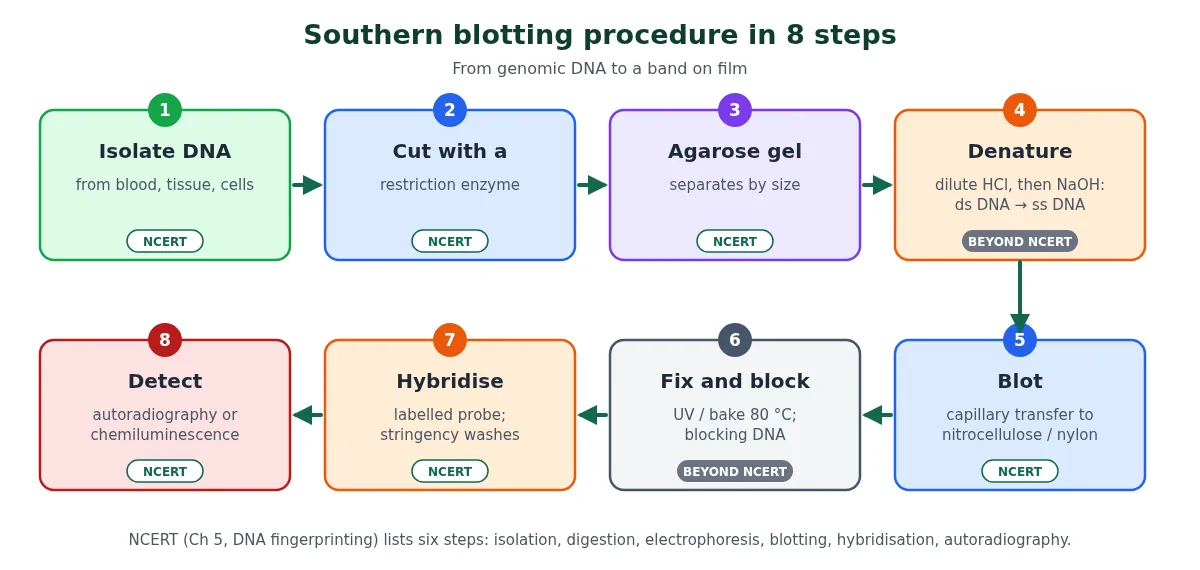
Steps of Southern blotting in NCERT
NCERT lists six steps for DNA fingerprinting by Southern blot hybridisation:
- isolation of DNA;
- digestion of DNA by restriction endonucleases;
- separation of the DNA fragments by electrophoresis;
- transferring (blotting) the separated fragments to synthetic membranes such as nitrocellulose or nylon;
- hybridisation using a labelled probe (a VNTR probe in fingerprinting);
- detection of the hybridised fragments by autoradiography.
Laboratory protocols add two steps in between: denaturing the DNA in the gel before transfer, and fixing and blocking the membrane before the probe is added BEYOND NCERT.
Isolation and digestion of DNA
DNA can be taken from any tissue (blood, hair follicles, skin, saliva and so on). In NCERT Chapter 9 the cells are opened with enzymes such as lysozyme, cellulase or chitinase, RNA and proteins are removed with ribonuclease and protease, and the DNA is precipitated with chilled ethanol. The purified DNA is then cut with a restriction enzyme. Isolation and cutting are explained in our biotechnology principles and processes notes.
3 Separation of multiple DNA fragments using gel electrophoresis
In order to separate multiple DNA fragments, gel electrophoresis is performed. In this procedure, DNA fragments are run in an agarose gel medium to separate DNA fragments on the basis of their respective size (length in base pairs, which also sets their molecular weight). However, the separated DNA fragments remain as double stranded DNA. The double stranded DNA needs to be converted into single stranded DNA.
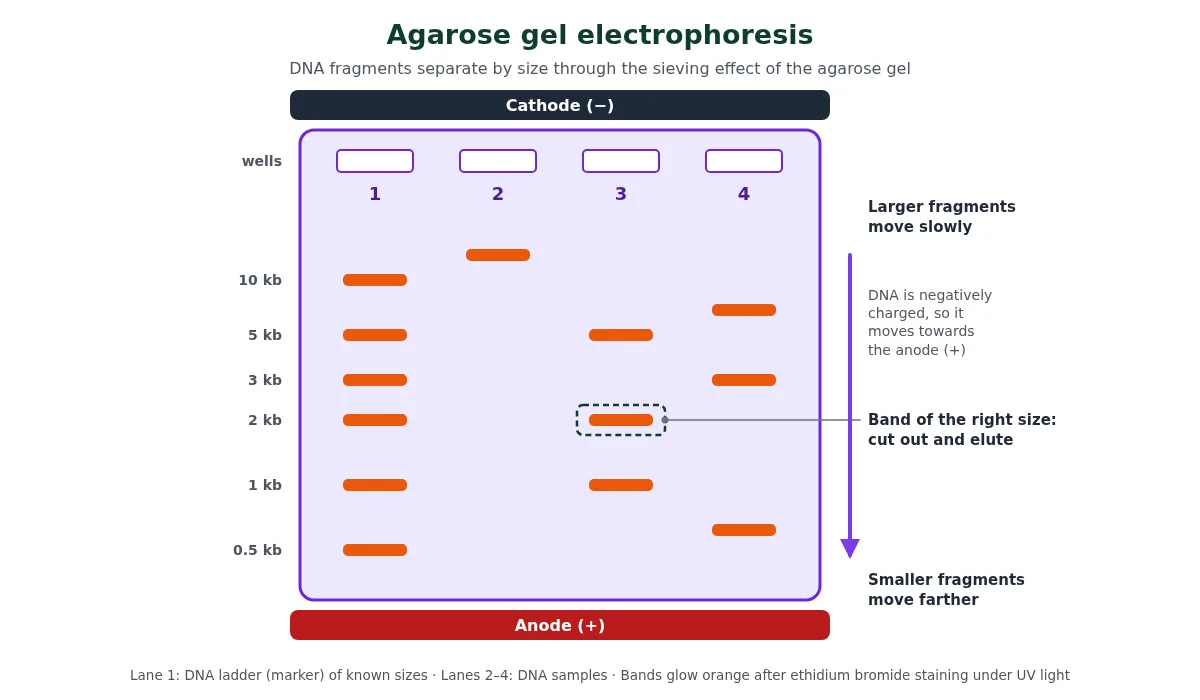
- Why DNA moves: DNA fragments are negatively charged, so in an electric field they move towards the anode (NCERT 9.2.1).
- The matrix: agarose is a natural polymer extracted from seaweeds. Its sieving effect separates fragments by size; the smaller the fragment, the farther it moves.
- Seeing the bands: DNA is stained with ethidium bromide and exposed to UV light, which gives bright orange bands.
- Southern blot vs elution: in gene cloning, a band is cut out and the DNA is extracted (elution). In Southern blotting nothing is cut out; the whole band pattern is transferred to the membrane.
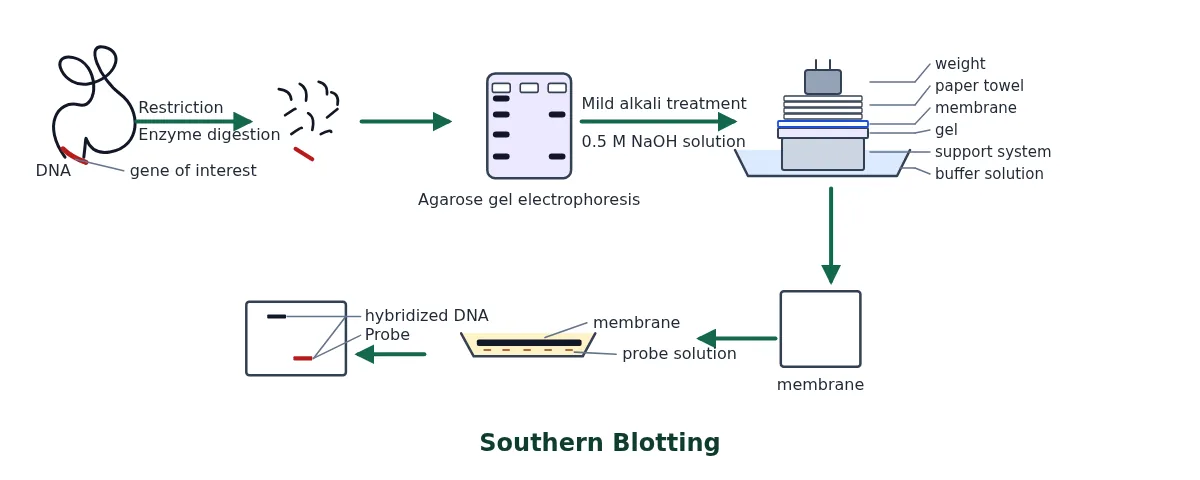
The figure below is the full Southern blotting flow drawn in the original article, redrawn here with the same steps and labels.
4 Denaturation of double stranded DNA
To denature double stranded DNA fragments into single stranded DNA fragments – mild alkali treatment is given. The gel is soaked in about 0.5M NaOH solution. Once the gel is soaked in the alkali solution – the hydrogen bonds present between two DNA strands break and double stranded DNA gets converted into single stranded DNA.
- Why single strands are needed: a probe can base-pair only with an exposed single strand, and single-stranded DNA binds the membrane well.
- Depurination BEYOND NCERT: before the alkali, a gel with large fragments (above about 10 kb) is often soaked briefly in dilute HCl (about 0.25 M). This removes some purine bases and nicks the long DNA into smaller pieces that leave the gel more easily.
- Neutralisation BEYOND NCERT: for nitrocellulose the gel is then brought back to neutral pH with a Tris–salt buffer, because nitrocellulose does not bind DNA well under alkaline conditions.
5 Transfer of single stranded DNA from gel to the membrane
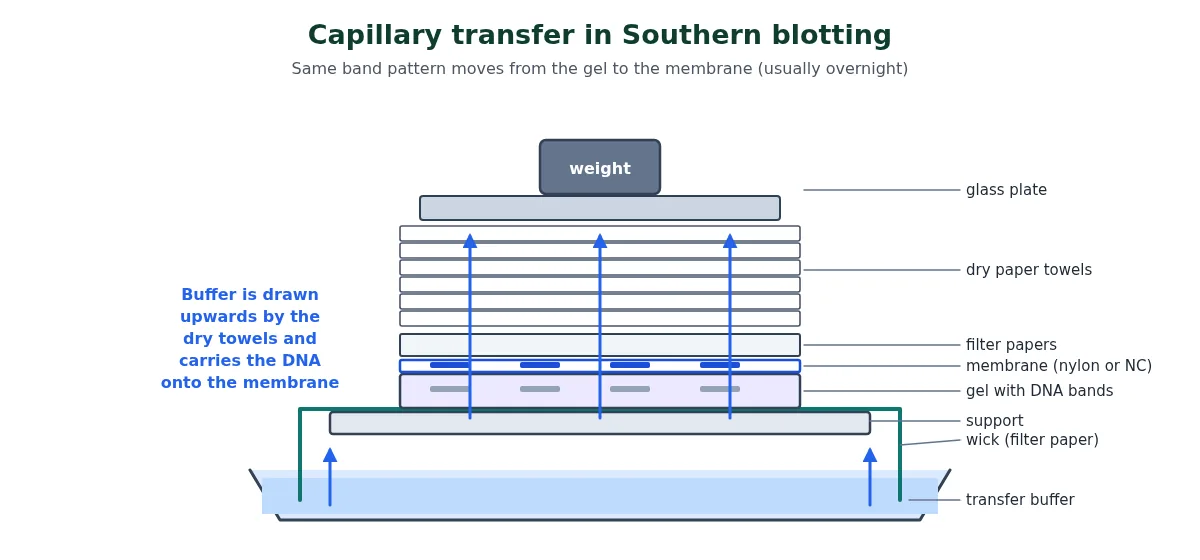
For transferring DNA from the gel to the nitrocellulose paper, we need a tray and it is filled with a transfer buffer solution. After that a support system is prepared before the DNA containing gel is placed on it. For the support system, we generally use either glass or sponges. On the support system, gel containing DNA is placed.
On top of the gel, nitrocellulose or nylon membrane of the same size of the gel is used. In a majority of cases, nylon membrane is used because nylon is a strong membrane and it binds with DNA molecules quite tightly. On top of the membrane, paper towels are kept and some weight is used at the top so that paper towel could press the membrane and the gel containing DNA fragments.
Once the setup is done – the transfer buffer present in the tray moves upward due to capillary action. Once it reaches the gel surface – DNA fragments present in the gel also move upward towards the membrane. And finally, the DNA fragments present in the gel get attached to the membrane.
The transfer is usually left for several hours or overnight; paper towels that get completely wet are replaced with dry ones so that the flow continues. After that the membrane is removed. Though DNA fragments have been transferred on the nylon / nitrocellulose membrane, nothing is visible on the membrane.
First, the membrane is either given heat treatment or UV light treatment to fix the DNA firmly onto the membrane.
Nitrocellulose or nylon membrane?
| Feature | Nitrocellulose | Nylon |
|---|---|---|
| Strength | Brittle, tears easily | Strong, can be re-probed |
| Binding of DNA | Good, needs neutral high-salt buffer | Tighter; positively charged nylon binds DNA even in alkali |
| Fixing the DNA | Baking at about 80 °C (under vacuum) | UV crosslinking, or baking |
Both membranes are named in NCERT; the comparison above is BEYOND NCERT.
Other ways to transfer and block BEYOND NCERT
- Vacuum blotting pulls the buffer through the gel with suction and is faster than capillary transfer.
- Electroblotting uses an electric field, as in Western blotting.
- Blocking (prehybridisation): before the probe is added, the membrane is soaked in a solution of unrelated DNA (such as salmon sperm DNA) and proteins. This covers the empty membrane surface so the probe does not stick everywhere.
6 Hybridisation with a labelled probe
The nylon / nitrocellulose membrane is incubated in a probe solution. For this purpose, a tray (or a sealed bag or tube) is taken with probe solution in which membrane is placed.
This solution contains probes – single-stranded pieces of DNA (or RNA), which may be a short oligonucleotide sequence or a longer DNA fragment. The probe carries a label (detector), either at one end or along its length. The detector could either be a radiolabelled atom or fluorescent molecules.
The sequence in the probe is the complementary sequence of the gene of interest (since we know the gene sequence of the gene of interest). If the membrane containing DNA fragments contain gene of interest fragment then the probe will hybridize with that gene segment.
NCERT definition of a probe
NCERT Chapter 10 (molecular diagnosis) describes a probe as a single-stranded DNA or RNA tagged with a radioactive molecule. It hybridises to its complementary DNA and is then detected by autoradiography. A mutated gene does not show on the film, because the probe is not complementary to it.
Stringency washes BEYOND NCERT
Hybridisation is usually done for several hours or overnight at a fixed temperature. The membrane is then washed to remove unbound probe. Washes with lower salt and higher temperature are more stringent: they strip off probe that is only partly matched and leave probe bound to the exactly matching band.
7 Detection: autoradiography and other methods
Once hybridization is done – nothing is visible on the membrane. However, based on the detector molecule used in the probe, we use different methods to visualize the hybridized DNA present on the membrane.
For instance, if the detector is radiolabelled, then we use autoradiography for visualization. If the probe is fluorescently tagged then after binding, it shows fluorescence which can be measured to detect whether the gene of interest has hybridized with the probe or not.
- Autoradiography (NCERT): the membrane with a radioactive (for example 32P-labelled) probe is placed against X-ray film. Radiation from the bound probe darkens the film only where the matching band lies. The developed film is the autoradiogram.
- Chemiluminescence BEYOND NCERT: the probe carries a tag such as digoxigenin or biotin. An enzyme linked to an antibody or streptavidin binds the tag and turns a substrate into light, which is recorded on film or by a camera. No radioactivity is needed.
8 Applications of Southern blotting
Southern blotting is used in a number of applications in the field of molecular biology. One of the primary applications of Southern blotting is to identify a specific gene in a DNA sample. This is done to identify viral and bacterial infections.
In recombinant DNA technology, it is used to identify the fragment or clone that carries a particular gene of interest, which can then be isolated. It is also used in DNA fingerprinting for paternity testing, victim and criminal identification.
Southern blotting in DNA fingerprinting (NCERT)
- DNA fingerprinting compares the repetitive DNA of individuals. Repetitive DNA separates from bulk DNA as small peaks called satellite DNA in density gradient centrifugation. Satellite DNA is grouped as micro-satellites, mini-satellites and so on, and normally does not code for proteins.
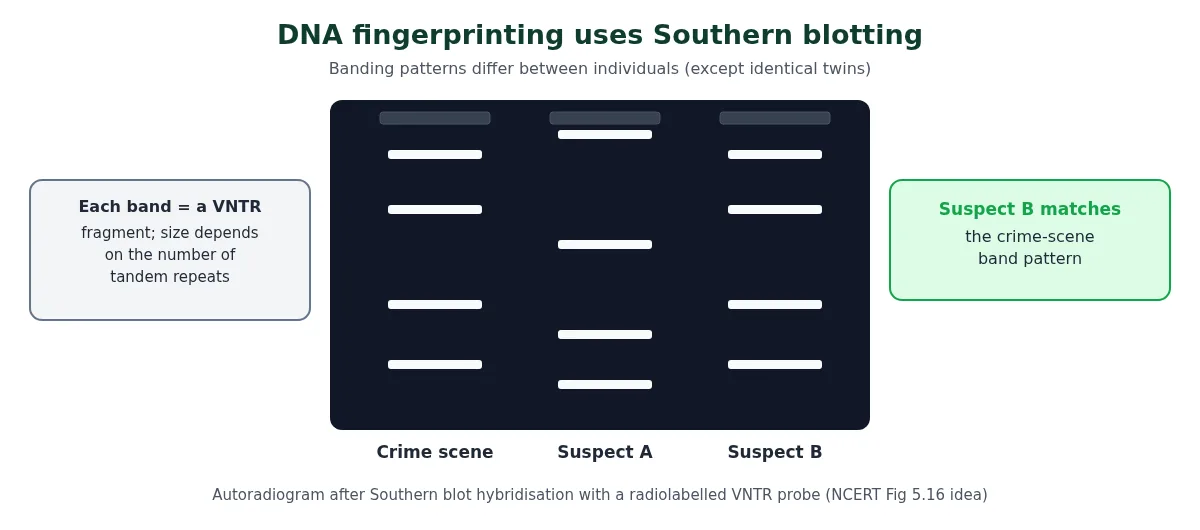
- Alec Jeffreys developed the technique. He used a satellite DNA called VNTR (Variable Number of Tandem Repeats), a mini-satellite, as the probe.
- The copy number of the repeat varies between chromosomes and people, so VNTRs range from 0.1 to 20 kb. The autoradiogram shows many bands of different sizes, a pattern that differs between individuals except monozygotic (identical) twins.
- Every tissue of a person (blood, hair follicle, skin, bone, saliva, sperm) gives the same pattern, which makes it useful in forensics. The polymorphisms are inherited, so it is the basis of paternity testing.
- PCR has increased the sensitivity, so the DNA of a single cell is now enough. The method is also used to study population and genetic diversity.
Other uses in research and diagnosis
- RFLP analysis and gene mapping: differences in restriction sites between individuals change fragment sizes. NCERT notes that the genetic and physical maps of the human genome used polymorphism of restriction sites and repetitive sequences (microsatellites). See DNA markers.
- Sickle-cell anaemia BEYOND NCERT: the single base change in codon 6 of the β-globin gene (GAG to GTG) removes a restriction site (Mst II). The probe-detected fragment becomes longer, so carriers and patients can be identified.
- Fragile X syndrome BEYOND NCERT: a very large expansion of CGG repeats in the FMR1 gene is too long for routine PCR but shows as a larger band on a Southern blot.
- Transgenic organisms BEYOND NCERT: it confirms that a transgene has been inserted and shows how many copies are present.
- Gene families and copy number BEYOND NCERT: one probe can show all related genes or extra copies of a gene in a genome.
9 Southern vs Northern vs Western blotting
The other blots were named after Southern’s method as a play on compass directions. Only the Southern blot is named after a person.
| Feature | Southern blot | Northern blot | Western blot |
|---|---|---|---|
| Molecule detected | DNA | RNA (mainly mRNA) | Protein |
| Gel | Agarose | Agarose with a denaturing agent (e.g. formaldehyde) | SDS-polyacrylamide (SDS-PAGE) |
| Denaturation before transfer | Yes, alkali | Not needed; RNA is already single-stranded | SDS unfolds proteins |
| Probe | Labelled DNA or RNA | Labelled DNA or RNA | Labelled antibody |
| Shows | Presence and size of a DNA sequence | Gene expression (amount and size of RNA) | Presence and amount of a protein |
| First described | E. M. Southern, 1975 | 1977 | 1979 |
The whole comparison table is BEYOND NCERT. The term Eastern blot is used for blots that detect post-translational modifications of proteins, but its meaning is not standardised. Northern blotting is explained step by step in Northern blotting technique.
10 Southern blotting steps: summary table
| Step | What is done | Why |
|---|---|---|
| 1. Isolate DNA | Lyse cells, remove RNA and protein, precipitate DNA | Pure genomic DNA |
| 2. Digest | Cut with a restriction enzyme | Fragments of defined sizes |
| 3. Electrophoresis | Agarose gel; DNA moves to the anode | Separate fragments by size |
| 4. Denature | (HCl,) then 0.5 M NaOH; neutralise for nitrocellulose | Single strands for the probe |
| 5. Blot | Capillary transfer to nitrocellulose or nylon | Copy the band pattern onto a membrane |
| 6. Fix and block | Bake or UV-crosslink; blocking solution | Hold DNA; stop non-specific probe binding |
| 7. Hybridise | Labelled probe, then stringency washes | Probe pairs only with the matching band |
| 8. Detect | Autoradiography or chemiluminescence | See the band(s) |
Key points
- The Southern blot detects a specific DNA sequence; Northern detects RNA and Western detects protein.
- It works by hybridisation of a labelled probe with complementary single-stranded DNA.
- NCERT steps: isolation, digestion, electrophoresis, blotting, hybridisation, autoradiography.
- VNTR probes give individual band patterns; only identical twins share the same pattern.
11 Common doubts about Southern blotting
Why is the DNA denatured before blotting?
A probe can pair only with single-stranded DNA. Soaking the gel in NaOH breaks the hydrogen bonds between the two strands, so the DNA on the membrane is single-stranded and ready for hybridisation.
Does the gel itself go onto the membrane?
No. Only the DNA moves. Buffer drawn up by capillary action carries the DNA fragments out of the gel onto the membrane, keeping the same band pattern; the gel is thrown away afterwards.
Why is a VNTR probe used in DNA fingerprinting?
VNTRs are mini-satellite repeats whose copy number differs from person to person. A labelled VNTR probe therefore gives many bands of different sizes, and this pattern is unique to an individual except for identical twins.
What is the difference between Southern and Northern blotting?
Southern blotting detects DNA fragments that have been cut by restriction enzymes and denatured. Northern blotting detects RNA, which is already single-stranded, and shows how strongly a gene is expressed.
Is Southern blotting still used now that PCR exists?
Yes, for jobs PCR does poorly: very large repeat expansions such as in fragile X syndrome, checking the number of transgene copies, and studying gene structure over long stretches of DNA.
12 Quick check
Tap each question to reveal the answer and check your grasp of the topic before you try the full MCQ set.
Test yourself
1. Which molecule is detected by Southern blotting?
DNA (a specific DNA sequence).
2. Who developed the technique, and when was it published?
Edwin M. Southern, published in 1975.
3. Which chemical is used to denature DNA in the gel?
Sodium hydroxide (about 0.5 M NaOH).
4. Name the two membranes NCERT mentions for blotting.
Nitrocellulose and nylon.
5. What drives the DNA out of the gel in the classic method?
Capillary action of the transfer buffer drawn up by dry paper towels.
6. How is a radioactive probe detected?
By autoradiography on X-ray film.
7. Who developed DNA fingerprinting, and which probe did he use?
Alec Jeffreys, using a VNTR (mini-satellite) probe.
8. What is the size range of VNTRs?
0.1 to 20 kb.
9. Which individuals have identical DNA fingerprints?
Monozygotic (identical) twins.
10. Which blot uses an antibody as the probe?
The Western blot (for proteins).
Related reading
- RNA version: Northern blotting technique
- RFLP and other markers: what is a DNA marker?
- Restriction enzymes and gels: Biotechnology Principles and Processes NEET notes
- Finding a cloned gene: gene cloning and its steps
- More sensitive fingerprinting: polymerase chain reaction (PCR)
- Practise: MCQs on biotechnology principles and processes
- All notes in Biotechnology: Principles and Processes
- Original paper: Southern EM (1975) Detection of specific sequences among DNA fragments separated by gel electrophoresis, J Mol Biol (PubMed)
Notes by Competitors Point for NEET Biology, based on NCERT Class XII Chapters 5 and 9 (rationalised syllabus) and standard molecular biology textbooks. All diagrams drawn for this page.