
Ecosystem NEET MCQs are one of the most scoring parts of NEET Biology, because almost every question comes straight from NCERT Class 12 Chapter 12. Practising Ecosystem NEET MCQs on trophic levels, productivity, decomposition, energy flow and ecological pyramids helps you spot the patterns NTA repeats every year. Use these Ecosystem NEET MCQs after reading the chapter: answer each question yourself first, then tap Show Answer to check your reasoning. If you get a question wrong, revise that topic and come back to these Ecosystem NEET MCQs again before your mock test.
These Ecosystem NEET MCQs cover the whole NCERT chapter: 25 multiple-choice questions, 10 assertion–reason questions and 6 match-the-following sets, each with an answer and a short explanation.
NCERT Class 12 Biology, Chapter 12 (Ecosystem), 2026-27 syllabus. Read each question and its four options, then tap Show Answer to check. Need the theory first? Read the Ecosystem NEET notes.
Ecosystem NEET MCQs with answers
Q1. The second trophic level in a lake is
- (a) Phytoplankton
- (b) Zooplankton
- (c) Benthos
- (d) Fishes
Show Answer
Answer: (b) Zooplankton
Zooplankton feed on phytoplankton (NCERT Exercise Q3).
Q2. Which of the following is an abiotic component of a pond?
- (a) Phytoplankton
- (b) Zooplankton
- (c) Dissolved oxygen
- (d) Fungi
Show Answer
Answer: (c) Dissolved oxygen
Dissolved oxygen is a non-living factor.
Q3. Vertical distribution of different species occupying different levels is called
- (a) Zonation
- (b) Stratification
- (c) Succession
- (d) Stagnation
Show Answer
Answer: (b) Stratification
NCERT calls vertical layering stratification (trees, shrubs, herbs, grasses).
Q4. Primary productivity is expressed as
- (a) g m⁻²
- (b) kcal m⁻²
- (c) g m⁻² yr⁻¹
- (d) kcal
Show Answer
Answer: (c) g m⁻² yr⁻¹
Productivity is a rate, so it has a time unit.
Q5. Net primary productivity equals
- (a) GPP + R
- (b) GPP − R
- (c) R − GPP
- (d) GPP × R
Show Answer
Answer: (b) GPP − R
NPP is what remains after respiration losses.
Q6. Annual net primary productivity of the whole biosphere is about
- (a) 55 billion tons
- (b) 115 billion tons
- (c) 170 billion tons
- (d) 1700 billion tons
Show Answer
Answer: (c) 170 billion tons
NCERT: about 170 billion tons (dry weight) of organic matter.
Q7. Productivity of oceans is about
- (a) 55 billion tons
- (b) 170 billion tons
- (c) 115 billion tons
- (d) 10 billion tons
Show Answer
Answer: (a) 55 billion tons
Despite covering ~70% of the surface, oceans produce only ~55 billion tons.
Q8. Secondary productivity is the rate of
- (a) Photosynthesis by producers
- (b) Formation of new organic matter by consumers
- (c) Respiration by plants
- (d) Decomposition
Show Answer
Answer: (b) Formation of new organic matter by consumers
Defined by NCERT as the rate of formation of new organic matter by consumers.
Q9. The raw material for decomposition is
- (a) Humus
- (b) Detritus
- (c) Minerals
- (d) Standing crop
Show Answer
Answer: (b) Detritus
Dead plant and animal remains (detritus).
Q10. Breakdown of detritus into smaller particles by earthworms is
- (a) Catabolism
- (b) Leaching
- (c) Fragmentation
- (d) Mineralisation
Show Answer
Answer: (c) Fragmentation
Detritivores carry out fragmentation.
Q11. Water-soluble inorganic nutrients going down into the soil and precipitating as unavailable salts is
- (a) Leaching
- (b) Humification
- (c) Catabolism
- (d) Fragmentation
Show Answer
Answer: (a) Leaching
This is leaching.
Q12. Humus is
- (a) Highly resistant to microbial action and decomposes slowly
- (b) Rapidly decomposed
- (c) Rich in lignin only
- (d) Part of the abiotic standing crop
Show Answer
Answer: (a) Highly resistant to microbial action and decomposes slowly
Humus is dark, amorphous, colloidal and resistant to microbes.
Q13. Decomposition is slowest when detritus is rich in
- (a) Sugars
- (b) Nitrogen
- (c) Lignin and chitin
- (d) Water-soluble substances
Show Answer
Answer: (c) Lignin and chitin
Lignin and chitin decompose slowly.
Q14. Decomposition is favoured by
- (a) Cold and dry conditions
- (b) Warm and moist conditions
- (c) Anaerobic conditions
- (d) Low temperature
Show Answer
Answer: (b) Warm and moist conditions
Warm, moist, aerobic conditions speed decomposition.
Q15. Of the incident solar radiation, PAR is
- (a) 100%
- (b) less than 50%
- (c) about 90%
- (d) 2–10%
Show Answer
Answer: (b) less than 50%
Less than 50% of incident radiation is PAR.
Q16. Plants capture what percentage of PAR?
- (a) 2–10%
- (b) 50%
- (c) 20–30%
- (d) 0.1%
Show Answer
Answer: (a) 2–10%
Only 2–10% of PAR is captured.
Q17. Except for one ecosystem, the sun is the only source of energy. That exception is
- (a) Desert
- (b) Deep-sea hydrothermal ecosystem
- (c) Tundra
- (d) Estuary
Show Answer
Answer: (b) Deep-sea hydrothermal ecosystem
Hydrothermal vents run on chemosynthesis.
Q18. Energy flow in an ecosystem is
- (a) Bidirectional
- (b) Cyclic
- (c) Unidirectional
- (d) Multidirectional
Show Answer
Answer: (c) Unidirectional
Energy moves one way from sun to producers to consumers.
Q19. Secondary producers are
- (a) Herbivores
- (b) Producers
- (c) Carnivores
- (d) None of the above
Show Answer
Answer: (a) Herbivores
NCERT Exercise Q4: herbivores form new organic matter (secondary productivity).
Q20. If producers fix 20,000 J, energy available to secondary consumers is
- (a) 2000 J
- (b) 200 J
- (c) 20 J
- (d) 2 J
Show Answer
Answer: (b) 200 J
20,000 → 2000 (herbivore) → 200 (carnivore).
Q21. In a terrestrial ecosystem, a much larger fraction of energy flows through
- (a) Grazing food chain
- (b) Detritus food chain
- (c) Parasitic chain
- (d) None
Show Answer
Answer: (b) Detritus food chain
NCERT states this for terrestrial ecosystems.
Q22. Decomposers are
- (a) Autotrophs
- (b) Heterotrophic saprotrophs, mainly fungi and bacteria
- (c) Chemoautotrophs only
- (d) Primary consumers
Show Answer
Answer: (b) Heterotrophic saprotrophs, mainly fungi and bacteria
They are heterotrophs that digest dead matter.
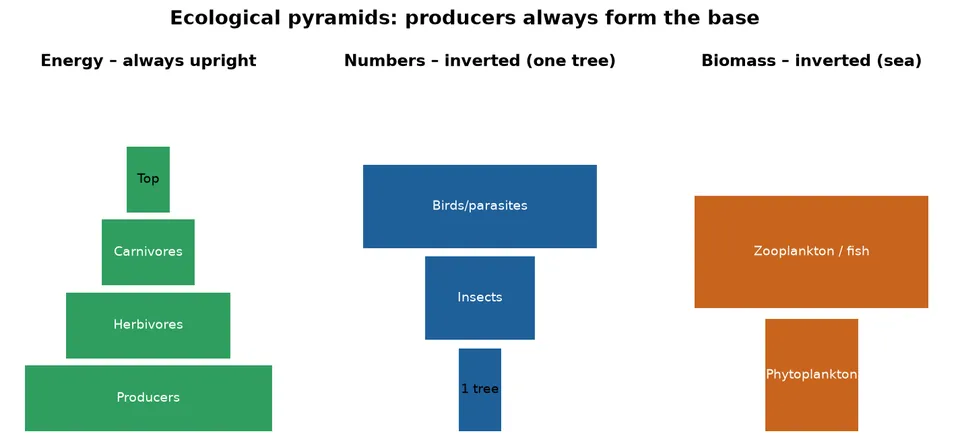
Q23. The pyramid that is always upright is that of
- (a) Number
- (b) Biomass
- (c) Energy
- (d) Biomass in sea
Show Answer
Answer: (c) Energy
Energy decreases at every step.
Q24. In NCERT’s grassland pyramid of numbers, about 6 million plants support how many top carnivores?
- (a) 3
- (b) 30
- (c) 300
- (d) 3000
Show Answer
Answer: (a) 3
NCERT Figure 12.4(a): only three top carnivores.
Q25. Which is NOT a limitation of ecological pyramids?
- (a) Saprophytes are not given a place
- (b) Food webs are ignored
- (c) A species may belong to two trophic levels
- (d) Producers are placed at the base
Show Answer
Answer: (d) Producers are placed at the base
Placing producers at the base is a rule, not a limitation.
Ecosystem NEET assertion–reason questions
(a) Both A and R true, R explains A. (b) Both true, R does not explain A. (c) A true, R false. (d) A false, R true.
AR1. Assertion (A): Pyramid of energy is always upright.
Reason (R): At each trophic level some energy is lost as heat.
- (a) Both A and R are true and R is the correct explanation of A.
- (b) Both A and R are true but R is not the correct explanation of A.
- (c) A is true but R is false.
- (d) A is false but R is true.
Show Answer
Answer: (a) Both A and R are true and R is the correct explanation of A.
Heat loss means each higher level has less energy.
AR2. Assertion (A): Primary productivity varies between ecosystems.
Reason (R): It depends on plant species, environmental factors, nutrient availability and photosynthetic capacity of plants.
- (a) Both A and R are true and R is the correct explanation of A.
- (b) Both A and R are true but R is not the correct explanation of A.
- (c) A is true but R is false.
- (d) A is false but R is true.
Show Answer
Answer: (a) Both A and R are true and R is the correct explanation of A.
These are the factors listed by NCERT.
AR3. Assertion (A): NPP is always less than GPP.
Reason (R): Plants use part of GPP in respiration.
- (a) Both A and R are true and R is the correct explanation of A.
- (b) Both A and R are true but R is not the correct explanation of A.
- (c) A is true but R is false.
- (d) A is false but R is true.
Show Answer
Answer: (a) Both A and R are true and R is the correct explanation of A.
NPP = GPP − R and R > 0.
AR4. Assertion (A): In aquatic ecosystems, GFC is the major conduit of energy flow.
Reason (R): Decomposers are absent in aquatic ecosystems.
- (a) Both A and R are true and R is the correct explanation of A.
- (b) Both A and R are true but R is not the correct explanation of A.
- (c) A is true but R is false.
- (d) A is false but R is true.
Show Answer
Answer: (c) A is true but R is false.
Decomposers are present in all ecosystems; GFC dominates in water because most aquatic producers are eaten.
AR5. Assertion (A): Humus is a reservoir of nutrients.
Reason (R): Humus decomposes very rapidly.
- (a) Both A and R are true and R is the correct explanation of A.
- (b) Both A and R are true but R is not the correct explanation of A.
- (c) A is true but R is false.
- (d) A is false but R is true.
Show Answer
Answer: (c) A is true but R is false.
Humus is resistant to microbes and decomposes very slowly.
AR6. Assertion (A): Decomposition is slow in cold regions.
Reason (R): Low temperature inhibits decomposer activity.
- (a) Both A and R are true and R is the correct explanation of A.
- (b) Both A and R are true but R is not the correct explanation of A.
- (c) A is true but R is false.
- (d) A is false but R is true.
Show Answer
Answer: (a) Both A and R are true and R is the correct explanation of A.
Decomposition is inhibited at low temperature.
AR7. Assertion (A): Pyramid of number for an ecosystem dominated by trees is inverted.
Reason (R): One big tree supports many insects.
- (a) Both A and R are true and R is the correct explanation of A.
- (b) Both A and R are true but R is not the correct explanation of A.
- (c) A is true but R is false.
- (d) A is false but R is true.
Show Answer
Answer: (a) Both A and R are true and R is the correct explanation of A.
Many insects feed on a single tree, so the base is narrow.
AR8. Assertion (A): Energy flow in an ecosystem is unidirectional.
Reason (R): Energy captured by producers does not revert to the sun.
- (a) Both A and R are true and R is the correct explanation of A.
- (b) Both A and R are true but R is not the correct explanation of A.
- (c) A is true but R is false.
- (d) A is false but R is true.
Show Answer
Answer: (a) Both A and R are true and R is the correct explanation of A.
Energy is lost as heat and cannot return to the sun.
AR9. Assertion (A): Earthworms are detritivores.
Reason (R): They are chemosynthetic producers.
- (a) Both A and R are true and R is the correct explanation of A.
- (b) Both A and R are true but R is not the correct explanation of A.
- (c) A is true but R is false.
- (d) A is false but R is true.
Show Answer
Answer: (c) A is true but R is false.
Earthworms are detritivores (heterotrophs), not producers.
AR10. Assertion (A): Pyramid of biomass in the sea is generally inverted.
Reason (R): The biomass of fishes far exceeds that of phytoplankton.
- (a) Both A and R are true and R is the correct explanation of A.
- (b) Both A and R are true but R is not the correct explanation of A.
- (c) A is true but R is false.
- (d) A is false but R is true.
Show Answer
Answer: (a) Both A and R are true and R is the correct explanation of A.
NCERT gives exactly this reason: a small standing crop of phytoplankton supports a much larger standing crop of consumers.
Ecosystem NEET match the following
Match 1
| Column I | Column II |
|---|---|
| A. Fragmentation | i. Enzymatic degradation by bacteria and fungi |
| B. Leaching | ii. Formation of dark colloidal substance |
| C. Catabolism | iii. Breakdown by detritivores |
| D. Humification | iv. Downward movement of soluble nutrients |
Choose the correct match for Match 1:
- (a) A-iii, B-iv, C-i, D-ii
- (b) A-iv, B-i, C-ii, D-iii
- (c) A-ii, B-i, C-iv, D-iii
- (d) A-iv, B-iii, C-ii, D-i
Show Answer
Answer: (a) A-iii, B-iv, C-i, D-ii
Match 2
| Column I | Column II |
|---|---|
| A. GPP | i. Living mass of a trophic level at a time |
| B. NPP | ii. Rate of new organic matter by consumers |
| C. Secondary productivity | iii. GPP − R |
| D. Standing crop | iv. Total rate of organic matter produced in photosynthesis |
Choose the correct match for Match 2:
- (a) A-iii, B-ii, C-i, D-iv
- (b) A-iv, B-iii, C-ii, D-i
- (c) A-i, B-ii, C-iii, D-iv
- (d) A-iii, B-iv, C-i, D-ii
Show Answer
Answer: (b) A-iv, B-iii, C-ii, D-i
Match 3
| Column I | Column II |
|---|---|
| A. Pyramid of energy | i. Inverted, phytoplankton base |
| B. Pyramid of biomass (sea) | ii. Always upright |
| C. Pyramid of number (tree) | iii. Upright |
| D. Pyramid of number (grassland) | iv. Inverted, single producer |
Choose the correct match for Match 3:
- (a) A-i, B-iv, C-iii, D-ii
- (b) A-iii, B-iv, C-i, D-ii
- (c) A-ii, B-i, C-iv, D-iii
- (d) A-i, B-ii, C-iii, D-iv
Show Answer
Answer: (c) A-ii, B-i, C-iv, D-iii
Match 4
| Column I | Column II |
|---|---|
| A. Producer | i. Frog |
| B. Primary consumer | ii. Fungi |
| C. Secondary consumer | iii. Phytoplankton |
| D. Decomposer | iv. Grasshopper |
Choose the correct match for Match 4:
- (a) A-iv, B-i, C-ii, D-iii
- (b) A-ii, B-i, C-iv, D-iii
- (c) A-iv, B-iii, C-ii, D-i
- (d) A-iii, B-iv, C-i, D-ii
Show Answer
Answer: (d) A-iii, B-iv, C-i, D-ii
Match 5
| Column I | Column II |
|---|---|
| A. NPP of biosphere | i. 2–10% |
| B. NPP of oceans | ii. 55 billion tons |
| C. PAR in incident radiation | iii. 170 billion tons |
| D. PAR captured by plants | iv. less than 50% |
Choose the correct match for Match 5:
- (a) A-iii, B-ii, C-iv, D-i
- (b) A-ii, B-iv, C-i, D-iii
- (c) A-i, B-iv, C-ii, D-iii
- (d) A-ii, B-iii, C-i, D-iv
Show Answer
Answer: (a) A-iii, B-ii, C-iv, D-i
Match 6
| Column I | Column II |
|---|---|
| A. Grazing food chain | i. Interconnected food chains |
| B. Detritus food chain | ii. Position of organism in food chain |
| C. Food web | iii. Begins with dead organic matter |
| D. Trophic level | iv. Begins with producers |
Choose the correct match for Match 6:
- (a) A-iii, B-i, C-ii, D-iv
- (b) A-iv, B-iii, C-i, D-ii
- (c) A-ii, B-i, C-iii, D-iv
- (d) A-iii, B-iv, C-ii, D-i
Show Answer
Answer: (b) A-iv, B-iii, C-i, D-ii
Revise before more Ecosystem NEET MCQs
Practise these Ecosystem NEET MCQs again after revising the chapter. Check the official NCERT Biology Class 12 textbook and the NTA NEET website for the current syllabus.
Got some wrong? Revise productivity, decomposition, energy flow and pyramids with diagrams in Ecosystem NEET notes (NCERT Class 12, Chapter 12).